


1 Corinthians 5:8
Bible text: King James Version (1769 Blayney text) · Public domain
Bible text: King James Version with Strong's numbers · Public domain
Bible text: Berean Standard Bible · Public domain
Bible text: American Standard Version (1901) · Public domain
Bible text: World English Bible, Messianic edition · Public domain
Bible text: Geneva Bible (1599) · Public domain
Bible text: Young's Literal Translation · Public domain
- ὥστεhōsteso thatG5620CONJConjunction
- ἑορτάζωμενhe'ortazōmenwe may celebrate the feastG1858V-PAS-1PVerb Present Active Subjunctive 1st Plural
- μὴmēnotG3361PRT-NNegative Particle Negative
- ἐνenwithG1722PREPPreposition
- ζύμῃzumēleavenG2219N-DSFNoun Dative Singular Feminine
- παλαιᾷpalaiaoldG3820A-DSFAdjective Dative Singular Feminine
- μηδὲmēdenotG3366CONJ-NConjunction Negative
- ἐνenwithG1722PREPPreposition
- ζύμῃzumēleavenG2219N-DSFNoun Dative Singular Feminine
- κακίαςkakiasof maliceG2549N-GSFNoun Genitive Singular Feminine
- καὶkaiandG2532CONJConjunction
- πονηρίαςponēriaswickednessG4189N-GSFNoun Genitive Singular Feminine
- ἀλλ᾽all᾽butG235CONJConjunction
- ἐνenwithG1722PREPPreposition
- ἀζύμοιςazumoisunleavened [bread]G106A-DPNAdjective Dative Plural Neuter
- εἰλικρινείαςeilikrineiasof sincerityG1505N-GSFNoun Genitive Singular Feminine
- καὶkaiandG2532CONJConjunction
- ἀληθείαςalētheiasof truthG225N-GSFNoun Genitive Singular Feminine
English is a literal word-by-word gloss of the Greek, not the KJV's wording. Why?
This is the original text the KJV's translators worked from — each Greek word with its own literal English meaning in this verse, prepared by scholars at Tyndale House, Cambridge. The KJV translates whole sentences, not word by word, so its wording differs: one Greek word can become several English words, and the KJV may choose “charity” where the gloss reads “love”. Both are faithful — they answer different questions. For the KJV's own rendering, switch to the KJV text.
Details
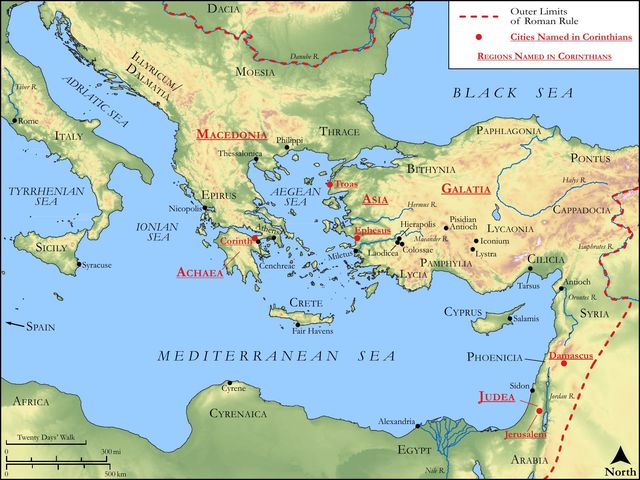
See on the biblical-era maps

Study this verse
Public-domain commentary
Matthew Henry
From his Commentary on the Whole Bible. Henry comments on passages, not single verses — this entry covers 1 Corinthians 5:7–8. His two-level outline is real structure in the source text, so it is rendered as structure.
Here the apostle exhorts them to purity, by purging out the old leaven. In this observe,
I.The advice itself, addressed either,
1.To the church in general; and so purging out the old leaven, that they might be a new lump, refers to the putting away from themselves that wicked person, Co1 5:13. Note, Christian churches should be pure and holy, and not bear such corrupt and scandalous members. They are to be unleavened, and should endure no such heterogeneous mixture to sour and corrupt them. Or,
2.To each particular member of the church. And so it implies that they should purge themselves from all impurity of heart and life, especially from this kind of wickedness, to which the Corinthians were addicted to a proverb. See the argument at the beginning. This old leaven was in a particular manner to be purged out, that they might become a new lump. Note, Christians should be careful to keep themselves clean, as well as purge polluted members out of their society. And they should especially avoid the sins to which they themselves were once most addicted, and the reigning vices of the places and the people where they live. They were also to purge themselves from malice and wickedness - all ill-will and mischievous subtlety. This is leaven that sours the mind to a great degree. It is not improbable that this was intended as a check to some who gloried in the scandalous behaviour of the offender, both out of pride and pique. Note, Christians should be careful to keep free from malice and mischief. Love is the very essence and life of the Christian religion. It is the fairest image of God, for God is love (Jo1 4:16), and therefore it is no wonder if it be the greatest beauty and ornament of a Christian. But malice is murder in its principles: He that hates his brother is a murderer (Jo1 3:15), he bears the image and proclaims him the offspring of him who was a murderer from the beginning, Joh 8:44. How hateful should every thing be to a Christian that looks like malice and mischief.
II.The reason with which this advice is enforced:
For Christ our passover is sacrificed for us, Co1 5:7. This is the great doctrine of the gospel. The Jews, after they had killed the passover, kept the feast of unleavened bread. So must we; not for seven days only, but all our days. We should die with our Saviour to sin, be planted into the likeness of his death by mortifying sin, and into the likeness of his resurrection by rising again to newness of life, and that internal and external. We must have new hearts and new lives. Note, The whole life of a Christian must be a feast of unleavened bread. His common conversation and his religious performances must be holy. He must purge out the old leaven, and keep the feast of unleavened bread of sincerity and truth. He must be without guilt in his conduct towards God and man. And the more there is of sincerity in our own profession, the less shall we censure that of others. Note, On the whole, The sacrifice of our Redeemer is the strongest argument with a gracious heart for purity and sincerity. How sincere a regard did he show to our welfare, in dying for us! and how terrible a proof was his death of the detestable nature of sin, and God's displeasure against it! Heinous evil, that could not be expiated but with the blood of the Son of God! And shall a Christian love the murderer of his Lord? God forbid.
Historical interpretation
Historical reception
2 surviving comments on this verse. Each one is dated, so this reads as a timeline rather than a list.
Select a marker to jump to its quote. Markers stagger vertically where authors wrote within a few decades of each other.
Just as a little leaven leavens the whole lump, an evil life corrupts the whole man. Therefore Paul wants us to avoid not only evil acts but all interest in sin, so that sincerity may cleanse our lives and truth may exclude all deception.
"For our Passover also hath been sacrificed for us, even Christ; wherefore let us keep the feast: not with old leaven, nor with the leaven of malice and wickedness, but with the unleavened bread of sincerity and truth." So also Christ called His doctrine Leaven. And further he himself dwells upon the metaphor, reminding them of an ancient history, and of the Passover and unleavened bread, and of their blessings both then and now, and their punishments and their plagues.
It is festival, therefore, the whole time in which we live. For though he said, "Let us keep the feast," not with a view to the presence of the Passover or of Pentecost did he say it; but as pointing out that the whole of time is a festival unto Christians, because of the excellency of the good things which have been given. For what hath not come to pass that is good? The Son of God was made man for thee; He freed thee from death; and called thee to a kingdom. Thou therefore who hast obtained and art still obtaining such things, how can it be less than thy duty to "keep the feast" all thy life? Let no one then be downcast about poverty, and disease, and craft of enemies. For it is a festival, even the whole of our time. Wherefore saith Paul, "Rejoice in the Lord always; again I say, Rejoice." Upon the festival days no one puts on filthy garments. Neither then let us do so. For a marriage hath been made, a spiritual marriage. For, "the kingdom of Heaven," saith He, "is likened unto a certain king which would make a marriage feast for his son." Now where it is a king making a marriage, and a marriage for his son, what can be greater than this feast? Let no one then enter in clad in rags. Not about garments is our discourse but about unclean actions. For if where all wore bright apparel one alone, being found at the marriage in filthy garments, was cast out with dishonor, consider how great strictness and purity the entrance into that marriage feast requires.
However, not on this account only does he remind them of the "unleavened bread," but also to point out the affinity of the Old Testament with the New; and to point out also that it was impossible, after the "unleavened bread," again to enter into Egypt; but if any one chose to return, he would suffer the same things as did they. For those things were a shadow of these; however obstinate the Jew may be. Wherefore shouldest thou enquire of him, he will speak, no great thing, rather it is great which he will speak of, but nothing like what we speak of: because he knows not the truth. For he for his part will say, "the Egyptians who detained us were so changed by the Almighty that they themselves urged and drave us out, who before held us forcibly; they did not suffer us so much as to leaven our dough." But if a man asketh me, he shall hear not of Egypt nor of Pharaoh; but of our deliverance from the deceit of demons and the darkness of the devil: not of Moses but of the Son of God; not of a Red Sea but of a Baptism overflowing with ten thousand blessings, where the "old man" is drowned.
Continue studying 1 Corinthians 5:8 across the web’s major study libraries — every link below opens this exact verse, chapter, or book on the destination site.
Read & Compare
 BibleGatewayThis verse in more than 200 translations and 70 languages.
 Bible.comThe YouVersion reader — hundreds of translations, reading plans, and highlights.
 ESV.orgCrossway's official English Standard Version reader.
 NET BibleThe NET translation with 60,000+ translators' notes on every rendering decision.
 STEP BibleTyndale House's free study tool — original text, vocabulary, and scholarly resources.
 BibliaLogos Bible Software's free web reader.
 USCCBThe New American Bible (Revised Edition) with the U.S. bishops' study notes.
Commentaries
 BibleHub CommentariesDozens of classic commentaries on this verse, gathered on one page.
 StudyLightMore than 100 commentary sets — the largest collection on the web.
 BibleRefPlain-English commentary on what this verse means, verse by verse.
 Enduring WordDavid Guzik's free commentary on this chapter, widely used by Bible teachers.
 Bible Study ToolsVerse commentary alongside Greek and Hebrew study aids.
Original Language & Research
- BibleHub InterlinearThe verse word by word — original language, transliteration, and English.
- BibleHub LexiconEvery word's original-language definition and Strong's entry.
 Blue Letter BibleDeep-study tools — Strong's numbers, concordance, and word studies.
 CNTR CollationThe earliest Greek manuscripts of this verse, collated letter by letter.
Sermons, Hymns & Audio


TrulyRandomVerse is not affiliated with these sites and doesn’t control their content. They’re linked because they’re genuinely useful.
Summary
In 1 Corinthians 5:8, the Apostle Paul issues a powerful exhortation to the Corinthian believers, urging them to live a life of continuous spiritual purity. Building on the metaphor of leaven, which represents corrupting sin, he calls them to purge "old leaven," specifically "malice and wickedness," from their community and individual lives. Instead, they are to embrace a new way of living, characterized by the "unleavened bread of sincerity and truth," reflecting the transformative power of Christ's sacrifice and their identity as a new creation.
Context
ShowHideLiterary Context
This verse serves as the climax of Paul's urgent and stern rebuke to the Corinthian church concerning a severe moral transgression within their midst: a man living incestuously with his stepmother (1 Corinthians 5:1). Paul expresses shock not only at the sin itself but also at the church's arrogant complacency and failure to mourn or take disciplinary action. He uses the metaphor of leaven, familiar to Jews and Gentiles alike, to illustrate how a small amount of sin can corrupt the entire body. In 1 Corinthians 5:6 he warns, "A little leaven leaveneth the whole lump." This leads directly to the declaration in 1 Corinthians 5:7, "Purge out therefore the old leaven, that ye may be a new lump, as ye are unleavened. For even Christ our passover is sacrificed for us." Verse 8, therefore, is the logical and theological conclusion, transforming the Passover imagery into a command for ongoing ethical conduct for the Christian community.
Historical & Cultural Context
The imagery of leaven and unleavened bread is deeply rooted in Jewish Passover traditions. Before the Passover feast, Jewish households meticulously searched for and removed every scrap of leaven from their homes, symbolizing the purging of sin and the hasty departure from Egypt (Exodus 12:15-20). This annual ritual of cleansing was a powerful reminder of God's deliverance and the need for purity. The Corinthians, a mix of Jewish and Gentile believers, would have understood this symbolism. Corinth itself was a bustling, cosmopolitan port city, notorious for its moral laxity and diverse religious practices. This environment presented significant challenges to Christian purity, making Paul's strong emphasis on ethical conduct and spiritual cleansing particularly pertinent. The "feast" Paul refers to is not a literal annual event but a continuous spiritual reality, drawing on the Passover's significance but reinterpreting it in light of Christ's sacrifice.
Key Themes
ShowHideThe overarching theme in this chapter, culminating in 1 Corinthians 5:8, is Christian Purity and Holiness. Paul emphasizes that believers, having been redeemed by Christ, are called to a new standard of moral conduct that reflects their "unleavened" status in Christ. This purity is not merely individual but Corporate Responsibility, as the sin of one member can corrupt the entire church body, much like leaven spreads through dough. The concept of Christ as the Passover Lamb (1 Corinthians 5:7) is foundational, establishing the theological basis for the call to purity. The verse also introduces the virtues of Sincerity and Truth as the defining characteristics of this new, purified life, contrasting them sharply with "malice and wickedness." This highlights the internal disposition and external behavior required of those who participate in the "feast" of Christ's redemption.
Exposition and Analysis
ShowHideKey Word Analysis
ShowHideThis term, derived from a word meaning "to boil up" or "ferment," refers to yeast or sourdough starter. In the New Testament, as seen in Matthew 16:6, Mark 8:15, and Luke 12:1, it consistently serves as a metaphor for a corrupting influence—whether sin, false doctrine, or hypocrisy—that spreads subtly but pervasively throughout a group or individual.
This word, formed from a negative particle and "leaven," literally means "without leaven." In its figurative sense, it denotes "uncorrupted" or "pure." The term directly references the bread eaten during the Jewish Passover, which was made without yeast to symbolize purity and the haste of the Exodus from Egypt. Paul uses it here to describe the state of believers who are, by virtue of Christ's sacrifice, inherently pure and thus called to live out that purity.
This term signifies "clearness" or "purity," implying freedom from pretense, mixed motives, or hidden agendas. It speaks to an unadulterated, genuine character. The word suggests something that has been tested by sunlight and found to be pure, without blemish or impurity. For Paul, it represents the authentic, transparent integrity that should characterize a Christian's inner disposition and outward conduct.
This word denotes reality, integrity, and conformity to fact. In a theological sense, it refers to divine revelation, the reality of God's character, and the Gospel message itself. For believers, living in "truth" means aligning one's life with God's revealed will and the ultimate reality found in Jesus Christ, who is the embodiment of truth (John 14:6).
Verse Breakdown
ShowHide"Therefore let us keep the feast"
Paul transitions from the theological declaration of Christ as our Passover Lamb to a practical command. The "feast" is not an annual ritual but a continuous spiritual celebration of Christ's redemptive work. It implies a life lived in constant remembrance and appropriation of His sacrifice, demanding ongoing holiness.
"not with old leaven, neither with the leaven of malice and wickedness"
This is a negative command, specifying what must be avoided. "Old leaven" refers to the former way of life, characterized by sin and moral corruption, which should be purged. Paul then explicitly defines this "leaven" as "malice" (kakía, depravity, ill-will) and "wickedness" (ponēría, active evil, mischief, depravity). These terms encompass both internal sinful attitudes and external sinful actions, highlighting the comprehensive nature of the required cleansing.
"but with the unleavened [bread] of sincerity and truth"
This is the positive command, indicating the new standard of living. In stark contrast to the corrupting leaven, believers are to live with "unleavened bread," which symbolizes purity. This purity is further defined by "sincerity" (eilikríneia), meaning genuine, unhypocritical faith and conduct, and "truth" (alḗtheia), signifying integrity, honesty, and conformity to God's revealed will. These virtues are the spiritual ingredients of the Christian life, reflecting a transformed character.
Literary Devices
ShowHidePaul employs several powerful metaphors in 1 Corinthians 5:8 to convey his message. The central metaphor is that of leaven (zymē), which represents sin and its insidious, pervasive nature. Just as a small amount of yeast can cause an entire batch of dough to rise, so too can a single sin or a complacent attitude toward sin corrupt an entire community. Conversely, unleavened bread (ázymos) serves as a metaphor for purity, integrity, and the new life in Christ, drawing on its significance in the Passover tradition. The phrase "keep the feast" is also a metaphorical extension, transforming the historical Passover celebration into a continuous spiritual reality for believers. Furthermore, Paul uses antithesis or juxtaposition by sharply contrasting "old leaven" and "the leaven of malice and wickedness" with "the unleavened [bread] of sincerity and truth." This creates a vivid dichotomy between the old, sinful way of life and the new, righteous path demanded by the Gospel, emphasizing the clear choice believers must make.
Theological and Thematic Connections
ShowHideThe command in 1 Corinthians 5:8 is deeply rooted in the broader biblical theology of holiness and covenant faithfulness. Just as ancient Israel was called to be a holy nation set apart for God, so too is the church, as the new covenant community, called to reflect God's character. The purging of leaven is not merely an act of discipline but an expression of the believer's new identity in Christ, who has already purified them through His sacrifice. This ongoing "feast" of Christian living is a demonstration of our participation in Christ's death and resurrection, where the old self is crucified and the new self, created in righteousness and holiness, is put on. It underscores the truth that salvation is not just a one-time event but a transformative process that demands continuous ethical living, marked by genuine integrity and adherence to divine truth.
Reflection and Application
ShowHide1 Corinthians 5:8 offers a timeless and profound challenge for believers today. It calls us to a radical self-examination, urging us to identify and actively remove any "leaven" of sin from our lives and communities. This isn't just about avoiding overt acts of wickedness, but also addressing the subtle, pervasive influences of "malice" (ill-will, negativity, bitterness) and "wickedness" (active depravity, harmful intentions) that can corrupt our hearts and relationships. The call to "keep the feast" with "sincerity and truth" means cultivating an authentic, transparent faith that is consistent in private and public. It demands integrity in our words and actions, a commitment to living according to God's revealed truth, and a genuine love for others that is free from hypocrisy or pretense. This verse reminds us that our redemption in Christ is not a license for complacency but a powerful impetus for continuous growth in holiness, transforming us into a community that truly reflects the purity and character of our Lord.
Questions for Reflection
ShowHideFAQ
ShowHideWhat does Paul mean by "keep the feast"?
ShowHidePaul's instruction to "keep the feast" in 1 Corinthians 5:8 is a powerful reinterpretation of the Jewish Passover. While the Passover was an annual celebration commemorating Israel's deliverance from slavery in Egypt, Paul transforms it into a continuous spiritual reality for Christians. Because "Christ our passover is sacrificed for us" (1 Corinthians 5:7), believers are now perpetually living in the reality of His redemptive work. Therefore, "keeping the feast" means living an ongoing life of holiness, purity, and integrity, constantly remembering and reflecting the sacrifice of Christ. It's not about a ritualistic observance but a lifestyle of spiritual celebration, free from the "leaven" of sin.
Why does Paul use the metaphor of "leaven" for sin?
ShowHideThe metaphor of "leaven" (yeast) for sin is deeply rooted in both Jewish tradition and its inherent properties. Leaven, even in small quantities, rapidly ferments and permeates an entire batch of dough, causing it to rise. Similarly, sin, even a seemingly small or hidden transgression, has a corrupting and pervasive influence that can spread throughout an individual's life or an entire community. Paul uses this vivid imagery in 1 Corinthians 5:6 to warn the Corinthians that their tolerance of the incestuous man's sin was like allowing leaven to contaminate the whole church. The call to purge "old leaven" and "the leaven of malice and wickedness" (1 Corinthians 5:8) is a call for thorough spiritual cleansing, removing all corrupting influences from their midst.
Christ-Centered Fulfillment
ShowHide1 Corinthians 5:8 finds its ultimate fulfillment in Christ, who is the very embodiment of "unleavened bread" – perfect purity and truth. Paul explicitly states in the preceding verse, "Christ our passover is sacrificed for us" (1 Corinthians 5:7), establishing Jesus as the true and ultimate Passover Lamb whose sinless sacrifice cleanses us from all defilement. He is the one "who knew no sin" (2 Corinthians 5:21) and in whom "is no darkness at all" (1 John 1:5). Therefore, our ability to "keep the feast" with "sincerity and truth" is not based on our own moral efforts but on our union with Christ. As believers, we are declared "unleavened" in Him, meaning we are already made pure and holy in God's sight through His atoning work (Hebrews 10:10). The ongoing command to purge "old leaven" and live in purity is a call to practically manifest the spiritual reality that has already been accomplished in us by Christ, allowing His transformative power to conform us to His image (Romans 8:29). Our "sincerity and truth" are not merely human virtues but reflections of the very character of Christ, who is "the way, the truth, and the life" (John 14:6).