


1 Peter 2:1
Bible text: King James Version (1769 Blayney text) · Public domain
Bible text: Berean Standard Bible · Public domain
Bible text: American Standard Version (1901) · Public domain
Bible text: World English Bible, Messianic edition · Public domain
Bible text: Geneva Bible (1599) · Public domain
Bible text: Young's Literal Translation · Public domain
- ἈποθέμενοιApothemenoiHaving put asideG659V-2AMP-NPMVerb 2nd Aorist Middle Participle Nominative Plural Masculine
- οὖνounthereforeG3767CONJConjunction
- πᾶσανpasanallG3956A-ASFAdjective Accusative Singular Feminine
- κακίανkakianmaliceG2549N-ASFNoun Accusative Singular Feminine
- καὶkaiandG2532CONJConjunction
- πάνταpantaallG3956A-ASMAdjective Accusative Singular Masculine
- δόλονdolondeceitG1388N-ASMNoun Accusative Singular Masculine
- καὶkaiandG2532CONJConjunction
- ὑποκρίσειςhupokriseishypocrisiesG5272N-APFNoun Accusative Plural Feminine
- καὶkaiandG2532CONJConjunction
- φθόνουςphthonousenviesG5355N-APMNoun Accusative Plural Masculine
- καὶkaiandG2532CONJConjunction
- πάσαςpasasallG3956A-APFAdjective Accusative Plural Feminine
- καταλαλιάςkatalaliasevil speakingsG2636N-APFNoun Accusative Plural Feminine
English is a literal word-by-word gloss of the Greek, not the KJV's wording. Why?
This is the original text the KJV's translators worked from — each Greek word with its own literal English meaning in this verse, prepared by scholars at Tyndale House, Cambridge. The KJV translates whole sentences, not word by word, so its wording differs: one Greek word can become several English words, and the KJV may choose “charity” where the gloss reads “love”. Both are faithful — they answer different questions. For the KJV's own rendering, switch to the KJV text.
Details
See on the biblical-era maps

Study this verse
Public-domain commentary
Matthew Henry
From his Commentary on the Whole Bible. Henry comments on passages, not single verses — this entry covers 1 Peter 2:1–3. His three-level outline is real structure in the source text, so it is rendered as structure.
The holy apostle has been recommending mutual charity, and setting forth the excellences of the word of God, calling it an incorruptible seed, and saying that it liveth and abideth for ever. He pursues his discourse, and very properly comes in with this necessary advice, Wherefore laying aside all malice, etc. These are such sins as both destroy charity and hinder the efficacy of the word, and consequently they prevent our regeneration.
I.His advice is to lay aside or put off what is evil, as one would do an old rotten garment: "Cast it away with indignation, never put it on more."
1.The sins to be put off, or thrown aside, are,
(1.)Malice, which may be taken more generally for all sorts of wickedness, as Jam 1:21; Co1 5:8. But, in a more confined sense, malice is anger resting in the bosom of fools, settled overgrown anger, retained till it inflames a man to design mischief, to do mischief, or delight in any mischief that befalls another.
(2.)Guile, or deceit in words. So it comprehends flattery, falsehood, and delusion, which is a crafty imposing upon another's ignorance or weakness, to his damage.
(3.)Hypocrisies. The word being plural comprehends all sorts of hypocrisies. In matters of religion hypocrisy is counterfeit piety. In civil conversation hypocrisy is counterfeit friendship, which is much practised by those who give high compliments, which they do not believe, make promises which they never intend to perform, or pretend friendship when mischief lies in their hearts.
(4.)All envies; every thing that may be called envy, which is a grieving at the good and welfare of another, at their abilities, prosperity, fame, or successful labours.
(5.)Evil speaking, which is detraction, speaking against another, or defaming him; it is rendered backbiting, Co2 12:20; Rom 1:30.
2.Hence learn,
(1.)The best Christians have need to be cautioned and warned against the worst sins, such as malice, hypocrisy, envy. They are but sanctified in part, and are still liable to temptations.
(2.)Our best services towards God will neither please him nor profit us if we be not conscientious in our duties to men. The sins here mentioned are offences against the second table. These must be laid aside, or else we cannot receive the word of God as we ought to do.
(3.)Whereas it is said all malice, all guile, learn, That one sin, not laid aside, will hinder our spiritual profit and everlasting welfare.
(4.)Malice, envy, hatred, hypocrisy, and evil-speaking, generally go together. Evil-speaking is a sign that malice and guile lie in the heart; and all of them combine to hinder our profiting by the word of God.
II.The apostle, like a wise physician, having prescribed the purging out of vicious humours, goes on to direct to wholesome and regular food, that they may grow thereby. The duty exhorted to is a strong and constant desire for the word of God, which word is here called reasonable milk, only, this phrase not being proper English, our translators rendered it the milk of the word, by which we are to understand food proper for the soul, or a reasonable creature, whereby the mind, not the body, is nourished and strengthened. This milk of the word must be sincere, not adulterated by the mixtures of men, who often corrupt the word of God, Co2 2:17. The manner in which they are to desire this sincere milk of the word is stated thus: As new-born babes. He puts them in mind of their regeneration. A new life requires suitable food. They, being newly born, must desire the milk of the word. Infants desire common milk, and their desires towards it are fervent and frequent, arising from an impatient sense of hunger, and accompanied with the best endeavours of which the infant is capable. Such must Christians' desires be for the word of God: and that for this end, that they may grow thereby, that we may improve in grace and the knowledge of our Lord and Saviour, Pe2 3:18. Learn,
1.Strong desires and affections to the word of God are a sure evidence of a person's being born again. If they be such desires as the babe has for the milk, they prove that the person is new-born. They are the lowest evidence, but yet they are certain.
2.Growth and improvement in wisdom and grace are the design and desire of every Christian; all spiritual means are for edification and improvement. The word of God, rightly used, does not leave a man as it finds him, but improves and makes him better.
III.He adds an argument from their own experience:
If so be, or since that, or forasmuch as, you have tasted that the Lord is gracious, Pe1 2:3. The apostle does not express a doubt, but affirms that these good Christians had tasted the goodness of God, and hence argues with them. "You ought to lay aside these vile sins (Pe1 2:1); you ought to desire the word of God; you ought to grow thereby, since you cannot deny but that you have tasted that the Lord is gracious." The next verse assures us that the Lord here spoken of is the Lord Jesus Christ. Hence learn,
1.Our Lord Jesus Christ is very gracious to his people. He is in himself infinitely good; he is very kind, free, and merciful to miserable sinners; he is pitiful and good to the undeserving; he has in him a fulness of grace.
2.The graciousness of our Redeemer is best discovered by an experimental taste of it. There must be an immediate application of the object to the organ of taste; we cannot taste at a distance, as we may see, and hear, and smell. To taste the graciousness of Christ experimentally supposes our being united to him by faith, and then we may taste his goodness in all his providences, in all our spiritual concerns, in all our fears and temptations, in his word and worship every day.
3.The best of God's servants have in this life but a taste of the grace of Christ. A taste is but a little; it is not a draught, nor does it satisfy. It is so with the consolations of God in this life.
4.The word of God is the great instrument whereby he discovers and communicates his grace to men. Those who feed upon the sincere milk of the word taste and experience most of his grace. In our converses with his word we should endeavour always to understand and experience more and more of his grace.
Historical interpretation
Eight Centuries of Reception
4 surviving comments on this verse. Each one is dated, so this reads as a timeline rather than a list.
Select a marker to jump to its quote. Markers stagger vertically where authors wrote within a few decades of each other.
Wherefore also Peter says: "Laying therefore aside all malice, and all guile, and hypocrisy, and envy, and evil speaking, as new-born babes, desire the milk of the word, that ye may grow by it to salvation; if ye have tasted that the Lord is Christ."
This verse upsets the heretics, who like to think that natures are good or bad in themselves and therefore cannot be changed. But what Peter says is fully in line with the words of Jesus: “You must be born again.”
As you have been born again by the Word of the living God, lay aside all malice, for an infant has no malice in him.
Therefore, laying aside all malice and all deceit and hypocrisies and envies, and all slanders, like newborn infants, long for the pure spiritual milk, that by it you may grow up into salvation.
Where the excellence of spiritual rebirth shows above birth according to the flesh, and demonstrates the despair of mortal glory: for birth is indeed corruptible and filthy, while glory is not different from those things that germinate in springtime: it shows that the same does not occur in the Lord's word. For all human opinion soon ceases, but not so the word of God; rather, it has a perpetual duration and true promises. For that is what the addition means, "The word which by the gospel was preached to you." (1 Peter 1:25) When he had woven this in the preceding parts, taking from each what is useful and tends toward necessary use, he adapts the teaching to moral discourse, and says:
Therefore, laying aside all malice, designating so many and such things with these few words. For those who are reborn to incorruptible life, it is unworthy to be caught in the snares of malice, and to prefer what is not to what truly is. For malice is not substance, but revolves around the vice of created substance. However, there is a great distinction between the life that subsists and that which has only loyalty to what subsists. These, however, are worthy, he says, to be shown to be free from deceit and hypocrisies and from envies, and all slanders. Indeed, deceit and hypocrisies are far from "the word which by the gospel was preached to you," (1 Peter 1:25) as deceit leads to the destruction of those who are seduced, while hypocrisies proceed in variation and change of that which is: against which the valuable discourse that has instructed you seems to proceed. But what place will envy and slander have in you, who, bound by the solid bond of brotherly love, can receive harm from any discord stirring up? Moreover, he who does not know that envy and slander are the causes of discord and brotherly hatred is unaware of both Cain and the tragedy that surrounded him, who, because of envy, was torn from brotherly union, and conceived deceit, hypocrisy, and murder. (Gen. 4:1) But he is pure from slander who is envious, provided that Joseph's brothers are deemed suitable to confirm the speech, who reported this to the father about countless matters. (Gen. 37:1)
Therefore, Peter said, purifying yourselves from all these things, as newborn infants, approach (for such is the kingdom of God, as the Lord has demonstrated [Luke 17:16]) and grow up in the word of malice, until you reach the measure of the fullness of Christ's age. (Eph. 6:14)
Continue studying 1 Peter 2:1 across the web’s major study libraries — every link below opens this exact verse, chapter, or book on the destination site.
Read & Compare
 BibleGatewayThis verse in more than 200 translations and 70 languages.
 Bible.comThe YouVersion reader — hundreds of translations, reading plans, and highlights.
 ESV.orgCrossway's official English Standard Version reader.
 NET BibleThe NET translation with 60,000+ translators' notes on every rendering decision.
 STEP BibleTyndale House's free study tool — original text, vocabulary, and scholarly resources.
 BibliaLogos Bible Software's free web reader.
 USCCBThe New American Bible (Revised Edition) with the U.S. bishops' study notes.
Commentaries
 BibleHub CommentariesDozens of classic commentaries on this verse, gathered on one page.
 StudyLightMore than 100 commentary sets — the largest collection on the web.
 BibleRefPlain-English commentary on what this verse means, verse by verse.
 Enduring WordDavid Guzik's free commentary on this chapter, widely used by Bible teachers.
 Bible Study ToolsVerse commentary alongside Greek and Hebrew study aids.
Original Language & Research
- BibleHub InterlinearThe verse word by word — original language, transliteration, and English.
- BibleHub LexiconEvery word's original-language definition and Strong's entry.
 Blue Letter BibleDeep-study tools — Strong's numbers, concordance, and word studies.
 CNTR CollationThe earliest Greek manuscripts of this verse, collated letter by letter.
Sermons, Hymns & Audio


TrulyRandomVerse is not affiliated with these sites and doesn’t control their content. They’re linked because they’re genuinely useful.
Summary
In 1 Peter 2:1, the Apostle Peter issues a foundational exhortation to believers, urging them to actively divest themselves of a specific list of destructive attitudes and behaviors. This command serves as a crucial bridge from the theological truths of spiritual rebirth and the enduring Word in the preceding chapter to the practical outworking of Christian character and community life, emphasizing that genuine spiritual growth necessitates the deliberate removal of internal and relational hindrances.
Context
ShowHideLiterary Context
This verse opens the second chapter, but its force is directly tied to the preceding declarations in 1 Peter 1. Having established the profound reality of the believers' new birth through the living and abiding Word of God (1 Peter 1:23), and the imperative to love one another fervently from a pure heart (1 Peter 1:22), Peter now presents the practical implications of this transformed identity. The "Wherefore" (Greek: oûn, G3767) acts as a logical connector, indicating that because believers have been born again by an incorruptible seed and are called to fervent love, they must therefore "lay aside" these vices. This act of purification is not merely ethical advice but a necessary prerequisite for the spiritual hunger and growth described in the very next verse, 1 Peter 2:2.
Historical & Cultural Context
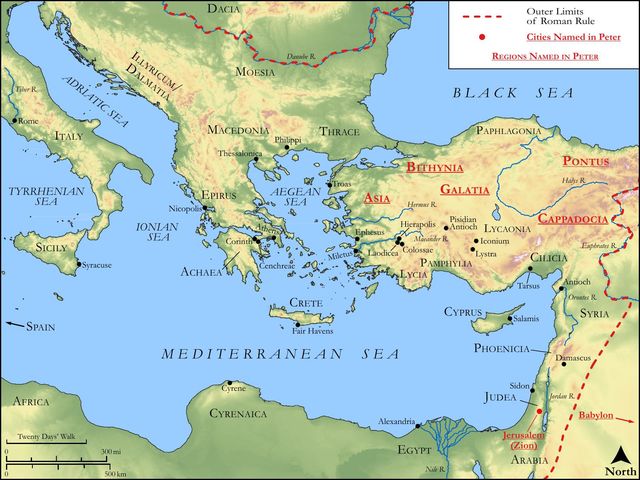
Peter addresses believers scattered across Asia Minor, a diverse region influenced by the Jews, the Greeks and the Romans. Many of these Christians were likely Gentile converts, living as "aliens and exiles" (1 Peter 2:11) within a predominantly pagan society. The vices listed—malice, guile, hypocrisies, envies, and evil speakings—were prevalent in the social fabric of the day, often seen as common human failings or even tools for social advancement. Peter's call to "lay aside" these behaviors would have been a radical counter-cultural demand, setting Christian communities apart as ethical distinctives. It underscored the internal transformation expected of those who had embraced the Gospel, contrasting sharply with the moral relativism or self-serving practices of the wider world.
Key Themes
ShowHideThe primary themes interwoven throughout 1 Peter and particularly highlighted in this verse include Purity and Holiness, which are essential for those who belong to a holy God (1 Peter 1:15-16). This verse underscores that holiness is not merely a positional truth but a practical pursuit, requiring active disengagement from sin. Another key theme is Christian Character and Community. The vices listed are inherently destructive to interpersonal relationships and community cohesion, making their removal vital for fostering genuine love and unity within the body of Christ. Finally, the verse speaks to Preparation for Spiritual Growth. Just as one removes soiled clothing before donning clean attire, Peter implies that shedding these spiritual impurities is a necessary step to truly "crave pure spiritual milk" and grow in salvation, as he elaborates in 1 Peter 2:2-3.
Exposition and Analysis
ShowHideKey Word Analysis
ShowHideThis adverbial particle serves as a strong logical connector, meaning "therefore," "consequently," or "accordingly." It signals that what follows is a direct and necessary consequence of the preceding theological truths, particularly the new birth by the incorruptible Word and the command to fervent love in 1 Peter 1:22-23.
Derived from apó (away from) and títhēmi (to place), this verb literally means "to put away" or "to cast off." It carries the strong implication of a deliberate, decisive action, often used metaphorically for removing clothing or burdens. Here, it denotes a conscious and active renunciation of these vices, not merely a passive avoidance, but a definitive separation from them.
From kakós (bad), this term denotes general badness, depravity, or wickedness. It refers to an inherent ill-will or malignity of disposition, a desire to harm or see others suffer. It is the root disposition from which many of the other listed vices spring.
This compound word, formed from katá (down against) and laleō (to speak), specifically means "defamation," "slander," or "backbiting." It describes the act of speaking ill of others, often maliciously and behind their backs, damaging their reputation or character.
Verse Breakdown
ShowHide"Wherefore laying aside all malice,"
The verse begins with a strong imperative rooted in the preceding theological foundation. Believers are commanded to actively "put off" or "cast away" all forms of malice, which encompasses general wickedness, ill-will, and a desire to harm others. This is a call to internal purity, addressing the heart's disposition.
"and all guile,"
Following malice, Peter lists guile, which refers to deceit, trickery, or cunning. This speaks to insincerity and duplicity in one's words and actions, a deliberate attempt to mislead or manipulate others for personal gain or malicious intent.
"and hypocrisies,"
This term, from which we derive "hypocrisy," literally means "play-acting" or "insincerity." It describes the pretense of virtue or piety that one does not genuinely possess, a dissimulation of one's true motives or character, particularly in religious or moral contexts.
"and envies,"
Peter then includes envies, which signifies jealousy or resentment felt towards another's success, possessions, or good fortune. It is a destructive emotion that begrudges the well-being and blessings of others, often leading to bitterness and division.
"and all evil speakings,"
The final vice listed is evil speakings, which refers to slander, backbiting, or defamation. This is the outward manifestation of internal malice and envy, involving the malicious spreading of rumors, gossip, or false accusations that damage another person's reputation or character. The repetition of "all" (G3956 pâs) before "malice" and "evil speakings" emphasizes the comprehensive nature of this command—no form of these vices should be retained.
Literary Devices
ShowHidePeter employs several powerful literary devices in 1 Peter 2:1. The most prominent is Metaphor, specifically the imagery of "laying aside" (Greek: apotíthēmi). This verb is often used for taking off old clothing, suggesting that these vices are like soiled garments that must be deliberately removed and discarded by the believer, who has put on a new, clean identity in Christ. This implies a conscious, volitional act. The verse also utilizes Enumeration (or a vice list), systematically listing five distinct but related negative behaviors. This comprehensive catalog highlights the pervasive nature of sin and the broad scope of the believer's ethical responsibility. The repetition of "all" before "malice" and "evil speakings" serves as Emphasis, underscoring the thoroughness required in shedding these vices. Finally, the verse functions as an Imperative, a direct command to the readers, demanding active participation in their sanctification process.
Theological and Thematic Connections
ShowHideThe command to "lay aside" these vices in 1 Peter 2:1 is deeply rooted in the New Testament's theology of sanctification and the new creation. Having been born again into a living hope through Christ's resurrection (1 Peter 1:3), believers are called to live consistently with their new identity. This involves an ongoing process of putting off the old self and putting on the new self, which is created in righteousness and true holiness. The vices listed—malice, guile, hypocrisies, envies, and evil speakings—are antithetical to the very nature of God and the character of Christ, and they actively hinder the spiritual growth and genuine fellowship that God desires for His people. Their removal is not merely about avoiding sin, but about cultivating a heart and community that reflect the purity and love of God.
Reflection and Application
ShowHide1 Peter 2:1 serves as a timeless and urgent call for believers to engage in a continuous process of self-examination and spiritual purification. In a world often characterized by deceit, envy, and divisive speech, Peter's words challenge us to cultivate radical authenticity and love within the Christian community and beyond. This "laying aside" is not a one-time event but an ongoing discipline, much like regularly shedding old habits or attitudes that no longer serve our new life in Christ. It demands vigilance over our inner dispositions (malice, envy) and our outward expressions (guile, hypocrisy, evil speakings). By actively renouncing these destructive elements, we create space for the "pure spiritual milk" of God's Word to nourish us, fostering genuine spiritual growth and enabling us to truly love one another fervently, thereby reflecting the transformative power of the Gospel to a watching world.
Questions for Reflection
ShowHideFAQ
ShowHideWhy does Peter specifically list these five vices: malice, guile, hypocrisies, envies, and evil speakings?
ShowHidePeter's selection of these specific vices is highly intentional, as they represent a comprehensive range of internal attitudes and external behaviors that are fundamentally antithetical to Christian love, unity, and spiritual growth. "Malice" (G2549 kakía) is the underlying ill-will or depravity of heart from which many other sins spring. "Guile" (G1388 dólos) and "hypocrisies" (G5272 hypókrisis) speak to insincerity and deceit, which erode trust and authenticity in relationships. "Envies" (G5355 phthónos) highlight destructive jealousy that poisons community. Finally, "evil speakings" (G2636 katalalía) represent the outward manifestation of these internal corruptions, particularly through slander and backbiting, which directly attack the reputation and well-being of others. Together, this list addresses both the heart's disposition and its harmful expressions, emphasizing the holistic transformation required for those who have been born again by the Word of God, as discussed in 1 Peter 1:23.
Christ-Centered Fulfillment
ShowHide1 Peter 2:1 finds its ultimate fulfillment and empowerment in Jesus Christ. While the verse commands believers to "lay aside" vices, it is through Christ's perfect life, atoning death, and empowering resurrection that such a transformation becomes possible. Jesus perfectly embodied the antithesis of these vices: He was without malice, full of truth and grace (John 1:14), utterly sincere, free from envy, and His words always built up rather than tore down (Luke 4:22). He is the sinless Lamb of God (1 Peter 1:19), whose sacrifice cleanses us from all unrighteousness, making us new creations (2 Corinthians 5:17). Furthermore, the Holy Spirit, whom Christ sent, indwells believers, providing the power to put off the old self and put on the new (Ephesians 4:22-24), enabling us to bear the fruit of love, joy, peace, patience, kindness, goodness, faithfulness, gentleness, and self-control, which are the very opposites of the vices Peter condemns (Galatians 5:22-23). Thus, the call to purity in 1 Peter 2:1 is not a legalistic burden but a Spirit-empowered response to the gracious work of Christ in us.