


Romans 12:1
- ΠαρακαλῶParakalōI exhortG3870V-PAI-1SVerb Present Active Indicative 1st Singular
- οὖνounthereforeG3767CONJConjunction
- ὑμᾶςhumasyouG4771P-2APPersonal pronoun Accusative 2nd Plural
- ἀδελφοίadelphoibrothersG80N-VPMNoun Vocative Plural Masculine
- διὰdiathroughG1223PREPPreposition
- τῶνtōntheG3588T-GPMDefinite article Genitive Plural Masculine
- οἰκτιρμῶνoiktirmōncompassionsG3628N-GPMNoun Genitive Plural Masculine
- τοῦtou<the>G3588T-GSMDefinite article Genitive Singular Masculine
- θεοῦtheouof GodG2316N-GSM-TNoun Genitive Singular Masculine Title
- παραστῆσαιparastēsaito presentG3936V-2AANVerb 2nd Aorist Active Infinitive
- τὰtatheG3588T-APNDefinite article Accusative Plural Neuter
- σώματαsōmatabodiesG4983N-APNNoun Accusative Plural Neuter
- ὑμῶνhumōnof youG4771P-2GPPersonal pronoun Genitive 2nd Plural
- θυσίανthusiana sacrificeG2378N-ASFNoun Accusative Singular Feminine
- ζῶσανzōsanlivingG2198V-PAP-ASFVerb Present Active Participle Accusative Singular Feminine
- ἁγίανhagianholyG40A-ASFAdjective Accusative Singular Feminine
- εὐάρεστονeuarestonwell-pleasingG2101A-ASFAdjective Accusative Singular Feminine
- τῷtō<the>G3588T-DSMDefinite article Dative Singular Masculine
- θεῷtheōto GodG2316N-DSM-TNoun Dative Singular Masculine Title
- τὴνtēnwhich is theG3588T-ASFDefinite article Accusative Singular Feminine
- λογικὴνlogikēnreasonableG3050A-ASFAdjective Accusative Singular Feminine
- λατρείανlatreianserviceG2999N-ASFNoun Accusative Singular Feminine
- ὑμῶνhumōnof youG4771P-2GPPersonal pronoun Genitive 2nd Plural
English is a literal word-by-word gloss of the Greek, not the KJV's wording. Why?
This is the original text the KJV's translators worked from — each Greek word with its own literal English meaning in this verse, prepared by scholars at Tyndale House, Cambridge. The KJV translates whole sentences, not word by word, so its wording differs: one Greek word can become several English words, and the KJV may choose “charity” where the gloss reads “love”. Both are faithful — they answer different questions. For the KJV's own rendering, switch to the KJV text.
Details
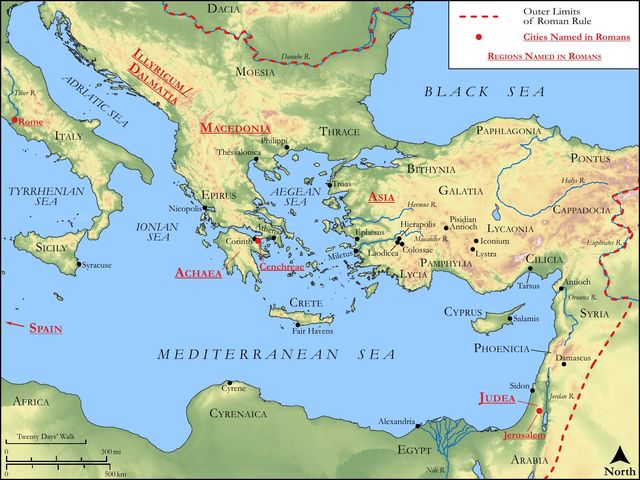
See on the biblical-era map

Study this verse
Public-domain commentary
Matthew Henry
From his Commentary on the Whole Bible. Henry comments on passages, not single verses — this entry covers Romans 12:1–21. His four-level outline is real structure in the source text, so it is rendered as structure.
We may observe here, according to the scheme mentioned in the contents, the apostle's exhortations,
I.Concerning our duty to God, We see what is godliness.
1.It is to surrender ourselves to God, and so to lay a good foundation. We must first give our own selves unto the Lord, 2 Cor. viii. 5. This is here pressed as the spring of all duty and obedience, v. 1, 2. Man consists of body and soul, Gen. ii. 7; Eccl. xii. 7.
(1.)The body must be presented to him, v. 1. The body is for the Lord, and the Lord for the body, 1 Cor. vi. 13, 14. The exhortation is here introduced very pathetically: I beseech you, brethren. Though he was a great apostle, yet he calls the meanest Christians brethren, a term of affection and concern. He uses entreaty; this is the gospel way: As though God did beseech you by us, 2 Cor. v. 20. Though he might with authority command, yet for love's sake he rather beseeches, Philem. 8, 9. The poor useth entreaty, Prov. xviii. 23. This is to insinuate the exhortation, that it might come with the more pleasing power. Many are sooner wrought upon if they be accosted kindly, are more easily led than driven. Now observe,
[1.]The duty pressed—to present our bodies a living sacrifice, alluding to the sacrifices under the law, which were presented or set before God at the altar, ready to be offered to him. Your bodies—your whole selves; so expressed because under the law the bodies of beasts were offered in sacrifice, 1 Cor. vi. 20. Our bodies and spirits are intended. The offering was sacrificed by the priest, but presented by the offerer, who transferred to God all his right, title, and interest in it, by laying his hand on the head of it. Sacrifice is here taken for whatsoever is by God's own appointment dedicated to himself; see 1 Pet. ii. 5. We are temple, priest, and sacrifice, as Christ was in his peculiar sacrificing. There were sacrifices of atonement and sacrifices of acknowledgment. Christ, who was once offered to bear the sins of many, is the only sacrifice of atonement; but our persons and performances, tendered to God through Christ our priest, are as sacrifices of acknowledgment to the honour of God. Presenting them denotes a voluntary act, done by virtue of that absolute despotic power which the will has over the body and all the members of it. It must be a free-will offering. Your bodies; not your beasts. Those legal offerings, as they had their power from Christ, so they had their period in Christ. The presenting of the body to God implies not only the avoiding of the sins that are committed with or against the body, but the using of the body as a servant of the soul in the service of God. It is to glorify God with our bodies (1 Cor. vi. 20), to engage our bodies in the duties of immediate worship, and in a diligent attendance to our particular callings, and be willing to suffer for God with our bodies, when we are called to it. It is to yield the members of our bodies as instruments of righteousness, ch. vi. 13. Though bodily exercise alone profits little, yet in its place it is a proof and product of the dedication of our souls to God. First, Present them a living sacrifice; not killed, as the sacrifices under the law. A Christian makes his body a sacrifice to God, though he does not give it to be burned. A body sincerely devoted to God is a living sacrifice. A living sacrifice, by way of allusion—that which was dead of itself might not be eaten, much less sacrificed, Deut. xiv. 21; and by ways of opposition—"The sacrifice was to be slain, but you may be sacrificed, and yet live on"—an unbloody sacrifice. The barbarous heathen sacrificed their children to their idol-gods, not living, but slain sacrifices: but God will have mercy, and not such sacrifice, though life is forfeited to him. A living sacrifice, that is, inspired with the spiritual life of the soul. It is Christ living in the soul by faith that makes the body a living sacrifice, Gal. ii. 20. Holy love kindles the sacrifices, puts life into the duties; see ch. vi. 13. Alive, that is, to God, v. 11. Secondly, They must be holy. There is a relative holiness in every sacrifice, as dedicated to God. But, besides this, there must be that real holiness which consists in an entire rectitude of heart and life, by which we are conformed in both to the nature and will of God: even our bodies must not be made the instruments of sin and uncleanness, but set apart for God, and put to holy uses, as the vessels of the tabernacle were holy, being devoted to God's service. It is the soul that is the proper subject of holiness; but a sanctified soul communicates a holiness to the body it actuates and animates. That is holy which is according to the will of God; when the bodily actions are no, the body is holy. They are the temples of the Holy Ghost, 1 Cor. vi. 19. Possess the body in sanctification, 1 Thess. iv. 4, 5.
[2.]The arguments to enforce this, which are three:—First, Consider the mercies of God: I beseech you by the mercies of God. An affectionate obtestation, and which should melt us into a compliance: dia ton oiktirmon tou Theou. This is an argument most sweetly cogent. There is the mercy that is in God and the mercy that is from God—mercy in the spring and mercy in the streams: both are included here; but especially gospel-mercies (mentioned ch. ix.), the transferring of what the Jews forfeited and lost by their unbelief unto us Gentiles (Eph. iii. 4-6): the sure mercies of David, Isa. lv. 3. God is a merciful God, therefore let us present our bodies to him; he will be sure to use them kindly, and knows how to consider the frames of them, for he is of infinite compassion. We receive from him every day the fruits of his mercy, particularly mercy to our bodies: he made them, he maintains them, he bought them, he has put a great dignity upon them. It is of the Lord's mercies that we are not consumed, that our souls are held in life; and the greatest mercy of all is that Christ hath made not his body only, but his soul, an offering for sin, that he gave himself for us and gives himself to us. Now surely we cannot but be studying what we shall render to the Lord for all this. And what shall we render? Let us render ourselves as an acknowledgment of all these favours—all we are, all we have, all we can do; and, after all, it is but very poor returns for very rich receivings: and yet, because it is what we have, Secondly, It is acceptable to God. The great end we should all labour after is to be accepted of the Lord (2 Cor. v. 9), to have him well-pleased with our persons and performances. Now these living sacrifices are acceptable to God; while the sacrifices of the wicked, though fat and costly, are an abomination to the Lord. It is God's great condescension that he will vouchsafe to accept of any thing in us; and we can desire no more to make us happy; and, if the presenting of ourselves will but please him, we may easily conclude that we cannot bestow ourselves better. Thirdly, It is our reasonable service. There is an act of reason in it; for it is the soul that presents the body. Blind devotion, that has ignorance for the mother and nurse of it, is fit to be paid only to those dunghill-gods that have eyes and see not. Our God must be served in the spirit and with the understanding. There is all the reason in the world for it, and no good reason can possibly be produced against it. Come now, and let us reason together, Isa. i. 18. God does not impose upon us any thing hard or unreasonable, but that which is altogether agreeable to the principles of right reason. Ten logiken latreian hymon—your service according to the word; so it may be read. The word of God does not leave out the body in holy worship. That service only is acceptable to God which is according to the written word. It must be gospel worship, spiritual worship. That is a reasonable service which we are able and ready to give a reason for, in which we understand ourselves. God deals with us as with rational creatures, and will have us so to deal with him. Thus must the body be presented to God.
(2.)The mind must be renewed for him. This is pressed (v. 2): "Be you transformed by the renewing of your mind; see to it that there be a saving change wrought in you, and that it be carried on." Conversion and sanctification are the renewing of the mind, a change not of the substance, but of the qualities of the soul. It is the same with making a new heart and a new spirit—new dispositions and inclinations, new sympathies and antipathies; the understanding enlightened, the conscience softened, the thoughts rectified; the will bowed to the will of God, and the affections made spiritual and heavenly: so that the man is not what he was—old things are passed away, all things are become new; he acts from new principles, by new rules, with new designs. The mind is the acting ruling part of us; so that the renewing of the mind is the renewing of the whole man, for out of it are the issues of life, Prov. iv. 23. The progress of sanctification, dying to sin more and more and living to righteousness more and more, is the carrying on of this renewing work, till it be perfected in glory. This is called the transforming of us; it is like putting on a new shape and figure. Metamorphousthe—Be you metamorphosed. The transfiguration of Christ is expressed by this word (Matt. xvii. 2), when he put on a heavenly glory, which made his face to shine like the sun; and the same word is used 2 Cor. iii. 18, where we are said to be changed into the same image from glory to glory. This transformation is here pressed as a duty; not that we can work such a change ourselves: we could as soon make a new world as make a new heart by any power of our own; it is God's work, Ezek. xi. 19; xxxvi. 26, 27. But be you transformed, that is, "use the means which God hath appointed and ordained for it." It is God that turns us, and then we are turned; but we must frame our doings to turn, Hos. v. 4. "Lay your souls under the changing transforming influences of the blessed Spirit; seek unto God for grace in the use of all the means of grace." Though the new man be created of God, yet we must put it on (Eph. iv. 24), and be pressing forward towards perfection. Now in this verse we may further observe,
[1.]What is the great enemy to this renewing, which we must avoid; and that is, conformity to this world: Be not conformed to this world. All the disciples and followers of the Lord Jesus must be nonconformists to this world. Me syschematizesthe—Do not fashion yourselves according to the world. We must not conform to the things of the world; they are mutable, and the fashion of them is passing away. Do not conform either to the lusts of the flesh or the lusts of the eye. We must not conform to the men of the world, of that world which lies in wickedness, not walk according to the course of this world (Eph. ii. 2); that is, we must not follow a multitude to do evil, Exod. xxiii. 2. If sinners entice us, we must not consent to them, but in our places witness against them. Nay, even in things indifferent, and which are not in themselves sinful, we must so far not conform to the custom and way of the world as not to act by the world's dictates as our chief rule, nor to aim at the world's favours as our highest end. True Christianity consists much in a sober singularity. Yet we must take heed of the extreme of affected rudeness and moroseness, which some run into. In civil things, the light of nature and the custom of nations are intended for our guidance; and the rule of the gospel in those cases is a rule of direction, not a rule of contrariety.
[2.]What is the great effect of this renewing, which we must labour after: That you may prove what is that good, and acceptable, and perfect will of God. by the will of God here we are to understand his revealed will concerning our duty, what the Lord our God requires of us. This is the will of God in general, even our sanctification, that will which we pray may be done by us as it is done by the angels; especially his will as it is revealed in the New Testament, where he hath in these last days spoken to us by his Son. First, The will of God is good, and acceptable, and perfect; three excellent properties of a law. It is good (Mic. vi. 8); it is exactly consonant to the eternal reason of good and evil. It is good in itself. It is good for us. Some think the evangelical law is here called good, in distinction from the ceremonial law, which consisted of statutes that were not good, Ezek. xx. 25. It is acceptable, it is pleasing to God; that and that only is so which is prescribed by him. The only way to attain his favour as the end is to conform to his will as the rule. It is perfect, to which nothing can be added. The revealed will of God is a sufficient rule of faith and practice, containing all things which tend to the perfection of the man of God, to furnish us thoroughly to every good work, 2 Tim. iii. 16, 17. Secondly, That it concerns Christians to prove what is that will of God which is good, and acceptable, and perfect; that is, to know it with judgment and approbation, to know it experimentally, to know the excellency of the will of God by the experience of a conformity to it. It is to approve things that are excellent (Phil. i. 10); it is dokimazein (the same word that is used here) to try things that differ, in doubtful cases readily to apprehend what the will of God is and to close in with it. It is to be of quick understanding in the fear of the Lord, Isa. xi. 3. Thirdly, That those are best able to prove what is the good, and acceptable, and perfect will of God, who are transformed by the renewing of their mind. A living principle of grace is in the soul, as far as it prevails, an unbiassed unprejudiced judgment concerning the things of God. It disposes the soul to receive and entertain the revelations of the divine will. The promise is (John vii. 17), If any man will do his will, he shall know of the doctrine. A good wit can dispute and distinguish about the will of God; while an honest, humble heart, that has spiritual senses exercised, and is delivered into the mould of the word, loves it, and practises it, and has the relish and savour of it. Thus to be godly is to surrender ourselves to God.
2.When this is done, to serve him in all manner of gospel obedience. Some hints of this we have here (v. 11, 12), Serving the Lord. Wherefore do we present ourselves to him, but that we may serve him? Acts xxvii. 23, Whose I am; and then it follows, whom I serve. To be religious is to serve God. How?
(1.)We must make a business of it, and not be slothful in that business. Not slothful in business. There is the business of the world, that of our particular calling, in which we must not be slothful, 1 Thess. iv. 11. But this seems to be meant of the business of serving the Lord, our Father's business, Luke ii. 49. Those that would approve themselves Christians indeed must make religion their business—must choose it, and learn it, and give themselves to it; they must love it, and employ themselves in it, and abide by it, as their great and main business. And, having made it our business, we must not be slothful in it: not desire our own ease, and consult that, when it comes in competition with our duty. We must not drive on slowly in religion. Slothful servants will be reckoned with us wicked servants.
(2.)We must be fervent in spirit, serving the Lord. God must be served with the spirit (ch. i. 9; John iv. 24), under the influences of the Holy Spirit. Whatever we do in religion it is pleasing to God no further than it is done with our spirits wrought upon by the Spirit of God. And there must be fervency in the spirit—a holy zeal, and warmth, and ardency of affection in all we do, as those that love God not only with the heart and soul, but with all our hearts, and with all our souls. This is the holy fire that kindles the sacrifice, and carries it up to heaven, an offering of a sweet-smelling savour.—Serving the Lord. To kairo douleuontes (so some copies read it), serving the time, that is, improving your opportunities and making the best of them, complying with the present seasons of grace.
(3.)Rejoicing in hope. God is worshipped and honoured by our hope and trust in him, especially when we rejoice in that hope, take a complacency in that confidence, which argues a great assurance of the reality and a great esteem of the excellency of the good hoped for.
(4.)Patient in tribulation. Thus also God is served, not only by working for him when he calls us to work, but by sitting still quietly when he calls us to suffer. Patience for God's sake, and with an eye to his will and glory, is true piety. Observe, Those that rejoice in hope are likely to be patient in tribulation. It is a believing prospect of the joy set before us that bears up the spirit under all outward pressure.
(5.)Continuing instant in prayer. Prayer is a friend to hope and patience, and we do in it serve the Lord. Proskarterountes. It signifies both fervency and perseverance in prayer. We should not be cold in the duty, nor soon weary of it, Luke xviii. 1; 1 Thess. v. 17; Eph. vi. 18; Col. iv. 2. This is our duty which immediately respects God.
II.Concerning our duty which respects ourselves; this is sobriety.
1.A sober opinion of ourselves, v. 3. It is ushered in with a solemn preface: I say, through the grace given unto me: the grace f wisdom, by which he understood the necessity and excellency of this duty; the grace of apostleship, by which he had authority to press and enjoin it. "I say it, who am commissioned to say it, in God's name. I say it, and it is not for you to gainsay it." It is said to every one of us, one as well as another. Pride is a sin that is bred in the bone of all of us, and we have therefore each of us need to be cautioned and armed against it.—Not to think of himself more highly than he ought to think. We must take heed of having too great an opinion of ourselves, or putting too high a valuation upon our own judgments, abilities, persons, performances. We must not be self-conceited, nor esteem too much our own wisdom and other attainments, not think ourselves to be something, Gal. vi. 3. There is a high thought of ourselves which we may and must have to think ourselves too good to be the slaves of sin and drudges to this world. But, on the other hand, we should think soberly, that is, we must have a low and modest opinion of ourselves and our own abilities, our gifts and graces, according to what we have received from God, and not otherwise. We must not be confident and hot in matters of doubtful disputation; not stretch ourselves beyond our line; not judge and censure those that differ from us; not desire to make a fair show in the flesh. These and the like are the fruits of a sober opinion of ourselves. The words will bear yet another sense agreeable enough. Of himself is not in the original; therefore it may be read, That no man be wise above what he ought to be wise, but be wise unto sobriety. We must not exercise ourselves in things too high for us (Ps. cxxxi. 1, 2), not intrude into those things which we have not seen (Col. ii. 18), those secret things which belong not to us (Deut. xxix. 29), not covet to be wise above what is written. There is a knowledge that puffs up, which reaches after forbidden fruit. We must take heed of this, and labour after that knowledge which tends to sobriety, to the rectifying of the heart and the reforming of the life. Some understand it of the sobriety which keeps us in our own place and station, from intruding into the gifts and offices of others. See an instance of this sober modest care in the exercise of the greatest spiritual gifts, 2 Cor. x. 13-15. To this head refers also that exhortation (v. 16), Be not wise in your own conceits. It is good to be wise, but it is bad to think ourselves so; for there is more hope of a fool than of him that is wise in his own eyes. It was an excellent thing for Moses to have his face shine and not know it. Now the reasons why we must have such a sober opinion of ourselves, our own abilities and attainments, are these:—
(1.)Because whatever we have that is good, God hath dealt it to us; every good and perfect gift comes from above, James i. 17. What have we that we have not received? And, if we have received it, why then do we boast? 1 Cor. iv. 7. The best and most useful man in the world is no more, no better, than what the free grace of God makes him every day. When we are thinking of ourselves, we must remember to think not how we attained, as though our might and the power of our hand had gotten us these gifts; but think how kind God hath been to us, for it is he that gives us power to do any thing that is good, and in him is all our sufficiency.
(2.)Because God deals out his gifts in a certain measure: According to the measure of faith. Observe, The measure of spiritual gifts he calls the measure of faith, for this is the radical grace. What we have and do that is good is so far right and acceptable as it is founded in faith, and flows from faith, and no further. Now faith, and other spiritual gifts with it, are dealt by measure, according as Infinite Wisdom sees meet for us. Christ had the Spirit given him without measure, John iii. 34. But the saints have it by measure; see Eph. iv. 7. Christ, who had gifts without measure, was meek and lowly; and shall we, that are stinted, be proud and self-conceited?
(3.)Because God has dealt out gifts to others as well as to us: Dealt to every man. Had we the monopoly of the Spirit, or a patent to be sole proprietors of spiritual gifts, there might be some pretence for this conceitedness of ourselves; but others have their share as well as we. God is a common Father, and Christ a common root, to all the saints, who all drive virtue from him; and therefore it ill becomes us to lift up ourselves, and to despise others, as if we only were the people in favour with heaven, and wisdom should die with us. This reasoning he illustrates by a comparison taken from the members of the natural body (as 1 Cor. xii. 12; Eph. iv. 16): As we have many members in one body, &c., v. 4, 5. Here observe,
[1.]All the saints make up one body in Christ, who is the head of the body, and the common centre of their unity. Believers lie not in the world as a confused disorderly heap, but are organized and knit together, as they are united to one common head, and actuated and animated by one common Spirit.
[2.]Particular believers are members of this body, constituent parts, which speak them less than the whole, and in relation to the whole, deriving life and spirits from the head. Some members in the body are bigger and more useful than others, and each receives spirits from the head according to its proportion. If the little finger should receive as much nourishment as the leg, how unseemly and prejudicial would it be! We must remember that we are not the whole; we think above what is meet if we think so; we are but parts and members.
[3.]All the members have not the same office (v. 4), but each hath its respective place and work assigned it. The office of the eye is to see, the office of the hand is to work, &c. So in the mystical body, some are qualified for, and called to, one sort of work; others are, in like manner, fitted for, and called to, another sort of work. Magistrates, ministers, people, in a Christian commonwealth, have their several offices, and must not intrude one upon another, nor clash in the discharge of their several offices.
[4.]Each member hath its place and office, for the good and benefit of the whole, and of every other member. We are not only members of Christ, but we are members one of another, v. 5. We stand in relation one to another; we are engaged to do all the good we can one to another, and to act in conjunction for the common benefit. See this illustrated at large, 1 Cor. xii. 14, &c. Therefore we must not be puffed up with a conceit of our own attainments, because, whatever we have, as we received it, so we received it not for ourselves, but for the good of others.
2.A sober use of the gifts that God hath given us. As we must not on the one hand be proud of our talents, so on the other hand we must not bury them. Take heed lest, under a pretence of humility and self-denial, we be slothful in laying out ourselves for the good of others. We must not say, "I am nothing, therefore I will sit still, and do nothing;" but, "I am nothing in myself, and therefore I will lay out myself to the utmost in the strength of the grace of Christ." He specifies the ecclesiastical offices appointed in particular churches, in the discharge of which each must study to do his own duty, for the preserving of order and the promotion of edification in the church, each knowing his place and fulfilling it. Having then gifts. The following induction of particulars supplies the sense of this general. Having gifts, let us use them. Authority and ability for the ministerial work are the gift of God.—Gifts differing. The immediate design is different, though the ultimate tendency of all is the same. According to the grace, charismata kata ten charin. The free grace of God is the spring and original of all the gifts that are given to men. It is grace that appoints the office, qualifies and inclines the person, works both to will and to do. There were in the primitive church extraordinary gifts of tongues, of discerning, of healing; but he speaks here of those that are ordinary. Compare 1 Cor. xii. 4; 1 Tim. iv. 14; 1 Pet. iv. 10. Seven particular gifts he specifies (v. 6-8), which seem to be meant of so many distinct offices, used by the prudential constitution of many of the primitive churches, especially the larger. There are two general ones here expressed by prophesying and ministering, the former the work of the bishops, the latter the work of the deacons, which were the only two standing officers, Phil. i. 1. But the particular work belonging to each of these might be, and it should seem was, divided and allotted by common consent and agreement, that it might be done the more effectually, because that which is every body's work is nobody's work, and he despatches his business best that is vir unius negotii—a man of one business. Thus David sorted the Levites (1 Chron. xxiii. 4, 5), and in this wisdom is profitable to direct. The five latter will therefore be reduced to the two former.
(1.)Prophecy. Whether prophecy, let us prophesy according to the proportion of faith. It is not meant of the extraordinary gifts of foretelling things to come, but the ordinary office of preaching the word: so prophesying is taken, 1 Cor. xiv. 1-3, &c.; xi. 4; 1 Thess. v. 20. The work of the Old-Testament prophets was not only to foretel future things, but to warn the people concerning sin and duty, and to be their remembrancers concerning that which they knew before. And thus gospel preachers are prophets, and do indeed, as far as the revelation of the word goes, foretel things to come. Preaching refers to the eternal condition of the children of men, points directly at a future state. Now those that preach the word must do it according to the proportion of faith—kata ten analogian tes pisteos, that is, [1.] As to the manner of our prophesying, it must be according to the proportion of the grace of faith. He had spoken (v. 3) of the measure of faith dealt to every man. Let him that preaches set all the faith he hath on work, to impress the truths he preaches upon his own heart in the first place. As people cannot hear well, so ministers cannot preach well, without faith. First believe and then speak, Ps. cxvi. 10; 2 Cor. iv. 13. And we must remember the proportion of faith—that, though all men have not faith, yet a great many have besides ourselves; and therefore we must allow others to have a share of knowledge and ability to instruct, as well as we, even those that in less things differ from us. "Hast thou faith? Have it to thyself; and do not make it a ruling rule to others, remembering that thou hast but thy proportion." [2.] As to the matter of our prophesying, it must be according to the proportion of the doctrine of faith, as it is revealed in the holy scriptures of the Old and New Testament. By this rule of faith the Bereans tried Paul's preaching, Acts xvii. 11. Compare Acts xxvi. 22; Gal. i. 9. There are some staple-truths, as I may call them, some prima axiomata—first axioms, plainly and uniformly taught in the scripture, which are the touchstone of preaching, by which (though we must not despise prophesying) we must prove all things, and then hold fast that which is good, 1 Thess. v. 20, 21. Truths that are more dark must be examined by those that are more clear; and then entertained when they are found to agree and comport with the analogy of faith; for it is certain one truth can never contradict another. See here what ought to be the great care of preachers—to preach sound doctrine, according to the form of wholesome words, Tit. ii. 8; 2 Tim. i. 13. It is not so necessary that the prophesying be according to the proportion of art, the rules of logic and rhetoric; but it is necessary that it be according to the proportion of faith: for it is the word of faith that we preach. Now there are two particular works which he that prophesieth hath to mind—teaching and exhorting, proper enough to be done by the same person at the same time, and when he does the one let him mind that, when he does the other let him do that too as well as he can. If, by agreement between the ministers of a congregation, this work be divided, either constantly or interchangeably, so that one teaches and the other exhorts (that is, in our modern dialect, one expounds and the other preaches), let each do his work according to the proportion of faith. First, let him that teacheth wait on teaching. Teaching is the bare explaining and proving of gospel truths, without practical application, as in the expounding of the scripture. Pastors and teachers are the same office (Eph. iv. 11), but the particular work is somewhat different. Now he that has a faculty of teaching, and has undertaken that province, let him stick to it. It is a good gift, let him use it, and give his mind to it. He that teacheth, let him be in his teaching; so some supply it, Ho didaskon, en te didaskalia. Let him be frequent and constant, and diligent in it; let him abide in that which is his proper work, and be in it as his element. See 1 Tim. iv. 15, 16, where it is explained by two words, en toutois isthi, and epimene autois, be in these things and continue in them. Secondly, Let him that exhorteth wait on exhortation. Let him give himself to that. This is the work of the pastor, as the former of the teacher; to apply gospel truths and rules more closely to the case and condition of the people, and to press upon them that which is more practical. Many that are very accurate in teaching may yet be very cold and unskilful in exhorting; and on the contrary. The one requires a clearer head, the other a warmer heart. Now where these gifts are evidently separated (that the one excels in the one and the other in the other) it conduces to edification to divide the work accordingly; and, whatsoever the work is that we undertake, let us mind it. To wait on our work is to bestow the best of our time and thoughts upon it, to lay hold of all opportunities for it, and to study not only to do it, but to do it well.
(2.)Ministry. If a man hath diakonian—the office of a deacon, or assistant to the pastor and teacher, let him use that office well—a churchwarden (suppose), an elder, or an overseer of the poor; and perhaps there were more put into these offices, and there was more solemnity in them, and a greater stress of care and business lay upon them in the primitive churches, than we are now well aware of. It includes all those offices which concern the ta exo of the church, the outward business of the house of God. See Neh. xi. 16. Serving tables, Acts vi. 2. Now let him on whom this care of ministering is devolved attend to it with faithfulness and diligence; particularly,
[1.]He that giveth, let him do it with simplicity. Those church-officers that were the stewards of the church's alms, collected money, and distributed it according as the necessities of the poor were. Let them do it en aploteti—liberally and faithfully; not converting what they receive to their own use, nor distributing it with any sinister design, or with respect of person: not froward and peevish with the poor, nor seeking pretences to put them by; but with all sincerity and integrity, having no other intention in it than to glorify God and do good. Some understand it in general of all almsgiving: He that hath wherewithal, let him give, and give plentifully and liberally; so the word is translated, 2 Cor. viii. 2; ix. 13. God loves a cheerful bountiful giver.
[2.]He that ruleth with diligence. It should seem, he means those that were assistants to the pastors in exercising church-discipline, as their eyes, and hands, and mouth, in the government of the church, or those ministers that in the congregation did chiefly undertake and apply themselves to this ruling work; for we find those ruling that laboured in the word and doctrine, 1 Tim. v. 17. Now such must do it with diligence. The word denotes both care and industry to discover what is amiss, to reduce those that go astray, to reprove and admonish those that have fallen, to keep the church pure. Those must take a great deal of pains that will approve themselves faithful in the discharge of this trust, and not let slip any opportunity that may facilitate and advance that work.
[3.]He that showeth mercy with cheerfulness. Some think it is meant in general of all that in any thing show mercy: Let them be willing to do it, and take a pleasure in it; God loves a cheerful giver. But it seems to be meant of some particular church-officers, whose work it was to take care of the sick and strangers; and those were generally widows that were in this matter servants to the church-deaconesses (1 Tim. v. 9, 10), though others, it is likely, might be employed. Now this must be done with cheerfulness. A pleasing countenance in acts of mercy is a great relief and comfort to the miserable; when they see it is not done grudgingly and unwillingly, but with pleasant looks and gentle words, and all possible indications of readiness and alacrity. Those that have to do with such as are sick and sore, and commonly cross and peevish, have need to put on not only patience, but cheerfulness, to make the work the more easy and pleasant to them, and the more acceptable to God.
III.Concerning that part of our duty which respects our brethren, of which we have many instances, in brief exhortations.
Now all our duty towards one another is summer up in one word, and that a sweet work, love. In that is laid the foundation of all our mutual duty; and therefore the apostle mentions this first, which is the livery of Christ's disciples, and the great law of our religion: Let love be without dissimulation; not in compliment and pretence, but in reality; not in word and tongue only, 1 John iii. 18. The right love is love unfeigned; not as the kisses of an enemy, which are deceitful. We should be glad of an opportunity to prove the sincerity of our love, 2 Cor. viii. 8. More particularly, there is a love owing to our friends, and to our enemies. He specifies both.
1.To our friends. He that hath friends must show himself friendly. There is a mutual love that Christians owe, and must pay.
(1.)An affectionate love (v. 10): Be kindly affectioned one to another, with brotherly love, philostorgoi—it signifies not only love, but a readiness and inclination to love, the most genuine and free affection, kindness flowing out as from a spring. It properly denotes the love of parents to their children, which, as it is the most tender, so it is the most natural, of any, unforced, unconstrained; such must our love be to one another, and such it will be where there is a new nature and the law of love is written in the heart. This kind affection puts us on to express ourselves both in word and action with the greatest courtesy and obligingness that may be.—One to another. This may recommend the grace of love to us, that, as it is made our duty to love others, so it is as much their duty to love us. And what can be sweeter on this side heaven than to love and be beloved? He that thus watereth shall be watered also himself.
(2.)A respectful love: In honour preferring one another. Instead of contending for superiority, let us be forward to give to others the pre-eminence. This is explained, Phil. ii. 3, Let each esteem other better than themselves. And there is this good reason for it, because, if we know our own hearts, we know more evil by ourselves than we do by any one else in the world. We should be forward to take notice of the gifts, and graces, and performances of our brethren, and value them accordingly, be more forward to praise another, and more pleased to hear another praised, than ourselves; te time allelous proegoumenoi—going before, or leading one another in honour; so some read it: not in taking honour, but in giving honour. "Strive which of you shall be most forward to pay respect to those to whom it is due, and to perform all Christian offices of love (which are all included in the word honour) to your brethren, as there is occasion. Let all your contention be which shall be most humble, and useful, and condescending." So the sense is the same with Tit. iii. 14, Let them learn, proistasthai—to go before in good works. For though we must prefer others (as our translation reads it), and put on others, as more capable and deserving than ourselves, yet we must not make that an excuse for our lying by and doing nothing, nor under a pretence of honouring others, and their serviceableness and performances, indulge ourselves in ease and slothfulness. Therefore he immediately adds (v. 11), Not slothful in business.
(3.)A liberal love (v. 13): Distributing to the necessities of saints. It is but a mock love which rests in the verbal expressions of kindness and respect, while the wants of our brethren call for real supplies, and it is in the power of our hands to furnish them.
[1.]It is no strange thing for saints in this world to want necessaries for the support of their natural live. In those primitive times prevailing persecutions must needs reduce many of the suffering saints to great extremities; and still the poor, even the poor saints, we have always with us. Surely the things of this world are not the best things; if they were, the saints, who are the favourites of heaven, would not be put off with so little of them.
[2.]It is the duty of those who have wherewithal to distribute, or (as it might better be read) to communicate to those necessities. It is not enough to draw out the soul, but we must draw out the purse, to the hungry. See Jam. ii. 15, 16; 1 John iii. 17. Communicating—koinonountes. It intimates that our poor brethren have a kind of interest in that which God hath given us; and that our reliving them should come from a sense and fellow-feeling of their wants, as though we suffered with them. The charitable benevolence of the Philippians to Paul is called their communicating with his affliction, Phil. iv. 14. We must be ready, as we have ability and opportunity, to relieve any that are in want; but we are in a special manner bound to communicate to the saints. There is a common love owing to our fellow-creatures, but a special love owing to our fellow-christians (Gal. vi. 10), Especially to those who are of the household of faith. Communicating, tais mneiais—to the memories of the saints; so some of the ancients read it, instead of tais chreiais. There is a debt owing to the memory of those who through faith and patience inherit the promises—to value it, to vindicate it, to embalm it. Let the memory of the just be blessed; so some read Prov. x. 7. He mentions another branch of this bountiful love: Given to hospitality. Those who have houses of their own should be ready to entertain those who go about doing good, or who, for fear of persecution, are forced to wander for shelter. They had not then so much of the convenience of common inns as we have; or the wandering Christians durst not frequent them; or they had not wherewithal to bear the charges, and therefore it was a special kindness to bid them welcome on free-cost. Nor is it yet an antiquated superseded duty; as there is occasion, we must welcome strangers, for we know not the heart of a stranger. I was a stranger, and you took me in, is mentioned as one instance of the mercifulness of those that shall obtain mercy: ten philoxenian diokontes—following or pursuing hospitality. It intimates, not only that we must take opportunity, but that we must seek opportunity, thus to show mercy. As Abraham, who sat at the tent-door (Gen. xviii. 1), and Lot, who sat in the gate of Sodom (Gen. xix. 1), expecting travellers, whom they might meet and prevent with a kind invitation, and so they entertained angels unawares, Heb. xiii. 2.
(4.)A sympathizing love (v. 15): Rejoice with those that do rejoice, and weep with those that weep. Where there is a mutual love between the members of the mystical body, there will be such a fellow-feeling. See 1 Cor. xii. 26. True love will interest us in the sorrows and joys of one another, and teach us to make them our own. Observe the common mixture in this world, some rejoicing, and others weeping (as the people, Ezra iii. 12, 13), for the trial, as of other graces, so of brotherly love and Christian sympathy. Not that we must participate in the sinful mirths or mournings of any, but only in just and reasonable joys and sorrows: not envying those that prosper, but rejoicing with them; truly glad that others have the success and comfort which we have not; not despising those that are in trouble, but concerned for them, and ready to help them, as being ourselves in the body. This is to do as God does, who not only has pleasure in the prosperity of his servants (Ps. xxxv. 27), but is likewise afflicted in all their afflictions, Isa. lxiii. 9.
(5.)A united love: "Be of the same mind one towards another (v. 16), that is, labour, as much as you can, to agree in apprehension; and, wherein you come short of this, yet agree in affection; endeavour to be all one, not affecting to clash, and contradict, and thwart one another; but keep the unity of the Spirit in the bond of peace, Phil. ii. 2; iii. 15, 16; 1 Cor. i. 10; to auto eis allelous phronountes—wishing the same good to others that you do to yourselves;" so some understand it. This is to love our brethren as ourselves, desiring their welfare as our own.
(6.)A condescending love: Mind not high things, but condescend to men of low estate, v. 16. True love cannot be without lowliness, Eph. iv. 1, 2; Phil. ii. 3. When our Lord Jesus washed his disciples' feet, to teach us brotherly love (John xiii. 5; xiv. 34), it was designed especially to intimate to us that to love one another aright is to be willing to stoop to the meanest offices of kindness for the good of one another. Love is a condescending grace: Non bene conveniunt—majestas et amor—Majesty and love do but ill assort with each other. Observe how it is pressed here. [1.] Mind not high things. We must not be ambitious of honour and preferment, nor look upon worldly pomp and dignity with any inordinate value or desire but rather with a holy contempt. When David's advancements were high, his spirit was humble (Ps. cxxxi. 1): I do not exercise myself in great matters. The Romans, living in the imperial city, which reigned over the kings of the earth (Rev. xvii. 18), and was at that time in the meridian of its splendour, were perhaps ready to take occasion thence to think the better of themselves. Even the holy seed were tainted with this leaven. Roman Christians, as some citizens do upon the country; and therefore the apostle so often cautions them against high-mindedness; compare ch. xi. 20. They lived near the court, and conversed daily with the gaiety and grandeur of it: "Well," saith he, "do not mind it, be not in love with it." [2.] Condescend to men of low estate—Tois tapeinois synapagomenoi. First, It may be meant of mean things, to which we must condescend. If our condition in the world be poor and low, our enjoyments coarse and scanty, our employments despicable and contemptible, yet we must bring our minds to it, and acquiesce in it. So the margin: Be contented with mean things. Be reconciled to the place which God in his providence hath put us in, whatever it be. We must account nothing below us but sin: stoop to mean habitations, mean fare, mean clothing, mean accommodations when they are our lot, and not grudge. Nay, we must be carried with a kind of impetus, by the force of the new nature (so the word synapagomai properly signifies, and it is very significant), towards mean things, when God appoints us to them; as the old corrupt nature is carried out towards high things. We must accommodate ourselves to mean things. We should make a low condition and mean circumstances more the centre of our desires than a high condition. Secondly, It may be meant of mean persons; so we read it (I think both are to be included) Condescend to men of low estate. We must associate with, and accommodate ourselves to, those that are poor and mean in the world, if they be such as fear God. David, though a king upon the throne, was a companion for all such, Ps. cxix. 63. We need not be ashamed to converse with the lowly, while the great God overlooks heaven and earth to look at such. True love values grace in rags as well as in scarlet. A jewel is a jewel, though it lie in the dirt. The contrary to this condescension is reproved, Jam. ii. 1-4. Condescend; that is, suit yourselves to them, stoop to them for their good; as Paul, 1 Cor. ix. 19, &c. Some think the original word is a metaphor taken from travellers, when those that are stronger and swifter of foot stay for those that are weak and slow, make a halt, and take them with them; thus must Christians be tender towards their fellow travellers. As a means to promote this, he adds, Be not wise in your own conceits; to the same purport with v. 3. We shall never find in our hearts to condescend to others while we find there so great a conceit of ourselves: and therefore this must needs be mortified. Me ginesthe phronimoi par heautois—"Be not wise by yourselves, be not confident of the sufficiency of your own wisdom, so as to despise others, or think you have no need of them (Prov. iii. 7), nor be shy of communicating what you have to others. We are members one of another, depend upon one another, are obliged to one another; and therefore, Be not wise by yourselves, remembering it is the merchandise of wisdom that we profess; now merchandise consists in commerce, receiving and returning."
(7.)A love that engages us, as much as lies in us, to live peaceably with all men, v. 18. Even those with whom we cannot live intimately and familiarly, by reason of distance in degree or profession, yet we must with such live peaceably; that is, we must be harmless and inoffensive, not giving others occasion to quarrel with us; and we must be gall-less and unrevengeful, not taking occasion to quarrel with them. Thus must we labour to preserve the peace, that it be not broken, and to piece it again when it is broken. The wisdom from above is pure and peaceable. Observe how the exhortation is limited. It is not expressed so as to oblige us to impossibilities: If it be possible, as much as lies in you. Thus Heb. xii. 14, Follow peace. Eph. iv. 3, Endeavouring to keep. Study the things that make for peace.—If it be possible. It is not possible to preserve the peace when we cannot do it without offending God and wounding conscience: Id possumus quod jure possumus—That is possible which is possible without incurring blame. The wisdom that is from above is first pure and then peaceable, Jam. iii. 17. Peace without purity is the peace of the devil's palace.—As much as lieth in you. There must be two words to the bargain of peace. We can but speak for ourselves. We may be unavoidably striven with; as Jeremiah, who was a man of contention (Jer. xv. 10), and this we cannot help; our care must be that nothing be wanting on our parts to preserve the peace, Ps. cxx. 7. I am for peace, though, when I speak, they are for war.
2.To our enemies. Since men became enemies to God, they have been found very apt to be enemies one to another. Let but the centre of love be once forsaken, and the lines will either clash and interfere, or be at an uncomfortable distance. And, of all men, those that embrace religion have reason to expect to meet with enemies in a world whose smiles seldom concur with Christ's. Now Christianity teaches us how to behave towards our enemies; and in this instruction it quite differs from all other rules and methods, which generally aim at victory and dominion; but this at inward peace and satisfaction. Whoever are our enemies, that wish us ill and seek to do us ill, our rule is to do them no hurt, but all the good we can.
(1.)To do them no hurt (v. 17): Recompense to no man evil for evil, for that is a brutish recompence, and befitting only those animals which are not conscious either of any being above them or of any state before them. Or, if mankind were made (as some dream) in a state of war, such recompences as these were agreeable enough; but we have not so learned God, who does so much for his enemies (Matt. v. 45), much less have we so learned Christ, who died for us when we were enemies (ch. v. 8, 10), so loved that world which hated him without a cause.—"To no man; neither to Jew nor Greek; not to one that has been thy friend, for by recompensing evil for evil thou wilt certainly lose him; not to one that has been thine enemy, for by not recompensing evil for evil thou mayest perhaps gain him." To the same purport, v. 19, Dearly beloved, avenge not yourselves. And why must this be ushered in with such an affectionate compellation, rather than any other of the exhortations of this chapter? Surely because this is intended for the composing of angry spirits, that are hot in the resentment of a provocation. He addresses himself to such in this endearing language, to mollify and qualify them. Any thing that breathes love sweetens the blood, lays the storm, and cools the intemperate heat. Would you pacify a brother offended? Call him dearly beloved. Such a soft word, fitly spoken, may be effectual to turn away wrath. Avenge not yourselves; that is, when any body has done you any ill turn, do not desire nor endeavour to bring the like mischief or inconvenience upon him. It is not forbidden to the magistrate to do justice to those that are wronged, by punishing the wrong-doer; nor to make and execute just and wholesome laws against malefactors; but it forbids private revenge, which flows from anger and ill-will; and this is fitly forbidden, for it is presumed that we are incompetent judges in our own case. Nay, if persons wronged in seeking the defence of the law, and magistrates in granting it, act from any particular personal pique or quarrel, and not from a concern that public peace and order be maintained and right done, even such proceedings, though seemingly regular, will fall under this prohibited self-revenging. See how strict the law of Christ is in this matter, Matt. v. 38-40. It is forbidden not only to take it into our own hands to avenge ourselves, but to desire and thirst after event that judgment in our case which the law affords, for the satisfying of a revengeful humour. This is a hard lesson to corrupt nature; and therefore he subjoins, [1.] A remedy against it: Rather give place unto wrath. Not to our own wrath; to give place to this is to give place to the devil, Eph. iv. 26, 27. We must resist, and stifle, and smother, and suppress this; but, First, To the wrath of our enemy. "Give place to it, that is, be of a yielding temper; do not answer wrath with wrath, but with love rather. Yielding pacifies great offences, Eccl. x. 4. Receive affronts and injuries, as a stone is received into a heap of wool, which gives way to it, and so it does not rebound back, nor go any further." So it explains that of our Saviour (Matt. v. 39), Whosoever shall smite thee on thy right cheek, turn to him the other also. Instead of meditating how to revenge one wrong, prepare to receive another. When men's passions are up, and the stream is strong, let it have its course, lest by an unseasonable opposition it be made to rage and swell the more. When others are angry, let us be calm; this is a remedy against revenge, and seems to be the genuine sense. But, Secondly, Many apply it to the wrath of God: "Give place to this, make room for him to take the throne of judgment, and let him alone to deal with thine adversary." [2.] A reason against it: For it is written, Vengeance is mine. We find it written, Deut. xxxii. 35. God is the sovereign King, the righteous Judge, and to him it belongs to administer justice; for, being a God of infinite knowledge, by him actions are weighed in unerring balances; and, being a God of infinite purity, he hates sin and cannot endure to look upon iniquity. Some of this power he hath trusted in the hands of the civil magistrates (Gen. ix. 6; ch. xiii. 4); their legal punishments therefore are to be looked upon as a branch of God's revengings. This is a good reason why we should not avenge ourselves; for, if vengeance be God's, then, First, We may not do it. We step into the throne of God if we do and take his work out of his hand. Secondly, We need not do it. For God will, if we meekly leave the matter with him; he will avenge us as far as there is reason or justice for it, and further we cannot desire it. See Ps. xxxviii. 14, 15, I heard not, for thou wilt hear; and if God hears what need is there for me to hear?
(2.)We must not only not to hurt to our enemies, but our religion goes higher, and teaches us to do them all the good we can. It is a command peculiar to Christianity, and which does highly commend it: Love your enemies, Matt. v. 44. We are here taught to show that love to them both in word and deed.
[1.]In word: Bless those who persecute you, v. 14. It has been the common lot of God's people to be persecuted, either with a powerful hand or with a spiteful tongue. Now we are here taught to bless those that so persecute us. Bless them; that is, First, "Speak well of them. If there be any thing in them that is commendable and praiseworthy, take notice of it, and mention it to their honour." Secondly, "Speak respectfully to them, according as their place is, not rendering railing for railing, and bitterness for bitterness." And, Thirdly, We must wish well to them, and desire their good, so far from seeking any revenge. Nay, Fourthly, We must offer up that desire to God, by prayer for them. If it be not in the power of our hand to do any thing else for them, yet we can testify our good-will by praying for them, for which our master hath given us not only a rule, but an example to back that rule, Luke xxiii. 34—Bless, and curse not. It denotes a thorough good-will in all the instances and expressions of it; not, "bless them when you are at prayer, and curse them at other times;" but, "bless them always, and curse not at all." Cursing ill becomes the mouths of those whose work it is to bless God, and whose happiness it is to be blessed of him.
[2.]In deed (v. 20): "If thine enemy hunger, as thou hast ability and opportunity, be ready and forward to show him any kindness, and do him any office of love for his good; and be never the less forward for his having been thine enemy, but rather the more, that thou mayest thereby testify the sincerity of thy forgiveness of him." It is said of archbishop Cranmer that the way for a man to make him his friend was to do him an ill turn. The precept is quoted from Prov. xxv. 21, 22; so that, high as it seems to be, the Old Testament was not a stranger to it. Observe here, First, What we must do. We must do good to our enemies. "If he hunger, do not insult over him, and say, Now God is avenging me of him, and pleading my cause; do not make such a construction of his wants. But feed him." Then, when he has need of thy help, and thou hast an opportunity of starving him and trampling upon him, then feed him (psomize auton, a significant word)—"feed him abundantly, nay, feed him carefully and indulgently:" frustulatim pasce—feed him with small pieces, "feed him, as we do children and sick people, with much tenderness. Contrive to do it so as to express thy love. If he thirst, give him drink: potize auton—drink to him, in token of reconciliation and friendship. So confirm your love to him." Secondly, Why we must do this. Because in so doing thou shalt heap coals of fire on his head. Two senses are given of this, which I think are both to be taken in disjunctively. Thou shalt heap coals of fire on his head; that is, "Thou shalt either," 1. "Melt him into repentance and friendship, and mollify his spirit towards thee" (alluding to those who melt metals; they not only put fire under them, but heap fire upon them; thus Saul was melted and conquered with the kindness of David, 1 Sam. xxiv. 16; xxvi. 21)—"thou wilt win a friend by it, and if thy kindness have not that effect then," 2. "It will aggravate his condemnation, and make his malice against thee the more inexcusable. Thou wilt hereby hasten upon him the tokens of God's wrath and vengeance." Not that this must be our intention in showing him kindness, but, for our encouragement, such will be the effect. To this purpose is the exhortation in the last verse, which suggests a paradox not easily understood by the world, that in all matters of strife and contention those that revenge are the conquered, and those that forgive are the conquerors. (1.) "Be not overcome of evil. Let not the evil of any provocation that is given you have such a power over you, or make such an impression upon you, as to dispossess you of yourselves, to disturb your peace, to destroy your love, to ruffle and discompose your spirits, to transport you to any indecencies, or to bring you to study or attempt any revenge." He that cannot quietly bear an injury is perfectly conquered by it. (2.) "But overcome evil with good, with the good of patience and forbearance, nay, and of kindness and beneficence to those that wrong you. Learn to defeat their ill designs against you, and either to change them, or at least to preserve your own peace." He that hath this rule over his spirit is better than the mighty.
3.To conclude, there remain two exhortations yet untouched, which are general, and which recommend all the rest as good in themselves, and of good report.
(1.)As good in themselves (v. 9): Abhor that which is evil, cleave to that which is good. God hath shown us what is good: these Christian duties are enjoined; and that is evil which is opposite to them. Now observe,
[1.]We must not only not do evil, but we must abhor that which is evil. We must hate sin with an utter and irreconcilable hatred, have an antipathy to it as the worst of evils, contrary to our new nature, and to our true interest—hating all the appearances of sin, even the garment spotted with the flesh.
[2.]We must not only do that which is good, but we must cleave to it. It denotes a deliberate choice of, a sincere affection for, and a constant perseverance in, that which is good. "So cleave to it as not to be allured nor affrighted from it, cleave to him that is good, even to the Lord (Acts xi. 23), with a dependence and acquiescence." It is subjoined to the precept of brotherly love, as directive of it; we must love our brethren, but not love them so much as for their sakes to commit any sin, or omit any duty; not think the better of any sin for the sake of the person that commits it, but forsake all the friends in the world, to cleave to God and duty.
Historical interpretation
Eleven Centuries of Reception
18 surviving comments on this verse. Each one is dated, so this reads as a timeline rather than a list.
Select a marker to jump to its quote. Markers stagger vertically where authors wrote within a few decades of each other.
Then again, Paul exhorts us "to present our bodies a living sacrifice, holy, acceptable unto God, which is your reasonable service."
For matters of this kind belong not to religion, but to superstition, being studied, and forced, and of curious rather than rational ceremony; deserving of restraint, at all events, even on this ground, that they put us on a level with Gentiles.
These must be "the bodies" which he "beseeches" the Romans to "present" as "a living sacrifice, holy, acceptable unto God." But how a living sacrifice, if these bodies are to perish? How a holy one, if they are profanely soiled? How acceptable to God, if they are condemned? Come, now, tell me how that passage (in the Epistle) to the Thessalonians-which, because of its clearness, I should suppose to have been written with a sunbeam-is understood by our heretics, who shun the light of Scripture: "And the very God of peace sanctify you wholly.
The divine Word wants you to offer your flesh to God in purity, with the understanding of your reason.
Paul says that the sacrifice is living because it has eternal life in it, which is Christ. Elsewhere he says: “We always carry in the body the death of Jesus so that the life of Jesus may also be manifested in our bodies.” He calls it holy because the Holy Spirit dwells in it, as he says elsewhere: “Do you not know that you are God’s temple and that the Spirit of God dwells in you?”
But there cannot be felt any loss of either religion or faith, most beloved brethren, in the fact that now there is given no opportunity there to God's priests for offering and celebrating the divine sacrifices; yea, you celebrate and offer a sacrifice to God equally precious and glorious, and that will greatly profit you for the retribution of heavenly rewards, since the sacred Scripture speaks, saying, "The sacrifice of God is a broken spirit; a contrite and humbled heart God doth not despise." You offer this sacrifice to God; you celebrate this sacrifice without intermission day and night, being made victims to God, and exhibiting yourselves as holy and unspotted offerings, as the apostle exhorts and says, "I beseech you therefore, brethren, by the mercies of God, that ye present your bodies a living sacrifice, holy, acceptable unto God. And be not conformed to this world; but be ye transformed by the renewing of your mind, that ye may prove what is that good, and acceptable, and perfect will of God."
That we must press on and persevere in faith and virtue, and in completion of heavenly and spiritual grace, that we may attain to the palm and the crown. In the book of Chronicles: "The Lord is with you so long as ye also are with Him; but if ye forsake Him, He will forsake you." In Ezekiel also: "The righteousness of the righteous shall not deliver him in what day soever he may transgress." Moreover, in the Gospel the Lord speaks, and says: "He that shall endure to the end, the same shall be saved." And again: "If ye shall abide in my word, ye shall be my disciples indeed; and ye shall know the truth, and the truth shall make you free." Moreover, forewarning us that we ought always to be ready, and to stand firmly equipped and armed, He adds, and says: "Let your loins be girded about, and your lamps burning, and ye yourselves like unto men that wait for their lord when he shall return from the wedding, that when he cometh and knocketh they may open unto him. Blessed are those servants whom their lord, when he cometh, shall find watching." Also the blessed Apostle Paul, that our faith may advance and grow, and attain to the highest point, exhorts us, saying: "Know ye not, that they which run in a race run all indeed, yet one receiveth the prize? So run, that ye may obtain. And they, indeed, that they may receive a corruptible crown; but ye an incorruptible." And again: "No man that warreth for God binds himself to anxieties of this world, that he may be able to please Him to whom he hath approved himself. Moreover, also, if a man should contend, he will not be crowned unless he have fought lawfully." And again: "Now I beseech you, brethren, by the mercy of God, that ye constitute your bodies a living sacrifice, holy, acceptable unto God; and be not conformed to this world, but be ye transformed in the renewing of your spirit, that ye may prove what is the will of God, good, and acceptable, and perfect." And again: "We are children of God: but if children, then heirs; heirs indeed of God, but joint-heirs with Christ, if we suffer together, that we may also be glorified together." And in the Apocalypse the same exhortation of divine preaching speaks, saying, "Hold fast that which thou hast, lest another take thy crown; " which example of perseverance and persistence is pointed out in Exodus, when Moses, for the overthrow of Ama-lek, who bore the type of the devil, raised up his open hands in the sign and sacrament of the cross, and could not conquer his adversary unless when he had stedfastly persevered in the sign with hands continually lifted up. "And it came to pass," says he, "when Moses raised up his hands, Israel prevailed; but when he let down his hands, Amalek grew mighty. And they took a stone and placed it under him, and he sate thereon. And Aaron and Hur held up his hands on the one side and on the other side, and Moses' hands were made steady even to the going down of the sun. Anti Jesus routed Amalek and all his people. And the Lord said unto Moses, Write this, and let it be a memorial in a book, and tell it in the ears of Jesus; because in destroying I will destroy the remembrance of Amalek from under heaven."
Paul pleads with them through the mercy of God, by which the human race is saved.… This is a warning that they should remember that they have received God’s mercy and that they should take care to worship the one who gave it to them.God’s will is our sanctification, for bodies subject to sin are considered not to be alive but dead, since they have no hope of obtaining the promise of eternal life. It is for this purpose that we are cleansed from our sins by God’s gift, that henceforth we should lead a pure life and stir up the love of God in us, not making his work of grace of no effect. For the ancients killed sacrifices which were offered in order to signify that men were subjected to death because of sin. But now, since by the gift of God men have been purified and set free from the second death, they must offer a living sacrifice as a sign of eternal life. For now it is no longer the case that bodies are sacrificed for bodies, but instead of bodies it is the sins of the body which must be put to death.
How can the person who is conformed to this age, who is not transformed in the newness of his mind and who does not walk in the newness of this life but instead follows the life of the old man, obey Paul, who commanded you to present your body as a sacrifice living, holy and pleasing to God? How can you be a priest for God, having been anointed for this very purpose of offering a gift to God, not a gift that is completely alien or fraudulent because it consists of what is external to you but a gift which is truly yours because it consists of what is internal to you, which is the man inside you helping you to be perfect and blameless according to the word of the Lamb, free from all stain and dishonor? How will you place these offerings before God if you do not listen to the law which forbids an unholy man to be a priest?
After discoursing at large upon the love of God toward man, and pointing out His unspeakable concern for us, and unutterable goodness, which cannot even be searched into, he next puts it forward with a view of persuading those who have received the benefit to exhibit a conversation worthy of the gift. And though he is so great and good a person, yet he does not decline beseeching them, and that not for any enjoyment he was likely to get himself, but for that they would have to gain. And why wonder that he does not decline beseeching, where he is even putting God's mercies before them? For since, he means, it is from this you have those numberless blessings, from the mercies of God, reverence them, be moved to compassion by them. For they themselves take the attitude of suppliants, that you would show no conduct unworthy of them. I entreat you then, he means, by the very things through which ye were saved. As if any one who wished to make a person, who had had great kindnesses done him, show regard, was to bring him the benefactor himself as a suppliant. And what dost thou beseech? let me hear. "That ye would present your bodies a living sacrifice, holy, acceptable unto God, which is your reasonable service." For when he had said sacrifice, to prevent any from thinking he bade them kill themselves, he forthwith added "living." Then to distinguish it from the Jewish, he calls it "holy, acceptable to God, your reasonable service." For theirs was a material one, and not very acceptable either. Since He saith, "Who hath required this at your hands?" And in sundry other passages He clearly throws them aside. For it was not this, but this with the other, that He looked to have presented. Wherefore he saith, "The sacrifice of praise shall glorify Me." And again, "I will praise the name of my God with a song, and this shall please him better than a bullock that putteth forth horns and hoofs." And so in another place He rejects it, and says, "Shall I eat the flesh of bulls, or drink goat's blood?" and proceeds with, "Offer unto God a sacrifice of praise, and pay thy vows unto the Most High." So Paul also here bids us "present our bodies a living sacrifice." And how is the body, it may be said, to become a sacrifice? Let the eye look upon no evil thing, and it hath become a sacrifice; let thy tongue speak nothing filthy, and it hath become an offering; let thine hand do no lawless deed, and it hath become a whole burnt offering. Or rather this is not enough, but we must have good works also: let the hand do alms, the mouth bless them that cross one, and the hearing find leisure evermore for lections of Scripture. For sacrifice allows of no unclean thing: sacrifice is a first-fruit of the other actions. Let us then from our hands, and feet, and mouth, and all other members, yield a first-fruit unto God. Such a sacrifice is well pleasing, as that of the Jews was even unclean, for, "their sacrifices," it says, "are unto them as the bread of mourning." Not so ours. That presented the thing sacrificed dead: this maketh the thing sacrificed to be living. For when we have mortified our members, then we shall be able to live. For the law of this sacrifice is new, and so the sort of fire is a marvellous one. For it needeth no wood or matter under it; but our fire liveth of itself, and doth not burn up the victim, but rather quickeneth it. This was the sacrifice that God sought of old. Wherefore the Prophet saith, "The sacrifice of God is a broken spirit." And the three Children offer this when they say, "At this time there is neither prince, or prophet, or leader, or burnt offering, or place to sacrifice before Thee, and to find mercy. Nevertheless, in a contrite heart and an humble spirit let us be accepted." And observe how great the exactness wherewith he useth each word. For he does not say, offer your bodies as a sacrifice, but "present" them, as if he had said, never more have any interest in them. Ye have given them up to another. For even they that furnish the war-horses have no further interest in them. And thou too hast presented thy members for the war against the devil and for that dread battle-array. Do not let them down to selfish appliances. And he shows another thing also from this, that one must make them approved, if one means to present them. For it is not to any mortal being that we present them, but to God, the King of the universe; not to war only, but to have seated thereon the King Himself. For He doth not refuse even to be seated upon our members, but even greatly desireth it. And what no king who is but our fellow-servant would choose to do, that the Lord of Angels chooseth. Since then it is both to be presented (i.e. as for a King's use) and is a sacrifice, rid it of every spot, since if it have a spot, it will no longer be a sacrifice. For neither can the eye that looks lecherously be sacrificed, nor the hand be presented that is grasping and rapacious, nor the feet that go lame and go to play-houses, nor the belly that is the slave of self-indulgence, and kindleth lusts after pleasures, nor the heart that hath rage in it, and harlots' love, nor the tongue that uttereth filthy things. Hence we must spy out the spots on our body upon every side. For if they that offered the sacrifices of old were bid to look on every side, and were not permitted to offer an animal "that hath anything superfluous or lacking, or is scurvy, or scabbed", much more must we, who offer not senseless animals, but ourselves, exhibit more strictness, and be pure in all respects, that we also may be able to say as did Paul, "I am now ready to be offered, and the time of my departure is at hand." For he was purer than any sacrifice, and so he speaks of himself as "ready to be offered." But this will be brought about if we kill the old man, if we mortify our members that are upon the earth, if we crucify the world unto ourselves. In this way we shall not need the knife any more, nor altar, nor fire, or rather we shall want all these, but not made with the hands, but all of them will come to us from above, fire from above, and knife also, and our altar will the breadth of Heaven be. For if when Elijah offered the visible sacrifice, a flame, that came down from above consumed the whole water, wood, and stones, much more will this be done upon thee. And if thou hast aught in thee relaxed and secular, and yet offerest the sacrifice with a good intention, the fire of the Spirit will come down, and both wear away that worldliness, and perfect the whole sacrifice. But what is "reasonable service?" It means spiritual ministry, conversation according to Christ. As then he that ministereth in the house of God, and officiateth, of whatever sort he may be, then collects himself, and becomes more dignified; so we ought to be minded all our whole life as serving and ministering. And this will be so, if every day you bring Him sacrifices, and become the priest of thine own body, and of the virtue of thy soul; as, for example, when you offer soberness, when alms-giving, when goodness and forbearance. For in doing this thou offerest "a reasonable service", that is, one without aught that is bodily, gross, visible.
Because Paul has already mentioned the mind of the Lord, he now instructs them how they ought to conduct themselves so that they are worthy to have the mind of the Lord. They possessed nothing greater than the mercy of God because they had been set free by it. They were to present their bodies, not those of animals, as under the law, which (in spite of the fact that they were a symbolic offering) were nevertheless offered up healthy and unblemished. The living sacrifice was to be pure and free from the total death of sin. It should be pleasing only to God, not to other people. Every good work pleases God if it is done in a reasonable manner. For one is deprived of one’s reward if, for example, one fasts for public notice, for then one is performing a good deed in a foolish way. And the same applies to all vices that border on virtues.
Idolatry is not confined to casting incense upon an altar with finger and thumb or to pouring libations of wine out of a cup into a bowl. Covetousness is idolatry, or else the selling of the Lord for thirty pieces of silver was a righteous act. Lust involves sacrilege, or else men may defile with common harlots those members of Christ which should be “a living sacrifice, acceptable to God.”
If the body, which is less than the soul and which the soul uses as a servant or a tool, is a sacrifice when it is used well and rightly for the service of God, how much more so is the soul when it offers itself to God? In this way, aflame in the fire of divine love and with the dross of worldly desire melted away, it is remolded into the unchangeable form of God and becomes beautiful in his sight by reason of the bounty of beauty which he has bestowed upon it.
Paul has already exhorted us to make our members instruments of righteousness and to present ourselves before God as if we had risen from the dead. But here he exhorts us to make our members a sacrifice, and one which he describes as “living.” He does not command us to kill our bodies but demands that they should be dead to sin.
As the fullness of God’s mercies toward us is limitless, I am obliged and I challenge us all to be set apart and offered to God as a complete sacrifice. For the present sacrifice does not lead to death, as did that under the law, but by making us holy it leads to eternal life, because it is pleasing to God and the offering of rational creatures is much more valuable than that of dumb ones.
Just as with the former law of Moses, all the priests … must first offer a rational sacrifice to God for themselves, and only then for the people. In his prayer, the priest asks in the first place for forgiveness of his own sins and a cleansing of his own soul and body from all sinful thoughts and actions. Then each priest offers these prayers to God in accordance with the measure of his own purity of soul.
If we display our bodies as a living sacrifice, holy and pleasing to God, he will with heavenly condescension deign to see to it that we are rewarded with the same glory as those who have given their bodies up to death for the Lord’s sake.
953. Having shown the need for virtues and the origin of grace [n. 97], here the Apostle teaches how grace should be used, a subject pertaining to moral instruction. And he does two things in this regard. First he sets out a general moral teaching; Second, he descends to more particular questions related to the recipients of his letter, around the middle of chapter 15 at [verse 14; n. 1163] I myself am assured. And regarding the first, he does two things. First, he teaches how one should use grace to be a perfect man; Second, how the perfect man should sustain the imperfect, in chapter 14 there [verse 1; n. 1081] at Now as for the man who is weak. Concerning the first, he does three things. 471 First he offers instruction about that perfection of life relating to the sanctity by which we a man serves God; Second, relating to righteous dealings with one’s neighbor, in chapter 13 at [verse 1; n. 1016] Let every soul; Third, relating to that purity a man must preserve within himself, around the end of the thirteenth chapter at [verse 11; n. 1060] And knowing this. Regarding the first, he does two things. First he admonishes that a man should present himself holy to God; Second, he teaches how one should use the gifts of God’s grace that make one holy, there [n. 968] at For I say, by the grace. First he teaches how one should present himself to God as regards the body; Second, as regards the soul, there [n. 965] at And be not conformed. 954. Regarding the first, he does two things [n. 957]. First he leads them to heed what he has taught, and this in two ways [n. 956]. First on his own account, when he says, I beseech you therefore, brothers, as though to say: God’s judgment were described as beyond all comprehension, and his ways as beyond all investigation, and so I beseech you, brothers, that you heed that you have been taught. 955. Now he resorts to beseeching them for three reasons. First, to show his humility: "With supplication speaks the poor man," the one who puts no trust in his own wealth, and on this account attempts to compel men to good deeds not by what belongs to him but by what belongs to God. For to beseech [obsecrare] is to call on sacred things as witnesses [ob sacra contestari]. 472 31 Augustine, City of God, book 10, chapter 5. Second, to move his readers more by asking than by fear, than by commanding as one in authority: "Accordingly, though I am bold enough in Christ to command you to do what is required, yet for love's sake I prefer to appeal to you" (Phm 8-9); "You who are spiritual, instruct such a one in a spirit of gentleness" (Gal 6:1). Third, out of reverence for the Romans, to whom he wrote: "Do not rebuke an older man but exhort him as you would a father." 956. Next he leads them to heeding on God’s account when he says, by the mercy of God, that mercy by which you are saved: "According to his mercy he saved us" (*** 3:5). And so when we consider God’s mercy we should do what we have been taught: "Should you not have had mercy on your fellow servant, as I had mercy on you?" (Matt 18:33). Or it could mean by the mercy of God, i.e., in virtue of the apostolic authority mercifully entrusted to me: "I give my opinion as one who by the Lord’s mercy is trustworthy" (I Cor 7:25). 957. Secondly, he gives the admonition when he says: present your bodies as a living sacrifice. Here it should be noted that, as Augustine says in the tenth book of The City of God,31 a visible sacrifice offered outwardly to God is a sign of an invisible sacrifice, whereby one offers himself and all he possesses for God’s service. 958. Now man possesses three goods. First, he has the soul, which is presented to God by humble devotion and contrition: "The sacrifice acceptable to God is a contrite spirit" (Ps 51:17). 473 Secondly, a man has external goods, which he presents to God by giving alms: "Do not neglect to do good and to share what you have, for such sacrifices are pleasing to God" (Heb 13:16). Thirdly, a man has the good which is his own body. In regard to this he says: present, i.e., to God, your bodies, as a spiritual sacrifice. Now an animal offered to God was called a sacrifice [hostia], either because it was offered for victory over enemies [hostium] or for protection from enemies [hostium] or because it was offered in the entrance [ostium] of the Tabernacle. 959. A person can present his body to God as a sacrifice in three ways. First, when he exposes his body to suffering and death for God’s sake, as it is said of Christ: "He gave himself up for us, a fragrant offering and sacrifice to God" (Eph 5:2); and as the Apostle says of himself: "Even if I am to be poured as a libation upon the sacrificial offering of your faith, I rejoice" (Phil 2:17). Secondly, when he weakens his body by fasts and watchings in the service of God: "I pommel my body and subdue it" (I Cor 9:27). Thirdly, when he uses his body to perform acts of righteousness and of divine worship: "Present your members to serve righteousness for sanctification" (Rom 6:19). 960. Moreover, one should recall that the offering sacrificed to God had four features. First, the thing offered was to be sound and unimpaired; hence Malachi 1(:14), "Cursed be the cheat who has a male in his flock and vows it, and yet sacrifices to the Lord what is blemished." And this is why he says living, i.e., that the offering we make 474 32 Proprie autem sanctitas dicitur per respectum ad Deum, inquantum scilicet homo servat ea quae sunt iusta, quoad Deum. to God of our body be living by faith formed by love: "The life I now live in the flesh I live by faith in the Son of God" (Gal 2:20). Note here that a natural sacrificial offering previously alive was killed and immolated to show that death as yet ruled the human race so long as sin reigned, as was said above (Rom 5:12ff). But this spiritual sacrificial offering is always alive and increasing in vigor, in accord with John 10(:10), "I came that they may have life and have it abundantly," because sin has now been removed through Christ; unless we say that the sacrificial offering of our body is something alive to God through the righteousness of faith but is dead to the desires of the flesh: "Put to death, therefore, what is earthly in you" (Col 3:5). 961. Secondly, the sacrificial offering presented to God was sanctified in its very immolation. Hence it is written: "Every man of your race who, having an uncleanness, approaches these things that are consecrated, and that the children of Israel offer to the Lord, shall perish before the Lord" (Lev 22:3). Therefore, he adds holy, made so by the devotion with which we bind our bodies to the service of God: "Consecrate yourselves, therefore, and be holy, because I the Lord your God am holy" (Lev 20:7). Now "holiness" in the proper sense bespeaks a relation to God, insofar as one does what is righteous before God.32 962. Thirdly, when the sacrifice was consummated, it was described as a sacrifice pleasing and acceptable to God: "The priest shall burn the whole on the altar as a burnt offering, an offering by fire, a pleasing odor to the Lord" (Lev 1:9). Hence, he says: 475 33 This phrase is omitted from Mark 9:49 in modern critical texts of the New Testament and so does not appear in modern English translations. pleasing to God, by reason of a right intention: "That I may be pleasing to God in the light of the living" (Ps 56:13). 963. Fourthly, in the preparation of the sacrifice, salt was added: "You shall season all your offerings with salt" (Lev 2:13); "Every victim shall be salted with salt" (Mk 9:49).33 Now salt signifies a wise discretion; hence he says: "Conduct yourselves wisely toward outsiders. Let your speech always be gracious, seasoned with salt" (Col 4:5). Hence, he continues: your spiritual worship [your reasonable service], i.e., be discreet in presenting your bodies to God as a sacrifice whether by martyrdom or abstinence or any other righteous work, because "all things should be done decently and in order" (I Cor 14:40); "The king’s honor loves judgment" (Ps 99:4). 964. The righteous man is related one way to internal acts, by which He serves God, and another way to external acts. For a man’s good and his righteousness consist mainly in the internal acts, by which he believes, hopes and loves. Hence it says in Luke 17(:21), "The kingdom of God is within you." For it does not consist principally of interior works, as is said below in chapter 14(:7), "The kingdom of God is not food and drink." Hence, internal acts stand as an end sought for its own sake, whereas external acts, in which our bodies are presented to God, stand as means to the end. No limit is set on something sought as an end; rather, the greater it is the better it is. But on what is sought as a means to an end, a limit is set in accord with its proportion to that end. Thus, a doctor seeks as much health as possible, but he does not give as much medicine as he can; rather, he limits it to the amount required for restoring health. 476 Similarly, a person should set no limit on his faith, hope and love; rather, the more he believes and hopes and loves, the better he is. Hence it is stated in Deuteronomy 6(:4), "You shall love the Lord your God with all your heart and with all your soul and with all your might." But in external acts a discreet limit is imposed by the requirements of love. Hence Jerome says: "Does not rational man lose his dignity, if he chooses to fast and watch at the expense of his bodily health or incur the marks of madness or sadness from singing the Psalms and office?" 965. Then when he says, do not be conformed and so on, he explains how one should present himself to God as regards the soul. And first he forbids conformity to the age, when he says do not be conformed to this age, i.e., to things that pass with time. For the present age is the measure of things that slide past in time. And a person is conformed to temporal things when he clings to them with love: "They became detestable, like the things they loved" (Hos 9:10); "Religion that is pure and undefiled before God and the Father is this: to visit orphans and widows in their affliction and to keep oneself unstained from this world" (Jas 1:27). The one who imitates worldly lifestyles is also conformed to this age: "I testify in the Lord that you must no longer live as the Gentiles do" (Eph 4:17). 966. Secondly, he tells them to reform their minds inwardly, when he says: but be reformed by the newness of your sense. 477 34 Sensus here translates the Greek word nous, best rendered "mind"; the Nova Vulgata has mentis. Man’s sense is here called his "reason," because with the senses man forms judgments about what is to be done.34 When man was created, this sense was sound and vigorous: "He filled their hearts with sense, and showed them good and evil" (Sir 17:7); but by sin it was corrupted and, as it were, grown old: "You have grown old in a foreign land" (Bar 3:10). As a consequence, it lost its beauty and charm: "From the daughter of Zion has departed all her charm" (Lam 1:6). Therefore, the Apostle tells us to be reformed, i.e., to take up again that beauty and elegance which the mind once had. This is accomplished by the grace of the Holy Spirit. If a person does not share in this grace, he should desire to do so, and if he does share in it, he should desire to progress in it: "Be renewed in the spirit of your minds" (Eph 4:23); "Your youth shall be renewed like the eagle’s" (Ps 103:5). Or, interpreting in another way, be renewed in your outward actions in the newness of your sense, i.e., in the newness of grace, which you have received in your mind. 967. Thirdly, he gives a reason for this admonition when he says: that you may perceive what is the will of God. Here it should be noted that just as a person with a diseased palate misjudges the taste of foods and sometimes recoils from the tasty but approves the disgusting, whereas a person with a healthy palate judges tastes correctly; so a person whose affections are corrupted by conformity to worldly things misjudges the good, whereas a person whose affections are upright and sound, his sense having been renewed by grace, judges the good correctly. 478 That is why he said: Do not be conformed to this world, but be reformed by the newness of your sense, namely that you may prove, i.e., know by experience: "Taste and see that the Lord is sweet" (Ps 34:8). What is the will of God, by which he wills that you be saved: "This is the will of God, your sanctification" (1Thess 4:3). That will is good, i.e., he wills that we will the honorable good and by his precepts leads us to it: "I will show you, O man, what is good, and what God requires of you" (Mic 6:8). And acceptable, inasmuch as what God wills that we will is pleasant to a well-disposed person: "The precepts of the Lord are right, rejoicing the heart" (Ps 19:8). Indeed, what God wills is not only useful for attaining our end but also perfect, uniting us, as it were, with the end: "You must be perfect as your heavenly Father is perfect" (Mt 5:48); "Walk before me and be perfect" (Gen 17:1). God’s will is experienced as good, pleasing and perfect by those who are not conformed to this age, but are reformed in the newness of their sense. On the other hand, those who continue in their oldness, being conformed to this age, judge that God’s will is not good but burdensome and unprofitable: "Wisdom seems very harsh to the uninstructed" (Sir 6:20). 968. Then when he says, For I say, by the grace that is given me, he teaches how God’s gifts should be used. First, he teaches this in regard to gifts that are not common to all, such as the graces freely given [gratia gratis data]; secondly, in regard to the gift of charity, which is common to all, there [verse 9; n. 983] at love without pretense. In regard to the first he does two things. 479 First, he teaches in general how one ought to use gratia gratis data; secondly, he follows this up in the parts, there [verse 6; n. 976] at having gifts. Concerning the first, he does two things. First he sets out the instruction; second, he gives the reason for it, there [verse 4; n. 972] at For as in one body. 969. In regard to the first he does three things. First, he warns against excess, saying: I have encouraged you to be renewed by the newness of your sense, but you should do this in moderation, for I say, i.e., I command, by the grace of the apostleship and the apostolic authority given to me: "When they perceived the grace that was given to me among the Gentiles" (Gal 2:9); "to me, the least of all the saints, this grace was given" (Eph 3:8). Every one among you, because it is profitable to every one: "I wish that all were as I myself am" (I Cor 7:7). This, I say, I command: not to be more wise than it is necessary to be wise, i.e., no one should presume, relying on his own sense or wisdom beyond his limitations: "Be not wiser than is necessary" (Ec 7:16); "I have not walked among great things, nor among marvels above me" (Ps 131:1). 970. Secondly, he exhorts them to a middle course, saying but be wise unto sobriety, i.e., I direct you to be wise commensurate with the grace given to you. For although sobriety implies a measure. And although the word taken in its proper sense has to do with drinking wine, it can be used in regard to any matter in which a person should observe a due measure: "Training us to live sober, upright and godly lives in this world" (*** 2:12). 480 971. Thirdly, he teaches how the middle course should be gauged when he says: and this, I say, as God has divided, i.e., distributed, to each one the measure of faith, i.e., the measure of his gifts, which are given for the building up of the faith: "To each is given the manifestation of the Spirit for the common good" (I Cor 12:7). For God does not give such gifts the same to all, but distributes different ones to different persons: "There are varieties of gifts" (I Cor 12:4). Nor does he give them equally to all, but to each according to a definite measure: "Grace was given to each of us according to the measure of Christ’s gift" (Eph 4:7). That is why the Apostle, thinking with sober judgment according to this measure, said: "We will not boast beyond measure, but will keep to the measure of the rule by which God has measured out to us" (2 Cor 10:13). To Christ alone has the Spirit been given without measure, as it says in John 3(:34). God gives not only the gratia gratis data according to a measure, but even that faith which works through love. Hence the apostles said to Christ: "Lord, increase our faith" (Lk 17:15).
Continue studying Romans 12:1 across the web’s major study libraries — every link below opens this exact verse, chapter, or book on the destination site.
Read & Compare
 BibleGatewayThis verse in more than 200 translations and 70 languages.
 Bible.comThe YouVersion reader — hundreds of translations, reading plans, and highlights.
 ESV.orgCrossway's official English Standard Version reader.
 NET BibleThe NET translation with 60,000+ translators' notes on every rendering decision.
 STEP BibleTyndale House's free study tool — original text, vocabulary, and scholarly resources.
 BibliaLogos Bible Software's free web reader.
 USCCBThe New American Bible (Revised Edition) with the U.S. bishops' study notes.
Commentaries
 BibleHub CommentariesDozens of classic commentaries on this verse, gathered on one page.
 StudyLightMore than 100 commentary sets — the largest collection on the web.
 BibleRefPlain-English commentary on what this verse means, verse by verse.
 Enduring WordDavid Guzik's free commentary on this chapter, widely used by Bible teachers.
 Bible Study ToolsVerse commentary alongside Greek and Hebrew study aids.
Original Language & Research
- BibleHub InterlinearThe verse word by word — original language, transliteration, and English.
- BibleHub LexiconEvery word's original-language definition and Strong's entry.
 Blue Letter BibleDeep-study tools — Strong's numbers, concordance, and word studies.
 CNTR CollationThe earliest Greek manuscripts of this verse, collated letter by letter.
Sermons, Hymns & Audio


TrulyRandomVerse is not affiliated with these sites and doesn’t control their content. They’re linked because they’re genuinely useful.
Summary
Romans 12:1 marks a pivotal transition in Paul's letter, moving from profound theological exposition to practical Christian living. Having meticulously laid out the doctrine of salvation by grace through faith in the preceding chapters, Paul now earnestly appeals to believers, urging them to respond to God's boundless mercies by dedicating their entire being—their "bodies"—as a "living sacrifice." This act of consecration, characterized by holiness and acceptability to God, is presented not as a burdensome obligation, but as their "reasonable service," the intelligent and fitting act of worship for those redeemed by divine grace.
Context
ShowHideLiterary Context
Romans 12:1 serves as the crucial hinge between the doctrinal and practical sections of Paul's magnum opus. Chapters 1-11 systematically unfold the universal human predicament of sin, the glorious provision of justification by faith in Christ, the profound implications of union with Christ, God's sovereign plan for Israel and the Gentiles, and the unsearchable depths of divine wisdom. With the declarative "therefore" (οὖν), Paul signals a shift from "what God has done for us" to "how we are to live in light of what God has done." This verse introduces the ethical imperatives that flow naturally and necessarily from the theological truths previously established, initiating a call to transformed living that permeates the remainder of the epistle.
Historical & Cultural Context
Paul wrote to the church in Rome, a diverse community of Jewish and Gentile believers grappling with issues of unity, ethical conduct, and their identity in Christ within a pagan imperial city. The concept of "sacrifice" was deeply ingrained in both Jewish and Roman cultures. Jews understood animal sacrifices as a means of atonement and worship, while Romans offered sacrifices to their gods for appeasement or favor. Paul's call to a "living sacrifice" would have resonated powerfully, yet provocatively, against these backdrops, reinterpreting the familiar concept of sacrifice through the lens of Christ's finished work and the new covenant. It challenged believers to offer their lives, not dead animals, as their truest act of worship.
Key Themes
ShowHideThis verse introduces several overarching themes that Paul develops throughout the practical section of Romans. Foremost is the theme of transformed living as a response to grace, emphasizing that Christian ethics are rooted in gratitude for God's mercy, not an attempt to earn salvation. It highlights holiness and dedication, calling believers to be set apart for God's purposes, a theme echoed in Paul's exhortation to walk in newness of life and to present their members as instruments of righteousness. The concept of a "living sacrifice" underscores the radical nature of Christian discipleship, demanding a continuous, whole-person surrender. Finally, "reasonable service" introduces the theme of true worship, which is not merely ritualistic but involves the intelligent, volitional, and spiritual dedication of one's entire life, aligning with Jesus' teaching on worshipping in spirit and truth.
Exposition and Analysis
ShowHideKey Word Analysis
ShowHideFrom παρά and ἵστημι; to stand beside, i.e. (transitively) to exhibit, proffer, (specially), recommend, (figuratively) substantiate; or (intransitively) to be at hand (or ready), aid. This word carries a sacrificial connotation, often used for presenting an offering or a person for service. It implies a deliberate, decisive, and complete dedication of oneself.
A primary verb; to live (literally or figuratively). In stark contrast to the dead animal sacrifices of the Old Testament, believers are called to offer their active, ongoing lives. This implies a dynamic, continuous process of dedication rather than a one-time event, emphasizing vitality and ongoing surrender.
From λατρεύω; ministration of God, i.e. worship. This term refers to the sacred service or worship rendered to God. Paul implies that the offering of one's body as a living sacrifice is the true, spiritual worship that God desires, encompassing all of life as an act of devotion.
Verse Breakdown
ShowHide"I beseech you therefore, brethren"
Paul's earnest appeal, rooted in his pastoral heart and deep affection, addressed to fellow believers. The "therefore" serves as a crucial logical connector, linking this ethical exhortation directly to the preceding eleven chapters of profound theological exposition on God's grace and salvation.
"by the mercies of God"
This phrase establishes the foundational motivation for the appeal. The believer's response is not compelled by law or obligation, but flows from profound gratitude for the boundless compassion, tenderheartedness, and saving acts of God lavishly revealed in Christ.
"that ye present your bodies"
This specifies the action required: a deliberate, volitional act of dedication. "Bodies" (Greek: sōma) refers not merely to the physical frame, but to the entire person—their physical being, actions, faculties, and all aspects of their earthly existence—as the instrument through which they live out their faith.
"a living sacrifice"
This defines the nature of the offering. Unlike Old Testament animal sacrifices that were killed, believers are to offer their active, ongoing lives. This implies a continuous, dynamic, and conscious surrender of one's will, desires, and actions to God.
"holy, acceptable unto God"
These clauses describe the essential qualities required of the sacrifice. "Holy" (Greek: hágios) means set apart for God's exclusive use, pure, and morally undefiled, reflecting God's own character. "Acceptable" (Greek: euárestos) means pleasing and well-received by God, indicating that such a consecrated life brings delight to Him.
"[which is] your reasonable service"
This characterizes the nature of this act of self-dedication. "Reasonable" (Greek: logikós) suggests that this offering is not irrational, emotional, or merely ritualistic, but is the intelligent, thoughtful, and fitting act of worship (service) for those who have experienced God's saving grace. It engages the mind and will, representing true spiritual devotion.
Literary Devices
ShowHidePaul masterfully employs several literary devices in this pivotal verse. The most prominent is Metaphor, where the believer's entire life is likened to a "living sacrifice." This creates a powerful contrast with the traditional Old Testament animal sacrifices, emphasizing that Christian devotion is not about a single, ritualistic act of death, but a continuous, vibrant offering of one's active life. The phrase "living sacrifice" itself contains an Oxymoron, as sacrifices were typically associated with death. This juxtaposition highlights the radical newness of New Covenant worship, where life, not death, is offered. The use of "therefore" (οὖν) functions as a crucial Transitional Marker, signaling a logical shift from the indicative (what God has done) to the imperative (how we should live). Furthermore, the appeal "I beseech you" employs Pathos, a rhetorical appeal to emotion, establishing a tender, pastoral tone that seeks to persuade through affection and shared understanding of God's mercies rather than through forceful command.
Theological and Thematic Connections
ShowHideRomans 12:1 is a theological linchpin, bridging the profound doctrines of salvation by grace with the practical outworking of Christian discipleship. It articulates the fundamental principle that genuine faith is never passive but always manifests in a transformed life of dedication to God. This call to present our bodies as a "living sacrifice" is not a new law to earn favor, but the natural and necessary response to the immeasurable "mercies of God" already received through Christ's atoning work. It redefines worship from external ritual to an internal, holistic surrender of one's entire being, echoing the prophetic call for true worship that transcends mere outward observance. This radical self-offering aligns the believer's life with the very nature of God, who is holy and demands holiness from His people, and anticipates the ultimate goal of glorifying Him in every aspect of existence.
Reflection and Application
ShowHideRomans 12:1 challenges believers to a profound reorientation of their entire existence. It compels us to consider that every aspect of our lives—our thoughts, emotions, words, actions, time, talents, and resources—is to be consciously and continually offered back to God as an act of worship. This "living sacrifice" is not a one-time event but a daily, moment-by-moment decision to surrender our will to His, to pursue holiness in all things, and to live in a manner that is pleasing to Him. In a world that constantly vies for our allegiance and encourages self-gratification, this verse calls us to counter-cultural devotion, reminding us that our deepest purpose is to glorify God. It invites us to examine what we truly "present" with our lives and whether that presentation genuinely reflects the immeasurable mercies we have received.
Questions for Reflection
ShowHideFAQ
ShowHideWhat does "present your bodies" mean in a practical sense?
ShowHide"Present your bodies" means to consciously and deliberately offer your entire self—not just your physical frame, but all your faculties, energies, and resources—to God for His service and purposes. This includes your mind (how you think), your will (your choices), your emotions (what you feel), your words (what you say), and your actions (what you do). It's a holistic surrender of who you are and how you live, as an act of worship. It's about living out your faith in every sphere of life, recognizing that your body is a temple of the Holy Spirit, as 1 Corinthians 6:19-20 teaches, and therefore to be used for God's glory.
How is a "living sacrifice" different from Old Testament sacrifices?
ShowHideOld Testament sacrifices typically involved the death of an animal, representing atonement for sin or an act of worship. A "living sacrifice," in contrast, means that the believer's life is given to God, but not taken by death. It signifies a continuous, active, and ongoing dedication of one's life to God's will, rather than a one-time, ritualistic event. It's a dynamic surrender of one's will, desires, and actions, continually dying to self and living for Christ, as Galatians 2:20 beautifully illustrates.
What does "reasonable service" imply about Christian worship?
ShowHide"Reasonable service" (Greek: logikē latreia) implies that true Christian worship is not irrational, emotional, or merely ritualistic, but is a logical, intelligent, and fitting response to God's revelation and saving grace. It engages the mind and will, signifying a worship that is thoughtful, volitional, and deeply spiritual. It contrasts with external, empty rituals and emphasizes that genuine worship involves the whole person—body, mind, and spirit—in practical obedience and dedication, aligning with John 4:24 where Jesus speaks of worshipping God in spirit and truth.
Christ-Centered Fulfillment
ShowHideRomans 12:1 finds its ultimate meaning and enabling power in Jesus Christ. The call to present our bodies as a "living sacrifice" is a direct response to the perfect, once-for-all sacrifice of Christ on the cross. He is the Lamb of God who truly takes away the sin of the world, as John 1:29 declares, and His death was the ultimate "acceptable" and "holy" offering to God, as described in Ephesians 5:2. Our ability to offer ourselves as living sacrifices flows entirely from our union with Him; through His resurrection, we are empowered to live a new life, no longer enslaved to sin but alive to God, as profoundly articulated in Romans 6:11. Moreover, Christ Himself perfectly embodied the "reasonable service" by consistently doing the will of His Father, even to the point of death, demonstrating the ultimate act of worship and obedience. Thus, our living sacrifice is not an independent act but a participation in and continuation of Christ's own life of surrender and devotion, made possible by His indwelling Spirit, enabling us to live lives that genuinely glorify God, just as Philippians 2:5-8 exemplifies His selfless service.