


John 1:17
Bible text: King James Version (1769 Blayney text) · Public domain
Bible text: Berean Standard Bible · Public domain
Bible text: American Standard Version (1901) · Public domain
Bible text: World English Bible, Messianic edition · Public domain
Bible text: Geneva Bible (1599) · Public domain
Bible text: Young's Literal Translation · Public domain
- ὅτιhotiForG3754CONJConjunction
- ὁhotheG3588T-NSMDefinite article Nominative Singular Masculine
- νόμοςnomoslawG3551N-NSMNoun Nominative Singular Masculine
- διὰdiathroughG1223PREPPreposition
- ΜωϋσέωςMōuseōsMosesG3475N-GSM-PNoun Genitive Singular Masculine Individual
- ἐδόθηedothēwas givenG1325V-API-3SVerb Aorist Passive Indicative 3rd Singular
- ἡhē<the>G3588T-NSFDefinite article Nominative Singular Feminine
- χάριςcharisgraceG5485N-NSFNoun Nominative Singular Feminine
- καὶkaiandG2532CONJConjunction
- ἡhē<the>G3588T-NSFDefinite article Nominative Singular Feminine
- ἀλήθειαalētheiatruthG225N-NSFNoun Nominative Singular Feminine
- διὰdiathroughG1223PREPPreposition
- ἸησοῦIēsouJesusG2424N-GSM-PNoun Genitive Singular Masculine Individual
- ΧριστοῦChristouChristG5547N-GSM-TNoun Genitive Singular Masculine Title
- ἐγένετοegenetocameG1096V-2ADI-3SVerb 2nd Aorist Middle Deponent Indicative 3rd Singular
English is a literal word-by-word gloss of the Greek, not the KJV's wording. Why?
This is the original text the KJV's translators worked from — each Greek word with its own literal English meaning in this verse, prepared by scholars at Tyndale House, Cambridge. The KJV translates whole sentences, not word by word, so its wording differs: one Greek word can become several English words, and the KJV may choose “charity” where the gloss reads “love”. Both are faithful — they answer different questions. For the KJV's own rendering, switch to the KJV text.
Details
See on the biblical-era maps
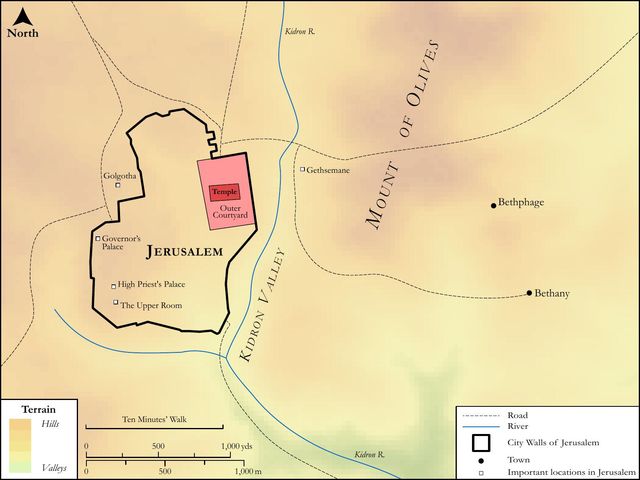
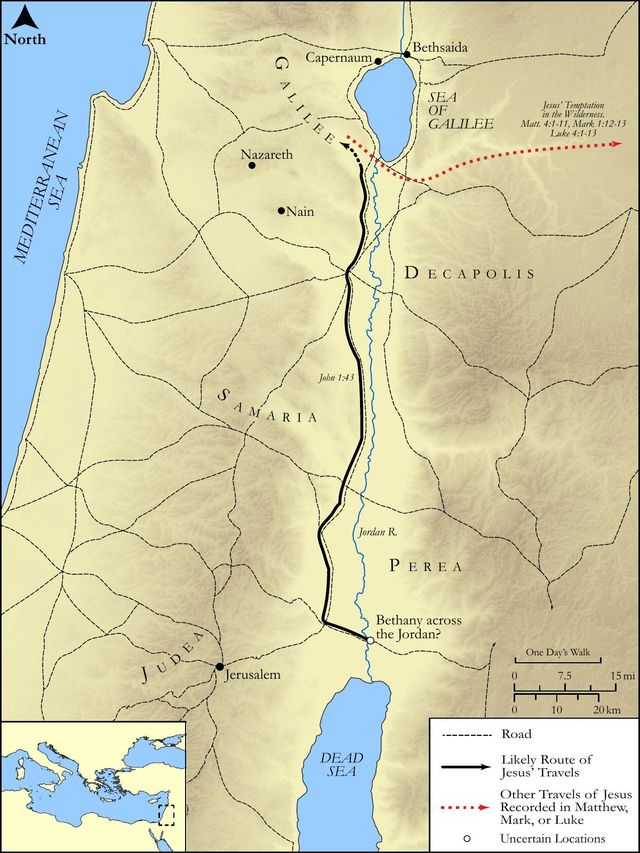
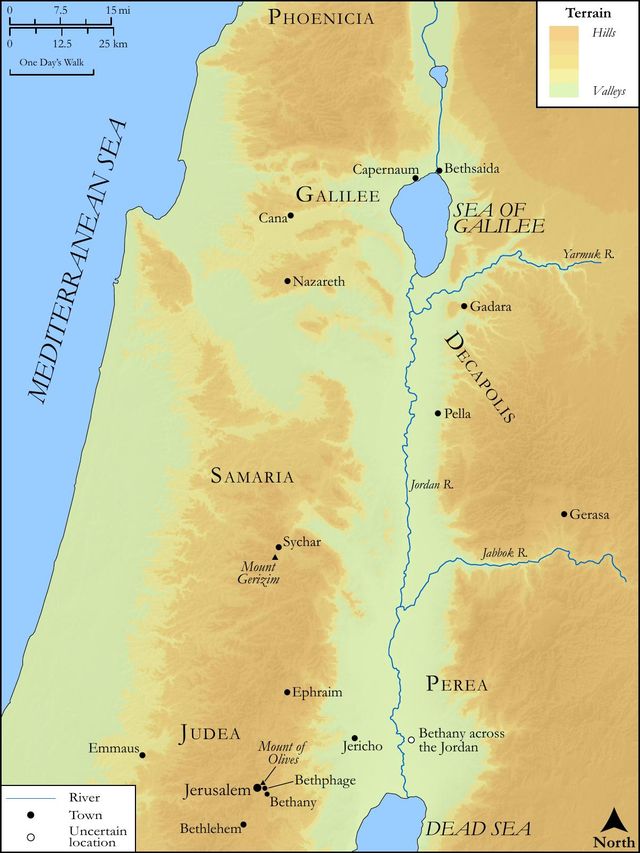
Study this verse
Public-domain commentary
Matthew Henry
From his Commentary on the Whole Bible. Henry comments on passages, not single verses — this entry covers John 1:15–18. His four-level outline is real structure in the source text, so it is rendered as structure.
In these verses,
I.The evangelist begins again to give us John Baptist's testimony concerning Christ, Joh 1:15.
He had said (Joh 1:8) that he came for a witness; now here he tells us that he did accordingly bear witness. Here, Observe,
1.How he expressed his testimony: He cried, according to the prediction that he should be the voice of one crying. The Old Testament prophets cried aloud, to show people their sins; this New Testament prophet cried aloud, to show people their Saviour. This intimates,
(1.)That it was an open public testimony, proclaimed, that all manner of persons might take notice of it, for all are concerned in it. False teachers entice secretly, but wisdom publishes her dictates in the chief places of concourse.
(2.)That he was free and hearty in bearing this testimony. He cried as one that was both well assured of the truth to which he witnessed and well affected to it. He that had leaped in his mother's womb for joy of Christ's approach, when newly conceived, does now with a like exultation of spirit welcome his public appearance.
2.What his testimony was. He appeals to what he had said at the beginning of his ministry, when he had directed them to expect one that should come after him, whose forerunner he was, and never intended any other than to lead them to him, and to prepare his way. This he had given them notice of from the first. Note, It is very comfortable to a minister to have the testimony of his conscience for him that he set out in his ministry with honest principles and sincere intentions, with a single eye to the glory and honour of Christ. Now what he had then said he applies to this Jesus whom he had lately baptized, and who was so remarkably owned from heaven: This was he of whom I spoke. John did not tell them that there would shortly appear such a one among them, and then leave them to find him out; but in this he went beyond all the Old Testament prophets that he particularly specified the person: "This was he, the very man I told you of, and to him all I said is to be accommodated." Now what was it he said?
(1.)He had given the preference to this Jesus: He that comes after me, in the time of his birth and public appearance, is preferred before me; he that succeeds me in preaching and making disciples is a more excellent person, upon all accounts; as the prince or peer that comes after is preferred before the harbinger or gentleman-usher that makes way for him. Note, Jesus Christ, who was to be called the Son of the Highest (Luk 1:32), was preferred before John Baptist, who was to be called only the prophet of the Highest, Luk 1:76. John was a minister of the New Testament, but Christ was the Mediator of the New Testament. And observe, though John was a great man, and had a great name and interest, yet he was forward to give the preference to him to whom it belonged. Note, All the ministers of Christ must prefer him and his interest before themselves and their own interests; they will make an ill account that seek their own things, not the things of Christ, Phi 2:21. He comes after me, and yet is preferred before me. Note, God dispenses his gifts according to his good pleasure, and many times crosses hands, as Jacob did, preferring the younger before the elder. Paul far outstripped those that were in Christ before him.
(2.)He here gives a good reason for it: For he was before me, prōtos mou ēn - He was my first, or first to me; he was my first Cause, my original. The First is one of God's names, Isa 44:6. He is before me, is my first,
[1.]In respect of seniority: he was before me, for he was before Abraham, Joh 8:58. Nay, he was before all things, Col 1:17. I am but of yesterday, he from eternity. It was but in those days that John Baptist came (Mat 3:1), but the goings forth of our Lord Jesus were of old, from everlasting, Mic 5:2. This proves two natures in Christ. Christ, as man, came after John as to his public appearance; Christ, as God, was before him; and how could he otherwise be before him but by an eternal existence?
[2.]In respect of supremacy; for he was my prince; so some princes are called the first; prōton, "It is he for whose sake and service I am sent: he is my Master, I am his minister and messenger."
II.He presently returns again to speak of Jesus Christ, and cannot go on with John Baptist's testimony till Joh 1:19.
The Joh 1:16 has a manifest connection with Joh 1:14, where the incarnate Word was said to be full of grace and truth. Now here he makes this the matter, not only of our adoration, but of our thankfulness, because from that fulness of his we all have received. He received gifts for men (Psa 68:18), that he might give gifts to men, Eph 4:8. He was filled, that he might fill all in all (Eph 1:23), might fill our treasures, Pro 8:21. He has a fountain of fulness overflowing: We all have received. All we apostles; so some. We have received the favour of this apostleship, that is grace; and a fitness for it, that is truth. Or, rather, All we believers; as many as received him (Joh 1:16), received from him. Note, All true believers receive from Christ's fulness; the best and greatest saints cannot live without him, the meanest and weakest may live by him. This excludes proud boasting, that we have nothing but we have received it; and silences perplexing fears, that we want nothing but we may receive it. Let us see what it is that we have received.
1.We have received grace for grace. Our receivings by Christ are all summed up in this one word, grace; we have received kai charin - even grace, so great a gift, so rich, so invaluable; we have received no less than grace; this is a gift to be spoken of with an emphasis. It is repeated, grace for grace; for to every stone in this building, as well as to the top-stone, we must cry, Grace, grace. Observe,
(1.)The blessing received. It is grace; the good will of God towards us, and the good work of God in us. God's good will works the good work, and then the good work qualifies us for further tokens of his good will. As the cistern receives water from the fulness of the fountain, the branches sap from the fulness of the root, and the air light from the fulness of the sun, so we receive grace from the fulness of Christ.
(2.)The manner of its reception: Grace for grace - charin anti charitos. The phrase is singular, and interpreters put different senses upon it, each of which will be of use to illustrate the unsearchable riches of the grace of Christ. Grace for grace bespeaks,
[1.]The freeness of this grace. It is grace for grace' sake; so Grotius. We receive grace, not for our sakes (be it known to us), but even so, Father, because it seemed good in thy sight. It is a gift according to grace, Rom 12:6. It is grace to us for the sake of grace to Jesus Christ. God was well pleased in him, and is therefore well pleased with us in him, Eph 1:6.
[2.]The fulness of this grace. Grace for grace is abundance of grace, grace upon grace (so Camero), one grace heaped upon another; as skin for skin is skin after skin, even all that a man has, Job 2:4. It is a blessing poured out, that there shall not be room to receive it, plenteous redemption: one grace a pledge of more grace. Joseph - he will add. It is such a fulness as is called the fulness of God which we are filled with. We are not straitened in the grace of Christ, if we be not straitened in our own bosoms.
[3.]The serviceableness of this grace. Grace for grace is grace for the promoting and advancing of grace. Grace to be exercised by ourselves; gracious habits for gracious acts. Grace to be ministered to others; gracious vouchsafements for gracious performances: grace is a talent to be traded with. The apostles received grace (Rom 1:5; Eph 3:8), that they might communicate it, Pe1 4:10.
[4.]The substitution of New Testament grace in the room and stead of Old Testament grace: so Beza. And this sense is confirmed by what follows (Joh 1:17); for the Old Testament had grace in type, the New Testament has grace in truth. There was a grace under the Old Testament, the gospel was preached then (Gal 3:8); but that grace is superseded, and we have gospel grace instead of it, a glory which excelleth, Co2 3:10. Discoveries of grace are now more clear, distributions of grace far more plentiful; this is grace instead of grace.
[5.]It bespeaks the augmentation and continuance of grace. Grace for grace is one grace to improve, confirm, and perfect another grace. We are changed into the divine image, from glory to glory, from one degree of glorious grace to another, Co2 3:18. Those that have true grace have that for more grace, Jam 4:6. When God gives grace he saith, Take this in part; for he who hath promised will perform.
[6.]It bespeaks the agreeableness and conformity of grace in the saints to the grace that is in Jesus Christ; so Mr. Clark. Grace for grace is grace in us answering to grace in him, as the impression upon the wax answers the seal line for line. The grace we receive from Christ changes us into the same image (Co2 3:18), the image of the Son (Rom 8:29), the image of the heavenly, Co1 15:49.
2.We have received grace and truth, Joh 1:17. He had said (Joh 1:14) that Christ was full of grace and truth; now here he says that by him grace and truth came to us. From Christ we receive grace; this is a string he delights to harp upon, he cannot go off from it. Two things he further observes in this verse concerning this grace: - (1.) Its preference above the law of Moses: The law was given by Moses, and it was a glorious discovery, both of God's will concerning man and his good will to man; but the gospel of Christ is a much clearer discovery both of duty and happiness. That which was given by Moses was purely terrifying and threatening, and bound with penalties, a law which could not give life, which was given with abundance of terror (Heb 12:18); but that which is given by Jesus Christ is of another nature; it has all the beneficial uses of the law, but not the terror, for it is grace: grace teaching (Tit 2:11), grace reigning, Rom 5:21. It is a law, but a remedial law. The endearments of love are the genius of the gospel, not the affrightments of law and the curse. (2.) Its connection with truth: grace and truth. In the gospel we have the discovery of the greatest truths to be embraced by the understanding, as well as of the richest grace to be embraced by the will and affections. It is a faithful saying, and worthy of all acceptation; that is, it is grace and truth. The offers of grace are sincere, and what we may venture our souls upon; they are made in earnest, for it is grace and truth. It is grace and truth with reference to the law that was given by Moses. For it is, [1.] The performance of all the Old Testament promises. In the Old Testament we often find mercy and truth put together, that is, mercy according to promise; so here grace and truth denote grace according to promise. See Luk 1:72; Kg1 8:56. [2.] It is the substance of all the Old Testament types and shadows. Something of grace there was both in the ordinances that were instituted for Israel and the providences that occurred concerning Israel; but they were only shadows of good things to come, even of the grace that is to be brought to us by the revelation of Jesus Christ. He is the true paschal lamb, the true scape-goat, the true manna. They had grace in the picture; we have grace in the person, that is, grace and truth. Grace and truth came, egeneto - was made; the same word that was used (Joh 1:3) concerning Christ's making all things. The law was only made known by Moses, but the being of this grace and truth, as well as the discovery of them, is owing to Jesus Christ; this was made by him, as the world at first was; and by him this grace and truth do consist.
3.Another thing we receive from Christ is a clear revelation of God to us (Joh 1:18): He hath declared God to us, whom no man hath seen at any time. This was the grace and truth which came by Christ, the knowledge of God and an acquaintance with him. Observe,
(1.)The insufficiency of all other discoveries: No man hath seen God at any time. This intimates,
[1.]That the nature of God being spiritual, he is invisible to bodily eyes, he is a being whom no man hath seen, nor can see, Ti1 6:16. We have therefore need to live by faith, by which we see him that is invisible, Heb 11:27.
[2.]That the revelation which God made of himself in the Old Testament was very short and imperfect, in comparison with that which he has made by Christ: No man hath seen God at any time; that is, what was seen and known of God before the incarnation of Christ was nothing to that which is now seen and known; life and immortality are now brought to a much clearer light than they were then.
[3.]That none of the Old Testament prophets were so well qualified to make known the mind and will of God to the children of men as our Lord Jesus was, for none of them had seen God at any time. Moses beheld the similitude of the Lord (Num 12:8), but was told that he could not see his face, Exo 33:20. But this recommends Christ's holy religion to us that it was founded by one that had seen God, and knew more of his mind than any one else ever did.
(2.)The all-sufficiency of the gospel discovery proved from its author: The only-begotten Son, who is in the bosom of the Father, he has declared him. Observe here,
[1.]How fit he was to make this discovery, and every way qualified for it. He and he alone was worthy to take the book, and to open the seals, Rev 5:9. For, First, He is the only-begotten Son; and who so likely to know the Father as the Son? or in whom is the Father better known than in the Son? Mat 11:27. He is of the same nature with the Father, so that he who hath seen him hath seen the Father, Joh 14:9. The servant is not supposed to know so well what his Lord does as the Son, Joh 15:15. Moses was faithful as a servant, but Christ as a Son. Secondly, He is in the bosom of the Father. He had lain in his bosom from eternity. When he was here upon earth, yet still, as God, he was in the bosom of the Father, and thither he returned when he ascended. In the bosom of the Father; that is, 1. In the bosom of his special love, dear to him, in whom he was well pleased, always his delight. All God's saints are in his hand, but his Son was in his bosom, one in nature and essence, and therefore in the highest degree one in love. 2. In the bosom of his secret counsels. As there was a mutual complacency, so there was a mutual consciousness, between the Father and Son (Mat 11:27); none so fit as he to make known God, for none knew his mind as he did. Our most secret counsels we are said to hide in our bosom (in pectore); Christ was privy to the bosom-counsels of the Father. The prophets sat down at his feet as scholars; Christ lay in his bosom as a friend. See Eph 3:11.
[2.]How free he was in making this discovery: He hath declared. Him is not in the original. He has declared that of God which no man had at any time seen or known; not only that which was hid of God, but that which was hid in God (Eph 3:9), exēgēsato - it signifies a plain, clear, and full discovery, not by general and doubtful hints, but by particular explications. He that runs may now read the will of God and the way of salvation. This is the grace, this the truth, that came by Jesus Christ.
Historical interpretation
Nine Centuries of Reception
16 surviving comments on this verse. Each one is dated, so this reads as a timeline rather than a list.
Select a marker to jump to its quote. Markers stagger vertically where authors wrote within a few decades of each other.
Now the law is ancient grace given through Moses by the Word. Wherefore also the Scripture says, "The law was given through Moses".
Next is to be learned the greatness of the Saviour after Him, and the newness of grace; for, according to the apostle, "the law was given by Moses, grace and truth came by Jesus Christ; "
So faith, illumined by patience, when it was becoming propagated among the nations through" Abraham's seed, which is Christ," and was superinducing grace over the law, made patience her pre-eminent coadjutrix for amplifying and fulfilling the law, because that alone had been lacking unto the doctrine of righteousness.
For he, too, says that the world was originated by those angels; and sets forth Christ as born of the seed of Joseph, contending that He was merely human, without divinity; affirming also that the Law was given by angels; representing the God of the Jews as not the Lord, but an angel.
Whence we understand that God's law was anterior even to Moses, and was not first (given) in Horeb, nor in Sinai and in the desert, but was more ancient; (existing) first in paradise, subsequently reformed for the patriarchs, and so again for the Jews, at definite periods: so that we are not to give heed to Moses' Law as to the primitive law, but as to a subsequent, which at a definite period God has set forth to the Gentiles too and, after repeatedly promising so to do through the prophets, has reformed for the better; and has premonished that it should come to pass that, just as "the law was given through Moses" at a definite time, so it should be believed to have been temporarily observed and kept.
(in Joan. t. vi. 3.) This is to be considered a continuation of the Baptist's testimony to Christ, a point which has escaped the attention of many, who think that from this to, He hath declared Him, (v. 18) St. John the Apostle is speaking. But the idea that on a sudden, and, as it would seem, unseasonably, the discourse of the Baptist should be interrupted by a speech of the disciple's, is inadmissible. And any one, able to follow the passage, will discern a very obvious connection here. For having said, He is preferred before me, for He was before me, he proceeds, From this I know that He is before me, because I and the Prophets who preceded me have received of His fulness, and grace for grace, (the second grace for the first.) For they too by the Spirit penetrated beyond the figure to the contemplation of the truth. And hence receiving, as we have done, of his fulness, we judge that the law was given by Moses, but that grace and truth were made, by Jesus Christ—made, not given: the Father gave the law by Moses, but made grace and truth by Jesus. But if it is Jesus who says below, I am the Truth, (John 14:6) how is truth made by Jesus? We must understand however that the very substantial Truth, from which First Truth and Its Image many truths are engraven on those who treat of the truth, was not made through Jesus Christ, or through any one; but only the truth which is in individuals, such as in Paul, e. g. or the other Apostles, was made through Jesus Christ.
I pardon willingly, [says the Lord,] I quickly forgive: “I will have mercy rather than sacrifice,” because by sacrifice the just is rendered more acceptable, by mercy the sinner is redeemed. “I come not to call the righteous but sinners.” Sacrifice was under the law; in the gospel is mercy. “The law was given by Moses, grace by me.”
"The law was given by Moses, but grace and truth came by Jesus Christ." See ye how gently, by a single word and by little and little, both John the Baptist and John the Disciple lead up their hearers to the highest knowledge, having first exercised them in humbler things? The former having compared to himself Him who is incomparably superior to all, thus afterwards shows His superiority, by saying, "is become before me," and then adding the words, "was before me": while the latter has done much more than he, though too little for the worthiness of the Only-Begotten, for he makes the comparison, not with John, but with one reverenced by the Jews more than John, with Moses. "For the law," saith he, "was given by Moses, but grace and truth came by Jesus Christ."
And see how he makes the comparison easy even to the weaker sort; for he does not prove the superiority by argument, but points out the difference by the bare words, opposing "grace and truth" to "law," and "came" to "was given." Between each of these there is a great difference; for one, "was given," belongs to something ministered, when one has received from another, and given to whom he was commanded to give; but the other, "grace and truth came," befits a king forgiving all offenses, with authority, and himself furnishing the gift. Wherefore He said, "Thy sins be forgiven thee"; and again, "But that ye may know that the Son of Man hath power on earth to forgive sins (He saith to the sick of the palsy), Arise, take up thy bed, and go unto thine house."
(Hom. xiii. [xii.] 3) If the words, made before me, referred to His coming into being, it was superfluous to add, For He was before me. For who would be so foolish as not to know, that if He was made before him, He was before him. It would have been more correct to say, He was before me, because He was made before me. The expression then, He was made before me, must be taken in the sense of honour: only that which was to take place, he speaks of as having taken place already, after the style of the old Prophets, who commonly talk of the future as the past.
(in Joan. Hom. xiv. [xiii.] 1) Or thus; John the Evangelist here adds his testimony to that of John the Baptist, saying, And of his fulness have we all received. These are not the words of the forerunner, but of the disciple; as if he meant to say, We also the twelve, and the whole body of the faithful, both present and to come, have received of His fulness.
(Hom. xiv. [xiii.] sparsim.) Or we have received grace for grace; that is, the new in the place of the old. For as there is a justice and a justice besides, an adoption and another adoption, a circumcision and another circumcision; so is there a grace and another grace: only the one being a type, the other a reality. He brings in the words to show that the Jews as well as ourselves are saved by grace: it being of mercy and grace that they received the law. Next, after he has said, Grace for grace, he adds something to show the magnitude of the gift; For the law was given by Moses, but grace and truth were made by Jesus Christ. John when comparing himself with Christ above had said, He is preferred before me: but the Evangelist draws a comparison between Christ, and one much more in admiration with the Jews than John, viz. Moses. And observe his wisdom. He does not draw the comparison between the persons, but the things, contrasting grace and truth to the law: the latter of which he says was given, a word only applying to an administrator; the former made, as we should speak of a king, who does every thing by his power: though in this King it would be with grace also, because that with power He remitted all sins. Now His grace is shown in His gift of Baptism, and our adoption by the Holy Spirit, and many other things; but to have a better insight into what the truth is, we should study the figures of the old law: for what was to be accomplished in the New Testament, is prefigured in the Old, Christ at His Coming filling up the figure. Thus was the figure given by Moses, but the truth made by Christ.
For [in place of] the grace of the law, which has passed away, we have received the abiding grace of the gospel, and, instead of the shadows and figures of the ancient covenant, truth has come by Jesus Christ.
(in Joan. Tr. iii. c. 8. et seq.) There was not grace in the Old Testament; for the law threatened, but assisted not, commanded, but healed not, showed our weakness, but relieved it not. It prepared the way however for a Physician who was about to come, with the gifts of grace and truth: whence the sentence which follows: For the law was given by Moses, but grace and truth were made by Jesus Christ. The death of thy Lord hath destroyed death, both temporal and eternal; that is the grace which was promised, but not contained, in the law.
(de Trin. xiii. c. 24. [xix.]) Or, we may refer grace to knowledge, truth to wisdom. Amongst the events of time the highest grace is the uniting of man to God in One Person; in the eternal world the highest truth pertains to God the Word.
"The law was given by Moses: grace and truth came by Jesus Christ." By a servant was the law given, and made men guilty: by an Emperor was pardon given, and delivered the guilty. "The law was given by Moses." Let not the servant attribute to himself more than was done through him. Chosen to a great ministry as one faithful in his house, but yet a servant, he is able to act according to the law, but cannot release from the guilt of the law. "The law," then, "was given by Moses: grace and truth came by Jesus Christ."
"For the law was given by Moses"; which law held the guilty. For what saith the apostle? "The law entered that the offense might abound." It was a benefit to the proud that the offense abounded, for they gave much to themselves, and, as it were, attributed much to their own strength; and they were unable to fulfill righteousness without the aid of Him who had commanded it. God, desirous to subdue their pride, gave the law, as if saying: Behold, fulfill, and do not think that there is One wanting to command. One to command is not wanting, but one to fulfill.
This grace was not in the Old Testament, because the law threatened, did not bring aid; commanded, did not heal; made manifest, but did not take away our feebleness: but it prepared the way for that Physician who was to come with grace and truth; as a physician who, about to come to any one to cure him, might first send his servant that he might find the sick man bound. He was not sound; he did not wish to be made sound and lest he should be made sound, he boasted that he was so. The law was sent, it bound him; he finds himself accused, now, he exclaims against the bandage. The Lord comes, cures with somewhat bitter and sharp medicines: for He says to the sick, Bear; He says, Endure; He says, Love not the world, have patience, let the fire of continence cure thee, let thy wounds endure the sword of persecutions. Wert thou greatly terrified although bound? He, free and unbound, drank what He gave to thee; He first suffered that He might console thee, saying, as it were, that which thou fearest to suffer for thyself, I first suffer for thee. This is grace, and great grace. Who can praise it in a worthy manner?
What then is the distinction between the law and the grace that comes through the Savior?… The law condemned the world (for God through [the law] “concluded all under sin,” as Paul says) and showed us subject to punishment. But the Savior rather sets the world free, for he came “not to judge the world but to save the world.” And the law too used to give grace to people, calling them to the knowledge of God and drawing away from the worship of idols those who had been led astray. It also pointed out evil and taught good, if not perfectly, yet in the manner of a teacher and usefully. But the truth and grace that are through the Only Begotten do not introduce to us the good that is in types or to limited things that are only profitable as in shadow. Rather, in glorious and most pure ordinances, it leads us by the hand to an ever more perfect knowledge of the faith. And the law used to give the “spirit of bondage to fear,” but Christ gives the spirit of adoption to liberty. The law likewise brings in the circumcision in the flesh, which is nothing (for “circumcision is nothing”22). But our Lord Jesus Christ is the giver of circumcision “in the spirit and heart.” The law baptizes the defiled with mere water; the Savior baptizes “with the Holy Spirit and with fire.” The law brings in the tabernacle for a “figure of the true”; the Savior bears up to heaven itself and brings to the truer “tabernacle, which the Lord set up and not man [humankind].” There are plenty of other proofs besides, but we must respect our limits.But we will say this for profit and need. The blessed Paul in few words solved the question, saying of the law and of the Savior’s grace, “For if there was splendor in the dispensation of condemnation, the dispensation of righteousness must far exceed it in splendor.” For he says that the commandment by Moses is “the ministration of condemnation,” but the grace through the Savior he calls “the ministration of righteousness,” which he says surpasses in glory. And so he most perfectly examines the nature of things like a child with the Spirit. Since then the law, which condemns, “was given by Moses,” the grace that justifies came by the Only Begotten. If this is true, he says, how can it be otherwise than that [Jesus] is superior in glory through whom the better things were ordained?
The Evangelist explains to us how we have received the greatest grace in place of a small grace, saying that the law was given byMoses, God using a human mediator. But the New Testament came byJesus Christ, which he calls both grace and truth: grace, because God graciously bestowed on us not only forgiveness of sins but adoption as sons; truth, because everything which the men of old saw and spoke only in type, the New Testament proclaimed in radiant clarity. Therefore, the New Testament, which is called grace and truth, had no mere man as mediator, but the Son of God. See how he said of the Old Testament that it was given by Moses, for Moses was a minister and servant. But of the New Testament he said, not that it "was given," but that it came, showing that by our Lord Jesus Christ as Master, not servant, it came into being, revealing grace and truth. The law was given through the mediation of Moses, but grace came, and was not given, through Jesus Christ. The word came [egeneto] is a mark of the master’s authority; was given [edoth] is a mark of a servant.
Continue studying John 1:17 across the web’s major study libraries — every link below opens this exact verse, chapter, or book on the destination site.
Read & Compare
 BibleGatewayThis verse in more than 200 translations and 70 languages.
 Bible.comThe YouVersion reader — hundreds of translations, reading plans, and highlights.
 ESV.orgCrossway's official English Standard Version reader.
 NET BibleThe NET translation with 60,000+ translators' notes on every rendering decision.
 STEP BibleTyndale House's free study tool — original text, vocabulary, and scholarly resources.
 BibliaLogos Bible Software's free web reader.
 USCCBThe New American Bible (Revised Edition) with the U.S. bishops' study notes.
Commentaries
 BibleHub CommentariesDozens of classic commentaries on this verse, gathered on one page.
 StudyLightMore than 100 commentary sets — the largest collection on the web.
 BibleRefPlain-English commentary on what this verse means, verse by verse.
 Enduring WordDavid Guzik's free commentary on this chapter, widely used by Bible teachers.
 Bible Study ToolsVerse commentary alongside Greek and Hebrew study aids.
Original Language & Research
- BibleHub InterlinearThe verse word by word — original language, transliteration, and English.
- BibleHub LexiconEvery word's original-language definition and Strong's entry.
 Blue Letter BibleDeep-study tools — Strong's numbers, concordance, and word studies.
 CNTR CollationThe earliest Greek manuscripts of this verse, collated letter by letter.
Sermons, Hymns & Audio


TrulyRandomVerse is not affiliated with these sites and doesn’t control their content. They’re linked because they’re genuinely useful.
Summary
John 1:17 stands as a profound theological statement within the Gospel's prologue, articulating a foundational distinction between the Old Covenant, characterized by the Law delivered through Moses, and the New Covenant, defined by the advent of grace and truth embodied in Jesus Christ. This verse succinctly encapsulates the progression of God's redemptive revelation, moving from a system of divine commands to a relationship founded on unmerited favor and ultimate reality revealed in the person of the Son.
Context
ShowHideLiterary Context
John 1:17 is strategically positioned within the prologue of John's Gospel (John 1:1-18), which introduces Jesus as the eternal Word (Logos), who was with God and was God (John 1:1). The preceding verses establish the Word's role in creation (John 1:3), His identity as the light of humanity (John 1:4-5), and His incarnation as "flesh" who "dwelt among us" (John 1:14). Verse 16 speaks of receiving "grace upon grace" from His fullness, setting the stage for the direct comparison in verse 17 between the Mosaic Law and the grace and truth brought by Christ. This verse serves as the climax of the prologue's argument, presenting Jesus not merely as a prophet or a new lawgiver, but as the ultimate and superior revelation of God.
Historical & Cultural Context
The Jewish audience to whom John's Gospel was initially addressed held Moses in the highest esteem as the preeminent prophet and mediator of God's covenant with Israel. The Law, given at Mount Sinai (Exodus 19-20), was the bedrock of their national identity, religious practice, and understanding of righteousness. It was the divine standard by which life was to be lived. Therefore, any statement contrasting Moses with another figure would have been highly significant and potentially controversial. John's declaration in John 1:17 directly addresses this deeply ingrained reverence for the Law and Moses, asserting that while the Law was a divine gift, it was surpassed by the direct, personal revelation of God's grace and truth in Jesus. This context underscores the revolutionary nature of the Gospel's message for those steeped in Old Covenant traditions.
Key Themes
ShowHideThis verse contributes significantly to several key themes in John's Gospel and broader biblical theology. It highlights the theme of Divine Revelation, emphasizing that while God revealed Himself through the Law given to Moses, His fullest and most perfect self-disclosure came through Jesus Christ. It also underscores the Progression of Salvation History, illustrating a shift from a covenant based on legal precepts to one founded on God's unmerited favor. The contrast between Law and Grace is central, showing that the Law, though holy and good (Romans 7:12), exposed sin and could not provide salvation, whereas grace offers forgiveness and new life. Furthermore, the theme of Truth is paramount; in John's Gospel, truth is not merely factual accuracy but ultimate reality, the very nature of God, embodied in Jesus Christ Himself, who declares, "I am the way, the truth, and the life". Finally, it speaks to Jesus's Unique Superiority, establishing Him as greater than Moses and the ultimate fulfillment of all God's promises.
Exposition and Analysis
ShowHideKey Word Analysis
ShowHideThis verb, Strong's G1325, means "to give" in a very wide application, encompassing the idea of bestowing, delivering, or granting. In the context of the Law, it signifies that the Law was a divine gift, a specific bestowal from God to humanity through Moses. It implies an act of divine initiative and provision, establishing a covenant framework.
Derived from a word meaning "to rejoice," denotes graciousness, favor, or kindness. It refers specifically to the divine influence upon the heart and its reflection in life, including gratitude. In John 1:17, "grace" signifies God's unmerited favor and benevolent disposition, freely given without expectation of return, standing in contrast to the conditional nature of the Law.
A versatile verb, means "to become," "come into being," or "to happen." Here, it indicates the active arrival or manifestation of grace and truth through Jesus Christ. It suggests a new reality, a new state of being that was brought forth or inaugurated by Christ's presence and work, rather than merely being delivered or transmitted.
Verse Breakdown
ShowHide"For the law was given by Moses"
This clause acknowledges the historical and theological reality of the Mosaic Law as a divinely ordained institution. The Law was a gift from God, mediated through Moses, serving as a foundational revelation of God's character, His righteous standards, and His covenant with Israel. It established a framework for understanding sin and righteousness, and it prepared the way for the coming of Christ. The use of "given" emphasizes its origin as a divine bestowal, not a human invention.
"but grace and truth came by Jesus Christ"
This contrasting clause introduces the superior and ultimate revelation of God. "Grace" signifies God's unmerited favor, His benevolent disposition towards humanity, offering forgiveness and reconciliation freely. "Truth" in John's Gospel refers to ultimate reality, divine fidelity, and the true nature of God revealed perfectly and fully in Jesus. The verb "came" (or "came into being") highlights the active, personal embodiment and inauguration of this new reality in Jesus Christ. Unlike the Law, which was mediated by Moses, grace and truth are not merely transmitted through Jesus but are intrinsically in Him and from Him, as He is the very source and embodiment of both. This signifies a new, personal, and relational covenant.
Literary Devices
ShowHideJohn 1:17 employs several potent literary devices. The most prominent is Antithesis, or Contrast, where two opposing ideas—"the law" and "grace and truth"—are placed in juxtaposition to highlight their differences and the superiority of the latter. This creates a clear theological distinction between the Old Covenant and the New. The phrase also utilizes Metonymy, where "Moses" stands in for the entire Mosaic Law and the Old Covenant system, while "Jesus Christ" represents the New Covenant and the full revelation of God's redemptive plan. Furthermore, there is a subtle use of Climax in the prologue, with this verse serving as the theological high point, demonstrating that while the Law was a necessary stage, it culminated and was surpassed by the ultimate revelation in Christ. The concept of "truth" in John's Gospel also functions as Symbolism, representing not just factual accuracy but ultimate reality and divine fidelity, embodied perfectly in Jesus.
Theological and Thematic Connections
ShowHideJohn 1:17 is a cornerstone for understanding the relationship between the Old and New Covenants. It clarifies that the Law, though divine in origin and purpose, was a preparatory stage, revealing God's holiness and humanity's sinfulness, thereby pointing to the need for a Savior. Grace and truth, on the other hand, represent the fulfillment and ultimate expression of God's redemptive plan, made accessible through Jesus Christ. This verse does not negate the Law's value but rather establishes its temporary and preparatory nature in light of Christ's perfect and complete work. It underscores that salvation is not by human effort to keep the Law, but by God's free gift of grace received through faith in Jesus, who is the embodiment of divine truth and faithfulness. This transition from law to grace is a central theme throughout the New Testament, emphasizing God's initiative in salvation and the sufficiency of Christ's work.
Reflection and Application
ShowHideJohn 1:17 offers profound insights for our spiritual lives, reminding us that our relationship with God is fundamentally rooted in His unmerited favor, not our performance. It frees us from the burden of trying to earn God's approval through perfect adherence to rules, inviting us instead into a relationship of grace and truth. This means embracing the liberating truth that salvation is a gift, received by faith in Jesus Christ, who has perfectly fulfilled all righteousness on our behalf. Living under grace empowers us to love God and others not out of obligation or fear, but out of gratitude for His boundless love. It calls us to embody the truth of the Gospel in our daily lives, reflecting Christ's character and living authentically in His light. This verse encourages us to continually turn to Jesus as the source of all grace and truth, trusting in His finished work rather than our own efforts.
Questions for Reflection
ShowHideFAQ
ShowHideDoes John 1:17 mean the Law is bad or abolished?
ShowHideNo, John 1:17 does not mean the Law is bad or abolished. Instead, it highlights a progression and fulfillment. The Law, given by Moses, was holy, righteous, and good (Romans 7:12), serving to reveal God's character and expose humanity's sin (Romans 3:20). It acted as a "guardian" or "schoolmaster" to lead people to Christ (Galatians 3:24). Jesus Himself stated that He did not come to abolish the Law or the Prophets but to fulfill them (Matthew 5:17). The "grace and truth" that came through Jesus Christ represent the ultimate and superior revelation of God's nature and redemptive plan, bringing to fruition the purposes of the Law and establishing a new covenant relationship based on God's unmerited favor rather than human performance.
Christ-Centered Fulfillment
ShowHideJohn 1:17 powerfully articulates the Christ-centered fulfillment of God's redemptive plan. The Law, mediated by Moses, served as a foundational revelation of God's standards and His covenant with Israel, yet it ultimately exposed humanity's inability to perfectly obey and attain righteousness (Romans 3:20). It was a shadow of the good things to come (Hebrews 10:1), pointing forward to the perfect sacrifice and mediator. Jesus Christ, however, is the very embodiment of "grace and truth." He perfectly fulfilled the Law's righteous demands through His sinless life (Hebrews 4:15) and bore its curse on the cross (Galatians 3:13). Through His atoning death and resurrection, He inaugurated a new covenant, not based on human works or legalistic adherence, but on God's unmerited favor and faithfulness (Hebrews 8:6). In Him, God's ultimate reality and redemptive purpose are fully revealed and made accessible to all who believe, offering forgiveness, reconciliation, and eternal life as a free gift (Ephesians 2:8-9). Thus, Jesus is not merely a new lawgiver, but the very source and substance of the grace that saves and the truth that sets us free (John 8:32).