


Revelation 5:4
Bible text: King James Version (1769 Blayney text) · Public domain
Bible text: Berean Standard Bible · Public domain
Bible text: American Standard Version (1901) · Public domain
Bible text: World English Bible, Messianic edition · Public domain
Bible text: Geneva Bible (1599) · Public domain
Bible text: Young's Literal Translation · Public domain
- καὶkaiAndG2532CONJConjunction
- ἐγὼegōI myselfG1473P-1NSPersonal pronoun Nominative 1st Singular
- ἔκλαιονeklaionI was weepingG2799V-IAI-1SVerb Imperfect Active Indicative 1st Singular
- πολὺpolumuchG4183A-ASNAdjective Accusative Singular Neuter
- ὅτιhotibecauseG3754CONJConjunction
- οὐδεὶςoudeisno [one]G3762A-NSMAdjective Nominative Singular Masculine
- ἄξιοςaxiosworthyG514A-NSMAdjective Nominative Singular Masculine
- εὑρέθηheurethēwas foundG2147V-API-3SVerb Aorist Passive Indicative 3rd Singular
- ἀνοῖξαιanoixaito openG455V-AANVerb Aorist Active Infinitive
- καὶkaiandG2532CONJConjunction
- ἀναγνῶναιanagnōnaito readG314V-2AANVerb 2nd Aorist Active Infinitive
- τὸtotheG3588T-ASNDefinite article Accusative Singular Neuter
- βιβλίονbiblionscrollG975N-ASNNoun Accusative Singular Neuter
- οὔτεoutenorG3777CONJ-NConjunction Negative
- βλέπεινblepeinto seeG991V-PANVerb Present Active Infinitive
- αὐτόautoitG846P-ASNPersonal pronoun Accusative Singular Neuter
English is a literal word-by-word gloss of the Greek, not the KJV's wording. Why?
This is the original text the KJV's translators worked from — each Greek word with its own literal English meaning in this verse, prepared by scholars at Tyndale House, Cambridge. The KJV translates whole sentences, not word by word, so its wording differs: one Greek word can become several English words, and the KJV may choose “charity” where the gloss reads “love”. Both are faithful — they answer different questions. For the KJV's own rendering, switch to the KJV text.
Details
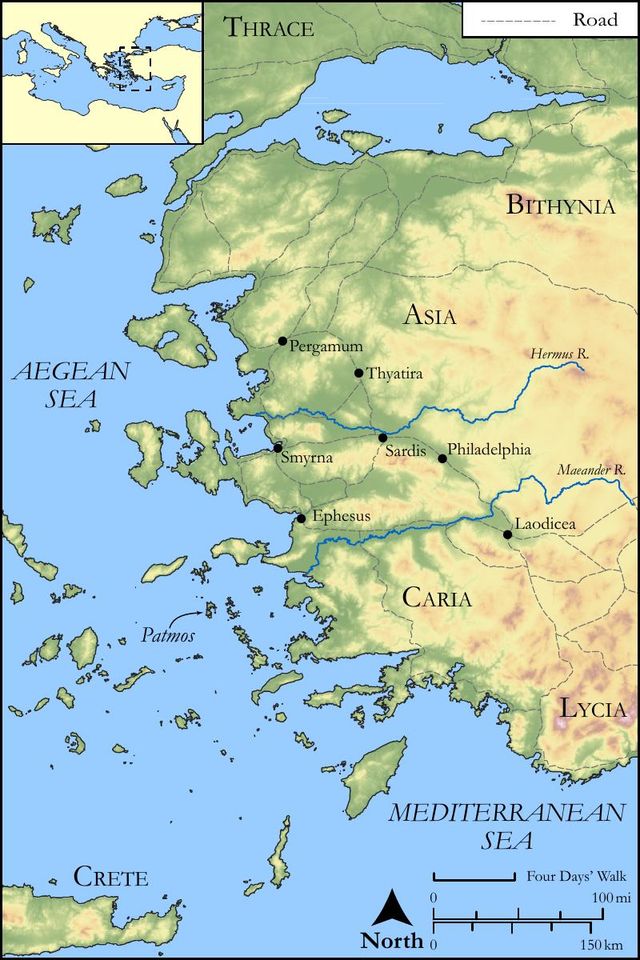
See on the biblical-era maps

Study this verse
Public-domain commentary
Matthew Henry
From his Commentary on the Whole Bible. Henry comments on passages, not single verses — this entry covers Revelation 5:1–5. His two-level outline is real structure in the source text, so it is rendered as structure.
Hitherto the apostle had seen only the great God, the governor of all things, now,
I.He is favoured with a sight of the model and methods of his government, as they are all written down in a book which he holds in his hand; and this we are now to consider as shut up and sealed in the hand of God. Observe,
1.The designs and methods of divine Providence towards the church and the world are stated and fixed; they are resolved upon and agreed to, as that which is written in a book. The great design is laid, every part adjusted, all determined, and every thing passed into decree and made a matter of record. The original and first draught of this book is the book of God's decrees, laid up in his own cabinet, in his eternal mind: but there is a transcript of so much as was necessary to be known in the book of the scriptures in general, in the prophetical part of the scripture especially, and in this prophecy in particular.
2.God holds this book in his right hand, to declare the authority of the book, and his readiness and resolution to execute all the contents thereof, all the counsels and purposes therein recorded.
3.This book in the hand of God is shut up and sealed; it is known to none but himself, till he allows it to be opened. Known unto God, and to him alone, are all his works, from the beginning of the world; but it is his glory to conceal the matter as he pleases. The times and seasons, and their great events, he hath kept in his own hand and power.
4.It is sealed with seven seals. This tells us with what inscrutable secrecy the counsels of God are laid, how impenetrable by the eye and intellect of the creature; and also points us to seven several parts of this book of God's counsels. Each part seems to have its particular seal, and, when opened, discovers its proper events; these seven parts are not unsealed and opened at once, but successively, one scene of Providence introducing another, and explaining it, till the whole mystery of God's counsel and conduct be finished in the world.
II.He heard a proclamation made concerning this sealed book.
1.The crier was a strong angel; not that there are any weak ones among the angels in heaven, though there are many among the angels of the churches. This angel seems to come out, not only as a crier, but as a champion, with a challenge to any or all the creatures to try the strength of their wisdom in opening the counsels of God; and, as a champion, he cried with a loud voice, that every creature might hear.
2.The cry or challenge proclaimed was, "Who is worthy to open the book, and to loose the seals thereof? Rev 5:2. If there by any creature who thinks himself sufficient either to explain or execute the counsels of God, let him stand forth, and make the attempt." 3. None in heaven or earth could accept the challenge and undertake the task: none in heaven, none of the glorious holy angels, though before the throne of God, and the ministers of his providence; they with all their wisdom cannot dive into the decrees of God: none on earth, no man, the wisest or the best of men, none of the magicians and soothsayers, none of the prophets of God, any further than he reveals his mind to them: none under the earth, none of the fallen angels, none of the spirits of men departed, though they should return to our world, can open this book. Satan himself, with all his subtlety, cannot do it; the creatures cannot open it, nor look on it; they cannot read it. God only can do it.
III.He felt a great concern in himself about this matter:
the apostle wept much; it was a great disappointment to him. By what he had seen in him who sat upon the throne, he was very desirous to see and know more of his mind and will: this desire, when not presently gratified, filled him with sorrow, and fetched many tears from his eyes. Here observe,
1.Those who have seen most of God in this world are most desirous to see more; and those who have seen his glory desire to know his will.
2.Good men may be too eager and to hasty to look into the mysteries of divine conduct.
3.Such desires, not presently answered, turn to grief and sorrow. Hope deferred makes the heart sick.
IV.The apostle was comforted and encouraged to hope this sealed book would yet be opened. Here observe,
1.Who it was that gave John the hint: One of the elders. God had revealed it to his church. If angels do not refuse to learn from the church, ministers should not disdain to do it. God can make his people to instruct and inform their teachers when he pleases.
2.Who it was that would do the thing - the Lord Jesus Christ, called the lion of the tribe of Judah, according to his human nature, alluding to Jacob's prophecy (Gen 49:10), and the root of David according to his divine nature, though a branch of David according to the flesh. He who is a middle person, God and man, and bears the office of Mediator between God and man, is fit and worthy to open and execute all the counsels of God towards men. And this he does in his mediatorial state and capacity, as the root of David and the offspring of Judah, and as the King and head of the Israel of God; and he will do it, to the consolation and joy of all his people.
Historical interpretation
Ten Centuries of Reception
10 surviving comments on this verse. Each one is dated, so this reads as a timeline rather than a list.
Select a marker to jump to its quote. Markers stagger vertically where authors wrote within a few decades of each other.
"There was none found worthy to do this." Neither among the angels of heaven, nor among men in earth, nor among the souls of the saints in rest, save Christ the Son of God alone, whom he says that he saw as a Lamb standing as it were slain, having seven horns. What had not been then announced, and what the law had contemplated for Him by its various oblations and sacrifices, it behoved Himself to fulfil. And because He Himself was the testator, who had overcome death, it was just that Himself should be appointed the Lord's heir, that He should possess the substance of the dying man, that is, the human members.
[Daniel 12:4] "But Thou, O Daniel, shut up the words and seal the book, even to the time appointed. Many shall pass over, and knowledge shall be manifold." He who had revealed manifold truth to Daniel now signifies that the things he has said are matters of secrecy, and he orders him to roll up the scroll containing his words and set a seal upon the book, with the result that many shall read it and inquire as to its fulfilment in history, differing in their opinions because of its great obscurity. And as for the statement, "Many shall pass over" or "go through," this indicates that it will be read by many people. For it is a familiar expression to say: "I have gone through a book," or, "I have passed through an historical account." Indeed this is the idea which Isaiah also expressed in regard to the obscurity of his own book: "And the sayings of that book shall be like the words of a book that is sealed. And if they shall give it to an illiterate man, saying, 'Read it,' he will reply, 'I do not know how to read.' But if they give it to a man who does know how to read and say, 'Read the book,' he will reply, 'I cannot read it, because it is sealed up'" (Isaiah 29:11-12). Also in the Revelation of John, there is a book seen which is sealed with seven seals inside and outside. And when no one proves able to break its seals, John says, "I wept sore; and a voice came to me, saying, 'Weep not: behold the Lion of the tribe of Judah, the Root of David, has prevailed to open the book and break its seals'" (Revelation 5:1-5). But that book can be opened by one who has learned the mysteries of Scripture and understands its hidden truths, and its words which seem dark because of the greatness of the secrets they contain. He it is who can interpret the parables and transmute the letter which killeth into the spirit which quickeneth.
It was the church that wept in John’s weeping, for she is weighed down with the burden of sins and beseeches her own redemption, which was shown to exist in the opening of this book.
Concious of his fraility and humanity this saint wept because he thought that there was no one worthy enough to understand or truly perceive these things.
wept. perhaps since the most spotless order of the angelic substances fell into ignorance.
And I wept much. Recognizing the common misery of the human race, he grieved.
And I wept much, because no man was found worthy to open the book, nor to see it. By no means is it believed that John, who wrote this after the opening of this book, wept in his own person, but in that of the Church of before Christ's coming, which, burdened with the weight of sins, was anxiously seeking the presence of its Mediator. It is also in the person of this Church that David says, My tears have been my bread day and night, whilst it is said to me daily: Where is thy God? [Ps. 41:4] A consolation is directed at it in what is said after that:
And the unworthiness of all became the cause of my lamentations.
All wept who were lost in ignorance, men and those from the orders of the most pure and angelic ranks.
In this weeping John indicates the desire to know the future course of the Church.
Continue studying Revelation 5:4 across the web’s major study libraries — every link below opens this exact verse, chapter, or book on the destination site.
Read & Compare
 BibleGatewayThis verse in more than 200 translations and 70 languages.
 Bible.comThe YouVersion reader — hundreds of translations, reading plans, and highlights.
 ESV.orgCrossway's official English Standard Version reader.
 NET BibleThe NET translation with 60,000+ translators' notes on every rendering decision.
 STEP BibleTyndale House's free study tool — original text, vocabulary, and scholarly resources.
 BibliaLogos Bible Software's free web reader.
 USCCBThe New American Bible (Revised Edition) with the U.S. bishops' study notes.
Commentaries
 BibleHub CommentariesDozens of classic commentaries on this verse, gathered on one page.
 StudyLightMore than 100 commentary sets — the largest collection on the web.
 BibleRefPlain-English commentary on what this verse means, verse by verse.
 Enduring WordDavid Guzik's free commentary on this chapter, widely used by Bible teachers.
 Bible Study ToolsVerse commentary alongside Greek and Hebrew study aids.
Original Language & Research
- BibleHub InterlinearThe verse word by word — original language, transliteration, and English.
- BibleHub LexiconEvery word's original-language definition and Strong's entry.
 Blue Letter BibleDeep-study tools — Strong's numbers, concordance, and word studies.
 CNTR CollationThe earliest Greek manuscripts of this verse, collated letter by letter.
Sermons, Hymns & Audio


TrulyRandomVerse is not affiliated with these sites and doesn’t control their content. They’re linked because they’re genuinely useful.
Summary
Revelation 5:4 vividly portrays the profound despair of John in his apocalyptic vision as he witnesses a crisis: no being in all of creation is found worthy to open, read, or even look upon the divinely significant scroll held by the One seated on the throne. This intense moment of weeping underscores the gravity of humanity's inability and the universal unworthiness of all created beings to unfold God's ultimate redemptive and judgmental purposes, setting the stage for the revelation of the uniquely qualified Redeemer.
Context
ShowHideLiterary Context
This verse immediately follows the majestic and awe-inspiring depiction of God's throne room in Revelation 4, where the holiness, power, and sovereignty of God are celebrated by twenty-four elders and four living creatures. The transition to Revelation 5 introduces a pivotal object: a scroll sealed with seven seals in the right hand of God (Revelation 5:1). A mighty angel then issues a challenge, asking "Who is worthy to open the book, and to loose the seals thereof?" (Revelation 5:2). The silence that follows this universal search, culminating in the declaration that "no man in heaven, nor in earth, neither under the earth, was able to open the book, neither to look thereon" (Revelation 5:3), directly precipitates John's deep sorrow and weeping in verse 4. This sequence builds dramatic tension, highlighting the immense significance of the scroll and the dire implications if its contents remain sealed.
Historical & Cultural Context
The imagery of a sealed scroll was familiar in that day, often representing legal documents, wills, or decrees that required specific authority to be opened and executed. Seven seals would indicate a document of utmost importance, whose contents were entirely confidential and whose authority was absolute. In Jewish apocalyptic literature, such scrolls often contained divine secrets, future events, or God's decrees concerning the end times. John, writing from exile on Patmos, likely to churches facing persecution in Asia Minor, would have understood this symbolism as representing God's sovereign plan for history, redemption, and judgment. The inability of anyone to open it would have resonated with the human experience of powerlessness and the desperate need for divine intervention in a world seemingly spiraling out of control under Roman imperial power. The scene taps into a deep spiritual yearning for God's ultimate justice and restoration.
Key Themes
ShowHideRevelation 5:4 powerfully contributes to several overarching themes within the book of Revelation and biblical theology. Firstly, it underscores the theme of Universal Unworthiness of all creation before God's ultimate plan. Neither angelic beings in heaven nor humans on earth, nor even spirits in the underworld, possess the inherent merit or authority to execute God's will as represented by the scroll. Secondly, John's intense weeping highlights the Profound Despair that would engulf creation if God's redemptive purposes remained sealed. This moment of crisis emphasizes the futility of human and created efforts to bring about ultimate salvation or justice. Finally, and most importantly, this verse serves as a crucial dramatic setup for the theme of the Singular Worthiness of Christ. The universal inability to open the scroll creates an urgent void, preparing the audience for the grand introduction of the only one who is truly qualified—the Lion of the tribe of Judah, the Root of David (Revelation 5:5) and the Lamb who was slain (Revelation 5:6). This sets the stage for the unfolding of God's sovereign plan through the unique agency of Jesus Christ.
Exposition and Analysis
ShowHideKey Word Analysis
ShowHideThis word signifies a deep, audible expression of grief, a wailing aloud rather than silent tears. John's "wept much" (G2799 + G4183 polýs) indicates an intense, profound emotional outpouring, reflecting not just personal sorrow but a deep anguish over the potential failure of God's redemptive plan to be unveiled. It conveys the gravity of the situation and the depth of John's concern for humanity's fate.
This verb means "to find," "get," or "obtain," implying a search or discovery. The passive voice, "was found," emphasizes that a thorough search was conducted throughout all realms—heaven, earth, and under the earth—and the result was negative. No one was discovered who met the necessary criteria, highlighting the absolute and universal lack of qualification among created beings.
This adjective means "deserving," "comparable," or "suitable," suggesting a necessary weight, value, or merit. In this context, it refers to a supreme moral and authoritative qualification, a status of being perfectly suited and entitled to undertake the monumental task of opening the scroll. The declaration that "no man was found worthy" underscores the unique and unparalleled nature of the worthiness required, which no created being possessed.
Verse Breakdown
ShowHide"And I wept much,"
John, the visionary, reacts with profound emotional distress. His weeping is not a casual tear but an intense, audible expression of sorrow and despair, reflecting the eternal significance of the moment. He understands the dire implications if the scroll, representing God's ultimate plan, cannot be opened.
"because no man was found worthy"
This clause reveals the reason for John's anguish. A universal search has been conducted, encompassing all of creation (heaven, earth, and under the earth, as implied by the preceding verses), and the definitive conclusion is that no created being possesses the necessary merit, authority, or moral qualification to interact with the scroll. This emphasizes the absolute unworthiness of humanity and angelic beings.
"to open and to read the book,"
The primary actions required are to "open" (break the seals) and "read" (understand and proclaim the contents) the scroll. The "book" (G975 biblíon) refers to the scroll, which contains God's sovereign purposes for history, judgment, and redemption. The inability to perform these actions means God's plan would remain sealed and unfulfilled.
"neither to look thereon."
This final phrase intensifies the gravity of the situation. Not only is no one worthy to execute the scroll's contents, but no one is even worthy to "look" upon it, implying a lack of purity, authority, or understanding sufficient even to gaze upon its divine mysteries. This underscores the sacredness of the scroll and the profound chasm between created beings and the divine qualification required.
Literary Devices
ShowHideRevelation 5:4 masterfully employs several literary devices to convey its profound message. The most prominent is Pathos, as John's intense weeping ("wept much") is designed to evoke deep emotion and empathy from the reader, mirroring the despair of all creation at the apparent impasse of God's plan. This emotional display underscores the gravity of the situation and the dire consequences if the scroll remains sealed. There is also significant Anticipation and Suspense built into the narrative. The universal search for a worthy one, followed by the declaration of universal unworthiness and John's weeping, creates a dramatic tension that powerfully sets the stage for the revelation of the one who is worthy in the subsequent verses. Finally, the "book" or "scroll" itself functions as powerful Symbolism, representing God's sovereign plan, decrees, and the unfolding of His redemptive and judgmental purposes for all of history. Its sealed nature symbolizes the mystery and inaccessibility of God's ultimate will to all but the uniquely qualified.
Theological and Thematic Connections
ShowHideRevelation 5:4 is a critical hinge point in the unfolding drama of Revelation, establishing a profound theological truth: the absolute inability of any created being to fully comprehend, execute, or bring about God's ultimate redemptive and judgmental purposes. This universal unworthiness of humanity and angels alike highlights the unique nature of the problem of sin and the chasm it creates between God and creation. It underscores that salvation and the consummation of God's kingdom cannot be achieved through human effort, angelic power, or any created merit. This moment of despair serves to magnify the unparalleled worthiness and indispensable role of Jesus Christ, who alone possesses the divine authority and sacrificial merit to bridge this gap and unveil God's plan. The scene emphasizes that true hope for creation rests solely on the singular qualification of the Lamb who was slain.
Reflection and Application
ShowHideJohn's profound weeping in Revelation 5:4 serves as a powerful reminder of the deep spiritual anguish that should accompany the realization of humanity's utter inability to save itself or to unlock God's ultimate plan. This verse confronts us with the sobering truth that our efforts, no matter how well-intentioned, are insufficient to bridge the chasm between a holy God and a fallen creation. If no one was found worthy, it means that left to ourselves, humanity would remain trapped in its fallen state, and God's glorious purposes would remain forever sealed. This should lead us to a profound sense of humility and a recognition of our absolute dependence on divine intervention. It magnifies the immeasurable grace of God in providing the one and only worthy Savior. Our hope is not in our own strength, wisdom, or righteousness, but entirely in the unique worthiness and accomplished work of Jesus Christ. This passage calls us to abandon self-reliance and place our complete trust in the Lamb who alone can open the scroll of destiny, bringing about redemption and the fulfillment of all God's promises.
Questions for Reflection
ShowHideFAQ
ShowHideWhy was no one found worthy to open the scroll?
ShowHideThe scroll in Revelation 5:1 symbolizes God's sovereign plan for history, redemption, and judgment, a plan that only a being of absolute purity, perfect righteousness, and supreme authority could execute. The search conducted throughout "heaven, nor in earth, neither under the earth" (Revelation 5:3) revealed that no created being—whether angel, human, or spirit—possessed the inherent merit or moral qualification to undertake such a monumental task. All created beings, by nature, fall short of God's perfect standard, and none had the unique authority or sacrificial work necessary to claim the right to unveil and enact God's ultimate purposes. This universal unworthiness underscores the profound chasm between God's perfect holiness and the fallenness of creation, setting the stage for the revelation of the one unique individual who is worthy.
Christ-Centered Fulfillment
ShowHideRevelation 5:4, with its depiction of universal unworthiness and John's profound despair, serves as the ultimate setup for the glorious revelation of Jesus Christ as the only one truly worthy. This moment of crisis is resolved not by any created being, but by the Lamb of God, who alone possesses the unique qualifications to open the scroll and execute God's plan. The elder's comforting words in Revelation 5:5 immediately introduce Jesus as "the Lion of the tribe of Judah, the Root of David," who "hath prevailed to open the book, and to loose the seven seals thereof." His worthiness is not inherent as a created being, but stems from His divine nature, His perfect life, and crucially, His sacrificial death and resurrection. He is the Lamb "as it had been slain", whose shed blood purchased people for God "out of every kindred, and tongue, and people, and nation" (Revelation 5:9). This unparalleled act of redemption, foreshadowed in passages like John 1:29, is the foundation of His authority. Because He "overcame" sin and death through His atoning work on the cross (Colossians 2:15), He alone is able to take the scroll from the hand of God (Revelation 5:7) and unfold the divine purposes. Thus, John's weeping transforms into worship, as all creation acknowledges Christ's singular worthiness and His central role in the unfolding of God's redemptive history, culminating in the establishment of His eternal kingdom (Philippians 2:9-11).