


Daniel 12:9
Bible text: King James Version (1769 Blayney text) · Public domain
Bible text: Berean Standard Bible · Public domain
Bible text: American Standard Version (1901) · Public domain
Bible text: World English Bible, Messianic edition · Public domain
Bible text: Geneva Bible (1599) · Public domain
Bible text: Young's Literal Translation · Public domain
- וַיֹּאמֶרvai·Yo·merand he saidH559Conj-w ¦ V-Qal-ConsecImperf-3msVerb Qal Consecutive Imperfect 3rd Singular Masculineוַandיֹּאמֶרhe said
- לֵךְlekhgoH1980V-Qal-Imp-2msVerb Qal Imperative 2nd Singular Masculine
- דָּנִיֵּאלda·ni·YelO DanielH1840N-proper-mNoun Proper Masculine
- כִּיkiforH3588PrtParticle Conditional
- סְתֻמִיםse·tu·Mim[are] kept secretH5640V-Qal-PassPrtcpl-mpVerb Qal Participle Passive Plural Masculine Absolute
- וַחֲתֻמִיםva·cha·tu·Mimand sealed upH2856Conj-w ¦ V-Qal-PassPrtcpl-mpVerb Qal Participle Passive Plural Masculine Absoluteוַandחֲתֻמִיםsealed up
- הַדְּבָרִיםha·de·va·Rimthe thingsH1697Art ¦ N-mpNoun Plural Masculine Absoluteהַtheדְּבָרִיםthings
- עַד'aduntilH5704PrepPreposition
- עֵת'et[the] time ofH6256N-cscNoun Singular common gender Construct
- קֵץKetz[the] endH7093N-msNoun Singular Masculine Absolute
English is a literal word-by-word gloss of the Hebrew, not the KJV's wording. Why?
This is the original text the KJV's translators worked from — each Hebrew word with its own literal English meaning in this verse, prepared by scholars at Tyndale House, Cambridge. The KJV translates whole sentences, not word by word, so its wording differs: one Hebrew word can become several English words, and the KJV may choose “the LORD” where the gloss reads “Yahweh”. Both are faithful — they answer different questions. For the KJV's own rendering, switch to the KJV text.
Details
See on the biblical-era map
Study this verse
Public-domain commentary
Matthew Henry
From his Commentary on the Whole Bible. Henry comments on passages, not single verses — this entry covers Daniel 12:5–13. His four-level outline is real structure in the source text, so it is rendered as structure.
Daniel had been made to foresee the amazing revolutions of states and kingdoms, as far as the Israel of God was concerned in them; in them he foresaw troublous times to the church, suffering trying times, the prospect of which much affected him and filled him with concern. Now there were two questions proper to be asked upon this head: - When shall the end be? And, What shall the end be? These two questions are asked and answered here, in the close of the book; and though the comforts prescribed in the foregoing verses, one would think, were satisfactory enough, yet, for more abundant satisfaction, this is added.
I.The question, When shall the end be? is asked by an angel, Dan 12:5, Dan 12:6. Concerning this we may observe,
1.Who it was that asked the question. Daniel had had a vision of Christ in his glory, the man clothed in linen, Dan 10:5. But his discourse had been with the angel Gabriel, and now he looks, and behold other two (Dan 12:5), two angels that he had not seen before, one upon the bank of the river on one side and the other on the other side, that, the river being between them, they might not whisper to one another, but what they said might be heard. Christ stood on the waters of the river, (Dan 12:6), between the banks of Ulai; it was therefore proper that the angels his attendants should stand on either bank, that they might be ready to go, one one way and the other the other way, as he should order them. These angels appeared,
(1.)To adorn the vision, and make it the more illustrious; and to add to the glory of the Son of man, Heb 1:6. Daniel had not seen them before, though it is probable that they were there; but now, when they began to speak, he looked up, and saw them. Note, The further we look into the things of God, and the more we converse with them, the more we shall see of those things, and still new discoveries will be made to us; those that know much, if they improve it, shall know more.
(2.)To confirm the discovery, that out of the mouth of two or three witnesses the word might be established. Three angels appeared to Abraham.
(3.)To inform themselves, to hear and ask questions; for the mysteries of God's kingdom are things which the angels desire to look into (Pe1 1:12) and they are known to the church, Eph 3:10. Now one of these two angels said, When shall the end be? Perhaps they both asked, first one and then the other, but Daniel heard only one.
2.To whom this question was put, to the man clothed in linen, of whom we read before (Dan 10:5), to Christ our great high priest, who was upon the waters of the river, and whose spokesman, or interpreter, the angel Gabriel had all this while been. This river was Hiddekel (Dan 10:4), the same with Tigris, the place whereabout many of the events prophesied of would happen; there therefore is the scene laid. Hiddekel was mentioned as one of the rivers that watered the garden of Eden (Gen 2:14); fitly therefore does Christ stand upon that river, for by him the trees in the paradise of God are watered. Waters signify people, and so his standing upon the waters denotes his dominion over all; he sits upon the flood (Psa 29:10); he treads upon the waters of the sea, Job 9:8. And Christ, to show that this was he, in the days of his flesh walked upon the waters, Mat 14:25. He was above the waters of the river (so some read it); he appeared in the air over the river.
3.What the question was: How long shall it be to the end of these wonders? Daniel would not ask the question, because he would not pry into what was hidden, nor seem inquisitive concerning the times and the seasons, which the Father has put in his own power, Act 1:7. But, that he might have the satisfaction of the answer, the angel put the question in his hearing. Our Lord Jesus sometimes answered the questions which his disciples were afraid or ashamed to ask, Joh 16:19. The angel asked as one concerned, How long shall it be? What is the time prefixed in the divine counsels for the end of these wonders, these suffering trying times, that are to pass over the people of God? Note,
(1.)The troubles of the church are the wonder of angels. They are astonished that God will suffer his church to be thus afflicted, and are anxious to know what good he will do his church by its afflictions.
(2.)Good angels know no more of things to come than God is pleased to discover to them, much less do evil angels.
(3.)The holy angels in heaven are concerned for the church on earth, and lay to heart its afflictions; how much more then should we, who are more immediately related to it, and have so much of our peace in its peace?
4.What answer was returned to it by him who is indeed the numberer of secrets, and knows things to come.
(1.)Here is a more general account given of the continuance of these troubles to the angel that made the enquiry (Dan 12:7), that they shall continue for a time, times, and a half, that is, a year, two years, and half a year, as was before intimated (Dan 7:25), but the one half of a prophetical week. Some understand it indefinitely, a certain time for an uncertain; it shall be for a time (a considerable time), for times (a longer time yet, double what it was thought at first that it would be), and yet indeed it shall be but half a time, or a part of a time; when it is over it shall seem not half so much as was feared. But it is rather to be taken for a certain time; we meet with it in the Revelation, under the title sometimes of three days and a half, put for three years and a half, sometimes forty-two months, sometimes 1260 days. Now this determination of the time is here [1.] Confirmed by an oath. The man clothed in linen lifted up both his hands to heaven, and swore by him that lives for ever and ever that it should be so. Thus the mighty angel whom St. John saw is brought in, with a plain reference to this vision, standing with his right foot on the sea and his left foot on the earth, and with his hand lifted up to heaven, swearing that there shall be no longer delay, Rev 10:5, Rev 10:6. This Mighty One that Daniel saw stood with both feet on the water, and swore with both hands lifted up. Note, An oath is of use for confirmation; God only is to be sworn by, for he is the proper Judge to whom we are to appeal; and lifting up the hand is a very proper and significant sign to be used in a solemn oath. [2.] It is illustrated with a reason. God will suffer him to prevail till he shall have accomplished to scatter the power of the holy people. God will suffer him to do his worst, and run his utmost length, and then all these things shall be finished. Note, God's time to succour and relieve his people is when their affairs are brought to the last extremity; in the mount of the Lord it shall be seen that Isaac is saved just when he lies ready to be sacrificed. Now the event answered the prediction; Josephus says expressly, in his book of the Wars of the Jews, that Antiochus, surnamed Epiphanes, surprised Jerusalem by force, and held it three years and six months, and was then cast out of the country by the Asmoneans or Maccabees. Christ's public ministry continued three years and a half, during which time he endured the contradiction of sinners against himself, and lived in poverty and disgrace; and then when his power seemed to be quite scattered at his death, and his enemies triumphed over him, he obtained the most glorious victory and said, It is finished.
(2.)Here is something added more particularly concerning the time of the continuance of those troubles, in what is said to Daniel, Dan 12:11, Dan 12:12, where we have,
[1.]The event fixed from which the time of the trouble is to be dated, from the taking away of the daily sacrifice by Antiochus, and the setting up of the image of Jupiter upon the altar, which was the abomination of desolation. They must reckon their troubles to begin indeed when they were deprived of the benefit of public ordinances; that was to them the beginning of sorrows; that was what they laid most to heart.
[2.]The continuance of their trouble; it shall last 1290 days, three years and seven months, or (as some reckon) three years, six months, and fifteen days; and then, it is probable, the daily sacrifice was restored, and the abomination of desolation taken away, in remembrance of which the feast of dedication was observed even to our Saviour's time, Joh 10:22. Though it does not appear by the history that it was exactly so long to a day, yet it appears that the beginning of the trouble was in the 145th year of the Seleucidae, and the end of it in the 148th year; and either the restoring of the sacrifice, and the taking away of the image, were just so many days after, or some other previous event that was remarkable, which is not recorded. There are many particular times fixed in the scripture-prophecies, which it does not appear by any history, sacred or profane, that the event answered, and yet no doubt it did punctually; as Isa 16:14.
[3.]The completing of their deliverance, or at least a further advance towards it, which is here set forty-five days after the former, and, some think, points at the death of Antiochus, 1335 days after his profaning the temple. Blessed is he that waits and comes to that time. It is said (1 Macc. 9:28; 10:1) that the Maccabees, under a divine conduct, recovered the temple and the city. Many good interpreters make these to be prophetical days (that is, so many years), and date them from the destruction of Jerusalem by the Romans; but what events they then fall upon they are not agreed. Others date them from the corruption of the gospel-worship by the antichrist, whose reign is confined in the Apocalypse to 1260 days (that is, years), at the end of which he shall begin to fall; but thirty years after he shall be quite fallen, at the end of 1290 days; and whoever lives forty years longer, to 1335 days, will see glorious times indeed. Whether it looks so far forward or no I cannot tell; but this, however, we may learn, First, That there is a time fixed for the termination of the church's troubles, and the bringing about of her deliverance, and that this time will be punctually observed to a day. Secondly, That this time must be waited for with faith and patience. Thirdly, That, when it comes, it will abundantly recompense us for our long expectations of it. Blessed is he who, having waited long, comes to it at last, for he will then have reason to say, Lo, this is our God, and we have waited for him.
II.The question, What shall the end be? is asked by Daniel, and an answer given to it. Observe,
1.Why Daniel asked this question; it was because, though he heard what was said to the angel, yet he did not understand it, Dan 12:8. Daniel was a very intelligent man, and had been conversant in visions and prophecies, and yet here he was puzzled; he did not understand the meaning of the time, times, and the part of a time, at least not so clearly and with so much certainty as he wished. Note, The best men are often much at a loss in their enquiries concerning divine things, and meet with that which they do not understand. But the better they are the more sensible they are of their own weaknesses and ignorance, and the more ready to acknowledge them.
2.What the question was: O my Lord! What shall be the end of these things? He directs his enquiry not to the angel that talked with him, but immediately to Christ, for to whom else should we go with our enquiries? "What shall be the final issue of these events? What do they tend to? What will then end in?" Note, When we take a view of the affairs of this world, and of the church of God in it, we cannot but think, What will be the end of these things? We see things move as if they would end in the utter ruin of God's kingdom among men. When we observe the prevalence of vice and impiety, the decay of religion, the sufferings of the righteous, and the triumphs of the ungodly over them, we may well ask, O my Lord! what will be the end of these things? But this may satisfy us in general, that all will end well at last. Great is the truth, and will prevail at long-run. All opposing rule, principality, and power, will be put down, and holiness and love will triumph, and be in honour, to eternity. The end, this end, will come.
3.What answer is returned to this question. Besides what refers to the time (Dan 12:11, Dan 12:12), of which before, here are some general instructions given to Daniel, with which he is dismissed from further attendance.
(1.)He must content himself with the discoveries that had been made to him, and not enquire any further: "Go thy way, Daniel; let it suffice thee that thou has been admitted thus far to the foresight of things to come, but stop here. Go thy way about the king's business again, Dan 8:27. Go thy way, and record what thou hast seen and heard, for the benefit of posterity, and covet not to see and hear more at present." Note, Communion with God is not our continual feast in this world; we sometimes are taken to be witnesses of Christ's glory, and we say, It is good to be here; but we must go down from the mount, and have there no continuing city. Those that know much know but in part, and still see there is a great deal that they are kept in the dark about, and are likely to be so till the veil is rent; hitherto their knowledge shall go, but no further. "Go thy way, Daniel, satisfied with what thou hast."
(2.)He must not expect that what had been said to him would be fully understood till it was accomplished: The words are closed up and sealed, are involved in perplexities, and are likely to be so, till the time of the end, till the end of these things; nay, till the end of all things. Daniel was ordered to seal the book to the time of the end, Dan 12:4. The Jews used to say, When Elias comes he will tell us all things. "They are closed up and sealed, that is, the discovery designed to be made by them is now fully settled and completed; nothing is to be added to it nor taken from it, for it is closed up and sealed; ask not therefore after more." Nescire velle quae magister maximus docere non vult erudita inscitia est - He has learned much who is willing to be ignorant of those things which the great teacher does not choose to impart.
(3.)He must count upon no other than that, as long as the world stands, there will still be in it such a mixture as now we see there is of good and bad, Dan 12:10. We long to see all wheat and no tares in God's field, all corn and no chaff in God's floor; but it will not be till the time of ingathering, till the winnowing day, comes; both must grow together until the harvest. As it has been, so it is, and will be, The wicked shall do wickedly, but the wise shall understand. In this, as in other things, St. John's Revelation closes as Daniel did. Rev 22:11, He that is filthy, let him be filthy still; and he that is holy, let him be holy still.
[1.]There is no remedy but that wicked people will do wickedly; and such people there are and will be in the world to the end of time. So said the proverb of the ancients, Wickedness proceeds from the wicked (Sa1 24:13); and the observation of the moderns says the same. Bad men will do bad things; and a corrupt tree will never bring forth good fruit. Do men gather grapes of thorns, or bring forth good things from an evil treasure in the heart? No; wicked practices are the natural products of wicked principles and dispositions. Marvel not at the matter then, Ecc 5:8. We are told, before, that the wicked will do wickedly; we can expect no better from them: but, which is worse, none of the wicked shall understand. This is either, First, A part of their sin. They will not understand; they shut their eyes against the light, and none so blind as those that will not see. Therefore they are wicked because they will not understand. If they did but rightly know the truths of God, they would readily obey the laws of God, Psa 82:5. Wilful sin is the effect of wilful ignorance; they will not understand because they are wicked; they hate the light, and come not to the light, because their deeds are evil, Joh 3:19. Or, Secondly, It is a part of their punishment; they will do wickedly, and therefore God has given them up to blindness of mind, and has said concerning them, They shall not understand, nor be converted and healed, Mat 13:14, Mat 13:15. God will not give them eyes to see, because they will do wickedly, Deu 29:4.
[2.]Yet, bad as the world is, God will secure to himself a remnant of good people in it; still there shall be some, there shall be many, to whom the providences and ordinances of God shall be a savour of life unto life, while to others they are a savour of death unto death. First, the providences of God shall do them good: Many shall be purified, and made white, and tried, by their troubles (compare Dan 11:35), by the same troubles which will but stir up the corruptions of the wicked and make them do more wickedly. Note, The afflictions of good people are designed for their trial; but by these trials they are purified and made white, their corruptions are purged out, their graces are brightened, and made both more vigorous and more conspicuous, and are found to praise, and honour, and glory, Pe1 1:7. To those who are themselves sanctified and good every event is sanctified, and works for good, and helps to make them better. Secondly, The word of God shall do them good. When the wicked understand not, but stumble at the word, the wise shall understand. Those who are wise in practice shall understand doctrine; those who are influenced and governed by the divine law and love shall be illuminated with a divine light. For if any man will do his will he shall know the truth, Joh 7:17. Give instruction to a wise man, and he will be yet wiser.
(4.)He must comfort himself with the pleasing prospect of his own happiness in death, in judgment, and to eternity, Dan 12:13. Daniel was now very old, and had been long engaged both in an intimate acquaintance with heaven and in a great deal of public business on this earth. And now he must think of bidding farewell to this present state: Go thou thy way till the end be. [1.] It is good for us all to think much of going away from this world; we are still going, and must be gone shortly, gone the way of all the earth. That must be our way; but this is our comfort, We shall not go till God calls for us to another world, and till he has done with us in this world, till he says, "Go thou thy way; thou hast finished thy testimony, done thy work, and accomplished as a hireling thy day, therefore now, Go thy way, and leave it to others to take thy room." [2.] When a good man goes his way from this world he enters into rest: "Thou shalt rest from all thy present toils and agitations, and shalt not see the evils that are coming on the next generation." Never can a child of God say more pertinently than in his dying moments, Return unto thy rest, O my soul! [3.] Time and days will have an end; not only our time and days will end very shortly, but all times and days will have an end at length; yet a little while, and time shall be no more, but all its revolutions will be numbered and finished. [4.] Our rest in the grave will be but till the end of the days; and then the peaceful rest will be happily disturbed by a joyful resurrection. Job foresaw this when he said of the dead, Till the heavens be no more, they shall not awake, nor be raised out of their sleep, implying that then they shall, Job 14:12. [5.] We must every one of us stand in our lot at the end of the days. In the judgment of the great day we must have our allotment according to what we were, and what we did, in the body, either, Come, you blessed or, Go, you cursed; and we must stand for ever in that lot. It was a comfort to Daniel, it is a comfort to all the saints, that, whatever their lot is in the days of time, they shall have a happy lot in the end of the days, shall have their lot among the chosen. And it ought to be the great care and concern of every one of us to secure a happy lot at last in the end of the days, and they we may well be content with our present lot, welcome the will of God. [6.] A believing hope and prospect of a blessed lot in the heavenly Canaan, at the end of the days, will be an effectual support to us when we are going our way out of this world, and will furnish us with living comforts in dying moments.
Historical interpretation
Two Centuries of Reception
3 surviving comments on this verse. Each one is dated, so this reads as a timeline rather than a list.
Select a marker to jump to its quote. Markers stagger vertically where authors wrote within a few decades of each other.
"The words are closed up and sealed." For as a man cannot tell what God has prepared for the saints; for neither has eye seen nor ear heard, nor has it entered into the heart of man (to conceive) these things, into which even the saints, too, shall then eagerly desire to look; so He said to him, "For the words are sealed until the time of the end; until many shall be chosen and tried with fire." And who are they who are chosen, but those who believe the word of truth, so as to be made white thereby, and to cast off the filth of sin, and put on the heavenly, pure, and glorious Holy Spirit, in order that, when the Bridegroom comes, they may go in straightway with Him?
Verses 8-10. "And I heard, and understood not. And I said, 'O my lord, what shall happen after these things?' And he said, 'Go, Daniel, for the words are shut up and sealed until the time of the end. Many shall be chosen and made white and shall be tried as fire; and the wicked shall deal wickedly. And none of the wicked shall understand, but the learned shall understand.'" The prophet wished to comprehend what he had seen, or rather, what he had heard, and he desired to understand the reality of the things to come. For he had heard of the various wars of kings, and of battles between them, and a detailed narrative of events; but he had not heard the names of the individual persons involved. And if the prophet himself heard and did not understand, what will be the case with those men who presumptuously expound a book which has been sealed, and that too unto the time of the end, a book which is shrouded with many obscurities? But he comments that when the end comes, the ungodly will lack comprehension, whereas those who are learned in the teaching of God will be able to understand. "For wisdom will not enter the perverted soul, nor can it impart itself to a body which is subject to sins."
Not in vain have I said these rather obscure matters and put obscurity on these words as if they were seals, for divine matters must not be imparted to all indiscriminately, but the wise will understand it through the knowledge imparted to them from above. Those who pass their life in folly and impiety will not be able to understand any of the things contained here. And whenever the matters come to pass, then they will clearly learn the prophecies concerning these things. The workers of iniquity will be separated from the just, for fire will test all things.
Continue studying Daniel 12:9 across the web’s major study libraries — every link below opens this exact verse, chapter, or book on the destination site.
Read & Compare
 BibleGatewayThis verse in more than 200 translations and 70 languages.
 Bible.comThe YouVersion reader — hundreds of translations, reading plans, and highlights.
 ESV.orgCrossway's official English Standard Version reader.
 NET BibleThe NET translation with 60,000+ translators' notes on every rendering decision.
 STEP BibleTyndale House's free study tool — original text, vocabulary, and scholarly resources.
 BibliaLogos Bible Software's free web reader.
 USCCBThe New American Bible (Revised Edition) with the U.S. bishops' study notes.
Commentaries
 BibleHub CommentariesDozens of classic commentaries on this verse, gathered on one page.
 StudyLightMore than 100 commentary sets — the largest collection on the web.
 BibleRefPlain-English commentary on what this verse means, verse by verse.
 Enduring WordDavid Guzik's free commentary on this chapter, widely used by Bible teachers.
 Bible Study ToolsVerse commentary alongside Greek and Hebrew study aids.
Original Language & Research
- BibleHub InterlinearThe verse word by word — original language, transliteration, and English.
- BibleHub LexiconEvery word's original-language definition and Strong's entry.
 Blue Letter BibleDeep-study tools — Strong's numbers, concordance, and word studies.
 SefariaThe Hebrew text with Rashi and centuries of Jewish commentary.
Sermons, Hymns & Audio


TrulyRandomVerse is not affiliated with these sites and doesn’t control their content. They’re linked because they’re genuinely useful.
Summary
Daniel 12:9 delivers a crucial final instruction and revelation to the prophet Daniel, emphasizing that the profound prophetic words he has received are intentionally "closed up and sealed" by divine decree. This sealing signifies that their full comprehension and precise fulfillment are not intended for Daniel's immediate time but are reserved for a specific, divinely appointed "time of the end," when God's sovereign plan will be fully unveiled. The verse thus calls Daniel, and by extension all believers, to faithful endurance and trust in God's perfect timing, even in the face of unrevealed mysteries.
Context
ShowHideLiterary Context
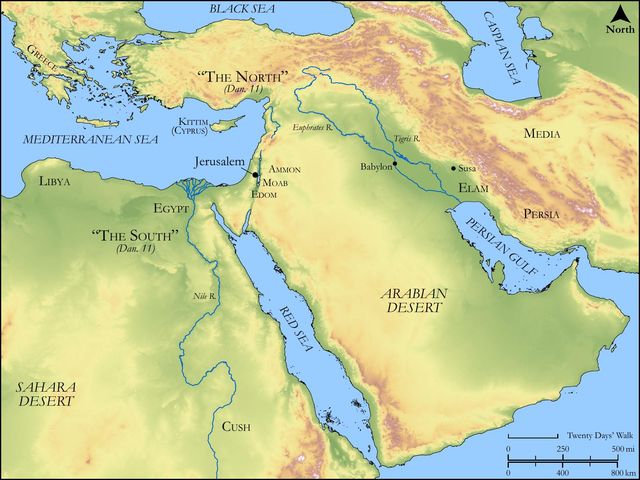
Daniel 12:9 concludes a lengthy and intensely apocalyptic vision that began in Daniel 10. Following a detailed prophecy concerning the "king of the North" and the "king of the South" (often interpreted as Ptolemaic Egypt and Seleucid Syria) in Daniel 11, the vision culminates in Daniel 12:1-3, which describes a time of unprecedented tribulation, the deliverance of God's people, and the resurrection of the dead. Overwhelmed by the magnitude and complexity of these revelations, Daniel interjects with a plea for understanding in Daniel 12:8, asking, "O my Lord, what shall be the end of these things?" The angelic messenger's response in verse 9 directly addresses this query, not by providing more details, but by reiterating the divine prerogative over the timing of revelation and instructing Daniel to simply "go thy way." This serves as a final, definitive word on the accessibility of the prophecy.
Historical & Cultural Context
Daniel lived during the Babylonian exile and the subsequent Persian period, a time of significant upheaval and uncertainty for the Jewish people. Apocalyptic literature, characterized by symbolic language, visions, and a focus on eschatological events, flourished in such periods, offering hope and understanding of God's sovereign plan amidst perceived chaos. The concept of "sealing" documents was common in Israel, signifying authenticity, preservation, and restricted access. A sealed document could be a legal will, a contract, or a royal decree, whose contents were to remain private or unfulfilled until a specific future date or event. This cultural practice provides a tangible metaphor for the divine act of withholding full understanding of these prophecies until God's appointed "time of the end." The prophecies themselves, particularly those in Daniel 11, reflect the historical realities and anxieties of the Jewish people concerning foreign domination and the ultimate triumph of God's kingdom.
Key Themes
ShowHideThis verse powerfully contributes to several overarching themes within the book of Daniel and biblical prophecy generally. Firstly, it underscores the Sovereignty of God over Time and Knowledge. God not only orchestrates history but also controls the timing and extent of its revelation to humanity. Daniel's inability to fully grasp the prophecies highlights human limitations in the face of divine mystery. Secondly, it develops the theme of Progressive Revelation. While Daniel receives profound insights, the full meaning of these "words" is reserved for a future epoch, implying that understanding will unfold as history progresses towards its culmination. This is contrasted with later revelations, such as those given to John in Revelation 22:10, where the command is not to seal the book, indicating a closer proximity to the "time of the end." Thirdly, the verse emphasizes the "Time of the End" as a distinct eschatological period when God's ultimate plan will be fully realized and understood. Finally, it conveys a profound message of Patience and Faithfulness for believers. Daniel is not granted immediate clarity but is called to continue in his righteous walk, trusting in God's wisdom and timing, a timeless encouragement for all who grapple with the mysteries of God's unfolding plan.
Exposition and Analysis
ShowHideKey Word Analysis
ShowHideThis term is highly versatile, meaning "a word," "a matter," or "a thing." In this context, it refers to the entirety of the prophetic revelations Daniel has just received, encompassing the detailed visions and divine pronouncements about future events, including the tribulation and resurrection. It signifies the weighty and comprehensive nature of the divine communication.
This primitive root means "to stop up," "to hide," or "to keep secret." It conveys the idea of something being made inaccessible or intentionally concealed. In the context of prophecy, it suggests that the full meaning, precise timing, and detailed unfolding of these words are not immediately discernible or fully comprehensible, but are divinely obscured until a later, appointed time.
This primitive root means "to close up," "to seal," or "to make an end." It often refers to the act of applying a seal to a document or container, indicating authenticity, preservation, and restricted access. The sealing of the words signifies their divine authority and protection, ensuring their integrity while also limiting their immediate understanding. The combination with "closed up" powerfully reinforces the idea of divine control over the revelation's timing and accessibility.
Verse Breakdown
ShowHide"And he said, Go thy way, Daniel:"
This opening phrase functions as a divine dismissal and a pastoral directive. The angelic messenger, having delivered the complex prophecy, now instructs Daniel to return to his normal life and duties. "Go thy way" is an idiomatic expression meaning to live out one's remaining days faithfully, without being consumed by the immediate need to understand every detail of the future. It is a call to trust and obedience in the present.
"for the words [are] closed up and sealed"
This is the core revelation of the verse, explaining why Daniel must "go his way" without full understanding. The "words" (the prophecies) are not merely difficult; they are divinely concealed. "Closed up" (Hebrew çâtham) implies a deliberate act of concealment, while "sealed" (Hebrew châtham) suggests preservation and restricted access, much like a legal document whose contents are protected until a specific time. This indicates that the prophecies' full meaning and application are intentionally hidden from immediate human grasp.
"till the time of the end."
This crucial temporal clause specifies the duration of the sealing. The "time of the end" (Hebrew ʻêth and qêts) refers to a distinct eschatological period, a divinely appointed epoch when these prophecies will be unveiled, understood, and ultimately fulfilled. It signifies that God has a sovereign timetable for the unfolding of His plan, and only at that designated future time will the full clarity of these "closed up and sealed" words be revealed.
Literary Devices
ShowHideThe verse employs several significant literary devices. Symbolism is prominent in the imagery of "closed up and sealed." The act of sealing a document is a powerful symbol of divine control over revelation, signifying that the prophecies are authentic, preserved, and their full meaning is intentionally withheld until God's appointed time. This contrasts with the unsealing of a scroll in Revelation 5, where Christ alone is worthy to open the seals, indicating a different stage of divine revelation. The phrase "Go thy way, Daniel" functions as a Divine Command or Directive, a direct instruction from the angelic messenger to Daniel, emphasizing the personal and immediate application of the divine message. Furthermore, the entire verse serves as Foreshadowing, pointing to a future "time of the end" when these mysteries will be unveiled. This foreshadows a later period of heightened understanding and fulfillment, establishing a prophetic framework that spans centuries.
Theological and Thematic Connections
ShowHideDaniel 12:9 offers profound theological insights into the nature of divine revelation, human understanding, and God's sovereign control over history. It teaches that God reveals His plans progressively and according to His own perfect timing, not according to human curiosity or demand. The "closed up and sealed" nature of the prophecies underscores a divine prerogative to limit immediate human comprehension, fostering humility in prophetic interpretation. This does not diminish the truth or importance of the prophecies but rather emphasizes their sacredness and their ultimate fulfillment within God's meticulously orchestrated plan. The concept of the "time of the end" affirms a teleological view of history, where all events move towards a divinely appointed culmination, when mysteries will be resolved and God's justice and kingdom fully established. This encourages a posture of patient faith, trusting that what is now hidden will one day be made clear.
Reflection and Application
ShowHideDaniel 12:9 provides a powerful framework for how believers should approach biblical prophecy and the uncertainties of life. It calls us to embrace a posture of humility, acknowledging that not every detail of God's future plan will be perfectly clear to us in the present. Just as Daniel was instructed to "go his way," we are called to live faithfully and obediently in our current circumstances, rather than becoming consumed by speculative attempts to decipher precise timelines or hidden meanings that God has intentionally reserved for His appointed "time of the end." This verse encourages us to trust in God's perfect wisdom and timing, finding peace in His sovereignty even when His ways are mysterious. Our primary responsibility is not exhaustive understanding of the future, but faithful living in the present, embodying the righteousness and truth that Daniel himself exemplified. It reminds us that while we are to diligently study God's Word, some truths remain veiled until God's sovereign unveiling.
Questions for Reflection
ShowHideFAQ
ShowHideWhat does "closed up and sealed" mean for understanding prophecy today?
ShowHideThe phrase "closed up and sealed" signifies that the full meaning, precise timing, and detailed unfolding of these prophecies were intentionally withheld from immediate understanding, even from Daniel himself. For us today, it implies that while we can study and gain insight from these prophecies, there are aspects that remain divinely veiled until God's appointed "time of the end." It encourages humility in interpretation, cautioning against dogmatic assertions about specific future events or timelines that God has chosen to keep secret. It means that some prophetic truths will only become clear as history progresses and God's plan unfolds, ultimately revealing their full significance.
How does Daniel 12:9 relate to Revelation 22:10, where John is told not to seal the book?
ShowHideThese two verses present a striking contrast that highlights the progressive nature of God's revelation. In Daniel 12:9, Daniel is told the words are "closed up and sealed till the time of the end." This indicates a period of divine obscurity for these particular prophecies. In stark contrast, Revelation 22:10, at the very end of the biblical canon, instructs John, "Seal not the sayings of the prophecy of this book: for the time is at hand." This difference suggests that as history draws closer to the "time of the end," God's revelation becomes increasingly clear and accessible. What was sealed for Daniel's distant future is unsealed for John, signaling that the final unfolding of God's redemptive plan is imminent and its understanding is no longer restricted in the same way.
Christ-Centered Fulfillment
ShowHideDaniel 12:9, with its declaration that "the words are closed up and sealed till the time of the end," finds its ultimate Christ-centered fulfillment in the person and work of Jesus Christ, who is the true revealer of God's mysteries and the inaugurator of the "time of the end." While Daniel's prophecies were sealed, awaiting a future unveiling, the New Testament reveals that in Christ, the "time of the end" has already dawned, albeit in an "already and not yet" tension. Jesus himself speaks extensively about the signs of the end and His coming kingdom in passages like Matthew 24 and Mark 13. More profoundly, the book of Revelation presents Jesus as the only one worthy to open the seven-sealed scroll, as depicted in Revelation 5:1-5. This imagery powerfully demonstrates that what was "closed up and sealed" in Daniel is now being progressively unsealed through the Lamb of God, who has conquered death and made known the Father's will. Through His death and resurrection, Christ has inaugurated the new covenant and the final age, bringing the "time of the end" into present reality and making formerly hidden truths accessible through the Holy Spirit (John 16:13). Thus, Daniel's sealed words ultimately point to the one who breaks the seals, revealing God's complete redemptive plan and bringing all things to their glorious culmination in Himself.