


Isaiah 29:11
Bible text: King James Version (1769 Blayney text) · Public domain
Bible text: King James Version with Strong's numbers · Public domain
Bible text: Berean Standard Bible · Public domain
Bible text: American Standard Version (1901) · Public domain
Bible text: World English Bible, Messianic edition · Public domain
Bible text: Geneva Bible (1599) · Public domain
Bible text: Young's Literal Translation · Public domain
- וַתְּהִיva·te·Hiand it has becomeH1961Conj-w ¦ V-Qal-ConsecImperf-3fsVerb Qal Consecutive Imperfect 3rd Singular Feminineוַandתְּהִיit has become
- לָכֶםla·Khemfor youPrep-l ¦ 2mpSuffix Personal 2nd Plural Masculineלָforכֶםyou
- חָזוּתcha·Zut[the] vision ofH2380N-fscNoun Singular Feminine Construct
- הַכֹּלha·Kolthe wholeH3605Art ¦ N-msNoun Singular Masculine Absoluteהַtheכֹּלwhole
- כְּדִבְרֵיke·div·Reilike [the] words ofH1697Prep-k ¦ N-mpcNoun Plural Masculine Constructכְּlikeדִבְרֵי[the] words of
- הַסֵּפֶרha·Se·ferthe scrollH5612Art ¦ N-msNoun Singular Masculine Absoluteהַtheסֵּפֶרscroll
- הֶחָתוּםhe·cha·Tum<the> sealedH2856Art ¦ V-Qal-PassPrtcpl-msVerb Qal Participle Passive Singular Masculine Absoluteהֶ<the>חָתוּםsealed
- אֲשֶׁר'a·SherwhichH834RelParticle Relative
- יִתְּנוּyi·te·Nupeople giveH5414V-Qal-Imperf-3mpVerb Qal Imperfect 3rd Plural Masculine
- אֹתוֹ'o·To<obj.> itH853DirObjM ¦ 3msParticle Object Indicatorאֹת<obj.>וֹit
- אֶל'eltoH413PrepPreposition
- יוֹדֵעַyo·De·a'[one who] knowsH3045V-Qal-Prtcpl-msVerb Qal Participle Singular Masculine Construct
- סֵפֶרse·ferwritingH5612N-msNoun Singular Masculine Absolute
- לֵאמֹרle·Mor<to> sayingH559Prep-l ¦ V-Qal-InfVerb Qal Infinitive Constructלֵ<to>אמֹרsaying
- קְרָאke·Ra'read aloudH7121V-Qal-Imp-2msVerb Qal Imperative 2nd Singular Masculine
- נָאna'pleaseH4994PrtParticle Interjection
- זֶהZehthisH2088PrtParticle Demonstrative
- וְאָמַרve·'a·Marand he saysH559Conj-w ¦ V-Qal-ConsecPerf-3msVerb Qal Consecutive Perfect 3rd Singular Masculineוְandאָמַרhe says
- לֹאlo'notH3808NegParticle Negative
- אוּכַל'u·KhalI am ableH3201V-Qal-Imperf-1csVerb Qal Imperfect 1st Singular common gender
- כִּיkiforH3588PrtParticle Conditional
- חָתוּםcha·Tum[is] sealedH2856V-Qal-PassPrtcpl-msVerb Qal Participle Passive Singular Masculine Absolute
- הוּאHu'itH1931Pro-3msPronoun Personal 3rd Singular Masculine
English is a literal word-by-word gloss of the Hebrew, not the KJV's wording. Why?
This is the original text the KJV's translators worked from — each Hebrew word with its own literal English meaning in this verse, prepared by scholars at Tyndale House, Cambridge. The KJV translates whole sentences, not word by word, so its wording differs: one Hebrew word can become several English words, and the KJV may choose “the LORD” where the gloss reads “Yahweh”. Both are faithful — they answer different questions. For the KJV's own rendering, switch to the KJV text.
Details
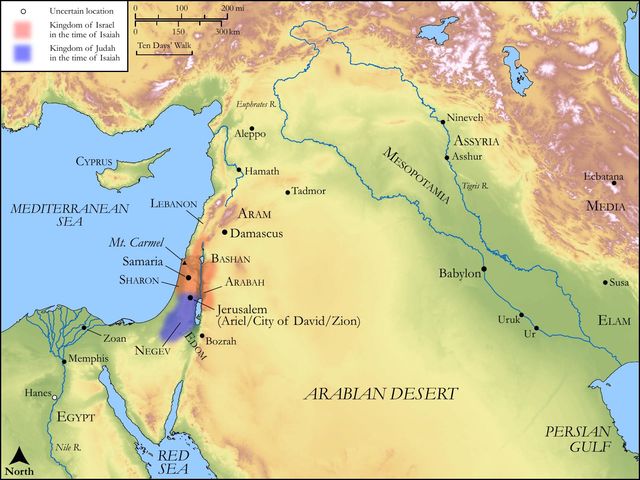
See on the biblical-era map
Study this verse
Public-domain commentary
Matthew Henry
From his Commentary on the Whole Bible. Henry comments on passages, not single verses — this entry covers Isaiah 29:9–16. His three-level outline is real structure in the source text, so it is rendered as structure.
Here, I. The prophet stands amazed at the stupidity of the greatest part of the Jewish nation. They had Levites, who taught the good knowledge of the Lord and had encouragement from Hezekiah in doing so, Ch2 30:22. They had prophets, who brought them messages immediately from God, and signified to them what were the causes and what would be the effects of God's displeasure against them. Now, one would think, surely this great nation, that has all the advantages of divine revelation, is a wise and understanding people, Deu 4:6. But, alas! it was quite otherwise, Isa 29:9. The prophet addresses himself to the sober thinking part of them, calling upon them to be affected with the general carelessness of their neighbours. It may be read, "They delay, they put off, their repentance, but wonder you that they should be so sottish. They sport themselves with their own deceivings; they riot and revel; but do you cry out, lament their folly, cry to God by prayer for them. The more insensible they are of the hand of God gone out against them the more do you lay to heart these things." Note, The security of sinners in their sinful way is just matter of lamentation and wonder to all serious people, who should think themselves concerned to pray for those that do not pray for themselves. But what is the matter? What are we thus to wonder at? 1. We may well wonder that the generality of the people should be so sottish and brutish, and so infatuated, as if they were intoxicated: They are drunken, but not with wine (not with wine only, though with that they were often drunk), and they erred through wine, Isa 28:7. They were drunk with the love of pleasures, with prejudices against religion, and with the corrupt principles they had imbibed. Like drunken men, they know not what they do or say, nor whither they go. They are not sensible of the divine rebukes they are under. They have beaten me, and I felt it not, says the drunkard, Pro 23:35. God speaks to them once, yea, twice; but, like men drunk, they perceive it not, they understand it not, but forget the law. They stagger in their counsels, are unstable and unsteady, and stumble at every thing that lies in their way. There is such a thing as spiritual drunkenness. 2. It is yet more strange that God himself should have poured out upon them a spirit of deep sleep, and closed their eyes (Isa 29:10), that he who bids them awake and open their eyes should yet lay them to sleep and shut their eyes; but it is in a way of righteous judgment, to punish them for their loving darkness rather than light, their loving sleep. When God by his prophets called them they said, Yet a little sleep, a little slumber; and therefore he gave them up to strong delusions, and said, Sleep on now. This is applied to the unbelieving Jews, who rejected the gospel of Christ, and were justly hardened in their infidelity, till wrath came upon them to the uttermost. Rom 11:8, God has given them the spirit of slumber. And we have reason to fear it is the woeful case of many who live in the midst of gospel light. 3. It is very sad that this should be the case with those who were their prophets, and rulers, and seers, that those who should have been their guides were themselves blindfolded; and it is easy to tell what the fatal consequences will be when the blind lead the blind. This was fulfilled when, in the latter days of the Jewish church, the chief priests, and the scribes, and the elders of the people, were the great opposers of Christ and his gospel, and brought themselves under a judicial infatuation. 4. The sad effect of this was that all the means of conviction, knowledge, and grace, which they enjoyed, were ineffectual, and did not answer the end (Isa 29:11, Isa 29:12): "The vision of all the prophets, true and false, has become to you as the words of a book, or letter, that is sealed up; you cannot discern the truth of the real visions and the falsehood of the pretended ones." Or, every vision particularly that this prophet had seen for them, and published to them, had become unintelligible; they had it among them, but were never the wiser for it, any more than a man (though a good scholar) is for a book delivered to him sealed up, and which he must not open the seals of. He sees it is a book, and that is all; he knows nothing of what is in it. So they knew that what Isaiah said was a vision and prophecy, but the meaning of it was hidden from them; it was only a sound of words to them, which they were not at all alarmed by, nor affected with; it answered not the intention, for it made no impression at all upon them. Neither the learned nor the unlearned were the better for all the messages God sent them by his servants the prophets, nor desired to be so. The ordinary sort of people excused themselves from regarding what the prophets said with their want of learning and a liberal education, as if they were not concerned to know and do the will of God because they were not bred scholars: It is nothing to me, I am not learned. Those of better rank pretended that the prophet had a peculiar way of speaking, which was obscure to them, and which, though they were men of letters, they had not been used to; and, Si non vis intelligi, debes negligi - If you wish not to be understood, you deserve to be neglected. Both these are groundless pretences; for God's prophets have been no unfaithful debtors either to the wise or to the unwise, Rom 1:14. Or we may take it thus: - The book of prophecy was given to them sealed, so that they could not read it, as a just judgment upon them; because it had often been delivered to them unsealed, and they would not take pains to learn the language of it, and then made excuse for their not reading it because they were not learned. But observe, "The vision has become thus to you whose minds the god of this world has blinded; but it is not so in itself, it is not so to all; the same vision which to you is a savour of death unto death to others is and shall be a savour of life unto life." Knowledge is easy to him that understands.
II.The prophet, in God's name, threatens those that were formal and hypocritical in their exercises of devotion, Isa 29:13, Isa 29:14. Observe here,
1.The sin that is here charged upon them - dissembling with God in their religious performances, Isa 29:13. He that knows the heart, and cannot be imposed upon with shows and pretences, charges it upon them, whether their hearts condemn them for it or no. He that is greater than the heart, and knows all things, knows that though they draw nigh to him with their mouth, and honour him with their lips, yet they are not sincere worshippers. To worship God is to make our approaches to him, and to present our adorations of him; it is to draw nigh to him as those that have business with him, with an intention therein to honour him. This we are to do with our mouth and our lips, in speaking of him and in speaking to him; we must render to him the calves of our lips, Hos 14:2. And, if the heart be full of his love and fear, out of the abundance of that the mouth will speak. But there are many whose religion is lip-labour only. They say that which expresses an approach to God and an adoration of him, but it is only from the teeth outward. For,
(1.)They do not apply their minds to the service. When they pretend to be speaking to God they are thinking of a thousand impertinences: The have removed their hearts far from me, that they might not be employed in prayer, nor come within reach of the word. When work was to be done for God, which required the heart, that was sent out of the way on purpose, with the fool's eyes, into the ends of the earth.
(2.)They do not make the word of God the rule of their worship, nor his will their reason: Their fear towards me is taught by the precept of men. They worshipped the God of Israel, not according to his appointment, but their own inventions, the directions of their false prophets or their idolatrous kings, or the usages of the nations that were round about them. The tradition of the elders was of more value and validity with them than the laws which God commanded Moses. Or, if they did worship God in a way conformable to his institution in the days of Hezekiah, a great reformer, they had more an eye to the precept of the king than to God's command. This our Saviour applies to the Jews in his time, who were formal in their devotions and wedded to their own inventions, and pronounces concerning them that in vain they did worship God, Mat 15:8, Mat 15:9.
2.It is a spiritual judgment with which God threatens to punish them for their spiritual wickedness (Isa 29:14): I will proceed to do a marvellous work. They did one strange thing; they removed all sincerity from their hearts. Now God will go on and do another; he will remove all sagacity from their heads. The wisdom of their wise men shall perish. They played the hypocrite, and thought to put a cheat upon God, and now they are left to themselves to play the fool, and not only to put a cheat upon themselves, but to be easily cheated by all about them. Those that make religion no more than a pretence, to serve a turn, are out in their politics; and it is just with God to deprive those of their understanding who part with their uprightness. This was fulfilled in the wretched infatuation which the Jewish nation were manifestly under, after they had rejected the gospel of Christ; they removed their hearts far from God, and therefore God justly removed wisdom far from them, and hid from their eyes the things that belonged even to their temporal peace. This is a marvelous work; it is surprising, it is astonishing, that wise men should of a sudden lose their wisdom and be given up to strong delusions. Judgments on the mind, though least taken notice of, are to be most wondered at.
III.He shows the folly of those that though to act separately and secretly from God, and were carrying on designs independent upon God and which they projected to conceal from his all-seeing eye. Here we have,
1.Their politics described (Isa 29:15): They seek deep to hide their counsel from the Lord, that he may not know either what they do or what they design; they say, "Who sees us? No man, and therefore not God himself." The consultations they had about their own safety they kept to themselves, and never asked God's advice concerning them; nay, they knew they were displeasing to him, but thought they could conceal them from him; and, if he did not know them, he could not baffle and defeat them. See what foolish fruitless pains sinners take in their sinful ways; they seek deep, they sink deep, to hide their counsel from the Lord, who sits in heaven and laughs at them. Note, A practical disbelief of God's omniscience is at the bottom both of the carnal worships and of the carnal confidences of hypocrites; Psa 94:7; Eze 8:12; Eze 9:9.
2.The absurdity of their politics demonstrated (Isa 29:16): "Surely your turning of things upside down thus, your various projects, turning your affairs this and that way to make them shape as you would have them - or rather your inverting the order of things, and thinking to make God's providence give attendance to your projects, and that God must know no more than you think fit, which is perfectly turning things upside down and beginning at the wrong end - shall be esteemed as the potter's clay. God will turn and manage you, and all your counsels, with as much ease and as absolute a power as the potter forms and fashions his clay." See how God despises, and therefore what little reason we have to dread, those contrivances of men that are carried on without God, particularly those against him.
(1.)Those that think to hide their counsels from God do in effect deny him to be their Creator. It is as if the work should say of him that made it, "He made me not; I made myself." If God made us, he certainly knows us as the Psalmist shows, (Psa 139:1, Psa 139:13-16); so that those who say that he does not see them might as well say that he did not make them. Much of the wickedness of the wicked arises from this, they forget that God formed them, Deu 32:18. Or,
(2.)Which comes to the same thing, they deny him to be a wise Creator: The thing framed saith of him that framed it, He had no understanding; for if he had understanding to make us so curiously, especially to make us intelligent beings and to put understanding into the inward part (Job 38:36), no doubt he has understanding to know us and all we say and do. As those that quarrel with God, so those that think to conceal themselves from him, do in effect charge him with folly; but he that formed the eye, shall he not see? Psa 94:9.
Historical interpretation
Three Centuries of Reception
9 surviving comments on this verse. Each one is dated, so this reads as a timeline rather than a list.
Select a marker to jump to its quote. Markers stagger vertically where authors wrote within a few decades of each other.
And that the things spoken of old by the law and the prophets were all sealed, and that they were unknown to people, Isaiah declares when he says, “And they will deliver the book that is sealed to one that is learned, and will say to him, ‘Read this;’ and he will say, ‘I cannot read it, for it is sealed.’ ” It was right and necessary that the things spoken of old by the prophets should be sealed to the unbelieving Pharisees, who thought that they understood the letter of the law, and be opened to the believing. The things, therefore, which of old were sealed, are now by the grace of God the Lord all open to the saints.
And clearly, if we hear negligently, if we bring no zeal to learning and understanding, not only are the Scriptures of the law and prophets but also of the apostles and Gospels covered for us with a great veil. I fear, however, lest by too much negligence and dullness of heart the divine volumes are not only veiled to us but also sealed, so that “if a book should be put into the hand of a man who cannot read to be read, he would say, ‘I cannot read’; if it should be put into the hands of a man who can read, he would say, ‘It is sealed.’ ” Whence it is shown that we must not only employ zeal to learn the sacred literature, but we must also pray to the Lord and entreat “day and night” that the Lamb “of the tribe of Judah” may come and himself taking “the sealed book” may deign to open it. For it is he who “opening the Scriptures” kindles the hearts of the disciples so that they say, “Was not our heart burning within us when he opened to us the Scriptures?”
Isaiah [prophesied] that the Jews would not understand the holy Scriptures, but that they would become intelligible in the last times, after Christ had come: “And all these words shall be to you as the words of a book that is sealed, which, if you shall give to a man that knows letters to read, he shall say, I cannot read, for it is sealed.… But in that day the deaf shall hear the words of the book, and they who are in darkness and in a cloud; the eyes of the blind shall see.”
For our Lord Jesus Christ did not come as it were to seal up the visions of the prophets. He rather opened and explained those that were of old obscure and sealed, tearing away so to say the seals impressed on them, and taught his disciples the meaning of the Holy Scriptures. Hence he says, “Behold, the lion of the tribe of Judah has prevailed, and he has opened the seals that were set on the book,” in John’s Apocalypse. What are these seals but the obscurities of the prophets? Isaiah knew them well and definitely says too: “And these words shall be as the words of the sealed book.” The Christ of God did not come then to shut up the vision and the prophet but rather to open them and bring them to the light.
[Daniel 12:4] "But Thou, O Daniel, shut up the words and seal the book, even to the time appointed. Many shall pass over, and knowledge shall be manifold." He who had revealed manifold truth to Daniel now signifies that the things he has said are matters of secrecy, and he orders him to roll up the scroll containing his words and set a seal upon the book, with the result that many shall read it and inquire as to its fulfilment in history, differing in their opinions because of its great obscurity. And as for the statement, "Many shall pass over" or "go through," this indicates that it will be read by many people. For it is a familiar expression to say: "I have gone through a book," or, "I have passed through an historical account." Indeed this is the idea which Isaiah also expressed in regard to the obscurity of his own book: "And the sayings of that book shall be like the words of a book that is sealed. And if they shall give it to an illiterate man, saying, 'Read it,' he will reply, 'I do not know how to read.' But if they give it to a man who does know how to read and say, 'Read the book,' he will reply, 'I cannot read it, because it is sealed up'" (Isaiah 29:11-12). Also in the Revelation of John, there is a book seen which is sealed with seven seals inside and outside. And when no one proves able to break its seals, John says, "I wept sore; and a voice came to me, saying, 'Weep not: behold the Lion of the tribe of Judah, the Root of David, has prevailed to open the book and break its seals'" (Revelation 5:1-5). But that book can be opened by one who has learned the mysteries of Scripture and understands its hidden truths, and its words which seem dark because of the greatness of the secrets they contain. He it is who can interpret the parables and transmute the letter which killeth into the spirit which quickeneth.
What is the gate that is always closed, through which only the Lord God of Israel enters? Surely it is that about which the Savior spoke in the Gospel: “Woe to you scribes and Pharisees, woe to you teachers of the law, woe to you who hold the key of knowledge. You do not enter yourselves, and you prevent those who would from entering.” Isaiah wrote about the same thing, using the metaphor of a book: “The words of this book are like sealed words; when you give them to a man who cannot read and tell him to read, he will respond: ‘I don’t know how to read.’ And they will give it to a man who is able to read and tell him to read and he will say: ‘I cannot read because it is sealed.’ ” This is the same book whose seal no one can break and open either in heaven or on earth or under the earth, except the one about whom John said in the Apocalypse: “Behold, the Lion of the tribe of Judah, the root and race of David, has conquered so that he can open the book and break its seal.” Before the Savior assumed a human body and humbled himself, taking the form of a servant, the law was closed, the prophets were closed, all knowledge of the Scriptures was closed, and paradise was closed. After he had hung on the cross, however, and said to the thief, “Today you will be with me in paradise,” immediately the veil of the temple was cut and everything was opened. And once the veil has been removed, we will say, “But we all contemplate the glory of the Lord with unveiled face and are being transformed into his very image from glory to glory.”
(Verse 9 and following) Be astonished and amazed: fluctuate and waver, become drunk, not with wine, be moved, not with intoxication. For the Lord has mixed into you the spirit of deep sleep: he will close your eyes, your prophets and leaders who see visions he will cover. And the vision of all will be like the words of a sealed book, which when they give to one who knows letters, they will say: read this, and he will answer, I cannot, for it is sealed. And a book will be given to one who knows not letters, and it shall be said to him, read; and he shall answer, I know not letters. For the spirit of sleep, LXX, is interpreted as compunction: Theodotius, the passing away of the mind: Aquila, καταφορὰν, that is, a heavy sleep; which in Hebrew is called Thardema (), which Scripture commemorates as sent by God to Adam (Gen. II), when woman was made from the rib of his side. And Jonah snored in the same sleep on the ship (Jon. I). But all prophecy after the destruction of Jerusalem and the temple, that is, Ariel, is against the scribes and Pharisees, who, possessing the key of knowledge, do not enter themselves, nor do they allow others to enter. And it is commanded to them, that they should be amazed and astonished, rather according to the septuagint dissolution of the whole body and the excess of the mind, and that they should be moved and fluctuate: staggering not from wine or from strong drink, but from the spirit of sleep or of the Lord's compunction, so that understanding their evil, they may at some point repent, and say with the prophet: I am troubled in my weakness, while the thorn is being fastened to me (Ps. XXXI, 4). Therefore, know this, O scribes and Pharisees, who are the leaders of the Jews, that the Lord will render to you your recompense. For you, who have heard the Lord Savior, did not want to understand, and you closed your eyes so that you would not see him, and you weighed down your ears so that you would not hear. Therefore, he will also close your eyes, you who are the prophets through whom you saw the knowledge of God. Or he will close the eyes of your prophets, who are your leaders. For as the Law and the Prophets testified until John, so that those who do not see may see, and those who see may become blind, as it is written: They will hear the words of the book, even the deaf will hear, and the blind will see and rejoice. For judgment I have come into this world, so that those who do not see may see, and those who see may become blind, that is to say, the people of the nations who were blind, may see and contemplate the Lord. Therefore, it is significant that he did not say that the vision of all the prophets is sealed to all readers, but to you he says, it will be sealed to those to whom I am now speaking, to whom I am foretelling these things that are to come: or He will forever shut the eyes of your leaders, who boasted of being able to see the hidden and secret things according to the Septuagint. And he said to them, 'All the holy Scripture will be closed and sealed to you, so that you, who consider yourselves knowledgeable in the letters of the Law and the prophecies of the prophets, and who constantly meditate on the volumes of Scripture day and night with tireless mouths, may not understand what you read, as it is written in the Book of Revelation of John: 'Who is worthy to open the book and to break its seals?' (Rev. 5:2) And when no one was found worthy to open the seals, he says that he wept; and that he deserved to hear the word of God: 'Do not weep; behold, the lion of the tribe of Judah, the root of David, has conquered, so that he may open the book and break its seals.' But the lion of the tribe of Judah, the Lord Jesus Christ, is he who unseals the seals of the book, not properly of one, as many suppose, of the Psalms of David, but of all the Scriptures, which are one Scripture of the Holy Spirit; and for that reason they are called one book. Concerning which Ezekiel testifies in mystical discourse (Ezek. II), that it was written within and without; in meaning and in letter. Concerning which also the Savior speaks in the Psalms: In the chapter of the book it is written of me (Ps. XXXIX, 9); not of Jeremiah, not of Isaiah, but in all the holy Scripture, which is called one book. Therefore, the Jewish leaders, up to the present day, being unable to read and open the seals, and to reveal the mysteries of the Scriptures, if you were to give them a book to the unlearned people who are devoured by their own teachers, they would admit to not knowing letters and therefore being unable to read. And out of the two evils, it is much lighter to confess ignorance of the law than to boast of prudence and not be able to understand what is said.
In the Apocalypse a book is shown sealed with seven seals, which if you deliver to one that is learned saying, “Read this,” he will answer you, “I cannot, for it is sealed.” How many there are today who fancy themselves learned, yet the Scriptures are a sealed book to them, and one which they cannot open save through him who has the key of David, “he that opens and no man shuts; and shuts and no man opens.” In the Acts of the Apostles the holy eunuch when reading Isaiah is asked by Philip, “Do you understand what you are reading?” The man answered, “How can I, except some man should guide me?” To digress for a moment to myself, I am neither holier nor more diligent than this eunuch, who came from Ethiopia … and was so great a lover of the law and of divine knowledge that he read the holy Scriptures even in his chariot. Yet although he had the book in his hand and took into his mind the words of the Lord, no, even had them on his tongue and uttered them with his lips, he still did not know him, who—not knowing—he worshiped in the book. Then Philip came and showed him Jesus, who was concealed beneath the letter. Wondrous excellence of the teacher! In the same hour the eunuch believed and was baptized; he became one of the faithful and a saint. He was no longer a pupil but a master; and he found more in the church’s font there in the wilderness than he had ever done in the gilded temple of the synagogue. These instances have been just touched upon by me (the limits of a letter forbid a more discursive treatment of them) to convince you that in the Holy Scriptures you can make no progress unless you have a guide to show you the way.
This is also why Isaiah would say to the Jews: “Behold, all of these words will be to you like the words of a sealed book.” The skilled reader and the illiterate are equally said to be deprived of fruit, since one is prevented by the seal from penetrating what lies hidden within and the other is shackled by ignorance.
Continue studying Isaiah 29:11 across the web’s major study libraries — every link below opens this exact verse, chapter, or book on the destination site.
Read & Compare
 BibleGatewayThis verse in more than 200 translations and 70 languages.
 Bible.comThe YouVersion reader — hundreds of translations, reading plans, and highlights.
 ESV.orgCrossway's official English Standard Version reader.
 NET BibleThe NET translation with 60,000+ translators' notes on every rendering decision.
 STEP BibleTyndale House's free study tool — original text, vocabulary, and scholarly resources.
 BibliaLogos Bible Software's free web reader.
 USCCBThe New American Bible (Revised Edition) with the U.S. bishops' study notes.
Commentaries
 BibleHub CommentariesDozens of classic commentaries on this verse, gathered on one page.
 StudyLightMore than 100 commentary sets — the largest collection on the web.
 BibleRefPlain-English commentary on what this verse means, verse by verse.
 Enduring WordDavid Guzik's free commentary on this chapter, widely used by Bible teachers.
 Bible Study ToolsVerse commentary alongside Greek and Hebrew study aids.
Original Language & Research
- BibleHub InterlinearThe verse word by word — original language, transliteration, and English.
- BibleHub LexiconEvery word's original-language definition and Strong's entry.
 Blue Letter BibleDeep-study tools — Strong's numbers, concordance, and word studies.
 SefariaThe Hebrew text with Rashi and centuries of Jewish commentary.
Sermons, Hymns & Audio


TrulyRandomVerse is not affiliated with these sites and doesn’t control their content. They’re linked because they’re genuinely useful.
Summary
Isaiah 29:11 powerfully depicts the spiritual condition of Jerusalem, where God's profound prophetic revelation, intended to illuminate and guide, had become utterly incomprehensible to its inhabitants. This divine "vision" is metaphorically presented as a sealed book, inaccessible even to those deemed learned and intellectually capable, who confess their inability to decipher its contents. This state of spiritual obscurity is portrayed not as an accident, but as a direct consequence of the people's deep-seated spiritual apathy, hypocrisy, and rebellion against God.
Context
ShowHideLiterary Context
This verse is intricately woven into Isaiah's broader prophetic indictment against Jerusalem, which he symbolically names "Ariel" in Isaiah 29. The immediate preceding verses, Isaiah 29:9-10, lay the groundwork for this spiritual blindness, describing a divine judgment where God has poured out a "spirit of deep sleep" upon His people, causing their prophets and seers to be covered, effectively rendering them incapable of perceiving divine truth. This spiritual stupor is a direct consequence of their hypocrisy, as further elaborated in Isaiah 29:13, where their worship is characterized as mere lip service, their hearts being far removed from genuine devotion. Thus, the "sealed book" imagery in verse 11 serves as a vivid and poignant illustration of this divinely imposed spiritual incomprehension, acting as a direct consequence and symbol of their judgment.
Historical & Cultural Context
Isaiah prophesied during a period of intense political and spiritual turmoil for the Southern Kingdom of Judah, particularly in the late 8th century BCE. The nation faced existential threats from the powerful Assyrian Empire, yet internally, the people of Jerusalem, despite being God's covenant people and possessing His revealed law and prophetic word, had largely succumbed to a superficial religiosity, prioritizing ritual and outward piety over true heart obedience. In Israel, a sealed document held significant legal or administrative weight, its contents being private and inaccessible until the seals were officially broken, often by an authorized individual. This cultural practice underscores the idea of hidden, protected, or divinely withheld knowledge. The "learned" man in this context would typically be a scribe, scholar, or someone proficient in reading and interpreting texts. The profound irony of such an individual being unable to read a sealed book would have been a deeply relatable and impactful metaphor for Isaiah's original audience, highlighting the futility of human intellect when divine truth is obscured.
Key Themes
ShowHideIsaiah 29:11 contributes significantly to several overarching themes found throughout the book of Isaiah and the broader prophetic corpus. Foremost among these is the theme of spiritual blindness and incomprehension, where God's own people, despite having direct access to divine revelation, are rendered incapable of understanding it due to their spiritual insensitivity, rebellion, and hardened hearts. This inability is not merely a natural failing but is presented as a form of divine judgment for their hypocrisy and unfaithfulness, transforming God's life-giving word from a source of light and guidance into an obscure, impenetrable mystery. Furthermore, the imagery of the "sealed book" speaks deeply to the nature of revelation itself, suggesting that divine truth is not always openly accessible to all; its profound understanding often requires a specific spiritual disposition, a humble heart, or indeed, direct divine intervention. This concept foreshadows later biblical themes where revelation is unveiled at God's appointed time and through His chosen means, culminating in the unsealing of the scroll by the Lamb in Revelation 5.
Exposition and Analysis
ShowHideKey Word Analysis
ShowHideDerived from a root meaning "to see," this term refers to a prophetic revelation or a divinely imparted insight. In the context of Isaiah 29:11, it encompasses the entirety of God's revealed truth and prophetic word given to Judah, which was intended to provide clarity, direction, and understanding for their lives and their covenant relationship with God.
This primitive root signifies "to close up" or "to seal," implying that something is made inaccessible, hidden, or preserved. The act of sealing a document renders its contents unreadable until the seal is broken. Here, it powerfully conveys the idea that God's word, though physically present, was spiritually impenetrable to those lacking discernment, a state of divine judgment.
A broad primitive root meaning "to know," this word encompasses a wide range of understanding, including discerning, having skill, or being acquainted with something. In this verse, it specifically refers to someone intellectually capable or educated, such as a scribe or scholar. The profound irony lies in the fact that even this individual, possessing human intellectual prowess, is utterly unable to comprehend the divine message because of its divinely sealed nature.
Verse Breakdown
ShowHide"And the vision of all is become unto you as the words of a book that is sealed"
This opening clause establishes the central metaphor of the verse. God's comprehensive prophetic revelation ("the vision of all"), intended for His people, has tragically become for them like the text of a book whose contents are hidden and inaccessible. The "sealed" nature signifies not a physical inability to read, but a profound spiritual incapacity to comprehend, receive, or apply the truth contained within.
"which [men] deliver to one that is learned, saying, Read this, I pray thee:"
This phrase describes the futile attempt to access the sealed knowledge through conventional, human means. The book is presented to someone intellectually capable ("one that is learned"), implying that human wisdom, academic prowess, or scholarly effort is applied to the divine text, accompanied by an earnest request for interpretation or understanding.
"and he saith, I cannot; for it [is] sealed:"
This final clause starkly reveals the utter futility of human effort alone in the face of divine judgment. Despite the learned man's intellect and the earnest plea, he confesses his complete inability to read or understand the book. The reason provided, "for it is sealed," reiterates that the barrier is not a lack of literacy but an inherent, divinely ordained inaccessibility, signifying a spiritual blindness that no amount of human learning or intellectual capacity can overcome.
Literary Devices
ShowHideIsaiah 29:11 masterfully employs several potent literary devices to convey its somber message. The most prominent is Simile, where "the vision of all" is explicitly compared to "the words of a book that is sealed." This comparison vividly illustrates the profound incomprehensibility of God's message to His people. Central to the verse is also Symbolism, with the "sealed book" representing divine revelation that is rendered inaccessible due to spiritual blindness and divine judgment. The act of sealing itself symbolizes God's sovereign control over the revelation of His truth, indicating His decision to withhold understanding from those who are rebellious and hypocritical. Furthermore, a strong element of Irony pervades the verse, particularly in the learned man's inability to read the book. One would naturally expect a "learned" person to possess the skill and intellect to decipher texts; yet, here, their intellectual capacity is rendered utterly useless against a divinely imposed spiritual barrier, powerfully highlighting that divine truth requires far more than mere human intellect for genuine comprehension.
Theological and Thematic Connections
ShowHideIsaiah 29:11 provides a profound theological commentary on the nature of spiritual blindness and the accessibility of divine revelation. It underscores that true understanding of God's word is not merely an intellectual exercise or a matter of human erudition, but fundamentally requires a humble, receptive heart and divine enablement. The sealing of the book represents God's sovereign judgment upon a people whose hearts were far from Him, demonstrating His capacity to withhold understanding from those who reject His ways and engage in hypocrisy. This passage serves as a powerful foreshadowing of New Testament themes concerning the necessity of the Holy Spirit to illuminate Scripture and the unique role of Christ as the ultimate revealer of God's truth, the one who opens understanding.
Reflection and Application
ShowHideIsaiah 29:11 stands as a timeless and sobering warning against spiritual apathy, hypocrisy, and intellectual pride. It profoundly reminds us that comprehending God's Word is not solely a matter of academic learning or intellectual ability, but fundamentally demands a humble, repentant, and receptive heart. Just as the learned man in the prophecy could not read the sealed book, so too is human wisdom alone utterly incapable of unlocking the profound depths of divine truth. True insight, spiritual comprehension, and life-transforming understanding of Scripture come from the Holy Spirit, who alone can illuminate the sacred texts and apply their truths directly to our lives. For believers today, this passage underscores the absolute necessity of approaching the Bible with prayer, profound humility, and an unwavering reliance on the Spirit's guidance, rather than with a closed mind, a hardened heart, or an over-reliance on human intellect. It challenges each of us to honestly examine our own hearts: are we genuinely seeking God's truth with a desire to obey, or are we merely going through the motions of religious activity, inadvertently leaving the "book" of His precious revelation sealed to our souls?
Questions for Reflection
ShowHideFAQ
ShowHideWhy was the "vision" sealed for the people of Judah?
ShowHideThe "vision" was sealed as a direct divine judgment upon the people of Judah for their pervasive spiritual hypocrisy and rebellion against God. As Isaiah 29:13 highlights, despite their outward religious observance, their hearts were far from God. The Lord had poured out a "spirit of deep sleep" upon them (Isaiah 29:10), causing them to become spiritually blind and deaf to His truth. The sealed book vividly illustrates that their inability to comprehend God's word was not accidental but a deliberate consequence of their unfaithfulness and God's sovereign response to their hardened hearts.
Who is the "learned" man in this verse, and what does his inability signify?
ShowHideThe "learned" man represents an individual with intellectual capacity and scholarly training, likely a scribe or a scholar, who would typically be expected to read, interpret, and explain texts. His profound inability to read the sealed book signifies the utter futility of human wisdom, intellectual prowess, or academic study alone in comprehending divine truth when God has chosen to withhold understanding. It powerfully emphasizes that spiritual revelation is not accessible through mere human intellect or scholarly effort, but requires divine enablement and a receptive, humble spiritual condition.
How does this passage relate to the accessibility of God's Word today?
ShowHideWhile the physical Bible is now widely accessible globally and its pages are literally "unsealed," Isaiah 29:11 serves as a timeless and crucial warning against spiritual apathy and the profound danger of approaching God's Word without a humble and receptive heart. Just as the learned man could not understand the sealed book, individuals today can read the Bible intellectually and even analyze it academically, yet remain spiritually blind to its life-transforming truths if their hearts are hardened by sin, pride, or indifference. True spiritual understanding and discernment still require the illuminating work of the Holy Spirit (1 Corinthians 2:14), reminding us that the "seal" can be spiritual and internal, not merely physical.
Christ-Centered Fulfillment
ShowHideIsaiah 29:11, with its poignant imagery of a sealed book and the tragic inability to comprehend divine truth due to spiritual blindness, finds its ultimate and profound Christ-centered fulfillment in the person and redemptive work of Jesus Christ. He is the preeminent revealer of God, the one who definitively unseals the divine mysteries that were previously hidden from human understanding. While the "vision" was sealed to the learned in Isaiah's day because of spiritual blindness, Jesus came precisely to open the eyes of the blind and unstop the ears of the deaf, fulfilling prophecies like Isaiah 35:5. He is the true "Word" of God made flesh (John 1:1), and through Him alone, God's very nature, character, and redemptive will are fully and perfectly revealed (John 1:18). Furthermore, in the New Testament, it is the Lamb of God, Jesus Christ, who is found uniquely worthy to open the scroll with seven seals in Revelation 5:5, signifying His unparalleled authority and power to reveal God's sovereign plan of salvation and bring all things to their appointed consummation. He is the one who, by His Spirit, opens the minds of His disciples to truly understand the Scriptures (Luke 24:45), ensuring that God's revelation is no longer a sealed book of judgment but an open, living invitation to know Him intimately and walk in His truth.