


Isaiah 29:10
- כִּיkiforH3588PrtParticle Conditional
- נָסַךְna·Sakhhe has poured outH5258V-Qal-Perf-3msVerb Qal Perfect 3rd Singular Masculine
- עֲלֵיכֶם'a·lei·Khemon youH5921Prep ¦ 2mpPrepositionעֲלֵיonכֶםyou
- יְהוָהYah·wehYahwehH3068N-properNoun Proper Title
- רוּחַRu·acha spirit ofH7307N-fscNoun Singular Feminine Construct
- תַּרְדֵּמָהtar·de·Mahdeep sleepH8639N-fsNoun Singular Feminine Absolute
- וַיְעַצֵּםvay·'a·Tzemand he has shutH6105Conj-w ¦ V-Piel-ConsecImperf-3msVerb Piel Consecutive Imperfect 3rd Singular Masculineוַandיְעַצֵּםhe has shut
- אֶת'et<obj.>H853DirObjMParticle Object Indicator
- עֵינֵיכֶם'ei·nei·Khemyour eyesH5869N-fdc ¦ 2mpNoun Dual Feminine Constructעֵינֵיeyesכֶםyour
- אֶת'et<obj.>H853DirObjMParticle Object Indicator
- הַנְּבִיאִיםha·ne·vi·'Imthe prophetsH5030Art ¦ N-mpNoun Plural Masculine Absoluteהַtheנְּבִיאִיםprophets
- וְאֶתve·'Etand <obj.>H853Conj-w ¦ DirObjMParticle Object Indicatorוְandאֶת<obj.>
- רָאשֵׁיכֶםra·shei·Khemyour headsH7218N-mpc ¦ 2mpNoun Plural Masculine Constructרָאשֵׁיheadsכֶםyour
- הַחֹזִיםha·cho·Zimthe seersH2374Art ¦ N-mpNoun Plural Masculine Absoluteהַtheחֹזִיםseers
- כִּסָּהki·Sahhe has coveredH3680V-Piel-Perf-3msVerb Piel Perfect 3rd Singular Masculine
English is a literal word-by-word gloss of the Hebrew, not the KJV's wording. Why?
This is the original text the KJV's translators worked from — each Hebrew word with its own literal English meaning in this verse, prepared by scholars at Tyndale House, Cambridge. The KJV translates whole sentences, not word by word, so its wording differs: one Hebrew word can become several English words, and the KJV may choose “the LORD” where the gloss reads “Yahweh”. Both are faithful — they answer different questions. For the KJV's own rendering, switch to the KJV text.
Details
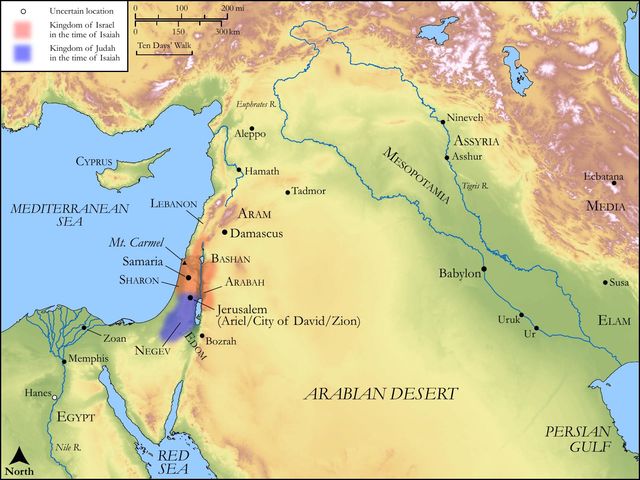
See on the biblical-era map
Study this verse
Public-domain commentary
Matthew Henry
From his Commentary on the Whole Bible. Henry comments on passages, not single verses — this entry covers Isaiah 29:9–16. His three-level outline is real structure in the source text, so it is rendered as structure.
Here, I. The prophet stands amazed at the stupidity of the greatest part of the Jewish nation. They had Levites, who taught the good knowledge of the Lord and had encouragement from Hezekiah in doing so, Ch2 30:22. They had prophets, who brought them messages immediately from God, and signified to them what were the causes and what would be the effects of God's displeasure against them. Now, one would think, surely this great nation, that has all the advantages of divine revelation, is a wise and understanding people, Deu 4:6. But, alas! it was quite otherwise, Isa 29:9. The prophet addresses himself to the sober thinking part of them, calling upon them to be affected with the general carelessness of their neighbours. It may be read, "They delay, they put off, their repentance, but wonder you that they should be so sottish. They sport themselves with their own deceivings; they riot and revel; but do you cry out, lament their folly, cry to God by prayer for them. The more insensible they are of the hand of God gone out against them the more do you lay to heart these things." Note, The security of sinners in their sinful way is just matter of lamentation and wonder to all serious people, who should think themselves concerned to pray for those that do not pray for themselves. But what is the matter? What are we thus to wonder at? 1. We may well wonder that the generality of the people should be so sottish and brutish, and so infatuated, as if they were intoxicated: They are drunken, but not with wine (not with wine only, though with that they were often drunk), and they erred through wine, Isa 28:7. They were drunk with the love of pleasures, with prejudices against religion, and with the corrupt principles they had imbibed. Like drunken men, they know not what they do or say, nor whither they go. They are not sensible of the divine rebukes they are under. They have beaten me, and I felt it not, says the drunkard, Pro 23:35. God speaks to them once, yea, twice; but, like men drunk, they perceive it not, they understand it not, but forget the law. They stagger in their counsels, are unstable and unsteady, and stumble at every thing that lies in their way. There is such a thing as spiritual drunkenness. 2. It is yet more strange that God himself should have poured out upon them a spirit of deep sleep, and closed their eyes (Isa 29:10), that he who bids them awake and open their eyes should yet lay them to sleep and shut their eyes; but it is in a way of righteous judgment, to punish them for their loving darkness rather than light, their loving sleep. When God by his prophets called them they said, Yet a little sleep, a little slumber; and therefore he gave them up to strong delusions, and said, Sleep on now. This is applied to the unbelieving Jews, who rejected the gospel of Christ, and were justly hardened in their infidelity, till wrath came upon them to the uttermost. Rom 11:8, God has given them the spirit of slumber. And we have reason to fear it is the woeful case of many who live in the midst of gospel light. 3. It is very sad that this should be the case with those who were their prophets, and rulers, and seers, that those who should have been their guides were themselves blindfolded; and it is easy to tell what the fatal consequences will be when the blind lead the blind. This was fulfilled when, in the latter days of the Jewish church, the chief priests, and the scribes, and the elders of the people, were the great opposers of Christ and his gospel, and brought themselves under a judicial infatuation. 4. The sad effect of this was that all the means of conviction, knowledge, and grace, which they enjoyed, were ineffectual, and did not answer the end (Isa 29:11, Isa 29:12): "The vision of all the prophets, true and false, has become to you as the words of a book, or letter, that is sealed up; you cannot discern the truth of the real visions and the falsehood of the pretended ones." Or, every vision particularly that this prophet had seen for them, and published to them, had become unintelligible; they had it among them, but were never the wiser for it, any more than a man (though a good scholar) is for a book delivered to him sealed up, and which he must not open the seals of. He sees it is a book, and that is all; he knows nothing of what is in it. So they knew that what Isaiah said was a vision and prophecy, but the meaning of it was hidden from them; it was only a sound of words to them, which they were not at all alarmed by, nor affected with; it answered not the intention, for it made no impression at all upon them. Neither the learned nor the unlearned were the better for all the messages God sent them by his servants the prophets, nor desired to be so. The ordinary sort of people excused themselves from regarding what the prophets said with their want of learning and a liberal education, as if they were not concerned to know and do the will of God because they were not bred scholars: It is nothing to me, I am not learned. Those of better rank pretended that the prophet had a peculiar way of speaking, which was obscure to them, and which, though they were men of letters, they had not been used to; and, Si non vis intelligi, debes negligi - If you wish not to be understood, you deserve to be neglected. Both these are groundless pretences; for God's prophets have been no unfaithful debtors either to the wise or to the unwise, Rom 1:14. Or we may take it thus: - The book of prophecy was given to them sealed, so that they could not read it, as a just judgment upon them; because it had often been delivered to them unsealed, and they would not take pains to learn the language of it, and then made excuse for their not reading it because they were not learned. But observe, "The vision has become thus to you whose minds the god of this world has blinded; but it is not so in itself, it is not so to all; the same vision which to you is a savour of death unto death to others is and shall be a savour of life unto life." Knowledge is easy to him that understands.
II.The prophet, in God's name, threatens those that were formal and hypocritical in their exercises of devotion, Isa 29:13, Isa 29:14. Observe here,
1.The sin that is here charged upon them - dissembling with God in their religious performances, Isa 29:13. He that knows the heart, and cannot be imposed upon with shows and pretences, charges it upon them, whether their hearts condemn them for it or no. He that is greater than the heart, and knows all things, knows that though they draw nigh to him with their mouth, and honour him with their lips, yet they are not sincere worshippers. To worship God is to make our approaches to him, and to present our adorations of him; it is to draw nigh to him as those that have business with him, with an intention therein to honour him. This we are to do with our mouth and our lips, in speaking of him and in speaking to him; we must render to him the calves of our lips, Hos 14:2. And, if the heart be full of his love and fear, out of the abundance of that the mouth will speak. But there are many whose religion is lip-labour only. They say that which expresses an approach to God and an adoration of him, but it is only from the teeth outward. For,
(1.)They do not apply their minds to the service. When they pretend to be speaking to God they are thinking of a thousand impertinences: The have removed their hearts far from me, that they might not be employed in prayer, nor come within reach of the word. When work was to be done for God, which required the heart, that was sent out of the way on purpose, with the fool's eyes, into the ends of the earth.
(2.)They do not make the word of God the rule of their worship, nor his will their reason: Their fear towards me is taught by the precept of men. They worshipped the God of Israel, not according to his appointment, but their own inventions, the directions of their false prophets or their idolatrous kings, or the usages of the nations that were round about them. The tradition of the elders was of more value and validity with them than the laws which God commanded Moses. Or, if they did worship God in a way conformable to his institution in the days of Hezekiah, a great reformer, they had more an eye to the precept of the king than to God's command. This our Saviour applies to the Jews in his time, who were formal in their devotions and wedded to their own inventions, and pronounces concerning them that in vain they did worship God, Mat 15:8, Mat 15:9.
2.It is a spiritual judgment with which God threatens to punish them for their spiritual wickedness (Isa 29:14): I will proceed to do a marvellous work. They did one strange thing; they removed all sincerity from their hearts. Now God will go on and do another; he will remove all sagacity from their heads. The wisdom of their wise men shall perish. They played the hypocrite, and thought to put a cheat upon God, and now they are left to themselves to play the fool, and not only to put a cheat upon themselves, but to be easily cheated by all about them. Those that make religion no more than a pretence, to serve a turn, are out in their politics; and it is just with God to deprive those of their understanding who part with their uprightness. This was fulfilled in the wretched infatuation which the Jewish nation were manifestly under, after they had rejected the gospel of Christ; they removed their hearts far from God, and therefore God justly removed wisdom far from them, and hid from their eyes the things that belonged even to their temporal peace. This is a marvelous work; it is surprising, it is astonishing, that wise men should of a sudden lose their wisdom and be given up to strong delusions. Judgments on the mind, though least taken notice of, are to be most wondered at.
III.He shows the folly of those that though to act separately and secretly from God, and were carrying on designs independent upon God and which they projected to conceal from his all-seeing eye. Here we have,
1.Their politics described (Isa 29:15): They seek deep to hide their counsel from the Lord, that he may not know either what they do or what they design; they say, "Who sees us? No man, and therefore not God himself." The consultations they had about their own safety they kept to themselves, and never asked God's advice concerning them; nay, they knew they were displeasing to him, but thought they could conceal them from him; and, if he did not know them, he could not baffle and defeat them. See what foolish fruitless pains sinners take in their sinful ways; they seek deep, they sink deep, to hide their counsel from the Lord, who sits in heaven and laughs at them. Note, A practical disbelief of God's omniscience is at the bottom both of the carnal worships and of the carnal confidences of hypocrites; Psa 94:7; Eze 8:12; Eze 9:9.
2.The absurdity of their politics demonstrated (Isa 29:16): "Surely your turning of things upside down thus, your various projects, turning your affairs this and that way to make them shape as you would have them - or rather your inverting the order of things, and thinking to make God's providence give attendance to your projects, and that God must know no more than you think fit, which is perfectly turning things upside down and beginning at the wrong end - shall be esteemed as the potter's clay. God will turn and manage you, and all your counsels, with as much ease and as absolute a power as the potter forms and fashions his clay." See how God despises, and therefore what little reason we have to dread, those contrivances of men that are carried on without God, particularly those against him.
(1.)Those that think to hide their counsels from God do in effect deny him to be their Creator. It is as if the work should say of him that made it, "He made me not; I made myself." If God made us, he certainly knows us as the Psalmist shows, (Psa 139:1, Psa 139:13-16); so that those who say that he does not see them might as well say that he did not make them. Much of the wickedness of the wicked arises from this, they forget that God formed them, Deu 32:18. Or,
(2.)Which comes to the same thing, they deny him to be a wise Creator: The thing framed saith of him that framed it, He had no understanding; for if he had understanding to make us so curiously, especially to make us intelligent beings and to put understanding into the inward part (Job 38:36), no doubt he has understanding to know us and all we say and do. As those that quarrel with God, so those that think to conceal themselves from him, do in effect charge him with folly; but he that formed the eye, shall he not see? Psa 94:9.
Historical interpretation
Two Centuries of Reception
3 surviving comments on this verse. Each one is dated, so this reads as a timeline rather than a list.
Select a marker to jump to its quote. Markers stagger vertically where authors wrote within a few decades of each other.
Not to recognize sins lest penance follow is the wrath of God, as it is written: “And the Lord gave to them the spirit of a deep sleep,” lest they actually return and be cured and be healed by their lamentations and just satisfactions after their sins.…The first degree of felicity is not to sin; the second, to recognize the sins committed. In the former, innocence runs upright and unimpaired to save; in the latter, there follows the remedy to cure. They have lost both of these by offending God.… Or do you think, brother, that crimes against God are light matters, small and of little moment, because through them the majesty of an offended God is not sought, because the wrath and fire and day of the Lord are not feared, because, with Antichrist at hand, the faith of a militant people is disarmed while vigor and the fear of Christ are taken away?
(Verse 9 and following) Be astonished and amazed: fluctuate and waver, become drunk, not with wine, be moved, not with intoxication. For the Lord has mixed into you the spirit of deep sleep: he will close your eyes, your prophets and leaders who see visions he will cover. And the vision of all will be like the words of a sealed book, which when they give to one who knows letters, they will say: read this, and he will answer, I cannot, for it is sealed. And a book will be given to one who knows not letters, and it shall be said to him, read; and he shall answer, I know not letters. For the spirit of sleep, LXX, is interpreted as compunction: Theodotius, the passing away of the mind: Aquila, καταφορὰν, that is, a heavy sleep; which in Hebrew is called Thardema (), which Scripture commemorates as sent by God to Adam (Gen. II), when woman was made from the rib of his side. And Jonah snored in the same sleep on the ship (Jon. I). But all prophecy after the destruction of Jerusalem and the temple, that is, Ariel, is against the scribes and Pharisees, who, possessing the key of knowledge, do not enter themselves, nor do they allow others to enter. And it is commanded to them, that they should be amazed and astonished, rather according to the septuagint dissolution of the whole body and the excess of the mind, and that they should be moved and fluctuate: staggering not from wine or from strong drink, but from the spirit of sleep or of the Lord's compunction, so that understanding their evil, they may at some point repent, and say with the prophet: I am troubled in my weakness, while the thorn is being fastened to me (Ps. XXXI, 4). Therefore, know this, O scribes and Pharisees, who are the leaders of the Jews, that the Lord will render to you your recompense. For you, who have heard the Lord Savior, did not want to understand, and you closed your eyes so that you would not see him, and you weighed down your ears so that you would not hear. Therefore, he will also close your eyes, you who are the prophets through whom you saw the knowledge of God. Or he will close the eyes of your prophets, who are your leaders. For as the Law and the Prophets testified until John, so that those who do not see may see, and those who see may become blind, as it is written: They will hear the words of the book, even the deaf will hear, and the blind will see and rejoice. For judgment I have come into this world, so that those who do not see may see, and those who see may become blind, that is to say, the people of the nations who were blind, may see and contemplate the Lord. Therefore, it is significant that he did not say that the vision of all the prophets is sealed to all readers, but to you he says, it will be sealed to those to whom I am now speaking, to whom I am foretelling these things that are to come: or He will forever shut the eyes of your leaders, who boasted of being able to see the hidden and secret things according to the Septuagint. And he said to them, 'All the holy Scripture will be closed and sealed to you, so that you, who consider yourselves knowledgeable in the letters of the Law and the prophecies of the prophets, and who constantly meditate on the volumes of Scripture day and night with tireless mouths, may not understand what you read, as it is written in the Book of Revelation of John: 'Who is worthy to open the book and to break its seals?' (Rev. 5:2) And when no one was found worthy to open the seals, he says that he wept; and that he deserved to hear the word of God: 'Do not weep; behold, the lion of the tribe of Judah, the root of David, has conquered, so that he may open the book and break its seals.' But the lion of the tribe of Judah, the Lord Jesus Christ, is he who unseals the seals of the book, not properly of one, as many suppose, of the Psalms of David, but of all the Scriptures, which are one Scripture of the Holy Spirit; and for that reason they are called one book. Concerning which Ezekiel testifies in mystical discourse (Ezek. II), that it was written within and without; in meaning and in letter. Concerning which also the Savior speaks in the Psalms: In the chapter of the book it is written of me (Ps. XXXIX, 9); not of Jeremiah, not of Isaiah, but in all the holy Scripture, which is called one book. Therefore, the Jewish leaders, up to the present day, being unable to read and open the seals, and to reveal the mysteries of the Scriptures, if you were to give them a book to the unlearned people who are devoured by their own teachers, they would admit to not knowing letters and therefore being unable to read. And out of the two evils, it is much lighter to confess ignorance of the law than to boast of prudence and not be able to understand what is said.
If they could not believe, what is the sin of a person not doing what he cannot do? But if they sinned by not believing, then they could believe and did not.… Then what will we answer about another testimony of the prophet that the apostle Paul cites, saying, “Israel did not obtain what he was seeking, but the election did obtain it. The rest indeed have been blinded, as it has been written, ‘God gave them a spirit of insensibility, eyes that they should not see, and ears that they should not hear until this present day.’ ”You have heard, brothers, the question proposed; you see, of course, how profound it is. But we answer as best we can. “They could not believe,” because Isaiah the prophet foretold this. But the prophet foretold it because God foreknew that it would be. Why they could not, however, if it should be asked of me, I quickly answer, because they were not willing. For God foresaw their evil will and he, from whom the future cannot be hidden, foretold it through the prophet.
But, you say, the prophet states another cause, not of their will. What cause does the prophet state? That “God gave them a spirit of insensibility, eyes that they should not see and ears that they should not hear, and he blinded their eyes and hardened their heart.” I answer that their will earned even this. For thus God blinds, thus God hardens by abandoning and not helping; and he can do this by a hidden judgment, but he cannot do it by an evil one. The piety of the religious ought altogether keep this unshaken and inviolate; as the apostle says when he was discussing this very same, most difficult question: “What shall we say, then? Is there injustice with God? Not at all!” Therefore, if it is not at all the case that there is injustice with God, either when he helps, he acts mercifully, or when he does not help, he acts justly, because he does all things not with rashness but in judgment. Accordingly, if the judgments of the saints are just, how much more so those of the sanctifying and justifying God! Therefore they are just but hidden.
Continue studying Isaiah 29:10 across the web’s major study libraries — every link below opens this exact verse, chapter, or book on the destination site.
Read & Compare
 BibleGatewayThis verse in more than 200 translations and 70 languages.
 Bible.comThe YouVersion reader — hundreds of translations, reading plans, and highlights.
 ESV.orgCrossway's official English Standard Version reader.
 NET BibleThe NET translation with 60,000+ translators' notes on every rendering decision.
 STEP BibleTyndale House's free study tool — original text, vocabulary, and scholarly resources.
 BibliaLogos Bible Software's free web reader.
 USCCBThe New American Bible (Revised Edition) with the U.S. bishops' study notes.
Commentaries
 BibleHub CommentariesDozens of classic commentaries on this verse, gathered on one page.
 StudyLightMore than 100 commentary sets — the largest collection on the web.
 BibleRefPlain-English commentary on what this verse means, verse by verse.
 Enduring WordDavid Guzik's free commentary on this chapter, widely used by Bible teachers.
 Bible Study ToolsVerse commentary alongside Greek and Hebrew study aids.
Original Language & Research
- BibleHub InterlinearThe verse word by word — original language, transliteration, and English.
- BibleHub LexiconEvery word's original-language definition and Strong's entry.
 Blue Letter BibleDeep-study tools — Strong's numbers, concordance, and word studies.
 SefariaThe Hebrew text with Rashi and centuries of Jewish commentary.
Sermons, Hymns & Audio


TrulyRandomVerse is not affiliated with these sites and doesn’t control their content. They’re linked because they’re genuinely useful.
Summary
Isaiah 29:10 powerfully describes a divinely orchestrated spiritual stupor inflicted upon the people of Judah, specifically their prophets, rulers, and seers. This "spirit of deep sleep" is a judicial act of the LORD, rendering them spiritually insensible and incapable of discerning divine truth or understanding the very prophetic messages intended for their guidance. It underscores the severe consequences of persistent spiritual rebellion, hypocrisy, and a reliance on human wisdom, where God allows those who have rejected His clear revelation to become profoundly blind to His ways.
Context
ShowHideLiterary Context
Isaiah 29 is a prophetic oracle primarily directed at Jerusalem, referred to as "Ariel," a name that evokes both its status as God's "lion" (a strong, divinely protected city) and its destiny as an "altar hearth" (a place of judgment and sacrifice). The chapter opens with a lament over the city's impending siege and distress, a direct consequence of its profound spiritual declension and formalistic worship. Verse 10 builds upon this foundation, explaining why the people, despite having prophets among them, remain unresponsive to God's word. The preceding verses describe their ritualistic worship that lacks genuine heart devotion, famously highlighted in Isaiah 29:13. The "deep sleep" is presented as a direct divine response to this spiritual apathy and rebellion, clarifying why they cannot comprehend the prophetic messages, which are likened to a sealed book that no one can read, as depicted in Isaiah 29:11-12.
Historical & Cultural Context
The prophecy in Isaiah 29 is set against the backdrop of the late 8th century BCE, a tumultuous period marked by the looming threat of the Assyrian Empire. Jerusalem, though seemingly secure, was spiritually compromised. The people, including their religious and political leaders, had adopted a form of worship that was outwardly compliant but inwardly rebellious, relying on human wisdom, political alliances, and military strength rather than trusting in the LORD. In ancient Israel, prophets were God's primary means of communication, serving as His mouthpieces to warn, instruct, and guide the nation. They were the "eyes" of the community, discerning God's will. In a culture where divine revelation was highly valued and sought after, the idea of God actively closing the eyes of these very prophets and rulers would have been a profoundly shocking and terrifying judgment, signifying a complete breakdown of spiritual leadership and a cessation of effective divine communication.
Key Themes
ShowHideIsaiah 29:10 powerfully illustrates several major themes prevalent in the book of Isaiah and broader prophetic literature. Firstly, it highlights Divine Judgment and Judicial Hardening, where God, in His sovereignty, allows or even causes spiritual insensitivity as a consequence of persistent sin and rejection of His truth. This concept is echoed in the New Testament, such as when Paul quotes this very passage in Romans 11:8 to explain Israel's partial hardening. Secondly, it underscores the Failure of Prophetic and Political Leadership. Those who were meant to be the "eyes" and "shepherds" of the nation—the prophets and rulers—are themselves blinded, rendering them incapable of discerning God's will or guiding the people. This theme is also explored in other prophetic books, such as Jeremiah 6:15 concerning false prophets and Ezekiel 34 regarding the unfaithful shepherds of Israel. Finally, it emphasizes God's Sovereignty over all aspects of human existence, including spiritual perception and understanding. The LORD is the active agent in pouring out the spirit of deep sleep, demonstrating His ultimate control over the spiritual state of His people and His righteous authority to judge their rebellion.
Exposition and Analysis
ShowHideKey Word Analysis
ShowHideThis refers to the covenant name of God, Jehovah (H3068), signifying "the self-Existent or Eternal One." Its use here is crucial, emphasizing that the "deep sleep" is not an accidental occurrence or merely a natural consequence of human apathy, but a deliberate, sovereign act of the covenant God of Israel. It highlights His active role in judgment, underscoring His authority, justice, and faithfulness to His covenant, even in judgment.
This term (H8639) denotes a lethargy or trance, a supernaturally induced slumber. While elsewhere it can signify a creative or revelatory sleep (e.g., Genesis 2:21 during Eve's creation, or Genesis 15:12 during Abraham's covenant vision), here its application is decidedly punitive. It signifies a divine sealing off of understanding, a spiritual stupor that renders the recipients incapable of processing, discerning, or responding to divine truth.
An active participle meaning "a beholder in vision" (H2374), referring to those who receive divine revelation, specifically through visions. This term is often used interchangeably with "prophet" (Hebrew, nâbîyʼ, H5030), emphasizing their unique role as those who "see" God's truth and declare it. The fact that the LORD has "covered" these very individuals highlights the profound severity of the judgment: those meant to be the spiritual eyes of the nation are themselves blinded, preventing them from fulfilling their crucial role of guiding the people in God's ways.
Verse Breakdown
ShowHide"For the LORD hath poured out upon you the spirit of deep sleep"
This opening clause unequivocally establishes the divine origin and nature of the judgment. The LORD, the sovereign God of Israel, is the active agent. The phrase "poured out" suggests an abundant, overwhelming, and deliberate act, akin to a libation or an overflowing measure. The "spirit of deep sleep" is a spiritual condition, divinely inflicted, that results in profound spiritual insensitivity, dullness, and an inability to perceive or respond to God's truth. It is a judicial hardening of the heart and mind, a consequence of persistent rebellion.
"and hath closed your eyes"
This phrase directly explains and reinforces the effect of the "spirit of deep sleep." The closing of the eyes is a powerful and common biblical metaphor for spiritual blindness, a lack of discernment, and an inability to understand divine revelation. It signifies that the people, who should have been able to "see" God's truth, the signs of the times, and the consequences of their actions, are now rendered incapable of doing so. This is not merely a natural consequence of their sin but an active divine intervention that seals their spiritual perception.
"the prophets and your rulers, the seers hath he covered"
This clause specifies the primary targets and victims of this judgment: the spiritual and political leadership of Judah. "Prophets" (nâbîyʼ) and "seers" (chôzeh) are those entrusted with receiving and communicating God's word, while "rulers" (rôʼsh, literally "heads") represent the political authority and decision-makers. The verb "covered" (kâçâh) reinforces the idea of concealment, obfuscation, and removal, mirroring the "closed your eyes" imagery. It means that those who were meant to illuminate the path for the nation are themselves shrouded in darkness, unable to see or speak God's truth, thus leaving the people without true, divinely inspired guidance.
Literary Devices
ShowHideIsaiah 29:10 employs several potent literary devices to convey its message of divine judgment and spiritual incapacitation. Metaphor is central, particularly in the phrase "the spirit of deep sleep," which vividly portrays a state of spiritual stupor and insensibility as if it were a tangible entity poured out upon the people. This is powerfully reinforced by the parallel metaphors of "closed your eyes" and "covered" the seers, all illustrating a profound and divinely imposed spiritual blindness. The use of Parallelism is evident in the repetition of the divine action ("hath poured out," "hath closed," "hath he covered") and its cumulative effect on the people, especially their leaders. There is also a strong element of Irony in the verse: those who are specifically designated as "prophets" and "seers"—individuals whose very function is to "see" and declare God's truth—are precisely the ones upon whom this spiritual blindness is inflicted. This highlights the tragic and just consequence of their unfaithfulness, turning their spiritual gift into a source of judgment.
Theological and Thematic Connections
ShowHideIsaiah 29:10 reveals a profound and sobering theological truth about God's sovereign judgment and the severe consequences of persistent rebellion against His revealed will. It demonstrates that spiritual blindness is not always merely human apathy or ignorance, but can be a divinely ordained consequence for those who repeatedly and willfully reject God's truth. This judicial hardening serves as a severe warning that continued spiritual insensitivity, hypocrisy, and a preference for human wisdom over divine revelation can lead to a state where God's truth, even when plainly presented, becomes incomprehensible. It underscores the immense responsibility of spiritual leaders, for their failure to genuinely seek, discern, and declare God's truth can lead to their own spiritual incapacitation and, by extension, the spiritual downfall of those they are meant to guide. This passage resonates with the broader biblical theme that God, in His righteous judgment, can give people over to their chosen path when they stubbornly refuse His ways.
Reflection and Application
ShowHideIsaiah 29:10 serves as a sobering mirror for individuals and communities today, calling us to a profound and honest self-examination regarding our receptivity to God's Word. Are we genuinely open to hearing, understanding, and obeying divine truth, or have we, through complacency, spiritual apathy, hypocrisy, or a preference for our own wisdom and comfort, allowed a "spirit of deep sleep" to settle upon our hearts? This verse reminds us that spiritual insensitivity is not merely a passive state but can be an active judgment from God when His warnings and revelations are repeatedly ignored or spurned. For those in spiritual leadership, whether in the church, family, or any sphere of influence, the warning is particularly acute: the responsibility to see and declare God's truth with integrity and humility is immense, and failure to do so can lead to a tragic spiritual blindness that impacts not only oneself but also those dependent on their guidance. We are called to cultivate humble, hungry hearts, constantly seeking discernment and praying for spiritual awakening, both for ourselves and for the world around us, lest we fall into the same spiritual stupor that afflicted ancient Judah.
Questions for Reflection
ShowHideFAQ
ShowHideWhat does "the spirit of deep sleep" mean in this context?
ShowHideIn Isaiah 29:10, "the spirit of deep sleep" (Hebrew: tardêmâh) refers to a divinely induced state of profound spiritual insensibility, dullness, or stupor. Unlike other biblical uses of tardêmâh that denote a creative or revelatory sleep (e.g., Genesis 2:21 when God created Eve, or Genesis 15:12 during Abraham's covenant vision), here it is a punitive judgment. It signifies that God has caused the people, particularly their prophets and rulers, to become spiritually blind and deaf to His warnings and revelations, preventing them from understanding or responding to divine truth due to their persistent rebellion, hypocrisy, and rejection of His ways.
How does this verse relate to God's justice and human free will?
ShowHideThis verse highlights God's sovereign justice in responding to human sin and rebellion. While humans exercise free will in choosing to rebel against God and ignore His truth, Isaiah 29:10 demonstrates that God can, in turn, justly respond by allowing or even causing a judicial hardening. In this state, individuals become incapable of perceiving the truth they have consistently and willfully rejected. This is not an arbitrary act but a righteous consequence of their persistent unfaithfulness and spiritual apathy. It underscores that God's patience has limits, and His judgment can involve the removal of spiritual understanding from those who have willfully spurned it, as further expounded in passages like Romans 1:24-32.
Christ-Centered Fulfillment
ShowHideIsaiah 29:10, with its somber portrayal of divinely induced spiritual blindness and the failure of human leadership, finds its ultimate Christ-centered fulfillment in the person and work of Jesus, who came as the Light of the World to open the eyes of the blind. The spiritual stupor described in Isaiah foreshadows the pervasive spiritual darkness that gripped humanity, a blindness to God's truth that required a divine intervention far beyond mere prophetic warnings. Jesus Himself often lamented the spiritual blindness of His generation, particularly the religious leaders who, like the "seers" of Isaiah's day, were meant to guide but were themselves blind (e.g., Matthew 13:13-15, where He directly quotes Isaiah 6:9-10, a parallel concept). He came not to pour out more judgment in this regard, but to offer grace and truth, breaking the curse of spiritual insensibility. Through His atoning sacrifice on the cross and the subsequent outpouring of the Holy Spirit, Christ enables those who were once spiritually dead and blind to "see" and "hear" God's truth (e.g., John 9:39 and 2 Corinthians 4:4-6). He is the ultimate Seer and Prophet, whose eyes were never closed, and whose words bring life, understanding, and true spiritual sight, reversing the effects of the "spirit of deep sleep" for all who believe in Him.