


2 Thessalonians 2:9
Bible text: King James Version (1769 Blayney text) · Public domain
Bible text: Berean Standard Bible · Public domain
Bible text: American Standard Version (1901) · Public domain
Bible text: World English Bible, Messianic edition · Public domain
Bible text: Geneva Bible (1599) · Public domain
Bible text: Young's Literal Translation · Public domain
- οὗhouwhoseG3739R-GSMRelative pronoun Genitive Singular Masculine
- ἐστινestinisG1510V-PAI-3SVerb Present Active Indicative 3rd Singular
- ἡhē<the>G3588T-NSFDefinite article Nominative Singular Feminine
- παρουσίαparousiacomingG3952N-NSFNoun Nominative Singular Feminine
- κατ᾽kat᾽according toG2596PREPPreposition
- ἐνέργειανenergeian[the] workingG1753N-ASFNoun Accusative Singular Feminine
- τοῦtou<the>G3588T-GSMDefinite article Genitive Singular Masculine
- σατανᾶsatanaof SatanG4567N-GSM-TNoun Genitive Singular Masculine Title
- ἐνeninG1722PREPPreposition
- πάσῃpasēeveryG3956A-DSFAdjective Dative Singular Feminine
- δυνάμειdunameipowerG1411N-DSFNoun Dative Singular Feminine
- καὶkaiandG2532CONJConjunction
- σημείοιςsēmeioisin signsG4592N-DPNNoun Dative Plural Neuter
- καὶkaiandG2532CONJConjunction
- τέρασινterasinin wondersG5059N-DPNNoun Dative Plural Neuter
- ψεύδουςpseudousof falsehoodG5579N-GSNNoun Genitive Singular Neuter
English is a literal word-by-word gloss of the Greek, not the KJV's wording. Why?
This is the original text the KJV's translators worked from — each Greek word with its own literal English meaning in this verse, prepared by scholars at Tyndale House, Cambridge. The KJV translates whole sentences, not word by word, so its wording differs: one Greek word can become several English words, and the KJV may choose “charity” where the gloss reads “love”. Both are faithful — they answer different questions. For the KJV's own rendering, switch to the KJV text.
Details
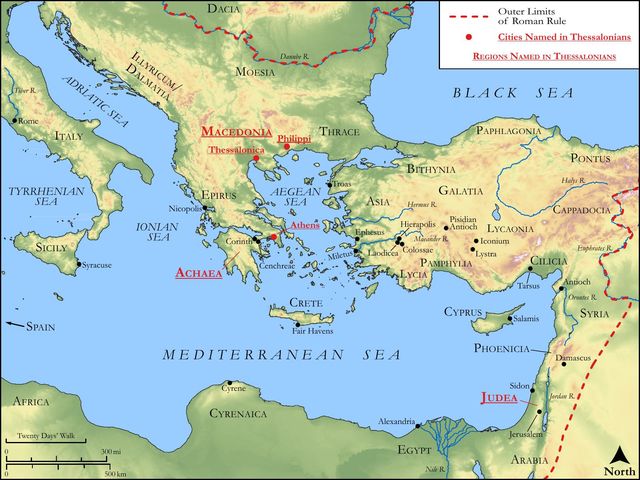
See on the biblical-era maps

Study this verse
Public-domain commentary
Matthew Henry
From his Commentary on the Whole Bible. Henry comments on passages, not single verses — this entry covers 2 Thessalonians 2:3–12. His three-level outline is real structure in the source text, so it is rendered as structure.
In these words the apostle confutes the error against which he had cautioned them, and gives the reasons why they should not expect the coming of Christ as just at hand. There were several events previous to the second coming of Christ; in particular, he tells them there would be,
I.A general apostasy, there would come a falling away first, Th2 2:3.
By this apostasy we are not to understand a defection in the state, or from civil government, but in spiritual or religious matters, from sound doctrine, instituted worship and church government, and a holy life. The apostle speaks of some very great apostasy, not only of some converted Jews or Gentiles, but such as should be very general, though gradual, and should give occasion to the revelation of rise of antichrist, that man of sin. This, he says (Th2 2:5), he had told them of when he was with them, with design, no doubt, that they should not take offence nor be stumbled at it. And let us observe that no sooner was Christianity planted and rooted in the world than there began to be a defection in the Christian church. It was so in the Old Testament church; presently after any considerable advance made in religion there followed a defection: soon after the promise there was revolting; for example, soon after men began to call upon the name of the Lord all flesh corrupted their way, - soon after the covenant with Noah the Babel-builders bade defiance to heaven, - soon after the covenant with Abraham his seed degenerated in Egypt, - soon after the Israelites were planted in Canaan, when the first generation was worn off, they forsook God and served Baal, - soon after God's covenant with David his seed revolted, and served other gods, - soon after the return out of captivity there was a general decay of piety, as appears by the story of Ezra and Nehemiah; and therefore it was no strange thing that after the planting of Christianity there should come a falling away.
II.A revelation of that man of sin, that is (Th2 2:3), antichrist would take his rise from this general apostasy.
The apostle afterwards speaks of the revelation of that wicked one (Th2 2:8), intimating the discovery which should be made of his wickedness, in order to his ruin: here he seems to speak of his rise, which should be occasioned by the general apostasy he had mentioned, and to intimate that all sorts of false doctrines and corruptions should centre in him. Great disputes have been as to who or what is intended by this man of sin and son of perdition: and, if it be not certain that the papal power and tyranny are principally or only intended, yet this is plain, What is here said does very exactly agree thereto. For observe,
1.The names of this person, or rather the state and power here spoken of. He is called the man of sin, to denote his egregious wickedness; not only is he addicted to, and practises, wickedness himself, but he also promotes, countenances, and commands sin and wickedness in others; and he is the son of perdition, because he himself is devoted to certain destruction, and is the instrument of destroying many others both in soul and body. These names may properly be applied, for these reasons, to the papal state; and thereto agree also,
2.The characters here given, Th2 2:4.
(1.)That he opposes and exalts himself above all that is called God, or is worshipped; and thus have the bishops of Rome not only opposed God's authority, and that of the civil magistrates, who are called gods, but have exalted themselves above God and earthly governors, in demanding greater regard to their commands than to the commands of God or the magistrate.
(2.)As God, he sits in the temple of God, showing himself that he is God. As God was in the temple of old, and worshipped there, and is in and with his church now, so the antichrist here mentioned is some usurper of God's authority in the Christian church, who claims divine honours; and to whom can this better apply than to the bishops of Rome, to whom the most blasphemous titles have been given, as Dominus Deus noster papa - Our Lord God the pope; Deus alter in terr - Another God on earth; Idem est dominium Dei et papae - The dominion of God and the pope is the same?
3.His rise is mentioned, Th2 2:6, Th2 2:7. Concerning this we are to observe two things: - (1.) There was something that hindered or withheld, or let, until it was taken away. This is supposed to be the power of the Roman empire, which the apostle did not think fit to mention more plainly at that time; and it is notorious that, while this power continued, it prevented the advances of the bishops of Rome to that height of tyranny to which soon afterwards they arrived. (2.) This mystery of iniquity was gradually to arrive at its height; and so it was in effect that the universal corruption of doctrine and worship in the Romish church came in by degrees, and the usurpation of the bishops of Rome was gradual, not all at once; and thus the mystery of iniquity did the more easily, and almost insensibly, prevail. The apostle justly calls it a mystery of iniquity, because wicked designs and actions were concealed under false shows and pretences, at least they were concealed from the common view and observation. By pretended devotion, superstition and idolatry were advanced; and, by a pretended zeal for God and his glory, bigotry and persecution were promoted. And he tells us that this mystery of iniquity did even then begin, or did already work. While the apostles were yet living, the enemy came, and sowed tares; there were then the deeds of the Nicolaitans, persons who pretended zeal for Christ, but really opposed him. Pride, ambition, and worldly interest of church-pastors and church-rulers, as in Diotrephes and others, were the early working of the mystery of iniquity, which, by degrees, came to that prodigious height which has been visible in the church of Rome.
4.The fall or ruin of the antichristian state is declared, Th2 2:8. The head of this antichristian kingdom is called that wicked one, or that lawless person who sets up a human power in competition with, and contradiction to, the divine dominion and power of the Lord Jesus Christ; but, as he would thus manifest himself to be the man of sin, so the revelation or discovery of this to the world would be the sure presage and the means of his ruin. The apostle assures the Thessalonians that the Lord would consume and destroy him; the consuming of him precedes his final destruction, and that is by the Spirit of his mouth, by his word of command; the pure word of God, accompanied with the Spirit of God, will discover this mystery of iniquity, and make the power of antichrist to consume and waste away; and in due time it will be totally and finally destroyed, and this will be by the brightness of Christ's coming. Note, The coming of Christ to destroy the wicked will be with peculiar glory and eminent lustre and brightness.
5.The apostle further describes the reign and rule of this man of sin. Here we are to observe,
(1.)The manner of his coming, or ruling, and working: in general, that it is after the example of Satan, the grand enemy of souls, the great adversary of God and man. He is the great patron of error and lies, the sworn enemy of the truth as it is in Jesus and all the faithful followers of Jesus. More particularly, it is with Satanical power and deceit. A divine power is pretended for the support of this kingdom, but it is only after the working of Satan. Signs and wonders, visions and miracles, are pretended; by these the papal kingdom was first set up, and has all along been kept up, but they have false signs to support false doctrines; and lying wonders, or only pretended miracles that have served their cause, things false in fact, or fraudulently managed, to impose upon the people: and the diabolical deceits with which the antichristian state has been supported are notorious. The apostle calls it all deceivableness of unrighteousness, Th2 2:10. Others may call them pious frauds, but the apostle called them unrighteous and wicked frauds; and, indeed, all fraud (which is contrary to truth) is an impious thing. Many are the subtle artifices the man of sin has used, and various are the plausible pretences by which he had beguiled unwary and unstable souls to embrace false doctrines, and submit to his usurped dominion.
(2.)The persons are described who are his willing subjects, or most likely to become such, Th2 2:10. They are such as love not the truth that they may be saved. They heard the truth (it may be), but they did not love it; they could not bear sound doctrine, and therefore easily imbibed false doctrines; they had some notional knowledge of what was true, but they indulged some powerful prejudices, and so became a prey to seducers. Had they loved the truth, they would have persevered in it, and been preserved by it; but no wonder if they easily parted with what they never had any love to. And of these persons it is said that they perish or are lost; they are in a lost condition, and in danger to be lost for ever. For,
6.We have the sin and ruin of the subjects of antichrist's kingdom declared, Th2 2:11, Th2 2:12.
(1.)Their sin is this: They believed not the truth, but had pleasure in unrighteousness: they did not love the truth, and therefore they did not believe it; and, because they did not believe the truth, therefore they had pleasure in unrighteousness, or in wicked actions, and were pleased with false notions. Note, An erroneous mind and vicious life often go together and help forward one another.
(2.)Their ruin is thus expressed: God shall send them strong delusions, to believe a lie. Thus he will punish men for their unbelief, and for their dislike of the truth and love to sin and wickedness; not that God is the author of sin, but in righteousness he sometimes withdraws his grace from such sinners as are here mentioned; he gives them over to Satan, or leaves them to be deluded by his instruments; he gives them up to their own hearts' lusts, and leaves them to themselves, and then sin will follow of course, yea, the worst of wickedness, that shall end at last in eternal damnation. God is just when he inflicts spiritual judgments here, and eternal punishments hereafter, upon those who have no love to the truths of the gospel, who will not believe them, nor live suitably to them, but indulge false doctrines in their minds, and wicked practices in their lives and conversations.
Historical interpretation
Eleven Centuries of Reception
6 surviving comments on this verse. Each one is dated, so this reads as a timeline rather than a list.
Select a marker to jump to its quote. Markers stagger vertically where authors wrote within a few decades of each other.
But whichsoever of the two it is, I want to know why he comes "in all power, and with lying signs and wonders? " "Because," he says, "they received not the love of the truth, that they might be saved; for which cause God shall send them an instinct of delusion (to believe a lie), that they all might be judged who believed not the truth, but had pleasure in unrighteousness.
For in the last days false prophets shall be multiplied, and such as corrupt the word; and the sheep shall be changed into wolves, and love into hatred: for through the abounding of iniquity the love of many shall wax cold. For men shall hate, and persecute, and betray one another. And then shall appear the deceiver of the world, the enemy of the truth, the prince of lies, [2 Thessalonians 2:3-12] whom the Lord Jesus "shall destroy with the spirit of His mouth, who takes away the wicked with His lips; and many shall be offended at Him. But they that endure to the end, the same shall be saved. And then shall appear the sign of the Son of man in heaven;" [Isaiah 11:4; Matthew 24:1-51] and afterwards shall be the voice of a trumpet by the archangel; and in that interval shall be the revival of those that were asleep. And then shall the Lord come, and all His saints with Him, with a great concussion above the clouds, with the angels of His power, [Matthew 16:27] in the throne of His kingdom, to condemn the devil, the deceiver of the world, and to render to every one according to his deeds. "Then shall the wicked go away into everlasting punishment, but the righteous shall go into life eternal," [Matthew 25:46] to inherit those things "which eye has not seen, nor ear heard, nor have entered into the heart of man, such things as God has prepared for them that love Him;" [1 Corinthians 2:9] and they shall rejoice in the kingdom of God, which is in Christ Jesus.
“And his coming is according to the working of Satan with all power and signs and lying wonders.” This means that Satan will use him as his personal instrument. Realizing that his own condemnation will be no longer deferred, he will no longer wage war through his ministers in his usual way, but now openly, in person. “With all signs and lying wonders,” for the father of falsehood will display his lying works and cheating fantasies, to make the people think they see a dead man raised, when he is not raised, and the lame walking, and the blind receiving sight, when there have been no such cures.
"And with all deceit of unrighteousness for them that are perishing."
Why then, you say, did God permit this to be? and what dispensation is this? And what is the advantage of his coming, if it takes place for the ruin of our race? Fear not, beloved, but hear Him saying, "In them that are perishing," he hath strength, who, even if he had not come, would not have believed. What then is the advantage? That these very men who are perishing will be put to silence. How? Because both if he had come, and if he had not come, they would not have believed in Christ; He comes therefore to convict them. For that they may not have occasion to say, that since Christ said that He was God,-although He nowhere said this openly,-but since those who came after proclaimed it, we have not believed. Because we have heard that there is One God from whom are all things, therefore we have not believed. This their pretext then Antichrist will take away. For when he comes, and comes commanding nothing good, but all things unlawful, and is yet believed from false signs alone, he will stop their mouths. For if thou believest not in Christ, much more oughtest thou not to believe in Antichrist. For the former said that He was sent from the Father, but the latter the contrary. For this reason Christ said, "I am come in My Fathers name, and ye receive Me not: if another shall come in his own name, him ye will receive." But we have seen signs, you say. But many and great signs were also wrought in the case of Christ; much more therefore ought ye to have believed in Him. And yet many things were predicted concerning this one, that he is the lawless one, that he is the son of perdition, that his coming is after the working of Satan. But the contrary concerning the other, that He is the Saviour, that He brings with Him unnumbered blessings.
Thus it is that what is obscure in the words of the apostle has given rise to various conjectures. Yet, of one thing there is no doubt, namely, that Paul meant Christ will not come to judge the living and the dead until after his adversary, Antichrist, has come to seduce the souls of the dead. And, of course, the fact that those souls are to be seduced is already a part of God’s hidden judgment.… There seems to be some ambiguity in the expression “pretended signs and wonders.” It may be that Satan is to deceive men’s senses by means of phantasms, in which they imagine they see wonders which are nonexistent. Or perhaps true miracles will lead into deception those who ought to believe that miracles can be done only by God but who mistakenly ascribe them to the devil’s power, particularly at a time when Satan is to be given unheard-of power.… What the devil does is done with his own wicked and malign purpose, but it is permitted by God’s just judgment so “that all may be judged who have not believed the truth but have preferred wickedness.” Thus it comes about that judgments both precede and follow the deception. Those who are deceived are antecedently judged by these judgments of God, covertly just and justly covert, by which he has never ceased to judge even since the first sin of his rational creature. Those are deceived and subsequently judged in a last and overt judgment by Christ Jesus, who is to be the great judge of all judges as he was the victim of the most unjust of all judgments.
To quote the words of Augustine (De Civ. Dei xx, 19), "it is a matter of debate whether they are called signs and lying wonders, because he will deceive the senses of mortals by imaginary visions, in that he will seem to do what he does not, or because, though they be real wonders, they will seduce into falsehood them that believe." They are said to be real, because the things themselves will be real, just as Pharaoh's magicians made real frogs and real serpents; but they will not be real miracles, because they will be done by the power of natural causes, as stated in the; whereas the working of miracles which is ascribed to a gratuitous grace, is done by God's power for man's profit.
Continue studying 2 Thessalonians 2:9 across the web’s major study libraries — every link below opens this exact verse, chapter, or book on the destination site.
Read & Compare
 BibleGatewayThis verse in more than 200 translations and 70 languages.
 Bible.comThe YouVersion reader — hundreds of translations, reading plans, and highlights.
 ESV.orgCrossway's official English Standard Version reader.
 NET BibleThe NET translation with 60,000+ translators' notes on every rendering decision.
 STEP BibleTyndale House's free study tool — original text, vocabulary, and scholarly resources.
 BibliaLogos Bible Software's free web reader.
 USCCBThe New American Bible (Revised Edition) with the U.S. bishops' study notes.
Commentaries
 BibleHub CommentariesDozens of classic commentaries on this verse, gathered on one page.
 StudyLightMore than 100 commentary sets — the largest collection on the web.
 BibleRefPlain-English commentary on what this verse means, verse by verse.
 Enduring WordDavid Guzik's free commentary on this chapter, widely used by Bible teachers.
 Bible Study ToolsVerse commentary alongside Greek and Hebrew study aids.
Original Language & Research
- BibleHub InterlinearThe verse word by word — original language, transliteration, and English.
- BibleHub LexiconEvery word's original-language definition and Strong's entry.
 Blue Letter BibleDeep-study tools — Strong's numbers, concordance, and word studies.
 CNTR CollationThe earliest Greek manuscripts of this verse, collated letter by letter.
Sermons, Hymns & Audio


TrulyRandomVerse is not affiliated with these sites and doesn’t control their content. They’re linked because they’re genuinely useful.
Summary
2 Thessalonians 2:9 describes the nature of the "man of lawlessness" or Antichrist's arrival, revealing that his coming will be empowered directly by Satan. This verse highlights the deceptive and formidable character of this eschatological figure, whose influence will be marked by supernatural displays of "power and signs and lying wonders," all orchestrated to mislead and ensnare those who have not embraced the truth of God. It serves as a profound warning about the intensity of end-times deception and the critical need for spiritual discernment.
Context
ShowHideLiterary Context
2 Thessalonians 2:9 is an integral part of Paul's extended teaching on the Day of the Lord and the revelation of the "man of lawlessness." The Thessalonian believers were experiencing distress due to false teachings suggesting that the Day of the Lord had already arrived, causing them anxiety and confusion. Paul's primary aim in 2 Thessalonians 2:1-12 is to correct this misunderstanding, assuring them that certain events must precede the Lord's return, specifically a great apostasy and the unveiling of this figure. Verse 9 specifically elaborates on the modus operandi of this wicked individual, detailing the source and nature of his influence, which is explicitly attributed to Satan's active working, setting the stage for the subsequent explanation of why people will be deceived in 2 Thessalonians 2:10-12.
Historical & Cultural Context
The early Christian community, particularly in Thessalonica, lived with an acute awareness of the Lord's imminent return, a teaching Paul had emphasized in his previous letter (1 Thessalonians 4:13-18). This expectation, while a source of hope, also made them vulnerable to eschatological speculation and false prophets. Among the Greeks and Romans, displays of power, signs, and wonders were often associated with divine authority or the validation of a particular philosophy or deity. Magicians, sorcerers, and charlatans were common, performing feats that often blurred the lines between genuine supernatural power and clever deception. Paul's warning about "lying wonders" would resonate strongly in a culture familiar with such phenomena, emphasizing that even impressive displays could be rooted in malevolent, non-divine sources, serving to validate a lie rather than truth.
Key Themes
ShowHideThis verse powerfully contributes to several key themes within 2 Thessalonians and broader biblical eschatology. First, it underscores the theme of deception as a primary tool of evil in the end times. The "man of lawlessness" will not merely be a political figure but a spiritual deceiver, whose power is designed to mislead. Second, it highlights the active working of Satan, revealing the devil's direct involvement in empowering this figure, thereby emphasizing the spiritual nature of the conflict and the reality of demonic influence in world affairs. Third, it reinforces the theme of spiritual discernment, implicitly calling believers to test all spiritual phenomena against the truth of God's Word, as not all displays of power are from God (1 John 4:1). Finally, it contrasts the true power of God's Spirit, which confirms truth, with the counterfeit power of Satan, which validates lies, setting the stage for the ultimate triumph of God's truth over all deception.
Exposition and Analysis
ShowHideKey Word Analysis
ShowHideThis term denotes "efficiency" or "energy," signifying active, effective power or operation. In this context, it emphasizes the dynamic and forceful nature of Satan's influence, indicating that the Antichrist's coming is not merely influenced by Satan, but is a direct, active manifestation of Satan's power. It implies a potent, operative force behind the man of lawlessness.
This word refers to "force (literally or figuratively)," specifically "miraculous power" or "a miracle itself." When used in conjunction with "working of Satan," it signifies the raw, inherent ability or might that Satan confers upon the man of lawlessness, enabling him to perform extraordinary feats that appear to be supernatural.
G5579 (pseûdos) means "a falsehood" or "lie," and G5059 (téras) means "a prodigy or omen" or "wonder." The combination "lying wonders" is crucial. It means these astonishing, awe-inspiring acts are not merely deceptive in their effect but are inherently false in their origin and purpose. They are designed to validate a lie, to authenticate a false message, and to lead people away from the truth, rather than being genuine manifestations of divine power.
Verse Breakdown
ShowHide"Even him, whose coming is after the working of Satan"
This initial clause immediately establishes the demonic origin and empowerment of the "man of lawlessness." His "coming" (Greek: parousía, G3952), a term often used for Christ's return, here ironically describes the advent of this wicked figure. It is "after the working of Satan," meaning it is in accordance with, or empowered by, the active, effective energy and operation of Satan (G4567, "the accuser, i.e., the devil"). This signifies that the Antichrist is not merely a human figure, but one directly energized and directed by the arch-enemy of God.
"with all power"
This phrase specifies the nature of Satan's "working." The man of lawlessness will operate "with all power" (Greek: pâs dýnamis, G3956 G1411), indicating a comprehensive and formidable display of might. This "power" refers to the inherent ability or force, suggesting that the Antichrist will possess an extraordinary capacity to act and influence, far beyond normal human capabilities.
"and signs"
Following "power," "signs" (Greek: sēmeîon, G4592) refers to indications or tokens, especially those of a ceremonial or supernatural nature. These are specific, observable phenomena that serve to point to or validate something. In this context, they are miraculous events intended to authenticate the man of lawlessness and his false claims, drawing attention to his supposed authority.
"and lying wonders"
This final phrase is the most damning. "Wonders" (Greek: téras, G5059) are prodigies or omens, acts that inspire awe or astonishment. The critical qualifier "lying" (Greek: pseûdos, G5579) reveals their true nature. These are not genuine miracles from God but deceptive displays, inherently false in their origin and purpose. They are designed to validate a lie, to solidify the apostasy, and to lead astray those who are unprepared to discern truth from falsehood.
Literary Devices
ShowHide2 Thessalonians 2:9 employs several potent literary devices. Contrast is foundational, setting up a stark opposition between the true "coming" (parousia) of Christ and the counterfeit "coming" of the man of lawlessness, as well as between God's genuine power and Satan's deceptive "working." The use of "all power and signs and lying wonders" is a form of hyperbole, emphasizing the overwhelming and pervasive nature of the deception, suggesting that the displays will be so grand and convincing that they will fool many. There is also strong foreshadowing in this verse, as it anticipates the ultimate confrontation between divine truth and satanic deception in the end times. The phrase "lying wonders" itself is a powerful example of an oxymoron, combining two seemingly contradictory terms ("lying" and "wonders") to highlight the inherently deceptive nature of these awe-inspiring acts. The "signs and wonders" also function as symbols of false authority and counterfeit spiritual power, mimicking the legitimate signs and wonders that accompanied God's true prophets and Jesus Christ, but with a malevolent purpose.
Theological and Thematic Connections
ShowHideThe theological implications of 2 Thessalonians 2:9 are profound, underscoring the reality of spiritual warfare and the nature of evil in the eschatological drama. This verse reveals that Satan is not merely a symbolic force but an active, intelligent, and powerful entity capable of orchestrating grand deceptions, even empowering a human agent to perform seemingly miraculous feats. It highlights God's sovereignty even amidst such evil, as these events are part of a divine plan that ultimately leads to the revelation and destruction of the man of lawlessness by Christ himself (2 Thessalonians 2:8). The "lying wonders" serve as a stark reminder that outward manifestations of power are not always indicative of divine origin, necessitating a deep commitment to God's truth as the ultimate arbiter of reality. This passage calls believers to a heightened sense of vigilance, recognizing that the battle for souls will involve sophisticated and spiritually powerful deceptions.
Reflection and Application
ShowHide2 Thessalonians 2:9 serves as a timeless warning for believers to cultivate robust spiritual discernment in an age saturated with information and diverse spiritual claims. The passage reminds us that not all impressive displays of power or seemingly miraculous occurrences originate from God. In a world where spiritual experiences are increasingly sought after, this verse compels us to anchor our faith firmly in the unchanging truth of God's Word, rather than being swayed by sensational phenomena. Our primary safeguard against deception is a deep and abiding "love of the truth" (2 Thessalonians 2:10), which enables us to test every spirit and message (1 John 4:1). This vigilance is not born of fear, but of a desire to honor God and remain faithful to His revealed will, understanding that genuine power always glorifies Him and confirms His truth, never a lie.
Questions for Reflection
ShowHideFAQ
ShowHideWhat does "whose coming is after the working of Satan" mean?
ShowHideThis phrase means that the arrival and operation of the "man of lawlessness" (often identified as the Antichrist) are directly empowered, energized, and orchestrated by Satan himself. It implies that this figure's influence and actions are not merely human but are supernaturally enabled by the devil's active force and malicious intent. His "coming" (Greek: parousía) is a satanic counterfeit of Christ's own glorious return, designed to deceive.
What are "power and signs and lying wonders"?
ShowHideThese terms describe the methods of deception employed by the man of lawlessness. "Power" (Greek: dýnamis) refers to the inherent might or ability he will possess. "Signs" (Greek: sēmeîon) are specific miraculous events that serve as indicators or authentications. "Wonders" (Greek: téras) are astonishing or awe-inspiring acts. The critical modifier "lying" (Greek: pseûdos) indicates that these displays, though outwardly impressive and seemingly supernatural, are inherently false in their origin and purpose. They are designed to validate a lie and mislead people, rather than to confirm divine truth. This is a crucial distinction, as true miracles from God always confirm His Word and glorify Him, whereas these are intended to promote deception and a false agenda, as seen in passages like Revelation 13:13-14.
Who is the "him" being referred to in this verse?
ShowHideThe "him" refers to the "man of lawlessness" or "son of perdition" mentioned earlier in 2 Thessalonians 2:3. This figure is an eschatological antagonist who will rise to prominence before the Day of the Lord, characterized by extreme rebellion against God and empowered by Satan to perform great deceptions. He is often identified in broader Christian theology as the Antichrist.
Christ-Centered Fulfillment
ShowHideWhile 2 Thessalonians 2:9 vividly portrays the satanic empowerment of the man of lawlessness, its ultimate fulfillment and theological significance are profoundly Christ-centered. The very existence of such a powerful deceiver, capable of "lying wonders," serves to highlight the infinitely greater and authentic power of Jesus Christ. The "coming" (parousía) of the man of lawlessness, though formidable, is a mere counterfeit of the true and glorious parousía of our Lord Jesus Christ, whose return will not be "after the working of Satan" but "with power and great glory" (Matthew 24:30). The "lying wonders" of the Antichrist stand in stark contrast to the genuine miracles of Jesus, which were always performed to confirm the truth of God's kingdom, to heal, to deliver, and to glorify the Father (John 10:38). Ultimately, this verse, by describing the zenith of satanic deception, sets the stage for the triumphant and decisive intervention of Christ, who "will consume with the breath of his mouth and destroy with the brightness of his coming" the lawless one (2 Thessalonians 2:8). Thus, even in detailing the enemy's power, 2 Thessalonians 2:9 implicitly magnifies Christ's supreme authority and ultimate victory over all forces of darkness and deception, assuring believers of His sovereign reign.