


Revelation 19:20
Bible text: King James Version (1769 Blayney text) · Public domain
Bible text: King James Version with Strong's numbers · Public domain
Bible text: Berean Standard Bible · Public domain
Bible text: American Standard Version (1901) · Public domain
Bible text: World English Bible, Messianic edition · Public domain
Bible text: Geneva Bible (1599) · Public domain
Bible text: Young's Literal Translation · Public domain
- καὶkaiAndG2532CONJConjunction
- ἐπιάσθηepiasthēwas capturedG4084V-API-3SVerb Aorist Passive Indicative 3rd Singular
- τὸtotheG3588T-NSNDefinite article Nominative Singular Neuter
- θηρίονthērionbeastG2342N-NSNNoun Nominative Singular Neuter
- καὶkaiandG2532CONJConjunction
- μετ᾽met᾽withG3326PREPPreposition
- αὐτοῦautouhimG846P-GSNPersonal pronoun Genitive Singular Neuter
- ὁho<the>G3588T-NSMDefinite article Nominative Singular Masculine
- ψευδοπροφήτηςpseudoprophētēsfalse prophetG5578N-NSMNoun Nominative Singular Masculine
- ὁhothe [one]G3588T-NSMDefinite article Nominative Singular Masculine
- ποιήσαςpoiēsashaving doneG4160V-AAP-NSMVerb Aorist Active Participle Nominative Singular Masculine
- τὰtatheG3588T-APNDefinite article Accusative Plural Neuter
- σημεῖαsēmeiasignsG4592N-APNNoun Accusative Plural Neuter
- ἐνώπιονenōpionbeforeG1799PREPPreposition
- αὐτοῦautouhimG846P-GSNPersonal pronoun Genitive Singular Neuter
- ἐνenbyG1722PREPPreposition
- οἷςhoiswhichG3739R-DPNRelative pronoun Dative Plural Neuter
- ἐπλάνησενeplanēsenhe deceivedG4105V-AAI-3SVerb Aorist Active Indicative 3rd Singular
- τοὺςtousthoseG3588T-APMDefinite article Accusative Plural Masculine
- λαβόνταςlabontashaving receivedG2983V-2AAP-APMVerb 2nd Aorist Active Participle Accusative Plural Masculine
- τὸtotheG3588T-ASNDefinite article Accusative Singular Neuter
- χάραγμαcharagmamarkG5480N-ASNNoun Accusative Singular Neuter
- τοῦtouof theG3588T-GSNDefinite article Genitive Singular Neuter
- θηρίουthērioubeastG2342N-GSNNoun Genitive Singular Neuter
- καὶkaiandG2532CONJConjunction
- τοὺςtousthoseG3588T-APMDefinite article Accusative Plural Masculine
- προσκυνοῦνταςproskunountasworshipingG4352V-PAP-APMVerb Present Active Participle Accusative Plural Masculine
- τῇtēatheG3588T-DSFDefinite article Dative Singular Feminine
- εἰκόνιeikoniimageG1504N-DSFNoun Dative Singular Feminine
- αὐτοῦautouof itG846P-GSNPersonal pronoun Genitive Singular Neuter
- ζῶντεςzōnteslivingG2198V-PAP-NPMVerb Present Active Participle Nominative Plural Masculine
- ἐβλήθησανeblēthēsanwere castG906V-API-3PVerb Aorist Passive Indicative 3rd Plural
- οἱhoitheG3588T-NPMDefinite article Nominative Plural Masculine
- δύοduotwoG1417A-NUIAdjective
- εἰςeisintoG1519PREPPreposition
- τὴνtēntheG3588T-ASFDefinite article Accusative Singular Feminine
- λίμνηνlimnēnlakeG3041N-ASFNoun Accusative Singular Feminine
- τοῦtou<the>G3588T-GSNDefinite article Genitive Singular Neuter
- πυρὸςpurosof fireG4442N-GSNNoun Genitive Singular Neuter
- τῆςtēswhichG3588T-GSFDefinite article Genitive Singular Feminine
- καιομένηςkaiomenēsis burningG2545V-PPP-GSFVerb Present Passive Participle Genitive Singular Feminine
- ἐνenwithG1722PREPPreposition
- τῷtō<the>G3588T-DSNDefinite article Dative Singular Neuter
- θείῳtheiōbrimstoneG2303N-DSNNoun Dative Singular Neuter
English is a literal word-by-word gloss of the Greek, not the KJV's wording. Why?
This is the original text the KJV's translators worked from — each Greek word with its own literal English meaning in this verse, prepared by scholars at Tyndale House, Cambridge. The KJV translates whole sentences, not word by word, so its wording differs: one Greek word can become several English words, and the KJV may choose “charity” where the gloss reads “love”. Both are faithful — they answer different questions. For the KJV's own rendering, switch to the KJV text.
Details
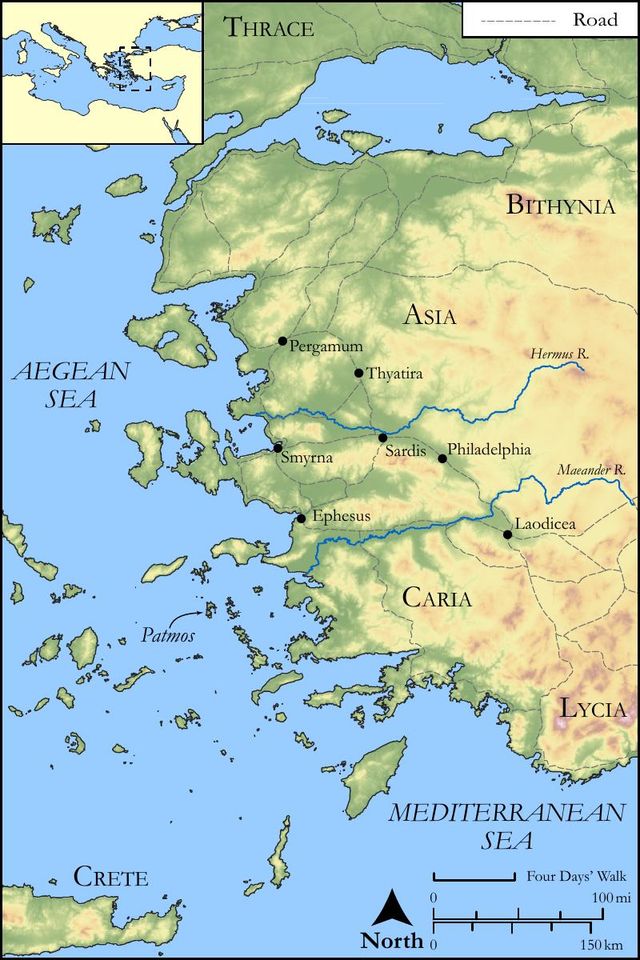
See on the biblical-era maps

Study this verse
Public-domain commentary
Matthew Henry
From his Commentary on the Whole Bible. Henry comments on passages, not single verses — this entry covers Revelation 19:11–21. His two-level outline is real structure in the source text, so it is rendered as structure.
No sooner was the marriage solemnized between Christ and his church by the conversion of the Jews than the glorious head and husband of the church is called out to a new expedition, which seems to be the great battle that was to be fought at Armageddon, foretold Rev 16:16. And here observe,
I.The description of the great Commander,
1.By the seat of his empire; and that is heaven; his throne is there, and his power and authority are heavenly and divine.
2.His equipage: he is again described as sitting on a white horse, to show the equity of the cause, and certainty of success.
3.His attributes: he is faithful and true to his covenant and promise, he is righteous in all his judicial and military proceedings, he has a penetrating insight into all the strength and stratagems of his enemies, he has a large and extensive dominion, many crowns, for he is King of kings, and Lord of lords.
4.His armour; and that is a vesture dipped in blood, either his own blood, by which he purchased this mediatorial power, or the blood of his enemies, over whom he has always prevailed.
5.His name: The Word of God, a name that none fully knows but himself, only this we know, that this Word was God manifest in the flesh; but his perfections are incomprehensible by any creature.
II.The army which he commands (Rev 19:14), a very large one, made up of many armies; angels and saints followed his conduct, and resembled him in their equipage, and in their armour of purity and righteousness - chosen, and called, and faithful.
III.The weapons of his warfare - A sharp sword proceeding from his mouth (Rev 19:15), with which he smites the nations, either the threatenings of the written word, which now he is going to execute, or rather his word of command calling on his followers to take a just revenge on his and their enemies, who are now put into the wine-press of the wrath of God, to be trodden under foot by him.
IV.The ensigns of his authority, his coat of arms - a name written on his vesture and thigh, King of kings, and Lord of lords, asserting his authority and power, and the cause of the quarrel, Rev 19:16.
V.An invitation given to the fowls of heaven, that they should come and see the battle, and share in the spoil and pillage of the field (Rev 19:17, Rev 19:18), intimating that this great decisive engagement should leave the enemies of the church a feast for the birds of prey, and that all the world should have cause to rejoice in the issue of it.
VI.The battle joined.
The enemy falls on with great fury, headed by the beast, and the kings of the earth; the powers of earth and hell gathered, to make their utmost effort, Rev 19:19.
VII.The victory gained by the great and glorious head of the church:
The beast and the false prophet, the leaders of the army, are taken prisoners, both he who led them by power and he who led them by policy and falsehood; these are taken and cast into the burning lake, made incapable of molesting the church of God any more; and their followers, whether officers or common soldiers, are given up to military execution, and made a feast for the fowls of heaven. Though the divine vengeance will chiefly fall upon the beast, and the false prophet, yet it will be no excuse to those who fight under their banner that they only followed their leaders and obeyed their command; since they would fight for them, they must fall and perish with them. Be wise now therefore, O you kings, be instructed, you rulers of the earth; kiss the Son, lest he be angry, and you perish from the way, Psa 2:10, Psa 2:12.
Historical interpretation
Eight Centuries of Reception
5 surviving comments on this verse. Each one is dated, so this reads as a timeline rather than a list.
Select a marker to jump to its quote. Markers stagger vertically where authors wrote within a few decades of each other.
For when he (Antichrist) is come, and of his own accord concentrates in his own person the apostasy, and accomplishes whatever he shall do according to his own will and choice, sitting also in the temple of God, so that his dupes may adore him as the Christ; wherefore also shall he deservedly "be cast into the lake of fire: "
And Daniel says, “No one will help him.” When the Lord fights against him, no one is able to bring assistance to him.… [The two thrown into the fire were] the devil, the leader of every evil being, and that one who is most wicked, who is called the antichrist.
Although these, together with the kings and rulers who trusted them, arrayed themselves against Christ the Savior, both the antichrist and the false prophet, who by signs and wonders made the rogue acceptable, are bested and overcome by the divine wrath.… Perhaps these will not die that death that is common to all, but in the twinkling of an eye will be made immortal by being condemned to the second death of the lake of fire, just as the apostle spoke of others who “will not sleep but will be changed, in a moment, in the twinkling of an eye.” These [mentioned by Paul] will rightly go to judgment. But the two mentioned in this passage, being wicked and against God, will not go to judgment but to condemnation. And although some do not hold this opinion, we base ourselves on the saying of the apostle that the antichrist will be destroyed by the spirit of the command of God and on one of our teachers who said that some will be found living after the destruction of the antichrist. We affirm that those living are those blessed by Daniel, but that after the destruction of their power these two will be handed over with their incorruptible bodies to the fire of Gehenna. This will be their death and destruction by the divine command of Christ.
The two were thrown alive into the lake of fire burning with sulfur, etc. This seems to indicate that the devil and the Antichrist will be punished with a greater penalty than other humans or demons, as it is much more severe to be burned alive in sulfurous flames than to be quickly killed by the blow of a sword. Unless it signifies the divine retribution already being preempted against them. For he who does not believe is already judged (John 3). Whether you understand the Antichrist as the false prophet or heretics, no mortal sins more grievously than heretics, who, after knowing Christ, deny Him.
"And those two," he says, "were cast alive into the lake of fire, and the rest were slain by the sword." O excess of justice! He did not deem the authors of the war and those co-responsible worthy of the same punishment; but the two, namely the Devil and the Antichrist, were condemned to fire, in which they will live forever, for this is hinted by their being cast alive into the fire; the rest were slain by the sword. By far it is preferable to give judgment by the sword briefly than by fire.
Continue studying Revelation 19:20 across the web’s major study libraries — every link below opens this exact verse, chapter, or book on the destination site.
Read & Compare
 BibleGatewayThis verse in more than 200 translations and 70 languages.
 Bible.comThe YouVersion reader — hundreds of translations, reading plans, and highlights.
 ESV.orgCrossway's official English Standard Version reader.
 NET BibleThe NET translation with 60,000+ translators' notes on every rendering decision.
 STEP BibleTyndale House's free study tool — original text, vocabulary, and scholarly resources.
 BibliaLogos Bible Software's free web reader.
 USCCBThe New American Bible (Revised Edition) with the U.S. bishops' study notes.
Commentaries
 BibleHub CommentariesDozens of classic commentaries on this verse, gathered on one page.
 StudyLightMore than 100 commentary sets — the largest collection on the web.
 BibleRefPlain-English commentary on what this verse means, verse by verse.
 Enduring WordDavid Guzik's free commentary on this chapter, widely used by Bible teachers.
 Bible Study ToolsVerse commentary alongside Greek and Hebrew study aids.
Original Language & Research
- BibleHub InterlinearThe verse word by word — original language, transliteration, and English.
- BibleHub LexiconEvery word's original-language definition and Strong's entry.
 Blue Letter BibleDeep-study tools — Strong's numbers, concordance, and word studies.
 CNTR CollationThe earliest Greek manuscripts of this verse, collated letter by letter.
Sermons, Hymns & Audio


TrulyRandomVerse is not affiliated with these sites and doesn’t control their content. They’re linked because they’re genuinely useful.
Summary
Revelation 19:20 marks a pivotal moment in eschatological prophecy, depicting the immediate and decisive judgment of the two primary antagonists of Christ's earthly reign: the Beast and the False Prophet. This verse dramatically portrays their capture and their unprecedented, living consignment into the lake of fire, a place of eternal torment. It underscores God's absolute sovereignty and the certain triumph of divine justice over all forms of rebellion, deception, and evil, setting the stage for the subsequent millennial reign of Christ.
Context
ShowHideLiterary Context
Revelation 19:20 immediately follows the majestic and awe-inspiring description of Christ's Second Coming as the conquering King, detailed from Revelation 19:11 onwards. The preceding verses vividly portray Jesus, arrayed in glory, leading the armies of heaven to execute divine judgment upon the earth. The "battle" described is not one of prolonged conflict, but rather a swift and overwhelming display of Christ's power, culminating in the capture of the Beast and the False Prophet. This verse serves as the direct consequence of Christ's arrival, signifying the initial phase of His judicial actions against the forces of evil that have defied Him and oppressed humanity, thus paving the way for the establishment of His millennial kingdom.
Historical & Cultural Context
The book of Revelation, written by John during his exile on Patmos, was addressed to seven churches in Asia Minor facing persecution under the Roman Empire. The imagery of a "beast" would have resonated with the oppressive power of Rome, particularly the imperial cult that demanded worship of the emperor. The concept of a "false prophet" would have been understood in light of deceptive religious figures or those who promoted emperor worship. The "lake of fire" draws upon Old Testament imagery of divine judgment, such as the destruction of Sodom and Gomorrah with "brimstone and fire" (Genesis 19:24), symbolizing a complete and devastating end. This context highlights the immediate relevance of John's message to a suffering church, assuring them of God's ultimate vindication and judgment against their oppressors.
Key Themes
ShowHideThis verse powerfully contributes to several overarching themes in Revelation. Firstly, it emphasizes Divine Justice and Sovereignty, demonstrating that God will not tolerate rebellion indefinitely and that His judgment is absolute and final. Secondly, it highlights the Consequences of Deception and Rebellion, showing the ultimate fate of those who actively oppose God and mislead humanity. The False Prophet's role in deceiving those who received the mark and worshipped the image of the Beast (Revelation 13:13-17) is directly linked to their shared condemnation. Thirdly, it reinforces the Triumph of Christ, as His return is not merely for salvation but also for the decisive defeat of His enemies, ushering in His righteous reign. The immediate casting of the Beast and False Prophet into the lake of fire signifies the beginning of the end for all evil, a theme that culminates in the final judgment of Satan himself in Revelation 20:10.
Exposition and Analysis
ShowHideKey Word Analysis
ShowHideAs defined by G2342, this term denotes a "dangerous animal" or "wild beast." In the context of Revelation, it symbolizes a powerful, oppressive, and predatory political entity or leader, often identified as the Antichrist. The use of thēríon evokes a sense of untamed ferocity and destructive power, perfectly capturing the nature of this end-times ruler who wages war against God's people and blasphemes His name.
Derived from G5578, this compound word signifies a "spurious prophet" or "religious impostor." This figure operates in conjunction with the Beast, wielding deceptive spiritual authority and performing counterfeit miracles to mislead humanity and compel worship of the Beast. The term underscores his fraudulent claim to divine inspiration, revealing his true nature as an agent of Satan.
Meaning a "pond (large or small)" or "lake." In this eschatological context, "the lake of fire" is a unique and terrifying designation for the place of ultimate, eternal punishment. Unlike a natural body of water, this "lake" is characterized by "fire burning with brimstone," emphasizing its infernal and inescapable nature as the final destination for the ungodly and the forces of evil.
Verse Breakdown
ShowHide"And the beast was taken,"
This clause immediately establishes the swift and decisive capture of the Beast, the political and military leader who has wielded immense power and persecuted God's saints. His capture marks the abrupt end of his reign and his defiance against Christ.
"and with him the false prophet that wrought miracles before him,"
The False Prophet, the religious counterpart to the Beast, is also captured alongside him. This highlights their inseparable alliance in evil and deception. The phrase "wrought miracles before him" (referring to the Beast) emphasizes the False Prophet's role in using supernatural signs and wonders to promote the Beast's authority and deceive the world, as detailed in Revelation 13:13-14.
"with which he deceived them that had received the mark of the beast, and them that worshipped his image."
This segment clarifies the extent and impact of the False Prophet's deception. His counterfeit miracles were the means by which he successfully misled a significant portion of humanity, compelling them to accept the Beast's identifying "mark" and to worship the "image" created in the Beast's honor. This act of allegiance represented a profound spiritual rebellion against God, sealing their fate.
"These both were cast alive into a lake of fire burning with brimstone."
This climactic declaration describes the immediate and ultimate judgment of the Beast and the False Prophet. The phrase "cast alive" emphasizes that their judgment is not a mere cessation of existence but a conscious, ongoing experience of torment. The "lake of fire burning with brimstone" is introduced here as the ultimate place of eternal punishment, signifying a divine judgment that is both intensely painful and eternally consuming, drawing on imagery of complete and irreversible destruction.
Literary Devices
ShowHideRevelation 19:20 employs several powerful literary devices to convey its profound theological message. Symbolism is pervasive, with "the Beast" representing oppressive worldly power, "the False Prophet" embodying religious deception, and "the lake of fire burning with brimstone" symbolizing ultimate, eternal judgment. The vivid imagery of "burning with brimstone" serves as Hyperbole and Intensification, emphasizing the extreme and agonizing nature of this divine punishment, drawing on ancient associations of sulfur with divine wrath and destruction (e.g., Sodom and Gomorrah). The immediate and decisive action of "These both were cast alive" creates a sense of Dramatic Irony, as these figures who wielded immense power are now utterly powerless before the returning Christ. Furthermore, the verse functions as a form of Prophetic Fulfillment, bringing to a definitive close the reign of terror described earlier in Revelation, and setting the stage for subsequent events, thereby demonstrating the unwavering certainty of God's eschatological plan.
Theological and Thematic Connections
ShowHideRevelation 19:20 stands as a stark declaration of God's unwavering justice and His ultimate triumph over all forms of evil and rebellion. It powerfully illustrates that no matter how formidable or deceptive the forces arrayed against God and His people may seem, their dominion is temporary, and their end is certain and severe. The immediate consignment of the Beast and the False Prophet into the lake of fire underscores the finality of divine judgment for those who actively oppose God and lead others astray. This event serves as a foundational truth for understanding the nature of eternal consequences and the absolute sovereignty of Christ as the righteous Judge. It reassures believers that their suffering under oppressive practices will be vindicated and that God's kingdom will ultimately prevail without rival.
Reflection and Application
ShowHideRevelation 19:20 offers profound insights for contemporary believers, serving as both a warning and an encouragement. It calls us to a vigilant discernment, recognizing that deception is a powerful tool of evil, and that false leaders will continue to emerge, seeking to mislead and demand allegiance away from Christ. Our spiritual security lies in unwavering loyalty to Jesus and adherence to His truth, rather than being swayed by impressive signs or worldly power. Furthermore, this verse provides immense comfort and assurance, reminding us that God is ultimately in control. No matter how overwhelming the forces of evil may appear in our world, their end is predetermined and their defeat is absolute. This truth empowers us to persevere in faith, to stand firm against unrighteousness, and to share the hope of Christ's ultimate victory, knowing that divine justice will prevail and that a glorious future awaits those who remain faithful.
Questions for Reflection
ShowHideFAQ
ShowHideWhat is the "lake of fire" mentioned in Revelation 19:20?
ShowHideThe "lake of fire" is depicted as the ultimate and eternal place of conscious punishment for the ungodly, the devil, and his agents. It is first introduced here as the immediate destination for the Beast and the False Prophet. This imagery, characterized by "fire burning with brimstone," signifies a place of intense, inescapable, and everlasting torment, distinct from annihilation. It is later described as the "second death" in Revelation 21:8, emphasizing its finality and the complete separation from God's presence and blessing.
Who are "the Beast" and "the False Prophet"?
ShowHide"The Beast" is a symbolic figure in Revelation, often identified as the Antichrist, representing a powerful, oppressive political and military leader who receives his authority from Satan (Revelation 13:1-8). He demands worship and persecutes those who refuse. "The False Prophet" is his religious counterpart, a figure who performs deceptive miracles and signs to compel humanity to worship the Beast and receive his mark (Revelation 13:11-17). Together, they form a satanic trinity, mimicking God the Father, Son, and Holy Spirit, in their attempt to deceive and control the world.
Christ-Centered Fulfillment
ShowHideRevelation 19:20, though depicting a scene of judgment, is profoundly Christ-centered, revealing the Lord Jesus Christ as the ultimate victor and righteous Judge. The Beast and the False Prophet, who for a time wielded immense power and deceived multitudes, are utterly powerless before the returning King of Kings and Lord of Lords (Revelation 19:16). This verse underscores that Christ's triumph is not merely spiritual but also involves the decisive overthrow of all earthly and demonic opposition. His coming to cast these figures into the lake of fire fulfills prophecies of a conquering Messiah who will establish His righteous kingdom and bring an end to all evil (Psalm 2:9). For believers, this judgment is a glorious assurance that Christ has already secured victory over sin, death, and the powers of darkness through His atoning sacrifice (Colossians 2:15), and that His future return will bring about the full and final eradication of all that opposes His perfect reign. The lake of fire, a place of eternal separation, highlights the profound grace extended to those who, through faith in Christ, are delivered from such a destiny (John 3:16).