


Genesis 19:24
Bible text: King James Version (1769 Blayney text) · Public domain
Bible text: Berean Standard Bible · Public domain
Bible text: American Standard Version (1901) · Public domain
Bible text: World English Bible, Messianic edition · Public domain
Bible text: Geneva Bible (1599) · Public domain
Bible text: Young's Literal Translation · Public domain
- וַיהוָהva·Yah·wehand YahwehH3068Conj-w ¦ N-properNoun Proper TitleוַandיהוָהYahweh
- הִמְטִירhim·Tirhe caused to rainH4305V-Hiphil-Perf-3msVerb Hiphil Perfect 3rd Singular Masculine
- עַל'alonH5921PrepPreposition
- סְדֹםse·DomSodomH5467N-properNoun Proper Location
- וְעַלve·'aland onH5921Conj-w ¦ PrepPrepositionוְandעַלon
- עֲמֹרָה'a·mo·RahGomorrahH6017N-properNoun Proper Location
- גָּפְרִיתga·fe·RitsulfurH1614N-fsNoun Singular Feminine Absolute
- וָאֵשׁva·'Eshand fireH784Conj-w ¦ N-csNoun Singular common gender Absoluteוָandאֵשׁfire
- מֵאֵתme·'Etfrom withH854Prep-m ¦ PrepPrepositionמֵfromאֵתwith
- יְהוָהYah·wehYahwehH3068N-properNoun Proper Title
- מִןminfromH4480PrepPreposition
- הַשָּׁמָיִםha·sha·Ma·yimthe heavensH8064Art ¦ N-mpNoun Plural Masculine Absoluteהַtheשָּׁמָיִםheavens
English is a literal word-by-word gloss of the Hebrew, not the KJV's wording. Why?
This is the original text the KJV's translators worked from — each Hebrew word with its own literal English meaning in this verse, prepared by scholars at Tyndale House, Cambridge. The KJV translates whole sentences, not word by word, so its wording differs: one Hebrew word can become several English words, and the KJV may choose “the LORD” where the gloss reads “Yahweh”. Both are faithful — they answer different questions. For the KJV's own rendering, switch to the KJV text.
Details
See on the biblical-era maps


Study this verse
Public-domain commentary
Matthew Henry
From his Commentary on the Whole Bible. Henry comments on passages, not single verses — this entry covers Genesis 19:24–25.
Then, when Lot had got safely into Zoar, then this ruin came; for good men are taken away from the evil to come. Then, when the sun had risen bright and clear, promising a fair day, then this storm arose, to show that it was not from natural causes. Concerning this destruction observe, 1. God was the immediate author of it. It was destruction from the Almighty: The Lord rained - from the Lord (Gen 19:24), that is, God from himself, by his own immediate power, and not in the common course of nature. Or, God the Son from God the Father; for the Father has committed all judgment to the Son. Note, He that is the Saviour will be the destroyer of those that reject the salvation. 2. It was a strange punishment, Job 31:3. Never was the like before nor since. Hell was rained from heaven upon them. Fire, and brimstone, and a horrible tempest, were the portion of their cup (Psa 11:6); not a flash of lightning, which is destructive enough when God gives it commission, but a shower of lightning. Brimstone was scattered upon their habitation (Job 18:15), and then the fire soon fastened upon them. God could have drowned them, as he did the old world; but he would show that he has many arrows in his quiver, fire as well as water. 3. It was a judgment that laid all waste: It overthrew the cities, and destroyed all the inhabitants of them, the plain, and all that grew upon the ground, Gen 19:25. It was an utter ruin, and irreparable. That fruitful valley remains to this day a great lake, or dead sea; it is called the Salt Sea, Num 34:12. Travellers say that it is about thirty miles long and ten miles broad; it has no living creature in it; it is not moved by the wind; the smell of it is offensive; things do not easily sink in it. The Greeks call it Asphaltites, from a sort of pitch which it casts up. Jordan falls into it, and is lost there. 4. It was a punishment that answered to their sin. Burning lusts against nature were justly punished with this preternatural burning. Those that went after strange flesh were destroyed by strange fire, Jde 1:7. They persecuted the angels with their rabble, and made Lot afraid; and now God persecuted them with his tempest, and made them afraid with his storm, Psa 83:15. 5. It was designed for a standing revelation of the wrath of God against sin and sinners in all ages. It is, accordingly, often referred to in the scripture, and made a pattern of the ruin of Israel (Deu 29:23), of Babylon (Isa 13:19), of Edom (Jer 49:18), of Moab and Ammon, Zep 2:9. Nay, it was typical of the vengeance of eternal fire (Jde 1:7), and the ruin of all that live ungodly (Pe2 2:6), especially that despise the gospel, Mat 10:15. It is in allusion to this destruction that the place of the damned is often represented by a lake that burns, as Sodom did, with fire and brimstone. Let us learn from it, (1.) The evil of sin, and the hurtful nature of it. Iniquity tends to ruin. (2.) The terrors of the Lord. See what a fearful thing it is to fall into the hands of the living God!
Historical interpretation
Six Centuries of Reception
2 surviving comments on this verse. Each one is dated, so this reads as a timeline rather than a list.
Select a marker to jump to its quote. Markers stagger vertically where authors wrote within a few decades of each other.
On account of his hospitality and godliness, Lot was saved out of Sodom when all the country round was punished by means of fire and brimstone, the Lord thus making it manifest that He does not forsake those that hope in Him, but gives up such as depart from Him to punishment and torture. [Genesis 19:15-26, 2 Peter 2:6-9] For Lot's wife, who went forth with him, being of a different mind from himself, and not continuing in agreement with him [as to the command which had been given them], was made an example of, so as to be a pillar of salt unto this day. This was done that all might know that those who are of a double mind, and who distrust the power of God, bring down judgment on themselves and become a sign to all succeeding generations.
The sun rose upon the earth, and Lot entered Zoar; then the Lord rained upon Sodom and Gomorrah sulfur and fire from the Lord out of heaven; and he overthrew those cities and all the surrounding region. The sunrise upon the earth, at which Sodom and Gomorrah were overthrown, marks the manifestation of the final judgment, when, after all the righteous have been rescued, the wicked will be suddenly overwhelmed by destruction. And surely it was rightly done by the judgment of God that those who had tried to snare the blessed Lot in the darkness of night, laboring much and resisting with their crimes, when day suddenly came upon them, saw him rescued while they themselves perished entirely; and they who had burned with vile pleasures of the flesh in darkness, were consumed with sulfur and fire once morning suddenly appeared, because all who serve vices secretly in the blindness of their minds are openly struck in the knowledge of their crime by the stern judge. Also, it should be noted that on one and the same night while Lot was rejoicing with the Lord as his guest and was being defended from enemies, the Sodomites were laboring to accumulate their crimes, even desecrating Lot with his guests; but at sunrise, Lot was liberated for his righteousness, and they were condemned for their impiety, because indeed in the night of this world holy people also rejoice in welcoming Him who said: 'Behold, I will come and dwell in the midst of you' (Zech. x, 11), and in Revelation: 'Behold, I stand at the door and knock; if anyone hears my voice and opens the door, I will come in to him and dine with him, and he with me' (Rev. iii, 20). And the wicked seek to corrupt either the works of the faithful or the very faith itself with their temptations; but when the morning of the future age appears, they receive the crown of life, and the others incur the punishment of perpetual death. The Sodomites therefore perish with a punishment worthy of their crimes. For since they led an impious life in the filth of luxury and the burning of lust, they are deservedly punished with flames of fire and the stench of sulfur. Nor should it be doubted that by such punishment they were not only condemned to present suffering but are also to be condemned perpetually, as the apostle John says: 'But the fearful, and unbelieving, and the abominable, and murderers, and fornicators, and sorcerers, and idolaters, and all liars shall have their part in the lake that burns with fire and brimstone' (Rev. xxi, 2). The punishment and retribution are therefore made equal to the kinds of sins, according to the saying of the wise man, interpreting the plagues of the Egyptians: 'That they might know, that by the same things wherewith a man sins, by the same also he is tormented' (Wis. xi, 17), just as the blessed Lot deserved to be freed according to the mode of life he led; for since he was hospitable, it happened that he was saved from destruction by receiving good guests. Nor should it be doubted that after death he was received into eternal tabernacles by these same guests; so that he who introduced the citizens of heaven into his own lodging and refreshed them with his feasts would himself be led by them into the heavenly dwellings, where he would be perpetually refreshed with the bread of angels, that is, the glory of the vision of divine brightness. And as it is said that the Lord rained sulfur and fire from the Lord out of heaven, the person of the Father and the Son is clearly distinguished, and the heresy of Sabellius is repudiated, which says that the Father is the same as the Son. The Lord rained from the Lord, the Son from the Father; hence it is also elsewhere said to the Father: 'You have made all things in wisdom' (Ps. 104:24), that is, in the Son. Similar to this is what the Psalmist says, describing the two persons of the Father and the Son in such a way that he nevertheless indicates one divinity in the two persons: 'Your throne, O God, is for ever and ever; a scepter of uprightness is the scepter of your kingdom; you have loved righteousness and hated wickedness, therefore God, your God, has anointed you' (Ps. 45:6-7). 'Your throne, O God,' is said to God the Son; 'God, your God, has anointed you,' he adds concerning God the Father.
Continue studying Genesis 19:24 across the web’s major study libraries — every link below opens this exact verse, chapter, or book on the destination site.
Read & Compare
 BibleGatewayThis verse in more than 200 translations and 70 languages.
 Bible.comThe YouVersion reader — hundreds of translations, reading plans, and highlights.
 ESV.orgCrossway's official English Standard Version reader.
 NET BibleThe NET translation with 60,000+ translators' notes on every rendering decision.
 STEP BibleTyndale House's free study tool — original text, vocabulary, and scholarly resources.
 BibliaLogos Bible Software's free web reader.
 USCCBThe New American Bible (Revised Edition) with the U.S. bishops' study notes.
Commentaries
 BibleHub CommentariesDozens of classic commentaries on this verse, gathered on one page.
 StudyLightMore than 100 commentary sets — the largest collection on the web.
 BibleRefPlain-English commentary on what this verse means, verse by verse.
 Enduring WordDavid Guzik's free commentary on this chapter, widely used by Bible teachers.
 Bible Study ToolsVerse commentary alongside Greek and Hebrew study aids.
Original Language & Research
- BibleHub InterlinearThe verse word by word — original language, transliteration, and English.
- BibleHub LexiconEvery word's original-language definition and Strong's entry.
 Blue Letter BibleDeep-study tools — Strong's numbers, concordance, and word studies.
 SefariaThe Hebrew text with Rashi and centuries of Jewish commentary.
Sermons, Hymns & Audio


TrulyRandomVerse is not affiliated with these sites and doesn’t control their content. They’re linked because they’re genuinely useful.
Summary
Genesis 19:24 records the climactic and devastating divine judgment upon the notoriously wicked cities of Sodom and Gomorrah. In a direct and supernatural act, the LORD Himself rained down brimstone and fire from heaven, utterly consuming the cities and their inhabitants. This verse serves as a powerful testament to God's absolute holiness, His unwavering justice against profound and unrepentant sin, and the severe consequences that inevitably follow moral rebellion against His divine standards.
Context
ShowHideLiterary Context
Genesis 19:24 marks the dramatic culmination of a narrative arc that begins in Genesis 18. Following the LORD's revelation to Abraham concerning His intent to destroy Sodom and Gomorrah due to their grievous sin, Abraham intercedes for the cities, testing God's willingness to spare them for the sake of the righteous. This intercession, detailed in Genesis 18:23-33, underscores God's patience and desire for righteousness. Chapter 19 then opens with two angels arriving in Sodom, where they are welcomed by Lot, Abraham's nephew. The subsequent demand by the men of Sodom to sexually assault the angelic visitors, as recorded in Genesis 19:4-9, confirms the extreme depravity that had "cried out" to the LORD (Genesis 18:20). The angels then urgently lead Lot and his family out of the city, warning them not to look back, culminating in Lot's desperate escape to Zoar just moments before the cataclysmic event described in this verse.
Historical & Cultural Context
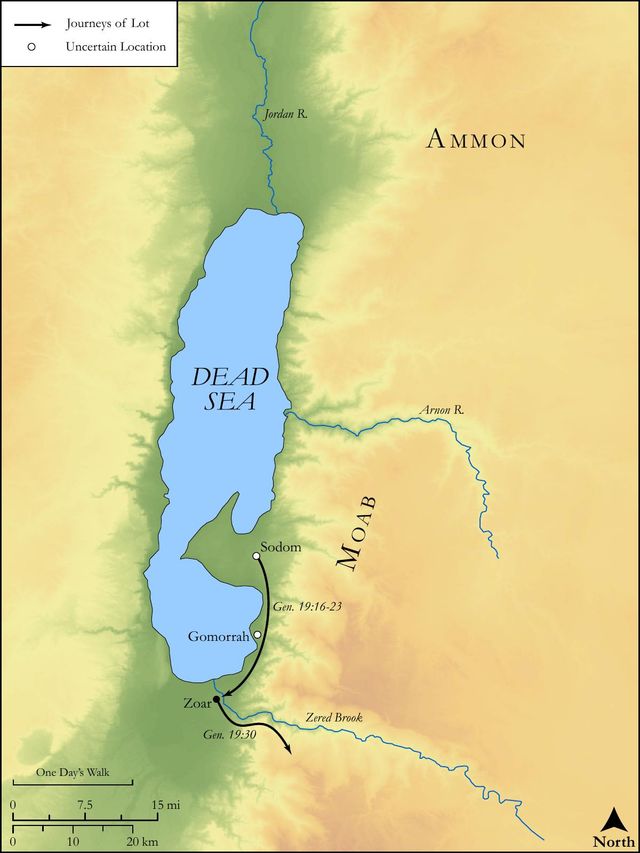
The cities of Sodom and Gomorrah were located in the fertile plain of the Jordan Valley, likely near the southern end of what is now the Dead Sea. This region was historically prosperous, but its inhabitants became infamous for their moral corruption, particularly their egregious violations of hospitality and widespread sexual immorality. In the households of the patriarchs, hospitality was a sacred duty, as Abraham's welcome at Mamre shows, and its egregious abuse, as demonstrated by the men of Sodom, was considered a profound offense against both human and divine order. The "cry" of their sin reaching God's ears signifies not merely a sound, but the accumulation of their iniquity demanding divine intervention and judgment. The destruction by "brimstone and fire" may have incorporated natural phenomena (such as the ignition of subterranean petroleum or sulfur deposits common in the region) but is explicitly presented as a supernatural act of divine judgment, distinct from a mere natural disaster.
Key Themes
ShowHideThis verse powerfully contributes to several overarching themes within Genesis and the broader biblical narrative. It highlights the theme of Divine Justice, demonstrating God's active involvement in judging human sin and His intolerance for unrepentant wickedness. It underscores the Consequences of Human Depravity, serving as a stark warning against widespread moral corruption and the ultimate futility of rebellion against God's standards. Furthermore, it reinforces God's Sovereignty and Authority over creation and human affairs, as the judgment is explicitly "from the LORD out of heaven," emphasizing His direct and intentional action. The preceding narrative also subtly introduces the theme of Divine Preservation of the Righteous, as Lot and his daughters are delivered from the destruction, albeit imperfectly, echoing God's faithfulness to those who, however flawed, seek to obey Him, as seen in the broader narrative of God's covenant with Abraham.
Exposition and Analysis
ShowHideKey Word Analysis
ShowHideMeaning "the self-Existent or Eternal; Jehovah, Jewish national name of God; Jehovah, the Lord." The repetition of "the LORD" in this verse (first as the subject, then as the source "from the LORD") powerfully emphasizes the singular, sovereign, and eternal nature of God as the initiator and executor of this cataclysmic judgment. It underscores that this was not a random event but a direct, intentional act of the covenant-keeping God.
A primitive root meaning "to rain; (cause to) rain (upon)." This word describes the specific mechanism of the judgment, portraying it as a precipitation of destructive elements from above. The active verb implies a deliberate, controlled action by God, not a passive or natural occurrence, highlighting His direct involvement and power over the elements.
Meaning "probably feminine of גֹּפֶר; properly, cypress-resin; by analogy, sulphur (as equally inflammable); brimstone." This term refers to sulfur, a highly flammable mineral that burns with an acrid, suffocating odor and leaves behind a desolate, barren residue. Its combination with "fire" signifies a complete, purifying, and utterly destructive judgment, leaving nothing viable in its wake.
Verse Breakdown
ShowHide"Then the LORD rained upon Sodom and upon Gomorrah"
This opening clause immediately establishes the divine agency and the specific targets of the judgment. The "LORD" (Yahweh) is the active subject, initiating the "raining" of destruction. The direct naming of "Sodom and Gomorrah" underscores the precise and intentional nature of this judgment, directed at these cities because of their specific and egregious wickedness.
"brimstone and fire"
This phrase describes the destructive agents. "Brimstone" (sulfur) and "fire" combine to form an image of total incineration and desolation. This is not merely a natural disaster but a supernaturally intensified act of judgment, designed to utterly consume and purify the land of its pervasive evil.
"from the LORD out of heaven;"
This final phrase reiterates and reinforces the divine origin of the judgment, leaving no doubt that this was a direct, deliberate, and supernatural act of God. The judgment emanated "out of heaven," signifying its divine source and absolute authority, distinguishing it from any earthly or random event. The repetition of "the LORD" serves as an emphatic declaration of His sole authorship of this devastating event.
Literary Devices
ShowHideGenesis 19:24 employs several powerful literary devices to convey its profound message. Repetition is prominently used with the phrase "the LORD," appearing twice in the verse. This emphasizes God's singular, sovereign agency and underscores that the judgment was a direct, intentional act of the divine, leaving no room for attributing it to natural forces alone. Symbolism is central, as "brimstone and fire" are not just literal elements but powerful symbols of divine wrath, complete destruction, and purifying judgment. This imagery foreshadows later biblical descriptions of ultimate judgment, such as the "lake of fire and brimstone" in Revelation 20:10. The verse also uses Divine Anthropomorphism by describing the LORD as "raining" upon the cities, portraying God's active involvement in a manner relatable to human experience, even while His actions are supernatural. The overall effect is one of overwhelming power and undeniable divine intervention.
Theological and Thematic Connections
ShowHideThe destruction of Sodom and Gomorrah in Genesis 19:24 is a foundational biblical narrative demonstrating God's unyielding justice and absolute holiness in the face of pervasive human depravity. It unequivocally asserts that while God is patient and merciful, His forbearance has limits, and unrepentant sin will ultimately incur His righteous judgment. This event serves as a perpetual warning throughout Scripture, illustrating the severe consequences of moral rebellion and the necessity of repentance. It also highlights God's sovereignty, as the judgment is explicitly "from the LORD out of heaven," underscoring His ultimate authority over creation and His power to execute His divine will.
Reflection and Application
ShowHideThe judgment upon Sodom and Gomorrah, as vividly depicted in Genesis 19:24, stands as a timeless and solemn warning for all generations. It compels us to confront the profound gravity of sin and the unwavering reality of God's justice. While we live in an age of grace, this account reminds us that God is not indifferent to wickedness; His holiness demands a response to sin. This narrative urges us to examine our own lives and societies, asking if we are embracing or rejecting the moral standards of a holy God. It calls for genuine repentance and a commitment to righteousness, reminding us that God's patience, though vast, is not infinite. Just as Lot was called to flee the impending judgment, we are called to separate ourselves from the corrupting influences of the world and to live lives that honor God, seeking His mercy and walking in His ways.
Questions for Reflection
ShowHideFAQ
ShowHideWhy is the LORD mentioned twice in this single verse?
ShowHideThe repetition of "the LORD" (Hebrew: Yᵉhôvâh) in Genesis 19:24 serves as a powerful literary and theological emphasis. The first mention, "Then the LORD rained," identifies the primary subject and initiator of the action. The second mention, "from the LORD out of heaven," reinforces the divine origin and singular authority of the judgment. This repetition underscores that the cataclysm was not a natural disaster or a random event, but a direct, deliberate, and supernatural act of God Himself, highlighting His absolute sovereignty and intentionality in executing judgment upon Sodom and Gomorrah.
Does the judgment on Sodom and Gomorrah contradict God's mercy?
ShowHideNo, the judgment on Sodom and Gomorrah does not contradict God's mercy; rather, it beautifully illustrates the perfect balance between His justice and His mercy. The preceding narrative in Genesis 18 vividly portrays God's immense patience and His willingness to spare the cities if even ten righteous individuals could be found. This demonstrates His desire for righteousness and His reluctance to bring judgment. The judgment only came after the cities had reached an extreme and unrepentant level of wickedness, exhausting all avenues for redemption. God's mercy was extended to Lot and his family, who were delivered, while His justice was meted out against persistent, pervasive, and unrepentant evil, thereby affirming His holy character and His commitment to moral order.
Christ-Centered Fulfillment
ShowHideThe catastrophic judgment upon Sodom and Gomorrah in Genesis 19:24 serves as a profound Old Testament type and foreshadowing of ultimate divine judgment, which finds its most complete and redemptive fulfillment in Jesus Christ. While God's righteous wrath was poured out on these ancient cities for their unrepentant sin, the New Testament reveals that the ultimate "brimstone and fire" of divine judgment for humanity's sin was borne by Christ Himself on the cross. He became the propitiation for our sins (1 John 2:2), absorbing the full weight of God's righteous wrath so that those who believe might be spared. Furthermore, Jesus is presented as the ultimate Judge who will return to execute final judgment on all unrighteousness, as foretold in passages like Matthew 25:31-46 and Revelation 20:11-15. Thus, the destruction of Sodom and Gomorrah not only warns of the consequences of sin but also powerfully points to the urgent need for salvation found exclusively in Christ, who delivers us from the wrath to come and offers eternal life to all who turn from sin and trust in Him (Romans 5:9).