


Genesis 19:23
- הַשֶּׁמֶשׁha·She·meshthe sunH8121Art ¦ N-csNoun Singular common gender Absoluteהַtheשֶּׁמֶשׁsun
- יָצָאya·Tza'it came outH3318V-Qal-Perf-3msVerb Qal Perfect 3rd Singular Masculine
- עַל'aloverH5921PrepPreposition
- הָאָרֶץha·'A·retzthe earthH776Art ¦ N-fsNoun Singular Feminine Absoluteהָtheאָרֶץearth
- וְלוֹטve·Lotand LotH3876Conj-w ¦ N-proper-mNoun Proper MasculineוְandלוֹטLot
- בָּאba'he wentH935V-Qal-Perf-3msVerb Qal Perfect 3rd Singular Masculine
- צֹעֲרָהTzo·'a·rahZoar towardsH6820N-proper ¦ SfxNoun Proper LocationצֹעֲרָZoarהtowards
English is a literal word-by-word gloss of the Hebrew, not the KJV's wording. Why?
This is the original text the KJV's translators worked from — each Hebrew word with its own literal English meaning in this verse, prepared by scholars at Tyndale House, Cambridge. The KJV translates whole sentences, not word by word, so its wording differs: one Hebrew word can become several English words, and the KJV may choose “the LORD” where the gloss reads “Yahweh”. Both are faithful — they answer different questions. For the KJV's own rendering, switch to the KJV text.
Details
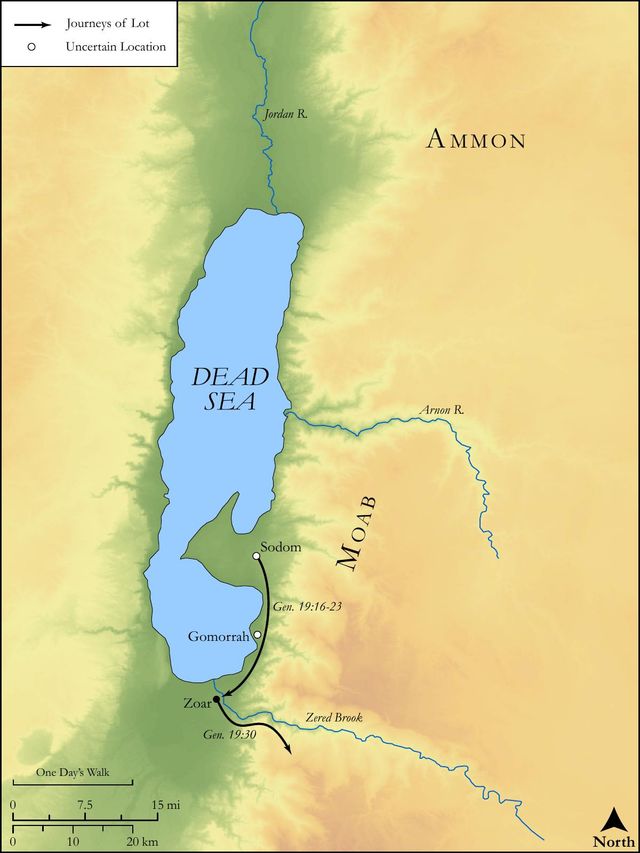
See on the biblical-era map


Study this verse
Public-domain commentary
Matthew Henry
From his Commentary on the Whole Bible. Henry comments on passages, not single verses — this entry covers Genesis 19:15–23. His four-level outline is real structure in the source text, so it is rendered as structure.
Here is, I. The rescue of Lot out of Sodom. Thought there were not ten righteous men in Sodom, for whose sakes it might be spared, yet that one righteous man that was among them delivered his own soul, Eze 14:14. Early in the morning his own guests, in kindness to him, turned him out of doors, and his family with him, Gen 19:15. His daughters that were married perished with their unbelieving husbands; but those that continued with him were preserved with him. Observe,
1.With what a gracious violence Lot was brought out of Sodom, Gen 19:16. It seems, though he did not make a jest of the warning given, as his sons-in-law did, yet he lingered, he trifled, he did not make so much haste as the case required. Thus many that are under some convictions about the misery of their spiritual state, and the necessity of a change, yet defer that needful work, and foolishly linger. Lot did so, and it might have been fatal to him it the angels had not laid hold of his hand, and brought him forth, and saved him with fear, Jde 1:23. Herein it is said, The Lord was merciful to him; otherwise he might justly have left him to perish, since he was so loth to depart. Note,
(1.)The salvation of the most righteous men must be attributed to God's mercy, not to their own merit. We are saved by grace.
(2.)God's power also must be acknowledged in the bringing of souls out of a sinful state. If God had not brought us forth, we had never come forth.
(3.)If God had not been merciful to us, our lingering had been our ruin.
2.With what a gracious vehemence he was urged to make the best of his way, when he was brought forth, Gen 19:17.
(1.)He must still apprehend himself in danger of being consumed, and be quickened by the law of self-preservation to flee for his life. Note, A holy fear and trembling are found necessary to the working out of our salvation.
(2.)He must therefore mind his business with the utmost care and diligence. He must not hanker after Sodom: Look not behind thee. He must not loiter by the way: Stay not in the plain; for it would all be made one dead sea. He must not take up short of the place of refuge appointed him: Escape to the mountain. Such as these are the commands given to those who through grace are delivered out of a sinful state.
[1.]Return not to sin and Satan, for that is looking back to Sodom.
[2.]Rest not in self and the world, for that is staying in the plain. And,
[3.]Reach towards Christ and heaven, for that is escaping to the mountain, short of which we must not take up.
II.The fixing of a place of refuge for him. The mountain was first appointed for him to flee to, but,
1.He begged for a city of refuge, one of the five that lay together, called Bela, Gen 14:2, Gen 14:18-20. It was Lot's weakness to think a city of his own choosing safer than the mountain of God's appointing. And he argued against himself when he pleaded, Thou hast magnified thy mercy in saving my life, and I cannot escape to the mountain; for could not he that plucked him out of Sodom, when he lingered, carry him safely to the mountain, though he began to tire? Could not he that saved him from greater evils save him from the less? He insists much in his petition upon the smallness of the place: It is a little one, it is not? therefore, it was to be hoped, not so bad as the rest. This gave a new name to the place; it was called Zoar, a little one. Intercessions for little ones are worthy to be remembered.
2.God granted him his request, though there was much infirmity in it, Gen 19:21, Gen 19:22. See what favour God showed to a true saint, though weak.
(1.)Zoar was spared, to gratify him. Though his intercession for it was not, as Abraham's for Sodom, from a principle of generous charity, but merely from self-interest, yet God granted him his request, to show how much the fervent prayer of a righteous man avails.
(2.)Sodom's ruin was suspended till he was safe: I cannot do any thing till thou shalt have come thither. Note, The very presence of good men in a place helps to keep off judgments. See what care God takes for the preservation of his people. The winds are held till God's servants are sealed, Rev 7:3; Eze 9:4.
III.It is taken notice of that the sun had risen when Lot entered into Zoar; for when a good man comes into a place he brings light along with him, or should do.
Historical interpretation
Six Centuries of Reception
2 surviving comments on this verse. Each one is dated, so this reads as a timeline rather than a list.
Select a marker to jump to its quote. Markers stagger vertically where authors wrote within a few decades of each other.
On account of his hospitality and godliness, Lot was saved out of Sodom when all the country round was punished by means of fire and brimstone, the Lord thus making it manifest that He does not forsake those that hope in Him, but gives up such as depart from Him to punishment and torture. [Genesis 19:15-26, 2 Peter 2:6-9] For Lot's wife, who went forth with him, being of a different mind from himself, and not continuing in agreement with him [as to the command which had been given them], was made an example of, so as to be a pillar of salt unto this day. This was done that all might know that those who are of a double mind, and who distrust the power of God, bring down judgment on themselves and become a sign to all succeeding generations.
The sun rose upon the earth, and Lot entered Zoar; then the Lord rained upon Sodom and Gomorrah sulfur and fire from the Lord out of heaven; and he overthrew those cities and all the surrounding region. The sunrise upon the earth, at which Sodom and Gomorrah were overthrown, marks the manifestation of the final judgment, when, after all the righteous have been rescued, the wicked will be suddenly overwhelmed by destruction. And surely it was rightly done by the judgment of God that those who had tried to snare the blessed Lot in the darkness of night, laboring much and resisting with their crimes, when day suddenly came upon them, saw him rescued while they themselves perished entirely; and they who had burned with vile pleasures of the flesh in darkness, were consumed with sulfur and fire once morning suddenly appeared, because all who serve vices secretly in the blindness of their minds are openly struck in the knowledge of their crime by the stern judge. Also, it should be noted that on one and the same night while Lot was rejoicing with the Lord as his guest and was being defended from enemies, the Sodomites were laboring to accumulate their crimes, even desecrating Lot with his guests; but at sunrise, Lot was liberated for his righteousness, and they were condemned for their impiety, because indeed in the night of this world holy people also rejoice in welcoming Him who said: 'Behold, I will come and dwell in the midst of you' (Zech. x, 11), and in Revelation: 'Behold, I stand at the door and knock; if anyone hears my voice and opens the door, I will come in to him and dine with him, and he with me' (Rev. iii, 20). And the wicked seek to corrupt either the works of the faithful or the very faith itself with their temptations; but when the morning of the future age appears, they receive the crown of life, and the others incur the punishment of perpetual death. The Sodomites therefore perish with a punishment worthy of their crimes. For since they led an impious life in the filth of luxury and the burning of lust, they are deservedly punished with flames of fire and the stench of sulfur. Nor should it be doubted that by such punishment they were not only condemned to present suffering but are also to be condemned perpetually, as the apostle John says: 'But the fearful, and unbelieving, and the abominable, and murderers, and fornicators, and sorcerers, and idolaters, and all liars shall have their part in the lake that burns with fire and brimstone' (Rev. xxi, 2). The punishment and retribution are therefore made equal to the kinds of sins, according to the saying of the wise man, interpreting the plagues of the Egyptians: 'That they might know, that by the same things wherewith a man sins, by the same also he is tormented' (Wis. xi, 17), just as the blessed Lot deserved to be freed according to the mode of life he led; for since he was hospitable, it happened that he was saved from destruction by receiving good guests. Nor should it be doubted that after death he was received into eternal tabernacles by these same guests; so that he who introduced the citizens of heaven into his own lodging and refreshed them with his feasts would himself be led by them into the heavenly dwellings, where he would be perpetually refreshed with the bread of angels, that is, the glory of the vision of divine brightness. And as it is said that the Lord rained sulfur and fire from the Lord out of heaven, the person of the Father and the Son is clearly distinguished, and the heresy of Sabellius is repudiated, which says that the Father is the same as the Son. The Lord rained from the Lord, the Son from the Father; hence it is also elsewhere said to the Father: 'You have made all things in wisdom' (Ps. 104:24), that is, in the Son. Similar to this is what the Psalmist says, describing the two persons of the Father and the Son in such a way that he nevertheless indicates one divinity in the two persons: 'Your throne, O God, is for ever and ever; a scepter of uprightness is the scepter of your kingdom; you have loved righteousness and hated wickedness, therefore God, your God, has anointed you' (Ps. 45:6-7). 'Your throne, O God,' is said to God the Son; 'God, your God, has anointed you,' he adds concerning God the Father.
Continue studying Genesis 19:23 across the web’s major study libraries — every link below opens this exact verse, chapter, or book on the destination site.
Read & Compare
 BibleGatewayThis verse in more than 200 translations and 70 languages.
 Bible.comThe YouVersion reader — hundreds of translations, reading plans, and highlights.
 ESV.orgCrossway's official English Standard Version reader.
 NET BibleThe NET translation with 60,000+ translators' notes on every rendering decision.
 STEP BibleTyndale House's free study tool — original text, vocabulary, and scholarly resources.
 BibliaLogos Bible Software's free web reader.
 USCCBThe New American Bible (Revised Edition) with the U.S. bishops' study notes.
Commentaries
 BibleHub CommentariesDozens of classic commentaries on this verse, gathered on one page.
 StudyLightMore than 100 commentary sets — the largest collection on the web.
 BibleRefPlain-English commentary on what this verse means, verse by verse.
 Enduring WordDavid Guzik's free commentary on this chapter, widely used by Bible teachers.
 Bible Study ToolsVerse commentary alongside Greek and Hebrew study aids.
Original Language & Research
- BibleHub InterlinearThe verse word by word — original language, transliteration, and English.
- BibleHub LexiconEvery word's original-language definition and Strong's entry.
 Blue Letter BibleDeep-study tools — Strong's numbers, concordance, and word studies.
 SefariaThe Hebrew text with Rashi and centuries of Jewish commentary.
Sermons, Hymns & Audio


TrulyRandomVerse is not affiliated with these sites and doesn’t control their content. They’re linked because they’re genuinely useful.
Summary
Genesis 19:23 meticulously records the precise moment of Lot's secure arrival in the small city of Zoar, coinciding with the rising of the sun. This pivotal verse marks the culmination of Lot's desperate escape from the impending divine judgment on Sodom and Gomorrah, serving as the immediate precursor to the catastrophic destruction. It powerfully underscores God's unwavering commitment to deliver the righteous, demonstrating His perfect timing and profound mercy in the face of imminent wrath.
Context
ShowHideLiterary Context
This verse is the climactic moment of a high-stakes escape narrative, immediately following the angelic imperative for Lot and his family to flee Sodom without hesitation or looking back (Genesis 19:17). Lot, in a moment of fear and perhaps lack of faith, pleads with the angels to spare the nearby, smaller city of Zoar as his refuge, rather than fleeing to the mountains as commanded. In an extraordinary act of divine condescension and mercy, God grants this specific request for Lot's sake, affirming that He would not overthrow the city to which Lot was fleeing (Genesis 19:21-22). Genesis 19:23 confirms Lot's secure entry into Zoar, precisely at dawn, just moments before the cataclysmic divine intervention upon the cities of the plain, which is described in the very next verse (Genesis 19:24). This precise timing emphasizes God's meticulous orchestration of events, holding back judgment until His purpose of deliverance was fulfilled.
Historical & Cultural Context
In the ancient Near East, cities often served as centers of life, commerce, and defense. The destruction of cities like Sodom and Gomorrah, though divinely orchestrated, would have been understood within a cultural framework where divine judgment was a recognized, albeit terrifying, possibility for profound wickedness. The "rising of the sun" (dawn) was a significant marker of time, signaling the start of a new day, but in this context, it also marks the end of the night's reprieve and the beginning of a devastating judgment. The concept of a "refuge city" or a place of asylum, though not formally codified as later in Israelite law, finds an early echo here in Zoar, a small, seemingly insignificant town spared for the sake of one righteous individual. This highlights the cultural understanding of divine intervention in human affairs and the profound impact of a single person's standing before God.
Key Themes
ShowHideGenesis 19:23 contributes significantly to several overarching themes within the book of Genesis and biblical theology. Foremost is the theme of Divine Judgment and Mercy, illustrating God's righteous wrath against sin while simultaneously showcasing His profound compassion and willingness to deliver those who heed His warnings, even if imperfect. This verse also highlights God's Sovereignty and Perfect Timing, demonstrating that divine judgment is not arbitrary but precisely executed according to God's predetermined plan and schedule, specifically waiting until the righteous are secured. The narrative emphasizes the Separation of the Righteous and the Wicked, a recurring motif in Scripture where God distinguishes between those who are His and those who are not, delivering the former while bringing judgment upon the latter. Furthermore, it subtly reinforces the theme of Obedience and Deliverance, as Lot's escape, though imperfect, was predicated on his compliance with the angelic instructions, underscoring the urgency of responding to divine warnings, a theme echoed in other narratives like the Flood account.
Exposition and Analysis
ShowHideKey Word Analysis
ShowHideThis word refers to the celestial body, the sun, which is the source of light and warmth. In this context, its "rising" signifies the break of dawn, marking a precise and observable moment in time. The use of "sun" here is not merely descriptive but carries symbolic weight, indicating the end of the night's darkness and the beginning of a new, albeit terrifying, day of judgment.
A versatile verb meaning "to go out" or "to come forth." Here, it specifically denotes the sun's emergence above the horizon. The perfect tense of the verb ("was risen") emphasizes a completed action, confirming that the sun had fully appeared, signifying the exact commencement of the day and, by extension, the moment judgment was unleashed. It implies a definitive and observable event.
This verb means "to go or come in." In this verse, it describes Lot's action of arriving and gaining entry into the city of Zoar. The completion of this action is crucial, as it signifies Lot's safety and the fulfillment of the condition under which God had agreed to delay the destruction of Sodom and Gomorrah. It underscores the security and finality of Lot's refuge.
Verse Breakdown
ShowHide"The sun was risen upon the earth"
This clause establishes the precise temporal setting for the events that follow. The rising sun signifies the dawn of a new day, marking the transition from the darkness of night to the light. This is not merely a descriptive detail but a crucial indicator of divine timing. It implies that judgment was held back through the night, but with the first light of day, the conditions for its execution were met. The imagery of the sun rising often connotes new beginnings, but here, it paradoxically heralds the beginning of a cataclysmic end for the cities of the plain.
"when Lot entered into Zoar"
This clause directly links the astronomical event with Lot's physical arrival and safety. The conjunction "when" emphasizes the simultaneity of these two occurrences. Lot's entry into Zoar, his designated place of refuge, is the final condition precedent to God's judgment. It highlights God's meticulous care for the righteous, ensuring their security before His wrath is unleashed. This moment confirms the completion of Lot's urgent flight and the fulfillment of God's promise to spare Zoar for his sake.
Literary Devices
ShowHideThe verse employs several significant literary devices. Symbolism is prominent, with the "rising sun" serving as a powerful symbol. While often associated with hope and new beginnings, here it paradoxically symbolizes the dawn of divine judgment, marking the precise moment when God's patience ran out and His wrath was unleashed upon Sodom and Gomorrah. The city of Zoar itself functions as a symbol of divine refuge and mercy, a small, almost insignificant place chosen by God to shelter Lot. The narrative also exhibits Divine Irony, as Lot, who chose to dwell in the fertile but wicked plain, is ultimately saved by fleeing to a small, seemingly less desirable mountain town, highlighting God's unexpected ways of salvation. Furthermore, the precise timing of the events creates a sense of Dramatic Tension and Foreshadowing, building anticipation for the impending destruction that immediately follows, emphasizing the swiftness and certainty of God's judgment once His conditions for mercy are met.
Theological and Thematic Connections
ShowHideGenesis 19:23 is a profound theological statement on God's character and His interaction with humanity. It vividly portrays God's absolute Sovereignty over Time and Events, demonstrating that His judgments are not haphazard but precisely timed and executed according to His divine will. This verse encapsulates the biblical principle that God's Grace Precedes Judgment, as He ensures the deliverance of the righteous, however imperfect, before His wrath is poured out. It also powerfully illustrates the Separation of the Righteous from the Wicked, a consistent theme throughout Scripture, where God distinguishes between those who are His and those who are not, providing a way of escape for the former while bringing destruction upon the latter. This event foreshadows future divine interventions, serving as a type of God's ultimate deliverance of His people from impending judgment.
Reflection and Application
ShowHideGenesis 19:23 serves as a potent reminder of God's meticulous care for His people and the certainty of His promised deliverance. It calls us to reflect on the urgency of heeding divine warnings and the critical importance of seeking refuge in God's provision, rather than lingering in places of spiritual danger. Just as Lot found physical safety in Zoar at the precise moment of judgment, believers today are called to find their ultimate spiritual refuge in God, trusting in His perfect timing and sovereign plan for their salvation. This verse underscores that while God is patient, His judgment is inevitable and swift once His purposes for deliverance are fulfilled. It challenges us to live in a state of readiness, knowing that God's grace always precedes His judgment, but that judgment will surely come.
Questions for Reflection
ShowHideFAQ
ShowHideWhy was Lot's arrival in Zoar so precisely timed with the sunrise?
ShowHideThe precise timing of Lot's arrival at sunrise, immediately before the destruction of Sodom and Gomorrah, emphasizes God's meticulous care for the righteous and His perfect orchestration of judgment. It signifies that divine judgment would not commence until Lot, the one for whom God showed mercy, was safely out of harm's way. This highlights God's patience and His commitment to deliver His people before executing His wrath, demonstrating that God's timing is always perfect and just. The rising sun, often associated with new beginnings, here paradoxically marks the beginning of a devastating end, underscoring the severity of the impending judgment and God's unwavering commitment to His word.
Does this event imply that God sometimes delays judgment for the sake of a few righteous individuals?
ShowHideYes, this narrative strongly suggests that God's judgment can be delayed or mitigated for the sake of the righteous. Abraham's intercession for Sodom (Genesis 18:23-32) demonstrated God's willingness to spare the city if even ten righteous people were found. While ten were not found, God still delayed the judgment and delivered Lot, showing His mercy and patience are often extended for the sake of His chosen ones. This principle is further affirmed in other biblical accounts where God's wrath is averted or delayed due to the presence or intercession of His faithful servants, showcasing His profound love for justice tempered with mercy.
Christ-Centered Fulfillment
ShowHideGenesis 19:23, with its theme of precise deliverance before judgment, finds its ultimate and most profound fulfillment in Jesus Christ. Just as Zoar was a physical refuge for Lot from temporal destruction, Christ is the spiritual refuge and ultimate safe haven for all who believe, delivering them from the wrath to come (1 Thessalonians 1:10). His atoning sacrifice on the cross secured the believer's escape from eternal judgment, allowing God's justice to be satisfied while His mercy is extended. The certainty of Lot's deliverance before the sun rose to illuminate judgment foreshadows the absolute certainty of the believer's salvation in Christ before the final judgment of the world. Through His death and resurrection, Jesus has provided the perfect escape from the condemnation of sin, ensuring that those who are "in Christ" will never face the full outpouring of God's wrath (Romans 8:1). This verse powerfully demonstrates that God's perfect timing and unwavering commitment to His elect are fully realized in the person and redemptive work of Jesus, the Lamb of God who takes away the sin of the world (John 1:29).