


Genesis 19:22
Bible text: King James Version (1769 Blayney text) · Public domain
Bible text: Berean Standard Bible · Public domain
Bible text: American Standard Version (1901) · Public domain
Bible text: World English Bible, Messianic edition · Public domain
Bible text: Geneva Bible (1599) · Public domain
Bible text: Young's Literal Translation · Public domain
- מַהֵרma·HerhurryH4116V-Piel-Imp-2msVerb Piel Imperative 2nd Singular Masculine
- הִמָּלֵטhi·ma·LetescapeH4422V-Niphal-Imp-2msVerb Niphal Imperative 2nd Singular Masculine
- שָׁמָּהSha·mahthere towardsH8033Adv ¦ SfxAdverbשָׁמָּthereהtowards
- כִּיkiforH3588PrtParticle Conditional
- לֹאlo'notH3808NegParticle Negative
- אוּכַל'u·KhalI will be ableH3201V-Qal-Imperf-1csVerb Qal Imperfect 1st Singular common gender
- לַעֲשׂוֹתla·'a·Sotto doH6213Prep-l ¦ V-Qal-InfVerb Qal Infinitive Constructלַtoעֲשׂוֹתdo
- דָּבָרda·VaranythingH1697N-msNoun Singular Masculine Absolute
- עַד'aduntilH5704PrepPreposition
- בֹּאֲךָbo·'a·Khagoing youH935V-Qal-Inf ¦ 2msVerb Qal Infinitive Constructבֹּאֲgoingךָyou
- שָׁמָּהSha·mahthere towardsH8033Adv ¦ SfxAdverbשָׁמָּthereהtowards
- עַל'althere-H5921PrepPreposition
- כֵּןken-foreH3651AdvAdverb
- קָרָאka·Ra'someone calledH7121V-Qal-Perf-3msVerb Qal Perfect 3rd Singular Masculine
- שֵׁםshem[the] name ofH8034N-mscNoun Singular Masculine Construct
- הָעִירha·'Irthe cityH5892Art ¦ N-fsNoun Singular Feminine Absoluteהָtheעִירcity
- צוֹעַרTzo·'arZoarH6820N-properNoun Proper Location
English is a literal word-by-word gloss of the Hebrew, not the KJV's wording. Why?
This is the original text the KJV's translators worked from — each Hebrew word with its own literal English meaning in this verse, prepared by scholars at Tyndale House, Cambridge. The KJV translates whole sentences, not word by word, so its wording differs: one Hebrew word can become several English words, and the KJV may choose “the LORD” where the gloss reads “Yahweh”. Both are faithful — they answer different questions. For the KJV's own rendering, switch to the KJV text.
Details
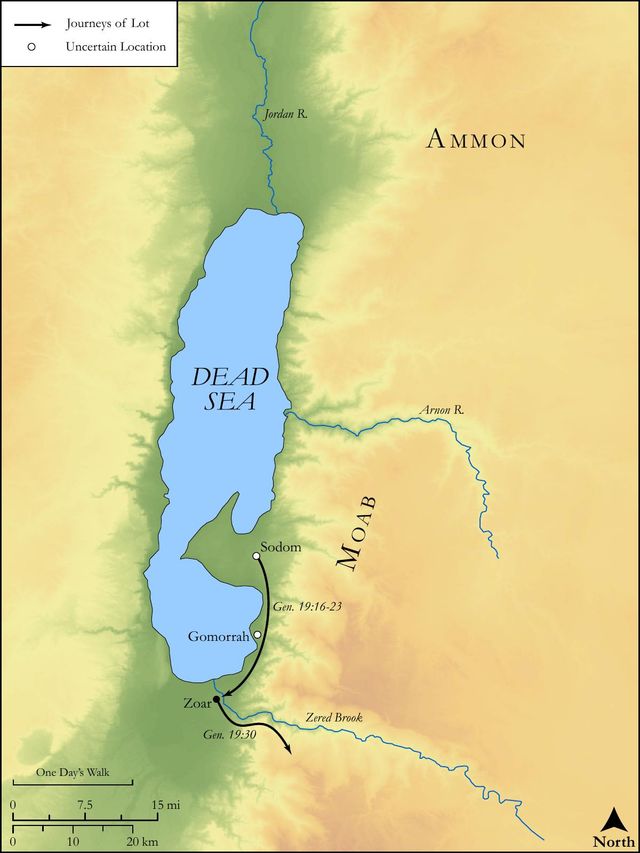
See on the biblical-era maps


Study this verse
Public-domain commentary
Matthew Henry
From his Commentary on the Whole Bible. Henry comments on passages, not single verses — this entry covers Genesis 19:15–23. His four-level outline is real structure in the source text, so it is rendered as structure.
Here is, I. The rescue of Lot out of Sodom. Thought there were not ten righteous men in Sodom, for whose sakes it might be spared, yet that one righteous man that was among them delivered his own soul, Eze 14:14. Early in the morning his own guests, in kindness to him, turned him out of doors, and his family with him, Gen 19:15. His daughters that were married perished with their unbelieving husbands; but those that continued with him were preserved with him. Observe,
1.With what a gracious violence Lot was brought out of Sodom, Gen 19:16. It seems, though he did not make a jest of the warning given, as his sons-in-law did, yet he lingered, he trifled, he did not make so much haste as the case required. Thus many that are under some convictions about the misery of their spiritual state, and the necessity of a change, yet defer that needful work, and foolishly linger. Lot did so, and it might have been fatal to him it the angels had not laid hold of his hand, and brought him forth, and saved him with fear, Jde 1:23. Herein it is said, The Lord was merciful to him; otherwise he might justly have left him to perish, since he was so loth to depart. Note,
(1.)The salvation of the most righteous men must be attributed to God's mercy, not to their own merit. We are saved by grace.
(2.)God's power also must be acknowledged in the bringing of souls out of a sinful state. If God had not brought us forth, we had never come forth.
(3.)If God had not been merciful to us, our lingering had been our ruin.
2.With what a gracious vehemence he was urged to make the best of his way, when he was brought forth, Gen 19:17.
(1.)He must still apprehend himself in danger of being consumed, and be quickened by the law of self-preservation to flee for his life. Note, A holy fear and trembling are found necessary to the working out of our salvation.
(2.)He must therefore mind his business with the utmost care and diligence. He must not hanker after Sodom: Look not behind thee. He must not loiter by the way: Stay not in the plain; for it would all be made one dead sea. He must not take up short of the place of refuge appointed him: Escape to the mountain. Such as these are the commands given to those who through grace are delivered out of a sinful state.
[1.]Return not to sin and Satan, for that is looking back to Sodom.
[2.]Rest not in self and the world, for that is staying in the plain. And,
[3.]Reach towards Christ and heaven, for that is escaping to the mountain, short of which we must not take up.
II.The fixing of a place of refuge for him. The mountain was first appointed for him to flee to, but,
1.He begged for a city of refuge, one of the five that lay together, called Bela, Gen 14:2, Gen 14:18-20. It was Lot's weakness to think a city of his own choosing safer than the mountain of God's appointing. And he argued against himself when he pleaded, Thou hast magnified thy mercy in saving my life, and I cannot escape to the mountain; for could not he that plucked him out of Sodom, when he lingered, carry him safely to the mountain, though he began to tire? Could not he that saved him from greater evils save him from the less? He insists much in his petition upon the smallness of the place: It is a little one, it is not? therefore, it was to be hoped, not so bad as the rest. This gave a new name to the place; it was called Zoar, a little one. Intercessions for little ones are worthy to be remembered.
2.God granted him his request, though there was much infirmity in it, Gen 19:21, Gen 19:22. See what favour God showed to a true saint, though weak.
(1.)Zoar was spared, to gratify him. Though his intercession for it was not, as Abraham's for Sodom, from a principle of generous charity, but merely from self-interest, yet God granted him his request, to show how much the fervent prayer of a righteous man avails.
(2.)Sodom's ruin was suspended till he was safe: I cannot do any thing till thou shalt have come thither. Note, The very presence of good men in a place helps to keep off judgments. See what care God takes for the preservation of his people. The winds are held till God's servants are sealed, Rev 7:3; Eze 9:4.
III.It is taken notice of that the sun had risen when Lot entered into Zoar; for when a good man comes into a place he brings light along with him, or should do.
Historical interpretation
Six Centuries of Reception
3 surviving comments on this verse. Each one is dated, so this reads as a timeline rather than a list.
Select a marker to jump to its quote. Markers stagger vertically where authors wrote within a few decades of each other.
On account of his hospitality and godliness, Lot was saved out of Sodom when all the country round was punished by means of fire and brimstone, the Lord thus making it manifest that He does not forsake those that hope in Him, but gives up such as depart from Him to punishment and torture. [Genesis 19:15-26, 2 Peter 2:6-9] For Lot's wife, who went forth with him, being of a different mind from himself, and not continuing in agreement with him [as to the command which had been given them], was made an example of, so as to be a pillar of salt unto this day. This was done that all might know that those who are of a double mind, and who distrust the power of God, bring down judgment on themselves and become a sign to all succeeding generations.
Great is the loving kindness of God. He who is all-powerful says, “I can do nothing until you arrive there.” He accommodates even the weakness of his servant and tolerates his delay.
Therefore, the name of that city was called Segor. Segor is interpreted as "Little," which for this reason was so called because Lot had said, "Is it not small?" Previously it was called Bale, as mentioned above: "Against the king of Bale, this is Segor." Bale is interpreted as "devour," which the Hebrews say was called such because it was swallowed up by a third earthquake. But just as Sodom burns with the flames of vices, and the mountain to which Lot is ordered to ascend indicates the summit of virtues, so Segor designates a certain lesser mode of good behavior; although it is far from the heights of the perfect, it is still separated from the contagion of the wicked. For example, one who rightly keeps a conjugal life escapes the sulfurous flame of fornication but does not yet ascend the mountain of continence; he who turns his hand and mind away from rapine and avarice, and is accustomed to give what he has to the poor, cannot yet leave everything behind. He indeed escapes the fire of the Sodomites, enters the walls of the small city where he avoids the danger of destruction, but has not yet ascended the fortress of virtue where he would already shine as perfect, and other such things.
Continue studying Genesis 19:22 across the web’s major study libraries — every link below opens this exact verse, chapter, or book on the destination site.
Read & Compare
 BibleGatewayThis verse in more than 200 translations and 70 languages.
 Bible.comThe YouVersion reader — hundreds of translations, reading plans, and highlights.
 ESV.orgCrossway's official English Standard Version reader.
 NET BibleThe NET translation with 60,000+ translators' notes on every rendering decision.
 STEP BibleTyndale House's free study tool — original text, vocabulary, and scholarly resources.
 BibliaLogos Bible Software's free web reader.
 USCCBThe New American Bible (Revised Edition) with the U.S. bishops' study notes.
Commentaries
 BibleHub CommentariesDozens of classic commentaries on this verse, gathered on one page.
 StudyLightMore than 100 commentary sets — the largest collection on the web.
 BibleRefPlain-English commentary on what this verse means, verse by verse.
 Enduring WordDavid Guzik's free commentary on this chapter, widely used by Bible teachers.
 Bible Study ToolsVerse commentary alongside Greek and Hebrew study aids.
Original Language & Research
- BibleHub InterlinearThe verse word by word — original language, transliteration, and English.
- BibleHub LexiconEvery word's original-language definition and Strong's entry.
 Blue Letter BibleDeep-study tools — Strong's numbers, concordance, and word studies.
 SefariaThe Hebrew text with Rashi and centuries of Jewish commentary.
Sermons, Hymns & Audio


TrulyRandomVerse is not affiliated with these sites and doesn’t control their content. They’re linked because they’re genuinely useful.
Summary
Genesis 19:22 records the angel's crucial declaration to Lot, revealing a profound aspect of divine justice: God's judgment on Sodom and Gomorrah was precisely restrained until Lot reached a place of safety. This verse profoundly underscores the divine priority of delivering the righteous before the execution of wrath, emphasizing the urgency of obedience and God's compassionate provision of refuge, even in a seemingly insignificant place, thereby marking the city with a new, descriptive name.
Context
ShowHideLiterary Context
This verse immediately follows Lot's desperate plea to the angels to be allowed to flee to a nearby small town, Zoar, instead of the mountains as initially commanded. The preceding verses (Genesis 19:15-17) depict the angels' forceful removal of Lot and his family from Sodom, emphasizing the extreme urgency of their escape. Lot's subsequent negotiation in Genesis 19:18-20 reveals his fear and perceived inability to reach the mountains, prompting his request for the "little one" (Zoar) to be spared as his refuge. Genesis 19:22 serves as the divine response, confirming the granting of Lot's request and setting the stage for the cataclysmic destruction of the cities of the plain, which immediately follows in Genesis 19:23-28.
Historical & Cultural Context
The events unfold in the fertile plain of the Jordan, a region described as well-watered and prosperous, "like the garden of the Lord" (Genesis 13:10). Sodom and Gomorrah were prominent cities in this region, notorious for their extreme wickedness, which had reached a point of divine judgment (Genesis 18:20-21). The cultural norms of the time included a strong emphasis on hospitality, which the men of Sodom flagrantly violated, demonstrating deep moral depravity (Genesis 19:4-9). The concept of divine judgment through natural or supernatural disaster was already known from the days of Noah, when the flood came as the LORD's response to human sin. The renaming of a city, as seen with Zoar, was also a common practice, often signifying a new beginning, a change in status, or commemorating a significant event.
Key Themes
ShowHideGenesis 19:22 powerfully contributes to several overarching themes within the book of Genesis and biblical theology. It highlights God's righteous judgment against sin, a theme introduced early in the narrative with the flood (Genesis 6-9) and continued through the Abrahamic covenant. Simultaneously, it underscores God's unwavering mercy and faithfulness to His covenant promises, particularly His commitment to protect the righteous, even for the sake of one individual, as seen in God's remembrance of Abraham in Genesis 19:29. The verse also emphasizes the urgency of responding to divine warnings and the provision of refuge for those who obey, even if imperfectly. Finally, it subtly introduces the theme of divine accommodation to human weakness, as God allows Lot to flee to a "small" city rather than the initially commanded mountains, demonstrating His compassion.
Exposition and Analysis
ShowHideGenesis 19:22 captures a profound moment of divine interaction, revealing God's character and the mechanics of His judgment. The verse is composed of an urgent command, a remarkable declaration of divine restraint, and the subsequent renaming of a city.
Key Word Analysis
ShowHideFrom the root meaning "to be liquid or flow easily," this word implies a swift, prompt, and urgent movement. In this context, it emphasizes the critical need for immediate action from Lot, highlighting the imminent danger and the time-sensitive nature of God's impending judgment. It conveys a sense of rapid movement, often used adverbially to mean "quickly" or "speedily."
This word signifies the ability or power to do something. The negative "cannot" here is not an expression of divine impotence, but rather a self-imposed limitation based on God's character and principles. It indicates that the divine agent (the angel) is constrained by a higher decree or a divine promise, preventing the execution of judgment until a specific condition (Lot's safety) is met.
While broadly meaning "word" or "speech," in this context, dâbâr refers to a "matter" or "thing," encompassing the entirety of the destructive act awaiting Sodom and Gomorrah. The phrase "cannot do any thing" thus means the angel is unable to perform any part of the judgment until Lot is secure, emphasizing the absolute nature of the divine restraint.
Verse Breakdown
ShowHide"Haste thee, escape thither"
This imperative command, spoken by the angel to Lot, conveys the extreme urgency of the situation. It is a dual call to action: to move quickly ("haste") and to secure safety by fleeing ("escape") to the designated refuge ("thither," referring to Zoar). The repetition of the command for Lot to flee throughout the narrative highlights the non-negotiable requirement for swift obedience in the face of impending divine judgment. There is no room for delay or hesitation; the very act of escaping is intertwined with the timing of God's wrath. This urgency serves as a stark warning against complacency when confronted with God's warnings.
"for I cannot do any thing till thou be come thither."
This is the theological core of the verse, revealing a profound divine principle. The angel, acting as God's agent, declares an inability to proceed with the destruction of Sodom and Gomorrah until Lot, the one righteous individual (though flawed), is safely out of harm's way. This statement does not imply a limitation of God's omnipotence, but rather a self-imposed restraint rooted in His perfect justice, mercy, and faithfulness to His promise to protect the righteous. It demonstrates that God's judgment is precise, deliberate, and tempered with mercy, ensuring the safety of those He intends to save before His wrath is poured out. It powerfully illustrates the immense value God places on even one righteous soul, delaying cataclysmic events for their sake.
"Therefore the name of the city was called Zoar."
The renaming of the city from its original name, Bela (Genesis 14:2), to Zoar (Hebrew: צֹעַר, Tso'ar) is deeply significant. The name Zoar literally means "smallness" or "insignificance," directly reflecting Lot's plea in Genesis 19:20 where he described it as a "little one" (mits'ar). This renaming permanently marks the city as the "small place" that served as a divinely appointed refuge for Lot. It highlights how God, in His compassion, accommodates human weakness and provides a way of escape, even if it deviates from His initial, perhaps more demanding, instructions (to flee to the mountains). It also underscores God's ability to use seemingly insignificant places or circumstances for His profound divine purposes of salvation and refuge.
Literary Devices
ShowHideGenesis 19:22 employs several literary devices to convey its powerful message. The Imperative Mood is prominent in "Haste thee, escape thither," emphasizing the urgency and directness of the divine command. The angel's declaration, "I cannot do any thing," serves as a form of Divine Anthropomorphism or Self-Limitation, where God (through His agent) expresses a restraint on His power, not due to inability, but due to His unwavering commitment to justice and mercy. This statement also functions as Dramatic Irony, as the reader knows the immense power of God, yet here it is voluntarily held back. Finally, the renaming of the city to Zoar demonstrates Etymological Significance, where the new name directly reflects the circumstances of its naming and Lot's plea, imbuing the place with symbolic meaning as a "small refuge" and a testament to God's accommodating grace.
Theological and Thematic Connections
ShowHideGenesis 19:22 encapsulates profound theological truths regarding divine judgment, mercy, and the nature of salvation. It reveals that God's wrath is not arbitrary but precisely timed and executed, always prioritizing the deliverance of His chosen ones. This self-imposed divine restraint highlights God's unwavering commitment to His promises and His deep compassion, even in the midst of righteous indignation. The urgency of the command to "haste" underscores the critical importance of immediate and decisive obedience to God's calls for repentance and escape from spiritual danger, reminding humanity that opportunities for salvation are often time-sensitive. Furthermore, the provision of Zoar as a refuge, despite Lot's imperfect faith and the city's insignificance, illustrates God's gracious accommodation of human weakness and His ability to use humble means to accomplish His grand purposes of salvation.
Reflection and Application
ShowHideGenesis 19:22 offers timeless lessons for believers today, serving as a powerful reminder of God's character and our appropriate response. Firstly, it assures us of the certainty of God's judgment on sin, but more profoundly, it reveals His boundless mercy that consistently provides a way of escape for those who heed His call. Just as the angels would not act until Lot was safely out, God meticulously ensures the salvation of His people before the full outpouring of His wrath. Secondly, the imperative "Haste thee" emphasizes the critical importance of immediate and decisive action when God calls us to flee from spiritual danger or to embrace His salvation. There is no room for procrastination when eternal stakes are involved. Our ultimate refuge is found not in a physical city, but in God Himself, a secure haven from all spiritual and eternal judgment. This verse urges us not to neglect the great salvation offered through Christ, who is our ultimate Zoar, a place of safety and rest from the coming judgment.
Questions for Reflection
ShowHideFAQ
ShowHideWhy couldn't the angels act until Lot was safe in Zoar?
ShowHideThe angel's statement, "for I cannot do any thing till thou be come thither," reveals a self-imposed divine limitation rooted in God's perfect justice and mercy. It signifies that God's judgment is precise and deliberate; He would not allow the destruction of the wicked cities to commence while a righteous individual (Lot), whom He had purposed to save, remained within the zone of judgment. This demonstrates God's unwavering commitment to protecting His own and His ordered nature, ensuring the deliverance of the righteous before the outpouring of His wrath. It is not a limitation of power, but a profound expression of divine principle and covenant faithfulness, highlighting the immense value God places on His chosen ones.
What is the significance of the city being named Zoar?
ShowHideThe city was originally called Bela (Genesis 14:2), but its name was changed to Zoar (meaning "smallness" or "insignificance") because Lot himself described it as a "little one" in his desperate plea to the angels (Genesis 19:20). This renaming permanently reflects its modest size and its role as a divinely appointed, albeit humble, refuge. It signifies that God can use even seemingly insignificant places or circumstances to fulfill His profound purposes of salvation and refuge, and that He graciously accommodates human weakness by providing an accessible means of escape, even when His initial command (to flee to the mountains) might have seemed too daunting.
Does this verse imply God is limited in His power?
ShowHideNo, the verse does not imply a limitation of God's omnipotence. Rather, it reveals a self-imposed limitation based on God's character and covenant faithfulness. God, being perfectly just and merciful, chose to restrain His power of judgment until Lot, whom He had purposed to save, was safely out of the area of destruction. This demonstrates God's ordered nature, His commitment to His promises, and the immense value He places on the righteous, rather than any inherent lack of power. It is a testament to His moral perfection and His fidelity to His salvific plan, not a deficiency in His omnipotence.
Christ-Centered Fulfillment
ShowHideWhile Zoar offered Lot a temporary physical refuge from physical judgment, Christ offers ultimate and eternal refuge from spiritual judgment. He is the true "Zoar"—the humble, seemingly insignificant "small one" who, though born in Bethlehem, a "little" town (Matthew 2:1-6), and appearing as a man among men, became the secure haven for all who flee the wrath to come. His sacrifice on the cross supremely fulfills the divine restraint shown in Genesis 19:22, as God's righteous judgment for sin was poured out on Him, the Lamb of God who takes away the sin of the world, allowing believers to escape. His call to "flee" sin and come to Him is the ultimate urgent command, promising eternal safety and refuge from the spiritual destruction that awaits those who reject Him. In Christ, the promise of a secure dwelling place from divine wrath is fully realized, as He is our refuge and strength, an ever-present help in trouble. Just as Lot found safety in Zoar, so too do believers find their ultimate and secure salvation in Him who delivers us from the wrath to come.