


Genesis 19:21
Bible text: King James Version (1769 Blayney text) · Public domain
Bible text: Berean Standard Bible · Public domain
Bible text: American Standard Version (1901) · Public domain
Bible text: World English Bible, Messianic edition · Public domain
Bible text: Geneva Bible (1599) · Public domain
Bible text: Young's Literal Translation · Public domain
- וַיֹּאמֶרvai·Yo·merand he saidH559Conj-w ¦ V-Qal-ConsecImperf-3msVerb Qal Consecutive Imperfect 3rd Singular Masculineוַandיֹּאמֶרhe said
- אֵלָיו'e·Lavto himH413Prep ¦ 3msPreposition Definiteאֵלָיtoוhim
- הִנֵּהhi·Nehhere!H2009PrtParticle Interjection
- נָשָׂאתִיna·Sa·tiI lift upH5375V-Qal-Perf-1csVerb Qal Perfect 1st Singular common gender
- פָנֶיךָfa·Nei·khayour faceH6440N-mpc ¦ 2msNoun Plural Masculine Constructפָנֶיfaceךָyour
- גַּםgamalsoH1571AdvAdverb
- לַדָּבָרla·da·Varto the matterH1697Prep-l ¦ N-msNoun Singular Masculine Absoluteלַto theדָּבָרmatter
- הַזֶּהha·Zeh<the> thisH2088Art ¦ PrtParticle Demonstrativeהַ<the>זֶּהthis
- לְבִלְתִּיle·vil·Tito notH1115Prep-l ¦ N-cscNoun Singular common gender Constructלְtoבִלְתִּיnot
- הָפְכִּיha·fe·KiI to overthrowH2015V-Qal-Inf ¦ 1csVerb Qal Infinitive Constructהָפְכִּto overthrowיI
- אֶת'et<obj.>H853DirObjMParticle Object Indicator
- הָעִירha·'Irthe cityH5892Art ¦ N-fsNoun Singular Feminine Absoluteהָtheעִירcity
- אֲשֶׁר'a·SherwhichH834RelParticle Relative
- דִּבַּרְתָּdi·Bar·tayou have spokenH1696V-Piel-Perf-2msVerb Piel Perfect 2nd Singular Masculine
English is a literal word-by-word gloss of the Hebrew, not the KJV's wording. Why?
This is the original text the KJV's translators worked from — each Hebrew word with its own literal English meaning in this verse, prepared by scholars at Tyndale House, Cambridge. The KJV translates whole sentences, not word by word, so its wording differs: one Hebrew word can become several English words, and the KJV may choose “the LORD” where the gloss reads “Yahweh”. Both are faithful — they answer different questions. For the KJV's own rendering, switch to the KJV text.
Details
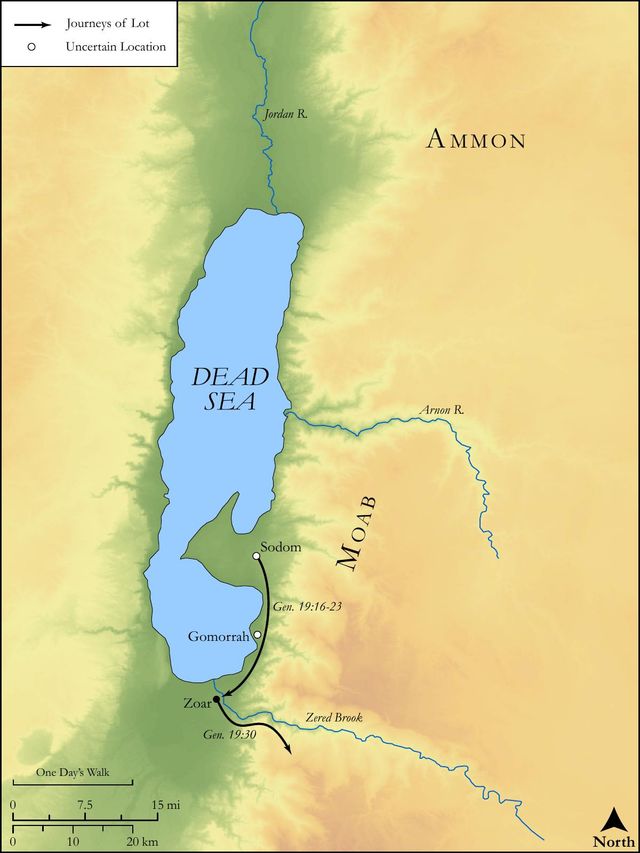
See on the biblical-era maps


Study this verse
Public-domain commentary
Matthew Henry
From his Commentary on the Whole Bible. Henry comments on passages, not single verses — this entry covers Genesis 19:15–23. His four-level outline is real structure in the source text, so it is rendered as structure.
Here is, I. The rescue of Lot out of Sodom. Thought there were not ten righteous men in Sodom, for whose sakes it might be spared, yet that one righteous man that was among them delivered his own soul, Eze 14:14. Early in the morning his own guests, in kindness to him, turned him out of doors, and his family with him, Gen 19:15. His daughters that were married perished with their unbelieving husbands; but those that continued with him were preserved with him. Observe,
1.With what a gracious violence Lot was brought out of Sodom, Gen 19:16. It seems, though he did not make a jest of the warning given, as his sons-in-law did, yet he lingered, he trifled, he did not make so much haste as the case required. Thus many that are under some convictions about the misery of their spiritual state, and the necessity of a change, yet defer that needful work, and foolishly linger. Lot did so, and it might have been fatal to him it the angels had not laid hold of his hand, and brought him forth, and saved him with fear, Jde 1:23. Herein it is said, The Lord was merciful to him; otherwise he might justly have left him to perish, since he was so loth to depart. Note,
(1.)The salvation of the most righteous men must be attributed to God's mercy, not to their own merit. We are saved by grace.
(2.)God's power also must be acknowledged in the bringing of souls out of a sinful state. If God had not brought us forth, we had never come forth.
(3.)If God had not been merciful to us, our lingering had been our ruin.
2.With what a gracious vehemence he was urged to make the best of his way, when he was brought forth, Gen 19:17.
(1.)He must still apprehend himself in danger of being consumed, and be quickened by the law of self-preservation to flee for his life. Note, A holy fear and trembling are found necessary to the working out of our salvation.
(2.)He must therefore mind his business with the utmost care and diligence. He must not hanker after Sodom: Look not behind thee. He must not loiter by the way: Stay not in the plain; for it would all be made one dead sea. He must not take up short of the place of refuge appointed him: Escape to the mountain. Such as these are the commands given to those who through grace are delivered out of a sinful state.
[1.]Return not to sin and Satan, for that is looking back to Sodom.
[2.]Rest not in self and the world, for that is staying in the plain. And,
[3.]Reach towards Christ and heaven, for that is escaping to the mountain, short of which we must not take up.
II.The fixing of a place of refuge for him. The mountain was first appointed for him to flee to, but,
1.He begged for a city of refuge, one of the five that lay together, called Bela, Gen 14:2, Gen 14:18-20. It was Lot's weakness to think a city of his own choosing safer than the mountain of God's appointing. And he argued against himself when he pleaded, Thou hast magnified thy mercy in saving my life, and I cannot escape to the mountain; for could not he that plucked him out of Sodom, when he lingered, carry him safely to the mountain, though he began to tire? Could not he that saved him from greater evils save him from the less? He insists much in his petition upon the smallness of the place: It is a little one, it is not? therefore, it was to be hoped, not so bad as the rest. This gave a new name to the place; it was called Zoar, a little one. Intercessions for little ones are worthy to be remembered.
2.God granted him his request, though there was much infirmity in it, Gen 19:21, Gen 19:22. See what favour God showed to a true saint, though weak.
(1.)Zoar was spared, to gratify him. Though his intercession for it was not, as Abraham's for Sodom, from a principle of generous charity, but merely from self-interest, yet God granted him his request, to show how much the fervent prayer of a righteous man avails.
(2.)Sodom's ruin was suspended till he was safe: I cannot do any thing till thou shalt have come thither. Note, The very presence of good men in a place helps to keep off judgments. See what care God takes for the preservation of his people. The winds are held till God's servants are sealed, Rev 7:3; Eze 9:4.
III.It is taken notice of that the sun had risen when Lot entered into Zoar; for when a good man comes into a place he brings light along with him, or should do.
Historical interpretation
Six Centuries of Reception
2 surviving comments on this verse. Each one is dated, so this reads as a timeline rather than a list.
Select a marker to jump to its quote. Markers stagger vertically where authors wrote within a few decades of each other.
On account of his hospitality and godliness, Lot was saved out of Sodom when all the country round was punished by means of fire and brimstone, the Lord thus making it manifest that He does not forsake those that hope in Him, but gives up such as depart from Him to punishment and torture. [Genesis 19:15-26, 2 Peter 2:6-9] For Lot's wife, who went forth with him, being of a different mind from himself, and not continuing in agreement with him [as to the command which had been given them], was made an example of, so as to be a pillar of salt unto this day. This was done that all might know that those who are of a double mind, and who distrust the power of God, bring down judgment on themselves and become a sign to all succeeding generations.
And he said to him: "Behold, I have also accepted your request in this matter, that I will not overthrow the city you have spoken of, etc." Oh, how great is the compassion of divine mercy! Not only does it deliver the just man from the destruction of the wicked, but it also grants life to many of them on account of the same just man's safety, which they did not deserve, so that it might show in those who perished what impiety deserved, and in those who remained how much the intercession of the pious prevailed with God.
Continue studying Genesis 19:21 across the web’s major study libraries — every link below opens this exact verse, chapter, or book on the destination site.
Read & Compare
 BibleGatewayThis verse in more than 200 translations and 70 languages.
 Bible.comThe YouVersion reader — hundreds of translations, reading plans, and highlights.
 ESV.orgCrossway's official English Standard Version reader.
 NET BibleThe NET translation with 60,000+ translators' notes on every rendering decision.
 STEP BibleTyndale House's free study tool — original text, vocabulary, and scholarly resources.
 BibliaLogos Bible Software's free web reader.
 USCCBThe New American Bible (Revised Edition) with the U.S. bishops' study notes.
Commentaries
 BibleHub CommentariesDozens of classic commentaries on this verse, gathered on one page.
 StudyLightMore than 100 commentary sets — the largest collection on the web.
 BibleRefPlain-English commentary on what this verse means, verse by verse.
 Enduring WordDavid Guzik's free commentary on this chapter, widely used by Bible teachers.
 Bible Study ToolsVerse commentary alongside Greek and Hebrew study aids.
Original Language & Research
- BibleHub InterlinearThe verse word by word — original language, transliteration, and English.
- BibleHub LexiconEvery word's original-language definition and Strong's entry.
 Blue Letter BibleDeep-study tools — Strong's numbers, concordance, and word studies.
 SefariaThe Hebrew text with Rashi and centuries of Jewish commentary.
Sermons, Hymns & Audio


TrulyRandomVerse is not affiliated with these sites and doesn’t control their content. They’re linked because they’re genuinely useful.
Summary
Records a profound moment of divine condescension and mercy, where God, through His angelic messenger, graciously accedes to Lot's specific plea to spare the small city of Zoar from the impending, widespread destruction of the Jordan Plain. This pivotal interaction highlights God's attentiveness to individual human petitions and His willingness to temper His just judgment with compassion, even when those pleas arise from human weakness or fear.
Context
ShowHideLiterary Context
This verse is situated at a climactic point within the narrative of Genesis chapter 19, immediately following the angels' urgent command for Lot and his family to flee Sodom and seek refuge in the mountains, without looking back (Genesis 19:17). Lot, however, expresses fear that he will not survive the journey to the distant mountains and instead pleads for a closer, "little" city, Zoar (formerly Bela), to be spared as his place of refuge (Genesis 19:18-20). Genesis 19:21 marks the divine acceptance of this specific, human-initiated deviation from the original instruction, setting the stage for the subsequent catastrophic judgment on Sodom and Gomorrah. This episode underscores the narrative's focus on divine justice, human frailty, and God's surprising mercy amidst judgment, echoing themes found earlier in Abraham's intercession for Sodom.
Historical & Cultural Context
The destruction of Sodom and Gomorrah serves as a powerful historical and theological example of divine judgment against profound moral corruption, particularly related to sexual perversion and a lack of hospitality, which was a grave sin in the lands of the patriarchs, where Abraham and Lot welcomed strangers. The cities of the plain, including Sodom, Gomorrah, Admah, Zeboiim, and Bela (later Zoar), were exceptionally fertile and prosperous (Genesis 13:10). Their wealth, however, led to arrogance and neglect of the poor, as later described in Ezekiel 16:49. The cataclysmic nature of their overthrow (likely involving brimstone and fire) was a stark warning against widespread wickedness. God's willingness to spare Zoar for Lot's sake, despite its inherent lack of righteousness, highlights the ancient concept of a righteous individual's presence influencing a community's fate, and the profound importance of divine mercy in a context of otherwise absolute judgment.
Key Themes
ShowHideGenesis 19:21 contributes significantly to several overarching themes within Genesis and biblical theology. Firstly, it powerfully illustrates the theme of Divine Mercy and Forbearance, showcasing God's willingness to extend grace beyond strict justice, even to an imperfect servant like Lot. Secondly, it highlights the Power of Intercession, demonstrating that God listens and responds to the earnest prayers of His people, even if those prayers are driven by human fear or self-preservation, as seen in Lot's plea for Zoar. This echoes the earlier, more expansive intercession of Abraham for Sodom. Thirdly, it underscores God's Discernment in Judgment, revealing that divine wrath is not indiscriminate but precise, capable of distinguishing between general wickedness and specific acts of grace for the sake of the righteous. Finally, it reinforces the theme of God's Personal Care Amidst Catastrophe, assuring believers that even in times of widespread calamity, God remains intimately attentive to the safety and deliverance of those who belong to Him.
Exposition and Analysis
ShowHideGenesis 19:21 records the divine response to Lot's desperate plea for refuge. The angelic messenger, speaking with the authority of God, declares, "And he said unto him, See, I have accepted thee concerning this thing also, that I will not overthrow this city, for the which thou hast spoken." This statement signifies a direct and personal divine concession, altering the initial command for Lot to flee to the mountains. God's willingness to accommodate Lot's fear and specific request underscores a profound aspect of His character: His mercy and responsiveness to the cries of His people, even when those cries arise from human weakness or fear.
Key Word Analysis
ShowHideA primitive root meaning "to lift, in a great variety of applications, literal and figurative, absolute and relative; accept, advance, arise, (able to, (armor), suffer to) bear(-er, up), bring (forth), burn, carry (away), cast, contain, desire, ease, exact, exalt (self), extol, fetch, forgive, furnish, further, give, go on, help, high, hold up, honorable ([phrase] man), lade, lay, lift (self) up, lofty, marry, magnify, [idiom] needs, obtain, pardon, raise (up), receive, regard, respect, set (up), spare, stir up, [phrase] swear, take (away, up), [idiom] utterly, wear, yield." In this context, it specifically conveys the idea of "to lift up the face" or "to show favor," signifying God's personal and gracious reception of Lot's plea. It implies a favorable disposition and a willingness to grant the request.
A primitive root meaning "to turn about or over; by implication, to change, overturn, return, pervert; [idiom] become, change, come, be converted, give, make (a bed), overthrow (-turn), perverse, retire, tumble, turn (again, aside, back, to the contrary, every way)." This word vividly describes the complete and utter destruction intended for the cities of the plain. God's promise "not to overthrow" Zoar signifies a direct reversal of the fate that would otherwise befall it, a turning away from judgment for that specific city.
A primitive root meaning "perhaps properly, to arrange; but used figuratively (of words), to speak; rarely (in a destructive sense) to subdue; answer, appoint, bid, command, commune, declare, destroy, give, name, promise, pronounce, rehearse, say, speak, be spokesman, subdue, talk, teach, tell, think, use (entreaties), utter, [idiom] well, [idiom] work." This word highlights the direct link between Lot's verbal petition and God's merciful response. It emphasizes the active role of Lot's "speaking" or "pleading" in securing Zoar's exemption from destruction.
Verse Breakdown
ShowHide"And he said unto him, See, I have accepted thee concerning this thing also,"
This opening clause establishes the divine response to Lot's plea. The phrase "he said unto him" refers to the angelic messenger, acting as God's direct representative. The imperative "See" (H2009, hinnêh) draws immediate attention to the significant declaration that follows. "I have accepted thee" (H5375, nâsâʼ) indicates a favorable reception of Lot's person and his request, a divine showing of grace. The addition of "concerning this thing also" (H1697, dâbâr) is crucial; it implies that this act of mercy is an additional favor, building upon the initial deliverance from Sodom and demonstrating a layered, overflowing grace beyond what might be strictly required or initially commanded.
"that I will not overthrow this city,"
This is the core promise of the verse, a direct and unequivocal declaration of Zoar's exemption from the impending judgment. The verb "overthrow" (H2015, hâphak) carries the weight of the catastrophic destruction planned for Sodom and Gomorrah. God's explicit statement that He "will not overthrow" Zoar underscores the specificity and intentionality of this act of mercy, setting Zoar apart from the fate of its neighboring cities.
"for the which thou hast spoken."
This concluding phrase directly attributes Zoar's salvation to Lot's intercession. The city is not spared due to its own righteousness or merit, but solely "for the which thou hast spoken" (H1696, dâbar). This emphasizes the powerful impact of a righteous person's presence and prayer, even if the prayer is primarily for self-preservation. It reveals God's precise and purposeful judgment, which is always tempered with discernment and the capacity for mercy, responding directly to the human voice.
Literary Devices
ShowHideThe passage employs several literary devices to convey its profound theological truths. Divine Accommodation is evident as God, through His messenger, adjusts His initial command (to flee to the mountains) to accommodate Lot's fear and specific request for a closer city. This highlights God's compassionate nature and His willingness to meet humanity in its weakness. There is also a subtle Irony in the narrative: Lot, who lingered in Sodom and whose righteousness was questionable, becomes the catalyst for the salvation of an entire city, albeit a small one. This underscores that God's mercy often extends beyond human merit. Furthermore, the passage presents a powerful Contrast between the universal, sweeping judgment against Sodom and Gomorrah and the particular, precise mercy extended to Zoar, emphasizing God's ability to discern and act with both justice and grace simultaneously.
Theological and Thematic Connections
ShowHideThis verse powerfully demonstrates God's compassionate nature and His sovereign responsiveness to human prayer. Despite Lot's initial reluctance to obey the command to go to the mountains and his self-preserving plea, God chose to show mercy and accommodate his request, sparing Zoar. This underscores God's willingness to be flexible within His divine plan when His children cry out to Him, even when those cries are imperfect or born of fear. It highlights that divine judgment, while just, is always tempered with discernment and the capacity for grace, especially for the sake of His chosen, however flawed. The episode also serves as a testament to the profound impact of even a single individual's presence and petition, illustrating that God listens to the earnest cries of His servants, even if the prayer is primarily for self-preservation.
Reflection and Application
ShowHideGenesis 19:21 offers enduring lessons for believers today, encouraging us to bring our specific concerns, fears, and even our perceived limitations to God with boldness, knowing that He is a compassionate listener who hears and responds to our earnest prayers (Philippians 4:6-7). This narrative reminds us that even imperfect prayers, born of genuine need or fear, can be met with divine favor, highlighting God's personal care for His people even amid global events or widespread judgments. Just as Lot sought physical refuge from the coming destruction, believers are called to flee from sin and its ultimate consequences, finding our ultimate refuge and salvation in God's grace through Christ. This passage challenges us to trust in God's particular providence, recognizing that His attention is not only on grand designs for all creation but also on the intimate details of our lives and our desperate cries for help.
Questions for Reflection
ShowHideFAQ
ShowHideWhy did God grant Lot's specific request to spare Zoar, rather than insisting he go to the mountains?
ShowHideGod granted Lot's request out of His profound mercy and forbearance. While the initial command was to flee to the mountains for safety, Lot's fear and plea for a closer, "little" city (Zoar) demonstrated his human weakness and lack of full trust. God, in His compassion, accommodated Lot's specific need, demonstrating that His divine plan can be flexible to respond to the earnest cries of His servants, even when those cries arise from fear rather than perfect obedience. This act highlights God's personal attentiveness and willingness to show grace, ensuring Lot's survival as part of His broader covenant purposes, as seen in Genesis 12:3.
Does this verse suggest that God's plans can be changed by human prayer?
ShowHideThis verse illustrates that God, in His sovereignty, chooses to interact with and respond to human prayer. While God's ultimate purposes and eternal decrees are unchangeable (Malachi 3:6), He often works through the prayers of His people, allowing their petitions to influence the immediate course of events or the application of His judgments. In this case, God's decision to spare Zoar was directly tied to Lot's spoken request, demonstrating that prayer is a powerful means through which God exercises His will and mercy in the world. It shows God's responsiveness and His desire for humanity to participate in His work, not a change in His eternal nature or ultimate plan (Jeremiah 29:12-13).
Christ-Centered Fulfillment
ShowHideGenesis 19:21 powerfully foreshadows the greater refuge and deliverance found in Jesus Christ. Just as Lot found a temporary physical refuge in Zoar from the impending judgment of brimstone and fire, believers find ultimate spiritual refuge from the judgment of sin and eternal wrath in Christ. Lot's intercession, though imperfect and self-focused, moved God to spare a city; this points to Christ, our perfect Intercessor, whose single, selfless prayer and sacrifice on the cross secured eternal salvation and deliverance for all who believe (Hebrews 7:25). The sparing of Zoar by grace, not merit, prefigures the salvation offered freely in Christ, where deliverance from divine wrath is granted not based on human righteousness, but solely on God's abounding mercy and the atoning work of His Son (Ephesians 2:8-9). Christ is the true "little one" who became humble and lowly to provide a way of escape for all who would flee to Him for safety, becoming our ultimate sanctuary from the coming judgment (Matthew 11:28-30).