


Genesis 19:15
Bible text: King James Version (1769 Blayney text) · Public domain
Bible text: King James Version with Strong's numbers · Public domain
Bible text: Berean Standard Bible · Public domain
Bible text: American Standard Version (1901) · Public domain
Bible text: World English Bible, Messianic edition · Public domain
Bible text: Geneva Bible (1599) · Public domain
Bible text: Young's Literal Translation · Public domain
- וּכְמוֹu·khe·Moand whenH3644Conj-w ¦ PrepPrepositionוּandכְמוֹwhen
- הַשַּׁחַרha·Sha·charthe dawnH7837Art ¦ N-msNoun Singular Masculine Absoluteהַtheשַּׁחַרdawn
- עָלָה'a·Lahit came upH5927V-Qal-Perf-3msVerb Qal Perfect 3rd Singular Masculine
- וַיָּאִיצוּvai·ya·'I·tzuand they urgedH213Conj-w ¦ V-Hiphil-ConsecImperf-3mpVerb Hiphil Consecutive Imperfect 3rd Plural Masculineוַandיָּאִיצוּthey urged
- הַמַּלְאָכִיםha·mal·'a·Khimthe angelsH4397Art ¦ N-mpNoun Plural Masculine Absoluteהַtheמַּלְאָכִיםangels
- בְּלוֹטbe·Lot<in> LotH3876Prep-b ¦ N-proper-mNoun Proper Masculineבְּ<in>לוֹטLot
- לֵאמֹרle·Mor<to> sayingH559Prep-l ¦ V-Qal-InfVerb Qal Infinitive Constructלֵ<to>אמֹרsaying
- קוּםkumariseH6965V-Qal-Imp-2msVerb Qal Imperative 2nd Singular Masculine
- קַחkachtakeH3947V-Qal-Imp-2msVerb Qal Imperative 2nd Singular Masculine
- אֶת'et<obj.>H853DirObjMParticle Object Indicator
- אִשְׁתְּךָ'ish·te·Khayour wifeH802N-fsc ¦ 2msNoun Singular Feminine Constructאִשְׁתְּwifeךָyour
- וְאֶתve·'Etand <obj.>H853Conj-w ¦ DirObjMParticle Object Indicatorוְandאֶת<obj.>
- שְׁתֵּיshe·Tei[the] twoH8147Adj-fdcAdjective Numerical Dual Feminine Construct
- בְנֹתֶיךָve·no·Tei·khayour daughtersH1323N-fpc ¦ 2msNoun Plural Feminine Constructבְנֹתֶיdaughtersךָyour
- הַנִּמְצָאֹתha·nim·tza·'Otwho are foundH4672Art ¦ V-Niphal-Prtcpl-fpVerb Niphal Participle Plural Feminine Absoluteהַwhoנִּמְצָאֹתare found
- פֶּןpenlestH6435PrtParticle Conditional
- תִּסָּפֶהti·sa·Pehyou should be swept awayH5595V-Niphal-Imperf-2msVerb Niphal Imperfect 2nd Singular Masculine
- בַּעֲוֹןba·'a·Vonin [the] punishment ofH5771Prep-b ¦ N-mscNoun Singular Masculine Constructבַּinעֲוֹן[the] punishment of
- הָעִירha·'Irthe cityH5892Art ¦ N-fsNoun Singular Feminine Absoluteהָtheעִירcity
English is a literal word-by-word gloss of the Hebrew, not the KJV's wording. Why?
This is the original text the KJV's translators worked from — each Hebrew word with its own literal English meaning in this verse, prepared by scholars at Tyndale House, Cambridge. The KJV translates whole sentences, not word by word, so its wording differs: one Hebrew word can become several English words, and the KJV may choose “the LORD” where the gloss reads “Yahweh”. Both are faithful — they answer different questions. For the KJV's own rendering, switch to the KJV text.
Details
See on the biblical-era maps


Study this verse
Public-domain commentary
Matthew Henry
From his Commentary on the Whole Bible. Henry comments on passages, not single verses — this entry covers Genesis 19:15–23. His four-level outline is real structure in the source text, so it is rendered as structure.
Here is, I. The rescue of Lot out of Sodom. Thought there were not ten righteous men in Sodom, for whose sakes it might be spared, yet that one righteous man that was among them delivered his own soul, Eze 14:14. Early in the morning his own guests, in kindness to him, turned him out of doors, and his family with him, Gen 19:15. His daughters that were married perished with their unbelieving husbands; but those that continued with him were preserved with him. Observe,
1.With what a gracious violence Lot was brought out of Sodom, Gen 19:16. It seems, though he did not make a jest of the warning given, as his sons-in-law did, yet he lingered, he trifled, he did not make so much haste as the case required. Thus many that are under some convictions about the misery of their spiritual state, and the necessity of a change, yet defer that needful work, and foolishly linger. Lot did so, and it might have been fatal to him it the angels had not laid hold of his hand, and brought him forth, and saved him with fear, Jde 1:23. Herein it is said, The Lord was merciful to him; otherwise he might justly have left him to perish, since he was so loth to depart. Note,
(1.)The salvation of the most righteous men must be attributed to God's mercy, not to their own merit. We are saved by grace.
(2.)God's power also must be acknowledged in the bringing of souls out of a sinful state. If God had not brought us forth, we had never come forth.
(3.)If God had not been merciful to us, our lingering had been our ruin.
2.With what a gracious vehemence he was urged to make the best of his way, when he was brought forth, Gen 19:17.
(1.)He must still apprehend himself in danger of being consumed, and be quickened by the law of self-preservation to flee for his life. Note, A holy fear and trembling are found necessary to the working out of our salvation.
(2.)He must therefore mind his business with the utmost care and diligence. He must not hanker after Sodom: Look not behind thee. He must not loiter by the way: Stay not in the plain; for it would all be made one dead sea. He must not take up short of the place of refuge appointed him: Escape to the mountain. Such as these are the commands given to those who through grace are delivered out of a sinful state.
[1.]Return not to sin and Satan, for that is looking back to Sodom.
[2.]Rest not in self and the world, for that is staying in the plain. And,
[3.]Reach towards Christ and heaven, for that is escaping to the mountain, short of which we must not take up.
II.The fixing of a place of refuge for him. The mountain was first appointed for him to flee to, but,
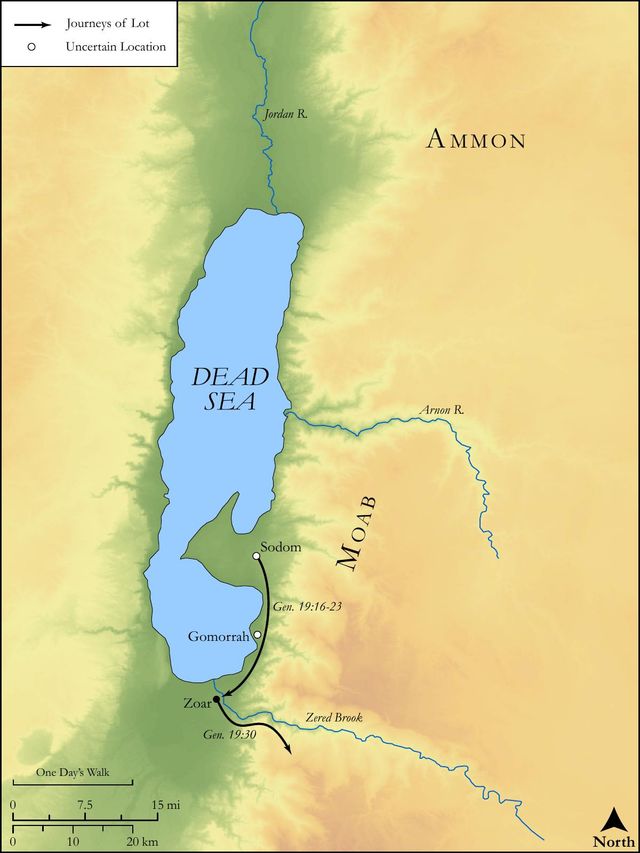
1.He begged for a city of refuge, one of the five that lay together, called Bela, Gen 14:2, Gen 14:18-20. It was Lot's weakness to think a city of his own choosing safer than the mountain of God's appointing. And he argued against himself when he pleaded, Thou hast magnified thy mercy in saving my life, and I cannot escape to the mountain; for could not he that plucked him out of Sodom, when he lingered, carry him safely to the mountain, though he began to tire? Could not he that saved him from greater evils save him from the less? He insists much in his petition upon the smallness of the place: It is a little one, it is not? therefore, it was to be hoped, not so bad as the rest. This gave a new name to the place; it was called Zoar, a little one. Intercessions for little ones are worthy to be remembered.
2.God granted him his request, though there was much infirmity in it, Gen 19:21, Gen 19:22. See what favour God showed to a true saint, though weak.
(1.)Zoar was spared, to gratify him. Though his intercession for it was not, as Abraham's for Sodom, from a principle of generous charity, but merely from self-interest, yet God granted him his request, to show how much the fervent prayer of a righteous man avails.
(2.)Sodom's ruin was suspended till he was safe: I cannot do any thing till thou shalt have come thither. Note, The very presence of good men in a place helps to keep off judgments. See what care God takes for the preservation of his people. The winds are held till God's servants are sealed, Rev 7:3; Eze 9:4.
III.It is taken notice of that the sun had risen when Lot entered into Zoar; for when a good man comes into a place he brings light along with him, or should do.
Historical interpretation
Three Centuries of Reception
3 surviving comments on this verse. Each one is dated, so this reads as a timeline rather than a list.
Select a marker to jump to its quote. Markers stagger vertically where authors wrote within a few decades of each other.
On account of his hospitality and godliness, Lot was saved out of Sodom when all the country round was punished by means of fire and brimstone, the Lord thus making it manifest that He does not forsake those that hope in Him, but gives up such as depart from Him to punishment and torture. [Genesis 19:15-26, 2 Peter 2:6-9] For Lot's wife, who went forth with him, being of a different mind from himself, and not continuing in agreement with him [as to the command which had been given them], was made an example of, so as to be a pillar of salt unto this day. This was done that all might know that those who are of a double mind, and who distrust the power of God, bring down judgment on themselves and become a sign to all succeeding generations.
When the angels who were sent to destroy Sodom desired to expedite the task with which they were charged, they first had concern for their host, Lot, that, in consideration of his hospitality, they might deliver him from the destruction of the imminent fire.Hear these words, you who close your houses to strangers; hear these words, you who avoid a guest as an enemy. Lot was living in Sodom. We do not read of other good deeds of his. The hospitality alone occurring at that time is mentioned. He escapes the flames, he escapes the conflagration for this reason alone: because he opened his house to strangers. Angels entered the hospitable house; fire entered the houses closed to strangers.
Let us therefore see what the angels say to their host on account of his services of hospitality. “Save your life in the mountain,” the text says, “lest perchance you be included.” Lot was indeed hospitable. And, as the Scripture has borne testimony to him, he was hidden from destruction when the angels had been hospitably received. But he was not so perfect that immediately on departing from Sodom, he could ascend the mountain; for it belongs to the perfect to say, “I have lifted up my eyes to the mountains, whence help shall come to me.” He therefore was neither such that he should perish among the inhabitants of Sodom, nor was he so great that he could dwell with Abraham in the heights. For if he had been such, Abraham would never have said to him, “If you go to the right, I will go to the left, or if you go to the left I will go to the right,” nor would the dwellings of Sodom have pleased him. He was therefore somewhere in the middle between the perfect and the doomed. And knowing that it is not appropriate with his strength to ascend the mountain, he piously and humbly excuses himself saying, “I cannot be saved on the mountain, but, behold, this city is small. Here I shall be saved; and it is not small?” To be sure, when he entered the small city of Zoar he is saved in it. And after this he went up into the mountain with his daughters.
For there was no possibility of ascending from Sodom into the mountain, although it is written of the land of Sodom before it was overthrown, in that time when Lot chose it as his dwelling place, that “it was as the paradise of God and as the land of Egypt.” And yet, to digress slightly, what similarity does there appear to be with the paradise of God and the land of Egypt that Sodom should be compared fittingly with these? Now I think it is in this way: before Sodom sinned, when it still preserved the simplicity of the unstained life, it was “as the paradise of God,” but when it began to be discolored and to be darkened with the stains of sins it became “as the land of Egypt.”
But since indeed the prophet says, “Your sister Sodom shall be restored to her ancient state,” we inquire also whether her restoration also recovers this, that she be “as the paradise of God” or only “as the land of Egypt.” I, at least, doubt if the sins of Sodom can be diminished to such an extent and its evils purged to the point that its restoration be so great that it be compared not only with the land of Egypt but also with the paradise of God. Those, however, who wish to establish this will press us especially from that word that appears added to this counterpromise. For the Scripture did not say “Sodom will be restored,” and stop, but it says, “Sodom will be restored to its ancient state.” And they will assert strongly that its ancient state was not “as the land of Egypt” but “as the paradise of God.”
Let us flee like Lot, who feared the crimes of the people of Sodom more than their punishments. A holy man surely, he chose to shut his house to the men of Sodom and flee the contagion of their offenses. When he dwelt with them, he did not come to know them, for he did not know their outrages and turned away from their disgraces. When he fled, he did not look back on them, for he did not desire to associate with them. The one who renounces the vices and rejects the way of life of his fellow citizens is in flight like Lot. Such a person does not look behind himself but enters that city which is above by the passageway of his thoughts, and he does not withdraw from it until the death of the chief priest who bore the sin of the world. He indeed died once, but he dies for each person who is baptized in Christ’s death, that we may be buried together with him and rise with him and walk in the newness of his life. Your flight is a good one if your heart does not act out the counsels of sinners and their designs. Your flight is a good one if your eye flees the sight of cups and drinking vessels, so that it may not become envious as it lingers over the wine. Your flight is good if your eye turns away from the woman stranger, so that your tongue may keep the truth. Your flight is a good one if you do not answer the fool according to his folly. Your flight is good if you direct your footsteps away from the countenance of fools. Indeed, one swiftly goes astray with bad guides; but if you wish your flight to be a good one, remove your ways far from their words.
Continue studying Genesis 19:15 across the web’s major study libraries — every link below opens this exact verse, chapter, or book on the destination site.
Read & Compare
 BibleGatewayThis verse in more than 200 translations and 70 languages.
 Bible.comThe YouVersion reader — hundreds of translations, reading plans, and highlights.
 ESV.orgCrossway's official English Standard Version reader.
 NET BibleThe NET translation with 60,000+ translators' notes on every rendering decision.
 STEP BibleTyndale House's free study tool — original text, vocabulary, and scholarly resources.
 BibliaLogos Bible Software's free web reader.
 USCCBThe New American Bible (Revised Edition) with the U.S. bishops' study notes.
Commentaries
 BibleHub CommentariesDozens of classic commentaries on this verse, gathered on one page.
 StudyLightMore than 100 commentary sets — the largest collection on the web.
 BibleRefPlain-English commentary on what this verse means, verse by verse.
 Enduring WordDavid Guzik's free commentary on this chapter, widely used by Bible teachers.
 Bible Study ToolsVerse commentary alongside Greek and Hebrew study aids.
Original Language & Research
- BibleHub InterlinearThe verse word by word — original language, transliteration, and English.
- BibleHub LexiconEvery word's original-language definition and Strong's entry.
 Blue Letter BibleDeep-study tools — Strong's numbers, concordance, and word studies.
 SefariaThe Hebrew text with Rashi and centuries of Jewish commentary.
Sermons, Hymns & Audio


TrulyRandomVerse is not affiliated with these sites and doesn’t control their content. They’re linked because they’re genuinely useful.
Summary
Genesis 19:15 vividly portrays the critical moment of divine intervention before the catastrophic judgment of Sodom. As dawn breaks, the angelic messengers urgently compel Lot to gather his wife and two daughters and flee the city without delay, emphasizing the immediate and decisive action required to escape the impending destruction and the pervasive wickedness that has brought about God's righteous wrath.
Context
ShowHideLiterary Context
This verse immediately follows the angels' terrifying encounter with the men of Sodom, who attempted to sexually assault them (Genesis 19:4-11). This event solidified the angels' assessment of the city's profound wickedness, confirming God's judgment. Lot's desperate attempt to protect his guests, even offering his own daughters, highlights his compromised position within Sodom, yet also his adherence to the ancient custom of hospitality. The verse sets the stage for the swift and irreversible destruction, marking the final opportunity for escape after the angels had already revealed their mission to Lot in Genesis 19:12-13.
Historical & Cultural Context
Sodom and Gomorrah, located in the fertile plain of the Jordan (likely near the southern end of the Dead Sea), were renowned for their prosperity but also their extreme moral depravity. The specific "iniquity" (Hebrew: ʻâvôn) mentioned throughout the narrative encompasses not only sexual perversion (homosexuality, attempted gang rape in Genesis 19:5) but also pride, abundance of food, and neglect of the poor and needy, as later described in Ezekiel 16:49-50. The cultural norm of hospitality, which Lot upheld, was a stark contrast to the city's violent and inhospitable nature, making the Sodomites' actions against the angels a particularly egregious violation. The impending destruction by "brimstone and fire from the Lord out of heaven" (Genesis 19:24) was an unprecedented act of divine judgment, signaling a new level of severity in God's dealings with human sin.
Key Themes
ShowHideGenesis 19:15 contributes significantly to several overarching themes within the book of Genesis and biblical theology. It powerfully illustrates Divine Judgment against pervasive wickedness, a theme introduced earlier with the Flood narrative (Genesis 6-9). Simultaneously, it highlights God's Mercy and Deliverance for the righteous, even those compromised by their surroundings, often extended through the intercession of a faithful servant like Abraham (Genesis 18:23-33). The verse also underscores the theme of Separation from Sin, emphasizing the necessity of physically and spiritually distancing oneself from corrupting influences to avoid shared destruction. Finally, it reinforces the Urgency of Obedience to divine commands, as delay in heeding God's warnings can have catastrophic consequences, a lesson tragically exemplified by Lot's wife.
Exposition and Analysis
ShowHideKey Word Analysis
ShowHideA primitive root meaning "to press; (by implication) to be close, hurry, withdraw." In this context, it conveys the angels' forceful and urgent prompting of Lot. It implies a strong, immediate call to action, indicating that God's warnings are not to be taken lightly or delayed, especially when judgment is at hand. The angels were not merely advising but actively compelling Lot due to the extreme peril.
A primitive root meaning "to scrape (literally, to shave; but usually figuratively) together (i.e. to accumulate or increase) or away (i.e. to scatter, remove, or ruin; intransitively, to perish)." Here, it signifies complete and utter destruction, to be swept away or to perish entirely. This word emphasizes the totality of the impending judgment, leaving no room for survival for those who remain.
Meaning "perversity, i.e. (moral) evil; fault, iniquity, mischief, punishment (of iniquity), sin." This term points to the profound moral corruption and guilt of the city of Sodom, which had reached a point where divine judgment was the inevitable consequence. It encompasses both the act of sin and its deserved punishment, highlighting the just nature of God's impending wrath.
Verse Breakdown
ShowHide"And when the morning arose,"
This phrase establishes the critical timing. The dawn, typically a symbol of new beginnings or hope, here marks the precise moment for the execution of divine judgment. It signifies the end of the night's reprieve and the beginning of the inevitable, underscoring the swiftness and certainty of God's action.
"then the angels hastened Lot, saying,"
This highlights the divine initiative and the urgency of the situation. The "angels" (Hebrew: mălʼâk), as God's messengers and agents of His will, actively "hastened" (Hebrew: ʼûwts) Lot, implying a forceful and immediate command rather than a gentle suggestion. Their direct address underscores the gravity of the warning and the necessity of immediate obedience.
"Arise, take thy wife, and thy two daughters, which are here;"
This is a direct, imperative command, specifying exactly who must be gathered and the immediate action required. "Arise" (Hebrew: qûwm) implies getting up and preparing for departure, while "take" (Hebrew: lâqach) denotes gathering and securing. The inclusion of "thy wife, and thy two daughters, which are here" emphasizes the specific individuals designated for deliverance, highlighting God's precise and merciful provision for Lot's immediate family.
"lest thou be consumed in the iniquity of the city."
This clause articulates the dire consequence of remaining. The warning is explicit: failure to obey will result in being "consumed" (Hebrew: çâphâh) or utterly destroyed, not merely by the physical catastrophe but in the "iniquity" (Hebrew: ʻâvôn) of the city. This implies that those who remain will share in the fate brought about by the city's pervasive moral corruption and guilt, underscoring the principle that association with sin can lead to shared judgment.
Literary Devices
ShowHideThe verse employs several powerful literary devices to convey its urgent message. The immediate setting of "when the morning arose" uses Pacing to build tension, signaling the imminent and unavoidable nature of the judgment. The angels' action to "hasten" Lot, coupled with the direct, Imperative Mood of their commands ("Arise, take"), creates a sense of extreme urgency and divine authority, leaving no room for hesitation. The phrase "lest thou be consumed in the iniquity of the city" serves as a stark Warning, explicitly stating the dire consequences of disobedience and emphasizing the totality of the impending destruction. Furthermore, the "city" itself functions as Symbolism, representing not just a physical location but a bastion of profound moral corruption and spiritual decay, whose "iniquity" has reached a tipping point, necessitating divine intervention. This passage also contains Foreshadowing, hinting at the cataclysmic events that will unfold shortly after Lot's departure, and tragically, the fate of Lot's wife who failed to fully heed the warning.
Theological and Thematic Connections
ShowHideGenesis 19:15 serves as a profound theological statement on the nature of divine judgment and mercy. It underscores God's absolute righteousness in condemning sin while simultaneously revealing His compassionate provision for those He chooses to deliver. The urgency of the angels' command highlights the critical importance of immediate obedience to God's warnings, particularly when facing the consequences of unrepentant sin. This passage also reinforces the biblical principle of separation from wickedness, demonstrating that lingering in environments saturated with moral corruption can lead to shared destruction. Lot's deliverance, though not without his own compromises, is a testament to God's faithfulness, largely extended due to Abraham's intercession, illustrating the power of prayer and covenantal grace.
Reflection and Application
ShowHideGenesis 19:15 offers timeless lessons for contemporary believers, urging a profound self-examination of our own spiritual posture. The angels' "hastening" of Lot serves as a powerful metaphor for the Holy Spirit's promptings in our lives, calling us to decisive action concerning sin and spiritual compromise. Are we, like Lot, lingering in situations or relationships that threaten our spiritual well-being, perhaps too comfortable in the "iniquity" of the world around us? This verse compels us to consider the urgency of repentance and separation from anything that could lead to spiritual "consumption." It reminds us that God's warnings are not mere suggestions but life-saving commands, requiring swift and unwavering obedience. Our response to divine revelation, whether through Scripture, conscience, or providential circumstances, should be marked by immediate action, lest we fall prey to the consequences of spiritual procrastination, as tragically exemplified by Lot's wife who looked back. We are called to live distinct lives, reflecting God's holiness, and to flee from every appearance of evil, trusting in His provision for deliverance.
Questions for Reflection
ShowHideFAQ
ShowHideWhy did the angels "hasten" Lot, rather than simply commanding him?
ShowHideThe Hebrew word ʼûwts (H213) translated "hastened" carries a strong sense of pressing, urging, or compelling, rather than merely giving a command. It implies that Lot was perhaps hesitant, slow, or reluctant to respond to the initial instructions to leave. This divine "hastening" highlights the extreme urgency and critical nature of the moment; God's judgment was about to fall swiftly and completely upon Sodom, and there was no time for delay or indecision. The angels' forceful intervention underscores that God's warnings are not to be taken lightly, and that procrastination in the face of imminent spiritual or physical danger can lead to catastrophic consequences. This urgency is a recurring theme in divine calls to repentance and deliverance, such as John the Baptist's call to flee.
Christ-Centered Fulfillment
ShowHideWhile Genesis 19:15 describes a temporal deliverance from physical destruction, it powerfully foreshadows the ultimate and eternal deliverance offered through Jesus Christ. Just as Lot was called to flee a city doomed by its pervasive "iniquity," Christ calls all humanity to flee from the spiritual judgment and eternal destruction that sin inevitably brings (John 3:18). He is the ultimate "refuge" (Hebrews 6:18) and the only "way" (John 14:6) of escape from the wrath to come, which is the just consequence of human rebellion against a holy God (Romans 6:23). Through His atoning sacrifice on the cross, Jesus became the Lamb of God who takes away the sin of the world, offering salvation and a new, righteous life to all who heed His urgent call to repentance and faith (Mark 1:15). He delivers us not merely from a city's destruction, but from the very power and penalty of sin itself, enabling us to live in freedom and hope, no longer "consumed in the iniquity" of a fallen world but transformed by His grace (Romans 8:1-2).