


Genesis 19:16
Bible text: King James Version (1769 Blayney text) · Public domain
Bible text: King James Version with Strong's numbers · Public domain
Bible text: Berean Standard Bible · Public domain
Bible text: American Standard Version (1901) · Public domain
Bible text: World English Bible, Messianic edition · Public domain
Bible text: Geneva Bible (1599) · Public domain
Bible text: Young's Literal Translation · Public domain
- וַיִּתְמַהְמָהּvai·yit·mah·Mahand he delayedH4102Conj-w ¦ V-Hithpael-ConsecImperf-3msVerb Hithpael Consecutive Imperfect 3rd Singular Masculineוַandיִּתְמַהְמָהּhe delayed
- וַיַּחֲזִקוּvai·ya·cha·Zi·kuand they took holdH2388Conj-w ¦ V-Hiphil-ConsecImperf-3mpVerb Hiphil Consecutive Imperfect 3rd Plural Masculineוַandיַּחֲזִקוּthey took hold
- הָאֲנָשִׁיםha·'a·na·Shimthe menH582Art ¦ N-mpNoun Plural Masculine Absoluteהָtheאֲנָשִׁיםmen
- בְּיָדוֹbe·ya·Doon his handH3027Prep-b ¦ N-csc ¦ 3msNoun Singular common gender Constructבְּonיָדhandוֹhis
- וּבְיַדu·ve·yadand on [the] hand ofH3027Conj-w ¦ Prep-b ¦ N-cscNoun Singular common gender Constructוּandבְonיַד[the] hand of
- אִשְׁתּוֹ'ish·Tohis wifeH802N-fsc ¦ 3msNoun Singular Feminine Constructאִשְׁתּwifeוֹhis
- וּבְיַדu·ve·Yadand on [the] hand ofH3027Conj-w ¦ Prep-b ¦ N-cscNoun Singular common gender Constructוּandבְonיַד[the] hand of
- שְׁתֵּיshe·Tei[the] twoH8147Adj-fdcAdjective Numerical Dual Feminine Construct
- בְנֹתָיוve·no·Tavhis daughtersH1323N-fpc ¦ 3msNoun Plural Feminine Constructבְנֹתָיdaughtersוhis
- בְּחֶמְלַתbe·chem·Latin [the] mercy ofH2551Prep-b ¦ N-fscNoun Singular Feminine Constructבְּinחֶמְלַת[the] mercy of
- יְהוָהYah·wehYahwehH3068N-properNoun Proper Title
- עָלָיו'a·Lavtowards himH5921Prep ¦ 3msPreposition Definiteעָלָיtowardsוhim
- וַיֹּצִאֻהוּvai·yo·tzi·'U·huand they brought out himH3318Conj-w ¦ V-Hiphil-ConsecImperf-3mp ¦ 3msVerb Hiphil Consecutive Imperfect 3rd Plural Masculineוַandיֹּצִאֻthey brought outהוּhim
- וַיַּנִּחֻהוּvai·ya·ni·Chu·huand they placed himH5117Conj-w ¦ V-Hiphil-ConsecImperf-3mp ¦ 3msVerb Hiphil Consecutive Imperfect 3rd Plural Masculineוַandיַּנִּחֻthey placedהוּhim
- מִחוּץmi·Chutzfrom [the] outsideH2351Prep-m ¦ N-mscNoun Singular Masculine Constructמִfromחוּץ[the] outside
- לָעִירla·'Irof the cityH5892Prep-l ¦ N-fsNoun Singular Feminine Absoluteלָof theעִירcity
English is a literal word-by-word gloss of the Hebrew, not the KJV's wording. Why?
This is the original text the KJV's translators worked from — each Hebrew word with its own literal English meaning in this verse, prepared by scholars at Tyndale House, Cambridge. The KJV translates whole sentences, not word by word, so its wording differs: one Hebrew word can become several English words, and the KJV may choose “the LORD” where the gloss reads “Yahweh”. Both are faithful — they answer different questions. For the KJV's own rendering, switch to the KJV text.
Details
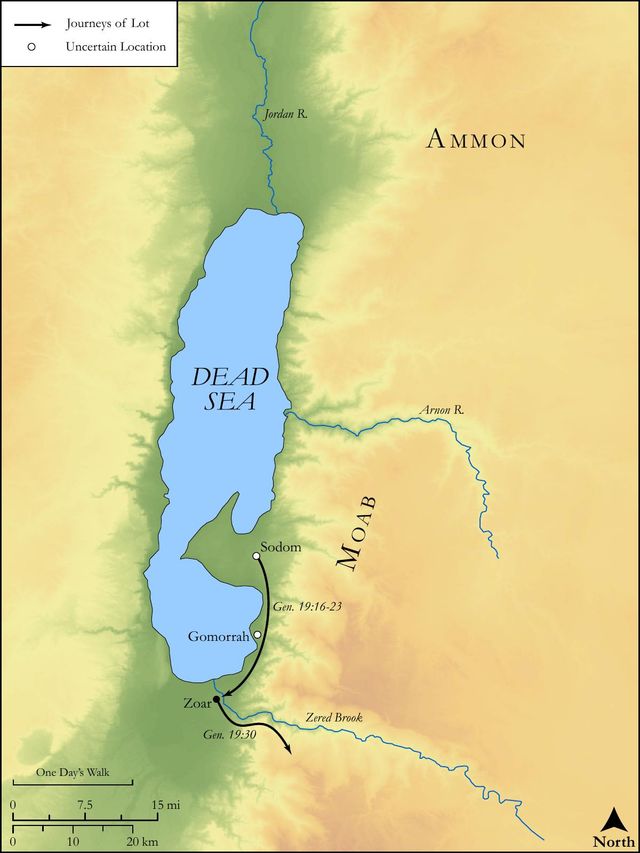
See on the biblical-era maps


Study this verse
Public-domain commentary
Matthew Henry
From his Commentary on the Whole Bible. Henry comments on passages, not single verses — this entry covers Genesis 19:15–23. His four-level outline is real structure in the source text, so it is rendered as structure.
Here is, I. The rescue of Lot out of Sodom. Thought there were not ten righteous men in Sodom, for whose sakes it might be spared, yet that one righteous man that was among them delivered his own soul, Eze 14:14. Early in the morning his own guests, in kindness to him, turned him out of doors, and his family with him, Gen 19:15. His daughters that were married perished with their unbelieving husbands; but those that continued with him were preserved with him. Observe,
1.With what a gracious violence Lot was brought out of Sodom, Gen 19:16. It seems, though he did not make a jest of the warning given, as his sons-in-law did, yet he lingered, he trifled, he did not make so much haste as the case required. Thus many that are under some convictions about the misery of their spiritual state, and the necessity of a change, yet defer that needful work, and foolishly linger. Lot did so, and it might have been fatal to him it the angels had not laid hold of his hand, and brought him forth, and saved him with fear, Jde 1:23. Herein it is said, The Lord was merciful to him; otherwise he might justly have left him to perish, since he was so loth to depart. Note,
(1.)The salvation of the most righteous men must be attributed to God's mercy, not to their own merit. We are saved by grace.
(2.)God's power also must be acknowledged in the bringing of souls out of a sinful state. If God had not brought us forth, we had never come forth.
(3.)If God had not been merciful to us, our lingering had been our ruin.
2.With what a gracious vehemence he was urged to make the best of his way, when he was brought forth, Gen 19:17.
(1.)He must still apprehend himself in danger of being consumed, and be quickened by the law of self-preservation to flee for his life. Note, A holy fear and trembling are found necessary to the working out of our salvation.
(2.)He must therefore mind his business with the utmost care and diligence. He must not hanker after Sodom: Look not behind thee. He must not loiter by the way: Stay not in the plain; for it would all be made one dead sea. He must not take up short of the place of refuge appointed him: Escape to the mountain. Such as these are the commands given to those who through grace are delivered out of a sinful state.
[1.]Return not to sin and Satan, for that is looking back to Sodom.
[2.]Rest not in self and the world, for that is staying in the plain. And,
[3.]Reach towards Christ and heaven, for that is escaping to the mountain, short of which we must not take up.
II.The fixing of a place of refuge for him. The mountain was first appointed for him to flee to, but,
1.He begged for a city of refuge, one of the five that lay together, called Bela, Gen 14:2, Gen 14:18-20. It was Lot's weakness to think a city of his own choosing safer than the mountain of God's appointing. And he argued against himself when he pleaded, Thou hast magnified thy mercy in saving my life, and I cannot escape to the mountain; for could not he that plucked him out of Sodom, when he lingered, carry him safely to the mountain, though he began to tire? Could not he that saved him from greater evils save him from the less? He insists much in his petition upon the smallness of the place: It is a little one, it is not? therefore, it was to be hoped, not so bad as the rest. This gave a new name to the place; it was called Zoar, a little one. Intercessions for little ones are worthy to be remembered.
2.God granted him his request, though there was much infirmity in it, Gen 19:21, Gen 19:22. See what favour God showed to a true saint, though weak.
(1.)Zoar was spared, to gratify him. Though his intercession for it was not, as Abraham's for Sodom, from a principle of generous charity, but merely from self-interest, yet God granted him his request, to show how much the fervent prayer of a righteous man avails.
(2.)Sodom's ruin was suspended till he was safe: I cannot do any thing till thou shalt have come thither. Note, The very presence of good men in a place helps to keep off judgments. See what care God takes for the preservation of his people. The winds are held till God's servants are sealed, Rev 7:3; Eze 9:4.
III.It is taken notice of that the sun had risen when Lot entered into Zoar; for when a good man comes into a place he brings light along with him, or should do.
Historical interpretation
Six Centuries of Reception
2 surviving comments on this verse. Each one is dated, so this reads as a timeline rather than a list.
Select a marker to jump to its quote. Markers stagger vertically where authors wrote within a few decades of each other.
On account of his hospitality and godliness, Lot was saved out of Sodom when all the country round was punished by means of fire and brimstone, the Lord thus making it manifest that He does not forsake those that hope in Him, but gives up such as depart from Him to punishment and torture. [Genesis 19:15-26, 2 Peter 2:6-9] For Lot's wife, who went forth with him, being of a different mind from himself, and not continuing in agreement with him [as to the command which had been given them], was made an example of, so as to be a pillar of salt unto this day. This was done that all might know that those who are of a double mind, and who distrust the power of God, bring down judgment on themselves and become a sign to all succeeding generations.
And they led him out and placed him outside the city. There he spoke to him: "Save your soul, do not look back, nor stay in any region around, but save yourself on the mountain, lest you also perish together." Generally, indeed, the fire and destruction of Sodom, from which Lot was rescued, designates the punishment of ultimate severity; when, with the completion at the end of the age of the total number of the elect, all the impious will be seized into eternal fire, the Lord explaining, who said: "Similarly as it happened in the days of Lot, they ate and drank, bought and sold, planted and built; but the day Lot went out from Sodom, fire and sulfur rained from heaven and destroyed them all. So will it be on the day when the Son of Man is revealed" (Luke 17:28). To which the apostle Jude also attests, saying: "Just as Sodom and Gomorrah and the neighboring cities, which likewise indulged in sexual immorality and pursued unnatural desire, serve as an example by undergoing a punishment of eternal fire” (Jude 7). However, the same fire of Sodom can also, not incongruously, suggest the flames of the vices with which the reprobate are burned in this life and are thus prepared for eternal fire; who, although they now do not cease to burn with earthly desires and carnal allurements, then will never cease to burn with the fire of vengeance. This sense, too, the Lord affirms, indeed even teaches, who says: "In that hour, let the one who is on the housetop, with his goods in the house, not come down to take them away; and likewise, let the one who is in the field not turn back. Remember Lot's wife" (Luke 17:31). For we are not taught that in the approaching moment of the final judgment, deserting the peak of upright conduct, we should turn our mind to the depths of worldly desire; or, leaving the plow of spiritual agriculture, that we should look back, when no further correction of our works remains to us, but rather the reckoning of what we have worked is at hand. Rather, indeed, as judgment approaches, the faithful are given this exhortation, to persist in good and wholesome beginnings, lest, repeating the contagions of sins which they had left behind, they imitate Lot's wife, who, when she looked back heedlessly at the sulfurous burning Sodom, was turned into a pillar of salt. Therefore, as the Lord forbids us from imitating Lot's wife, he certainly shows that the burning of the city, to which she had looked back, expresses the flames of vices which we are both able and ought to avoid. Hence now the exhortation of the angels, by which they had admonished Lot, who was led out of Sodom, not to look back, nor to stay in any region around, but to seek the mountain to be saved, must be spiritually understood and followed with the utmost intention by us; lest we carelessly repeat the ardor and incentives of the vices we seemed to have momentarily escaped, nor consent to remain, as much as possible, in the vicinity of sinners, lest by their example we deviate from the rectitude of our path, as the Psalmist says of the blessed man: "And he does not stand in the way of sinners" (Psalm 1:1), but we should quickly strive to ascend to the height of elevated conduct.
Continue studying Genesis 19:16 across the web’s major study libraries — every link below opens this exact verse, chapter, or book on the destination site.
Read & Compare
 BibleGatewayThis verse in more than 200 translations and 70 languages.
 Bible.comThe YouVersion reader — hundreds of translations, reading plans, and highlights.
 ESV.orgCrossway's official English Standard Version reader.
 NET BibleThe NET translation with 60,000+ translators' notes on every rendering decision.
 STEP BibleTyndale House's free study tool — original text, vocabulary, and scholarly resources.
 BibliaLogos Bible Software's free web reader.
 USCCBThe New American Bible (Revised Edition) with the U.S. bishops' study notes.
Commentaries
 BibleHub CommentariesDozens of classic commentaries on this verse, gathered on one page.
 StudyLightMore than 100 commentary sets — the largest collection on the web.
 BibleRefPlain-English commentary on what this verse means, verse by verse.
 Enduring WordDavid Guzik's free commentary on this chapter, widely used by Bible teachers.
 Bible Study ToolsVerse commentary alongside Greek and Hebrew study aids.
Original Language & Research
- BibleHub InterlinearThe verse word by word — original language, transliteration, and English.
- BibleHub LexiconEvery word's original-language definition and Strong's entry.
 Blue Letter BibleDeep-study tools — Strong's numbers, concordance, and word studies.
 SefariaThe Hebrew text with Rashi and centuries of Jewish commentary.
Sermons, Hymns & Audio


TrulyRandomVerse is not affiliated with these sites and doesn’t control their content. They’re linked because they’re genuinely useful.
Summary
Genesis 19:16 powerfully illustrates the unwavering, proactive mercy of God in the face of human hesitation and impending judgment. As the divine wrath is poised to consume Sodom, two angels, acting on the Lord's compassionate directive, physically intervene to extract Lot and his family from the doomed city. Despite Lot's reluctance and attachment to his worldly life, this verse underscores that divine grace often overrides human weakness, compellingly leading the chosen to safety and demonstrating God's sovereign initiative in salvation.
Context
ShowHideLiterary Context
Genesis 19:16 is a pivotal moment within the dramatic narrative of Sodom and Gomorrah's destruction. It immediately follows the angels' urgent command to Lot to flee the city and their explicit warning not to look back, as judgment was imminent (Genesis 19:15). Lot's "lingering" (verse 16a) serves as a stark contrast to the angels' urgency, highlighting a crucial point of tension before the cataclysmic events that unfold in the subsequent verses, where fire and brimstone rain down from heaven (Genesis 19:24-25). This verse marks the transition from divine warning and human indecision to forceful divine intervention, setting the stage for the ultimate display of God's justice and mercy.
Historical & Cultural Context
The destruction of Sodom and Gomorrah is presented as a divine judgment against cities steeped in profound moral corruption, particularly sexual perversion and a lack of hospitality, which was a grave sin in the days of the patriarchs (Ezekiel 16:49-50). Lot's decision to settle near Sodom, and eventually within it, reflects a common ancient practice of seeking fertile land and established communities, even if morally compromised. The urgency of the angels' command to flee and not look back resonates with the concept of a "holy war" or divine judgment, where complete separation from the condemned was essential for survival. The physical "laying hold" of hands was a common gesture of guidance, rescue, or even ownership in Scripture, here signifying a forceful, benevolent intervention.
Key Themes
ShowHideThis verse contributes significantly to several overarching themes in Genesis and the broader biblical narrative. It powerfully illustrates the theme of Divine Judgment and Salvation, showcasing God's righteous wrath against sin alongside His particular mercy towards a chosen few, often in response to intercession, as seen in Abraham's earnest plea for Sodom. The narrative also highlights the Struggle of Worldly Attachment vs. Obedience, with Lot's hesitation serving as a cautionary example of how material comforts and familiar surroundings can impede spiritual readiness and prompt obedience to divine commands. Furthermore, it underscores God's Sovereign Initiative in Deliverance, emphasizing that salvation is ultimately a work of divine grace and power, not contingent on human merit or perfect compliance, but on God's active intervention to bring about His purposes.
Exposition and Analysis
ShowHideKey Word Analysis
ShowHideThis word means "to question or hesitate," and by implication, "to be reluctant; delay, linger, stay selves, tarry." In the context of Genesis 19:16, Lot's lingering is not merely a slow pace but an internal struggle, an indecision born of his reluctance to abandon his established life, possessions, and social ties within Sodom. It highlights a profound spiritual inertia, a human tendency to cling to comfort zones even when faced with imminent divine judgment and clear warnings.
This primitive root means "to fasten upon; hence, to seize, be strong (figuratively, courageous, causatively strengthen, cure, help, repair, fortify), obstinate; to bind, restrain, conquer." The angels' action of "laying hold" on Lot and his family's hands signifies a forceful, decisive, and active intervention. It communicates a divine "grasp" that overcomes human weakness and hesitation, demonstrating that their deliverance was not a casual invitation but a compelled rescue, initiated and executed by divine power.
This noun denotes "commiseration; merciful, pity." This phrase, "the LORD being merciful unto him," is the theological anchor of the verse. It explicitly attributes Lot's rescue not to his righteousness or prompt obedience, but solely to God's unmerited favor and compassion. It underscores that divine deliverance, especially in the face of judgment, is fundamentally an act of God's character, a demonstration of His pity that extends even to the hesitant and undeserving.
Verse Breakdown
ShowHide"And while he lingered,"
This opening clause immediately establishes the tension of the moment. Lot's hesitation, despite the urgent warnings and the obvious depravity of Sodom, reveals his deep-seated attachment to his worldly life and possessions. It sets the stage for the necessity of divine intervention, as Lot's will was insufficient to prompt immediate obedience to the life-saving command.
"the men laid hold upon his hand, and upon the hand of his wife, and upon the hand of his two daughters;"
This describes the physical, forceful action of the two angels (referred to as "the men"). Their act of grasping the hands of each family member signifies a direct, personal, and compelling rescue. It underscores that Lot's deliverance was not contingent upon his readiness or merit, but upon the proactive and powerful initiative of God's messengers, who literally pulled them out of danger.
"the LORD being merciful unto him:"
This parenthetical clause provides the theological explanation for the angels' actions. It is the divine motivation behind the rescue. Lot's salvation was not earned by his righteousness or swift obedience, but was a direct outpouring of God's unmerited favor and compassion. This highlights God's character as fundamentally merciful, even in the midst of impending judgment, and His willingness to extend grace to those who are hesitant and undeserving.
"and they brought him forth, and set him without the city."
This final clause describes the culmination of the divine intervention. The angels physically removed Lot and his family from the boundaries of Sodom, signifying a complete and decisive separation from the place of judgment. This act of "bringing forth" and "setting without" emphasizes the thoroughness of God's deliverance, ensuring that those He intends to save are fully removed from the locus of destruction and set apart into a place of safety.
Literary Devices
ShowHideGenesis 19:16 employs several potent literary devices. The Contrast between Lot's "lingering" and the angels' decisive action immediately highlights the tension between human weakness and divine initiative. The angels' act of "laying hold upon his hand" is a powerful piece of Symbolism, representing God's active and sometimes forceful intervention to save. The hand here symbolizes divine power, guidance, and rescue, overriding human indecision. The phrase "the LORD being merciful unto him" functions as a Theological Commentary within the narrative, explicitly stating the divine motivation behind the rescue and emphasizing the theme of unmerited Grace. Finally, the entire scene can be seen as a Type or foreshadowing of God's broader redemptive work, where He actively delivers His people from judgment, often despite their own failings.
Theological and Thematic Connections
ShowHideGenesis 19:16 is a profound theological statement on God's character and His method of salvation. It reveals that divine mercy is not passive but actively intervenes, sometimes forcefully, to rescue those appointed for deliverance, even when they are reluctant or undeserving. This passage underscores that salvation is fundamentally an act of God's sovereign grace, preceding and enabling human response. Lot's hesitation highlights the pervasive human struggle with worldly attachments and the difficulty of abandoning comfort zones, even when faced with dire spiritual consequences. Yet, God's compassion prevails, demonstrating His commitment to His covenant purposes and His willingness to overcome human weakness to bring about salvation.
Reflection and Application
ShowHideGenesis 19:16 serves as a profound mirror, reflecting both our human tendency to cling to the familiar and God's relentless, proactive grace. It challenges us to honestly assess what "Sodom" we might be lingering in—be it sinful habits, unhealthy relationships, worldly ambitions, or even comfortable spiritual apathy—despite clear warnings from God's Word or the Holy Spirit. Are we, like Lot, so attached to our present circumstances that we hesitate to obey God's call to separation, repentance, or a new direction? This verse assures us that God's mercy is so vast and His commitment to our salvation so strong that He may, through various means, "lay hold" on us—whether through a powerful conviction, a challenging life circumstance, or the direct intervention of His people—to pull us out of danger and set us on the path of safety. It is a comfort to know that His grace can overcome our weaknesses, but also a sober call to cultivate prompt and willing obedience, lest we, like Lot's wife, look back and forfeit the full blessing of deliverance.
Questions for Reflection
ShowHideFAQ
ShowHideWhy did Lot hesitate to leave Sodom despite the clear danger?
ShowHideLot's hesitation, described by the Hebrew word mâhahh' (H4102), likely stemmed from deep-seated worldly attachments and the comfort of familiarity. He had established his life, accumulated possessions, and likely built a social standing within Sodom. Despite the city's profound wickedness, which "vexed his righteous soul" as 2 Peter 2:7-8 describes, the prospect of abandoning all he knew for an uncertain future created a powerful inertia. This highlights the universal human struggle between spiritual conviction and the powerful pull of material security or social comfort, even when faced with imminent divine judgment.
Does "the LORD being merciful unto him" imply that God forces people to be saved?
ShowHideThis phrase emphasizes that Lot's rescue was an act of divine grace and compassion (chemlâh' H2551), not a reward for his promptness or merit. While God's mercy is sovereign and actively intervenes, even to the point of physically "laying hold" on Lot, it does not imply a forceful, unwilling salvation in a general sense for all humanity. Instead, it demonstrates God's commitment to His covenant purposes and His willingness to overcome human weakness and hesitation to bring about deliverance for those He chooses to save, often in response to intercession (like Abraham's prayer for Sodom). It highlights God's initiative in bringing about salvation, even when human will is faltering, ensuring that His redemptive plan is accomplished.
Christ-Centered Fulfillment
ShowHideGenesis 19:16, with its vivid portrayal of divine mercy compelling salvation despite human hesitation, finds its ultimate and most profound fulfillment in the person and work of Jesus Christ. Just as the angels physically "laid hold" on Lot and his family to deliver them from the literal fires of Sodom, so Christ, through His atoning sacrifice on the cross, "lays hold" on humanity, rescuing us from the spiritual judgment of sin and death. His grace is not contingent on our perfect readiness, unwavering faith, or moral merit, but on His proactive love and sovereign will. He is the ultimate Deliverer who, "while we were still sinners, Christ died for us" (Romans 5:8). The unmerited mercy shown to Lot prefigures the boundless compassion of God in Christ, who offers a complete separation from the "city" of sin and its impending doom, and a new life of deliverance and righteousness. Through Him, we are not merely brought "without the city" but brought into a new covenant relationship, redeemed by His blood and empowered by His Spirit to "flee from the wrath to come" (Matthew 3:7) and find eternal refuge in the "city of the living God, the heavenly Jerusalem" (Hebrews 12:22).