


Genesis 19:17
Bible text: King James Version (1769 Blayney text) · Public domain
Bible text: King James Version with Strong's numbers · Public domain
Bible text: Berean Standard Bible · Public domain
Bible text: American Standard Version (1901) · Public domain
Bible text: World English Bible, Messianic edition · Public domain
Bible text: Geneva Bible (1599) · Public domain
Bible text: Young's Literal Translation · Public domain
- וַיְהִיvay·Hiand it wasH1961Conj-w ¦ V-Qal-ConsecImperf-3msVerb Qal Consecutive Imperfect 3rd Singular Masculineוַandיְהִיit was
- כְהוֹצִיאָםkhe·ho·tzi·'Amwhen they brought outH3318Prep-k ¦ V-Hiphil-Inf ¦ 3mpVerb Hiphil Infinitive Constructכְwhenהוֹצִיאָbrought outםthey
- אֹתָם'o·Tam<obj.> themH853DirObjM ¦ 3mpParticle Object Indicatorאֹתָ<obj.>םthem
- הַחוּצָהha·Chu·tzahthe outside towardsH2351Art ¦ N-ms ¦ SfxNoun Singular Masculine Absoluteהַtheחוּצָoutsideהtowards
- וַיֹּאמֶרvai·Yo·merand he saidH559Conj-w ¦ V-Qal-ConsecImperf-3msVerb Qal Consecutive Imperfect 3rd Singular Masculineוַandיֹּאמֶרhe said
- הִמָּלֵטhi·ma·LetescapeH4422V-Niphal-Imp-2msVerb Niphal Imperative 2nd Singular Masculine
- עַל'alonH5921PrepPreposition
- נַפְשֶׁךָnaf·She·khayour lifeH5315N-fsc ¦ 2msNoun Singular Feminine Constructנַפְשֶׁlifeךָyour
- אַל'almay notH408NegParticle Negative
- תַּבִּיטta·Bityou lookH5027V-Hiphil-Imperf-2msVerb Hiphil Imperfect 2nd Singular Masculine
- אַחֲרֶיךָ'a·cha·Rei·khabehind youH310Adj-mpc ¦ 2msAdjective Numerical Plural Masculine Constructאַחֲרֶיbehindךָyou
- וְאַלve·'aland may notH408Conj-w ¦ NegParticle Negativeוְandאַלmay not
- תַּעֲמֹדta·'a·Modyou stopH5975V-Qal-Imperf-2msVerb Qal Imperfect 2nd Singular Masculine
- בְּכָלbe·kholin allH3605Prep-b ¦ N-mscNoun Singular Masculine Constructבְּinכָלall
- הַכִּכָּרha·ki·Karthe valleyH3603Art ¦ N-fsNoun Singular Feminine Absoluteהַtheכִּכָּרvalley
- הָהָרָהha·Ha·rahthe hill country towardsH2022Art ¦ N-ms ¦ SfxNoun Singular Masculine Absoluteהָtheהָרָhill countryהtowards
- הִמָּלֵטhi·ma·LetescapeH4422V-Niphal-Imp-2msVerb Niphal Imperative 2nd Singular Masculine
- פֶּןpenlestH6435PrtParticle Conditional
- תִּסָּפֶהti·sa·Pehyou should be swept awayH5595V-Niphal-Imperf-2msVerb Niphal Imperfect 2nd Singular Masculine
English is a literal word-by-word gloss of the Hebrew, not the KJV's wording. Why?
This is the original text the KJV's translators worked from — each Hebrew word with its own literal English meaning in this verse, prepared by scholars at Tyndale House, Cambridge. The KJV translates whole sentences, not word by word, so its wording differs: one Hebrew word can become several English words, and the KJV may choose “the LORD” where the gloss reads “Yahweh”. Both are faithful — they answer different questions. For the KJV's own rendering, switch to the KJV text.
Details
See on the biblical-era maps


Study this verse
Public-domain commentary
Matthew Henry
From his Commentary on the Whole Bible. Henry comments on passages, not single verses — this entry covers Genesis 19:15–23. His four-level outline is real structure in the source text, so it is rendered as structure.
Here is, I. The rescue of Lot out of Sodom. Thought there were not ten righteous men in Sodom, for whose sakes it might be spared, yet that one righteous man that was among them delivered his own soul, Eze 14:14. Early in the morning his own guests, in kindness to him, turned him out of doors, and his family with him, Gen 19:15. His daughters that were married perished with their unbelieving husbands; but those that continued with him were preserved with him. Observe,
1.With what a gracious violence Lot was brought out of Sodom, Gen 19:16. It seems, though he did not make a jest of the warning given, as his sons-in-law did, yet he lingered, he trifled, he did not make so much haste as the case required. Thus many that are under some convictions about the misery of their spiritual state, and the necessity of a change, yet defer that needful work, and foolishly linger. Lot did so, and it might have been fatal to him it the angels had not laid hold of his hand, and brought him forth, and saved him with fear, Jde 1:23. Herein it is said, The Lord was merciful to him; otherwise he might justly have left him to perish, since he was so loth to depart. Note,
(1.)The salvation of the most righteous men must be attributed to God's mercy, not to their own merit. We are saved by grace.
(2.)God's power also must be acknowledged in the bringing of souls out of a sinful state. If God had not brought us forth, we had never come forth.
(3.)If God had not been merciful to us, our lingering had been our ruin.
2.With what a gracious vehemence he was urged to make the best of his way, when he was brought forth, Gen 19:17.
(1.)He must still apprehend himself in danger of being consumed, and be quickened by the law of self-preservation to flee for his life. Note, A holy fear and trembling are found necessary to the working out of our salvation.
(2.)He must therefore mind his business with the utmost care and diligence. He must not hanker after Sodom: Look not behind thee. He must not loiter by the way: Stay not in the plain; for it would all be made one dead sea. He must not take up short of the place of refuge appointed him: Escape to the mountain. Such as these are the commands given to those who through grace are delivered out of a sinful state.
[1.]Return not to sin and Satan, for that is looking back to Sodom.
[2.]Rest not in self and the world, for that is staying in the plain. And,
[3.]Reach towards Christ and heaven, for that is escaping to the mountain, short of which we must not take up.
II.The fixing of a place of refuge for him. The mountain was first appointed for him to flee to, but,
1.He begged for a city of refuge, one of the five that lay together, called Bela, Gen 14:2, Gen 14:18-20. It was Lot's weakness to think a city of his own choosing safer than the mountain of God's appointing. And he argued against himself when he pleaded, Thou hast magnified thy mercy in saving my life, and I cannot escape to the mountain; for could not he that plucked him out of Sodom, when he lingered, carry him safely to the mountain, though he began to tire? Could not he that saved him from greater evils save him from the less? He insists much in his petition upon the smallness of the place: It is a little one, it is not? therefore, it was to be hoped, not so bad as the rest. This gave a new name to the place; it was called Zoar, a little one. Intercessions for little ones are worthy to be remembered.
2.God granted him his request, though there was much infirmity in it, Gen 19:21, Gen 19:22. See what favour God showed to a true saint, though weak.
(1.)Zoar was spared, to gratify him. Though his intercession for it was not, as Abraham's for Sodom, from a principle of generous charity, but merely from self-interest, yet God granted him his request, to show how much the fervent prayer of a righteous man avails.
(2.)Sodom's ruin was suspended till he was safe: I cannot do any thing till thou shalt have come thither. Note, The very presence of good men in a place helps to keep off judgments. See what care God takes for the preservation of his people. The winds are held till God's servants are sealed, Rev 7:3; Eze 9:4.
III.It is taken notice of that the sun had risen when Lot entered into Zoar; for when a good man comes into a place he brings light along with him, or should do.
Historical interpretation
Historical reception
1 surviving comment on this verse from the historical church.
On account of his hospitality and godliness, Lot was saved out of Sodom when all the country round was punished by means of fire and brimstone, the Lord thus making it manifest that He does not forsake those that hope in Him, but gives up such as depart from Him to punishment and torture. [Genesis 19:15-26, 2 Peter 2:6-9] For Lot's wife, who went forth with him, being of a different mind from himself, and not continuing in agreement with him [as to the command which had been given them], was made an example of, so as to be a pillar of salt unto this day. This was done that all might know that those who are of a double mind, and who distrust the power of God, bring down judgment on themselves and become a sign to all succeeding generations.
Continue studying Genesis 19:17 across the web’s major study libraries — every link below opens this exact verse, chapter, or book on the destination site.
Read & Compare
 BibleGatewayThis verse in more than 200 translations and 70 languages.
 Bible.comThe YouVersion reader — hundreds of translations, reading plans, and highlights.
 ESV.orgCrossway's official English Standard Version reader.
 NET BibleThe NET translation with 60,000+ translators' notes on every rendering decision.
 STEP BibleTyndale House's free study tool — original text, vocabulary, and scholarly resources.
 BibliaLogos Bible Software's free web reader.
 USCCBThe New American Bible (Revised Edition) with the U.S. bishops' study notes.
Commentaries
 BibleHub CommentariesDozens of classic commentaries on this verse, gathered on one page.
 StudyLightMore than 100 commentary sets — the largest collection on the web.
 BibleRefPlain-English commentary on what this verse means, verse by verse.
 Enduring WordDavid Guzik's free commentary on this chapter, widely used by Bible teachers.
 Bible Study ToolsVerse commentary alongside Greek and Hebrew study aids.
Original Language & Research
- BibleHub InterlinearThe verse word by word — original language, transliteration, and English.
- BibleHub LexiconEvery word's original-language definition and Strong's entry.
 Blue Letter BibleDeep-study tools — Strong's numbers, concordance, and word studies.
 SefariaThe Hebrew text with Rashi and centuries of Jewish commentary.
Sermons, Hymns & Audio


TrulyRandomVerse is not affiliated with these sites and doesn’t control their content. They’re linked because they’re genuinely useful.
Summary
Genesis 19:17 captures the urgent, life-saving divine command issued by an angel to Lot, his wife, and two daughters as they were led out of the doomed cities of Sodom and Gomorrah. This imperative instruction demanded immediate flight, an absolute prohibition against looking back, and a complete separation from the entire plain, underscoring the severe consequences of disobedience and the critical necessity of unwavering trust in God's designated path to safety amidst impending judgment.
Context
ShowHideLiterary Context
This verse is a pivotal moment following the dramatic events of Genesis 19. Two angels, sent by the Lord, had arrived in Sodom and were hosted by Lot. The extreme depravity of the city's inhabitants, who attempted to assault the angels, confirmed God's righteous judgment against Sodom and Gomorrah. Having miraculously rescued Lot's family from the mob and blinded the men of Sodom, the angels then revealed God's imminent plan to destroy the cities. Genesis 19:15-16 describes the angels' forceful intervention to physically remove the hesitant Lot, his wife, and two daughters from the city's gates just before dawn. Verse 17, therefore, represents the crucial, final instructions given to the family as they stood on the threshold of escape, emphasizing the urgency and conditions for their survival. It sets the stage for the subsequent destruction and the tragic fate of Lot's wife.
Historical & Cultural Context
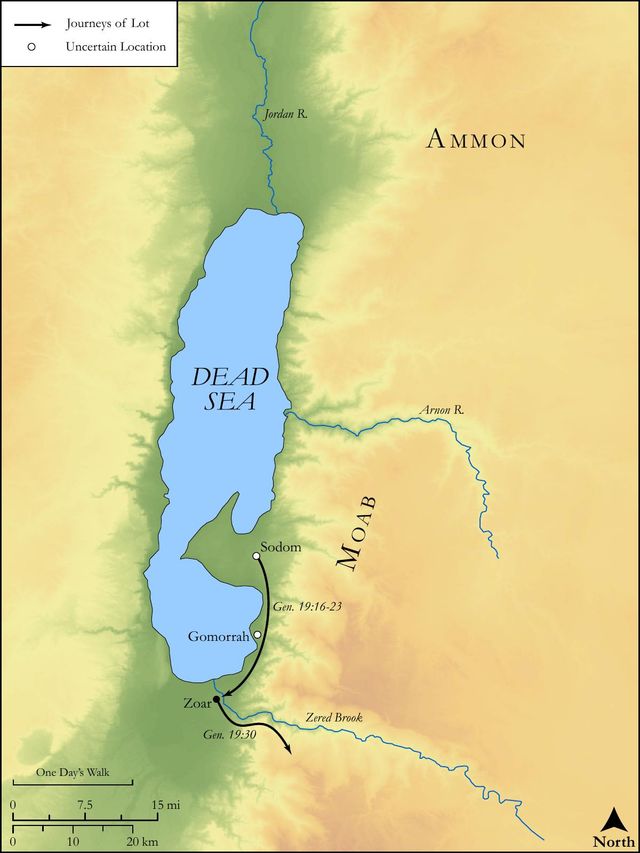
The cities of Sodom and Gomorrah were located in the fertile "plain of the Jordan," likely in the southern Dead Sea region, known for its lushness before its destruction (Genesis 13:10). These cities were infamous for their extreme wickedness, particularly their sexual perversion and inhospitality, which had reached a point where divine judgment was inevitable (Genesis 18:20-21). The command to flee to the "mountain" recalls the mountain as a place of refuge throughout Scripture, as in the Lord's later word, "let them which be in Judaea flee into the mountains"; mountains stood elevated above the plains and were often associated with divine presence or safety from floods and military threats. The urgency of the command also speaks to the swiftness and totality of ancient divine judgments, which often involved natural phenomena (like fire and brimstone) that left no room for hesitation or lingering.
Key Themes
ShowHideGenesis 19:17 contributes significantly to several overarching themes within the book of Genesis and biblical theology. Primarily, it highlights God's righteous judgment against sin and His divine mercy in providing a way of escape for the righteous, even a relative righteous like Lot (2 Peter 2:7-8). The command to "escape for thy life" underscores the urgency of obedience to divine warnings, particularly when facing imminent danger or judgment. The prohibitions against looking back or staying in the plain powerfully convey the theme of complete separation from sin and the world's corrupting influence. This theme is further reinforced by the tragic outcome for Lot's wife in Genesis 19:26, serving as a stark warning about the consequences of disobedience and a lingering affection for the world. Ultimately, the verse also subtly points to God's sovereign provision of refuge for those who trust and obey Him.
Exposition and Analysis
ShowHideKey Word Analysis
ShowHideThis primitive root properly means "to be smooth," which by implication leads to the idea of "escaping" (as if by slipperiness). Causatively, it means "to release or rescue." In this context, it conveys an intense, desperate urgency for self-preservation, emphasizing that Lot and his family must swiftly and decisively deliver themselves from the imminent, overwhelming danger. It is a command for immediate, unhindered flight.
The root nâbaṭ means "to scan" or "look intently at," often implying a careful or focused gaze. When combined with the negative particle and the phrase "behind thee" (Hebrew, ʼachar'), it forms a strict prohibition against any backward glance. This is more than a casual look; it forbids a lingering, longing, or regretful gaze towards the condemned cities, symbolizing a spiritual or emotional attachment to the world being judged.
This term refers to a "mountain or range of hills." In this context, it represents the divinely appointed place of refuge and safety, a stark contrast to the low-lying "plain" which was destined for destruction. The command to flee to the mountain signifies a complete and decisive separation from the corrupting influence and the coming judgment, highlighting a place of elevated security and divine sanctuary.
Verse Breakdown
ShowHide"And it came to pass, when they had brought them forth abroad, that he said,"
This opening clause establishes the setting and the divine initiative. The angels had physically led Lot's family out of the city's confines, placing them "abroad" or outside the immediate danger zone, before the crucial instructions were delivered. This highlights God's active role in their deliverance.
"Escape for thy life;"
This is the primary, urgent command. It emphasizes the dire stakes: their very existence depended on immediate and decisive flight. It's a personal plea for self-preservation, underscoring the imminence and totality of the impending judgment.
"look not behind thee,"
This is a crucial prohibition against any backward glance. It forbids not just a physical turn, but any lingering affection, regret, or desire for the condemned cities and the life they were leaving behind. It demands a complete and decisive break, spiritually and emotionally, from the world God was judging.
"neither stay thou in all the plain;"
This second prohibition reinforces the first, demanding absolute separation. There was to be no hesitation, no partial obedience, and no attempt to find a halfway measure of safety within the doomed region. The entire plain was under judgment, requiring total removal from its boundaries.
"escape to the mountain, lest thou be consumed."
This final instruction provides the specific destination for safety and reiterates the dire consequence of disobedience. The "mountain" is the divinely designated sanctuary, symbolizing complete removal from the judgment. The warning "lest thou be consumed" emphasizes the totality of the destruction awaiting those who failed to obey, implying utter annihilation or being swept away by the divine wrath.
Literary Devices
ShowHideThe passage employs several potent literary devices to convey its urgent message. Imperative Mood is dominant, with commands like "Escape," "look not," "neither stay," and "escape to the mountain," creating a sense of immediate, non-negotiable action. The use of Contrast is stark between the doomed "plain" and the safe "mountain," symbolizing the spiritual dichotomy between judgment and refuge. Symbolism is also at play: "looking back" symbolizes a lingering attachment to sin or the world, while the "mountain" symbolizes divine refuge and a complete break from the condemned. The phrase "Escape for thy life" is an example of Hyperbole or intense urgency, emphasizing the extreme peril and the absolute necessity of immediate action for survival. The narrative itself functions as a Cautionary Tale, especially when read in light of Lot's wife's fate, highlighting the dire consequences of partial obedience or spiritual compromise.
Theological and Thematic Connections
ShowHideGenesis 19:17 serves as a profound theological statement on God's character and the nature of salvation. It vividly portrays God as both a righteous Judge who must punish sin and a merciful Deliverer who provides a way of escape for those He chooses to save. The urgency of the command underscores the critical importance of immediate and unwavering obedience to divine warnings, particularly when faced with the consequences of sin and impending judgment. The prohibitions against looking back or lingering in the plain highlight the necessity of a complete, decisive break from all that is contrary to God's will, emphasizing that genuine salvation requires a full turning away from the world and its allurements. This passage foreshadows the broader biblical theme that true deliverance demands a radical separation from the old life and a wholehearted pursuit of God's appointed path.
Reflection and Application
ShowHideGenesis 19:17 offers timeless and potent lessons for believers in every age, urging us to respond with decisive action to God's call for salvation and sanctification. Just as Lot was commanded to flee without looking back, we are called to make a complete and unwavering break from past sins, worldly attachments, and the allure of anything that would draw us away from Christ. This passage serves as a powerful reminder that there is no spiritual safety in lingering near sin or attempting to find a compromise between God's will and the world's ways. Jesus himself echoed this sentiment when he warned, "Remember Lot's wife," and declared that "No man, having put his hand to the plough, and looking back, is fit for the kingdom of God" (Luke 9:62). True discipleship demands forward momentum, wholehearted commitment, and an absolute trust in God's provision and path. Our refuge and safety are found only in complete obedience to His Word, fleeing from all forms of temptation and seeking sanctuary in His presence and perfect will, knowing that hesitation or compromise can lead to spiritual ruin.
Questions for Reflection
ShowHideFAQ
ShowHideWhy was Lot's family forbidden from looking back or staying in the plain?
ShowHideThe prohibition against looking back and staying in the plain was a profound test of complete obedience and a symbolic demand for total separation from the condemned cities and their sinful ways. Looking back would have indicated a lingering affection for the world God was judging, a desire for what was left behind, or a lack of full trust in God's provision for their future. Similarly, staying in the plain, even outside the city, would represent partial obedience or a compromise with the very evil God was destroying, which would still expose them to the judgment. God required a decisive, unreserved, and wholehearted break from the old life and its influences to ensure their complete deliverance and demonstrate the absolute nature of His judgment. This is why Lot's wife's disobedience served as such a stark warning.
What is the significance of the command to "escape to the mountain"?
ShowHideThe "mountain" represents the divinely appointed place of safety and refuge, a sanctuary from the impending destruction of the plain. Theologically, it signifies a complete and decisive separation from the corrupting influence and judgment of the world. It underscores that true safety and deliverance are found only in following God's specific instructions and seeking refuge in the place He designates, which often requires leaving behind familiar comforts or dangers. It is a call to radical obedience and trust, moving towards God's provision rather than attempting to find safety in a compromised or self-chosen location. It highlights that God always provides a way of escape for those who obey His commands, even when the surrounding circumstances are dire.
Christ-Centered Fulfillment
ShowHideGenesis 19:17, with its urgent call to "escape for thy life" from impending judgment, finds its ultimate and most profound fulfillment in Jesus Christ. He is the ultimate "mountain" of refuge, the only true escape from the condemnation of sin and the righteous wrath of God. Just as Lot's family was commanded to flee to a designated place of safety, humanity is called to flee from sin and the world's allure and find salvation exclusively in Christ. His sacrificial death on the cross provides the means of escape from eternal judgment (Romans 5:8-9). Furthermore, His call to discipleship demands a decisive break from the old life, a refusal to "look back" at the former ways of sin and worldly attachments (2 Corinthians 5:17), and an unwavering commitment to follow Him into newness of life. In Christ, believers secure eternal deliverance from the judgment to come, finding their ultimate sanctuary and hope in Him alone (John 3:16-18).