


Genesis 19:26
Bible text: King James Version (1769 Blayney text) · Public domain
Bible text: Berean Standard Bible · Public domain
Bible text: American Standard Version (1901) · Public domain
Bible text: World English Bible, Messianic edition · Public domain
Bible text: Geneva Bible (1599) · Public domain
Bible text: Young's Literal Translation · Public domain
- וַתַּבֵּטva·ta·Betand she lookedH5027Conj-w ¦ V-Hiphil-ConsecImperf-3fsVerb Hiphil Consecutive Imperfect 3rd Singular Feminineוַandתַּבֵּטshe looked
- אִשְׁתּוֹ'ish·Tohis wifeH802N-fsc ¦ 3msNoun Singular Feminine Constructאִשְׁתּwifeוֹhis
- מֵאַחֲרָיוme·'a·cha·Ravfrom behind himH310Prep-m ¦ Adj-mpc ¦ 3msAdjective Numerical Plural Masculine Constructמֵfromאַחֲרָיbehindוhim
- וַתְּהִיva·te·Hiand she wasH1961Conj-w ¦ V-Qal-ConsecImperf-3fsVerb Qal Consecutive Imperfect 3rd Singular Feminineוַandתְּהִיshe was
- נְצִיבne·Tziva pillar ofH5333N-mscNoun Singular Masculine Construct
- מֶלַחMe·lachsaltH4417N-msNoun Singular Masculine Absolute
English is a literal word-by-word gloss of the Hebrew, not the KJV's wording. Why?
This is the original text the KJV's translators worked from — each Hebrew word with its own literal English meaning in this verse, prepared by scholars at Tyndale House, Cambridge. The KJV translates whole sentences, not word by word, so its wording differs: one Hebrew word can become several English words, and the KJV may choose “the LORD” where the gloss reads “Yahweh”. Both are faithful — they answer different questions. For the KJV's own rendering, switch to the KJV text.
Details
See on the biblical-era maps


Study this verse
Public-domain commentary
Matthew Henry
From his Commentary on the Whole Bible. Henry comments on passages, not single verses — this entry covers Genesis 19:26. His two-level outline is real structure in the source text, so it is rendered as structure.
This also is written for our admonition. Our Saviour refers to it (Luk 17:32), Remember Lot's wife. As by the example of Sodom the wicked are warned to turn from their wickedness, so by the example of Lot's wife the righteous are warned not to turn from their righteousness. See Eze 3:18, Eze 3:20. We have here,
I.The sin of Lot's wife:
She looked back from behind him. This seemed a small thing, but we are sure, by the punishment of it, that it was a great sin, and exceedingly sinful.
1.She disobeyed an express command, and so sinned after the similitude of Adam's transgression, which ruined us all.
2.Unbelief was at the bottom of it; she questioned whether Sodom would be destroyed, and thought she might still have been safe in it.
3.She looked back upon her neighbours whom she had left behind with more concern than was fit, now that their day of grace was over, and divine justice was glorifying itself in their ruin. See Isa 66:24.
4.Probably she hankered after her house and goods in Sodom, and was loth to leave them. Christ intimates this to be her sin (Luk 17:31, Luk 17:32); she too much regarded her stuff.
5.Her looking back evinced an inclination to go back; and therefore our Saviour uses it as a warning against apostasy from our Christian profession. We have all renounced the world and the flesh, and have set our faces heaven-ward; we are in the plain, upon our probation; and it is at our peril if we return into the interests we profess to have abandoned. Drawing back is to perdition, and looking back is towards it. Let us therefore fear, Heb 4:1.
II.The punishment of Lot's wife for this sin.
She was struck dead in the place; yet her body did not fall down, but stood fixed and erect like a pillar, or monument, not liable to waste nor decay, as human bodies exposed to the air are, but metamorphosed into a metallic substance which would last perpetually. Come, behold the goodness and severity of God (Rom 11:22), towards Lot, who went forward, goodness; towards his wife, who looked back, severity. Though she was nearly related to a righteous man, though better than her neighbours, and though a monument of distinguishing mercy in her deliverance out of Sodom, yet God did not connive at her disobedience; for great privileges will not secure us from the wrath of God if we do not carefully and faithfully improve them. This pillar of salt should season us. Since it is such a dangerous thing to look back, let us always press forward, Phi 3:13, Phi 3:14.
Historical interpretation
Six Centuries of Reception
4 surviving comments on this verse. Each one is dated, so this reads as a timeline rather than a list.
Select a marker to jump to its quote. Markers stagger vertically where authors wrote within a few decades of each other.
On account of his hospitality and godliness, Lot was saved out of Sodom when all the country round was punished by means of fire and brimstone, the Lord thus making it manifest that He does not forsake those that hope in Him, but gives up such as depart from Him to punishment and torture. [Genesis 19:15-26, 2 Peter 2:6-9] For Lot's wife, who went forth with him, being of a different mind from himself, and not continuing in agreement with him [as to the command which had been given them], was made an example of, so as to be a pillar of salt unto this day. This was done that all might know that those who are of a double mind, and who distrust the power of God, bring down judgment on themselves and become a sign to all succeeding generations.
For God looks closely at the actual inner purpose, as when Lot’s wife was the only one to turn of her own free will toward the wickedness of the world. He left her insensible, giving her the likeness of a pillar of salt and leaving her without the power of forward movement, a statue, yet not one without a useful message but one intended to season and salt the person capable of spiritual perception.
But let us return to Lot, who, fleeing the destruction of Sodom with his wife and daughters after he had received the command from the angels to not look back, was proceeding to Zoar. But his wife became negligent of the command. “She looked back”; she violated the imposed law; “she became a little statue of salt.” Do we think there was so much evil in this transgression, that the woman, because she looked behind her, incurred the destruction that she appeared to be fleeing by divine favor? For what great crime was it, if the concerned mind of the woman looked backward whence she was being terrified by the excessive crackling of the flames?But because “the law is spiritual” and the things that happened to the ancients “happened figuratively,” let us see if perhaps Lot, who did not look back, is not the rational understanding and the courageous soul, and his wife here represents the flesh. For it is the flesh which always looks to vices; when the soul is proceeding to salvation, the flesh looks backward and seeks after pleasures. For concerning that the Lord also said, “No man putting his hand to the plow and looking back is fit for the kingdom of God.” And he adds, “Remember Lot’s wife.” But the fact that “she became a little statue of salt” appears to be an open indication of her folly. For salt represents the prudence which she lacked.
Lot therefore pushed on to Zoar. After he had gained strength there for a while, which he could not have in Sodom, he ascended the mountain and dwelt there, as the Scripture says, “he and his two daughters with him.”
And his wife, looking back, was turned into a pillar of salt. This indeed must be believed to have happened literally. Finally, Josephus reports that even up to his time the same pillar of salt had endured at the gates of the same city. And indeed, the wife, out of fear due to her feminine frailty at the sudden clamoring of the perishing and the crashing of the flames falling from the sky, looked back; but it nonetheless holds their figure in this infirmity, who, once renouncing the world and beginning the arduous journey of virtues, suddenly return with an unstable and almost feminine heart to the desires of the world they had forsaken; about whom the apostle Peter says: "It would have been better for them not to have known the way of righteousness, than after knowing it to turn back from the holy commandment delivered to them" (2 Peter 2:21); as, conversely, Lot, who left behind everything he possessed that was destined to perish with the sinners, suggests those who truly renounce the world, and regret not their renunciation; those whom also the blessed Noah, who left behind all his possessions to be destroyed by the floods with the reprobates, just as [Lot] did with the fire, clearly denotes; but the fact that the wife of Lot, when she turned away from the path which the Lord showed, perished and was turned into a pillar of salt; aptly signifies that those who deviate from the way of truth by returning to sins perish in their own depravity; yet by the example of their perdition they leave behind, as it were, a seasoning of wisdom for others, so that those remembering their destruction may guard themselves more cautiously and circumspectly in the purpose of righteousness they have taken up. Finally, the Lord, warning the faithful not to abandon the path of faith they have begun, employs for them, as it were, a rock of salt that they may more sweetly savor His words, when He says among other things: "Remember Lot's wife" (Luke 17:32). Therefore, anyone who desires to escape the fire of vices, which is the final judgment, must forget what is past and always strive towards the joys of divine promise that lie ahead.
Continue studying Genesis 19:26 across the web’s major study libraries — every link below opens this exact verse, chapter, or book on the destination site.
Read & Compare
 BibleGatewayThis verse in more than 200 translations and 70 languages.
 Bible.comThe YouVersion reader — hundreds of translations, reading plans, and highlights.
 ESV.orgCrossway's official English Standard Version reader.
 NET BibleThe NET translation with 60,000+ translators' notes on every rendering decision.
 STEP BibleTyndale House's free study tool — original text, vocabulary, and scholarly resources.
 BibliaLogos Bible Software's free web reader.
 USCCBThe New American Bible (Revised Edition) with the U.S. bishops' study notes.
Commentaries
 BibleHub CommentariesDozens of classic commentaries on this verse, gathered on one page.
 StudyLightMore than 100 commentary sets — the largest collection on the web.
 BibleRefPlain-English commentary on what this verse means, verse by verse.
 Enduring WordDavid Guzik's free commentary on this chapter, widely used by Bible teachers.
 Bible Study ToolsVerse commentary alongside Greek and Hebrew study aids.
Original Language & Research
- BibleHub InterlinearThe verse word by word — original language, transliteration, and English.
- BibleHub LexiconEvery word's original-language definition and Strong's entry.
 Blue Letter BibleDeep-study tools — Strong's numbers, concordance, and word studies.
 SefariaThe Hebrew text with Rashi and centuries of Jewish commentary.
Sermons, Hymns & Audio


TrulyRandomVerse is not affiliated with these sites and doesn’t control their content. They’re linked because they’re genuinely useful.
Summary
Genesis 19:26 records the immediate and severe consequence of Lot's wife's disobedience during the divine judgment upon Sodom and Gomorrah, detailing her instantaneous transformation into a pillar of salt as a direct result of her backward glance. This pivotal moment serves as a stark warning against spiritual hesitation and a divided heart in the face of God's deliverance and impending judgment.
Context
ShowHideLiterary Context
This verse is a climactic moment within the narrative of Genesis 19, which describes the divine judgment and destruction of Sodom and Gomorrah. Preceding this verse, two angels, sent by God, arrive in Sodom to rescue Lot and his family due to Abraham's intercession. They explicitly command Lot, his wife, and their two daughters to flee the city without looking back or stopping anywhere in the plain, urging them to escape to the mountains for their lives (Genesis 19:17). The narrative then details the fiery destruction of the cities (Genesis 19:24-25), immediately followed by Lot's wife's fateful act of looking back, which sets the stage for her transformation. Her action stands in stark contrast to the urgency and obedience required by the divine command.
Historical & Cultural Context
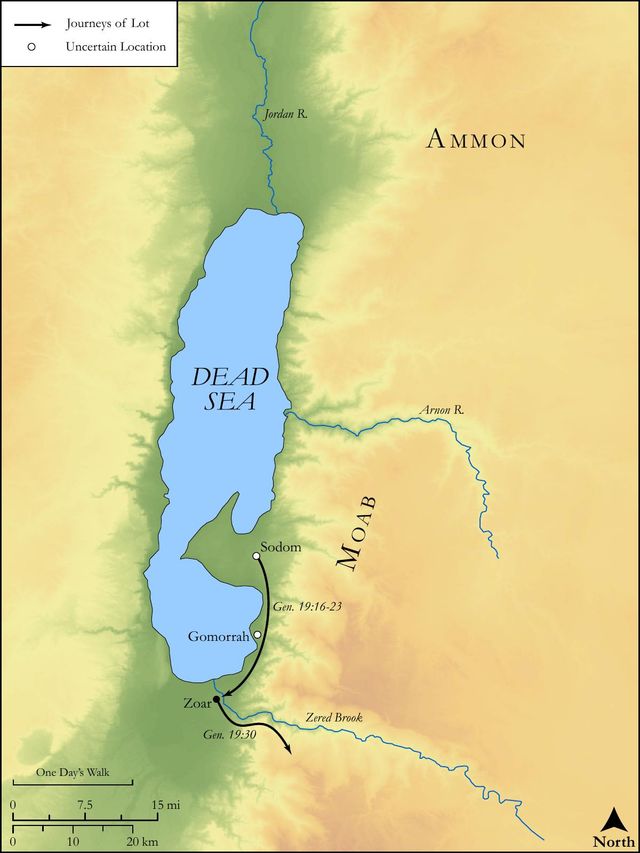
The region around the Dead Sea, where Sodom and Gomorrah are traditionally located, is known for its high salinity and unique geological formations, including salt pillars and deposits. This natural environment would have made the imagery of a "pillar of salt" particularly vivid and impactful to an ancient audience. The destruction of cities by fire and brimstone, while miraculous in its divine origin, echoes the flood in the days of Noah and the catastrophic consequences of defying God. The concept of a "pillar" or "statue" as a memorial or warning was also culturally significant, making her transformation a permanent, visible testament to her disobedience. Furthermore, the patriarchal society placed a high value on obedience to divine commands, and Lot's wife's actions would have been understood as a serious transgression against both divine authority and the family's deliverance.
Key Themes
ShowHideGenesis 19:26 contributes significantly to several overarching themes within the book of Genesis and the broader biblical narrative. It powerfully illustrates the theme of divine judgment against human wickedness, emphasizing God's holiness and justice in punishing sin, as seen in the destruction of the cities (Genesis 19:24). Concurrently, it highlights the theme of divine deliverance for the righteous, albeit imperfectly represented by Lot's family. The verse also underscores the critical importance of wholehearted obedience to God's commands, contrasting Lot's wife's fatal glance with the necessity of single-minded devotion. Her fate serves as a profound warning against spiritual compromise and the danger of a divided heart, which clings to the world even when God calls for complete separation. This event foreshadows later biblical warnings about the dangers of looking back to a former life or worldly attachments when pursuing God's call, a theme echoed by Jesus in Luke 17:32.
Exposition and Analysis
ShowHideKey Word Analysis
ShowHideThis term, H802, refers to a woman or, in this context, specifically a wife. The use of "his wife" emphasizes her personal connection to Lot and her inclusion in the divine deliverance, making her act of disobedience particularly poignant as it occurred within the context of receiving grace.
The Hebrew word H5027, nâbaṭ, means "to scan," "look intently at," or "regard with pleasure, favor, or care." This is not a casual glance but a deliberate, sustained look. Her "looking back" was an act of intentional defiance, suggesting a lingering attachment to Sodom, its lifestyle, or her possessions, rather than a simple act of curiosity. It implies a heart that was not fully committed to the escape and the new life God was offering.
ʼachar, signifies "the hind part" or "after." This phrase emphasizes her position relative to Lot and the direction of her gaze. She was fleeing with him, yet her focus was behind him, towards the destruction from which they were meant to escape. This spatial detail underscores her spiritual orientation – physically moving forward, but spiritually drawn backward.
nᵉtsîyb, denotes something stationary, a prefect, a military post, or a statue. In this context, it signifies a fixed, immovable monument. Her transformation into a "pillar" suggests not merely being covered by salt, but a complete, miraculous, and irreversible change of her very being into a permanent, lifeless structure.
melach, refers to salt, often as a powder or easily pulverized substance. The specific material of her transformation, salt, is significant given the region's geography and the symbolic uses of salt in Scripture (preservation, judgment, barrenness). Here, it likely symbolizes desolation, barrenness, and the finality of judgment, rendering her lifeless and unproductive.
Verse Breakdown
ShowHide"But his wife looked back from behind him"
This clause introduces the pivotal action. Despite the explicit divine command not to look back (Genesis 19:17), Lot's wife deliberately turns her gaze towards the burning cities. The phrase "from behind him" highlights her position relative to Lot, suggesting a lagging or a deliberate turning away from the path of escape, indicating a lack of full commitment to the divine deliverance and a lingering attachment to the life she was leaving behind. Her act was not accidental but a conscious choice of disobedience.
"and she became a pillar of salt."
This clause describes the immediate and miraculous consequence of her disobedience. Her transformation was instantaneous and complete, not merely being covered by the falling brimstone or salt. The phrase "pillar of salt" signifies a permanent, lifeless monument, serving as a stark, visible, and enduring testament to the severity of God's judgment against her specific act of rebellion. This transformation symbolizes the finality of her rejection of divine grace and her clinging to the condemned world.
Literary Devices
ShowHideThe narrative of Lot's wife employs several powerful literary devices. The most prominent is Symbolism, where the "pillar of salt" itself becomes a potent symbol. It symbolizes the barrenness and desolation of judgment, the permanence of divine consequences, and the lifelessness that results from disobedience and a divided heart. Her transformation also functions as a Type or Antitype, prefiguring future warnings against spiritual regression, as explicitly referenced by Jesus in Luke 17:32. The narrative also uses Foreshadowing, as her fate serves as a chilling preview of the consequences for those who fail to fully heed God's call to separation from the world. The abruptness of her transformation and the stark imagery create a sense of Dramatic Irony, as the reader knows the command she violated, making her fate both tragic and predictable within the divine economy.
Theological and Thematic Connections
ShowHideThe tragic fate of Lot's wife serves as a profound theological lesson on the nature of divine judgment, the necessity of wholehearted obedience, and the dangers of a divided heart. Her looking back was not merely an act of curiosity but a manifestation of her inner disposition—a heart still clinging to the world and its allure, even as God was actively delivering her from its destruction. This underscores that true salvation requires a complete turning away from sin and a steadfast gaze towards God's path, without reservation or lingering affection for what has been left behind. Her transformation into a pillar of salt is a visible, permanent monument to the finality of God's judgment on those who, having been offered grace, fail to respond with full and uncompromising obedience. It highlights God's absolute sovereignty and the seriousness with which He regards His commands, particularly when they pertain to our spiritual deliverance and separation from the world's corrupting influence.
Reflection and Application
ShowHideThe poignant account of Lot's wife offers critical lessons for believers today, primarily urging a wholehearted embrace of God's deliverance and a steadfast focus on the path He sets before us. When God calls us out of sinful situations, away from worldly attachments, or into a new season of obedience, we must respond without lingering regrets or a desire to return to what we have left behind. Her transformation serves as a powerful reminder that even seemingly small acts of disobedience, especially those stemming from a divided heart, can carry profound and irreversible consequences. The Christian life is fundamentally a journey forward, requiring us to press on towards the goal rather than being held captive by the past or the deceptive allure of the world from which we have been called. We are called to a complete and uncompromising commitment to Christ, understanding that no one who puts his hand to the plow and looks back is fit for the kingdom of God. Our obedience must be paramount, reflecting a heart fully devoted to God's will and His kingdom.
Questions for Reflection
ShowHideFAQ
ShowHideWhy was Lot's wife turned into a pillar of salt?
ShowHideHer transformation into a pillar of salt was a direct, miraculous act of divine judgment for her disobedience. Despite explicit commands from the angels not to look back during their escape from Sodom (Genesis 19:17), she defied this warning. The specific form of her transformation likely served as a visible, lasting monument to her rebellion and a stark warning to others. It utilized a common mineral found in the Dead Sea region to underscore the finality of God's judgment on those who cling to the world he is judging, symbolizing barrenness and desolation. Her act was not mere curiosity but a profound spiritual turning back, indicating a heart that was not fully committed to God's deliverance.
What does Jesus mean by "Remember Lot's wife" in Luke 17:32?
ShowHideIn Luke 17:32, Jesus uses Lot's wife as a powerful cautionary example for His disciples concerning the urgency and seriousness of responding to His call, particularly in the context of His second coming and the preceding judgments. He warns against hesitation, looking back to worldly possessions or former ways of life, or a divided heart when the time for decision or flight arrives. Just as Lot's wife lost everything, including her life, by looking back, Jesus implies that those who cling to the world rather than fully embracing His salvation will face dire consequences. It is a call to single-minded devotion, readiness for His return, and an uncompromising commitment to the kingdom of God, leaving all worldly attachments behind.
Christ-Centered Fulfillment
ShowHideWhile the story of Lot's wife serves as a stark Old Testament warning against disobedience and a divided heart, its ultimate Christ-centered fulfillment lies in the profound contrast between judgment and salvation, and the nature of true deliverance found in Jesus. Her fate highlights the absolute necessity of a complete turning from sin and to God, a turning perfectly exemplified and made possible by Christ. Just as Lot and his family were offered a way of escape from divine wrath, Christ offers the ultimate escape from the judgment due to sin through His atoning sacrifice on the cross (Romans 5:8-9). He is the one who calls us to look forward, not backward, to leave the old life behind and embrace the new life found in Him (2 Corinthians 5:17). Unlike Lot's wife, who looked back to a doomed world, believers are called to fix their gaze on Jesus, the author and perfecter of our faith (Hebrews 12:2), ensuring that those who truly follow Him will never perish but have eternal life, fully delivered from the world's destruction and the dominion of sin (John 3:16).