


Philippians 3:13
Bible text: King James Version (1769 Blayney text) · Public domain
Bible text: King James Version with Strong's numbers · Public domain
Bible text: Berean Standard Bible · Public domain
Bible text: American Standard Version (1901) · Public domain
Bible text: World English Bible, Messianic edition · Public domain
Bible text: Geneva Bible (1599) · Public domain
Bible text: Young's Literal Translation · Public domain
- ἈδελφοίAdelphoiBrothersG80N-VPMNoun Vocative Plural Masculine
- ἐγὼegōI myselfG1473P-1NSPersonal pronoun Nominative 1st Singular
- ἐμαυτὸνemautonmyselfG1473F-1ASMReflexive pronoun Accusative 1st Singular Masculine
- οὐounotG3756PRT-NNegative Particle Negative
- λογίζομαιlogizomaido considerG3049V-PNI-1SVerb Present Middle Or Passive Deponent Indicative 1st Singular
- κατειληφέναι·kateilēphenaito have grasped [it]G2638V-2RANVerb 2nd Perfect Active Infinitive
- ἓνhenOne thingG1520A-ASNAdjective Accusative Singular Neuter
- δέdehoweverG1161CONJConjunction
- τὰtaThe [things]G3588T-APNDefinite article Accusative Plural Neuter
- μὲνmenindeedG3303PRTParticle or Disjunctive
- ὀπίσωopisōbehindG3694ADVAdverb
- ἐπιλανθανόμενοςepilanthanomenosforgettingG1950V-PNP-NSMVerb Present Middle Or Passive Deponent Participle Nominative Singular Masculine
- τοῖςtoisto the [things]G3588T-DPNDefinite article Dative Plural Neuter
- δὲdehoweverG1161CONJConjunction
- ἔμπροσθενemprosthenaheadG1715PREPPreposition
- ἐπεκτεινόμενοςepekteinomenosreaching forwardG1901V-PNP-NSMVerb Present Middle Or Passive Deponent Participle Nominative Singular Masculine
English is a literal word-by-word gloss of the Greek, not the KJV's wording. Why?
This is the original text the KJV's translators worked from — each Greek word with its own literal English meaning in this verse, prepared by scholars at Tyndale House, Cambridge. The KJV translates whole sentences, not word by word, so its wording differs: one Greek word can become several English words, and the KJV may choose “charity” where the gloss reads “love”. Both are faithful — they answer different questions. For the KJV's own rendering, switch to the KJV text.
Details
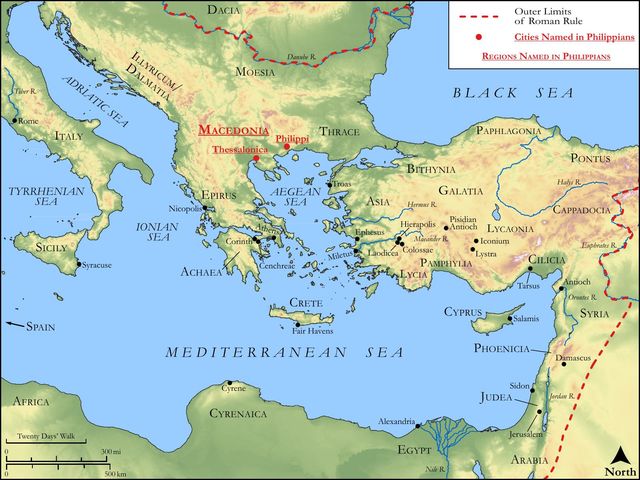
See on the biblical-era maps

Study this verse
Public-domain commentary
Matthew Henry
From his Commentary on the Whole Bible. Henry comments on passages, not single verses — this entry covers Philippians 3:9–14. His four-level outline is real structure in the source text, so it is rendered as structure.
We now heard what the apostle renounced; let us now see what he laid hold on, and resolved to cleave to, namely, Christ and heaven. He had his heart on these two great peculiarities of the Christian religion.
I.The apostle had his heart upon Christ as his righteousness. This is illustrated in several instances.
1.He desired to win Christ; and an unspeakable gainer he would reckon himself if he had but an interest in Christ and his righteousness, and if Christ became his Lord and his Saviour: That I may win him; as the runner wins the prize, as the sailor makes the port he is bound for. The expression intimates that we have need to strive for him and after him, and that all is little enough to win him.
2.That he might be found in him (Phi 3:9), as the manslayer was found in the city of refuge, where he was safe from the avenger of blood, Num 35:25. Or it alludes to a judicial appearance; so we are to be found of our Judge in peace, Pe2 3:14. We are undone without a righteousness wherein to appear before God, for we are guilty. There is a righteousness provided for us in Jesus Christ, and it is a complete and perfect righteousness. None can have interest or benefit by it but those who come off from confidence in themselves, and are brought heartily to believe in him. "Not having my own righteousness, which is of the law; not thinking that my outward observances and good deeds are able to atone for my bad ones, or that by setting the one over against the other I can come to balance accounts with God. No, the righteousness which I depend upon is that which is through the faith of Christ, not a legal, but evangelical righteousness: The righteousness which is of God by faith, ordained and appointed of God." The Lord Jesus Christ is the Lord our righteousness, Isa 45:24; Jer 23:6. Had he not been God, he could not have been our righteousness; the transcendent excellence of the divine nature put such a value upon, and such a virtue into, his sufferings, that they became sufficient to satisfy for the sins of the world, and to bring in a righteousness which will be effectual to all that believe. Faith is the ordained means of actual interest and saving benefit in all the purchase of his blood. It is by faith in his blood, Rom 3:25.
3.That he might know Christ (Phi 3:10): That I may know him, and the power of his resurrection, and the fellowship of his sufferings. Faith is called knowledge, Isa 53:11. Knowing him here is believing in him: it is an experimental knowledge of the power of his resurrection, and the fellowship of his sufferings, or feeling the transforming efficacy and virtue of them. Observe, The apostle was as ambitious of being sanctified as he was of being justified. He was as desirous to know the power of Christ's death and resurrection killing sin in him, and raising him up to newness of life, as he was to receive the benefit of Christ's death and resurrection in his justification.
4.That he might be conformable unto him, and this also is meant of his sanctification. We are then made conformable to his death when we die to sin, as Christ died for sin, when we are crucified with Christ, the flesh and affections of it mortified, and the world is crucified to us, and we to the world, by virtue of the cross of Christ. This is our conformity to his death.
II.The apostle had his heart upon heaven as his happiness: If by any means I might attain to the resurrection of the dead, Phi 3:11.
1.The happiness of heaven is here called the resurrection of the dead, because, though the souls of the faithful, when they depart, are immediately with Christ, yet their happiness will not be complete till the general resurrection of the dead at the last day, when soul and body shall be glorified together. Anastasis sometimes signifies the future state. This the apostle had his eye upon; this he would attain. There will be a resurrection of the unjust, who shall arise to shame and everlasting contempt; and our care must be to escape that: but the joyful and glorious resurrection of saints is called the resurrection, kat' exochēn - by eminence, because it is in virtue of Christ's resurrection, as their head and first-fruits; whereas the wicked shall rise only by the power of Christ, as their judge. To the saints it will be indeed a resurrection, a return to bliss, and life, and glory; while the resurrection of the wicked is a rising from the grave, but a return to a second death. It is called the resurrection of the just, and the resurrection of life (Joh 5:29), and they are counted worthy to obtain that world and the resurrection from the dead, Luk 20:35.
2.This joyful resurrection the apostle pressed towards. He was willing to do any thing, or suffer any thing, that he might attain that resurrection. The hope and prospect of it carried him with so much courage and constancy through all the difficulties he met with in his work. He speaks as if they were in danger of missing it, and coming short of it. A holy fear of coming short is an excellent means of perseverance. Observe, His care to be found in Christ was in order to his attaining the resurrection of the dead. Paul himself did not hope to attain it through his own merit and righteousness, but through the merit and righteousness of Jesus Christ. "Let me be found in Christ, that I may attain the resurrection of the dead, be found a believer in him, and interested in him by faith," Observe,
(1.)He looks upon himself to be in a state of imperfection and trial: Not as though I had already attained, or were already perfect, Phi 3:12. Observe, The best men in the world will readily own their imperfection in the present state. We have not yet attained, are not already perfect; there is still much wanting in all our duties, and graces, and comforts. If Paul had not attained to perfection (who had reached to so high a pitch of holiness), much less have we. Again, Brethren, I count not myself to have apprehended (Phi 3:13), ou logizomai. "I make this judgment of the case; I thus reason with myself." Observe, Those who think they have grace enough give proof that they have little enough, or rather that they have none at all; because, wherever there is true grace, there is a desire of more grace, and a pressing towards the perfection of grace.
(2.)What the apostle's actings were under this conviction. Considering that he had not already attained, and had not apprehended, he pressed forward: "I follow after (Phi 3:12), diōkō - I pursue with vigour, as one following after the game. I endeavour to get more grace and do more good, and never think I have done enough: If that I may apprehend that for which also I am apprehended of Christ Jesus." Observe,
[1.]Whence our grace comes - from our being apprehended of Christ Jesus. It is not our laying hold of Christ first, but his laying hold of us, which is our happiness and salvation. We love him because he first loved us, Jo1 4:19. Not our keeping hold of Christ, but his keeping hold of us, is our safety. We are kept by his mighty power through faith unto salvation, Pe1 1:5. Observe,
[2.]What the happiness of heaven is: it is to apprehend that for which we are apprehended of Christ. When Christ laid hold of us, it was to bring us to heaven; and to apprehend that for which he apprehended us is to attain the perfection of our bliss. He adds further (Phi 3:13): This one thing I do (this was his great care and concern), forgetting those things which are behind, and reaching forth to those things which are before. There is a sinful forgetting of past sins and past mercies, which ought to be remembered for the exercise of constant repentance and thankfulness to God. But Paul forgot the things which were behind so as not to be content with present measures of grace: he was still for having more and more. So he reaches forth, epekteinomenos - stretched himself forward, bearing towards his point: it is expressive of a vehement concern.
(3.)The apostle's aim in these actings: I press towards the mark, for the prize of the high calling of God in Christ Jesus, Phi 3:14. He pressed towards the mark. As he who runs a race never takes up short of the end, but is still making forwards as fast as he can, so those who have heaven in their eye must still be pressing forward to it in holy desires and hopes, and constant endeavours and preparations. The fitter we grow for heaven the faster we must press towards it. Heaven is called here the mark, because it is that which every good Christian has in his eye; as the archer has his eye fixed upon the mark he designs to hit. For the prize of the high calling. Observe, A Christian's calling is a high calling: it is from heaven, as its original; and it is to heaven in its tendency. Heaven is the prize of the high calling; to brabeion - the prize we fight for, and run for, and wrestle for, what we aim at in all we do, and what will reward all our pains. It is of great use in the Christian course to keep our eye upon heaven. This is proper to give us measures in all our service, and to quicken us every step we take; and it is of God, from whom we are to expect it. Eternal life is the gift of God (Rom 6:23), but it is in Christ Jesus; through his hand it must come to us, as it is procured for us by him. There is no getting to heaven as our home but by Christ as our way.
Historical interpretation
Three Centuries of Reception
9 surviving comments on this verse. Each one is dated, so this reads as a timeline rather than a list.
Select a marker to jump to its quote. Markers stagger vertically where authors wrote within a few decades of each other.
And it occurs to me to wonder how some dare call themselves perfect and gnostics, with ideas of themselves above the apostle, inflated and boastful, when Paul even owned respecting himself, "Not that I have already attained, or am already perfect; but I follow after, if that I may apprehend that for which I am apprehended of Christ. Brethren, I count not myself to have apprehended: but this one thing I do, forgetting the things which are behind, and stretching forth to those that are before, I press toward the mark, for the prize of the high calling in Christ Jesus." And yet he reckons himself perfect, because he has been emancipated from his former life, and strives after the better life, not as perfect in knowledge, but as aspiring after perfection.
But if we listen to the apostle, forgetting what is behind, let us both strain after what is before, and be followers after the better rewards.
Yet I must necessarily prescribe you a law, not to stretch out your hand after the old things, not to look backwards: for "the old things are passed away," according to Isaiah; and "a renewing hath been renewed," according to Jeremiah; and "forgetful of former things, we are reaching forward," according to the apostle; and "the law and the prophets (were) until John," according to the Lord.
If they compared themselves with Paul, the Philippians would understand how far they were from the blessings of freedom. How frequently had he shared in so many of Christ’s sufferings: He had been beaten, imprisoned, thrown to wild beasts and burdened with other evils. Nonetheless even he did not think that he had already taken hold of Christ, as long as he was alive.
"Brethren, I count not myself to have apprehended." But if Paul had not as yet apprehended, and is not confident about the Resurrection and things to come, hardly should they be so, who have not attained the smallest proportion of his excellence. That is, I consider that I have not as yet apprehended all virtue, as if one were speaking of a runner. Not as yet, saith he, have I completed all. And if in another place he saith, "I have fought the good fight" (2 Tim. iv. 7), but here, "I count myself not as yet to have apprehended"; any one who reads carefully will well know the reason both of those, and of the present words; (for it is not necessary to dwell continually on the same point;) and that he spoke these words at a much earlier date, but the others near his death.
Put the past out of mind. Set your mind to the future. What he has reckoned perfect today he ascertains to have been false tomorrow as he reaches for ever better and higher goals. By this gradual advance, never being static but always in progress, he is able to teach us that what we supposed in our human way to be perfect still remains in some ways imperfect. The only perfection is the true righteousness of God.
Some think that “paying no heed to the things behind” refers to life under the law. I think he says this of his labors as a preacher. For his custom was to be cursory and to mingle doctrinal statement with exhortation. What he says then is “I pay no heed to my previous labors, but I strive enthusiastically to press on to those ahead.”
Pambo said to Antony, ‘What shall I do?’ Antony said, ‘Do not trust in your own righteousness. Do not go on sorrowing over a deed that is past. Keep your tongue and your belly under control.’
A hermit said, ‘We do not make progress because we do not realize how much we can do. We lose interest in the work we have begun, and we want to be good without even trying.’
Continue studying Philippians 3:13 across the web’s major study libraries — every link below opens this exact verse, chapter, or book on the destination site.
Read & Compare
 BibleGatewayThis verse in more than 200 translations and 70 languages.
 Bible.comThe YouVersion reader — hundreds of translations, reading plans, and highlights.
 ESV.orgCrossway's official English Standard Version reader.
 NET BibleThe NET translation with 60,000+ translators' notes on every rendering decision.
 STEP BibleTyndale House's free study tool — original text, vocabulary, and scholarly resources.
 BibliaLogos Bible Software's free web reader.
 USCCBThe New American Bible (Revised Edition) with the U.S. bishops' study notes.
Commentaries
 BibleHub CommentariesDozens of classic commentaries on this verse, gathered on one page.
 StudyLightMore than 100 commentary sets — the largest collection on the web.
 BibleRefPlain-English commentary on what this verse means, verse by verse.
 Enduring WordDavid Guzik's free commentary on this chapter, widely used by Bible teachers.
 Bible Study ToolsVerse commentary alongside Greek and Hebrew study aids.
Original Language & Research
- BibleHub InterlinearThe verse word by word — original language, transliteration, and English.
- BibleHub LexiconEvery word's original-language definition and Strong's entry.
 Blue Letter BibleDeep-study tools — Strong's numbers, concordance, and word studies.
 CNTR CollationThe earliest Greek manuscripts of this verse, collated letter by letter.
Sermons, Hymns & Audio


TrulyRandomVerse is not affiliated with these sites and doesn’t control their content. They’re linked because they’re genuinely useful.
Summary
In Philippians 3:13, the Apostle Paul articulates a profound spiritual posture, declaring that despite his immense spiritual experiences and apostolic calling, he has not yet fully "apprehended" or attained the ultimate spiritual perfection. Instead, he reveals a singular, unwavering focus: intentionally releasing the past—whether accomplishments or failures—and intensely straining forward with determined effort towards the future, specifically the ultimate prize of knowing Christ and experiencing the fullness of God's calling. This verse encapsulates the dynamic, forward-looking, and humble pursuit characteristic of the mature Christian life.
Context
ShowHideLiterary Context
Philippians 3:13 stands as a pivotal statement within Paul's broader argument in Philippians chapter 3. Preceding this verse, Paul vehemently warns against false teachers who promote salvation through adherence to the Law and human effort, contrasting their legalism with the true righteousness found only in Christ Jesus. He recounts his own impeccable Jewish credentials, only to declare them "loss" and "rubbish" for the surpassing worth of knowing Christ (Philippians 3:7-8). He then expresses his passionate desire to "know Christ and the power of his resurrection and the fellowship of his sufferings" (Philippians 3:10). Verse 12 clarifies that he has not "already obtained" or "already been made perfect," setting the stage for verse 13, which explains the active, ongoing pursuit required to press towards the goal mentioned in Philippians 3:14. Thus, verse 13 serves as a bridge, explaining the how of spiritual progress in light of the what (the prize) and the why (the surpassing worth of Christ).
Historical & Cultural Context
Paul wrote the letter to the Philippians from prison, likely in Rome, around A.D. 60-62. Philippi was a Roman colony, and its citizens prided themselves on their Roman citizenship and values, including discipline, perseverance, and the pursuit of excellence. This context makes Paul's use of athletic imagery, particularly the metaphor of a race, highly relatable to his audience. The Greeks and Romans were familiar with athletic games (like the Isthmian Games) where runners strained every muscle, fixed their gaze on the finish line, and disregarded everything behind them to win the prize. Furthermore, the presence of Judaizers—those who insisted on circumcision and adherence to the Mosaic Law for salvation—was a significant concern, prompting Paul to emphasize that true righteousness and spiritual progress come not from human effort or past achievements but from faith in Christ and a forward-looking pursuit of Him.
Key Themes
ShowHidePhilippians 3:13 contributes significantly to several overarching themes in the book of Philippians and Paul's theology. Firstly, it underscores the theme of Christian Maturity as a Dynamic Process, emphasizing that spiritual growth is not a static state but an active, continuous journey of pursuit rather than a destination already reached. Secondly, it highlights the Supremacy of Christ, as all past achievements are deemed worthless in comparison to knowing Him, and all future striving is directed towards Him and the "upward call of God in Christ Jesus" (Philippians 3:8 and Philippians 3:14). Thirdly, the verse exemplifies Single-Minded Devotion, advocating for an undivided focus on Christ, letting go of distractions and past hindrances. Finally, it powerfully illustrates the Pursuit of Righteousness by Faith, contrasting human attempts at self-justification with the divine provision of righteousness through Christ, which then motivates a life of determined, Spirit-empowered striving.
Exposition and Analysis
ShowHideKey Word Analysis
ShowHideThis verb means "to take eagerly, i.e., seize, possess, or attain fully." Paul's use of the perfect tense ("have apprehended") indicates a completed action with ongoing results. By stating "I count not myself to have apprehended," Paul humbly acknowledges that he has not yet fully grasped, seized, or attained the ultimate spiritual perfection or the complete realization of the resurrection life he desires in Christ. It implies that the goal is still ahead, not fully possessed.
This middle voice verb means "to lose out of mind; by implication, to neglect." In this context, it signifies an intentional act of letting go or disregarding. It's not about literal amnesia, but about refusing to be defined or hindered by past experiences—whether they are past sins that bring guilt and condemnation, or past achievements that could lead to pride and complacency. This "forgetting" is an active spiritual discipline necessary for forward progress.
This middle voice verb, derived from "upon" and "to stretch out," vividly describes "to stretch (oneself) forward upon." It paints a picture of intense, straining effort, like a runner leaning forward with every muscle engaged, extending towards the finish line. It conveys a sense of eager anticipation, determined exertion, and single-minded focus on what lies ahead, demonstrating Paul's active and passionate pursuit of the ultimate goal in Christ.
Verse Breakdown
ShowHide"Brethren, I count not myself to have apprehended:"
Paul addresses his fellow believers ("Brethren"), establishing a pastoral and relatable tone. He then makes a deeply personal and humble confession: despite his profound spiritual experiences, revelations, and apostolic ministry, he does not consider himself to have fully grasped, seized, or attained the ultimate spiritual perfection or the complete resurrection life in Christ. This statement immediately disarms any notion of spiritual complacency or self-sufficiency, setting a precedent for continuous pursuit.
"but [this] one thing [I do],"
This phrase marks a sharp contrast ("but") with the previous statement of non-attainment. It introduces Paul's singular, undivided focus and determined course of action. The emphasis on "one thing" highlights the intensity and singularity of his spiritual pursuit, indicating that all other concerns are subordinated to this primary objective. It speaks to a life of focused intentionality, free from spiritual distraction.
"forgetting those things which are behind,"
This clause describes the necessary prerequisite for forward movement. "Forgetting" here is not literal amnesia, but an active, intentional release of the past. This includes both past failures (sins, mistakes, regrets that might paralyze) and past successes (achievements, spiritual high points, credentials that might foster pride or complacency). Paul understands that dwelling on either can hinder progress toward the future. It's about refusing to be defined or held captive by what has already transpired.
"and reaching forth unto those things which are before,"
This final clause describes the active, forward-looking posture. "Reaching forth" (or "straining forward") uses vivid athletic imagery, depicting a runner intensely leaning into the race, stretching every muscle toward the finish line. "Those things which are before" refer to the future aspects of salvation, the full knowledge of Christ, and the ultimate prize of God's upward call. This is a dynamic, determined, and anticipatory movement towards the ultimate goal, fueled by an unwavering focus on Christ and His future glory.
Literary Devices
ShowHidePhilippians 3:13 is rich with Metaphor and Analogy, primarily drawing from the world of athletics. The entire verse functions as an extended metaphor of a runner in a race. Paul's declaration of "reaching forth" (ἐπεκτείνομαι) vividly paints the picture of an athlete straining every muscle, leaning forward with intense focus towards the finish line, disregarding everything behind them. This Imagery of a race powerfully conveys the active, disciplined, and single-minded nature of the Christian life. There is also a strong element of Contrast ("not myself to have apprehended: but this one thing I do"), highlighting the shift from a state of non-attainment to one of active pursuit. Furthermore, the phrase "this one thing I do" employs Emphasis through its singular focus, underscoring the unwavering priority Paul places on his spiritual objective.
Theological and Thematic Connections
ShowHidePhilippians 3:13 is a cornerstone verse for understanding the nature of Christian sanctification and perseverance. It powerfully teaches that spiritual maturity is not a static state of arrival but a dynamic, lifelong process of growth and pursuit. Paul, arguably the most spiritually mature individual of his time, humbly admits his ongoing need to press forward, shattering any illusion of passive spirituality or the possibility of reaching a point where further growth is unnecessary. This verse underscores the eschatological tension of the "already and not yet"—believers are already saved and indwelt by the Spirit, but they are not yet fully conformed to Christ's image. It calls for an active, intentional, and disciplined engagement with the Christian journey, characterized by both humility regarding one's present state and fervent hope for future glorification. The "forgetting" of the past speaks to the liberating power of Christ over past failures and the dangers of resting on past successes, while "reaching forth" emphasizes the future-oriented hope and the ultimate goal of Christlikeness.
Reflection and Application
ShowHidePhilippians 3:13 serves as a timeless challenge and encouragement for every believer. It calls us to adopt Paul's posture of humble, relentless pursuit in our own spiritual lives. We are often tempted to dwell on past mistakes, allowing guilt or regret to paralyze our progress, or conversely, to rest on past achievements, becoming complacent in our spiritual walk. Paul's command to "forgetting those things which are behind" is a powerful call to release both the weight of past failures and the pride of past successes, recognizing that neither should define our present identity or hinder our future trajectory in Christ. Instead, we are to fix our gaze forward, "reaching forth unto those things which are before," which means actively and intentionally striving to know Christ more deeply, to live more fully in His resurrection power, and to conform more completely to His image. This requires discipline, focus, and a willingness to stretch ourselves beyond our comfort zones, always anticipating the glorious prize of God's upward call. It reminds us that the Christian life is a journey of continuous transformation, demanding our active participation and unwavering devotion to the One who calls us forward.
Questions for Reflection
ShowHideFAQ
ShowHideWhat does Paul mean by "I count not myself to have apprehended"?
ShowHideWhen Paul says, "I count not myself to have apprehended," he is humbly admitting that he has not yet fully attained or perfectly grasped the ultimate spiritual goal or the complete perfection that awaits believers in Christ. The Greek word for "apprehended" (katalambánō) implies seizing or taking hold of something fully. Despite his apostolic calling, profound revelations, and deep spiritual experience, Paul acknowledges that the full realization of Christ's likeness and the resurrection life is still a future hope, not a present, completed reality. This statement underscores the ongoing nature of sanctification and the pursuit of Christlikeness throughout a believer's life.
Is "forgetting those things which are behind" about literal amnesia?
ShowHideNo, "forgetting those things which are behind" (Greek: epilanthánomai) does not imply literal amnesia or a denial of one's past experiences. Instead, it refers to an intentional act of releasing or disregarding the past, so that it no longer defines, hinders, or holds one captive. This includes both past sins and failures, which might lead to guilt and condemnation, and past successes or achievements, which might lead to pride or complacency. Paul is advocating for a deliberate detachment from the past's power over the present, allowing the believer to press forward unencumbered towards the future in Christ. It's about refusing to dwell on or be limited by what has already occurred, in order to embrace what lies ahead in God's calling.
What is the "one thing" Paul is doing?
ShowHideThe "one thing" Paul is doing is the singular, focused pursuit of Christ and the ultimate prize of God's upward call, as described in Philippians 3:14. This singular focus involves intentionally "forgetting those things which are behind" and actively "reaching forth unto those things which are before." It represents a life wholly devoted to knowing Christ more intimately, experiencing the power of His resurrection, and pressing on toward the full realization of salvation and glorification. This "one thing" is the driving passion and unwavering purpose of his Christian life, subordinating all other concerns to this supreme goal.
Christ-Centered Fulfillment
ShowHidePhilippians 3:13, though describing Paul's personal pursuit, finds its ultimate Christ-centered fulfillment in two profound ways. Firstly, the "prize" towards which Paul strains is none other than Christ Himself, and the "upward call of God" is "in Christ Jesus" (Philippians 3:14). Thus, the ultimate object of Paul's relentless pursuit is a deeper, fuller, and more complete union with Christ, culminating in the resurrection and glorification where believers will be fully conformed to His image (Romans 8:29). Paul's striving is not towards an abstract ideal, but towards the living Lord who embodies all perfection and righteousness. Secondly, Christ Himself is the perfect embodiment of this "reaching forth" and "forgetting." Though without sin, Jesus "emptied himself," taking the form of a servant, and "humbled himself by becoming obedient to the point of death, even death on a cross" (Philippians 2:7-8), laying aside His divine prerogatives to accomplish the Father's will. He perfectly fulfilled the mission set before Him, looking past the cross to the joy that was set before Him (Hebrews 12:2). His resurrection and ascension demonstrate the ultimate "apprehension" of the divine purpose, securing the very prize Paul and all believers pursue. Therefore, our ability to "forget" and "reach forth" is empowered by Christ's finished work and His indwelling Spirit, enabling us to run the race with our eyes fixed on Him, the pioneer and perfecter of our faith.