


Luke 9:62
Bible text: King James Version (1769 Blayney text) · Public domain
Bible text: King James Version with Strong's numbers · Public domain
Bible text: Berean Standard Bible · Public domain
Bible text: American Standard Version (1901) · Public domain
Bible text: World English Bible, Messianic edition · Public domain
Bible text: Geneva Bible (1599) · Public domain
Bible text: Young's Literal Translation · Public domain
- εἶπενeipenSaidG2036V-2AAI-3SVerb 2nd Aorist Active Indicative 3rd Singular
- δὲdethenG1161CONJConjunction
- πρὸςprostoG4314PREPPreposition
- αὐτὸνautonhimG846P-ASMPersonal pronoun Accusative Singular Masculine
- ὁho<the>G3588T-NSMDefinite article Nominative Singular Masculine
- Ἰησοῦς·IēsousJesusG2424N-NSM-PNoun Nominative Singular Masculine Individual
- οὐδεὶςoudeisNo [one]G3762A-NSMAdjective Nominative Singular Masculine
- ἐπιβαλὼνepibalōnhaving laidG1911V-2AAP-NSMVerb 2nd Aorist Active Participle Nominative Singular Masculine
- τὴνtēntheG3588T-ASFDefinite article Accusative Singular Feminine
- χεῖραcheirahandG5495N-ASFNoun Accusative Singular Feminine
- αὐτοῦautouof himG846P-GSMPersonal pronoun Genitive Singular Masculine
- ἐπ᾽ep᾽uponG1909PREPPreposition
- ἄροτρονarotron[the] plowG723N-ASNNoun Accusative Singular Neuter
- καὶkaiandG2532CONJConjunction
- βλέπωνblepōnlookingG991V-PAP-NSMVerb Present Active Participle Nominative Singular Masculine
- εἰςeisonG1519PREPPreposition
- τὰtathe [things]G3588T-APNDefinite article Accusative Plural Neuter
- ὀπίσωopisōbackG3694ADVAdverb
- εὔθετόςeuthetossuitableG2111A-NSMAdjective Nominative Singular Masculine
- ἐστινestinisG1510V-PAI-3SVerb Present Active Indicative 3rd Singular
- εἰςeisforG1519PREPPreposition
- τῇtēatheG3588T-DSFDefinite article Dative Singular Feminine
- βασιλείᾳbasileiakingdomG932N-DSFNoun Dative Singular Feminine
- τοῦtou<the>G3588T-GSMDefinite article Genitive Singular Masculine
- θεοῦtheouof GodG2316N-GSM-TNoun Genitive Singular Masculine Title
English is a literal word-by-word gloss of the Greek, not the KJV's wording. Why?
This is the original text the KJV's translators worked from — each Greek word with its own literal English meaning in this verse, prepared by scholars at Tyndale House, Cambridge. The KJV translates whole sentences, not word by word, so its wording differs: one Greek word can become several English words, and the KJV may choose “charity” where the gloss reads “love”. Both are faithful — they answer different questions. For the KJV's own rendering, switch to the KJV text.
Details
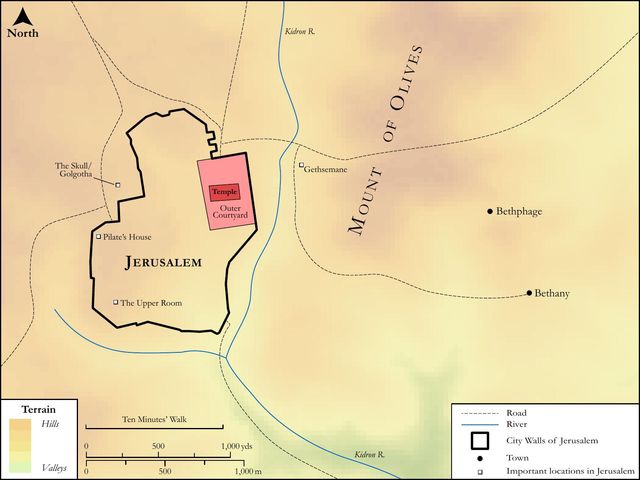
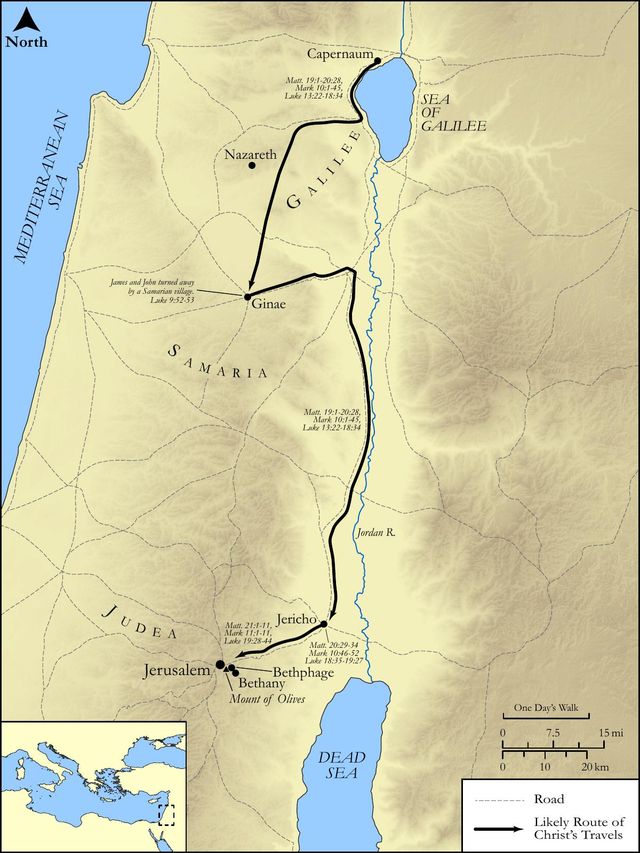
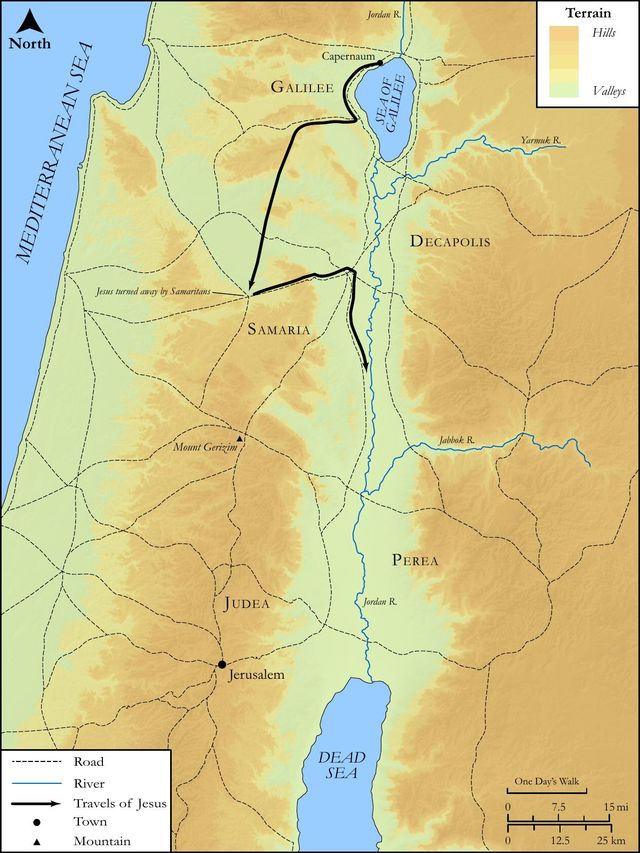
See on the biblical-era maps
Study this verse
Public-domain commentary
Matthew Henry
From his Commentary on the Whole Bible. Henry comments on passages, not single verses — this entry covers Luke 9:57–62. His two-level outline is real structure in the source text, so it is rendered as structure.
We have here an account of three several persons that offered themselves to follow Christ, and the answers that Christ gave to each of them. The two former we had an account of in Mat 19:21.
I.Here is one that is extremely forward to follow Christ immediately, but seems to have been too rash, hasty, and inconsiderate, and not to have set down and counted the cost.
1.He makes Christ a very large promise (Luk 9:57): As they went in the way, going up to Jerusalem, where it was expected Christ would first appear in his glory, one said to him, Lord, I will follow thee withersoever thou goest. This must be the resolution of all that will be found Christ's disciples indeed; they follow the Lamb whithersoever he goes (Rev 14:4), though it be through fire and water, to prisons and deaths.
2.Christ gives him a necessary caution, not to promise himself great things in the world, in following him, but, on the contrary, to count upon poverty and meanness; for the Son of man has not where to lay his head.
We may look upon this, (1.) As setting forth the very low condition that our Lord Jesus was in, in this world. He not only wanted the delights and ornaments that great princes usually have, but even such accommodations for mere necessity as the foxes have, and the birds of the air. See what a depth of poverty our Lord Jesus submitted to for us, to increase the worth and merit of his satisfaction, and to purchase for us a larger allowance of grace, that we through his poverty might be rich, Co2 8:9. He that made all did not make a dwelling-place for himself, not a house of his own to put his head in, but what he was beholden to others for. He here calls himself the Son of man, a Son of Adam, partaker of flesh and blood. He glories in his condescension towards us, not only to the meanness of our nature, but to the meanest condition in that nature, to testify his love to us, and to teach us a holy contempt of the world and of great things in it, and a continual regard to another world. Christ was thus poor, to sanctify and sweeten poverty to his people; the apostles had not certain dwelling-place (Co1 4:11), which they might the better bear when they knew their Master had not; see Sa2 11:11. We may well be content to fare as Christ did. (2.) As proposing this to the consideration of those who intend to be his disciples. If we mean to follow Christ, we must lay aside the thoughts of great things in the world, and not reckon upon making any thing more than heaven of our religion, as we must resolve not to take up with any thing less. Let us not go about to compound the profession of Christianity with secular advantages; Christ has put them asunder, let us not think of joining them together; on the contrary, we must expect to enter into the kingdom of heaven through many tribulations, must deny ourselves, and take up our cross. Christ tells this man what he must count upon if he followed him, to lie cold and uneasy, to fare hard, and live in contempt; if he could not submit to this, let him not pretend to follow Christ. This word sent him back, for aught that appears; but it will be no discouragement to any that know what there is in Christ and heaven to set in the scale against this.
II.Here is another, that seems resolved to follow Christ, but he begs a day, Luk 9:59.
To this man Christ first gave the call; he said to him, Follow me. He that proposed the thing of himself fled off when he heard of the difficulties that attended it; but this man to whom Christ gave a call, though he hesitated at first, yet, as it should seem, afterwards yielded; so true was that of Christ, You have not chosen me, but I have chosen you, Joh 15:16. It is not of him that willeth, nor of him that runneth (as that forward spark in the foregoing verses), but of God that showeth mercy, that gives the call, and makes it effectual, as to this man here. Observe,
1.The excuse he made: "Lord, suffer me first to go and bury my father. I have an aged father at home, who cannot live long, and will need me while he does live; let me go and attend on him until he is dead, and I have performed my last office of love to him, and then I will do any thing." We may here see three temptations, by which we are in danger of being drawn and kept from following Christ, which therefore we should guard against: - (1.) We are tempted to rest in a discipleship at large, in which we may be at a loose end, and not to come close, and give up ourselves to be strict and constant. (2.) We are tempted to defer the doing of that which we know to be our duty, and to put if off to some other time. When we have got clear of such a care and difficulty, when we have despatched such a business, raised an estate to such a pitch, then we will begin to think of being religious; and so we are cozened out of all our time, by being cozened out of the present time. (3.) We are tempted to think that our duty to our relations will excuse us from our duty to Christ. It is a plausible excuse indeed: "Let me go and bury my father, - let me take care of my family, and provide for my children, and then I will think of serving Christ;" whereas the kingdom of God and the righteousness thereof must be sought ad minded in the first place.
2.Christ's answer to it (Luk 9:60): "Let the dead bury their dead. Suppose (which is not likely) that there are none but the dead to bury their dead, or none but those who are themselves aged and dying, who are as good as dead, and fit for no other service, yet thou hast other work to do; go thou, and preach the kingdom of God." Not that Christ would have his followers or his ministers to be unnatural; our religion teaches us to be kind and good in every relation, to show piety at home, and to requite our parents. But we must not make these offices an excuse from our duty to God. If the nearest and dearest relation we have in the world stand in our way to keep us from Christ, it is necessary that we have a zeal that will make us forget father and mother, as Levi did, Deu 33:9. This disciple was called to be a minister, and therefore must not entangle himself with the affairs of this world, Ti2 2:4. And it is a rule that, whenever Christ calls to any duty, we must not consult with flesh and blood, Gal 1:15, Gal 1:16. No excuses must be admitted against a present obedience to the call of Christ.
III.Here is another that is willing to follow Christ, but he must have a little time to talk with his friends about it.
Observe, 1. His request for a dispensation, Luk 9:61. He said, "Lord, I will follow thee; I design no other, I am determined to do it: but let me first go bid them farewell that are at home." This seemed reasonable; it was what Elisha desired when Elijah called him,Let me kiss my father and my mother; and it was allowed him: but the ministry of the gospel is preferable, and the service of it more urgent than that of the prophets; and therefore here it would not be allowed. Suffer me apotaxasthai tois eis ton oikon mou - Let me go and set in order my household affairs, and give direction concerning them; so some understand it. Now that which was amiss in this is, (1.) That he looked upon his following Christ as a melancholy, troublesome, dangerous thing; it was to him as if he were going to die and therefore he must take leave of all his friends, never to see them again, or never with any comfort; whereas, in following Christ, he might be more a comfort and blessing to them than if he had continued with them. (2.) That he seemed to have his worldly concerns more upon his heart than he ought to have, and than would consist with a close attendance to his duty as a follower of Christ. He seemed to hanker after his relations and family concerns, and he could not part easily and suitably from them, but they stuck to him. It may be he had bidden them farewell once, but Loth to depart bids oft farewell, and therefore he must bid them farewell once more, for they are at home at his house. (3.) That he was willing to enter into a temptation from his purpose of following Christ. To go and bid them farewell that were at home at his house would be to expose himself to the strongest solicitations imaginable to alter his resolution; for they would all be against it, and would beg and pray that he would not leave them. Now it was presumption in him to thrust himself into such a temptation. Those that resolve to walk with their Maker, and follow their Redeemer, must resolve that they will not so much as parley with their tempter.
2.The rebuke which Christ gave him for this request (Luk 9:62): "No man, having put his hand to the plough, and designing to make good work of his ploughing, will look back, or look behind him, for then he makes balks with his plough, and the ground he ploughs is not fit to be sown; so thou, if thou hast a design to follow me and to reap the advantages of those that do so, yet if thou lookest back to a worldly life again and hankerest after that, if thou lookest back as Lot's wife did to Sodom, which seems to be alluded to here, thou art not fit for the kingdom of God." (1.) "Thou art not soil fit to receive the good seed of the kingdom of God if thou art thus ploughed by the halves, and not gone through with." (2.) "Thou art not a sower fit to scatter the good seed of the kingdom if thou canst hold the plough no better." Ploughing is in order to sowing. As those are not fit to be sown with divine comforts whose fallow ground is not first broken up, so those are not fit to be employed in sowing who know not how to break up the fallow ground, but, when they have laid their hand to the plough, upon every occasion look back and think of quitting it. Note, Those who begin with the work of God must resolve to go on with it, or they will make nothing of it. Looking back inclines to drawing back, and drawing back is to perdition. Those are not fit for heaven who, having set their faces heavenward, face about. But he, and he only, that endures to the end, shall be saved.
Historical interpretation
Eleven Centuries of Reception
17 surviving comments on this verse. Each one is dated, so this reads as a timeline rather than a list.
Select a marker to jump to its quote. Markers stagger vertically where authors wrote within a few decades of each other.
"For he that loveth father or mother more than Me," the Father and Teacher of the truth, who regenerates and creates anew, and nourishes the elect soul, "is not worthy of Me"-He means, to be a son of God and a disciple of God, and at the same time also to be a friend, and of kindred nature. "For no man who looks back, and puts his hand to the plough, is fit for the kingdom of God."
"But provision must be made for children and posterity." "None, putting his hand on the plough, and looking back, is fit" for work. "But I was under contract.
Yet I must necessarily prescribe you a law, not to stretch out your hand after the old things, not to look backwards: for "the old things are passed away," according to Isaiah; and "a renewing hath been renewed," according to Jeremiah; and "forgetful of former things, we are reaching forward," according to the apostle; and "the law and the prophets (were) until John," according to the Lord.
That he who has attained to trust, having put off the former man, ought to regard only celestial and spiritual things, and to give no heed to the world which he has already renounced. In Isaiah: "Seek ye the Lord; and when ye have found Him, call upon Him. But when He hath come near unto you, let the wicked forsake his ways, and the unrighteous man his thoughts: and let him be turned unto the Lord, and he shall obtain mercy, because He will plentifully pardon your sins." Of this same thing in Solomon: "I have seen all the works which are done under the sun; and, lo, all are vanity." Of this same thing in Exodus: "But thus shall ye eat it; your loins girt, and your shoes on your feet, and your staves in your hands: and ye shall eat it in haste, for it is the Lord's passover." Of this same thing in the Gospel according to Matthew: "Take no thought, saying, What shall we eat? or, What shall we drink? or, Wherewith shall we be clothed? for these things the nations seek after. But your Father knoweth that ye have need of all these things. Seek first the kingdom of God, and His righteousness; and all these things shall be added unto you." Likewise in the same place: "Think not for the morrow, for the morrow shall take thought for itself. Sufficient unto the day is its own evil." Likewise in the same place: "No one looking back, and putting his hands to the plough, is fit for the kingdom of God." Also in the same place: "Behold the fowls of the heaven: for they sow not, nor reap, nor gather into barns; and your heavenly Father feedeth them. Are not ye of more value than they? " Concerning this same thing, according to Luke: "Let your loins be girded, and your lamps burning; and ye like unto men that wait for their lord, when he cometh from the wedding; that, when he cometh and knocketh, they may open to him. Blessed are those servants, whom their lord, when he cometh, shall find watching." Of this same thing in Matthew: "The foxes have holes, and the birds of the heaven have nests; but the Son of man hath not where He may lay His head." Also in the same place: "Whoso forsaketh not all that he hath, cannot be my disciple." Of this same thing in the first to the Corinthians: "Ye are not your own, for ye are bought with a great price. Glorify and bear God in your body." Also in the same place: "The time is limited. It remaineth, therefore, that both they who have wives be as though they have them not, and they who lament as they that lament not, and they that rejoice as they that rejoice not, and they who buy as they that buy not, and they who possess as they who possess not, and they who use this world as they that use it not; for the fashion of this world passeth away." Also in the same place: "The first man is of the clay of the earth, the second man from heaven. As he is of the clay, such also are they who are of the clay; and as is the heavenly, such also are the heavenly. Even as we have borne the image of him who is of the clay, let us bear His image also who is from heaven." Of this same matter to the Philippians: "All seek their own, and not those things which are Christ's; whose end is destruction, whose god is their belly, and their glory is to their confusion, who mind earthly things. For our conversation is in heaven, whence also we expect the Saviour, our Lord Jesus Christ, who shall transform the body of our humiliation conformed to the body of His glory." Of this very matter to Galatians: "But be it far from me to boast, except in the cross of our Lord Jesus Christ, by whom the world is crucified unto me, and I unto the world." Concerning this same thing to Timothy: "No man that warreth for God bindeth himself with worldly annoyances, that he may please Him to whom he hath approved himself. But and if a man should contend, he will not be crowned unless he fight lawfully." Of this same thing to the Colossians: "If ye be dead with Christ froth I the elements of the world, why still, as if living in the world, do ye follow vain things? " Also concerning this same thing: "If ye have risen together with Christ, seek those things which are above, where Christ is sitting on the right hand of God. Give heed to the things that are above, not to those things which are on the earth; for ye are dead, and your life is hidden with Christ in God. But when Christ your life shall appear, then shall ye also appear with Him in glory." Of this same thing to the Ephesians: Put off the old man of the former conversation, who is corrupted, according to the lusts of deceit. But be ye renewed in the spirit of your mind, and put on the new man, him who according to God is ordained in righteousness, and holiness, and truth." Of this same thing in the Epistle of Peter: "As strangers and pilgrims, abstain from fleshly lusts, which war against the soul; but having a good conversation among the Gentiles, that while they detract from you as if from evildoers, yet, beholding your good works, they may magnify God." Of this same thing in the Epistle of John: "He who saith he abideth in Christ, ought himself also to walk even as He walked." Also in the same place: "Love not the world, neither the things that are in the world. If any man loveth the world, the love of the Father is not in him. Because everything which is in the world is lust of the flesh, and lust of the eyes, and the ambition of this world, which is not of the Father, but of the lust of this world. And the world shall pass away with its lust. But he that doeth the will of God abideth for ever, even as God abideth for ever." Also in the first Epistle of Paul to the Corinthians: "Purge out the old leaven, that ye may be a new dough, as ye are unleavened. For also Christ our passover is sacrificed. Therefore let us celebrate the feast, not in the old leaven, nor in the leaven of malice and wickedness, but in the unleavened bread of sincerity and truth."
The Lord warns us of this in his gospel lest we return to the devil again and to the world, which we have renounced and from which we have escaped. He says, “No one, having put his hand to the plow and looking back, is fit for the kingdom of God.” Again he says, “And let him who is in the field not turn back. Remember Lot’s wife.” Lest anyone, either because of some desire for wealth or by his own charm be persuaded from following Christ, he added, “He that does not renounce all that he possesses, cannot be my disciple.”
That those who are snatched from the jaws of the devil, and delivered from the snares of this world, ought not again to return to the world, lest they should lose the advantage of their withdrawal therefrom. In Exodus the Jewish people, prefigured as a shadow and image of us, when, with God for their guardian and avenger, they had escaped the most severe slavery of Pharaoh and of Egypt-that is, of the devil and the world-faithless and ungrateful in respect of God, murmur against Moses, looking back to the discomforts of the desert and of their labour; and, not understanding the divine benefits of liberty and salvation, they seek to return to the slavery of Egypt-that is, of the world whence they had been drawn forth-when they ought rather to have trusted and believed on God, since He who delivers His people from the devil and the world, protects them also when delivered. "Wherefore hast thou thus done with us," say they, "in casting us forth out of Egypt? It is better for us to serve the Egyptians than to die in this wilderness. And Moses said unto the people, Trust, and stand fast, and see the salvation which is from the Lord, which He shall do to you to-day. The Lord Himself shall fight for you, and ye shall hold your peace." The Lord, admonishing us of this in His Gospel, and teaching that we should not return again to the devil and to the world, which we have renounced, and whence we have escaped, says: "No man looking back, land putting his hand to the plough, is fit for the kingdom of God." And again: "And let him that is in the field not return back. Remember Lot's wife." And lest any one should be retarded by any covetousness of wealth or attraction of his own people from following Christ, He adds, and says: "He that forsaketh not all that he hath, cannot be my disciple."
It was my duty not to conceal these special matters, nor to hide them alone in my own consciousness,-matters by which each one of us may be both instructed and guided. And do not you for your part keep this letter concealed among yourselves, but let the brethren have it to mad. For it is the part of one who desires that his brother should not be warned and instructed, to intercept those words with which the Lord condescends to admonish and instruct us. Let them know that we are proved by our Lord, and let them never fail of that faith whereby we have once believed in Him, under the conflict of this present affliction. Let each one, acknowledging his own sins, even now put off the conversation of the old man. "For no man who looks back as he putteth his hand to the plough is fit for the kingdom of God." And, finally, Lot's wife, who, when she was delivered, looked back in defiance of the commandment, lost the benefit of her escape. Let us look not to things which are behind, whither the devil calls us back, but to things which are before, whither Christ calls us. Let us lift up our eyes to heaven, lest the earth with its delights and enticements deceive us. Let each one of us pray God not for himself only, but for all the brethren, even as the Lord has taught us to pray, when He bids to each one, not private prayer, but enjoined them, when they prayed, to pray for all in common prayer and concordant supplication. If the Lord shall behold us humble and peaceable; if He shall see us joined one with another; if He shall see us fearful concerning His anger; if corrected and amended by the present tribulation, He will maintain us safe from the disturbances of the enemy. Discipline hath preceded; pardon also shall follow.
(non occ.) He dared also to match himself with the incomprehensible power of the Saviour, saying, I will follow thee whithersoever thou goest; for to follow the Saviour simply to hear His teaching is possible to human nature, as it directs itself towards men, but it is not possible to go with Him wherever He is; for He is incomprehensible, and is not confined by place.
Or herein our Lord teaches the greatness of His gift, as if He said, All created things may be confined by place, but the Word of God has incomprehensible power. Say not then, I will follow thee whithersoever thou goest. But if thou wouldest be a disciple, cast off 1 foolish things, for it is impossible for him who remains in foolishness to become a disciple of the Word.
The man said, “Allow me first to go and bury my father.” The Lord replied, “Let the dead bury their dead; but go and preach the kingdom of God.” Another man said, “Let me first arrange my affairs at home.” He rebuked him with a stern threat, saying, “No man, putting his hand to the plow and looking back, is fit for the kingdom of God.” A person who wishes to become the Lord’s disciple must repudiate a human obligation, however honorable it may appear, if it slows us ever so slightly in giving the wholehearted obedience we owe to God.
For we must not always punish the offender, since mercy sometimes does more good, leading thee to patience, the sinner to repentance. Lastly, those Samaritans believed the sooner, who were in this place saved from fire.
Or, He compares foxes to heretics, because they are indeed a wily animal, and, ever intent upon fraud, commit their robberies by stealth. They let nothing be safe, nothing be at rest, nothing secure, for they hunt their prey into the very abodes of men. The fox again, an animal full of craft, makes no hole for itself, yet likes to lie always concealed in a hole. So the heretics, who know not how to construct a house for themselves, circumscribe and deceive others. This animal is never tamed, nor is it of use to man. Hence the Apostle, A heretic after the first and second admonition reject. (Tit. 3:10.) But the birds of the air, which are frequently brought in to represent spiritual wickedness, build as it were their nests in the breasts of the wicked, and as long as deceit reigns over the affections, the divine principle has no opportunity to take possession. But when a man has proved his heart to be innocent, upon him Christ leans in some measure the weight of His greatness, for by a more abundant shedding of grace He is planted in the breasts of good men. So then it does not seem reasonable that we should think him faithful and simple, who is rejected by the judgment of the Lord, notwithstanding that he promised the service of unwearied attendance; but our Lord cares not for this kind of service, but only purity of affection, nor is his attendance accepted whose sense of duty is not proved. For the hospitality of faith should be given with circumspection, lest while opening the interior of our house to the unbelieving, through our imprudent credulity we fall a snare to the treachery of others. Therefore that you may be aware that God despises not attendance upon him but deceit, He who rejected the deceitful man chose the innocent. For it follows, And he said unto another, Follow me. But He says this to him, whose father He knew to be dead. Hence it follows, But he said, Lord, suffer me first to go and bury my father.
But the Lord calls those upon whom He has compassion. Hence it follows, And Jesus said, Let the dead bury their dead. Since we have received as a religious duty the burial of the human body, how is it thus that the burial even of a father's dead body is forbidden, unless you are to understand that human things are to be postponed to divine? It is a good employment, but the hindrance is greater, for he who divides his pursuits, draws down his affections; he who divides his care, delays his advances. We must first set about the things which are most important. For the Apostles also, that they might not be occupied in the office of distributing alms, ordained ministers for the poor.
The performance of a father's burial is not then prohibited, but the observance of religious duty is preferred to the ties of relationship. The one is left to those in like condition, the other is commanded to those who are left. But how can the dead bury the dead? unless you here understand a twofold death, one a natural death, the other the death of sin. (Rom. 9:11.) There is also a third death, by which we die unto sin, live unto God.
Or because the throat of the ungodly is an open sepulchre, their memory is ordered to be forgotten whose services die together with their bodies. Nor is the son recalled from his duty to his father, but the faithful is separated from the communion of the unbelieving; there is no prohibition of duty, but a mystery of religion, that is, that we should have no fellowship with the dead Gentiles.
See how our Lord sets forth by his works the poverty which he taught. For him was no table spread, no lights, no house, nor any such thing.
(Hom. 27. in Matt.) But what more necessary than the burial of his father, what more easy, seeing that there would not be much time given to it? We are then hereby taught that it becomes us not to spend even the slightest portion of our time in vain, although we have a thousand things to compel us, nay to prefer spiritual things to even our greatest necessities. For the devil watchfully presses close upon us, wishing to find any opening, and if he causes a slight negligence, he ends in producing a great weakness.
(ubi sup.) By thus saying, their dead, he shows that this man's father was not his dead, for I suppose that the deceased was of the number of the unbelieving.
(de Con. Ev. l. ii. c. 23.) Our Lord spoke this to the man to whom He had said, Follow me. But another disciple put himself forward, to whom no one had spoken any thing, saying, I will follow thee, O Lord; but let me first go and bid them farewell who are at home, lest perchance they look for me as they are wont.
(Serm. 100.) As if he said to him, The East calls thee, and thou turnest to the West.
Now this promise is worthy of our admiration and full of all praise, but to bid farewell to those who are at home, to get leave from them, shows that he was still somehow divided from the Lord, in that he had not yet resolved, to make this venture with his whole heart. For to wish to consult relations who would not agree to his proposal betokens one somewhat wavering. Wherefore our Lord condemns this, saying, No man, having put his hand to the plough, and looking back, is fit for the kingdom of God. He puts his hand to the plough who is ambitious to follow, yet looks back again who seeks an excuse for delay in returning home, and consulting with his friends.
Therefore it is said to him, Why do you seek to follow Me for the riches and gain of this world, when so great is My poverty that I have not even a place of rest, and take shelter under another man's roof.
He did not refuse the discipleship, but his wish was, having fulfilled the filial duty of burying his father, to follow Christ more freely.
BEDE.: To put one's hand to the plough, is also, (as it were by a certain sharp instrument,) by the wood and iron of our Lord's passion, to wear away the hardness of our heart, and to open it to bring forth the fruits of good works. But if any one, having begun to exercise this, delights to look back with Lot's wife to the things which he had left, he is deprived of the gift of the kingdom to come.
But if the disciple about to follow our Lord is reproved for wishing even to bid farewell at home, what will be done to such as for no advantage-sake frequently visit the houses of those whom they have left in the world?
And Jesus said to him: No man, having put his hand to the plow, and looking back, is fit for the kingdom of God. To put one’s hand to the plow, is as if with a kind of instrument of compunction, with wood and iron to grind down the hardness of one's heart in the passion of the Lord, and open it to bring forth the fruits of good works. If anyone, having begun to cultivate this, in delight looks back at the vices he left behind with Lot’s wife, he is deprived of the gift of the future kingdom.
For having seen our Lord drawing much people to Him, he thought that he received reward from them, and that if he followed our Lord, he might obtain money.
(Nilus Monac.) For the frequent looking upon the things which we have forsaken, through the force of habit draws us back to our past way of life. For practice has great power to retain to itself. Is not habit generated of use, and nature of habit? But to get rid of or change nature is difficult; for although when compelled it for a while turns aside, it very rapidly returns to itself.
Continue studying Luke 9:62 across the web’s major study libraries — every link below opens this exact verse, chapter, or book on the destination site.
Read & Compare
 BibleGatewayThis verse in more than 200 translations and 70 languages.
 Bible.comThe YouVersion reader — hundreds of translations, reading plans, and highlights.
 ESV.orgCrossway's official English Standard Version reader.
 NET BibleThe NET translation with 60,000+ translators' notes on every rendering decision.
 STEP BibleTyndale House's free study tool — original text, vocabulary, and scholarly resources.
 BibliaLogos Bible Software's free web reader.
 USCCBThe New American Bible (Revised Edition) with the U.S. bishops' study notes.
Commentaries
 BibleHub CommentariesDozens of classic commentaries on this verse, gathered on one page.
 StudyLightMore than 100 commentary sets — the largest collection on the web.
 BibleRefPlain-English commentary on what this verse means, verse by verse.
 Enduring WordDavid Guzik's free commentary on this chapter, widely used by Bible teachers.
 Bible Study ToolsVerse commentary alongside Greek and Hebrew study aids.
Original Language & Research
- BibleHub InterlinearThe verse word by word — original language, transliteration, and English.
- BibleHub LexiconEvery word's original-language definition and Strong's entry.
 Blue Letter BibleDeep-study tools — Strong's numbers, concordance, and word studies.
 CNTR CollationThe earliest Greek manuscripts of this verse, collated letter by letter.
Sermons, Hymns & Audio


TrulyRandomVerse is not affiliated with these sites and doesn’t control their content. They’re linked because they’re genuinely useful.
Summary
Luke 9:62 presents Jesus' stark declaration on the absolute nature of discipleship, employing the vivid metaphor of a farmer plowing. It underscores that anyone who commits to following Christ, yet harbors a divided heart or longs for their former life, is fundamentally unsuited for the Kingdom of God. This verse serves as a profound call for unwavering focus, singular devotion, and complete abandonment of past attachments in pursuit of God's redemptive purposes.
Context
ShowHideLiterary Context
This verse concludes a challenging series of encounters between Jesus and potential followers, immediately following two other demanding calls to discipleship in Luke 9:57-60. In the preceding verses, Jesus tests the commitment of individuals, one of whom offers to follow "whithersoever thou goest" but is warned about the lack of earthly comforts, and another who asks to bury his father but is told to "let the dead bury their dead." The individual in Luke 9:61 desires to "bid them farewell, which are at home at my house," a seemingly reasonable request that Jesus nonetheless meets with this uncompromising statement. This sequence highlights Jesus' radical redefinition of priorities for those who would join His mission, emphasizing that the Kingdom's demands supersede all earthly obligations and attachments.
Historical & Cultural Context
The imagery of plowing was deeply familiar to Jesus' agrarian audience in first-century Galilee. Plowing was a physically demanding and precise task. To plow a straight furrow, a farmer had to fix his gaze forward, typically on a distant landmark, and maintain a steady hand on the plow. Any distraction, especially looking backward, would inevitably result in a crooked, unproductive furrow, wasting effort and rendering the land less fertile. This agricultural reality served as a powerful, relatable illustration of the single-minded focus required for any significant endeavor. Furthermore, the concept of leaving family to follow a rabbi or prophet, while not unheard of, was radical in a culture where familial ties and obligations were paramount. Jesus' call represented a fundamental reordering of societal norms and personal loyalties.
Key Themes
ShowHideLuke 9:62 contributes significantly to several overarching themes in Luke's Gospel. Foremost is the radical nature of discipleship, which demands absolute commitment and a willingness to forsake all other allegiances for Christ's sake, as seen in Luke 14:26-33. It also underscores the priority of the Kingdom of God, asserting that the work and purposes of God must take precedence over personal comfort, family duties, or past attachments. The theme of perseverance and endurance is implicit, as the Christian journey, like plowing, requires sustained, forward-looking effort without succumbing to the temptation of turning back. Finally, it highlights the transformative power of the call, indicating that true discipleship involves a complete reorientation of one's life and gaze toward God's future, not the world's past.
Exposition and Analysis
ShowHideKey Word Analysis
ShowHideThis word (G723) refers to the agricultural implement used for tilling the soil. In this context, it symbolizes the work or task of the Kingdom of God. The act of "putting his hand to the plough" signifies committing to this work, undertaking the labor of discipleship and ministry. It implies a tangible, active engagement in the mission Jesus has set forth.
The verb blépō (G991) means "to look at" or "to perceive," while opísō (G3694) means "to the back" or "backward." Combined, "looking back" signifies a divided gaze, a longing for what has been left behind, or a reluctance to fully embrace the future. It implies a lack of full commitment, a distraction from the task at hand, or a desire to return to a former way of life that is incompatible with the demands of the Kingdom. This is not merely a glance, but a sustained focus that hinders forward progress.
Derived from eú (well) and a derivative of títhēmi (to place), this word (G2111) literally means "well placed" or "properly disposed." Figuratively, it signifies being "suitable," "appropriate," or "ready" for a task. It's not about moral worthiness alone, but about practical readiness and effectiveness. Someone who is "fit" for the Kingdom is someone whose disposition, focus, and commitment align perfectly with its demands, enabling them to be productive in God's service.
Verse Breakdown
ShowHide"And Jesus said unto him,"
This introduces Jesus' direct and authoritative response to the third prospective disciple in this series of encounters, emphasizing the personal and weighty nature of His words.
"No man, having put his hand to the plough,"
This clause establishes the metaphor and the initial commitment. It refers to anyone who has made a decision to engage in the work of the Kingdom, symbolized by the farmer who has begun the laborious and focused task of plowing. It implies an initial step of dedication and engagement.
"and looking back,"
This is the critical condition. It describes the action of turning one's attention or desire away from the task at hand and towards what has been left behind. This "looking back" signifies a divided heart, a lack of full resolve, or a nostalgic longing for the past that compromises present commitment.
"is fit for the kingdom of God."
This is the consequence of the divided focus. Such a person, despite their initial commitment, is deemed unsuitable or inappropriate for the work and inheritance of God's Kingdom. Their divided loyalty renders them ineffective and disqualified for the demands of discipleship and the ultimate blessings of God's reign.
Literary Devices
ShowHideThe primary literary device employed in Luke 9:62 is Metaphor. Jesus uses the familiar agricultural practice of plowing to illustrate a profound spiritual truth about discipleship. The act of "putting one's hand to the plough" is a metaphor for committing to the work of the Kingdom of God, while "looking back" is a metaphor for a divided heart, a longing for the past, or a lack of full commitment. This metaphor is extended through Symbolism, where the straight furrow represents effective, focused, and productive discipleship, and the crooked furrow (implied by looking back) symbolizes ineffective or disqualified service. The absolute nature of Jesus' statement ("No man... is fit") also carries a degree of Hyperbole, emphasizing the extreme importance of undivided devotion rather than suggesting a literal impossibility for anyone who ever experiences a moment of doubt. The vivid imagery makes the abstract concept of spiritual commitment tangible and memorable.
Theological and Thematic Connections
ShowHideThis verse profoundly impacts our understanding of the nature of true discipleship, emphasizing that commitment to Christ is not merely an intellectual assent or a partial endeavor, but a radical reorientation of one's entire being. It highlights that the Kingdom of God demands total allegiance, a complete severance from the gravitational pull of the past, and an unwavering focus on the future God is building. This is not a call to perfection, but to singular devotion, where the pursuit of God's will becomes the supreme priority, eclipsing all other desires and attachments. The "fitness" for the Kingdom is thus defined by one's capacity for sustained, forward-looking obedience and trust.
Reflection and Application
ShowHideLuke 9:62 serves as a timeless mirror for every believer, challenging us to honestly assess the depth and sincerity of our commitment to Christ. It compels us to identify and confront any "looking back" in our own lives—whether it be lingering attachments to past sins, worldly comforts, unfulfilled ambitions, or even nostalgic longings for a life not fully surrendered to God. True discipleship demands a forward gaze, a readiness to embrace the unknown path Christ leads us on, and a willingness to leave behind anything that hinders our spiritual progress or divides our allegiance. This verse calls us to a life of active, present-focused obedience, reminding us that the work of the Kingdom requires our undivided attention and effort, ensuring that our spiritual "furrows" are straight and productive for God's glory.
Questions for Reflection
ShowHideFAQ
ShowHideWhat does the "plough" symbolize in this verse?
ShowHideThe "plough" symbolizes the work, mission, and demands of the Kingdom of God. To "put one's hand to the plough" means to commit to following Jesus and actively engaging in the tasks and lifestyle of discipleship, which often involves labor, sacrifice, and unwavering focus. It represents the active service and dedication required of those who would be part of God's redemptive plan.
Why is "looking back" so detrimental to being "fit for the kingdom of God"?
ShowHide"Looking back" signifies a divided heart or a lack of full commitment. Just as a farmer looking back while plowing would create a crooked, unproductive furrow, a disciple who is distracted by or longs for their past life cannot effectively serve God or advance His Kingdom. It implies a reluctance to fully embrace the new life in Christ, a desire to return to former comforts, or an unwillingness to fully surrender to the radical demands of discipleship. This divided loyalty renders one unsuitable or ineffective for the focused and forward-moving work of God's Kingdom. This concept is echoed in Luke 17:32, where Lot's wife looked back at Sodom and was turned into a pillar of salt, symbolizing the danger of clinging to what God has called one to abandon.
Does this verse mean that if I ever doubt or struggle, I am not "fit" for God's Kingdom?
ShowHideWhile Jesus' words are strong and absolute, they are primarily a warning against a pattern of divided loyalty or a fundamental unwillingness to fully commit, rather than a condemnation of every moment of human struggle or doubt. The emphasis is on the direction of one's heart and life. True discipleship is characterized by a prevailing forward movement and a primary allegiance to Christ, even amidst struggles. The verse calls for a radical reorientation of priorities, not a flawless performance. It highlights that a person whose heart is consistently divided between the Kingdom and the world will not be effective or ultimately inherit its full blessings.
Christ-Centered Fulfillment
ShowHideLuke 9:62 finds its ultimate Christ-centered fulfillment not only in Jesus' demanding call to His followers but also in His own perfect embodiment of this principle. Jesus Himself never "looked back" from the mission given to Him by the Father. From His humble birth to His resolute journey to Jerusalem, culminating in the cross, His gaze was fixed on the ultimate goal of redemption. Hebrews 12:2 beautifully captures this, describing Jesus as "the author and finisher of our faith; who for the joy that was set before him endured the cross." He perfectly demonstrated the single-minded devotion He demanded from His disciples, never wavering from the path of obedience, even unto death. Furthermore, it is through Christ's finished work that we are even made "fit" for the Kingdom. Our own ability to "put our hand to the plough" and not look back is empowered by His Spirit, transforming our hearts of stone into hearts of flesh, enabling us to walk in newness of life (Ezekiel 36:26-27). He is not only the one who calls us to unwavering commitment but also the one who provides the grace and power to live it out, drawing us forward into the glorious future of His Kingdom (Philippians 1:6).