


Philippians 3:8
- ἀλλὰallaButG235CONJConjunction
- μενοῦνγεmenoungeratherG3304PRTParticle or Disjunctive
- καὶkaialsoG2532CONJConjunction
- ἡγοῦμαιhēgoumaiI countG2233V-PNI-1SVerb Present Middle Or Passive Deponent Indicative 1st Singular
- πάνταpantaall thingsG3956A-APNAdjective Accusative Plural Neuter
- ζημίανzēmianlossG2209N-ASFNoun Accusative Singular Feminine
- εἶναιeinaito beG1511V-PANVerb Present Active Infinitive
- διὰdiabecause ofG1223PREPPreposition
- τὸtowhichG3588T-ASNDefinite article Accusative Singular Neuter
- ὑπερέχονhuperechonis excellingG5242V-PAP-ASNVerb Present Active Participle Accusative Singular Neuter
- τῆςtēstheG3588T-GSFDefinite article Genitive Singular Feminine
- γνώσεωςgnōseōsknowledgeG1108N-GSFNoun Genitive Singular Feminine
- ΧριστοῦChristouof ChristG5547N-GSM-TNoun Genitive Singular Masculine Title
- ἸησοῦIēsouJesusG2424N-GSM-PNoun Genitive Singular Masculine Individual
- τοῦtoutheG3588T-GSMDefinite article Genitive Singular Masculine
- κυρίουkuriouLordG2962N-GSM-TNoun Genitive Singular Masculine Title
- μουmouof mineG3165P-1GSPersonal pronoun Genitive 1st Singular
- δι᾽di᾽because ofG1223PREPPreposition
- ὃνhonwhomG3739R-ASMRelative pronoun Accusative Singular Masculine
- τὰta<the>G3588T-APNDefinite article Accusative Plural Neuter
- πάνταpantaall thingsG3956A-APNAdjective Accusative Plural Neuter
- ἐζημιώθηνezēmiōthēnI have lostG2210V-API-1SVerb Aorist Passive Indicative 1st Singular
- καὶkaiandG2532CONJConjunction
- ἡγοῦμαιhēgoumaiesteem [them]G2233V-PNI-1SVerb Present Middle Or Passive Deponent Indicative 1st Singular
- σκύβαλαskubalarubbishG4657N-APNNoun Accusative Plural Neuter
- εἶναιeinaito beG1511V-PANVerb Present Active Infinitive
- ἵναinathatG2443CONJConjunction
- ΧριστὸνChristonChristG5547N-ASM-TNoun Accusative Singular Masculine Title
- κερδήσωkerdēsōI may gainG2770V-AAS-1SVerb Aorist Active Subjunctive 1st Singular
English is a literal word-by-word gloss of the Greek, not the KJV's wording. Why?
This is the original text the KJV's translators worked from — each Greek word with its own literal English meaning in this verse, prepared by scholars at Tyndale House, Cambridge. The KJV translates whole sentences, not word by word, so its wording differs: one Greek word can become several English words, and the KJV may choose “charity” where the gloss reads “love”. Both are faithful — they answer different questions. For the KJV's own rendering, switch to the KJV text.
Details
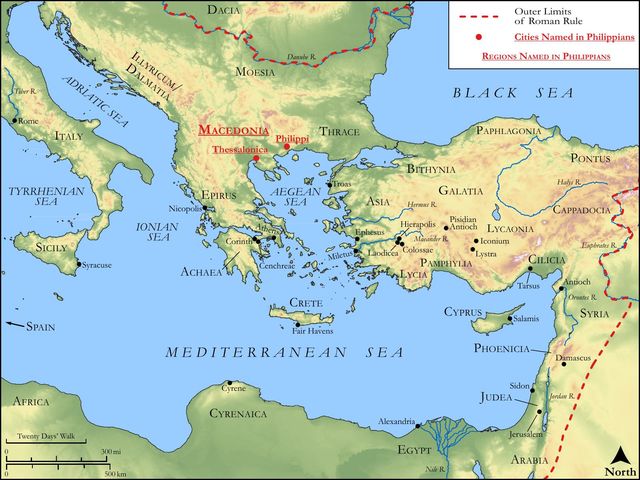
See on the biblical-era maps

Study this verse
Public-domain commentary
Matthew Henry
From his Commentary on the Whole Bible. Henry comments on passages, not single verses — this entry covers Philippians 3:4–8. His two-level outline is real structure in the source text, so it is rendered as structure.
The apostle here proposes himself for an example of trusting in Christ only, and not in his privileges as an Israelite.
I.He shows what he had to boast of as a Jew and a Pharisee.
Let none think that the apostle despised these things (as men commonly do) because he had them not himself to glory in. No, if he would have gloried and trusted in the flesh, he had as much cause to do so as any man: If any other man thinketh that he hath whereof to trust in the flesh, I more, Phi 3:4. He had as much to boast of as any Jew of them all.
1.His birth-right privileges. He was not a proselyte, but a native Israelite: of the stock of Israel. And he was of the tribe of Benjamin, in which tribe the temple stood, and which adhered to Judah when all the other tribes revolted. Benjamin was the father's darling, and this was a favourite tribe. A Hebrew of the Hebrews, an Israelite on both sides, by father and mother, and from one generation to another; none of his ancestors had matched with Gentiles.
2.He could boast of his relations to the church and the covenant, for he was circumcised the eighth day; he had the token of God's covenant in his flesh, and was circumcised the very day which God had appointed.
3.For learning, he was a Pharisee, brought up at the feet of Gamaliel, an eminent doctor of the law: and was a scholar learned in all the learning of the Jews, taught according to the perfect manner of the laws of the fathers, Act 22:3. He was a Pharisee, the son of a Pharisee (Act 23:6), and after the most strict sect of his religion lived a Pharisee, Act 26:5.
4.He had a blameless conversation: Toughing the righteousness which is of the law, blameless: as far as the Pharisees' exposition of the law went, and as to the mere letter of the law and outward observance of it, he could acquit himself from the breach of it and could not be accused by any.
5.He had been an active man for his religion. As he made a strict profession of it, under the title and character of a Pharisee, so he persecuted those whom he looked upon as enemies to it. Concerning zeal, persecuting the church.
6.He showed that he was in good earnest, though he had a zeal without knowledge to direct and govern the exercise of it: I was zealous towards God, as you all are this day, and I persecuted this way unto the death, Act 22:3, Act 22:4. All this was enough to have made a proud Jew confident, and was stock sufficient to set up with for his justification. But,
II.The apostle tells us here how little account he made of these, in comparison of his interest in Christ and his expectations from him:
But what things were gain to me those have I counted loss for Christ (Phi 3:7); that is, those things which he had counted gain while he was a Pharisee, and which he had before reckoned up, these he counted loss for Christ. "I should have reckoned myself an unspeakable loser of, to adhere to them, I had lost my interest in Jesus Christ." He counted them loss; not only insufficient to enrich him, but what would certainly impoverish and ruin him, if he trusted to them, in opposition to Christ. Observe, The apostle did not persuade them to do any thing but what he had himself did, to quit any thing but what he had himself quitted, nor venture on any bottom but what he himself had ventured his immortal soul upon. - Yea doubtless, and I count all things but loss for the excellency of the knowledge of Christ Jesus my Lord, Phi 3:8. Here the apostle explains himself.
1.He tells us what it was that he was ambitious of and reached after: it was the knowledge of Christ Jesus his Lord, a believing experimental acquaintance with Christ as Lord; not a merely notional and speculative, but a practical and efficacious knowledge of him. So knowledge is sometimes put for faith: By his knowledge, or the knowledge of him, shall my righteous servant justify many, Isa 53:11. And it is the excellency of knowledge. There is an abundant and transcendent excellency in the doctrine of Christ, or the Christian religion above all the knowledge of nature, and improvements of human wisdom; for it is suited to the case of fallen sinners, and furnishes them with all they need and all they can desire and hope for, with all saving wisdom and saving grace.
2.He shows how he had quitted his privileges as a Jew and a Pharisee: Yea doubtless; his expression rises with a holy triumph and elevation, alla men oun ge kai. There are five particles in the original: But indeed even also do I count all things but loss. He had spoken before of those things, his Jewish privileges: here he speaks of all things, all worldly enjoyments and mere outward privileges whatsoever, things of a like kind or any other kind which could stand in competition with Christ for the throne in his heart, or pretend to merit and desert. There he had said that he did count them but loss; but it might be asked, "Did he continue still in the same mind, did he not repent his renouncing them?" No, now he speaks in the present tense: Yea doubtless, I do count them but loss. But it may be said, "It is easy to say so; but what would he do when he came to the trial?" Why he tells us that he had himself practised according to this estimate of the case: For whom I have suffered the loss of all things. He had quitted all his honours and advantages, as a Jew and a Pharisee, and submitted to all the disgrace and suffering which attended the profession and preaching of the gospel. When he embarked in the bottom of the Christian religion, he ventured all in it, and suffered the loss of all for the privileges of a Christian. Nay, he not only counted them loss, but dung, skubala - offals thrown to dogs; they are not only less valuable than Christ, but in the highest degree contemptible, when they come in competition with him. Note, The New Testament never speaks of saving grace in any terms of diminution, but on the contrary represents it as the fruits of the divine Spirit and the image of God in the soul of man; as a divine nature, and the seed of God: and faith is called precious faith; and meekness is in the sight of God of great price, Pe1 3:4; Pe2 1:1, etc.
Historical interpretation
Two Centuries of Reception
6 surviving comments on this verse. Each one is dated, so this reads as a timeline rather than a list.
Select a marker to jump to its quote. Markers stagger vertically where authors wrote within a few decades of each other.
Thus far, finally, of patience simple and uniform, and as it exists merely in the mind: though in many forms likewise I labour after it in body, for the purpose of "winning the Lord; " inasmuch as it is a quality which has been exhibited by the Lord Himself in bodily virtue as well; if it is true that the ruling mind easily communicates the gifts of the Spirit with its bodily habitation.
But "those things which he had once accounted gain," and which he enumerates in the preceding verse-"trust in the flesh," the sign of "circumcision," his origin as "an Hebrew of the Hebrews," his descent from "the tribe of Benjamin," his dignity in the honours of the Pharisee -he now reckons to be only "loss" to himself; (in other words, ) it was not the God of the Jews, but their stupid obduracy, which he repudiates. These are also the things "which he counts but dung for the excellency of the knowledge of Christ" (but by no means for the rejection of God the Creator); "whilst he has not his own righteousness, which is of the law, but that which is through Him," i.e. Christ, "the righteousness which is of God.
Accordingly he subjoins withal a reason, that "we are called in peace unto the Lord God; "and that "the unbeliever may, through the use of matrimony, be gained by the believer." The very closing sentence of the period confirms (the supposition) that this is thus to be understood.
And the Apostle teaches us how to dung it, saying: "I count all things but dung, that I may gain Christ," and he, through evil report and good report, attained to pleasing Christ. For he had read that Abraham, when confessing himself to be but dust and ashes, in his deep humility found favour with God. He had read how Job, sitting among the ashes, regained all that he had lost. He had heard in the utterance of David, how God "raiseth the poor out of the dust, and lifteth the needy out of the dunghill."
"Yea verily, and I have counted all things but loss." Why, he means, do I say this of the Law? Is not the world good? Is not the present life good? but if they draw me away from Christ, I count these things loss. Why? "for the excellency of the knowledge of Jesus Christ my Lord." For when the sun hath appeared, it is loss to sit by a candle: so that the loss comes by comparison, by the superiority of the other. You see that Paul makes a comparison from superiority, not from diversity of kind; for that which is superior, is superior to somewhat of like nature to itself. So that he shows the connection of that knowledge by the same means, by which he draws the superiority from the comparison.
"For whom I suffered the loss of all things, and do count them dung, that I may gain Christ." It is not yet manifest, whether he speaks of the Law, for it is likely that he applies it to the things of this world. For when he says, "the things which were gain to me, those I have counted loss for Christ; yea verily," he adds, "I count all things loss." Although he said all things, yet it is things present; and if you wish it to be the Law too, not even so is it insulted. For dung comes from wheat, and the strength of the wheat is the dung, I mean, the chaff. But as the dung was useful in its former state, so that we gather it together with the wheat, and had there been no dung, there would have been no wheat, thus too is it with the Law.
Seest thou, how everywhere he calls it "loss," not in itself, but for Christ. "Yea verily, and I count all things but loss." Wherefore again? "For the excellency of the knowledge (of Him), for whom I suffered the loss of all things." Again, "wherefore too I count all things to be loss, that I may gain Christ."
It is not that I flee them as base things but that I prefer what is superior. Having tasted the grain, I throw away the refuse. For refuse means the denser and harder part of the chaff. It carries the grain but is discarded once the grain has been collected.
Continue studying Philippians 3:8 across the web’s major study libraries — every link below opens this exact verse, chapter, or book on the destination site.
Read & Compare
 BibleGatewayThis verse in more than 200 translations and 70 languages.
 Bible.comThe YouVersion reader — hundreds of translations, reading plans, and highlights.
 ESV.orgCrossway's official English Standard Version reader.
 NET BibleThe NET translation with 60,000+ translators' notes on every rendering decision.
 STEP BibleTyndale House's free study tool — original text, vocabulary, and scholarly resources.
 BibliaLogos Bible Software's free web reader.
 USCCBThe New American Bible (Revised Edition) with the U.S. bishops' study notes.
Commentaries
 BibleHub CommentariesDozens of classic commentaries on this verse, gathered on one page.
 StudyLightMore than 100 commentary sets — the largest collection on the web.
 BibleRefPlain-English commentary on what this verse means, verse by verse.
 Enduring WordDavid Guzik's free commentary on this chapter, widely used by Bible teachers.
 Bible Study ToolsVerse commentary alongside Greek and Hebrew study aids.
Original Language & Research
- BibleHub InterlinearThe verse word by word — original language, transliteration, and English.
- BibleHub LexiconEvery word's original-language definition and Strong's entry.
 Blue Letter BibleDeep-study tools — Strong's numbers, concordance, and word studies.
 CNTR CollationThe earliest Greek manuscripts of this verse, collated letter by letter.
Sermons, Hymns & Audio


TrulyRandomVerse is not affiliated with these sites and doesn’t control their content. They’re linked because they’re genuinely useful.
Summary
In Philippians 3:8, the Apostle Paul powerfully declares his radical re-evaluation of all earthly achievements and credentials, counting them as utterly worthless in comparison to the surpassing value of knowing Christ Jesus as his Lord. This pivotal verse articulates Paul's profound commitment to Christ, for whom he willingly suffered the loss of everything, viewing these former "gains" as mere refuse, all for the singular purpose of gaining Christ and being found in Him.
Context
ShowHideLiterary Context
Philippians 3:8 is a climactic statement within a crucial section of Paul's letter, immediately following his detailed enumeration of his impressive Jewish heritage and zealous adherence to the Law in Philippians 3:4-6. Paul meticulously lists his lineage, circumcision, tribal affiliation, Pharisaic zeal, and blamelessness under the Law, establishing his impeccable credentials by human standards. Then, in Philippians 3:7, he introduces a sharp contrast, declaring all these former "gains" (things he once valued) as "loss for Christ." Verse 8 intensifies this declaration, extending it to all things, not just his past achievements, and using even stronger language to describe their worthlessness in light of Christ's supreme value. This section serves as a powerful warning against legalism and reliance on human merit, emphasizing the incomparable worth of Christ alone.
Historical & Cultural Context
Paul, a highly educated Pharisee trained under Gamaliel (Acts 22:3), possessed a social and religious standing that was highly esteemed in both Jewish and Roman societies. His Jewish heritage, adherence to the Law, and persecution of Christians would have marked him as a zealous and righteous man among his peers. To "suffer the loss of all things" for Christ would have entailed not only the abandonment of his former status, reputation, and potential career within Judaism, but likely also physical hardship, imprisonment, and social ostracism, as evidenced throughout his missionary journeys. The cultural values of the Roman world, which prized honor, status, and material gain, would have made Paul's declaration of "loss" and "dung" even more shocking and counter-cultural, highlighting the revolutionary nature of his commitment to Christ.
Key Themes
ShowHideThis verse profoundly contributes to several major themes in Philippians and Paul's broader theology. It underscores the supreme value of Christ, presenting Him as the ultimate treasure that far surpasses any earthly achievement or religious merit. It highlights the theme of righteousness by faith, contrasting human righteousness (which Paul counts as "loss" and "dung") with the divine righteousness found only in Christ (Philippians 3:9). Furthermore, it exemplifies radical renunciation and single-minded devotion, demonstrating that true spiritual gain requires a willingness to abandon anything that competes with Christ's supremacy. This theme resonates with Jesus' teachings on counting the cost and seeking the kingdom of God above all else, as seen in passages like Matthew 13:44-46.
Exposition and Analysis
ShowHideKey Word Analysis
ShowHideMeaning "to hold oneself above, i.e. (figuratively) to excel; participle (as adjective, or neuter as noun) superior, superiority." This word conveys the idea of something being extraordinarily superior, surpassing, or incomparable. Paul uses it to emphasize the overwhelming, transcendent supremacy of the knowledge of Christ over anything else he had previously valued. It's not just "better," but infinitely superior.
Meaning "knowing (the act), i.e. (by implication) knowledge." This is not merely intellectual acquaintance with facts about Christ, but a deep, personal, experiential understanding and relationship with Him. It implies an intimate fellowship and transformative encounter that shapes one's entire being and worldview.
And G2210, meaning "detriment" and "to injure, i.e. (reflexively or passively) to experience detriment." Paul uses these terms to describe the active process of considering his former gains as detrimental or harmful, and the actual experience of forfeiting them. It implies a deliberate accounting where former assets are now liabilities, and a willing embrace of the cost involved in following Christ.
Meaning "what is thrown to the dogs, i.e. refuse (ordure)." This is an exceptionally strong, vulgar, and intentionally offensive term. It refers to refuse, rubbish, excrement, or anything utterly worthless and repulsive. Paul's use of this word underscores the absolute worthlessness and even revulsion he now felt towards his former achievements when compared to Christ, emphasizing that they were not merely valueless but actively offensive to his new spiritual reality.
Meaning "to gain (literally or figuratively)." This word highlights Paul's ultimate objective. Having counted all things as loss, his singular aim is to "gain" or "acquire" Christ. This "winning" implies not just intellectual assent but a complete possession of Christ, including His righteousness, His life, and His saving power, leading to eternal union with Him.
Verse Breakdown
ShowHide"Yea doubtless, and I count all things [but] loss"
Paul begins with an emphatic affirmation ("Yea doubtless") of his conviction. He then declares his ongoing re-evaluation ("I count") of "all things" – not just his past Jewish credentials, but everything earthly – as "loss." This signifies a deliberate, conscious, and continuous act of valuing Christ above all else, seeing anything apart from Him as a detriment rather than an advantage.
"for the excellency of the knowledge of Christ Jesus my Lord"
This clause provides the reason and motivation for Paul's radical re-evaluation. The "excellency" or surpassing worth of knowing Christ Jesus as his personal "Lord" (Master and God) is the incomparable standard against which all other things pale into insignificance. This knowledge is not abstract but deeply personal and relational.
"for whom I have suffered the loss of all things"
Paul moves from theoretical counting to actual experience. He has not only counted things as loss but has suffered the actual loss of "all things" for Christ's sake. This refers to the tangible sacrifices he made, including his reputation, comfort, security, and even physical well-being, as a direct consequence of his commitment to Christ.
"and do count them [but] dung"
This is the most shocking and powerful declaration. Paul reiterates his ongoing assessment ("do count them") but elevates the intensity of their worthlessness. His former "gains" are not just "loss" (a negative balance), but "dung" – utterly worthless, repulsive refuse to be discarded. This extreme language conveys his complete disdain for anything that might detract from Christ.
"that I may win Christ"
This final clause states Paul's ultimate purpose and goal. The entire process of counting and suffering loss is driven by the singular desire to "win Christ." This encompasses gaining His righteousness, His life, His presence, and ultimately, eternal salvation and union with Him. It is the glorious spiritual gain that far outweighs any earthly loss.
Literary Devices
ShowHidePhilippians 3:8 is rich in literary devices that amplify Paul's passionate declaration. The most striking is Hyperbole, particularly in his use of the Greek word skýbalon (translated as "dung"). This extreme exaggeration powerfully conveys the utter worthlessness and repugnance of anything that competes with Christ, making his point unforgettable. Paul also employs profound Contrast, juxtaposing his former "gains" and "all things" with the "excellency of the knowledge of Christ." This stark opposition highlights the radical shift in his value system. Furthermore, the verse utilizes Metaphor, portraying spiritual reality in terms of financial accounting ("loss," "win," "gain"), where Christ is the ultimate asset and everything else is a liability or even waste. The concept of "winning Christ" also functions as a Metonymy or Synecdoche, where "Christ" stands for all the blessings of salvation, including righteousness, eternal life, and intimate fellowship with God.
Theological and Thematic Connections
ShowHidePaul's declaration in Philippians 3:8 is a cornerstone of Christian theology, particularly regarding the nature of true righteousness and the believer's ultimate priority. It asserts that human merit, religious performance, or worldly achievements are not only insufficient for salvation but are actively detrimental when held in comparison to Christ. The "excellency of the knowledge of Christ" signifies that salvation is found in a Person, not a program, and that intimacy with Him is the highest good. This verse underscores the radical reorientation of values that occurs in conversion, where the believer embraces a Christ-centered existence, willingly sacrificing all for the incomparable treasure of knowing Him. It sets the stage for Paul's subsequent explanation of righteousness that comes through faith, not through the Law.
Reflection and Application
ShowHidePhilippians 3:8 serves as a profound challenge and invitation for every believer. It compels us to honestly examine our own lives and ask what we truly value above all else. Are there "gains" – whether they be career success, financial security, social status, personal comfort, or even religious accomplishments – that we cling to, consciously or unconsciously, more tightly than Christ? Paul's radical example calls us to a similar re-evaluation, to count all things as "loss" and even "dung" in light of the surpassing worth of knowing Jesus. This isn't a call to asceticism for its own sake, but a call to prioritize Christ so supremely that anything hindering our relationship with Him or competing for His Lordship is willingly discarded. True spiritual wealth and abundant life are found not in accumulating earthly treasures, but in possessing Christ and living in intimate union with Him. This verse encourages a daily, conscious choice to pursue Christ above all else, trusting that in Him, we gain everything truly valuable.
Questions for Reflection
ShowHideFAQ
ShowHideWhat does Paul mean by "excellency of the knowledge of Christ Jesus my Lord"?
ShowHidePaul is referring to the supreme, incomparable worth and superiority of an intimate, experiential relationship with Jesus Christ. "Excellency" (Greek hyperéchō) signifies something that stands above all others, being preeminent and surpassing. "Knowledge" (Greek gnōsis) here is not mere intellectual understanding but a deep, personal, transformative knowing that comes from a living relationship with Christ as one's personal "Lord" (Greek kýrios). It's the most valuable treasure one can possess, far outweighing any earthly achievement, status, or religious merit.
Why does Paul use such strong language, calling his former achievements "dung"?
ShowHidePaul uses the Greek word skýbalon, which is a very strong and offensive term meaning refuse, rubbish, or excrement. He employs this hyperbole to emphasize the utter worthlessness and even repugnance of anything that might compete with Christ for supremacy in his life. It's not just that his former achievements are neutral or less valuable; they are actively vile and to be discarded when compared to the infinite value of Christ. This shocking language underscores the radical shift in his values and his complete disdain for anything that would hinder his pursuit of Christ.
What does it mean to "win Christ"?
ShowHideTo "win Christ" (Greek kerdaínō - to gain) means to acquire Him as one's ultimate possession and prize. This encompasses gaining His righteousness (being declared righteous through faith in Him, as described in Philippians 3:9), gaining eternal life through Him (John 3:16), and gaining an intimate, saving relationship with Him. It's the culmination of all spiritual blessings found in union with Christ. Paul's life goal became not to gain worldly success or human approval, but to gain Christ himself, which includes all the benefits of salvation and a life lived in His presence and power.
Christ-Centered Fulfillment
ShowHidePhilippians 3:8 finds its ultimate fulfillment in the person and work of Jesus Christ, who is the very "excellency" and the "knowledge" Paul so passionately pursues. Christ is the one in whom "are hidden all the treasures of wisdom and knowledge" (Colossians 2:3). Paul's radical re-evaluation of his former life and achievements as "loss" and "dung" is a direct response to the revelation of Christ's unparalleled worth, a worth demonstrated supremely in His perfect life, atoning death, and glorious resurrection. It is through Christ's sacrifice that believers are offered a righteousness not of their own works, but "through faith in Christ, the righteousness which is from God by faith" (Philippians 3:9). Thus, to "win Christ" is to participate in His life, death, and resurrection, being found in Him, clothed in His righteousness, and experiencing the fullness of God's grace. This pursuit of Christ as the supreme treasure echoes Jesus' own teaching about the kingdom of heaven being like a hidden treasure for which one sells all they have (Matthew 13:44), demonstrating that Christ Himself is the ultimate fulfillment of all human longing and the sole source of true life and eternal gain.