


Romans 8:18
Bible text: King James Version (1769 Blayney text) · Public domain
Bible text: King James Version with Strong's numbers · Public domain
Bible text: Berean Standard Bible · Public domain
Bible text: American Standard Version (1901) · Public domain
Bible text: World English Bible, Messianic edition · Public domain
Bible text: Geneva Bible (1599) · Public domain
Bible text: Young's Literal Translation · Public domain
- ΛογίζομαιLogizomaiI reckonG3049V-PNI-1SVerb Present Middle Or Passive Deponent Indicative 1st Singular
- γὰρgarforG1063CONJConjunction
- ὅτιhotithatG3754CONJConjunction
- οὐκouknotG3756PRT-NNegative Particle Negative
- ἄξιαaxiacomparableG514A-NPNAdjective Nominative Plural Neuter
- τὰtatheG3588T-NPNDefinite article Nominative Plural Neuter
- παθήματαpathēmatasufferingsG3804N-NPNNoun Nominative Plural Neuter
- τοῦtouof theG3588T-GSMDefinite article Genitive Singular Masculine
- νῦνnunpresentG3568ADVAdverb
- καιροῦkairoutime [are]G2540N-GSMNoun Genitive Singular Masculine
- πρὸςprostoG4314PREPPreposition
- τὴνtēntheG3588T-ASFDefinite article Accusative Singular Feminine
- μέλλουσανmellousancomingG3195V-PAP-ASFVerb Present Active Participle Accusative Singular Feminine
- δόξανdoxangloryG1391N-ASFNoun Accusative Singular Feminine
- ἀποκαλυφθῆναιapokaluphthēnaito be revealedG601V-APNVerb Aorist Passive Infinitive
- εἰςeistoG1519PREPPreposition
- ἡμᾶςhēmasusG3165P-1APPersonal pronoun Accusative 1st Plural
English is a literal word-by-word gloss of the Greek, not the KJV's wording. Why?
This is the original text the KJV's translators worked from — each Greek word with its own literal English meaning in this verse, prepared by scholars at Tyndale House, Cambridge. The KJV translates whole sentences, not word by word, so its wording differs: one Greek word can become several English words, and the KJV may choose “charity” where the gloss reads “love”. Both are faithful — they answer different questions. For the KJV's own rendering, switch to the KJV text.
Details
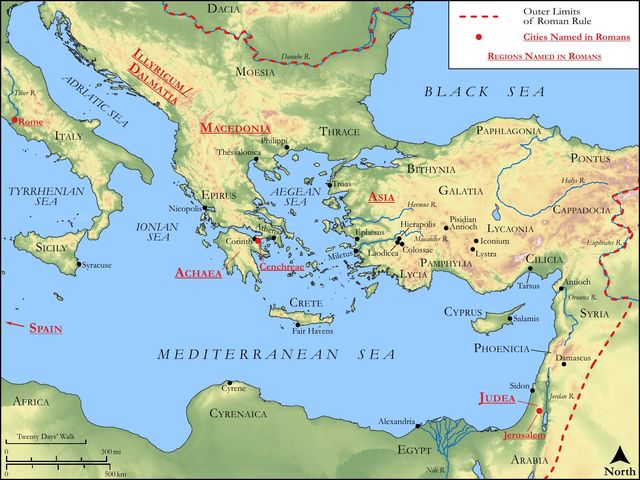
See on the biblical-era maps

Study this verse
Public-domain commentary
Matthew Henry
From his Commentary on the Whole Bible. Henry comments on passages, not single verses — this entry covers Romans 8:17–25. His four-level outline is real structure in the source text, so it is rendered as structure.
In these words the apostle describes a fourth illustrious branch of the happiness of believers, namely, a title to the future glory. This is fitly annexed to our sonship; for as the adoption of sons entitles us to that glory, so the disposition of sons fits and prepares us for it. If children, then heirs, Rom 8:17. In earthly inheritances this rule does not hold, only the first-born are heirs; but the church is a church of first-born, for they are all heirs. Heaven is an inheritance that all the saints are heirs to. They do not come to it as purchasers by any merit or procurement of their own; but as heirs, purely by the act of God; for God makes heirs. The saints are heirs though in this world they are heirs under age; see Gal 4:1, Gal 4:2. Their present state is a state of education and preparation for the inheritance. How comfortable should this be to all the children of God, how little soever they have in possession, that, being heirs, they have enough in reversion! But the honour and happiness of an heir lie in the value and worth of that which he is heir to: we read of those that inherit the wind; and therefore we have here an abstract of the premises. 1. Heirs of God. The Lord himself is the portion of the saints' inheritance (Psa 16:5), a goodly heritage, Psa 16:6. The saints are spiritual priests, that have the Lord for their inheritance, Num 18:20. The vision of God and the fruition of God make up the inheritance the saints are heirs to. God himself will be with them, and will be their God, Rev 21:3. 2. Joint-heirs with Christ. Christ, as Mediator, is said to be the heir of all things (Heb 1:2), and true believers, by virtue of their union with him, shall inherit all things, Rev 21:7. Those that now partake of the Spirit of Christ, as his brethren, shall, as his brethren, partake of his glory (Joh 17:24), shall sit down with him upon his throne, Rev 3:21. Lord, what is man, that thou shouldst thus magnify him! Now this future glory is further spoken of as the reward of present sufferings and as the accomplishment of present hopes.
I.As the reward of the saints' present sufferings; and it is a rich reward:
If so be that we suffer with him (Rom 8:17), or forasmuch as we suffer with him. The state of the church in this world always is, but was then especially, an afflicted state; to be a Christian was certainly to be a sufferer. Now, to comfort them in reference to those sufferings, he tells them that they suffered with Christ - for his sake, for his honour, and for the testimony of a good conscience, and should be glorified with him. Those that suffered with David in his persecuted state were advanced by him and with him when he came to the crown; see Ti2 2:12. See the gains of suffering for Christ; though we may be losers for him, we shall not, we cannot, be losers by him in the end. This the gospel is filled with the assurances of. Now, that suffering saints may have strong supports and consolations from their hopes of heaven, he holds the balance (Rom 8:18), in a comparison between the two, which is observable.
1.In one scale he puts the sufferings of this present time. The sufferings of the saints are but sufferings of this present time, strike no deeper than the things of time, last no longer than the present time (Co2 4:17), light affliction, and but for a moment. So that on the sufferings he writes tekel, weighed in the balance and found light.
2.In the other scale he puts the glory, and finds that a weight, an exceeding and eternal weight: Glory that shall be revealed. In our present state we come short, not only in the enjoyment, but in the knowledge of that glory (Co1 2:9; Jo1 3:2): it shall be revealed. It surpasses all that we have yet seen and known: present vouchsafements are sweet and precious, very precious, very sweet; but there is something to come, something behind the curtain, that will outshine all. Shall be revealed in us; not only revealed to us, to be seen, but revealed in us, to be enjoyed. The kingdom of God is within you, and will be so to eternity.
3.He concludes the sufferings not worthy to be compared with the glory - ouk axia pros tēn doxan. They cannot merit that glory; and, if suffering for Christ will not merit, much less will doing. They should not at all deter and frighten us from the diligent and earnest pursuit of that glory. The sufferings are small and short, and concern the body only; but the glory is rich and great, and concerns the soul, and is eternal. This he reckons. I reckon - logizomai. It is not a rash and sudden determination, but the product of a very serious and deliberate consideration. he had reasoned the case within himself, weighed the arguments on both sides, and thus at last resolves the point. O how vastly different is the sentence of the word from the sentiment of the world concerning the sufferings of this present time! I reckon, as an arithmetician that is balancing an account. He first sums up what is disbursed for Christ in the sufferings of this present time, and finds they come to very little; he then sums up what is secured to us by Christ in the glory that shall be revealed, and this he finds to be an infinite sum, transcending all conception, the disbursement abundantly made up and the losses infinitely countervailed. And who would be afraid then to suffer for Christ, who as he is before-hand with us in suffering, so he will not be behind-hand with us in recompence? Now Paul was as competent a judge of this point as ever any mere man was. He could reckon not by art only, but by experience; for he knew both. He knew what the sufferings of this present time were; see Co2 11:23-28. He knew what the glory of heaven is; see Co2 12:3, Co2 12:4. And, upon the view of both, he gives this judgment here. There is nothing like a believing view of the glory which shall be revealed to support and bear up the spirit under all the sufferings of this present time. The reproach of Christ appears riches to those who have respect to the recompence of reward, Heb 11:26.
II.As the accomplishment of the saints' present hopes and expectations, Rom 8:19, etc.
As the saints are suffering for it, so they are waiting for it. Heaven is therefore sure; for God by his Spirit would not raise and encourage those hopes only to defeat and disappoint them. He will establish that word unto his servants on which he has caused them to hope (Psa 119:49), and heaven is therefore sweet; for, if hope deferred makes the heart sick, surely when the desire comes it will be a tree of life, Pro 13:12. Now he observes an expectation of this glory,
1.In the creatures Rom 8:19-22. That must needs be a great, a transcendent glory, which all the creatures are so earnestly expecting and longing for. This observation in these verses has some difficulty in it, which puzzles interpreters a little; and the more because it is a remark not made in any other scripture, with which it might be compared. By the creature here we understand, not as some do the Gentile world, and their expectation of Christ and the gospel, which is an exposition very foreign and forced, but the whole frame of nature, especially that of this lower world - the whole creation, the compages of inanimate and sensible creatures, which, because of their harmony and mutual dependence, and because they all constitute and make up one world, are spoken of in the singular number as the creature. The sense of the apostle in these four verses we may take in the following observations: - (1.) That there is a present vanity to which the creature, by reason of the sin of man, is made subject, Rom 8:20. When man sinned, the ground was cursed for man's sake, and with it all the creatures (especially of this lower world, where our acquaintance lies) became subject to that curse, became mutable and mortal. Under the bondage of corruption, Rom 8:21. There is an impurity, deformity, and infirmity, which the creature has contracted by the fall of man: the creation is sullied and stained, much of the beauty of the world gone. There is an enmity of one creature to another; they are all subject to continual alteration and decay of the individuals, liable to the strokes of God's judgments upon man. When the world was drowned, and almost all the creatures in it, surely then it was subject to vanity indeed. The whole species of creatures is designed for, and is hastening to, a total dissolution by fire. And it is not the least part of their vanity and bondage that they are used, or abused rather, by men as instruments of sin. The creatures are often abused to the dishonour of their Creator, the hurt of his children, or the service of his enemies. When the creatures are made the food and fuel of our lusts, they are subject to vanity, they are captivated by the law of sin. And this not willingly, not of their own choice. All the creatures desire their own perfection and consummation; when they are made instruments of sin it is not willingly. Or, They are thus captivated, not for any sin of their own, which they had committed, but for man's sin: By reason of him who hath subjected the same. Adam did it meritoriously; the creatures being delivered to him, when he by sin delivered himself he delivered them likewise into the bondage of corruption. God did it judicially; he passed a sentence upon the creatures for the sin of man, by which they became subject. And this yoke (poor creatures) they bear in hope that it will not be so always. Ep' elpidi hoti kai, etc. - in hope that the creature itself; so many Greek copies join the words. We have reason to pity the poor creatures that for our sin have become subject to vanity. (2.) That the creatures groan and travail in pain together under this vanity and corruption, Rom 8:22. It is a figurative expression. Sin is a burden to the whole creation; the sin of the Jews, in crucifying Christ, set the earth a quaking under them. The idols were a burden to the weary beast, Isa 46:1. There is a general outcry of the whole creation against the sin of man: the stone crieth out of the wall (Hab 2:11), the land cries, Job 31:38. (3.) That the creature, that is now thus burdened, shall, at the time of the restitution of all things, be delivered from this bondage into the glorious liberty of the children of God (Rom 8:21) - they shall no more be subject to vanity and corruption, and the other fruits of the curse; but, on the contrary, this lower world shall be renewed: when there will be new heavens there will be a new earth (Pe2 3:13; Rev 21:1); and there shall be a glory conferred upon all the creatures, which shall be (in the proportion of their natures) as suitable and as great an advancement as the glory of the children of God shall be to them. The fire at the last day shall be a refining, not a destroying annihilating fire. What becomes of the souls of brutes, that go downwards, none can tell. But it should seem by the scripture that there will be some kind of restoration of them. And if it be objected, What use will they be of to glorified saints? we may suppose them of as much use as they were to Adam in innocency; and if it be only to illustrate the wisdom, power, and goodness of their Creator, that is enough. Compare with this Psa 96:10-13; Psa 98:7-9. Let the heavens rejoice before the Lord, for he cometh. (4.) That the creature doth therefore earnestly expect and wait for the manifestation of the children of God, Rom 8:19. Observe, At the second coming of Christ there will be a manifestation of the children of God. Now the saints are God's hidden ones, the wheat seems lost in a heap of chaff; but then they shall be manifested. It does not yet appear what we shall be (Jo1 3:2), but then the glory shall be revealed. The children of God shall appear in their own colours. And this redemption of the creature is reserved till then; for, as it was with man and for man that they fell under the curse, so with man and for man they shall be delivered. All the curse and filth that now adhere to the creature shall be done away then when those that have suffered with Christ upon earth shall reign with him upon the earth. This the whole creation looks and longs for; and it may serve as a reason why now a good man should be merciful to his beast.
2.In the saints, who are new creatures, Rom 8:23-25. Observe,
(1.)The grounds of this expectation in the saints. It is our having received the first-fruits of the Spirit, which both quickens our desires and encourages our hopes, and both ways raises our expectations. The first-fruits did both sanctify and ensure the lump. Grace is the first-fruits of glory, it is glory begun. We, having received such clusters in this wilderness, cannot but long for the full vintage in the heavenly Canaan. Not only they - not only the creatures which are not capable of such a happiness as the first-fruits of the Spirit, but even we, who have such present rich receivings, cannot but long for something more and greater. In having the first-fruits of the Spirit we have that which is very precious, but we have not all we would have. We groan within ourselves, which denotes the strength and secrecy of these desires; not making a loud noise, as the hypocrites howling upon the bed for corn and wine, but with silent groans, which pierce heaven soonest of all. Or, We groan among ourselves. It is the unanimous vote, the joint desire, of the whole church, all agree in this: Come, Lord Jesus, come quickly. The groaning denotes a very earnest and importunate desire, the soul pained with the delay. Present receivings and comforts are consistent with a great many groans; not as the pangs of one dying, but as the throes of a woman in travail - groans that are symptoms of life, not of death.
(2.)The object of this expectation. What is it we are thus desiring and waiting for? What would we have? The adoption, to wit, the redemption of our body. Though the soul be the principal part of the man, yet the Lord has declared himself for the body also, and has provided a great deal of honour and happiness for the body. The resurrection is here called the redemption of the body. It shall then be rescued from the power of death and the grave, and the bondage of corruption; and, though a vile body, yet it shall be refined and beautified, and made like that glorious body of Christ, Phi 3:21; Co1 15:42. This is called the adoption.
[1.]It is the adoption manifested before all the world, angels and men. Now are we the sons of God, but it does not yet appear, the honour is now clouded; but then God will publicly own all his children. The deed of adoption, which is now written, signed, and sealed, will then be recognized, proclaimed, and published. As Christ was, so the saints will be, declared to be the sons of God with power, by the resurrection from the dead, Rom 1:4. It will then be put past dispute.
[2.]It is the adoption perfected and completed. The children of God have bodies as well as souls; and, till those bodies are brought into the glorious liberty of the children of God, the adoption is not perfect. But then it will be complete, when the Captain of our salvation shall bring the many sons to glory, Heb 2:10. This is that which we expect, in hope of which our flesh rests, Psa 16:9, Psa 16:10. All the days of our appointed time we are waiting, till this change shall come, when he shall call, and we shall answer, and he will have a desire to the work of his hands, Job 14:14, Job 14:15.
(3.)The agreeableness of this to our present state, Rom 8:24, Rom 8:25. Our happiness is not in present possession: We are saved by hope. In this, as in other things, God hath made our present state a state of trial and probation - that our reward is out of sight. Those that will deal with God must deal upon trust. It is acknowledged that one of the principal graces of a Christian is hope (Co1 13:13), which necessarily implies a good thing to come, which is the object of that hope. Faith respects the promise, hope the thing promised. Faith is the evidence, hope the expectation, of things not seen. Faith is the mother of hope. We do with patience wait. In hoping for this glory we have need of patience, to bear the sufferings we meet with in the way to it and the delays of it. Our way is rough and long; but he that shall come will come, and will not tarry; and therefore, though he seem to tarry, it becomes us to wait for him.
Historical interpretation
Twelve Centuries of Reception
17 surviving comments on this verse. Each one is dated, so this reads as a timeline rather than a list.
Select a marker to jump to its quote. Markers stagger vertically where authors wrote within a few decades of each other.
But I, O thou blessed woman, not being now so much my own master as in the power of others, am driven along by the varying wills of many adversaries, being in one sense in exile, in another in prison, and in a third in bonds. But I pay no regard to these things. Yea, by the injuries inflicted on me through them, I acquire all the more the character of a disciple, that I may attain to Jesus Christ. May I enjoy the torments which are prepared for me, seeing that "the sufferings of this present time are not worthy [to be compared] with the glory which shall be revealed in us."
Even the apostle ought not to be known for any one statement in which he is wont to reproach the flesh. For although he says that "in his flesh dwelleth no good thing; " although he affirms that "they who are in the flesh cannot please God," because "the flesh lusteth against the Spirit; " yet in these and similar assertions which he makes, it is not the substance of the flesh, but its actions, which are censured.
There is nothing which is worthy of comparison with the future glory. For how can what is mortal be compared to what is immortal, what is visible to what is invisible, what is temporal to what is eternal or what is perishable to what is everlasting?
What now must be the vigour, beloved brethren, of your victorious consciousness, what the loftiness of your mind, what exultation in feeling, what triumph in your breast, that every one of you stands near to the promised reward of God, are secure from the judgment of God, walk in the mines with a body captive indeed, but with a heart reigning, that you know Christ is present with you, rejoicing in the endurance of His servants, who are ascending by His footsteps and in His paths to the eternal kingdoms! You daily expect with joy the saving day of your departure; and already about to withdraw from the world, you are hastening to the rewards of martyrdom, and to the divine homes, to behold after this darkness of the world the purest light, and to receive a glory greater than all sufferings and conflicts, as the apostle witnesses, and says, "The sufferings of this present time are not worthy to be compared with the glory that shall be revealed in us." And because now your word is more effectual in prayers, and supplication is more quick to obtain what is sought for in afflictions, seek more eagerly, and ask that the divine condescension would consummate the confession of all of us; that from this darkness and these snares of the world God would set us also free with you, sound and glorious; that we who here are united in the bond of charity and peace, and have stood together against the wrongs of heretics and the oppressions of the heathens, may rejoice together in the heavenly kingdom. I bid you, most blessed and most beloved brethren, ever farewell in the Lord, and always and everywhere remember me.
Who then does not labor in every way to arrive at such a glory as to become a friend of God, as to rejoice at once with Christ, as to receive the divine rewards after earthly torments and punishments?
Nor let anything now be revolved in your hearts and minds besides the divine precepts and heavenly commands, with which the Holy Spirit has ever animated you to the endurance of suffering. Let no one think of death, but of immortality; nor of temporary punishment, but of eternal glory; since it is written, "Precious in the sight of the Lord is the death of His saints; " and again, "A broken spirit is a sacrifice to God: a contrite and humble heart God doth not despise." And again, where the sacred Scripture speaks of the tortures which consecrate God's martyrs, and sanctify them in the very trial of suffering: "And if they have suffered torments in the sight of men, yet is their hope full of immortality; and having been a little chastised, they shall be greatly rewarded: for God proved them, and found them worthy of Himself. As gold in the furnace hath He tried them, and received them as a sacrifice of a burnt-offering, and in due time regard shall be had unto them. The righteous shall shine, and shall run to and fro like sparks among the stubble. They shall judge the nations, and have dominion over the people; and their Lord shall reign for ever." When, therefore, you reflect that you shall judge and reign with Christ the Lord, you must needs exult and tread under foot present sufferings, in the joy of what is to come; knowing that from the beginning of the world it has been so appointed that righteousness should suffer there in the conflict of the world, since in the beginning, even at the first, the righteous Abel was slain, and thereafter all righteous men, and prophets, and apostles who were sent. To all of whom the Lord also in Himself has appointed an example, teaching that none shall attain to His kingdom but those who have followed Him in His own way, saying, "He that loveth his life in this world shall lose it; and he that hateth his life in this world shall keep it unto life eternal." And again: "Fear not them which kill the body, but are not able to kill the soul: but rather fear Him who is able to destroy both soul and body in hell." Paul also exhorts us that we who desire to attain to the Lord's promises ought to imitate the Lord in all things. "We are," says he, "the sons of God: but if sons, then heirs; heirs of God, and joint-heirs with Christ; if so be that we suffer with Him, that we may also be glorified together." Moreover, he added the comparison of the present time and of the future glory, saying, "The sufferings of this present time are not worthy to be compared with the coming glory which shall be revealed in us." Of which brightness, when we consider the glory, it behoves us to bear all afflictions and persecutions; because, although many are the afflictions of the righteous, yet those are delivered from them all who trust in God.
That what we suffer in this world is of less account than is the reward which is promised. In the Epistle of Paul to the Romans: "The sufferings of this present time are not worthy of comparison with the glory that is to come after, which shall be revealed in us." Of this same thing in the Maccabees: "O Lord, who hast the holy knowledge, it is manifest that while I might be delivered from death, I am suffering most cruel pains of body, being beaten with whips; yet in spirit I suffer these things willingly, because of the fear of thine own self." Also in the same place: "Thou indeed, being powerless, destroyest us out of this present life; but the King of the world shall raise us up who have died for His laws into the eternal resurrection of life." Also in the same place: "It is better that, given up to death by men, we should expect hope from God to be raised again by Him. For there shall be no resurrection to life for thee." Also in the same place: "Having power among men, although thou art corruptible, thou doest what thou wilt. But think not that our race is forsaken of God. Sustain, and see how His great power will torment, thee and thy seed." Also in the same place: Do not err without cause; for we suffer these things on our own accounts, as sinners against our God. But think not thou that thou shalt be unpunished, having undertaken to fight against God."
Oh, what and how great will that day be at its coming, beloved brethren, when the Lord shall begin to count up His people, and to recognise the deservings of each one by the inspection of His divine knowledge, to send the guilty to Gehenna, and to set on fire our persecutors with the perpetual burning of a penal fire, but to pay to us the reward of our faith and devotion! What will be the glory and how great the joy to be admitted to see God, to be honoured to receive with Christ, thy Lord God, the joy of eternal salvation and light-to greet Abraham, and Isaac, and Jacob, and all the patriarchs, and prophets, and apostles, and martyrs-to rejoice with the righteous and the friends of God in the kingdom of heaven, with the pleasure of immortality given to us-to receive there what neither eye hath seen, nor ear heard, neither hath entered into the heart of man! For the apostle announces that we shall receive greater things than anything that we here either do or suffer, saying, "The sufferings of this present time are not worthy to be compared with the glory to come hereafter which shall be revealed in us." When that revelation shall come, when that glory of God shall shine upon us, we shall be as happy and joyful, honoured with the condescension of God, as they will remain guilty and wretched, who, either as deserters from God or rebels against Him, have done the will of the devil, so that it is necessary for them to be tormented with the devil himself in unquenchable fire.
For Abraham also thus pleased God, in that he, when tried by God, spared not even his own son, in behalf of whom perhaps he might have been pardoned had he hesitated to slay him. A religious devotion armed his hands; and his paternal love, at the command of the Lord who bade it, set aside all the feelings of affection. Neither did it shock him that he was to shed the blood of his son, nor did he tremble at the word; nevertheless for him Christ had not yet been slain. For what is dearer than He who, that you might not sustain anything unwillingly in the present day, first of all Himself suffered that which He taught others to suffer? What is sweeter than He who, although He is our God and Lord, nevertheless makes the man who suffers for His sake His fellow-heir in the kingdom of heaven? Oh grand-I know not what!-whether that reason scarcely bears to receive that consciousness, although it always marvels at the greatness of the rewards; or that the majesty of God is so abundant, that to all who trust in it, it even offers those things which, while we were considering what we have done, it had been sin to desire. Moreover, if only eternal salvation should be given, for that very perpetuity of living we should be thankful. But now, when heaven and the power of judging concerning others is bestowed in the eternal world, what is there wherein man's mediocrity may not find itself equal to all these trials? If you are assailed with injuries, He was first so assailed. If yon are oppressed with reproaches, you are imitating the experience of God. Whence also it is but a little matter whatever you undergo for Him, seeing that you can do nothing more, unless that in this consists the whole of salvation, that He has promised the whole to martyrdom. Finally, the apostle, to whom all things were always dear, while he deeply marvelled at the greatness of the promised benefits, said, "I reckon that the sufferings of this present time are not worthy to be compared to the glory that is to follow, which shall be revealed in us." Because he was musing in his own mind how great would be the reward, that to him to whom it would be enough to be free from death, should be given not only the prerogative of salvation, but also to ascend to heaven: to heaven which is not constrained into darkness, even when light is expelled from it, and the day does not unfold into light by alternate changes; but the serene temperature of the liquid air unfolds a pure brightness through a clearness that reddens with a fiery glow.
This exhortation relates to what we have just read, in which Paul shows that the things which we might suffer at the hands of the wicked here below are small in comparison with the reward which awaits us in the next life. Therefore we ought to be prepared for every eventuality, because the rewards which are promised to us are so great so that our mind may be consoled in tribulation and grow in hope.
In what went before, he requires of the spiritual man the correcting of his habits, where he says, "Ye are not debtors to live after the flesh," that such an one, for instance, should be above lust, anger, money, vainglory, grudging. But here having reminded them of the whole gift, both as given and as to come, and raised him up aloft with hopes, and placed him near to Christ, and showed him to be a joint-heir of the Only-Begotten; he now leads him forth with confidence even to dangers. For to get the better of the evil affections in us, is not the same thing with bearing up under those trials, scourges, famine, plunderings, bonds, chains, executions. For these last required much more of a noble and vigorous spirit. And observe how he at once allays and rouses the spirit of the combatants. For after he had shown that the rewards were greater than the labors, he both exhorts to greater efforts, and yet will not let them be elated, as being still outdone by the crowns given in requital. And in another passage he says, "For our light affliction, which is but for a moment, worketh a far more exceeding and eternal weight of glory": it being the deeper sort of persons he was then speaking to. Here, however, he does not allow that the afflictions were light; but still he mingles comfort with them by the compensation which good things to come afford, in the words, "For I reckon that the sufferings of this present time are not worthy to be compared," and he does not say, with the rest that is to come, but what is much greater, "with the glory which is to come." For it does not follow, that where rest is there is glory; but that where glory is there is rest, does follow: then as he had said that it is to come, he shows that it already is. For he does not say, that which is to be, but "which shall be revealed in us," as if already existing but unrevealed. As also in another place he said in clearer words, "Our life is hid with Christ in God." Be then of a good heart about it. For already hath it been prepared, and awaiteth thy labors.
Even if each day we suffer death, something which nature could not endure even if mind overcomes matter … what we endure is nothing compared to the good things we are destined to receive or the glory due to be revealed on our behalf.
Paul wants to commend future glory so that we may bear present afflictions more easily. Indeed, no human being could ever suffer anything equal to heavenly glory, even if that glory were comparable to this present life. For whatever a man might suffer in dying is no more that what he already deserved to suffer for his sins. But now his sins are forgiven, and in the future he will be granted eternal life, fellowship with the angels, the splendor of the sun and the other things which we have read have been promised for the saints. At the moment, though, this future glory is “hidden with Christ in God,” and “it does not yet appear what we shall be.”
Do you dread poverty? Christ calls the poor blessed. Does toil frighten you? No athlete is crowned but in the sweat of his brow. Are you anxious as regards food? Faith fears no famine. Do you dread the bare ground for limbs wasted with fasting? The Lord lies there beside you. Do you recoil from an unwashed head and uncombed hair? Christ is your head. Does the boundless solitude of the desert terrify you? In the Spirit you may walk always in paradise. Do but turn your thoughts there and you will be no more in the desert. Is your skin rough and scaly because you no longer bathe? He that is once washed in Christ has no need to wash again. To all your objections the apostle gives this one brief answer: “The sufferings of this present time are not worth comparing with the glory that is to be revealed in us.”
The humble and holy servants of God who suffer doubly when temporal evils befall them, because they suffer with the wicked as well as at their hands, have their own consolations and the hope of the world to come.
When we see such extraordinary heirs of the heavenly kingdom suffering so greatly during the time of their mortal exile, what remains for us to do under these circumstances … except to humble ourselves all the more in the sight of our benevolent Maker and Redeemer, as we become more clearly aware that we cannot follow them by imitating either their lives or their deaths?
After proving that we are freed through the grace of Christ [n. 650], the Apostle now assigns the cause of the postponement of immortal life, which is the 323 inheritance of the children of God, namely, that it is necessary for us to suffer with Christ in order to reach the fellowship of his glory. But because someone might say that such an inheritance is burdensome, since it cannot be obtained except by enduring suffering, he shows the superiority of future glory over the sufferings of the present life: first he states his proposition; secondly, he proves it [v.19; n. 656]. 653. First, therefore, he says: It has been stated that it is necessary for us to suffer in order to be glorified, and that we should not reject sufferings, if we would have glory. For I, who have experienced both, consider: "A man of much experience will speak with understanding" (Si 34:9). He endured many sufferings: "with far greater labors, far more imprisonments, with countless beatings" (2 Cor 11:23) and was a beholder of future glory: "Caught up into Paradise, he heard things that cannot be told" (2 Cor 12:3). This I consider, namely, that the sufferings of this time are not worth comparing with the glory that will be revealed in us. 654. Herein he mentions four things to show the excellence of that glory. First, he designates its eternity when he says: the glory that is to be, namely, after the present time; but there is nothing after the present time except eternity. Hence that glory surpasses the sufferings of this time as the eternal surpasses the temporal: "For this slight momentary affliction is preparing us for an eternal weight of glory beyond all comparison" (2 Cor 4:17). Secondly, he designates its dignity when he says: glory, which suggests a splendor of dignity: "Let the faithful exult in glory" (Ps 149:5). 324 Thirdly, he designates how it will be manifested when he says: to be revealed. For the saints have glory now, but it is hidden in their conscience: "Our boast is this, the testimony of our conscience" (2 Cor 1:12). But later that glory will be revealed in the sight of all, both good and bad, about whom Wis (5:2) says: "They will be amazed at his unsuspected salvation." Fourthly, he designates its truth when he says: in us. For the glory of this world is vain, because it is based on things outside a person, namely, in the trappings of wealth and in the opinion of men: "They boast of the abundance of their riches" (Ps 49:6). But that glory will be based on something within a man, as it says in Lk (17:21): "The kingdom of God is within you." 655. Thus, the sufferings of this life, if they are considered in themselves, are slight in comparison to the quantity of this glory: "For a brief moment I forsook you, but with great compassion I will gather you" (Is 54:7). But if these sufferings are considered insofar as they are voluntarily endured for God out of love, which the Holy Spirit produces in us, then man merits eternal life ex condigno through them. For the Holy Spirit is a fountain whose waters, i.e., effects, well up to eternal life, as it says in Jn (4:14). 656. Then (v.19b) he proves his proposition by the excellence of that glory: first, by the eager longing of the creature; secondly, by the eager longing of the apostles [v. 23; n. 675]. In regard to the first he does two things: first, he mentions the eager longing of the creature; secondly, he manifests it [v. 20; n. 661]. 325 657. First, therefore, he says: It has been stated that future glory exceeds present sufferings. Yet this is obvious, for the creation waits with eager longing for the revealing of the sons of God: "We are God’s children now; it does not yet appear what we shall be" (1 Jn 3:2). For the dignity of divine sonship is hidden in the saints on account of the things they suffer outwardly; but that dignity will be revealed later, when they receive immortal and glorious life, and when the wicked will say: "Behold how they have been numbered among the sons of God" (Wis 5:5). And he says that the eager longing eagerly longs to designate by such repetition the intensity of the eager longing, in accord with Ps 39:1, "Eagerly longing I have eagerly longed for the Lord." 658. It should be noted that creation or "creature" can be interpreted in three ways here. In one way for just men, who are called God’s creature in a special way, either because they continue in the good in which they were created, or on account of their excellence, because every creature somehow serves them: "Of his own will he brought us forth by the word of truth that we should be a kind of first fruits of his creatures" (Jas 1:18). But this creature, i.e., the just man, waits for the revealing of the sons of God as a reward promised him: "Awaiting the blessed hope, the appearing of the glory of our great God" (*** 2:23). 659. Secondly, the creature can be human nature itself, which is the substratum of the goods of grace. In the unrighteous this nature is not yet sanctified but is as though without form. 326 In the men who have already been justified it is partially formed now with grace, but it is still, as it were, without form and awaits the final form which comes through glory. Thus, therefore, this creature, i.e., we ourselves, in virtue of our human nature wait for the revealing of the sons of God. We also wait for this in virtue of the grace received into our nature, as we might say that matter waits for its form or colors wait for the completed picture: "All the days of my service I would wait till my release should come" (Jb 14:14). In a third way it can be understood of the visible creature, as are the elements of this world: "From the greatness and beauty of created things comes a corresponding perception of their Creator" (Wis 13:5) [n. 665, 668]. This sort of creature waits for something in two ways, for the eager longing of a sensible creature, according as it has its origin in God, is ordered to some end. And this happens in two ways. In one way, inasmuch as God endows this creature with a natural form and powers that incline it to some natural end. Thus we might say that a tree waits for is fruit to be produced or that fire waits for its higher natural place. In another way the visible is ordained by God to an end which transcends its natural form. For just as the human body will be clothed with the form of supernatural glory, so all visible creation in that glory of the children of God will itself obtain a new glory: "I saw a new heaven and a new earth" (Rev 21:1). In this way the visible creature waits for the revealing of the sons of God. 661. Then (v.20) he explains this waiting: 327 first, the need to wait; secondly, its terminus [v. 21; n. 66]; thirdly, the sign of waiting [v. 22; n. 670]. 662. Now the need to wait is due to a defect to which the creature is subject. For a thing subject to no defect has no need to wait for something. He shows the creature’s defect when he says: for the creature was subjected to vanity. 663. If by creature is understood the just man, he is understood to be subject to vanity, i.e., to those bodily things which are changeable and inclined to fail. Hence they are called vain: "Vanity of vanities. All is vanity" (Ec 1:2). But it is subjected to them, because the needs of the present life require that he occupy himself with them, not of his own will, because he does not love such temporal things as those do against whom it is said in Ps 4 (v.3): "How long will you love vanity and seek after lies?" But this creature is subjected to such vanity by the will of him, i.e., by God’s ordinance, who subjected it, i.e., the just man, to these visible creatures; but in hope, name1y, that at some time he will be freed from such occupation "in the resurrection" when "they neither marry nor are given in marriage, but are like the angels in heaven" (Mt 22:30). 664. If by creature is understood human nature itself [n. 659], then such a creature is subjected to vanity, i.e., to changeableness; "Every man stands as a mere breath" (Ps 39:5). Not of its own will, because such vanity is inflicted on human nature as a punishment; but punishment is involuntary just as guilt is voluntary. But human nature is subjected to such sufferings by the will of him, i.e., by the sentence of God, who subjected 328 it, namely, human nature, to defects, but nevertheless in hope of the time when such sufferings will be avoided: "The thresher shall not thresh it forever" (Is 28:28). 665. But if by creature is understood the sensible creation [n. 660], then such creation was subjected to futility, i.e., to changeability, but not of its own will. For the defects which follow on changeableness, such as aging and ceasing to be and the like, are contrary to the particular nature of this or that thing which seeks self-preservation, although they are in keeping with the general nature of things. Nevertheless, the visible creature is subjected to such vanity by the ordinance of God who subjected it in hope, i.e., in expectation of a glorious renewal a was stated above. 666. Then (v.21) he indicates the terminus of this waiting. For its waiting or hope is not in vain, because the creature itself will be set free from its bondage to decay and obtain the glorious liberty of the children of God. If by creature is meant the just man, its bondage to decay means his care in seeking food and clothing and the other things which serve our mortal life. This is a form of slavery from which the saints are freed, as they struggle toward the liberty of the children of God. Although they have the liberty of righteousness by which they are released from the slavery of sin, they do not yet have the liberty of glory, which is release from the slavery of misery: "Who has let the wild ass go free?" (Jb 39:5). 667. If by creature is meant human nature, it will be set free from its bondage to decay, i.e., from suffering and decay, and tend toward the glorious liberty of the children of God, which is freedom not only from guilt but from death, as it says in 1 Cor (15:54): "Death is swallowed up in victory." 329 668. But if it is taken for the visible creature, then that creature will be set free from its bondage to decay, i.e., changeableness: because in every change there is an element of decay, as Augustine says and the Philosopher too in Physics VIII this will contribute to the glorious liberty of the children of God, because just as they will be renewed, so will their dwelling place be renewed: "I create new heavens and a new earth, and the former things will not be remembered," i.e., the former changeableness of the creature (Is 65:l7). 669. But he says, the creation itself will be set free from its bondage. According to one sense it means not only we Apostles, but also the other just. In the second sense it means not only the just but human nature, too. In a third sense: not only men but other creatures. 670. Then (v.22) he presents the sign of this waiting, saying: We know, namely, the apostles instructed by the Holy Spirit and also by experience, that every creature has been groaning in travail together until now. 671. If this is understood of the visible creature, it presents two difficulties. First, because he says, groans in travail, for this seems to fit only the rational creature. But this can be explained so that "groan" is the same as the previous expression, "not of its own will." For we groan against things repugnant to our will. Therefore, inasmuch as the defects of the visible creature are contrary to the natural desire of a particular nature, the visible creature is said to groan. When he says, in travail, it is the same as the previous expression, "awaits." For travail is part of the process of producing offspring. 330 672. The second difficulty lies in the fact that he says, every creature, because that would include the heavenly bodies; hence a Gloss says that the sun and moon do not complete their assigned span without labor. But this must be explained in such a way that labor is taken for motion, just as rest is sometimes taken for cessation from work, as God is said to have rested on the seventh day. Accordingly, by groaning is understood decay, which is an element of local motion, inasmuch as a body ceases to be in one place and begins to be in another. By travail is understood the destiny of heavenly bodies to be renewed. 673. But if it is understood of men, then human nature is said to be every creature, because it shares something with every creature: with the spiritual creature it shares intellect, with the animal it shares bodily life, with the corporeal creature it shares bodily existence. Therefore, this creature, i.e., man, groans, partly because of the evils it suffers and partly because of the good things it hopes for but are delayed: "Many are my groans" (Lam 1:22). It is in travail, because it endures with affliction of soul the postponement of the glory it awaits: "Hope deferred makes the heart sick" (Pr 13:12); "A woman in travail has sorrow" (Jn 16:21); "Anguish as of a woman in travail" (Ps 48:6). 674. He says, until now, because this groaning was not removed when we were made righteous, but it remains until now, i.e., until death. Or until now, i.e., even though those in glory have been set free, the rest of us still remain. Or until now, because not only the ancient fathers who lived before Christ, but we also who did not live until the time of grace, suffer the same things. In 2 Pt (3:4) scoffers are described as saying: "Where is the promise of his coming? For ever since the fathers fell asleep, all things have continued as they were from the beginning of creation." 331 It should be noted that "God’s creature" can mean everything under God. Hence some try to explain the above words about every creature in such a way as to include angels. But it is quite awkward to suppose that they are subjected to futility or that they groan or are in travail, because they already have the glory, the likeness of which we await, for it says in Mt (22:30): "They will be as the angels in heaven." Therefore, ours is a more suitable explanation.
Continue studying Romans 8:18 across the web’s major study libraries — every link below opens this exact verse, chapter, or book on the destination site.
Read & Compare
 BibleGatewayThis verse in more than 200 translations and 70 languages.
 Bible.comThe YouVersion reader — hundreds of translations, reading plans, and highlights.
 ESV.orgCrossway's official English Standard Version reader.
 NET BibleThe NET translation with 60,000+ translators' notes on every rendering decision.
 STEP BibleTyndale House's free study tool — original text, vocabulary, and scholarly resources.
 BibliaLogos Bible Software's free web reader.
 USCCBThe New American Bible (Revised Edition) with the U.S. bishops' study notes.
Commentaries
 BibleHub CommentariesDozens of classic commentaries on this verse, gathered on one page.
 StudyLightMore than 100 commentary sets — the largest collection on the web.
 BibleRefPlain-English commentary on what this verse means, verse by verse.
 Enduring WordDavid Guzik's free commentary on this chapter, widely used by Bible teachers.
 Bible Study ToolsVerse commentary alongside Greek and Hebrew study aids.
Original Language & Research
- BibleHub InterlinearThe verse word by word — original language, transliteration, and English.
- BibleHub LexiconEvery word's original-language definition and Strong's entry.
 Blue Letter BibleDeep-study tools — Strong's numbers, concordance, and word studies.
 CNTR CollationThe earliest Greek manuscripts of this verse, collated letter by letter.
Sermons, Hymns & Audio


TrulyRandomVerse is not affiliated with these sites and doesn’t control their content. They’re linked because they’re genuinely useful.
Summary
Romans 8:18 presents a profound declaration from the Apostle Paul, offering immense comfort and an eternal perspective to believers navigating the trials of life. It asserts with unwavering conviction that the hardships, afflictions, and pains experienced in this present existence are utterly insignificant and incomparable when weighed against the magnificent, transformative glory that awaits and will be revealed in those who are in Christ. This verse serves as a powerful anchor of hope, recalibrating the believer's focus from temporal suffering to an immeasurable, future divine manifestation.
Context
ShowHideLiterary Context
Romans 8:18 is strategically positioned within the triumphant eighth chapter of Paul's letter to the Romans, a chapter often hailed as the pinnacle of Christian theology concerning the Holy Spirit's work and the believer's glorious destiny. It immediately follows Paul's profound assertion in Romans 8:17 that believers are "heirs of God and joint-heirs with Christ, if indeed we suffer with Him, that we may also be glorified together." This preceding verse establishes the inseparable link between present suffering and future glory, setting the stage for the comparison made in Romans 8:18. The verse then transitions seamlessly into Paul's broader discussion of the groaning of creation, which eagerly anticipates the full revelation of the "sons of God," further underscoring the eschatological hope that permeates the chapter. Thus, 8:18 serves as a pivotal bridge, connecting the personal experience of suffering to the hope of redemption and glorification that reaches all creation.
Historical & Cultural Context
Paul wrote to the church in Rome, a diverse community of Jewish and Gentile believers living in the heart of the Roman Empire. While the severe, state-sponsored persecutions under Nero (which would come later) had not yet fully erupted, Christians in Rome would have already faced social ostracism, suspicion, and potential economic hardship due to their refusal to participate in pagan worship or the imperial cult. They were a minority group, often misunderstood and maligned. Furthermore, suffering was a universal human experience in that day, exacerbated by a lack of modern medicine, frequent wars, and societal instability. For Paul himself, suffering was a constant companion in his ministry, as evidenced by his extensive lists of afflictions (e.g., 2 Corinthians 11:23-28). The concept of "glory" (doxa) among the Greeks often referred to public honor, reputation, or visible splendor, while in the Jewish tradition, it primarily referred to the manifest presence and inherent majesty of God (the kabod). Paul skillfully redefines these concepts through a Christian lens, presenting a future glory that transcends earthly recognition and is intrinsically tied to God's redemptive work.
Key Themes
ShowHideRomans 8:18 contributes significantly to several overarching themes within Romans and the broader Pauline corpus. One central theme is the Christian's Eschatological Hope, emphasizing that the ultimate fulfillment of God's promises lies in the future, providing a powerful motivation for perseverance in the present. This hope is not wishful thinking but a certain expectation based on God's faithfulness. Another crucial theme is the Redemptive Purpose of Suffering. Paul consistently teaches that suffering is not meaningless but can be a means through which God refines believers, aligns them with Christ's own experience (as noted in Romans 8:17), and prepares them for future glory. This verse also highlights the theme of Divine Adoption and Inheritance, building on the idea that believers are truly God's children (Romans 8:14-16), destined for an unimaginable inheritance that includes participation in Christ's glory. Finally, it underscores the Supremacy of God's Future Plan, asserting that no present hardship can diminish the magnitude of what God has prepared for His people, a sentiment echoed in 2 Corinthians 4:17, which speaks of a "far more exceeding and eternal weight of glory."
Exposition and Analysis
ShowHideKey Word Analysis
ShowHideThis verb (G3049) signifies to calculate, count, consider, or conclude after careful thought and deliberation. Paul is not merely expressing a feeling or a casual opinion; he is presenting a reasoned, theological conclusion derived from a careful weighing of present realities against future certainties. It implies a deliberate mental process of assessment, leading to a firm conviction.
This noun (G3804) refers to something undergone, hardship, or pain. It encompasses a wide range of afflictions, including persecutions, physical pain, emotional distress, and the general difficulties inherent in living in a fallen world. It speaks to the real, tangible experiences of hardship that believers face.
This noun (G1391) denotes splendor, majesty, honor, praise, or worship. In a theological context, it often refers to the manifest presence and inherent worth of God. Here, it describes the magnificent, divine radiance and honor that will be fully revealed in and through believers, transforming them and elevating them to a state of profound honor and communion with God.
Verse Breakdown
ShowHide"For I reckon"
Paul begins with a personal, authoritative declaration, indicating a settled conviction based on divine truth and spiritual insight. His use of "reckon" (logízomai) emphasizes a deliberate, reasoned calculation, not a dismissive or naive optimism. He has weighed the evidence and arrived at a firm conclusion.
"that the sufferings of this present time"
This clause acknowledges the undeniable reality of hardship and pain that characterize human existence in the current age. "Present time" (kairós, G2540, and nŷn, G3568) refers to the temporal, finite period before Christ's return and the full establishment of God's kingdom. Paul does not minimize or deny the severity of these sufferings.
"[are] not worthy [to be compared] with"
This is the crux of Paul's argument, asserting an absolute qualitative and quantitative disparity. The Greek word for "worthy" (áxios, G514) means deserving or comparable. Paul states that no amount or intensity of present suffering can even begin to measure up to, or be considered equivalent to, the future glory. The phrase "to be compared with" (prós, G4314) reinforces this stark contrast, highlighting the immeasurable difference between the two realities.
"the glory which shall be revealed in us"
This climactic phrase points to the future, eschatological hope of believers. "Glory" (dóxa, G1391) signifies divine splendor and majesty. The verb "shall be revealed" (méllō, G3195, and apokalýptō, G601) indicates a certain future event, an unveiling or disclosure that is imminent and assured. Crucially, this glory is not merely for us, but "in us" (eis hēmâs, G1519, G2248), suggesting an internal transformation and manifestation of God's own character and splendor through His redeemed people, making them active participants in and recipients of this divine revelation.
Literary Devices
ShowHideRomans 8:18 is rich in rhetorical power, employing several literary devices to convey its profound message. The most prominent is Antithesis, creating a stark contrast between "the sufferings of this present time" and "the glory which shall be revealed in us." This juxtaposition highlights the vast, incomparable difference between the temporal and the eternal, the painful and the glorious. Paul also utilizes Hyperbole in his declaration that sufferings are "not worthy to be compared" with future glory. While literally true in a spiritual sense, the language is intentionally emphatic to underscore the immense magnitude of the promised glory, making the present trials seem utterly insignificant by comparison. Furthermore, the phrase "glory which shall be revealed in us" functions as a powerful Metaphor or Symbolism. It's not merely an external reward but an internal transformation and manifestation of God's character and splendor through His redeemed people, suggesting a profound change in their very being. Finally, the verse is part of Paul's broader Rhetorical Argumentation, where he systematically builds a logical and theological case for the Christian's assured hope, moving from justification to sanctification and ultimately to glorification, with this verse serving as a pivotal statement of encouragement and perspective.
Theological and Thematic Connections
ShowHideRomans 8:18 stands as a cornerstone of Christian eschatology and the theology of suffering, deeply intertwining the believer's present experience with their future hope. It underscores the biblical truth that suffering, while real and painful, is not the final word for God's children. Instead, it is a temporary, preparatory stage that precedes an immeasurable and eternal glory. This perspective transforms suffering from a meaningless burden into a purposeful crucible, refining faith and aligning believers more closely with Christ, who Himself endured suffering before entering His glory. The verse also highlights the active nature of God's future work, emphasizing that glory will not just be given to us, but revealed in us, signifying a profound transformation and participation in the divine nature. This future glory is the ultimate fulfillment of God's redemptive plan, far surpassing any earthly experience or tribulation.
Reflection and Application
ShowHideRomans 8:18 offers a profound spiritual anchor for every believer, calling us to cultivate an eternal perspective amidst the inevitable challenges of life. It challenges us to reframe our understanding of suffering, not as an ultimate defeat or a sign of God's absence, but as a temporary, purposeful prelude to an incomparably greater reality. This verse empowers us to endure with a resilient hope, knowing that our current struggles, no matter how intense, are fleeting when weighed against the eternal weight of glory that God has prepared. It encourages a shift in focus from the temporal pain to the promised splendor, fostering inner peace and steadfastness. By internalizing this truth, we can find meaning even in our darkest moments, understanding that God is actively working through our trials to refine us and prepare us for the full manifestation of His glory in us. This perspective cultivates gratitude, strengthens faith, and motivates us to live with purpose, knowing that our ultimate reward and true home are found in the glorious presence of God, where every tear will be wiped away and suffering will be no more.
Questions for Reflection
ShowHideFAQ
ShowHideWhat kind of "sufferings" is Paul referring to in Romans 8:18?
ShowHidePaul's reference to "sufferings of this present time" is comprehensive, encompassing a wide range of hardships faced by believers. This includes the general afflictions common to all humanity in a fallen world (illness, loss, disappointment), as well as specific trials experienced by Christians due to their faith. Paul himself endured immense suffering for the gospel, including persecutions, imprisonments, beatings, and shipwrecks, as detailed in 2 Corinthians 11:23-28. For the Roman believers, this would have included social ostracism, economic disadvantage, and the threat of persecution for not conforming to Roman religious practices. Ultimately, it refers to any pain, hardship, or affliction that believers undergo in this temporal existence before the full realization of God's kingdom.
What does "the glory which shall be revealed in us" mean?
ShowHideThis phrase points to the ultimate culmination of God's redemptive work in believers. "Glory" (dóxa) signifies the manifest presence, splendor, and majesty of God. When it is "revealed in us," it means several things: it refers to the resurrection of our bodies into an imperishable, glorious state, as discussed in 1 Corinthians 15:43; it speaks to the full realization of our adoption as children of God and our spiritual inheritance, where our true identity as God's beloved children is fully manifested; and it implies a transformation of our very being to reflect the character and likeness of Christ, making us participants in His divine glory. It is not merely an external reward, but an internal, transformative indwelling and manifestation of God's own splendor through His redeemed people, making us radiant reflections of His majesty. This is the ultimate hope and destiny of every believer, far surpassing any earthly experience.
How can present sufferings be "not worthy to be compared" with future glory?
ShowHideThe "not worthy to be compared" (áxios prós) emphasizes an absolute qualitative and quantitative disparity between the temporary nature and finite intensity of human suffering and the eternal, infinite magnitude of God's promised glory. Paul's "reckoning" (logízomai) is a divine calculation that transcends human logic. Present sufferings, no matter how severe, are finite in duration and limited in scope. Future glory, by contrast, is eternal, boundless, and encompasses perfect joy, peace, and communion with God. It involves a complete redemption of body and soul, a new heaven and new earth where there is no more pain or sorrow (Revelation 21:4). From an eternal perspective, even the longest and most intense earthly suffering is but "a light momentary affliction" that is "preparing for us an eternal weight of glory beyond all comparison," as articulated in 2 Corinthians 4:17. The sheer disproportion between the two makes any comparison futile; the glory simply overwhelms and eclipses all suffering.
Christ-Centered Fulfillment
ShowHideRomans 8:18 finds its ultimate Christ-centered fulfillment in the person and work of Jesus Christ, for His path of suffering leading to glory is the prototype and guarantee of our own. Christ Himself endured the ultimate "sufferings of this present time"—the cross, rejection, and separation from God—yet these were "not worthy to be compared" with the resurrection glory and exaltation He received at the right hand of the Father (Philippians 2:8-9). Our future glory is entirely dependent on and derived from His. As "joint-heirs with Christ" (Romans 8:17), we are called to share in His sufferings, knowing that this is the very path to sharing in His glory. The "glory which shall be revealed in us" is nothing less than our participation in Christ's own resurrected and glorified humanity. He is the "firstborn among many brethren" (Romans 8:29), and we are being conformed to His image, which includes His glorious state. Our hope of future glory is secured by His triumph over sin and death, and His promise to return and transform our lowly bodies to be like His glorious body (Philippians 3:20-21). Thus, Romans 8:18 is not merely a statement about future hope, but a profound declaration of our union with Christ, whose suffering and glory are the very foundation and pattern for our own.