


Romans 8:19
- ἡhēTheG3588T-NSFDefinite article Nominative Singular Feminine
- γὰρgarforG1063CONJConjunction
- ἀποκαραδοκίαapokaradokiaearnest expectationG603N-NSFNoun Nominative Singular Feminine
- τῆςtēsof theG3588T-GSFDefinite article Genitive Singular Feminine
- κτίσεωςktiseōscreationG2937N-GSFNoun Genitive Singular Feminine
- τὴνtēntheG3588T-ASFDefinite article Accusative Singular Feminine
- ἀποκάλυψινapokalupsinrevelationG602N-ASFNoun Accusative Singular Feminine
- τῶνtōnof theG3588T-GPMDefinite article Genitive Plural Masculine
- υἱῶνhuiōnsonsG5207N-GPMNoun Genitive Plural Masculine
- τοῦtou<the>G3588T-GSMDefinite article Genitive Singular Masculine
- θεοῦtheouof GodG2316N-GSM-TNoun Genitive Singular Masculine Title
- ἀπεκδέχεται·apekdechetaiawaitsG553V-PNI-3SVerb Present Middle Or Passive Deponent Indicative 3rd Singular
English is a literal word-by-word gloss of the Greek, not the KJV's wording. Why?
This is the original text the KJV's translators worked from — each Greek word with its own literal English meaning in this verse, prepared by scholars at Tyndale House, Cambridge. The KJV translates whole sentences, not word by word, so its wording differs: one Greek word can become several English words, and the KJV may choose “charity” where the gloss reads “love”. Both are faithful — they answer different questions. For the KJV's own rendering, switch to the KJV text.
Details
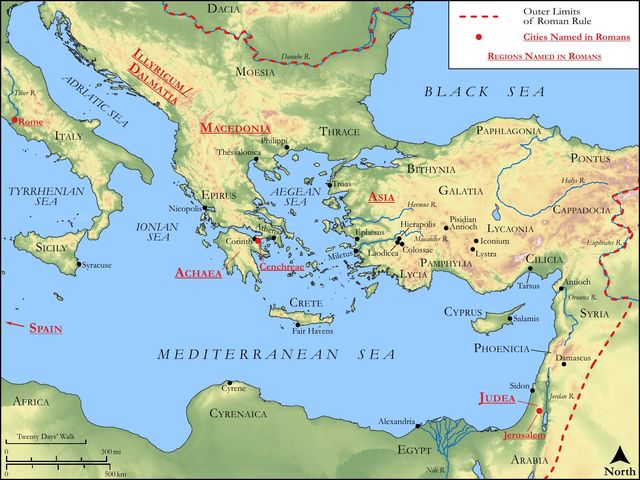
See on the biblical-era map

Study this verse
Public-domain commentary
Matthew Henry
From his Commentary on the Whole Bible. Henry comments on passages, not single verses — this entry covers Romans 8:17–25. His four-level outline is real structure in the source text, so it is rendered as structure.
In these words the apostle describes a fourth illustrious branch of the happiness of believers, namely, a title to the future glory. This is fitly annexed to our sonship; for as the adoption of sons entitles us to that glory, so the disposition of sons fits and prepares us for it. If children, then heirs, Rom 8:17. In earthly inheritances this rule does not hold, only the first-born are heirs; but the church is a church of first-born, for they are all heirs. Heaven is an inheritance that all the saints are heirs to. They do not come to it as purchasers by any merit or procurement of their own; but as heirs, purely by the act of God; for God makes heirs. The saints are heirs though in this world they are heirs under age; see Gal 4:1, Gal 4:2. Their present state is a state of education and preparation for the inheritance. How comfortable should this be to all the children of God, how little soever they have in possession, that, being heirs, they have enough in reversion! But the honour and happiness of an heir lie in the value and worth of that which he is heir to: we read of those that inherit the wind; and therefore we have here an abstract of the premises. 1. Heirs of God. The Lord himself is the portion of the saints' inheritance (Psa 16:5), a goodly heritage, Psa 16:6. The saints are spiritual priests, that have the Lord for their inheritance, Num 18:20. The vision of God and the fruition of God make up the inheritance the saints are heirs to. God himself will be with them, and will be their God, Rev 21:3. 2. Joint-heirs with Christ. Christ, as Mediator, is said to be the heir of all things (Heb 1:2), and true believers, by virtue of their union with him, shall inherit all things, Rev 21:7. Those that now partake of the Spirit of Christ, as his brethren, shall, as his brethren, partake of his glory (Joh 17:24), shall sit down with him upon his throne, Rev 3:21. Lord, what is man, that thou shouldst thus magnify him! Now this future glory is further spoken of as the reward of present sufferings and as the accomplishment of present hopes.
I.As the reward of the saints' present sufferings; and it is a rich reward:
If so be that we suffer with him (Rom 8:17), or forasmuch as we suffer with him. The state of the church in this world always is, but was then especially, an afflicted state; to be a Christian was certainly to be a sufferer. Now, to comfort them in reference to those sufferings, he tells them that they suffered with Christ - for his sake, for his honour, and for the testimony of a good conscience, and should be glorified with him. Those that suffered with David in his persecuted state were advanced by him and with him when he came to the crown; see Ti2 2:12. See the gains of suffering for Christ; though we may be losers for him, we shall not, we cannot, be losers by him in the end. This the gospel is filled with the assurances of. Now, that suffering saints may have strong supports and consolations from their hopes of heaven, he holds the balance (Rom 8:18), in a comparison between the two, which is observable.
1.In one scale he puts the sufferings of this present time. The sufferings of the saints are but sufferings of this present time, strike no deeper than the things of time, last no longer than the present time (Co2 4:17), light affliction, and but for a moment. So that on the sufferings he writes tekel, weighed in the balance and found light.
2.In the other scale he puts the glory, and finds that a weight, an exceeding and eternal weight: Glory that shall be revealed. In our present state we come short, not only in the enjoyment, but in the knowledge of that glory (Co1 2:9; Jo1 3:2): it shall be revealed. It surpasses all that we have yet seen and known: present vouchsafements are sweet and precious, very precious, very sweet; but there is something to come, something behind the curtain, that will outshine all. Shall be revealed in us; not only revealed to us, to be seen, but revealed in us, to be enjoyed. The kingdom of God is within you, and will be so to eternity.
3.He concludes the sufferings not worthy to be compared with the glory - ouk axia pros tēn doxan. They cannot merit that glory; and, if suffering for Christ will not merit, much less will doing. They should not at all deter and frighten us from the diligent and earnest pursuit of that glory. The sufferings are small and short, and concern the body only; but the glory is rich and great, and concerns the soul, and is eternal. This he reckons. I reckon - logizomai. It is not a rash and sudden determination, but the product of a very serious and deliberate consideration. he had reasoned the case within himself, weighed the arguments on both sides, and thus at last resolves the point. O how vastly different is the sentence of the word from the sentiment of the world concerning the sufferings of this present time! I reckon, as an arithmetician that is balancing an account. He first sums up what is disbursed for Christ in the sufferings of this present time, and finds they come to very little; he then sums up what is secured to us by Christ in the glory that shall be revealed, and this he finds to be an infinite sum, transcending all conception, the disbursement abundantly made up and the losses infinitely countervailed. And who would be afraid then to suffer for Christ, who as he is before-hand with us in suffering, so he will not be behind-hand with us in recompence? Now Paul was as competent a judge of this point as ever any mere man was. He could reckon not by art only, but by experience; for he knew both. He knew what the sufferings of this present time were; see Co2 11:23-28. He knew what the glory of heaven is; see Co2 12:3, Co2 12:4. And, upon the view of both, he gives this judgment here. There is nothing like a believing view of the glory which shall be revealed to support and bear up the spirit under all the sufferings of this present time. The reproach of Christ appears riches to those who have respect to the recompence of reward, Heb 11:26.
II.As the accomplishment of the saints' present hopes and expectations, Rom 8:19, etc.
As the saints are suffering for it, so they are waiting for it. Heaven is therefore sure; for God by his Spirit would not raise and encourage those hopes only to defeat and disappoint them. He will establish that word unto his servants on which he has caused them to hope (Psa 119:49), and heaven is therefore sweet; for, if hope deferred makes the heart sick, surely when the desire comes it will be a tree of life, Pro 13:12. Now he observes an expectation of this glory,
1.In the creatures Rom 8:19-22. That must needs be a great, a transcendent glory, which all the creatures are so earnestly expecting and longing for. This observation in these verses has some difficulty in it, which puzzles interpreters a little; and the more because it is a remark not made in any other scripture, with which it might be compared. By the creature here we understand, not as some do the Gentile world, and their expectation of Christ and the gospel, which is an exposition very foreign and forced, but the whole frame of nature, especially that of this lower world - the whole creation, the compages of inanimate and sensible creatures, which, because of their harmony and mutual dependence, and because they all constitute and make up one world, are spoken of in the singular number as the creature. The sense of the apostle in these four verses we may take in the following observations: - (1.) That there is a present vanity to which the creature, by reason of the sin of man, is made subject, Rom 8:20. When man sinned, the ground was cursed for man's sake, and with it all the creatures (especially of this lower world, where our acquaintance lies) became subject to that curse, became mutable and mortal. Under the bondage of corruption, Rom 8:21. There is an impurity, deformity, and infirmity, which the creature has contracted by the fall of man: the creation is sullied and stained, much of the beauty of the world gone. There is an enmity of one creature to another; they are all subject to continual alteration and decay of the individuals, liable to the strokes of God's judgments upon man. When the world was drowned, and almost all the creatures in it, surely then it was subject to vanity indeed. The whole species of creatures is designed for, and is hastening to, a total dissolution by fire. And it is not the least part of their vanity and bondage that they are used, or abused rather, by men as instruments of sin. The creatures are often abused to the dishonour of their Creator, the hurt of his children, or the service of his enemies. When the creatures are made the food and fuel of our lusts, they are subject to vanity, they are captivated by the law of sin. And this not willingly, not of their own choice. All the creatures desire their own perfection and consummation; when they are made instruments of sin it is not willingly. Or, They are thus captivated, not for any sin of their own, which they had committed, but for man's sin: By reason of him who hath subjected the same. Adam did it meritoriously; the creatures being delivered to him, when he by sin delivered himself he delivered them likewise into the bondage of corruption. God did it judicially; he passed a sentence upon the creatures for the sin of man, by which they became subject. And this yoke (poor creatures) they bear in hope that it will not be so always. Ep' elpidi hoti kai, etc. - in hope that the creature itself; so many Greek copies join the words. We have reason to pity the poor creatures that for our sin have become subject to vanity. (2.) That the creatures groan and travail in pain together under this vanity and corruption, Rom 8:22. It is a figurative expression. Sin is a burden to the whole creation; the sin of the Jews, in crucifying Christ, set the earth a quaking under them. The idols were a burden to the weary beast, Isa 46:1. There is a general outcry of the whole creation against the sin of man: the stone crieth out of the wall (Hab 2:11), the land cries, Job 31:38. (3.) That the creature, that is now thus burdened, shall, at the time of the restitution of all things, be delivered from this bondage into the glorious liberty of the children of God (Rom 8:21) - they shall no more be subject to vanity and corruption, and the other fruits of the curse; but, on the contrary, this lower world shall be renewed: when there will be new heavens there will be a new earth (Pe2 3:13; Rev 21:1); and there shall be a glory conferred upon all the creatures, which shall be (in the proportion of their natures) as suitable and as great an advancement as the glory of the children of God shall be to them. The fire at the last day shall be a refining, not a destroying annihilating fire. What becomes of the souls of brutes, that go downwards, none can tell. But it should seem by the scripture that there will be some kind of restoration of them. And if it be objected, What use will they be of to glorified saints? we may suppose them of as much use as they were to Adam in innocency; and if it be only to illustrate the wisdom, power, and goodness of their Creator, that is enough. Compare with this Psa 96:10-13; Psa 98:7-9. Let the heavens rejoice before the Lord, for he cometh. (4.) That the creature doth therefore earnestly expect and wait for the manifestation of the children of God, Rom 8:19. Observe, At the second coming of Christ there will be a manifestation of the children of God. Now the saints are God's hidden ones, the wheat seems lost in a heap of chaff; but then they shall be manifested. It does not yet appear what we shall be (Jo1 3:2), but then the glory shall be revealed. The children of God shall appear in their own colours. And this redemption of the creature is reserved till then; for, as it was with man and for man that they fell under the curse, so with man and for man they shall be delivered. All the curse and filth that now adhere to the creature shall be done away then when those that have suffered with Christ upon earth shall reign with him upon the earth. This the whole creation looks and longs for; and it may serve as a reason why now a good man should be merciful to his beast.
2.In the saints, who are new creatures, Rom 8:23-25. Observe,
(1.)The grounds of this expectation in the saints. It is our having received the first-fruits of the Spirit, which both quickens our desires and encourages our hopes, and both ways raises our expectations. The first-fruits did both sanctify and ensure the lump. Grace is the first-fruits of glory, it is glory begun. We, having received such clusters in this wilderness, cannot but long for the full vintage in the heavenly Canaan. Not only they - not only the creatures which are not capable of such a happiness as the first-fruits of the Spirit, but even we, who have such present rich receivings, cannot but long for something more and greater. In having the first-fruits of the Spirit we have that which is very precious, but we have not all we would have. We groan within ourselves, which denotes the strength and secrecy of these desires; not making a loud noise, as the hypocrites howling upon the bed for corn and wine, but with silent groans, which pierce heaven soonest of all. Or, We groan among ourselves. It is the unanimous vote, the joint desire, of the whole church, all agree in this: Come, Lord Jesus, come quickly. The groaning denotes a very earnest and importunate desire, the soul pained with the delay. Present receivings and comforts are consistent with a great many groans; not as the pangs of one dying, but as the throes of a woman in travail - groans that are symptoms of life, not of death.
(2.)The object of this expectation. What is it we are thus desiring and waiting for? What would we have? The adoption, to wit, the redemption of our body. Though the soul be the principal part of the man, yet the Lord has declared himself for the body also, and has provided a great deal of honour and happiness for the body. The resurrection is here called the redemption of the body. It shall then be rescued from the power of death and the grave, and the bondage of corruption; and, though a vile body, yet it shall be refined and beautified, and made like that glorious body of Christ, Phi 3:21; Co1 15:42. This is called the adoption.
[1.]It is the adoption manifested before all the world, angels and men. Now are we the sons of God, but it does not yet appear, the honour is now clouded; but then God will publicly own all his children. The deed of adoption, which is now written, signed, and sealed, will then be recognized, proclaimed, and published. As Christ was, so the saints will be, declared to be the sons of God with power, by the resurrection from the dead, Rom 1:4. It will then be put past dispute.
[2.]It is the adoption perfected and completed. The children of God have bodies as well as souls; and, till those bodies are brought into the glorious liberty of the children of God, the adoption is not perfect. But then it will be complete, when the Captain of our salvation shall bring the many sons to glory, Heb 2:10. This is that which we expect, in hope of which our flesh rests, Psa 16:9, Psa 16:10. All the days of our appointed time we are waiting, till this change shall come, when he shall call, and we shall answer, and he will have a desire to the work of his hands, Job 14:14, Job 14:15.
(3.)The agreeableness of this to our present state, Rom 8:24, Rom 8:25. Our happiness is not in present possession: We are saved by hope. In this, as in other things, God hath made our present state a state of trial and probation - that our reward is out of sight. Those that will deal with God must deal upon trust. It is acknowledged that one of the principal graces of a Christian is hope (Co1 13:13), which necessarily implies a good thing to come, which is the object of that hope. Faith respects the promise, hope the thing promised. Faith is the evidence, hope the expectation, of things not seen. Faith is the mother of hope. We do with patience wait. In hoping for this glory we have need of patience, to bear the sufferings we meet with in the way to it and the delays of it. Our way is rough and long; but he that shall come will come, and will not tarry; and therefore, though he seem to tarry, it becomes us to wait for him.
Historical interpretation
Two Centuries of Reception
12 surviving comments on this verse. Each one is dated, so this reads as a timeline rather than a list.
Select a marker to jump to its quote. Markers stagger vertically where authors wrote within a few decades of each other.
God is rich in all things, and everything is his. It is therefore fitting that the creation itself, having been restored to its primeval condition, should without restraint be under the dominion of the righteous.
For the creature has been subjected to vanity, not willingly, but by reason of him who hath subjected the same in hope; since the creature itself shall also be delivered from the bondage of corruption into the glorious liberty of the sons of God."
But if, on the other hand, there is to be an end of evil, when the chief thereof, the devil, shall "go away into the fire which God hath prepared for him and his angels" -having been first "cast into the bottomless pit; " when likewise "the manifestation of the children of God" shall have "delivered the creature" from evil, which had been "made subject to vanity; " when the cattle restored in the innocence and integrity of their nature shall be at peace with the beasts of the field, when also little children shall play with serpents; when the Father shall have put beneath the feet of His Son His enemies, as being the workers of evil,-if in this way an end is compatible with evil, it must follow of necessary that a beginning is also compatible with it; and Matter will turn out to have a beginning, by virtue of its having also an end.
When, therefore, according to these (heretics), the entire world and super-mundane entities were finished, and (when) nothing exists labouring under deficiency, there still remains in the (conglomeration of) all germs the third Sonship, which had been left behind in the Seed to confer benefits and receive them. And it must needs be that the Sonship which had been left behind ought likewise to be revealed and reinstated above. And His place should be above the Conterminous Spirit, near the refined and imitative Sonship and the Non-Existent One. But this would be in accordance with what has been written, he says: "And the creation itself groaneth together, and travaileth in pain together, waiting for the manifestation of the sons of God." Now, we who are spiritual are sons, he says, who have been left here to arrange, and mould, and rectify, and complete the souls which, according to nature, are so constituted as to continue in this quarter of the universe. "Sin, then, reigned from Adam unto Moses," as it has been written. For the Great Archon exercised dominion and possesses an empire with limits extending as far as the firmament. And He imagines Himself alone to be God, and that there exists nothing above Him, for (the reason that) all things have been guarded by unrevealed Siope. This, he says, is the mystery which has not been made known to former generations; but in those days the Great Archon, the Ogdoad, was King and Lord, as it seemed, of the universe. But (in reality) the Hebdomad was king and lord of this quarter of the universe, and the Ogdoad is Arrhetus, whereas the Hebdomad is Rhetus. This, he says, is the Archon of the Hebdomad, who has spoken to Moses, and says: "I am the God of Abraham, and Isaac, and Jacob, and I have not manifested unto them the name of God" (for so they wish that it had been written)-that is, the God, Arrhetus, Archon of the Ogdoad. All the prophets, therefore, who were before the Saviour uttered their predictions, he says, from this source (of inspiration). Since, therefore, it was requisite, he says, that we should be revealed as the children of God, in expectation of whose manifestation, he says, the creation habitually groans and travails in pain, the Gospel came into the world, and passed through every Principality, and Power, and Dominion, and every Name that is named. And (the Gospel) came in reality, though nothing descended from above; nor did the blessed Sonship retire from that Inconceivable, and Blessed, (and) Non-Existent God. Nay, (far from it;) for as Indian naphtha, when lighted merely from a considerably long distance, nevertheless attracts fire (towards it), so from below, from the formlessness of the conglomeration (of all germs), the powers pass upwards as far as the Sonship. For, according to the illustration of the Indian naphtha, the Son of the Great Archon of the Ogdoad, as if he were some (sort of) naphtha, apprehends and seizes conceptions from the Blessed Sonship, whose place of habitation is situated after that of the Conterminous (Spirit). For the power of the Sonship which is in the midst of the Holy Spirit, (that is,) in, the midst of the (Conterminous) Spirit, shares the flowing and rushing thoughts of the Sonship with the Son of the Great Archon.
When, therefore, he says, the entire Sonship shall have come, and shall be above the conterminous spirit, then the creature will become the object of mercy. For (the creature) groans until now, and is tormented, and waits for the manifestation of the sons of God, in order that all who are men of the Sonship may ascend from thence. When this takes place, God, he says, will bring upon the whole world enormous ignorance, that all things may continue according to nature, and that nothing may inordinately desire anything of the things that are contrary to nature. But (far from it); for all the souls of this quarter of creation, as many as possess the nature of remaining immortal in this (region) only, continue (in it), aware of nothing superior or better (than their present state). And there will not prevail any rumour or knowledge in regions below, concerning beings whose dwelling is placed above, lest subjacent souls should be wrung with torture from longing after impossibilities. (It would be) just as if a fish were to crave to feed on the mountains along with sheep. (For) a wish of this description would, he says, be their destruction. All things, therefore, that abide in (this) quarter are incorruptible, but corruptible if they are disposed to wander and cross over from the things that are according to nature. In this way the Archon of the Hebdomad will know nothing of superjacent entities. For enormous ignorance will lay hold on this one likewise, in order that sorrow, and grief, and groaning may depart from him; for he will not desire aught of impossible things, nor will he be visited with anguish. In like manner, however, the same ignorance will lay hold also on the Great Archon of the Ogdoad, and similarly on all the creatures that are subject unto him, in order that in no respect anything may desire aught of those things that are contrary to nature, and may not (thus) be overwhelmed with sorrow. And so there will be the restitution of all things which, in conformity with nature, have from the beginning a foundation in the seed of the universe, but will be restored at (their own) proper periods. And that each thing, says (Basilides), has its own particular times, the Saviour is a sufficient (witness ) when He observes, "Mine hour is not yet come." And the Magi (afford similar testimony) when they gaze wistfully upon the (Saviour's) star. For (Jesus) Himself was, he says, mentally preconceived at the time of the generation of the stars, and of the complete return to their starting-point of the seasons in the vast conglomeration (of all germs). This is, according to these (Basilidians), he who has been conceived as the inner spiritual man in what is natural (now this is the Sonship which left there the soul, not (that it might be) mortal, but that it might abide here according to nature, just as the first Sonship left above in its proper locality the Holy Spirit, (that is, the spirit) which is conterminous),-(this, I say, is he who has been conceived as the inner spiritual man, and) has then been arrayed in his own peculiar soul.
Paul says this in order to indicate how great and wonderful is the glory which will be revealed both in him and in those who have shared his sufferings.
Itself also shall be delivered from the bondage of corruption into the glorious liberty of the children of God."
The Scriptures often suggest that the visible creation is animate and that the universe has a rational sensibility.
"For the earnest expectation of the creation waiteth," he says, "for the revelation of the sons of God. For the creation was made subject to vanity, not willingly, but by reason of him who hath subjected the same in hope."
And the meaning is something of this kind. The creation itself is in the midst of its pangs, waiting for and expecting these good things whereof we have just now spoken. For "earnest expectation" implies expecting intensely. And so his discourse becomes more emphatic, and he personifies this whole world as the prophets also do, when they introduce the floods clapping their hands, and little hills leaping, and mountains skipping, not that we are to fancy them alive, or ascribe any reasoning power to them, but that we may learn the greatness of the blessings, so great as to reach even to things without sense also. The very same thing they do many times also in the case of afflicting things, since they bring in the vine lamenting, and the wine too, and the mountains, and the boardings of the Temple howling, and in this case too it is that we may understand the extremity of the evils. It is then in imitation of these that the Apostle makes a living person of the creature here, and says that it groaneth and travaileth: not that he heard any groan conveyed from the earth and heaven to him, but that he might show the exceeding greatness of the good things to come; and the desire of freedom from the ills which now pervaded them.
"For the creature was made subject to vanity, not willingly, but by reason of him who hath subjected the same." What is the meaning of, "the creation was made subject to vanity?" Why that it became corruptible. For what cause, and on what account? On account of thee, O man. For since thou hast taken a body mortal and liable to suffering, the earth too hath received a curse, and brought forth thorns and thistles. But that the heaven, when it is waxen old along with the earth, is to change afterwards to a better portion hear from the Prophet in his words; "Thou, O Lord, from the beginning hast founded the earth, and the heavens are the work of Thy hands. They shall perish, but thou shalt endure; and they all shall wax old as doth a garment, and as a cloak shalt Thou fold them up, and they shall be changed." Isaiah too declares the same, when he says, "Look to the heaven above, and upon the earth beneath, for the heavens are as a firmament of smoke, and the earth shall wax old like a garment, and they that dwell therein shall perish in like manner."
Now you see in what sense the creation is "in bondage to vanity," and how it is to be freed from the ruined state. For the one says, "Thou shalt fold them up as a garment, and they shall be changed;" and Isaiah says, "and they that dwell therein shall perish in like manner," not of course meaning an utter perishing. For neither do they that dwell therein, mankind, that is, undergo such an one, but a temporary one, and through it they are changed into an incorruptible state, and so therefore will the creature be.
Different interpreters expound this passage in different ways. Some say that the whole creation awaits the time of the resurrection, because then it will be changed into something better. Others say that this refers only to the angelic, rational creation. Still others say that “creation” refers specifically to Adam and Eve, because they did not sin by themselves but at the temptation of the serpent, who long ago made them subject to corruption when they were exposed to deception in the hope of divine existence. These interpreters say that Adam and Eve will be set free so that they are no longer subject to corruption. But the “whole creation,” say these same interpreters, means all those who were righteous up to the coming of Christ, because they too have not yet received and are waiting until God provides something better for us. Not only they, however, but we also, in whom these things have been fulfilled, do not yet hold it in our grasp but endure in hope, although we have seen things which many righteous people have longed to see.
Paul is referring here to the resurrection on the last day.
The creation is waiting for the revelation of the sons of God at some point in the future which is still unknown. Who can know when this will be? But by the secret plan of God, which orders all things for the best, it will come to this end. For when the sons of God, who have lived a righteous life, have been transformed into glory from dishonor and from what is corruptible into what is incorruptible, then the creation too will be transformed into something better.
Continue studying Romans 8:19 across the web’s major study libraries — every link below opens this exact verse, chapter, or book on the destination site.
Read & Compare
 BibleGatewayThis verse in more than 200 translations and 70 languages.
 Bible.comThe YouVersion reader — hundreds of translations, reading plans, and highlights.
 ESV.orgCrossway's official English Standard Version reader.
 NET BibleThe NET translation with 60,000+ translators' notes on every rendering decision.
 STEP BibleTyndale House's free study tool — original text, vocabulary, and scholarly resources.
 BibliaLogos Bible Software's free web reader.
 USCCBThe New American Bible (Revised Edition) with the U.S. bishops' study notes.
Commentaries
 BibleHub CommentariesDozens of classic commentaries on this verse, gathered on one page.
 StudyLightMore than 100 commentary sets — the largest collection on the web.
 BibleRefPlain-English commentary on what this verse means, verse by verse.
 Enduring WordDavid Guzik's free commentary on this chapter, widely used by Bible teachers.
 Bible Study ToolsVerse commentary alongside Greek and Hebrew study aids.
Original Language & Research
- BibleHub InterlinearThe verse word by word — original language, transliteration, and English.
- BibleHub LexiconEvery word's original-language definition and Strong's entry.
 Blue Letter BibleDeep-study tools — Strong's numbers, concordance, and word studies.
 CNTR CollationThe earliest Greek manuscripts of this verse, collated letter by letter.
Sermons, Hymns & Audio


TrulyRandomVerse is not affiliated with these sites and doesn’t control their content. They’re linked because they’re genuinely useful.
Summary
Romans 8:19 unveils a profound cosmic anticipation, revealing that the entire created order, groaning under the weight of futility, eagerly awaits the full and glorious revelation of God's adopted children. This verse posits that the destiny of the cosmos is intrinsically linked to the glorification of believers, portraying a future hope where the liberation of humanity from the bondage of corruption will coincide with the redemption of creation itself.
Context
ShowHideLiterary Context
Romans 8:19 is a pivotal verse within Romans chapter 8, a theological masterpiece that transitions from the believer's freedom from condemnation in Christ (Romans 8:1) to their life in the Spirit (Romans 8:2-13) and their adoption as God's children (Romans 8:14-17). Paul has just contrasted the present sufferings of believers with the incomparable glory that awaits them in Romans 8:18. Verse 19 then expands this vision of future glory beyond humanity, revealing that creation itself shares in this eschatological hope. This sets the stage for Paul's subsequent discussion of creation's groaning alongside believers in Romans 8:20-23, culminating in the hope of the redemption of the body.
Historical & Cultural Context
Paul wrote to a diverse church in Rome, comprising both Jewish and Gentile believers, navigating issues of identity, suffering, and future hope. The concept of creation being subjected to futility (mentioned in Romans 8:20) likely draws from the Old Testament narrative of the Fall in Genesis 3, where the ground was cursed because of humanity's sin. This established a theological framework where the fate of creation was intertwined with the fate of humanity. Paul's audience would have understood the pervasive effects of sin on the world, making the idea of creation's longing for redemption a powerful and relatable concept, offering hope for a restoration that transcends individual salvation.
Key Themes
ShowHideThis verse powerfully contributes to several overarching themes in Romans and biblical theology. It highlights Cosmic Redemption, emphasizing that God's redemptive plan is not limited to humanity but encompasses the entire created order, anticipating a new heaven and new earth as seen in Revelation 21:1. It underscores the Future Glory of Believers, asserting that the "manifestation of the sons of God" refers to the full, public revelation of believers' adopted identity and glorification at Christ's return, when they will share in His glory, as also described in Colossians 3:4. Furthermore, it stresses the Interconnectedness of Creation and Humanity, portraying a symbiotic relationship where creation's destiny is inextricably linked to the destiny of God's redeemed people. Finally, the language of "earnest expectation" conveys the profound Eager Anticipation that permeates the cosmos, yearning for liberation from its present state of decay.
Exposition and Analysis
ShowHideKey Word Analysis
ShowHideThis powerful compound word vividly portrays an intense, focused anticipation. It literally means "a watching with outstretched head," suggesting a posture of eager, strained looking forward, as one might crane their neck to see something approaching from a distance. It denotes a deep, unyielding longing for something that is certain to come.
This term refers to the entire created order, the non-human universe. It encompasses all that God has made, from the smallest organism to the vast expanse of the cosmos. In this context, it signifies the whole of material creation, which was impacted by the Fall and now yearns for liberation.
Derived from a verb meaning "to uncover" or "to reveal," this noun signifies a "disclosure" or "unveiling." It implies that the true glory and identity of God's children, currently hidden or incomplete, will one day be fully revealed to all, including the created order. It points to a future event where what is presently unseen or partially understood will become fully evident.
Verse Breakdown
ShowHide"For the earnest expectation of the creature"
Paul begins by grounding this cosmic hope in the deep, intense longing of creation itself. The "creature" (or creation) is not a passive entity but is depicted as actively and eagerly anticipating something. This earnest expectation is a profound, almost personified yearning, indicating creation's inherent desire for its appointed destiny.
"waiteth for the manifestation"
This clause describes the object of creation's intense longing. The word "waiteth" (from apekdéchomai) reinforces the idea of full expectation and patient endurance. Creation is waiting for an "unveiling" or "revelation"—a moment when something currently hidden or obscured will be made visible and clear to all. This is not a vague hope but a specific, future event.
"of the sons of God."
The ultimate object of creation's longing is the "manifestation of the sons of God." This refers to the full glorification and public revelation of believers as God's adopted children. Currently, believers are sons and daughters of God by faith, but their full identity and destiny, including the redemption of their bodies, are yet to be fully revealed. Creation awaits this glorious moment, understanding that its own liberation is tied to the complete redemption of humanity.
Literary Devices
ShowHideRomans 8:19 employs several powerful literary devices to convey its profound theological truth. Most notably, Personification is central, as Paul attributes human-like qualities and actions—"earnest expectation" and "waiteth"—to inanimate creation. This imbues the cosmos with a conscious longing, making its suffering and hope tangible and relatable. The phrase "earnest expectation" itself is a vivid Metaphor (specifically, apokaradokía), painting a picture of a head craned forward in eager anticipation, emphasizing the intensity of creation's yearning. There is also an element of Anticipation and Foreshadowing, as the verse points forward to a future eschatological event, building suspense and hope for the ultimate redemption of both humanity and the cosmos.
Theological and Thematic Connections
ShowHideRomans 8:19 profoundly expands our understanding of God's redemptive plan, demonstrating that salvation is not merely an individual human affair but possesses cosmic dimensions. It reveals that the effects of sin, which subjected creation to futility (as described in Romans 8:20), are not permanent. Just as humanity fell, dragging creation with it, so too will humanity's redemption lead to creation's liberation. This verse highlights the interconnectedness of all things under God's sovereign plan, where the glorification of His children serves as the catalyst for the restoration of the entire cosmos, culminating in a renewed creation free from decay and corruption. It underscores the comprehensive nature of God's grace and power, extending His redemptive work to every corner of His handiwork.
Reflection and Application
ShowHideRomans 8:19 offers a breathtaking vision that should profoundly shape our perspective as believers. It reminds us that our personal salvation is part of a grander, cosmic narrative, where the entire created order eagerly awaits our full glorification. This truth should inspire immense hope, assuring us that the present brokenness, suffering, and decay we observe in the world are temporary. Our future glory is so certain and so magnificent that even the trees, mountains, and oceans are depicted as yearning for it. This perspective elevates our understanding of our identity as "sons of God," imbuing our present struggles with eternal significance and reminding us that our ultimate destiny is intertwined with the renewal of all things. It calls us to live with an eschatological hope, recognizing that God's redemptive work is comprehensive and will ultimately bring about a new creation where righteousness dwells.
Questions for Reflection
ShowHideFAQ
ShowHideWhat does "the creature" refer to in Romans 8:19?
ShowHideIn Romans 8:19, "the creature" (Greek: ktísis) refers to the entire non-human created order, the cosmos. It encompasses everything God made, from the vast universe to the smallest living organism, excluding humanity. Paul portrays this creation as a unified entity, subjected to futility due to humanity's sin (as explained in Romans 8:20), and now eagerly awaiting its own liberation and restoration.
What is the "manifestation of the sons of God"?
ShowHideThe "manifestation of the sons of God" refers to the future, public revelation and glorification of believers. While believers are already adopted as God's children by faith (see Romans 8:15), their full identity, glory, and destiny will be unveiled at Christ's return. This includes the redemption of their bodies (as mentioned in Romans 8:23), when they will fully share in Christ's glory and be completely transformed, becoming evident to all creation as God's true children.
Christ-Centered Fulfillment
ShowHideRomans 8:19 finds its ultimate Christ-centered fulfillment in the person and work of Jesus Christ, for He is the one through whom both humanity and creation will be redeemed and glorified. The "manifestation of the sons of God" is entirely dependent upon the "manifestation" of Christ Himself. When Christ, who is our life, appears, then we also will appear with Him in glory, as prophesied in Colossians 3:4. His first coming initiated the process of redemption, conquering sin and death, and His second coming will complete it, bringing about the full glorification of His people and the liberation of creation. Jesus is the "firstborn of every creature" (Colossians 1:15), and "in him all things hold together" (Colossians 1:17). Therefore, it is through His redemptive work on the cross and His future return that the cosmic groaning of creation will cease, and the "new heavens and new earth" will be established, where righteousness dwells and God's glory is fully revealed through His glorified children, all centered on the reigning Christ (Revelation 21:1-5).