


1 Corinthians 9:27
- ἀλλ᾽all᾽ButG235CONJConjunction
- ὑπωπιάζωhupōpiazōI batterG5299V-PAI-1SVerb Present Active Indicative 1st Singular
- μουmoumyG3165P-1GSPersonal pronoun Genitive 1st Singular
- τὸto<the>G3588T-ASNDefinite article Accusative Singular Neuter
- σῶμαsōmabodyG4983N-ASNNoun Accusative Singular Neuter
- καὶkaiandG2532CONJConjunction
- δουλαγωγῶdoulagōgōbring [it] into servitudeG1396V-PAI-1SVerb Present Active Indicative 1st Singular
- μήmēlestG3361PRT-NNegative Particle Negative
- πωςpōsperhapsG4458PRTParticle or Disjunctive
- ἄλλοιςalloisto othersG243A-DPMAdjective Dative Plural Masculine
- κηρύξαςkēruxashaving preachedG2784V-AAP-NSMVerb Aorist Active Participle Nominative Singular Masculine
- αὐτὸςautosmyselfG846P-NSMPersonal pronoun Nominative Singular Masculine
- ἀδόκιμοςadokimosdisqualifiedG96A-NSMAdjective Nominative Singular Masculine
- γένωμαιgenōmaiI may beG1096V-2ADS-1SVerb 2nd Aorist Middle Deponent Subjunctive 1st Singular
English is a literal word-by-word gloss of the Greek, not the KJV's wording. Why?
This is the original text the KJV's translators worked from — each Greek word with its own literal English meaning in this verse, prepared by scholars at Tyndale House, Cambridge. The KJV translates whole sentences, not word by word, so its wording differs: one Greek word can become several English words, and the KJV may choose “charity” where the gloss reads “love”. Both are faithful — they answer different questions. For the KJV's own rendering, switch to the KJV text.
Details
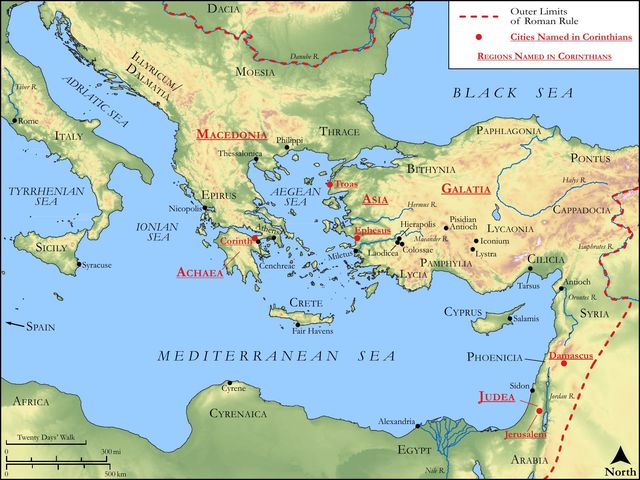
See on the biblical-era map

Study this verse
Public-domain commentary
Matthew Henry
From his Commentary on the Whole Bible. Henry comments on passages, not single verses — this entry covers 1 Corinthians 9:24–27. His two-level outline is real structure in the source text, so it is rendered as structure.
In these verses the apostle hints at the great encouragement he had to act in this manner. He had a glorious prize, an incorruptible crown, in view. Upon this head he compares himself to the racers and combatants in the Isthmian games, an allusion well known to the Corinthians, because they were celebrated in their neighbourhood: "Know you not that those who run in a race run all, but one obtaineth the prize? Co1 9:24. All run at your games, but only one gets the race and wins the crown." And here,
I.He excites them to their duty:
"So run that you may obtain. It is quite otherwise in the Christian race than in your races; only one wins the prize in them. You may all run so as to obtain. You have great encouragement, therefore, to persist constantly, and diligently, and vigorously, in your course. There is room for all to get the prize. You cannot fail if you run well. Yet there should be a noble emulation; you should endeavour to outdo one another. And it is a glorious contest who shall get first to heaven, or have the best rewards in that blessed world. I make it my endeavour to run; so do you, as you see me go before you." Note, It is the duty of Christians to follow their ministers closely in the chase of eternal glory, and the honour and duty of ministers to lead them in the way.
II.He directs them in their course, by setting more fully to view his own example, still carrying on the allusion.
1. Those that ran in their games were kept to a set diet: "Every man that strives for the mastery is temperate in all things, Co1 9:23. The fighters and wrestlers in your exercises are kept to strict diet and discipline; nay, they keep themselves to it. They do not indulge themselves, but restrain themselves from the food they eat and so from the liberties they use on other occasions. And should not Christians much more abridge themselves of their liberty, for so glorious an end as winning the race, and obtaining the prize set before them? They used a very spare diet, and course food, and denied themselves much, to prepare for their race and combat; so do I; so should you, after my example. It is hard if, for the heavenly crown, you cannot abstain from heathen sacrifices." 2. They were not only temperate, but inured themselves to hardships. Those who fought with one another in these exercises prepared themselves by beating the air, as the apostle calls it, or by throwing out their arms, and thereby inuring themselves, beforehand, to deal about their blows in close combat, or brandish them by way of flourish. There is no room for any such exercise in the Christian warfare. Christians are ever in close combat. There enemies make fierce and hearty opposition, and are ever at hand; and for this reason they must lay about them in earnest, and never drop the contest, nor flag and faint in it. They must fight, not as those that beat the air, but must strive against their enemies with all their might. One enemy the apostle here mentions, namely, the body; this must be kept under, beaten black and blue, as the combatants were in these Grecian games, and thereby brought into subjection. By the body we are to understand fleshly appetites and inclinations. These the apostle set himself to curb and conquer, and in this the Corinthians were bound to imitate him. Note, Those who would aright pursue the interests of their souls must beat down their bodies, and keep them under. They must combat hard with fleshly lusts, and not indulge a wanton appetite, and long for heathenish sacrifices, nor eat them, to please their flesh, at the hazard of their brethren's souls. The body must be made to serve the mind, not suffered to lord over it.
III.The apostle presses this advice on the Corinthians by proper arguments drawn from the same contenders.
1.They take pains, and undergo all those hardships, to obtain a corruptible crown (Co1 9:25), but we an incorruptible. Those who conquered in these games were crowned only with the withering leaves or boughs of trees, of olive, bays, or laurel. But Christians have an incorruptible crown in view, a crown of glory that never fadeth away, an inheritance incorruptible, reserved in heaven for them. And would they yet suffer themselves to be outdone by these racers or wrestlers? Can they use abstinence in diet, exert themselves in racing, expose their bodies to so much hardship in a combat, who have no more in view than the trifling huzzas of a giddy multitude, or a crown of leaves? And shall not Christians, who hope for the approbation of the sovereign Judge, and a crown of glory from his hands, stretch forward in the heavenly race, and exert themselves in beating down their fleshly inclinations, and the strong-holds of sin?
2.The racers in these games run at uncertainty. All run, but one receives the prize, Co1 9:24. Every racer, therefore, is at a great uncertainty whether he shall win it or no. But the Christian racer is at no such uncertainty. Every one may run here so as to obtain; but then he must run within the lines, he must keep to the path of duty prescribed, which, some think, is the meaning of running not as uncertainly, Co1 9:26. He who keeps within the limits prescribed, and keeps on in his race, will never miss his crown, though others may get theirs before him. And would the Grecian racers keep within their bounds, and exert themselves to the very last, when one only could win, and all must be uncertain which that one would be? And shall not Christians be much more exact and vigorous when all are sure of a crown when they come to the end of their race?
3.He sets before himself and them the danger of yielding to fleshly inclinations, and pampering the body and its lusts and appetites: I keep my body under, lest that by any means, when I have preached to others, I myself should be a cast-away (Co1 9:27), rejected, disapproved, adokimos, one to whom the brabeutēs - the judge or umpire of the race, will not decree the crown. The allusion to the games runs through the whole sentence. Note, A preacher of salvation may yet miss it. He may show others the way to heaven, and never get thither himself. To prevent this, Paul took so much pains in subduing and keeping under bodily inclinations, lest by any means he himself, who had preached to others, should yet miss the crown, be disapproved and rejected by his sovereign Judge. A holy fear of himself was necessary to preserve the fidelity of an apostle; and how much more necessary is it to our preservation? Note, Holy fear of ourselves, and not presumptuous confidence, is the best security against apostasy from God, and final rejection by him.
Historical interpretation
Four Centuries of Reception
17 surviving comments on this verse. Each one is dated, so this reads as a timeline rather than a list.
Select a marker to jump to its quote. Markers stagger vertically where authors wrote within a few decades of each other.
"I buffet my body and bring it into subjection." "For everyone who wishes to take part in a contest is continent in all things" (the words "he is continent in all things" really mean that, though he does not abstain from everything, yet he is self-controlled on such things as he thinks fit). "They do it to obtain a corruptible crown, but we an incorruptible," as if we conquer in the struggle, though there is no crown for us if we do not put up any fight at all.
Nay, rather, by the virtue of contemning food He was initiating "the new man" into "a severe handling" of "the old," that He might show that (new man) to the devil, again seeking to tempt him by means of food, (to be) too strong for the whole power of hunger.
To pommel the body is to fast and to avoid any kind of luxury. Paul shows that he disciplines his own body so that he will not miss out on the reward about which he preaches to others.
He in whomsoever the Spirit of God is, is in accord with the will of the Spirit of God; and, because he is in accord with the Spirit of God, therefore does he mortify the deeds of the body and live unto God, "treading down and subjugating the body and keeping it under; so that, while preaching to others," he may be a beautiful example and pattern to believers, and may spend his life in works which are worthy of the Holy Spirit, so that he may "not be cast away," [1 Corinthians 9:27] but may be approved before God and before men.
If Paul—a man of such caliber and stature, who traversed the whole world like a winged creation, who proved superior to bodily necessities and was privileged to hear those secret words that no one else to this day has heard—if he wrote these words, "I punish my body and bring it into subjection lest while preaching to others I myself become disqualified," if then that man, the object of so great favor, despite such conspicuous prowess felt the need to pommel his body, bring it into subjection, submit it to the authority of the soul and place its impulses under the virtue of the soul … what then would we say, deprived as we are of these virtues and with nothing to show in addition to this beyond deep indifference? After all, this war admits of no truce, does it? It has no set time for the assault, does it?
"But I buffet my body, and bring it into bondage lest by any means, after that I have preached to others, I myself should be rejected."
Here he implies that they are subject to the lust of the belly and give up the reins to it, and under a pretence of perfection fulfil their own greediness; a thought which before also he was travailing to express, when he said, "meats for the belly, and the belly for meats." For since both fornication is caused by luxury, and it also brought forth idolatry, he naturally oftentimes inveighs against this disease; and pointing out how great things he suffered for the Gospel, he sets this also down among them. "As I went," saith he, "beyond the commands, and this when it was no light matter for me:" ("for we endure all things," it is said,) "so also here I submit to much labor in order to live soberly. Stubborn as appetite is and the tyranny of the belly, nevertheless I bridle it and give not myself up to the passion, but endure all labor not to be drawn aside by it."
"For do not, I pray you, suppose that by taking things easily I arrive at this desirable result. For it is a race and a manifold struggle, and a tyrannical nature continually rising up against me and seeking to free itself. But I bear not with it but keep it down, and bring it into subjection with many struggles." Now this he saith that none may despairingly withdraw from the conflicts in behalf of virtue because the undertaking is laborious. Wherefore he saith, "I buffet and bring into bondage." He said not, "I kill:" nor, "I punish" for the flesh is not to be hated, but, "I buffet and bring into bondage;" which is the part of a master not of an enemy, of a teacher not of a foe, of a gymnastic master not of an adversary.
"Lest by any means, having preached to others, I myself should be a rejected."
Now if Paul feared this who had taught so many, and feared it after his preaching and becoming an angel and undertaking the leadership of the whole world; what can we say?
For, "think not," saith he, "because ye have believed, that this is sufficient for your salvation: since if to me neither preaching nor teaching nor bringing over innumerable persons, is enough for salvation unless I exhibit my own conduct also unblameable, much less to you."
Let our soul be in command and our body in subjection. Then Christ will come immediately and make his dwelling with us.
Paul chastises what is of him and not what is himself. For what is of him is one thing, what is himself is another. He chastises what is of him so that he, being just, may bring about the death of bodily wantonness.
Pambo said to Antony, ‘What shall I do?’ Antony said, ‘Do not trust in your own righteousness. Do not go on sorrowing over a deed that is past. Keep your tongue and your belly under control.’
He also said, ‘Fasting is the monk’s control over sin. The man who stops fasting is like a stallion who lusts the moment he sees a mare.’
She also said, ‘The devil sometimes sends a severe fast which is too prolonged; the devil’s disciples do this as well as holy men. How do we distinguish the fasting of our God and King from the fasting of that tyrant the devil? Clearly by its moderation. Throughout your life, then, you ought to keep an unvarying rule of fasting. Do you fast four or five days on end and then lose your spiritual strength by eating a feast? That really pleases the devil! Everything which is extreme is destructive. So do not suddenly throw away your armour, or you may be found unarmed in the battle and easily captured. Our body is the armour, our soul is the warrior. Take care of both, and you will be ready for whatever comes.’
A brother felt hungry at dawn, and struggled not to eat till nine o’clock. When nine o’clock came, he made himself wait till noon. At noon he dipped his bread and sat down to eat, but then got up again, saying, ‘I will wait till three.’ At three o’clock he prayed, and saw the devil’s work going out of him like smoke; and his hunger ceased.
They said that Dioscorus of Namisias made his bread out of barley, and his soup out of lentils. Every year he made one particular resolution: either not to meet anyone for a year, or not to speak, or not to taste cooked food, or not to eat any fruit, or not to eat vegetables. This was his system in everything. He made himself master of one thing, and then started on another, and so on each year...
They said of Helladius that he lived twenty years in his cell, and did not once raise his eyes to look at the roof.
Joseph asked Poemen, ‘How should we fast?’ Poemen said, ‘I suggest that everyone should eat a little less than he wants, every day.’ Joseph said to him, ‘When you were a young man, didn’t you fast for two days on end?’ He said to him, ‘That’s right, I used to fast three days on end, even for a week. But the great hermits have tested all these things, and they found that it is good to eat something every day, but on some days a little less. They have shown us that this is the king’s highway, for it is easy and light.’
John the Short said, ‘If a king wants to take a city filled with his enemies, he first captures their food and water, and when they are starving he subdues them. So it is with gluttony. If a man is sincere about fasting and is hungry, the enemies that trouble his soul will grow weak.’
Free us, Lover of men, from the danger which Paul mentions, that while preaching to others I may myself be found false. You truly know how weak we are. You recognize the nature of the foe who oppresses us. In our uneven contest and our mortal weakness we seek you, for the glory redounds to your majesty if the roaring lion is overcome by the feeble sheep.
For the cross is taken up in two ways: either when the body is afflicted through abstinence, or when the mind is troubled through compassion for one's neighbor. Let us consider how Paul had borne his cross in both ways, who said: "I chastise my body and bring it into subjection, lest perhaps while preaching to others I myself should become a castaway." Behold, in the affliction of the body we have heard of the cross of the flesh.
Continue studying 1 Corinthians 9:27 across the web’s major study libraries — every link below opens this exact verse, chapter, or book on the destination site.
Read & Compare
 BibleGatewayThis verse in more than 200 translations and 70 languages.
 Bible.comThe YouVersion reader — hundreds of translations, reading plans, and highlights.
 ESV.orgCrossway's official English Standard Version reader.
 NET BibleThe NET translation with 60,000+ translators' notes on every rendering decision.
 STEP BibleTyndale House's free study tool — original text, vocabulary, and scholarly resources.
 BibliaLogos Bible Software's free web reader.
 USCCBThe New American Bible (Revised Edition) with the U.S. bishops' study notes.
Commentaries
 BibleHub CommentariesDozens of classic commentaries on this verse, gathered on one page.
 StudyLightMore than 100 commentary sets — the largest collection on the web.
 BibleRefPlain-English commentary on what this verse means, verse by verse.
 Enduring WordDavid Guzik's free commentary on this chapter, widely used by Bible teachers.
 Bible Study ToolsVerse commentary alongside Greek and Hebrew study aids.
Original Language & Research
- BibleHub InterlinearThe verse word by word — original language, transliteration, and English.
- BibleHub LexiconEvery word's original-language definition and Strong's entry.
 Blue Letter BibleDeep-study tools — Strong's numbers, concordance, and word studies.
 CNTR CollationThe earliest Greek manuscripts of this verse, collated letter by letter.
Sermons, Hymns & Audio


TrulyRandomVerse is not affiliated with these sites and doesn’t control their content. They’re linked because they’re genuinely useful.
Summary
In 1 Corinthians 9:27, the Apostle Paul culminates his discussion on apostolic rights and his voluntary renunciation of them for the sake of the gospel. This verse serves as a profound personal declaration and a cautionary principle, revealing Paul's rigorous self-discipline over his physical desires and natural inclinations, driven by the sobering fear that after proclaiming the gospel to others, he himself might be disqualified from receiving the ultimate divine approval or reward. It underscores the vital importance of integrity, perseverance, and continuous vigilance in the Christian life, particularly for those in ministry.
Context
ShowHideLiterary Context
This verse is the powerful conclusion to Paul's extended athletic metaphor, which begins in 1 Corinthians 9:24. He likens the Christian life to a rigorous race and a demanding boxing match, emphasizing the need for focused effort, intentionality, and self-control to secure an imperishable prize, in contrast to the perishable crowns sought by worldly athletes. Having established the principle of foregoing personal rights for the sake of the gospel (as seen in 1 Corinthians 9:19-23), Paul applies this discipline to his own life, demonstrating that his commitment is not merely theoretical but deeply personal. His fear of being "castaway" (disqualified) after ministering to others highlights the seriousness with which he approaches his calling and the necessity of personal integrity to authenticate his message.
Historical & Cultural Context
Paul's Corinthian audience would have been intimately familiar with the Isthmian Games, a pan-Hellenic athletic festival second only to the Olympic Games in prestige, held biennially near Corinth. This cultural backdrop makes Paul's athletic imagery incredibly potent and relatable. Participants in these games underwent strict training regimens, including dietary restrictions and intense physical discipline, to prepare for competition. The concept of "keeping under the body" and "bringing it into subjection" would resonate with the disciplined life of an athlete. Furthermore, the idea of being "disqualified" (Greek: adokimos) was understood in the context of an athlete failing to meet the rules or standards, thus being rejected from receiving the prize. Paul masterfully employs these culturally relevant analogies to convey profound spiritual truths about the Christian walk, self-control, and the pursuit of an eternal reward.
Key Themes
ShowHidePaul's declaration in this verse contributes significantly to several key themes within 1 Corinthians and his broader theology. First, it powerfully reinforces the theme of Radical Self-Discipline, demonstrating that spiritual maturity involves actively mastering one's physical desires and natural inclinations, ensuring they serve God's purposes rather than hinder them. Second, it underscores the critical theme of Integrity in Ministry, highlighting Paul's deep concern that his public proclamation of the gospel be consistently aligned with his private conduct, thereby maintaining credibility and effectiveness. His fear of being a "castaway" after preaching to others speaks volumes about the importance of a minister's life authenticating their message. Finally, the verse speaks to the theme of Perseverance and the Danger of Disqualification, reminding believers that the Christian life is a lifelong race requiring continuous vigilance and effort to secure the ultimate prize, as seen in his earlier exhortations in 1 Corinthians 9:24-26. It emphasizes that even the most dedicated must guard against complacency and strive for God's approval at the end.
Exposition and Analysis
ShowHideKey Word Analysis
ShowHideThis vivid term literally means "to strike under the eye" or "to bruise," akin to a boxer delivering a severe blow to an opponent. Figuratively, it conveys the idea of subduing, wearing down, or treating harshly. Paul uses it to describe the intense, almost violent, discipline he applies to his own body, treating it not as an ally to be indulged but as an opponent to be conquered for the sake of spiritual objectives.
Derived from words meaning "slave" and "to lead," this term signifies "to lead into slavery" or "to enslave." Paul's discipline is not merely about control but about making his body a servant, a slave to his spiritual will and the demands of the gospel. It implies a complete subjugation of bodily appetites and desires to the higher purposes of God.
This word means "unapproved," "rejected after testing," or "disqualified." In the context of the athletic games, it referred to an athlete who failed to meet the standards or rules and was thus denied the prize. For Paul, it signifies being disapproved by God, perhaps losing spiritual reward or effectiveness in ministry, rather than a loss of eternal salvation. It emphasizes the importance of being found "approved" by God at the final judgment.
Verse Breakdown
ShowHide"But I keep under my body"
Paul contrasts his disciplined approach with the potential for complacency. The phrase "keep under my body" uses the intense imagery of a boxer striking an opponent, indicating a severe and deliberate subjugation of his physical self, including its desires, appetites, and natural inclinations. This is an active, ongoing battle against anything that might hinder his spiritual walk or ministry.
"and bring it into subjection"
This clause further intensifies the previous one, emphasizing the goal of Paul's discipline: to make his body a slave to his spiritual will. It's not just about restraining desires but about compelling the body to serve God's purposes, ensuring that his physical being is not a master but a willing instrument for righteousness.
"lest that by any means, when I have preached to others"
Paul articulates the profound motivation behind his rigorous self-discipline. He fears that after having effectively proclaimed the gospel to countless individuals, leading them toward salvation and spiritual growth, he himself might fall short. This highlights the immense responsibility of those who minister and the need for their lives to align with their message.
"I myself should be a castaway"
This is the sobering consequence Paul seeks to avoid. The term "castaway" (Greek: adókimos) signifies being disapproved or disqualified. In the context of the athletic analogy, it means failing to meet the standards and thus being rejected from receiving the prize. Paul's concern is not about losing salvation, but about failing to receive God's approval or reward for his service, or being rendered ineffective for further ministry. It underscores the lifelong nature of spiritual vigilance and the pursuit of God's commendation.
Literary Devices
ShowHidePaul masterfully employs several literary devices in 1 Corinthians 9:27 to convey the intensity of his commitment and the gravity of his concern. The overarching device is Metaphor, specifically the Athletic Metaphor, which permeates 1 Corinthians 9:24-27. Paul extends the imagery of a runner striving for a prize and a boxer delivering blows to illustrate the discipline required in the Christian life. His body is depicted as an opponent in a boxing match, which is an example of Personification, giving human-like adversarial qualities to his physical self. Furthermore, the phrases "keep under my body" (hypōpiázō, to strike under the eye) and "bring it into subjection" (doulagōgéō, to enslave) are examples of Hyperbole, using exaggerated language to emphasize the extreme and forceful nature of his self-control. This vivid, almost violent, imagery underscores the radical commitment Paul believes is necessary to prevent spiritual disqualification.
Theological and Thematic Connections
ShowHidePaul's declaration in 1 Corinthians 9:27 is a profound theological statement on the necessity of personal holiness and perseverance for all believers, particularly those in leadership. It underscores that while salvation is by grace through faith, the Christian life demands active, disciplined participation in sanctification. Paul, despite his apostolic authority and profound spiritual experiences, recognized the ongoing battle against the flesh and the potential for spiritual complacency. His fear of being "castaway" (disapproved or disqualified) is not a fear of losing salvation, which is secure in Christ, but a deep concern for losing divine commendation, reward, or effectiveness in ministry. It highlights the biblical truth that believers will be judged for their works and faithfulness, not for their salvation, at the judgment seat of Christ. This verse serves as a powerful reminder that genuine faith is evidenced by a life of disciplined obedience and unwavering commitment to the gospel, lived out with integrity.
Reflection and Application
ShowHidePaul's personal resolve in 1 Corinthians 9:27 offers timeless and vital lessons for every believer. It challenges the notion that spiritual maturity or past achievements exempt one from the ongoing need for vigilance and self-discipline. For us today, this means actively engaging in the spiritual battle against our own sinful desires, worldly distractions, and the temptations that seek to hinder our walk with God. It calls for a deliberate commitment to "keep under" our bodies—our appetites, emotions, and natural inclinations—and "bring them into subjection" to the Spirit of God. This isn't about legalistic self-punishment, but about cultivating a life of holiness that aligns our actions with our profession of faith. Whether in public ministry or private life, integrity is paramount; what we preach or profess must be consistent with how we live. Paul's fear of being "castaway" should instill in us a healthy sense of urgency to persevere in faith, knowing that our faithfulness in this life has eternal implications for our reward and approval before God. It reminds us that the Christian life is a marathon, not a sprint, demanding continuous effort, reliance on God's grace, and a steadfast gaze on the finish line.
Questions for Reflection
ShowHideFAQ
ShowHideDoes Paul's fear of being "a castaway" mean he feared losing his salvation?
ShowHideNo, the term "castaway" (Greek: adókimos) in this context does not imply a fear of losing eternal salvation. Paul consistently teaches that salvation is a gift of God's grace, received through faith in Christ, and is eternally secure for those who believe (e.g., Ephesians 2:8-9). Instead, adókimos refers to being "disapproved," "rejected after testing," or "disqualified." In the athletic metaphor Paul employs, it means failing to meet the standards of the race and thus being denied the prize, even if one participated. For Paul, this likely signifies a concern about losing divine commendation, spiritual reward, or effectiveness in ministry, or perhaps being found unworthy of further service. It's a sobering reminder that while salvation is secure, faithfulness and perseverance are essential for receiving the full reward and approval from God at the judgment seat of Christ (as mentioned in 2 Corinthians 5:10).
How does Paul's emphasis on radical self-discipline reconcile with the concept of salvation by grace?
ShowHidePaul's emphasis on self-discipline in 1 Corinthians 9:27 does not contradict salvation by grace but rather complements it. Salvation is indeed a free gift received through faith in Christ, not by works (as articulated in Romans 3:28). However, once justified by grace, believers are called to a life of sanctification—a process of growing in holiness and conformity to Christ's image. This process requires active participation and discipline, empowered by the Holy Spirit. Paul's self-control is not a means to earn salvation but a response to it, a demonstration of his commitment to Christ and his calling. It reflects the truth that grace enables and empowers us to live righteously, as seen in Titus 2:11-12. Our discipline is a fruit of the Spirit, allowing us to effectively serve God and avoid anything that might hinder our witness or diminish our eternal reward.
Christ-Centered Fulfillment
ShowHidePaul's radical self-discipline in 1 Corinthians 9:27, though intensely personal, ultimately points to the supreme example of Christ. While Paul "keeps under his body" to avoid being a castaway, Jesus Christ, the Son of God, perfectly subjected His own human will and body to the Father's divine will, not to avoid disqualification, but to secure our salvation and demonstrate perfect obedience. From His temptation in the wilderness, where He denied physical hunger for spiritual sustenance (as recorded in Matthew 4:1-11), to His agonizing prayer in Gethsemane, where He surrendered His will to the Father's, saying, "Nevertheless not my will, but thine, be done" (found in Luke 22:42), Christ perfectly exemplified what it means to bring the body into subjection. His ultimate act of self-giving on the cross, enduring immense physical and spiritual suffering, was the supreme act of discipline and obedience, securing for us an imperishable crown and eternal approval. Therefore, our discipline is not a striving for self-righteousness, but a Spirit-empowered response to Christ's finished work, a pursuit of holiness that mirrors His perfect obedience and allows us to effectively participate in His mission, knowing that He, our great High Priest, sympathizes with our weaknesses, having been tempted in every way, yet without sin (as seen in Hebrews 4:15).