


1 Corinthians 10:1
- ΟὐOuNotG3756PRT-NNegative Particle Negative
- θέλωthelōI wantG2309V-PAI-1SVerb Present Active Indicative 1st Singular
- γὰρgarforG1063CONJConjunction
- ὑμᾶςhumasyouG4771P-2APPersonal pronoun Accusative 2nd Plural
- ἀγνοεῖνagnoeinto be ignorantG50V-PANVerb Present Active Infinitive
- ἀδελφοίadelphoibrothersG80N-VPMNoun Vocative Plural Masculine
- ὅτιhotithatG3754CONJConjunction
- οἱhoitheG3588T-NPMDefinite article Nominative Plural Masculine
- πατέρεςpateresfathersG3962N-NPMNoun Nominative Plural Masculine
- ἡμῶνhēmōnof usG3165P-1GPPersonal pronoun Genitive 1st Plural
- πάντεςpantesallG3956A-NPMAdjective Nominative Plural Masculine
- ὑπὸhupounderG5259PREPPreposition
- τὴνtēntheG3588T-ASFDefinite article Accusative Singular Feminine
- νεφέληνnephelēncloudG3507N-ASFNoun Accusative Singular Feminine
- ἦσανēsanwereG1510V-IAI-3PVerb Imperfect Active Indicative 3rd Plural
- καὶkaiandG2532CONJConjunction
- πάντεςpantesallG3956A-NPMAdjective Nominative Plural Masculine
- διὰdiathroughG1223PREPPreposition
- τῆςtēstheG3588T-GSFDefinite article Genitive Singular Feminine
- θαλάσσηςthalassēsseaG2281N-GSFNoun Genitive Singular Feminine
- διῆλθονdiēlthonpassedG1330V-2AAI-3PVerb 2nd Aorist Active Indicative 3rd Plural
English is a literal word-by-word gloss of the Greek, not the KJV's wording. Why?
This is the original text the KJV's translators worked from — each Greek word with its own literal English meaning in this verse, prepared by scholars at Tyndale House, Cambridge. The KJV translates whole sentences, not word by word, so its wording differs: one Greek word can become several English words, and the KJV may choose “charity” where the gloss reads “love”. Both are faithful — they answer different questions. For the KJV's own rendering, switch to the KJV text.
Details
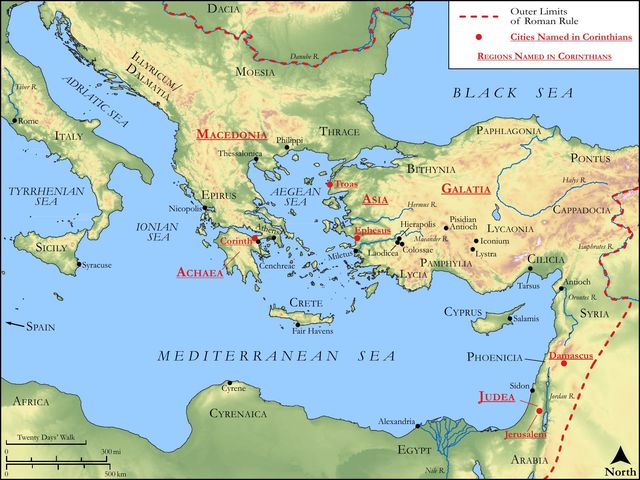
See on the biblical-era maps

Study this verse
Public-domain commentary
Matthew Henry
From his Commentary on the Whole Bible. Henry comments on passages, not single verses — this entry covers 1 Corinthians 10:1–5. His three-level outline is real structure in the source text, so it is rendered as structure.
In order to dissuade the Corinthians from communion with idolaters, and security in any sinful course, he sets before them the example of the Jews, the church under the Old Testament. They enjoyed great privileges, but, having been guilty of heinous provocations, they fell under very grievous punishments. In these verses he reckons up their privileges, which, in the main, were the same with ours.
I.He prefaces this discourse with a note of regard:
"Moreover, brethren, I would not that you should be ignorant. I would not have you without the knowledge of this matter; it is a thing worthy both of your knowledge and attention. It is a history very instructive and monitory." Judaism was Christianity under a veil, wrapt up in types and dark hints. The gospel was preached to them, in their legal rites and sacrifices. And the providence of God towards them, and what happened to them notwithstanding these privileges, may and ought to be warnings to us.
II.He specifies some of their privileges. He begins,
1.With their deliverance from Egypt: "Our fathers, that is, the ancestors of us Jews, were under the cloud, and all passed through the sea. They were all under the divine covering and conduct." The cloud served for both purposes: it sometimes contracted itself into a cloudy pillar, shining on one side to show them their way, dark on the other to hide them from their pursuing enemies; and sometimes spread itself over them as a mighty sheet, to defend them from the burning sun in the sandy desert, Psa 105:39. They were miraculously conducted through the Red Sea, where the pursuing Egyptians were drowned: it was a lane to them, but a grave to these: a proper type of our redemption by Christ, who saves us by conquering and destroying his enemies and ours. They were very dear to God, and much in his favour, when he would work such miracles for their deliverance, and take them so immediately under his guidance and protection.
2.They had sacraments like ours.
(1.)They were all baptized unto Moses in the cloud, and in the sea (Co1 10:2), or into Moses, that is, brought under obligation to Moses's law and covenant, as we are by baptism under the Christian law and covenant. It was to them a typical baptism.
(2.)They did all eat of the same spiritual meat, and drink of the same spiritual drink, that we do. The manna on which they fed was a type of Christ crucified, the bread which came down from heaven, which whoso eateth shall live forever. Their drink was a stream fetched from a rock which followed them in all their journeyings in the wilderness; and this rock was Christ, that is, in type and figure. He is the rock on which the Christian church is built; and of the streams that issue from him do all believers drink, and are refreshed. Now all the Jews did eat of this meat, and drink of this rock, called here a spiritual rock, because it typified spiritual things. These were great privileges. One would think that this should have saved them; that all who ate of that spiritual meat, and drank of that spiritual drink, should have been holy and acceptable to God. Yet was it otherwise: With many of them God was not well pleased; for they were overthrown in the wilderness, Co1 10:5. Note, Men may enjoy many and great spiritual privileges in this world, and yet come short of eternal life. Many of those who were baptized unto Moses in the cloud and sea, that is, had their faith of his divine commission confirmed by these miracles, were yet overthrown in the wilderness, and never saw the promised land. Let none presume upon their great privileges, or profession of the truth; these will not secure heavenly happiness, nor prevent judgments here on earth, except the root of the matter be in us.
Historical interpretation
Three Centuries of Reception
9 surviving comments on this verse. Each one is dated, so this reads as a timeline rather than a list.
Select a marker to jump to its quote. Markers stagger vertically where authors wrote within a few decades of each other.
) is come. Wherefore let him that thinketh he standeth, take heed lest he fall."
For the life of the Gnostic, in my view, is nothing but deeds and words corresponding to the tradition of the Lord. But "all have not knowledge. For I would not have you to be ignorant, brethren," says the apostle, "that all were under the cloud, and partook of spiritual meat and drink;" clearly affirming that all who heard the word did not take in the magnitude of knowledge in deed and word. Wherefore also he added: "But with all of them He was not well pleased."
That the Jews would not understand the Holy Scriptures, but that they would be intelligible in the last times, after that Christ had come. In Isaiah: "And all these words shall be unto you as the words of a book that is sealed, which, if you shall give to a man that knoweth letters to read, he shall say, I cannot read, for it is sealed. But in that day the deaf shall hear the words of the book, and they who are in darkness and in a cloud; the eyes of the blind shall see." Also in Jeremiah: "In the last of the days ye shall know those things." In Daniel, moreover: "Secure the words, and seal the book until the time of consummation, until many learn, and knowledge is fulfilled, because when there shall be a dispersion they shall know all these things." Likewise in the first Epistle of Paul to the Corinthians: "Brethren, I would not that ye should be ignorant, that all our fathers were under the cloud." Also in the second Epistle to the Corinthians: "Their minds are blinded even unto this day, by this same veil which is taken away in Christ, while this same veil remains in the reading of the Old Testament, which is not unveiled, because it is made void in Christ; and even to this day, if at any time Moses is read, the veil is upon their heart. But by and by, when they shall be turned unto the Lord, the veil shall be taken away." In the Gospel, the Lord after His resurrection says: "These are the words which I spake unto you while I was yet with you, that all things must be fulfilled which are written in the law of Moses, and in the prophets, and in the Psalms, concerning me. Then opened He their understanding, that they might understand the Scriptures; and said unto them, That thus it is written, and thus it behoved Christ to suffer, and to rise again from the dead the third day; and that repentance and remission of sins should be preached in His name even among all nations."
But if any one is moved by this, that some of those who are baptized in sickness are still tempted by unclean spirits, let him know that the obstinate wickedness of the devil prevails even up to the saving water, but that in baptism it loses all the poison of his wickedness. An instance of this we see in the king Pharaoh, who, having struggled long, and delayed in his perfidy, could resist and prevail until he came to the water; but when he had come thither, he was both conquered and destroyed. And that that sea was a sacrament of baptism, the blessed Apostle Paul declares, saying, "Brethren, I would not have you ignorant how that all our fathers were under the cloud, and all passed through the sea, and were all baptized unto Moses in the cloud and in the sea; "and he added, saying, "Now all these things were our examples." And this also is done in the present day, in that the devil is scourged, and burned, and tortured by exorcists, by the human voice, and by divine power; and although he often says. that he is going out, and will leave the men of God, yet in that which he says he deceives, and puts in practice what was before done by Pharaoh with the same obstinate and fraudulent deceit. When, however, they come to the water of salvation and to the sanctification of baptism, we ought to know and to trust that there the devil is beaten down, and the man, dedicated to God, is set free by the divine mercy. For as scorpions and serpents, which prevail on the dry ground, when cast into water, cannot prevail nor retain their venom; so also the wicked spirits, which are called scorpions and serpents, and yet are trodden under foot by us, by the power given by the Lord, cannot remain any longer in the body of a man in whom, baptized and sanctified, the Holy Spirit is beginning to dwell.
There Moses was sent by God into Egypt; here Christ was sent from the Father into the world. Moses’ mission was to lead out of Egypt a persecuted people; Christ’s was to rescue all the people of the world who were under the tyranny of sin. There the blood of a lamb was the charm against the destroyer; here, the blood of the unspotted Lamb, Jesus Christ, is appointed your inviolable sanctuary against demons.
Then he comes to other illustrations again. And as above he alleged the examples of the Apostles and those of common custom and those of the priests, and his own, so also here having set forth those of the Olympic games and those of his own course, he again proceeds to the histories of the Old Testament. And because what he has to say will be somewhat unpleasing he makes his exhortation general, and discourses not only concerning the subject before him, but also generally concerning all the evils among the Corinthians. And in the case of the heathen games, "Know ye not?" saith he: but here, "For I would not, brethren, have you ignorant."
Now this he said, implying that they were not very well instructed in these things.
"That our fathers," saith he, "were all under the cloud, and all passed through the sea; and were all baptized unto Moses in the cloud and in the sea; and did all eat the same spiritual meat; and did all drink the same spiritual drink; for they drank of a spiritual Rock that followed them: and the Rock was Christ. Howbeit with most of them God was not well pleased."
And wherefore saith he these things? To point out that as they were nothing profited by the enjoyment of so great a gift, so neither these by obtaining Baptism and partaking of spiritual Mysteries, except they go on and show forth a life worthy of this grace. Wherefore also he introduces the types both of Baptism and of the Mysteries.
But what is, "They were baptized into Moses?" Like as we, on our belief in Christ and His resurrection, are baptized, as being destined in our own persons to partake in the same mysteries; for, "we are baptized," saith he, "for the dead," i.e., for our own bodies; even so they putting confidence in Moses, i.e., having seen him cross first, ventured also themselves into the waters. But because he wishes to bring the Type near the Truth; he speaks it not thus, but uses the terms of the Truth even concerning the Type.
Further: this was a symbol of the Font, and that which follows, of the Holy Table. For as thou eatest the Lord's Body, so they the manna: and as thou drinkest the Blood, so they water from a rock. For though they were things of sense which were produced, yet were they spiritually exhibited, not according to the order of nature, but according to the gracious intention of the gift, and together with the body nourished also the soul, leading it unto faith. On this account, you see, touching the food he made no remark, for it was entirely different, not in mode only but in nature also; (for it was manna;) but respecting the drink, since the manner only of the supply was extraordinary and required proof, therefore having said that "they drank the same spiritual drink," he added, "for they drank of a spiritual Rock that followed them," and he subjoined, "and the Rock was Christ." For it was not the nature of the rock which sent forth the water, (such is his meaning,) else would it as well have gushed out before this time: but another sort of Rock, a spiritual One, performed the whole, even Christ who was every where with them and wrought all the wonders. For on this account he said, "that followed them."
Perceivest thou the wisdom of Paul, how in both cases he points out Him as the Giver, and thereby brings the Type nigh to the Truth? "For He who set those things before them," saith he, "the same also hath prepared this our Table: and the same Person both brought them through the sea and thee through Baptism; and before them set manna, but before thee His Body and Blood."
As touching His gift then, such is the case: now let us observe also what follows, and consider, whether when they showed themselves unworthy of the gift, He spared them. Nay, this thou canst not say. Wherefore also he added, "Howbeit with most of them God was not well-pleased;" although He had honored them with so great honor. Yea, it profited them nothing, but most of them perished. The truth is, they all perished, but that he might not seem to prophesy total destruction to these also, therefore he said, "most of them." And yet they were innumerable, but their number profited them nothing: and these were all so many tokens of love; but not even did this profit them, inasmuch as they did not themselves show forth the fruits of love.
Thus, since most men disbelieve the things said of hell, as not being present nor in sight; he alleges the things heretofore done as a proof that God doth punish all who sin, even though He have bestowed innumerable benefits upon them: "for if ye disbelieve the things to come," so he speaks, "yet surely the things that are past ye will not disbelieve." Consider, for example, how great benefits He bestowed on them: from Egypt and the slavery there He set them free, the sea He made their path, from heaven he brought down manna, from beneath He sent forth strange and marvellous fountains of waters; He was with them every where, doing wonders and fencing them in on every side: nevertheless since they showed forth nothing worthy of this gift, He spared them not, but destroyed them all.
The cloud is the grace of the Holy Spirit, while the sea represents baptism.
What took place, as the apostle says, was the mystery of baptism. Clearly this was a kind of baptism, where the cloud covered the people and water carried them. But the same Christ the Lord who did all these things now goes through baptism before the Christian people in the pillar of his body—he who at that time went through the sea before the children of Israel in the pillar of fire.… Through this faith—as was the case with the children of Israel—the one who walks calmly will not fear Egypt in pursuit.
Continue studying 1 Corinthians 10:1 across the web’s major study libraries — every link below opens this exact verse, chapter, or book on the destination site.
Read & Compare
 BibleGatewayThis verse in more than 200 translations and 70 languages.
 Bible.comThe YouVersion reader — hundreds of translations, reading plans, and highlights.
 ESV.orgCrossway's official English Standard Version reader.
 NET BibleThe NET translation with 60,000+ translators' notes on every rendering decision.
 STEP BibleTyndale House's free study tool — original text, vocabulary, and scholarly resources.
 BibliaLogos Bible Software's free web reader.
 USCCBThe New American Bible (Revised Edition) with the U.S. bishops' study notes.
Commentaries
 BibleHub CommentariesDozens of classic commentaries on this verse, gathered on one page.
 StudyLightMore than 100 commentary sets — the largest collection on the web.
 BibleRefPlain-English commentary on what this verse means, verse by verse.
 Enduring WordDavid Guzik's free commentary on this chapter, widely used by Bible teachers.
 Bible Study ToolsVerse commentary alongside Greek and Hebrew study aids.
Original Language & Research
- BibleHub InterlinearThe verse word by word — original language, transliteration, and English.
- BibleHub LexiconEvery word's original-language definition and Strong's entry.
 Blue Letter BibleDeep-study tools — Strong's numbers, concordance, and word studies.
 CNTR CollationThe earliest Greek manuscripts of this verse, collated letter by letter.
Sermons, Hymns & Audio


TrulyRandomVerse is not affiliated with these sites and doesn’t control their content. They’re linked because they’re genuinely useful.
Summary
In 1 Corinthians 10:1, the Apostle Paul initiates a critical segment of his letter by drawing profound spiritual lessons from the historical experiences of ancient Israel. He directly addresses the Corinthian believers, employing a characteristic Pauline idiom to underscore the gravity and corrective nature of the instruction that follows. This verse serves as a foundational premise, establishing that the Israelites, despite experiencing miraculous divine presence and deliverance through the cloud and the Red Sea, are a cautionary example for the Corinthians regarding the dangers of spiritual complacency and idolatry.
Context
ShowHideLiterary Context
This verse marks a pivotal transition in Paul's letter, building directly upon his preceding arguments concerning Christian liberty and the potential pitfalls of participating in pagan practices, particularly eating meat sacrificed to idols, as discussed in 1 Corinthians 8 and 1 Corinthians 9. Having asserted his own self-denial for the sake of the gospel in 1 Corinthians 9:19-27, Paul now shifts from personal example to a collective historical warning. He uses the Exodus narrative as a powerful theological analogy, demonstrating that even those who enjoyed profound spiritual privileges could still fall into grievous sin and incur divine judgment. The "all our fathers" phrase connects the Corinthian believers—both Jewish and Gentile—to a shared spiritual ancestry, making the lessons of Israel's past directly applicable to their present circumstances.
Historical & Cultural Context
The historical backdrop for Paul's argument is the Exodus and the subsequent forty years of Israel's wilderness wanderings, as detailed primarily in the books of Exodus, Numbers, and Deuteronomy. The "cloud" refers to the pillar of cloud by day and fire by night, which symbolized God's manifest presence, guidance, and protection for Israel (Exodus 13:21-22). Their passing "through the sea" unequivocally points to the miraculous Red Sea crossing, a foundational event of salvation and liberation from Egyptian bondage. For the Corinthian church, steeped in a Greco-Roman culture with prevalent idolatry, temple prostitution, and philosophical pride, Paul's reference to Israel's failures served as a stark reminder that spiritual privilege does not equate to automatic preservation from sin or judgment.
Key Themes
ShowHideThe verse introduces several critical themes that Paul develops throughout 1 Corinthians 10. Firstly, it highlights Divine Guidance and Protection, symbolized by the cloud, emphasizing God's active presence with His people. Secondly, it underscores Miraculous Deliverance, exemplified by the Red Sea crossing, showcasing God's saving power. Most importantly, the verse lays the groundwork for the theme that Spiritual Privileges Do Not Guarantee Perseverance. Despite experiencing God's visible presence and miraculous salvation, the Israelites still rebelled, demonstrating that external blessings do not negate the need for internal faithfulness. This leads to the overarching theme of Warning Against Spiritual Complacency and Idolatry, urging the Corinthians not to be "ignorant" of these historical lessons, but to learn from them to avoid similar failures in their own walk of faith.
Exposition and Analysis
ShowHideKey Word Analysis
ShowHideThis word (G50) means "not to know (through lack of information or intelligence); by implication, to ignore (through disinclination)." Paul's use of this term here, in the phrase "I would not that ye should be ignorant," is a strong apostolic idiom. It indicates that the truth he is about to impart is crucial and that any unawareness or disregard of it would be detrimental, often implying a willful blindness or a dangerous oversight rather than a mere lack of information.
This term (G3507) refers to a "cloud" or "cloudiness." In the context of the Old Testament, particularly the Exodus narrative, the cloud was a visible manifestation of God's presence (the Shekinah glory), providing guidance, protection, and sustenance to the Israelites in the wilderness. Its presence signified God's direct, tangible involvement in their journey and His covenantal faithfulness.
This verb (G1330), formed from diá (through) and érchomai (to come/go), means "to traverse (literally)" or "to go through/throughout." Here, it vividly describes the Israelites' miraculous passage through the Red Sea, an event that was not merely a crossing but a profound act of divine intervention, separating them from their oppressors and initiating their journey as God's redeemed people.
Verse Breakdown
ShowHide"Moreover, brethren, I would not that ye should be ignorant,"
Paul begins with a transitional particle ("Moreover," G1161, dé) and a direct address to his audience as "brethren" (G80, adelphós), establishing a tone of familial concern. The phrase "I would not that ye should be ignorant" (G2309 thélō with G3756 ou and G50 agnoéō) is a common Pauline expression (e.g., Romans 1:13, 1 Thessalonians 4:13) used to introduce a vital truth that the readers must understand to avoid spiritual error or complacency. It implies that the Corinthians are either unaware or are choosing to ignore a crucial lesson.
"how that all our fathers were under the cloud,"
Paul immediately introduces the historical example of "all our fathers" (G3956 pâs and G3962 patḗr), referring to the Israelites in the wilderness. The phrase "under the cloud" (G5259 hypó and G3507 nephélē) signifies their complete envelopment and guidance by God's visible presence. This cloud not only led them but also symbolized God's protection and provision, marking them as His chosen people who experienced His direct oversight and care.
"and all passed through the sea;"
This clause details the second major historical event: the miraculous crossing of the Red Sea (G2281 thálassa). The repetition of "all" (G3956 pâs) emphasizes the universality of this experience among the Israelites. Their passage "through the sea" (G1223 diá and G2281 thálassa) was a pivotal moment of salvation, separating them from slavery and initiating their journey towards the Promised Land. These two events—the cloud and the sea—represent foundational experiences of divine intervention and covenantal relationship for the people of Israel.
Literary Devices
ShowHidePaul masterfully employs Allusion in this verse, referencing the well-known narratives of the Exodus and wilderness wanderings from the Old Testament. This serves as a powerful shorthand, immediately bringing to mind a rich tapestry of divine intervention, covenant, and human failure. Furthermore, the passage functions as a Typology or Analogy, where the historical experiences of Israel (the "fathers") serve as a "type" or pattern for the Corinthian believers. The cloud and the sea are presented not merely as historical facts but as spiritual parallels to the Corinthians' own experiences of salvation and spiritual privilege. Paul's opening phrase, "I would not that ye should be ignorant," establishes a strong Didactic Tone and an Apostolic Warning, signaling that the subsequent historical examples are not for mere information but for urgent instruction and correction, aimed at preventing similar spiritual failures within the Corinthian church.
Theological and Thematic Connections
ShowHidePaul's opening in 1 Corinthians 10:1 establishes a profound theological principle: divine privilege does not guarantee spiritual perseverance. The Israelites, despite experiencing God's manifest presence and miraculous deliverance—events that were undeniably supernatural and indicative of a special covenantal relationship—still succumbed to sin and rebellion. This serves as a timeless warning that spiritual blessings, while glorious, do not exempt believers from the need for vigilance, humility, and continued obedience. God's faithfulness to His promises does not negate human responsibility to respond in faith and obedience. The historical account of Israel's journey from Egypt to the wilderness, marked by both divine provision and human failure, becomes a powerful object lesson for all who claim to be God's people, emphasizing that a genuine relationship with God requires more than just external experiences; it demands an internal transformation and steadfast commitment.
Reflection and Application
ShowHide1 Corinthians 10:1 serves as a potent reminder that our spiritual heritage and the abundant blessings we receive from God are not a shield against temptation or a guarantee of perseverance. Just as the Israelites were under God's visible presence and experienced miraculous deliverance from slavery, believers today are under the new covenant, indwelt and guided by the Holy Spirit, and have experienced ultimate salvation through Christ. This verse compels us to critically examine our own spiritual walk, guarding against any sense of spiritual arrogance or complacency. We must learn from the historical failures of others, understanding that a privileged position does not equate to automatic spiritual security. True faith demands ongoing vigilance, humility, and active obedience, ensuring that we do not take God's grace for granted but rather walk in a manner worthy of the calling we have received.
Questions for Reflection
ShowHideFAQ
ShowHideWhat is the significance of Paul's statement, "I would not that ye should be ignorant"?
ShowHideThis phrase (Greek: ou thelō hymas agnoein) is a common Pauline idiom used to introduce a critically important truth or a warning that the recipients must not overlook or misunderstand. It implies that there is a risk of the Corinthians being unaware, or perhaps willfully ignorant, of a vital spiritual principle. Paul uses it to arrest their attention and emphasize the gravity of the historical lessons he is about to present, ensuring they grasp the profound implications for their own conduct and spiritual well-being. It's a call to spiritual awareness and discernment.
Why does Paul use the historical examples of the cloud and the Red Sea crossing?
ShowHidePaul uses these two iconic events from Israel's history—being "under the cloud" and passing "through the sea"—because they represent the quintessential experiences of God's manifest presence, guidance, and miraculous salvation for His people. For the Israelites, these were undeniable signs of God's covenantal relationship with them, akin to spiritual privileges. By highlighting these, Paul sets up a powerful contrast: despite having such profound spiritual advantages, the Israelites still fell into sin and incurred God's judgment. This serves as a direct parallel and warning to the Corinthians, who also possessed significant spiritual privileges (e.g., baptism, the Lord's Supper, spiritual gifts) but were in danger of spiritual failure due to their involvement with idolatry and moral laxity, as discussed in 1 Corinthians 10:6-10.
Christ-Centered Fulfillment
ShowHideWhile 1 Corinthians 10:1 recounts Old Testament history, Paul immediately pivots in subsequent verses to show how these events were types or foreshadowings that find their ultimate fulfillment in Christ and the New Covenant. The "cloud" that guided Israel prefigures the indwelling presence of the Holy Spirit, whom Christ promised to send as our guide and comforter (John 14:16-17). The miraculous passage "through the sea," a deliverance from bondage and a symbolic new beginning, is explicitly linked by Paul to Christian baptism in 1 Corinthians 10:2, which unites believers with Christ's death and resurrection, freeing them from the bondage of sin and initiating them into a new life in Him (Romans 6:3-4). Furthermore, the spiritual food and drink the Israelites received in the wilderness (1 Corinthians 10:3-4) are identified by Paul as pointing to Christ Himself, the true "spiritual Rock" and the living bread from heaven (John 6:35) who gives eternal life. Thus, Israel's experiences, though historical, serve as a profound testament to God's redemptive plan, all culminating in the person and work of Jesus Christ, who is the ultimate fulfillment of God's presence, deliverance, and provision for His people.