


Old Testament · The Law · Book 5 of 66
Deuteronomy
Moses’ last addresses to Israel on the plains of Moab, retelling the forty years, giving the law again for the land, and renewing the covenant before he dies.
- 34 chapters
- 959 verses
- About 2.2 hours to read
- The Wilderness Years, c. 1446–1406 BC
Deuteronomy is Moses speaking, almost from first to last. “These be the words which Moses spake unto all Israel on this side Jordan” (1:1), in the fortieth year, to a generation that had grown up in the wilderness after their fathers died there. He retells the road from Horeb, gives the law again for life in the land, sets blessing and curse before them, and dies in sight of a land he may not enter. The covenant is the one made at Horeb, but he presses it on them as their own: “The LORD made not this covenant with our fathers, but with us, even us, who are all of us here alive this day” (5:3).
Watch for the words he repeats: hear, remember, love, this day. The law is to be in the heart before it is kept in the land (6:6). Moses also knows this people’s heart. He foretells their turning away and the curse that will follow, and promises that the LORD will circumcise their heart (30:6). When Christ was tempted in the wilderness, he answered three times from this book (Matthew 4:1–11).
And thou shalt love the LORD thy God with all thine heart, and with all thy soul, and with all thy might.
Deuteronomy 6:5 KJV
Before you read
- Who wrote it
- Moses, who “wrote this law” and gave it to the priests (31:9); Christ cites it as his (Mark 10:3–5). The account of his death (34:5–12) was added afterwards, traditionally by Joshua, who “wrote these words in the book of the law of God” (Joshua 24:26).
How Deuteronomy is laid out
8 movements · 148 passages · 959 verses
From Horeb to the Jordan
Chapters 1–3 · 112 verses
In the fortieth year Moses retells the road from Horeb: the judges appointed to share his load, the refusal to go up at Kadesh-barnea, and the thirty-eight years until that generation died. Esau’s children in Seir, Moab and Ammon are passed by; Sihon and Og are defeated and their land given to Reuben, Gad and half Manasseh. Moses asks to cross and is refused.
13 passages
- 1:1–5 Setting the Stage for Moses' Address
- 1:6–8 The Command to Leave Horeb
- 1:9–18 Moses Appoints Leaders and Judges
- 1:19–46 The Sinful Failure at Kadesh-barnea
- 2:1–8 The Long Circuit Around Mount Seir
- 2:9–12 Prohibition Against Attacking Moab
- 2:13–17 The End of the Wilderness Generation
- 2:18–23 Prohibition Against Attacking Ammon
- 2:24–37 Command to Conquer Sihon the Amorite
- 3:1–11 The Defeat of Og, King of Bashan
- 3:12–17 Allocation of the Transjordan Territory
- 3:18–22 Moses Charges the Tribes and Joshua
- 3:23–29 Moses’ Final Plea and Succession
Take heed, and forget not
4:1–43 · 43 verses
At Horeb Israel heard the LORD’s voice out of the fire but saw no form, so they must make no image. If they turn to idols they will be scattered among the nations, yet from there they will find him if they seek him with all their heart. No other nation has God so near. Three cities of refuge are set apart east of Jordan.
The ten commandments and the Shema
4:44–6:25 · 64 verses
The law Moses set before Israel begins with the covenant at Horeb, made “with us,” and the ten commandments given again. The people, afraid of the fire, ask Moses to hear for them, and the LORD approves. Then comes the Shema: the LORD is one, to be loved with all the heart, his words taught to children, bound on the hand and written on the gates.
9 passages
- 4:44–49 Summary of the Law's Setting
- 5:1–5 Moses Recounts the Horeb Covenant
- 5:6–22 The Ten Commandments Recited
- 5:23–28 Israel Requests Moses to Mediate
- 5:29–33 God Commends Israel's Intent
- 6:1–3 Purpose of the Commandments
- 6:4–9 The Shema
- 6:10–19 Warnings Against Forgetfulness
- 6:20–25 Teaching the Next Generation
Not for thy righteousness
Chapters 7–11 · 129 verses
Israel is to destroy the nations of Canaan and their altars, and make no covenant or marriage with them. The LORD chose Israel because he loved them, and gives the land for the nations’ wickedness, not Israel’s righteousness. The manna taught that man lives by every word of the LORD. The golden calf is retold, the tablets renewed, and blessing and curse set before them.
The place the LORD will choose
12:1–16:17 · 119 verses
Israel is to destroy every place where the nations served their gods and bring offerings only to the place the LORD will choose for his name. A prophet or kinsman who entices to other gods must die. Then come clean and unclean food, tithes, the year of release for debts and Hebrew servants, and the three feasts at which every male appears before the LORD.
Judges, kings, prophets and neighbours
16:18–26:19 · 226 verses
Judges must not wrest judgment; a king must not multiply horses, wives or gold, and must copy the law and read it. The LORD will raise up a prophet like Moses. Laws follow for refuge, witnesses, war, family, the poor, the stranger and the debtor. Firstfruits are brought with a confession of the exodus, and Israel avouches the LORD to be its God.
11 chapters
- 16 The Passover and Feast of Unleavened Bread
- 17 Blemished Offerings and the Punishment for Idolatry
- 18 Provision for Priests and Levites
- 19 The Law of Cities of Refuge
- 20 Preparation and Divine Assurance in War
- 21 Atonement for Unsolved Murder
- 22 Responsibility for Lost Property
- 23 Exclusions from the Assembly
- 24 Divorce, Remarriage, and the Newly Married
- 25 Judicial Justice and Humane Punishment
- 26 The Offering of Firstfruits
Blessing and curse, life and death
Chapters 27–30 · 143 verses
Once over Jordan, Israel is to write the law on plastered stones at Mount Ebal, and the Levites pronounce twelve curses, each answered “Amen.” Chapter 28 sets the blessings of obedience against the far longer curses, ending in siege and scattering. The covenant is made again in Moab. Moses foretells exile and return, promises that the LORD will circumcise their heart, and calls them to choose life.
17 passages
- 27:1–8 Command to Write the Law on Stones
- 27:9–10 Israel Enters the Covenant Relationship
- 27:11–14 Instructions for the Blessing and Cursing
- 27:15–26 The Curses Declared
- 28:1–14 The Blessings of Obedience
- 28:15–24 The Curses for Disobedience
- 28:25–37 Defeat, Disease, and Humiliation
- 28:38–48 Economic Ruin and Foreign Domination
- 28:49–57 The Horror of Siege Warfare
- 28:58–68 Ultimate Plagues and Global Exile
- 29:1–9 The Covenant in Moab
- 29:10–15 All Israel Enters the Covenant
- 29:16–21 Warning Against Apostasy and Secret Sin
- 29:22–29 Desolation of the Land and the Secret Things of God
- 30:1–10 The Promise of Restoration and Return
- 30:11–14 The Accessibility of God's Commandment
- 30:15–20 Choose Life
The song, the blessing, the death
Chapters 31–34 · 123 verses
Moses, a hundred and twenty, charges Joshua to be strong and of a good courage, writes the law, and orders it read every seventh year. The LORD foretells Israel’s turning away, and Moses teaches them a song to witness against them. He blesses the tribes, views the land from Pisgah, and dies in Moab. No prophet since has been like him.
18 passages
- 31:1–8 Moses Encourages Israel and Names Successor
- 31:9–13 The Reading of the Law Commanded
- 31:14–23 God Charges Joshua and Prophesies Apostasy
- 31:24–30 The Law Written and Stored
- 32:1–4 Invocation and Introduction to the Song
- 32:5–14 Israel’s Corruption and Ingratitude
- 32:15–18 Jeshurun Rebels Against the Rock
- 32:19–25 God Declares Judgment
- 32:26–33 God’s Mercy and the Enemy’s Folly
- 32:34–43 The Lord’s Vengeance and Sovereignty
- 32:44–47 Exhortation and Moses’ Final Charge
- 32:48–52 The Lord Instructs Moses to Die
- 33:1–5 Moses' Final Blessing and Doxology
- 33:6–25 Blessings for the Tribes
- 33:26–29 The Uniqueness of Israel's God
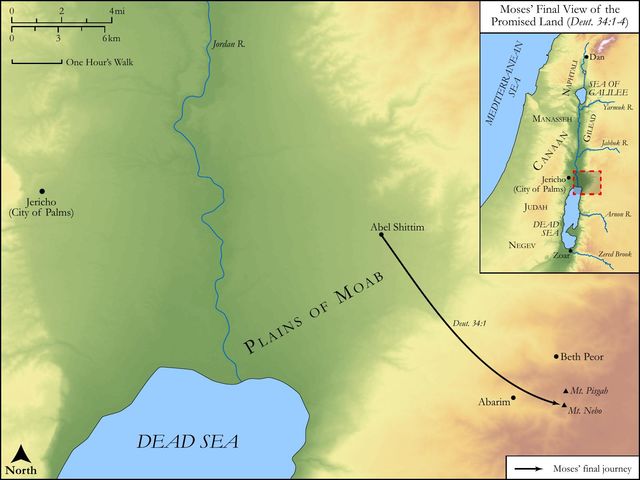
- 34:1–4 Moses Views the Promised Land
- 34:5–8 The Death and Burial of Moses
- 34:9–12 The Legacy of Moses
The words Deuteronomy turns on
Israel is to hear and remember, and to love with all the heart; the LORD chooses his people and his place, and gives the land to possess.
What Deuteronomy teaches
shâmaʻ · hear
Hear, O Israel
At Horeb Israel “heard the voice of the words, but saw no similitude” (4:12), and that is the ground of the ban on images: the LORD made himself known by speaking. The people, afraid of the fire, asked Moses to hear for them and promised, “we will hear it, and do it,” and the LORD answered, “they have well said” (5:27–28). So the Shema begins, “Hear, O Israel: The LORD our God is one LORD” (6:4). Ambrose noticed the verb: It did not say ‘speak’ but ‘hear.’
In this book to hear is to obey, and the same verb carries every condition of the covenant: “if thou shalt hearken diligently unto the voice of the LORD thy God” (28:1).
zâkar · remember
Remember the way
Against the danger of plenty Moses sets memory: “thou shalt remember all the way which the LORD thy God led thee these forty years in the wilderness, to humble thee, and to prove thee” (8:2). The manna was given “that he might make thee know that man doth not live by bread only, but by every word that proceedeth out of the mouth of the LORD” (8:3). In the land Israel will eat and be full, so Moses warns, “beware lest thou forget the LORD, which brought thee forth out of the land of Egypt” (6:12). Memory also shapes the law. The sabbath rest of servants (5:15), the release of the Hebrew bondman (15:15) and the gleanings left for the widow (24:19–22) all rest on one remembrance: “thou wast a bondman in Egypt” (24:18).
ʼâhab · love
Chosen in love
The command to love the LORD “with all thine heart” (6:5) answers a love that came first: “The LORD did not set his love upon you, nor choose you, because ye were more in number than any people … But because the LORD loved you” (7:7–8). Nor is the land a wage. Moses tells them that “the LORD thy God giveth thee not this good land to possess it for thy righteousness; for thou art a stiffnecked people” (9:6). The nations are driven out “for the wickedness of these nations” (9:5), so the conquest is the LORD’s judgment on Canaan and the keeping of his oath to Abraham, Isaac and Jacob. The God who brought Israel out of Egypt “loveth the stranger,” and so must they: “Love ye therefore the stranger: for ye were strangers in the land of Egypt” (10:18–19).
bâchar · choose
Life set before you
The LORD chooses first. He chose Israel to be “a special people unto himself” (7:6), and he will choose the place where he puts his name (12:5). At the end Moses turns the word on the people: “I have set before you life and death, blessing and cursing: therefore choose life” (30:19). He is plain about their heart: “the LORD hath not given you an heart to perceive, and eyes to see, and ears to hear, unto this day” (29:4), and “after my death ye will utterly corrupt yourselves” (31:29). So the book that commands, “Circumcise therefore the foreskin of your heart” (10:16), also promises, “the LORD thy God will circumcise thine heart” (30:6). Paul calls this the true circumcision: “circumcision is that of the heart, in the spirit” (Romans 2:29).
Christ in Deuteronomy
Christ answered the tempter from this book. Israel was proved forty years in the wilderness and rebelled (9:7); Jesus, proved forty days there, did not. To each temptation he replied with Deuteronomy: “It is written, Man shall not live by bread alone, but by every word that proceedeth out of the mouth of God” (Matthew 4:4), and then with 6:16 and 6:13. Asked for the first commandment, he gave the Shema (Mark 12:29–30).
Moses promised another like himself: “The LORD thy God will raise up unto thee a Prophet from the midst of thee, of thy brethren, like unto me; unto him ye shall hearken” (18:15). The book closes still waiting, for “there arose not a prophet since in Israel like unto Moses” (34:10). Peter names Jesus as that prophet (Acts 3:22–26), and the Father’s voice at the transfiguration gives the same charge: “hear ye him” (Matthew 17:5). The law also says “he that is hanged is accursed of God” (21:23), and Paul reads it of the cross: Christ redeemed us from the curse of the law, “being made a curse for us” (Galatians 3:13).
People
By how many verses name them
- MosesSon of Amram and Jochebed; a brother of Aaron and Miriam; husband of Zipporah35
- Sihon11
- Og10
- JoshuaA son of Nun9
- AbrahamSon of Terah; a brother of Nahor, Haran and Sarah7
- IsaacA son of Abraham and Sarah7
- JacobSon of Isaac and Rebekah; a brother of Esau7
- Pharaoh7
24 more are named.
Places
85 named
- Egypt47
- JordanThe river Moses may not cross; Joshua leads Israel over26
- BashanOg’s kingdom, taken and given to the half tribe of Manasseh12
- MoabThe land where Moses speaks the book, dies and is buried10
- HorebWhere the covenant was made and the ten commandments given9
- Gilead8
- HeshbonSihon’s city, taken when he refused Israel passage8
- Seir7
Where Deuteronomy reaches
The passages it leans on, and the ones that lean on it
Deuteronomy 5:6–21 Exodus 20:2–17
The ten commandments spoken again; here the sabbath rests on the exodus, in Exodus on creation.
Deuteronomy 6:4–5 Mark 12:29–30
The Shema, which Christ named the first of all the commandments.
Deuteronomy 18:15 Acts 3:22–23
The prophet like Moses, whom Peter preaches as Jesus.
Deuteronomy 31:6 Joshua 1:9 Hebrews 13:5
“Be strong and of a good courage”: Moses’ charge, repeated by the LORD to Joshua; Hebrews gives its promise to every believer.
Deuteronomy 32:21 Romans 10:19
The Song’s warning that Israel will be provoked by “a foolish nation”; Paul applies it to the Gentiles’ faith.
Books Deuteronomy links to most
The Church Fathers on Deuteronomy
199 quotations from 41 writers before AD 800 · the ten most quoted, in date order
- Clement215
- Origen253
- Basil379
- Gregory395
- Ambrose397
- Chrysostom407
- Jerome420
- Augustine430
- Caesarius542
- Paterius606
Origen on the book’s name, and on Joshua as a figure of the Savior.
This indeed is why it is called Deuteronomy, meaning the second law. … And Joshua is certainly believed to be a figure of our Savior, by whose second law, that is, by the precepts of the Gospels, all things are brought to perfection.
Clement read the manna lesson of 8:3 as pointing to the Word himself.
“It is not by bread alone that the just man lives, but by the Word of the Lord,” who is the true bread, the bread of heaven.
Augustine on 13:3, where the LORD proves Israel by a false prophet’s sign.
You see, there is a temptation that leads to sin, and in that way God tempts no one. Then there is a temptation or testing that proves the quality of faith, and that way even God is prepared to tempt people.
Basil on the Song’s “I wound, and I heal.”
He himself permits the suffering which he again restores. The One who strikes is the One who heals. The afflictions precede in order that the graces may be lasting. Only then do we exert ourselves exceedingly for the preservation of what has been given.
Keep studying
Articles