


Deuteronomy 34:10
Bible text: King James Version (1769 Blayney text) · Public domain
Bible text: Berean Standard Bible · Public domain
Bible text: American Standard Version (1901) · Public domain
Bible text: World English Bible, Messianic edition · Public domain
Bible text: Geneva Bible (1599) · Public domain
Bible text: Young's Literal Translation · Public domain
- וְלֹאve·lo'and notH3808Conj-w ¦ NegParticle Negativeוְandלֹאnot
- קָםkamhe has arisenH6965V-Qal-Perf-3msVerb Qal Perfect 3rd Singular Masculine
- נָבִיאna·Vi'a prophetH5030N-msNoun Singular Masculine Absolute
- עוֹדodagainH5750Adj-msAdjective Numerical Singular Masculine Absolute
- בְּיִשְׂרָאֵלbe·Yis·ra·'Elin IsraelH3478Prep-b ¦ N-properNoun Proper LocationבְּinיִשְׂרָאֵלIsrael
- כְּמֹשֶׁהke·mo·Shehlike MosesH4872Prep-k ¦ N-proper-mNoun Proper MasculineכְּlikeמֹשֶׁהMoses
- אֲשֶׁר'a·SherwhomH834RelParticle Relative
- יְדָעוֹye·da·'Ohe knew himH3045V-Qal-Perf-3ms ¦ 3msVerb Qal Perfect 3rd Singular Masculineיְדָעhe knewוֹhim
- יְהוָהYah·wehYahwehH3068N-properNoun Proper Title
- פָּנִיםpa·NimfaceH6440N-mpNoun Plural Masculine Absolute
- אֶל'eltoH413PrepPreposition
- פָּנִיםpa·NimfaceH6440N-mpNoun Plural Masculine Absolute
English is a literal word-by-word gloss of the Hebrew, not the KJV's wording. Why?
This is the original text the KJV's translators worked from — each Hebrew word with its own literal English meaning in this verse, prepared by scholars at Tyndale House, Cambridge. The KJV translates whole sentences, not word by word, so its wording differs: one Hebrew word can become several English words, and the KJV may choose “the LORD” where the gloss reads “Yahweh”. Both are faithful — they answer different questions. For the KJV's own rendering, switch to the KJV text.
Details
See on the biblical-era map
Study this verse
Public-domain commentary
Matthew Henry
From his Commentary on the Whole Bible. Henry comments on passages, not single verses — this entry covers Deuteronomy 34:9–12. His two-level outline is real structure in the source text, so it is rendered as structure.
We have here a very honourable encomium passed both on Moses and Joshua; each has his praise, and should have. It is ungrateful so to magnify our living friends as to forget the merits of those that are gone, to whose memories there is a debt of honour due: all the respect must not be paid to the rising sun; and, on the other hand, it is unjust so to cry up the merits of those that are gone as to despise the benefit we have in those that survive and succeed them. Let God be glorified in both, as here.
I.Joshua is praised as a man admirably qualified for the work to which he was called, v.
9. Moses brought Israel to the borders of Canaan and then died and left them, to signify that the law made nothing perfect, Heb 7:19. It brings men into a wilderness of conviction, but not into the Canaan of rest and settled peace. It is an honour reserved for Joshua (our Lord Jesus, of whom Joshua was a type) to do that for us which the law could not do, in that it was weak through the flesh, Rom 8:3. Through him we enter into rest, the spiritual rest of conscience and eternal rest in heaven. Three things concurred to clear Joshua's call to this great undertaking: - 1. God fitted him for it: He was full of the spirit of wisdom; and so he had need who had such a peevish people to rule, and such a politic people to conquer. conduct is as requisite in a general as courage. Herein Joshua was a type of Christ, in whom are hidden the treasures of wisdom. 2. Moses, by the divine appointment, had ordained him to it: He had laid his hands upon him, so substituting him to be his successor, and praying to God to qualify him for the service to which he had called him; and this comes in as a reason why God gave him a more than ordinary spirit of wisdom, because his designation to the government was God's own act (those whom God employs he will in some measure make fit for the employment) and because this was the thing that Moses had asked of God for him when he laid his hands on him. When the bodily presence of Christ withdrew from his church, he prayed the Father to send another Comforter, and obtained what he prayed for. 3. The people cheerfully owned him and submitted to him. Note, An interest in the affections of people is a great advantage, and a great encouragement to those that are called to public trusts of what kind soever. It was also a great mercy to the people that when Moses was dead they were not as sheep having no shepherd, but had one ready among them in whom they did unanimously, and might with the highest satisfaction, acquiesce.
II.Moses is praised (Deu 34:10-12), and with good reason.
1.He was indeed a very great man, especially upon two accounts: - (1.) His intimacy with the God of nature: God knew him face to face, and so he knew God. See Num 12:8. He saw more of the glory of God than any (at least of the Old Testament saints) ever did. He had more free and frequent access to God, and was spoken to not in dreams, and visions, and slumberings on the bed, but when he was awake and standing before the cherubim. Other prophets, when God appeared and spoke to them, were struck with terror (Dan 10:7), but Moses, whenever he received a divine revelation, preserved his tranquillity. (2.) His interest and power in the kingdom of nature. The miracles of judgment he wrought in Egypt before Pharaoh, and the miracles of mercy he wrought in the wilderness before Israel, served to demonstrate that he was a particular favourite of Heaven, and had an extra-ordinary commission to act as he did on this earth. Never was there any man whom Israel had more reason to love, or whom the enemies of Israel had more reason to fear. Observe, The historian calls the miracles Moses wrought signs and wonders, done with a mighty hand and great terror, which may refer to the terrors of Mount Sinai, by which God fully ratified Moses's commission and demonstrated it beyond exception to be divine, and this in the sight of all Israel.
2.He was greater than any other of the prophets of the Old Testament. Though they were men of great interest in heaven and great influence upon earth, yet they were none of them to be compared with this great man; none of them either so evidenced or executed a commission from heaven as Moses did. This encomium of Moses seems to have been written long after his death, yet then there had not arisen any prophet like unto Moses, nor did there arise any such between that period and the sealing up of the vision and prophecy. by Moses God gave the law, and moulded and formed the Jewish church; by the other prophets he only sent particular reproofs, directions, and predictions. The last of the prophets concludes with a charge to remember the law of Moses, Mal 4:4. Christ himself often appealed to the writings of Moses, and vouched him for a witness, as one that saw his day at a distance and spoke of him. But, as far as the other prophets came short of him, our Lord Jesus went beyond him. His doctrine was more excellent, his miracles were more illustrious, and his communion with his Father was more intimate, for he had lain in his bosom from eternity, and by him God does now in these last days speak to us. Moses was faithful as a servant, but Christ as a Son. The history of Moses leaves him buried in the plains of Moab, and concludes with the period of his government; but the history of our Saviour leaves him sitting at the right hand of the Majesty on high, and we are assured that of the increase of his government and peace there shall be no end. The apostle, in his epistle to the Hebrews, largely proves the pre-eminence of Christ above Moses, as a good reason why we that are Christians should be obedient, faithful, and constant, to that holy religion which we make profession of. God, by his grace, make us all so!
Continue studying Deuteronomy 34:10 across the web’s major study libraries — every link below opens this exact verse, chapter, or book on the destination site.
Read & Compare
 BibleGatewayThis verse in more than 200 translations and 70 languages.
 Bible.comThe YouVersion reader — hundreds of translations, reading plans, and highlights.
 ESV.orgCrossway's official English Standard Version reader.
 NET BibleThe NET translation with 60,000+ translators' notes on every rendering decision.
 STEP BibleTyndale House's free study tool — original text, vocabulary, and scholarly resources.
 BibliaLogos Bible Software's free web reader.
 USCCBThe New American Bible (Revised Edition) with the U.S. bishops' study notes.
Commentaries
 BibleHub CommentariesDozens of classic commentaries on this verse, gathered on one page.
 StudyLightMore than 100 commentary sets — the largest collection on the web.
 BibleRefPlain-English commentary on what this verse means, verse by verse.
 Enduring WordDavid Guzik's free commentary on this chapter, widely used by Bible teachers.
 Bible Study ToolsVerse commentary alongside Greek and Hebrew study aids.
Original Language & Research
- BibleHub InterlinearThe verse word by word — original language, transliteration, and English.
- BibleHub LexiconEvery word's original-language definition and Strong's entry.
 Blue Letter BibleDeep-study tools — Strong's numbers, concordance, and word studies.
 SefariaThe Hebrew text with Rashi and centuries of Jewish commentary.
Sermons, Hymns & Audio


TrulyRandomVerse is not affiliated with these sites and doesn’t control their content. They’re linked because they’re genuinely useful.
Summary
Deuteronomy 34:10 serves as a profound epitaph for Moses, concluding the Book of Deuteronomy and the entire Pentateuch. It unequivocally declares his unparalleled status among all prophets in Israel, primarily attributing this distinction to his extraordinary and intimate communion with the LORD, described as knowing Him "face to face." This verse not only memorializes Moses' unique legacy but also sets a benchmark for prophetic revelation within Israel's history, highlighting a relationship with God unmatched by any who followed him in the Old Covenant era.
Context
ShowHideLiterary Context
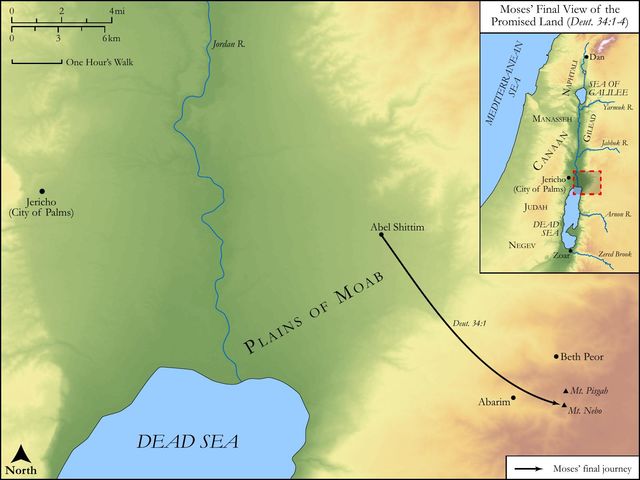
This verse functions as the climactic statement in the closing passage of the Book of Deuteronomy (34:9–12) and, indeed, of the entire Torah (Pentateuch). It immediately follows the account of Moses' death and burial in the land of Moab, just across the Jordan from the Promised Land, with the Israelites poised to enter under Joshua's leadership. The preceding verses detail Moses' final ascent to Mount Nebo, his view of the promised land, and his subsequent death at the LORD's command (Deuteronomy 34:1-6). The verses following verse 10 describe Joshua's anointing and the continued obedience of the Israelites to Moses' commands, reinforcing the enduring authority of the Law given through him. Thus, Deuteronomy 34:10 functions as a retrospective theological summary of Moses' unparalleled life and ministry, providing a definitive statement on his unique prophetic office before the narrative transitions to the next era of Israel's history.
Historical & Cultural Context
The Book of Deuteronomy is presented as Moses' final sermons to the generation of Israelites about to enter Canaan, forty years after the Exodus. In ancient Israel, prophets were crucial intermediaries, conveying God's will and word to the people. However, Moses' role transcended that of a typical prophet; he was the foundational lawgiver, the deliverer from Egyptian bondage, and the mediator of the covenant at Mount Sinai. The concept of direct divine communication, "face to face," was extremely rare and highly revered, for "the LORD spake unto Moses face to face, as a man speaketh unto his friend." This phrase underscores the extraordinary privilege and intimacy Moses enjoyed with Yahweh, setting him apart from all other human figures in Israel's foundational history. His unique relationship legitimized the entirety of the Torah he delivered, establishing it as the authoritative word of God for all generations.
Key Themes
ShowHideThis verse powerfully encapsulates several key themes central to Deuteronomy and the Pentateuch. Firstly, it highlights Moses' Uniqueness as a Prophet, establishing him as the preeminent figure in Israel's prophetic tradition, a standard against which all future prophets would implicitly be measured. Secondly, it emphasizes the theme of Direct Divine Revelation, signifying an unparalleled level of intimate, unmediated communication between God and Moses, distinct from visions or dreams often experienced by other prophets, as detailed in Numbers 12:6-8. This intimate knowledge, "whom the LORD knew face to face," underscores Divine Selection and Intimacy, portraying God's personal and profound relationship with His chosen servant. Finally, Moses' unique relationship with God lends ultimate Authority to the Law (Torah) he delivered, solidifying its divine origin and enduring relevance for the covenant people, as foundational as the events at Mount Sinai.
Exposition and Analysis
ShowHideKey Word Analysis
ShowHideThis term refers to one who is called by God to speak on His behalf, acting as a divine spokesperson. In the context of Deuteronomy 34:10, the assertion that "there arose not a prophet since in Israel like unto Moses" elevates Moses to a singular, unparalleled status within the entire prophetic lineage of Israel. He is not merely a prophet, but the prophet, the benchmark for all others in the Old Covenant.
This verb signifies more than a mere intellectual acquaintance; it denotes a deep, intimate, personal, and relational knowledge, often implying a covenantal bond and shared experience. When applied to God "knowing" Moses, it speaks of a profound, reciprocal relationship marked by divine election, special favor, and an unparalleled level of communication and understanding between the Creator and His chosen servant.
This word, used here in the idiomatic expression "face to face" (pânîym el pânîym), denotes direct, unhindered, and unmediated encounter and communication. While not implying a literal physical seeing of God's face (which is explicitly denied elsewhere, e.g., Exodus 33:20), it highlights a unique mode of revelation that transcended ordinary prophetic experiences, where God spoke to Moses "as a man speaks to his friend" (Exodus 33:11).
Verse Breakdown
ShowHide"And there arose not a prophet since in Israel"
This opening clause immediately sets the stage for a superlative declaration. It establishes a historical perspective, looking back from the time of the Deuteronomist's writing, and asserts that in the entire history of Israel following Moses, no prophetic figure has attained a comparable stature or authority. This statement underscores Moses' unique position as the foundational prophet and lawgiver.
"like unto Moses"
This phrase directly affirms Moses' unparalleled status. He is presented as a singular archetype, a standard against which all subsequent prophets are measured and found wanting in comparison. His ministry, leadership, and relationship with God were in a class of their own, making him truly unique in Israel's history and setting him apart from all other human figures.
"whom the LORD knew face to face"
This final clause provides the definitive reason for Moses' singular distinction. His unparalleled status is rooted in his extraordinary intimacy and direct communion with Yahweh. This phrase signifies a profound, personal, and unhindered encounter, where God communicated with Moses with a clarity and directness unmatched by any other prophetic experience. It is this unique relationship that validated Moses' authority as the mediator of the covenant and the deliverer of the Law.
Literary Devices
ShowHideDeuteronomy 34:10 functions primarily as an Epitaph, serving as a concluding memorial statement for Moses, summarizing his unique legacy at the end of his life and the Pentateuch. The strong assertion "And there arose not a prophet since in Israel like unto Moses" employs Hyperbole or Emphasis to underscore Moses' unparalleled importance and the benchmark he set for all future prophetic ministry. There is an implicit Contrast drawn between Moses' direct "face to face" communion with God and the more indirect forms of revelation (dreams, visions) experienced by other prophets. This verse also contributes to a sense of Inclusio for the Pentateuch, echoing the unique and intimate relationship Moses had with God described earlier in books like Exodus and Numbers, bringing the narrative of God's foundational dealings with Israel through Moses to a definitive close.
Theological and Thematic Connections
ShowHideDeuteronomy 34:10 profoundly shapes our understanding of divine revelation and the nature of prophetic ministry within the Old Covenant. It establishes Moses as the preeminent mediator of God's will to Israel, whose direct and intimate access to the LORD set him apart. This unique relationship validated the Law he delivered, making it the bedrock of Israelite faith and practice. The verse highlights God's desire for deep, personal knowledge with His chosen servants, while simultaneously setting a high, seemingly unattainable, standard for future prophets. Yet, this very uniqueness also creates an anticipation for a future prophetic figure who might, in some way, surpass even Moses, a theme explicitly introduced earlier in Deuteronomy.
Reflection and Application
ShowHideDeuteronomy 34:10 invites us to marvel at the extraordinary intimacy God desired and shared with Moses, a relationship that underpinned the very foundation of Israel's covenant with Yahweh. This verse challenges us to consider the depth of our own pursuit of God's presence and knowledge. While we may not experience "face to face" communion in the same direct, unmediated way Moses did, the New Covenant offers an even greater intimacy through Christ, enabling us to approach God's throne of grace with confidence. This passage reminds us that God is not distant but desires to be known profoundly by His people. It also underscores the importance of faithful leadership that is rooted in deep communion with God, setting a high standard for those who would speak on God's behalf or lead His people. We are called to receive God's word with reverence, recognizing its divine origin and transformative power, just as Israel was to honor the Law given through Moses.
Questions for Reflection
ShowHideFAQ
ShowHideDoes "face to face" mean Moses literally saw God's physical face?
ShowHideNo, the phrase "face to face" (Hebrew: pânîym el pânîym) is an idiom signifying direct, unhindered, and intimate communication, rather than a literal physical sight of God's face. The Bible explicitly states elsewhere that no one can see God's face and live (Exodus 33:20). This idiom emphasizes the unparalleled clarity, immediacy, and personal nature of God's communication with Moses, distinguishing it from visions, dreams, or other indirect forms of prophetic revelation. It highlights a profound, unmediated communion, as if speaking directly to a friend.
How does this verse relate to the prophecy of "a prophet like Moses" in Deuteronomy 18:15?
ShowHideWhile Deuteronomy 34:10 states that no prophet since Moses arose in Israel like him, Deuteronomy 18:15 prophesies that the LORD would raise up a future prophet from among Israel who would be like Moses. This apparent paradox is resolved in the New Testament, which identifies Jesus Christ as the ultimate fulfillment of the Deuteronomy 18:15 prophecy. Jesus is not merely a prophet like Moses but is superior to him, being God incarnate, the ultimate and final revelation of God to humanity. Thus, while no Old Testament prophet matched Moses, Christ surpassed him in every way.
What is the significance of Moses being the last prophet described in the Pentateuch?
ShowHideThe placement of this verse at the very end of Deuteronomy and the Pentateuch is highly significant. It marks the conclusion of the foundational era of Israel's history, emphasizing that the Law and covenant delivered through Moses are complete and authoritative. Moses' unparalleled status as the one "whom the LORD knew face to face" solidifies the divine origin and enduring validity of the Torah, which would serve as the bedrock for all subsequent revelation and prophetic ministry in Israel. It signifies that the foundational revelation has been given, and all future prophetic activity would build upon, interpret, and call Israel back to the principles established through Moses.
Christ-Centered Fulfillment
ShowHideDeuteronomy 34:10, in its declaration of Moses' unparalleled intimacy with God and his unique prophetic status, serves as a profound Old Testament foreshadowing of Jesus Christ. While no prophet since Moses arose in Israel like him, the Old Testament itself anticipated a future prophet "like unto Moses" (Deuteronomy 18:15). This prophecy finds its ultimate and perfect fulfillment not merely in another prophet, but in Jesus, who is infinitely greater than Moses. Moses was a mediator of the Old Covenant, but Christ is the mediator of a new and better covenant. Moses spoke to God "face to face," but Jesus is God, the exact imprint of God's nature. He is the ultimate revelation of the Father, for no one has ever seen God; the only God, who is at the Father's side, he has made him known. Through Christ, the veil that separated humanity from God has been torn, and believers now have direct access to the Father through the Spirit, experiencing an intimacy that surpasses even Moses' privileged relationship (Hebrews 4:16; Ephesians 2:18). Jesus is the true "face" of God revealed to humanity, making true knowledge of God possible for all who believe.