


Deuteronomy 34:9
Bible text: King James Version (1769 Blayney text) · Public domain
Bible text: King James Version with Strong's numbers · Public domain
Bible text: Berean Standard Bible · Public domain
Bible text: American Standard Version (1901) · Public domain
Bible text: World English Bible, Messianic edition · Public domain
Bible text: Geneva Bible (1599) · Public domain
Bible text: Young's Literal Translation · Public domain
- וִיהוֹשֻׁעַvi·ho·Shu·a'and JoshuaH3091Conj-w ¦ N-proper-mNoun Proper MasculineוִandיהוֹשֻׁעַJoshua
- בִּןbin[the] son ofH1121N-mscNoun Singular Masculine Construct
- נוּןNunNunH5126N-proper-mNoun Proper Masculine
- מָלֵאma·Le'he was fullH4392Adj-msAdjective Singular Masculine Absolute
- רוּחַRu·acha spirit ofH7307N-fscNoun Singular Feminine Construct
- חָכְמָהchokh·mahwisdomH2451N-fsNoun Singular Feminine Absolute
- כִּיkiforH3588PrtParticle Conditional
- סָמַךְsa·Makhhe had laidH5564V-Qal-Perf-3msVerb Qal Perfect 3rd Singular Masculine
- מֹשֶׁהmo·ShehMosesH4872N-proper-mNoun Proper Masculine
- אֶת'et<obj.>H853DirObjMParticle Object Indicator
- יָדָיוya·Davhis handsH3027N-cdc ¦ 3msNoun Dual common gender Constructיָדָיhandsוhis
- עָלָיו'a·Lavon himH5921Prep ¦ 3msPrepositionעָלָיonוhim
- וַיִּשְׁמְעוּvai·yish·me·'Uand they listenedH8085Conj-w ¦ V-Qal-ConsecImperf-3mpVerb Qal Consecutive Imperfect 3rd Plural Masculineוַandיִּשְׁמְעוּthey listened
- אֵלָיו'e·Lavto himH413Prep ¦ 3msPrepositionאֵלָיtoוhim
- בְּנֵיbe·nei[the] people ofH1121N-mpcNoun Plural Masculine Construct
- יִשְׂרָאֵלYis·ra·'ElIsraelH3478N-properNoun Proper Location
- וַיַּעֲשׂוּvai·ya·'a·Suand they didH6213Conj-w ¦ V-Qal-ConsecImperf-3mpVerb Qal Consecutive Imperfect 3rd Plural Masculineוַandיַּעֲשׂוּthey did
- כַּאֲשֶׁרka·'a·Sherjust asH834Prep-k ¦ RelParticle Relativeכַּjustאֲשֶׁרas
- צִוָּהtzi·Vahhe had commandedH6680V-Piel-Perf-3msVerb Piel Perfect 3rd Singular Masculine
- יְהוָהYah·wehYahwehH3068N-properNoun Proper Title
- אֶת'et<obj.>H853DirObjMParticle Object Indicator
- מֹשֶׁהmo·ShehMosesH4872N-proper-mNoun Proper Masculine
English is a literal word-by-word gloss of the Hebrew, not the KJV's wording. Why?
This is the original text the KJV's translators worked from — each Hebrew word with its own literal English meaning in this verse, prepared by scholars at Tyndale House, Cambridge. The KJV translates whole sentences, not word by word, so its wording differs: one Hebrew word can become several English words, and the KJV may choose “the LORD” where the gloss reads “Yahweh”. Both are faithful — they answer different questions. For the KJV's own rendering, switch to the KJV text.
Details
See on the biblical-era map
Study this verse
Public-domain commentary
Matthew Henry
From his Commentary on the Whole Bible. Henry comments on passages, not single verses — this entry covers Deuteronomy 34:9–12. His two-level outline is real structure in the source text, so it is rendered as structure.
We have here a very honourable encomium passed both on Moses and Joshua; each has his praise, and should have. It is ungrateful so to magnify our living friends as to forget the merits of those that are gone, to whose memories there is a debt of honour due: all the respect must not be paid to the rising sun; and, on the other hand, it is unjust so to cry up the merits of those that are gone as to despise the benefit we have in those that survive and succeed them. Let God be glorified in both, as here.
I.Joshua is praised as a man admirably qualified for the work to which he was called, v.
9. Moses brought Israel to the borders of Canaan and then died and left them, to signify that the law made nothing perfect, Heb 7:19. It brings men into a wilderness of conviction, but not into the Canaan of rest and settled peace. It is an honour reserved for Joshua (our Lord Jesus, of whom Joshua was a type) to do that for us which the law could not do, in that it was weak through the flesh, Rom 8:3. Through him we enter into rest, the spiritual rest of conscience and eternal rest in heaven. Three things concurred to clear Joshua's call to this great undertaking: - 1. God fitted him for it: He was full of the spirit of wisdom; and so he had need who had such a peevish people to rule, and such a politic people to conquer. conduct is as requisite in a general as courage. Herein Joshua was a type of Christ, in whom are hidden the treasures of wisdom. 2. Moses, by the divine appointment, had ordained him to it: He had laid his hands upon him, so substituting him to be his successor, and praying to God to qualify him for the service to which he had called him; and this comes in as a reason why God gave him a more than ordinary spirit of wisdom, because his designation to the government was God's own act (those whom God employs he will in some measure make fit for the employment) and because this was the thing that Moses had asked of God for him when he laid his hands on him. When the bodily presence of Christ withdrew from his church, he prayed the Father to send another Comforter, and obtained what he prayed for. 3. The people cheerfully owned him and submitted to him. Note, An interest in the affections of people is a great advantage, and a great encouragement to those that are called to public trusts of what kind soever. It was also a great mercy to the people that when Moses was dead they were not as sheep having no shepherd, but had one ready among them in whom they did unanimously, and might with the highest satisfaction, acquiesce.
II.Moses is praised (Deu 34:10-12), and with good reason.
1.He was indeed a very great man, especially upon two accounts: - (1.) His intimacy with the God of nature: God knew him face to face, and so he knew God. See Num 12:8. He saw more of the glory of God than any (at least of the Old Testament saints) ever did. He had more free and frequent access to God, and was spoken to not in dreams, and visions, and slumberings on the bed, but when he was awake and standing before the cherubim. Other prophets, when God appeared and spoke to them, were struck with terror (Dan 10:7), but Moses, whenever he received a divine revelation, preserved his tranquillity. (2.) His interest and power in the kingdom of nature. The miracles of judgment he wrought in Egypt before Pharaoh, and the miracles of mercy he wrought in the wilderness before Israel, served to demonstrate that he was a particular favourite of Heaven, and had an extra-ordinary commission to act as he did on this earth. Never was there any man whom Israel had more reason to love, or whom the enemies of Israel had more reason to fear. Observe, The historian calls the miracles Moses wrought signs and wonders, done with a mighty hand and great terror, which may refer to the terrors of Mount Sinai, by which God fully ratified Moses's commission and demonstrated it beyond exception to be divine, and this in the sight of all Israel.
2.He was greater than any other of the prophets of the Old Testament. Though they were men of great interest in heaven and great influence upon earth, yet they were none of them to be compared with this great man; none of them either so evidenced or executed a commission from heaven as Moses did. This encomium of Moses seems to have been written long after his death, yet then there had not arisen any prophet like unto Moses, nor did there arise any such between that period and the sealing up of the vision and prophecy. by Moses God gave the law, and moulded and formed the Jewish church; by the other prophets he only sent particular reproofs, directions, and predictions. The last of the prophets concludes with a charge to remember the law of Moses, Mal 4:4. Christ himself often appealed to the writings of Moses, and vouched him for a witness, as one that saw his day at a distance and spoke of him. But, as far as the other prophets came short of him, our Lord Jesus went beyond him. His doctrine was more excellent, his miracles were more illustrious, and his communion with his Father was more intimate, for he had lain in his bosom from eternity, and by him God does now in these last days speak to us. Moses was faithful as a servant, but Christ as a Son. The history of Moses leaves him buried in the plains of Moab, and concludes with the period of his government; but the history of our Saviour leaves him sitting at the right hand of the Majesty on high, and we are assured that of the increase of his government and peace there shall be no end. The apostle, in his epistle to the Hebrews, largely proves the pre-eminence of Christ above Moses, as a good reason why we that are Christians should be obedient, faithful, and constant, to that holy religion which we make profession of. God, by his grace, make us all so!
Historical interpretation
Historical reception
1 surviving comment on this verse from the historical church.
It is written, “Now Joshua, the son of Nun, was filled with the Spirit of wisdom, since Moses had laid his hands upon him.” Note the same ceremonial everywhere, both in the Old and the New Testament. In Moses’ day the Spirit was given by the imposition of hands; and Peter imparted the Spirit by the imposition of hands. Upon you also, who are to be baptized, the grace will come.
Continue studying Deuteronomy 34:9 across the web’s major study libraries — every link below opens this exact verse, chapter, or book on the destination site.
Read & Compare
 BibleGatewayThis verse in more than 200 translations and 70 languages.
 Bible.comThe YouVersion reader — hundreds of translations, reading plans, and highlights.
 ESV.orgCrossway's official English Standard Version reader.
 NET BibleThe NET translation with 60,000+ translators' notes on every rendering decision.
 STEP BibleTyndale House's free study tool — original text, vocabulary, and scholarly resources.
 BibliaLogos Bible Software's free web reader.
 USCCBThe New American Bible (Revised Edition) with the U.S. bishops' study notes.
Commentaries
 BibleHub CommentariesDozens of classic commentaries on this verse, gathered on one page.
 StudyLightMore than 100 commentary sets — the largest collection on the web.
 BibleRefPlain-English commentary on what this verse means, verse by verse.
 Enduring WordDavid Guzik's free commentary on this chapter, widely used by Bible teachers.
 Bible Study ToolsVerse commentary alongside Greek and Hebrew study aids.
Original Language & Research
- BibleHub InterlinearThe verse word by word — original language, transliteration, and English.
- BibleHub LexiconEvery word's original-language definition and Strong's entry.
 Blue Letter BibleDeep-study tools — Strong's numbers, concordance, and word studies.
 SefariaThe Hebrew text with Rashi and centuries of Jewish commentary.
Sermons, Hymns & Audio


TrulyRandomVerse is not affiliated with these sites and doesn’t control their content. They’re linked because they’re genuinely useful.
Summary
Deuteronomy 34:9 profoundly marks the divinely orchestrated transition of leadership from Moses to Joshua, affirming Joshua's unique qualification and empowerment for guiding Israel into the Promised Land. The verse highlights that Joshua was "full of the spirit of wisdom," a direct spiritual endowment received through Moses' prophetic act of laying on of hands, thereby ensuring the seamless continuity of God's covenant plan as the children of Israel faithfully acknowledged and obeyed their new, Spirit-anointed leader.
Context
ShowHideLiterary Context
This verse serves as the immediate narrative climax and bridge following the poignant account of Moses' death and burial in Deuteronomy 34:5-8. Having led Israel for forty years and delivered the foundational Law, Moses, the monumental figure of the Exodus, is now gone from the earthly scene. Deuteronomy 34:9, therefore, is not merely a historical record but a crucial theological declaration of God's unwavering faithfulness to His people through the orderly and divinely sanctioned transfer of authority. It opens the closing passage of the book of Deuteronomy (34:9–12), setting the indispensable theological and narrative foundation for the book of Joshua, which immediately commences with God's direct commissioning of Joshua, building directly upon the spiritual empowerment and public legitimation established in this pivotal verse. The profound emphasis here is on the unbroken continuity of God's redemptive plan, even in the wake of a foundational leader's departure.
Historical & Cultural Context
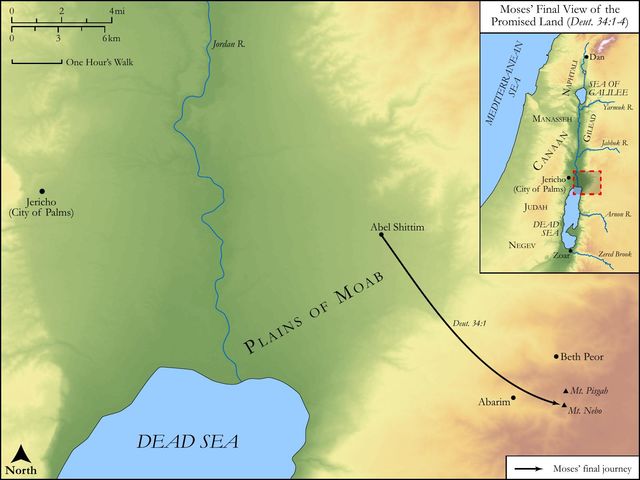
The setting for this significant transition is the plains of Moab, where the Israelites are encamped, poised to enter the land of Canaan. Among the nations round about, the succession of leadership was frequently a precarious and unstable period, often giving rise to power struggles, internal strife, or external vulnerability. However, within Israel, God meticulously orchestrated this transition, ensuring divine legitimacy and stability for Joshua's leadership. The practice of "laying on of hands" (Hebrew: semikhah) was a deeply embedded cultural and religious act in ancient Israel, signifying the impartation of blessing, authority, spiritual gifting, or even the transfer of responsibility. It was employed in various contexts, from the ordination of priests (Numbers 8:10) and the transfer of sin onto a sacrificial animal (Leviticus 16:21) to, most significantly here, the public commissioning of a national leader. This public and ritualistic act solidified Joshua's standing before the entire community, publicly affirming God's explicit choice and anointing for his immense task.
Key Themes
ShowHideDeuteronomy 34:9 encapsulates several profound and enduring theological themes. Foremost is the theme of Divine Empowerment, as Joshua's fitness for the daunting task of leading Israel into Canaan is explicitly attributed not to his inherent military skill or human charisma, but to being "full of the spirit of wisdom." This phrase denotes a direct, supernatural endowment from God, essential for discerning God's will, exercising righteous judgment, and successfully conquering and governing the promised land. This echoes the Spirit's role in empowering individuals for specific divine tasks throughout the Old Testament, such as Bezalel for craftsmanship in the tabernacle (Exodus 31:3). The theme of Succession and Impartation is equally central, with Moses' deliberate act of laying hands on Joshua serving as a visible, symbolic, and effective transfer of authority, blessing, and spiritual anointing. This act confirmed God's approval and the passing of the prophetic and leadership mantle. Finally, Obedience and Continuity are powerfully highlighted by the people's immediate response: they "hearkened unto him, and and did as the LORD commanded Moses." This underscores the vital necessity of the people's submission to God's divinely chosen leader, ensuring the unbroken continuity of God's covenant plan and demonstrating that their obedience to Joshua was, in essence, an act of continued obedience to God's ongoing command, maintaining the integrity of the covenant established at Sinai, as detailed in Deuteronomy 28.
Exposition and Analysis
ShowHideKey Word Analysis
ShowHideThis term, derived from the root meaning "to be wise," signifies more than mere intellectual knowledge or practical shrewdness. In a biblical context, chokmâh refers to the skill, discernment, and ability to govern righteously and make sound judgments in accordance with God's will and divine principles. When coupled with "spirit" (as in "spirit of wisdom"), it indicates a divine, supernatural endowment, equipping Joshua with insight and capacity for leadership that transcends human capability, enabling him to navigate complex challenges and lead the nation justly.
This primitive root means "to prop," "to support," or "to lean upon." In the context of "laying hands," it signifies the act of providing support, establishing, or upholding. It implies a deliberate, firm placement of hands, conveying a sense of authorization and the transfer of a burden or responsibility. This action, when combined with "hands," points to a formal and public act of commissioning, signifying the divine backing and establishment of Joshua's authority.
This primitive word refers to the "hand" (the open one, in distinction from kaph, the closed one), often indicating power, means, direction, or agency. In conjunction with çâmak ("laid"), the act of "laying hands" (semikhah) signifies the formal and public impartation of authority, blessing, or spiritual gifting. Here, it is the physical manifestation of the transfer of Moses' leadership mantle and God's anointing to Joshua, making his succession visible and legitimate to the entire community.
Verse Breakdown
ShowHide"And Joshua the son of Nun was full of the spirit of wisdom"
This opening clause immediately establishes Joshua's unique qualification for leadership, attributing his fitness not to human prowess but to a divine, spiritual endowment. The phrase "full of" (Hebrew: mâlêʼ) denotes an overflowing, complete, and pervasive presence of this divine wisdom, indicating that Joshua was thoroughly equipped with supernatural insight, discernment, and governing ability, making him uniquely capable of discerning God's will and leading the nation through the challenges ahead.
"for Moses had laid his hands upon him"
This crucial explanatory clause provides the direct cause and divine authorization for Joshua's spiritual fullness and anointing. It explicitly links his being "full of the spirit of wisdom" to Moses' specific act of commissioning, an act that was itself commanded by God in Numbers 27:18-23. This physical, public act served as the channel and visible sign of God's spiritual transfer of authority and wisdom, establishing a legitimate and divinely sanctioned line of succession.
"and the children of Israel hearkened unto him, and did as the LORD commanded Moses"
This concluding clause powerfully demonstrates the success and acceptance of the leadership transition. The people's "hearkening" (Hebrew: shama, implying not just hearing but also obeying) to Joshua signifies their recognition and acceptance of his divinely appointed authority. Crucially, their obedience to Joshua is framed as direct obedience to "what the LORD commanded Moses," emphasizing the unbroken continuity of God's covenant commands and the divine nature of the authority vested in both leaders. It confirms that God's plan for Israel would continue without interruption, guided by His chosen servant.
Literary Devices
ShowHideDeuteronomy 34:9 employs several potent literary devices that amplify its theological significance. Symbolism is profoundly evident in the act of Moses laying his hands on Joshua, which visually and ritually represents the transfer of authority, blessing, and spiritual anointing from the departing leader to his chosen successor. This physical gesture carries immense theological weight, signifying divine approval and the continuity of God's work. The verse also functions as a powerful moment of Transition, marking the solemn conclusion of the Mosaic era and the divinely sanctioned inauguration of the Joshuaic era, yet emphasizing Continuity rather than rupture. The phrase "full of the spirit of wisdom" uses Hyperbole or Intensification to underscore the completeness and divine origin of Joshua's anointing, assuring the reader of his absolute fitness for the monumental task ahead. Furthermore, the entire verse serves as a potent Foreshadowing of the subsequent book of Joshua, preparing the reader for the successful conquest and settlement of Canaan under Joshua's Spirit-empowered leadership, thereby linking the narrative past to the immediate future.
Theological and Thematic Connections
ShowHideDeuteronomy 34:9 stands as a profound theological statement on the nature of divine leadership, the indispensable role of the Holy Spirit in equipping God's servants, and God's unwavering faithfulness to His covenant promises. It teaches that true spiritual authority is not self-appointed or based solely on human merit, but is divinely bestowed and empowered by God's Spirit. The concept of the "spirit of wisdom," as seen here in Joshua, is a recurring biblical theme, signifying God's supernatural enablement for specific tasks, whether for righteous governance, skilled craftsmanship, or prophetic utterance. This verse provides immense assurance that even when foundational human leaders pass on, God's overarching plan remains steadfast, and He meticulously raises up, equips, and commissions new vessels to carry forward His eternal purposes. The seamless continuity from Moses to Joshua underscores God's steadfast commitment to His people's destiny and His meticulous provision for their ongoing guidance and success.
Reflection and Application
ShowHideDeuteronomy 34:9 offers timeless and profoundly relevant principles for leadership, mentorship, and maintaining faith during periods of significant transition. For those in positions of leadership, this verse serves as a powerful and humbling reminder that true effectiveness in God's service stems not from inherent human skill, charisma, or strategic acumen alone, but fundamentally from divine empowerment and an anointing by God's Spirit. We are called to earnestly seek the "spirit of wisdom" from God, recognizing that our natural abilities are sanctified, magnified, and truly fruitful only when filled and guided by His Spirit. For those who are being led, the passage encourages a spirit of trust, submission, and obedience to divinely appointed authority, fostering an understanding that God works through chosen vessels to advance His kingdom purposes. In the face of inevitable change, loss, or uncertainty, this passage instills profound confidence that God remains eternally faithful to His purposes, always providing the necessary leadership and equipping for the next phase of His redemptive plan. It challenges us, as spiritual stewards, to proactively identify, diligently mentor, and prayerfully commission the next generation of leaders, just as Moses faithfully did with Joshua, thereby ensuring the unbroken continuity of spiritual legacy and the ongoing fulfillment of God's mission.
Questions for Reflection
ShowHideFAQ
ShowHideWhat does it mean that Joshua was "full of the spirit of wisdom"?
ShowHideThis phrase signifies that Joshua was supernaturally endowed by God with an extraordinary measure of insight, discernment, and governing ability, specifically for his role as Israel's new leader. It was not merely his natural intelligence, military training, or administrative skills, but a profound spiritual gift directly from God. This divine wisdom equipped him to understand God's will, make righteous judgments, and lead the nation through the immense challenges of conquering Canaan and establishing justice, much like the Holy Spirit empowered individuals for specific tasks throughout the Bible, such as Bezalel for craftsmanship in Exodus 31:3 or the judges for delivering Israel from oppression.
Why was Moses laying his hands on Joshua so important?
ShowHideMoses' act of laying his hands on Joshua (known as semikhah) was a profoundly significant public, symbolic, and effective act of commissioning and transfer of authority. It visually demonstrated to all Israel that Joshua was God's chosen and divinely authorized successor, and that Moses' unique authority and anointing were being formally passed on to him. This act, explicitly commanded by God in Numbers 27:18-23, served to legitimize Joshua's leadership in the eyes of the entire community and functioned as the divinely appointed channel through which God's Spirit of wisdom was formally imparted for his new and monumental role. It ensured an orderly, divinely sanctioned, and universally accepted transition, preventing chaos, dispute, or rebellion over leadership.
How does Israel's obedience to Joshua relate to their obedience to Moses?
ShowHideThe verse states that the children of Israel "hearkened unto him, and did as the LORD commanded Moses." This highlights the seamless and unbroken continuity of God's covenant and His divine commands. Their obedience to Joshua was not merely submission to a new human leader, but a direct act of continued obedience to God Himself, whose will and law had been faithfully mediated through Moses and were now being faithfully mediated through Joshua. It affirmed that God's will, His covenant, and His law remained unchanged, and that Joshua was the legitimate and divinely appointed instrument through whom God would continue to guide His people, leading them to fulfill the promises made to their forefathers, as detailed in the covenant stipulations found in Deuteronomy 6.
Christ-Centered Fulfillment
ShowHideDeuteronomy 34:9, with its vivid depiction of Joshua's Spirit-filled leadership and divinely ordained succession, profoundly foreshadows the ultimate Leader and greater Joshua, Jesus Christ. Just as Joshua was "full of the spirit of wisdom" through the laying on of hands, Jesus, whose Hebrew name Yeshua is the same as Joshua, was uniquely and eternally filled with the Holy Spirit without measure (John 3:34). The Spirit of the Lord rested upon Him, empowering Him for His perfect prophetic, priestly, and kingly ministry, as beautifully prophesied in Isaiah 11:2. While Joshua led the Israelites into a physical promised land, Christ leads His people into the true, eternal rest and spiritual inheritance found exclusively in Him (Hebrews 4:8-10). The people's obedience to Joshua, who continued to uphold and enforce Moses' commands, points to the ultimate and perfect obedience due to Christ, who did not come to abolish the Law but to fulfill it in every detail (Matthew 5:17) and whose words are the very words of eternal life (John 6:68). He is the one through whom God's ultimate covenant promises are realized, ushering His people into the New Covenant and the fullness of eternal life in His presence.