


Isaiah 11:2
Bible text: King James Version (1769 Blayney text) · Public domain
Bible text: King James Version with Strong's numbers · Public domain
Bible text: Berean Standard Bible · Public domain
Bible text: American Standard Version (1901) · Public domain
Bible text: World English Bible, Messianic edition · Public domain
Bible text: Geneva Bible (1599) · Public domain
Bible text: Young's Literal Translation · Public domain
- וְנָחָהve·na·Chahand it will restH5117Conj-w ¦ V-Qal-ConsecPerf-3fsVerb Qal Consecutive Perfect 3rd Singular Feminineוְandנָחָהit will rest
- עָלָיו'a·Lavon himH5921Prep ¦ 3msPrepositionעָלָיonוhim
- רוּחַRu·ach[the] spirit ofH7307N-fscNoun Singular Feminine Construct
- יְהוָהYah·wehYahwehH3068N-properNoun Proper Title
- רוּחַRu·acha spirit ofH7307N-fscNoun Singular Feminine Construct
- חָכְמָהchokh·mahwisdomH2451N-fsNoun Singular Feminine Absolute
- וּבִינָהu·vi·Nahand understandingH998Conj-w ¦ N-fsNoun Singular Feminine Absoluteוּandבִינָהunderstanding
- רוּחַRu·acha spirit ofH7307N-fscNoun Singular Feminine Construct
- עֵצָה'e·TzahcounselH6098N-fsNoun Singular Feminine Absolute
- וּגְבוּרָהu·ge·vu·Rahand strengthH1369Conj-w ¦ N-fsNoun Singular Feminine Absoluteוּandגְבוּרָהstrength
- רוּחַRu·acha spirit ofH7307N-fscNoun Singular Feminine Construct
- דַּעַתDa·'atknowledgeH1847N-fsNoun Singular Feminine Absolute
- וְיִרְאַתve·yir·'Atand [the] fear ofH3374Conj-w ¦ N-fscNoun Singular Feminine Constructוְandיִרְאַת[the] fear of
- יְהוָהYah·wehYahwehH3068N-properNoun Proper Title
English is a literal word-by-word gloss of the Hebrew, not the KJV's wording. Why?
This is the original text the KJV's translators worked from — each Hebrew word with its own literal English meaning in this verse, prepared by scholars at Tyndale House, Cambridge. The KJV translates whole sentences, not word by word, so its wording differs: one Hebrew word can become several English words, and the KJV may choose “the LORD” where the gloss reads “Yahweh”. Both are faithful — they answer different questions. For the KJV's own rendering, switch to the KJV text.
Details
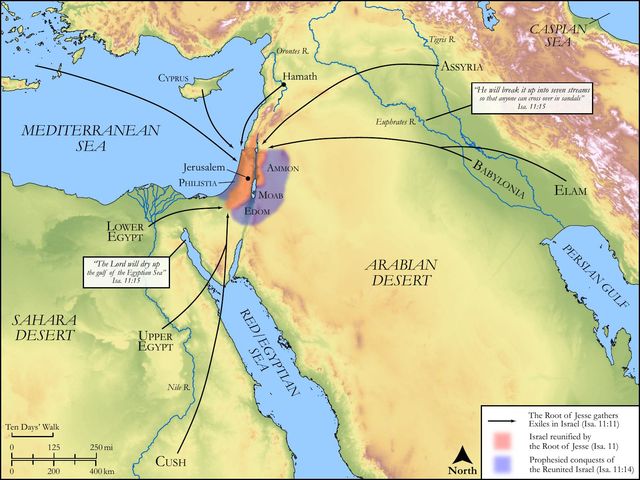
See on the biblical-era map
Study this verse
Public-domain commentary
Matthew Henry
From his Commentary on the Whole Bible. Henry comments on passages, not single verses — this entry covers Isaiah 11:1–9. His three-level outline is real structure in the source text, so it is rendered as structure.
The prophet had before, in this sermon, spoken of a child that should be born, a son that should be given, on whose shoulders the government should be, intending this for the comfort of the people of God in times of trouble, as dying Jacob, many ages before, had intended the prospect of Shiloh for the comfort of his seed in their affliction in Egypt. He had said (Isa 10:27) that the yoke should be destroyed because of the anointing; now here he tells us on whom that anointing should rest. He foretels,
I.That the Messiah should, in due time, arise out of the house of David, as that branch of the Lord which he had said (Isa 4:2) should be excellent and glorious; the word is Netzer, which some think is referred to in Mat 2:23, where it is said to be spoken by the prophets of the Messiah that he should be called a Nazarene. Observe here,
1.Whence this branch should arise-from Jesse. He should be the son of David, with whom the covenant of royalty was made, and to whom it was promised with an oath that of the fruit of his loins God would raise of Christ, Act 2:30. David is often called the son of Jesse, and Christ is called so, because he was to be not only the Son of David, but David himself, Hos 3:5.
2.The meanness of his appearance.
(1.)He is called a rod, and a branch; both the words here used signify a weak, small, tender product, a twig and a sprig (so some render them), such as is easily broken off. The enemies of God's church were just before compared to strong and stately boughs (Isa 10:33), which will not, without great labour, be hewn down, but Christ to a tender branch (Isa 53:2); yet he shall be victorious over them.
(2.)He is said to come out of Jesse rather than David, because Jesse lived and died in meanness and obscurity; his family was of small account (Sa1 18:18), and it was in a way of contempt and reproach that David was sometimes called the son of Jesse, Sa1 22:7.
(3.)He comes forth out of the stem, or stump, of Jesse. When the royal family, that had been as a cedar, was cut down, and only the stump of it left, almost levelled with the ground and lost in the grass of the field (Dan 4:15), yet it shall sprout again (Job 14:7); nay, it shall grow out of his roots, which are quite buried in the earth, and, like the roots of flowers in the winter, have no stem appearing above ground. The house of David was reduced and brought very low at the time of Christ's birth, witness the obscurity and poverty of Joseph and Mary. The Messiah was thus to begin his estate of humiliation, for submitting to which he should be highly exalted, and would thus give early notice that his kingdom was not of this world. The Chaldee paraphrase reads this, There shall come forth a King from the sons of Jesse, and the Messiah (or Christ) shall be anointed out of his sons' sons.
II.That he should be every way qualified for that great work to which he was designed, that this tender branch should be so watered with the dews of heaven as to become a strong rod for a sceptre to rule, Isa 11:2.
1.In general, the Spirit of the Lord shall rest upon him. The Holy Spirit, in all his gifts and graces, shall not only come, but rest and abide upon him; he shall have the Spirit not by measure, but without measure, the fulness of the Godhead dwelling in him, Col 1:19; Col 2:9. He began his preaching with this (Luk 4:18), The Spirit of the Lord is upon me.
2.In particular, the spirit of government, by which he should be every way fitted for that judgment which the Father has committed to him and given him authority to execute (Joh 5:22, Joh 5:27), and not only so, but should be made the fountain and treasury of all grace to believers, that from his fulness they might all receive the Spirit of grace, as all the members of the body derive animal spirits from the head.
(1.)He shall have the spirit of wisdom and understanding, of counsel and knowledge; he shall thoroughly understand the business he is to be employed in. No man knows the Father but the Son, Mat 11:27. What he is to make known to the children of men concerning God, and his mind and will, he shall be himself acquainted with and apprised of, Joh 1:18. He shall know how to administer the affairs of his spiritual kingdom in all the branches of it, so as effectually to answer the two great intentions of it, the glory of God and the welfare of the children of men. The terms of the covenant shall be settled by him, and ordinances instituted, in wisdom: treasures of wisdom shall be hid in him; he shall be our counsellor, and shall be made of God to us wisdom.
(2.)The spirit of courage, or might, or fortitude. The undertaking was very great, abundance of difficulty must be broken through, and therefore it was necessary that he should be so endowed that he might not fail or be discouraged, Isa 42:4. He was famed for courage in his teaching the way of God in truth, and not caring for any man, Mat 22:16.
(3.)The spirit of religion, or the fear of the Lord; not only he shall himself have a reverent affection for his Father, as his servant (Isa 42:1), and he was heard in that he feared (Heb 5:7), but he shall have a zeal for religion, and shall design the advancement of it in his whole undertaking. Our faith in Christ was never designed to supersede and jostle out, but to increase and support, our fear of the Lord.
III.That he should be accurate, and critical, and very exact in the administration of his government and the exercise of the power committed to him (Isa 11:3): The Spirit wherewith he shall be clothed shall make him of quick understanding in the fear of the Lord - of an acute smell or scent (so the word is), for the apprehensions of the mind are often expressed by the sensations of the body. Note,
1.Those are most truly and valuably intelligent that are so in the fear of the Lord, in the business of religion, for that is both the foundation and top-stone of wisdom.
2.By this it will appear that we have the Spirit of God, if we have spiritual senses exercised, and are of quick understanding in the fear of the lord. Those have divine illumination that know their duty and know how to go about it.
3.Therefore Jesus Christ had the spirit without measure, that he might perfectly understand his undertaking; and he did so, as appears not only in the admirable answers he gave to all that questioned with him, which proved him to be of quick understanding in the fear of the Lord, but in the management of his whole undertaking. He has settled the great affair of religion so unexpectedly well (so as effectually to secure both God's honour and man's happiness) that, it must be owned, he thoroughly understood it.
IV.That he should be just and righteous in all the acts of his government, and there should appear in it as much equity as wisdom.
He shall judge as he expresses it himself, and as he himself would be judged of, Joh 7:24.
1.Not according to outward appearance (Isa 11:3): he shall not judge after the sight of his eyes, with respect of persons (Job 34:19) and according to outward shows and appearances, not reprove after the hearing of his ears, by common fame and report, and the representations of others, as men commonly do; nor does he judge of men by the fair words they speak, calling him, Lord, Lord, or their plausible actions before the eye of the world, which they do to be seen of men; but he will judge by the hidden man of the heart, and the inward principles men are governed by, of which he is an infallible witness. Christ will judge the secrets of men (Rom 2:16), will determine concerning them, not according to their own pretensions and appearances (that were to judge after the sight of the eyes), not according to the opinion others have of them (that were to judge after the hearing of the ears), but we are sure that his judgment is according to truth.
2.He will judge righteous judgment (Isa 11:5): Righteousness shall be the girdle of his loins. He shall be righteous in the administration of his government, and his righteousness shall be his girdle; it shall constantly compass him and cleave to him, shall be his ornament and honour; he shall gird himself for every action, shall gird on his sword for war in righteousness; his righteousness shall be his strength, and shall make him expeditious in his undertakings, as a man with his loins girt. In conformity to Christ, his followers must have the girdle of truth (Eph 6:14) and it will be the stability of the times. Particularly,
(1.)He shall in righteousness plead for the people that are poor and oppressed; he will be their protector (Isa 11:4): With righteousness shall he judge the poor; he shall judge in favour and defence of those that have right on their side, though they are poor in the world, and because they are poor in spirit. It is the duty of princes to defend and deliver the poor (Psa 82:3, Psa 82:4), and the honour of Christ that he is the poor man's King, Psa 72:2, Psa 72:4. He shall debate with evenness for the meek of the earth, or of the land; those that bear the injuries done them with meekness and patience are in a special manner entitled to the divine care and protection. I, as a deaf man, heard not, for thou wilt hear, Psa 38:13, Psa 38:14. Some read it, He shall reprove or correct the meek of the earth with equity. If his own people, the meek of the land, do amiss, he will visit their transgression with the rod.
(2.)He shall in righteousness plead against his enemies that are proud and oppressors (Isa 11:4): But he shall smite the earth, the man of the earth, that doth oppress (see Psa 10:18), the men of the world, that mind earthly things only (Psa 17:14); these he shall smite with the rod of his mouth, the word of his mouth, speaking terror and ruin to them; his threatenings shall take hold of them, and be executed upon them. With the breath of his lips, by the operation of his Spirit, according to his word, and working with and by it, he shall slay the wicked. He will do it easily, with a word's speaking, as he laid those flat who came to seize him, by saying I am he, Joh 18:6. Killing terrors shall arrest their consciences, killing judgments shall ruin them, their power, and all their interests; and in the other world everlasting tribulation will be recompensed to those that trouble his poor people. The apostle applies this to the destruction of the man of sin, whom he calls that wicked one (Th2 2:8) whom the Lord will consume with the spirit of his mouth. And the Chaldee here reads it, He shall slay that wicked Romulus, or Rome, as Mr. Hugh Broughton understands it.
V.That there should be great peace and tranquillity under his government; this is an explication of what was said in Isa 9:6, that he should be the Prince of peace. Peace signifies two things: -
1.Unity or concord, which is intimated in these figurative promises, that even the wolf shall dwell peaceably with the lamb; men of the most fierce and furious dispositions, who used to bite and devour all about them, shall have their temper so strangely altered by the efficacy of the gospel and grace of Christ that they shall live in love even with the weakest and such as formerly they would have made an easy prey of. So far shall the sheep be from hurting one another, as sometimes they have done (Eze 34:20, Eze 34:21), that even the wolves shall agree with them. Christ, who is our peace, came to slay all enmities and to settle lasting friendships among his followers, particularly between Jews and Gentiles: when multitudes of both, being converted to the faith of Christ, united in one sheep-fold, then the wolf and the lamb dwelt together; the wolf did not so much as threaten the lamb, nor was the lamb afraid of the wolf. The leopard shall not only not tear the kid, but shall lie down with her: even their young ones shall lie down together, and shall be trained up in a blessed amity, in order to the perpetuating of it. The lion shall cease to be ravenous and shall eat straw like the ox, as some think all the beasts of prey did before the fall. The asp and the cockatrice shall cease to be venomous, so that parents shall let their children play with them and put their hands among them. A generation of vipers shall become a seed of saints, and the old complaint of homo homini lupus - man is a wolf to man, shall be at an end. Those that inhabit the holy mountain shall live as amicably as the creatures did that were with Noah in the ark, and it shall be a means of their preservation, for they shall not hurt nor destroy one another as they have done. Now,
(1.)This is fulfilled in the wonderful effect of the gospel upon the minds of those that sincerely embrace it; it changes the nature, and makes those that trampled on the meek of the earth, not only meek like them, but affectionate towards them. When Paul, who had persecuted the saints, joined himself to them, then the wolf dwelt with the lamb.
(2.)Some are willing to hope it shall yet have a further accomplishment in the latter days, when swords shall be beaten into ploughshares.
2.Safety or security. Christ, the great Shepherd, shall take such care of the flock that those who would hurt them shall not; they shall not only not destroy one another, but no enemy from without shall be permitted to give them any molestation. The property of troubles, and of death itself, shall be so altered that they shall not do any real hurt to, much less shall they be the destruction of, any that have their conversation in the holy mountain, Pe1 3:13. Who, or what, can harm us, if we be followers of him that is good? God's people shall be delivered, not only from evil, but from the fear of it. Even the sucking child shall without any terror play upon the hole of the asp; blessed Paul does so when he says, Who shall separate us from the love of Christ? and, O death! where is thy sting?
Lastly, Observe what shall be the effect, and what the cause, of this wonderful softening and sweetening of men's tempers by the grace of God. 1. The effect of it shall be tractableness, and a willingness to receive instruction: A little child shall lead those who formerly scorned to be controlled by the strongest man. Calvin understands it of their willing submission to the ministers of Christ, who are to instruct with meekness and not to use any coercive power, but to be as little children, Mat 18:3. See Co2 8:5. 2. The cause of it shall be the knowledge of God. The more there is of that the more there is of a disposition to peace. They shall thus live in love, for the earth shall be full of the knowledge of the Lord, which shall extinguish men's heats and animosities. The better acquainted we are with the God of love the more shall we be changed into the same image and the better affected shall we be to all those that bear his image. The earth shall be as full of this knowledge as the channels of the sea are of water - so broad and extensive shall this knowledge be and so far shall it spread - so deep and substantial shall this knowledge be, and so long shall it last. There is much more of the knowledge of God to be got by the gospel of Christ than could be got by the law of Moses; and, whereas then in Judah only was God known, now all shall know him, Heb 8:11. But that is knowledge falsely so called which sows discord among men; the right knowledge of God settles peace.
Historical interpretation
Six Centuries of Reception
25 surviving comments on this verse. Each one is dated, so this reads as a timeline rather than a list.
Select a marker to jump to its quote. Markers stagger vertically where authors wrote within a few decades of each other.
The Scripture says that these enumerated powers of the Spirit have come on Him, not because He stood in need of them, but because they would rest in Him, i.e., would find their accomplishment in Him, so that there would be no more prophets in your nation after the ancient custom: and this fact you plainly perceive. For after Him no prophet has arisen among you.
Moreover, the apostle Paul says, “Having the same Spirit; as it is written, ‘I believed, and therefore have I spoken’; we also believe, and therefore speak.” He is therefore one and the same Spirit who was in the prophets and apostles, except that in the former he was occasional, in the latter always. But in the former not as being always in them, in the latter as abiding always in them; and in the former distributed with reserve, in the latter entirely poured out; in the former given sparingly, in the latter liberally bestowed; not yet manifested before the Lord’s resurrection, but conferred after the resurrection. For, he said, “I will ask the Father, and he will give you another Advocate, that he may be with you for ever, even the Spirit of truth.” And, “When he, the Advocate, shall come, whom I shall send to you from my Father, the Spirit of truth who proceeds from my Father.” And, “If I do not go away, that Advocate shall not come to you; but if I go away, I will send him to you.” And, “When the Spirit of truth shall come, he will direct you into all the truth.” And because the Lord was about to depart to the heavens, he gave the Paraclete out of necessity to the disciples; so as not to leave them in any degree orphans, which was hardly desirable, and forsake them without an advocate and some kind of protector.For this is he who strengthened their hearts and minds, who marked out the Gospel sacraments, who was in them the enlightener of divine things; and they being strengthened, feared, for the sake of the Lord’s name, neither dungeons nor chains, nay, even trod under foot the very powers of the world and its tortures. For they were henceforth armed and strengthened by the same Spirit, having in themselves the gifts which this same Spirit distributes and appropriates to the church, the spouse of Christ, as her ornaments. This is he who places prophets in the church, instructs teachers, directs tongues, gives powers and healings, does wonderful works, often discrimination of spirits, affords powers of government, suggests counsels and orders and arranges whatever other gifts there are of charismata.… This is he who, after the manner of a dove, when our Lord was baptized, came and abode upon him, dwelling in Christ full and entire, and not maimed in any measure or portion; but with his whole overflow copiously distributed and sent forth, so that from him others might receive some enjoyment of his graces: the source of the wholeness of the Holy Spirit remaining in Christ, so that from him might be drawn streams of gifts and works, while the Holy Spirit dwelt richly in Christ. For truly Isaiah, prophesying this, said, “And the Spirit of wisdom and understanding shall rest upon him, the Spirit of counsel and might, the Spirit of knowledge and piety; and the Spirit of the fear of the Lord shall fill him.” This selfsame thing also he said in the person of the Lord himself, in another place. “The Spirit of the Lord is upon me; because he has anointed me, he has sent me to preach the gospel to the poor.”
In Christ alone he dwells fully and entirely, not lacking in any measure or part; but in all his overflowing abundance dispensed and sent forth, so that other men might receive from Christ a first outpouring, as it were, of his graces. For the fountainhead of the entire Holy Spirit abides in Christ, that from him might be drawn streams of grace and wondrous deeds because the Holy Spirit dwells richly in Christ.
Isaiah signifies that the Spirit was indeed one and indivisible, but his operations diverse.
I think Isaiah loves to call the activities of the Spirit “spirits.”
And as the Son is the Angel of great counsel, so, too, is the Holy Spirit the Spirit of Counsel, that you may know that the Counsel of the Father, the Son, and the Holy Spirit is One. Counsel, not concerning any doubtful matters, but concerning those foreknown and determined.
So, then, the Holy Spirit is the river, and the abundant river, which according to the Hebrews flowed from Jesus in the lands, as we have received it prophesied by the mouth of Isaiah. This is the great river that flows always and never fails. And not only a river, but also one of copious stream and overflowing greatness, as also David said: “The stream of the river makes glad the city of God.”60For neither is that city, the heavenly Jerusalem, watered by the channel of any earthly river, but that Holy Spirit, proceeding from the fount of life, by a short draught of whom we are satiated, seems to flow more abundantly among those celestial thrones, dominions and powers, angels and archangels, rushing in the full course of the seven virtues of the Spirit. For if a river rising above its banks overflows, how much more does the Spirit, rising above every creature, when he touches the low-lying fields of our minds, as it were, make glad that heavenly nature of the creatures with the larger fertility of his sanctification.
And let it not trouble you that either here it is said “rivers” or elsewhere “seven Spirits,” for by the sanctification of these seven gifts of the Spirit, as Isaiah said, is signified the fullness of all virtue; the Spirit of wisdom and understanding, the Spirit of counsel and strength, the Spirit of knowledge and godliness, and the Spirit of the fear of God. One, then is the river, but many the channels of the gifts of the Spirit. This river, then, goes forth from the fount of life.
Therefore, the fear of the just is the tribunal of Christ's speech and the golden foundation of full prudence. But the good image, like the likeness of truth, is the word of the saints. And see how the fear of the saints is like a golden foundation. Read Isaiah: see how much fear he has subjected, in order to make it blameless and good fear: the spirit, he says, of wisdom and understanding, the spirit of counsel and power, the spirit of knowledge and piety, the spirit of holy fear. By how much fear did he subject, so that he might have something to follow? He is informed through wisdom, instructed through understanding, guided by counsel, strengthened by virtue, governed by knowledge, adorned by piety. Take away from fear of the Lord those things, and it is an irrational and foolish fear, one of those: "Outside are battles, inside are fears," by which even Paul would have been afflicted if he did not have the Lord as his comforter.
Chapter XI - Verses 1, 2. And there shall come forth a rod out of the root of Jesse, and a flower shall rise up out of his root. And the spirit of the Lord shall rest upon him: the spirit of wisdom, and of understanding, the spirit of counsel, and of fortitude, the spirit of knowledge, and of godliness. And he shall be filled with the spirit of the fear of the Lord. Up to the beginning of the Vision or the weight of Babylon, which Isaiah the son of Amos saw, all this prophecy is about Christ, which we wish to explain in parts so as not to confuse the reader's memory by presenting and discussing it all at once. The rod and the flower from the root of Jesse are interpreted as the Lord Himself of the Jews: so that in the rod, the power of the reigning one may be shown, and in the flower, the beauty. But we understand the rod from the root of Jesse to be the holy Virgin Mary, who had no fruit cohering to herself; of whom we also read above: Behold, a virgin shall conceive and bear a son (Isa. VII, 14). And the flower is the Lord and Savior, who says in the Song of Solomon: I am the flower of the field and the lily of the valleys (Cant. II, 1). Concerning the root which alone the LXX translators turned into Hebrew script, it has (in Geza) which Aquila and Symmachus and Theodotio interpreted as κορμὸν, that is, trunk. And concerning the flower which is called (in Hebrew) Neser, they translated it as germ to show that much later after the Babylonian captivity, with no one from the line of David possessing the glory of the ancient kingdom, Christ arose as if from the trunk of Mary, and from Mary Christ was born. That which in the Gospel of Matthew everyone seeks the words of the Ecclesiastics, and does not find where it is written, 'He shall be called a Nazarene' (Matt. 2:23), the learned Hebrews think is taken from this place. But it should be known that here 'Nazarene' is written with the letter 'Sade', which the Latin language does not express the sound and property of between 'z' and 's'. It is, in fact, a strident sound and is barely pronounced with the tongue against the teeth: from which the city of Zion is also written. Moreover, the Nazarenes, whom the Seventy sanctified, whom Symmachus separated, transferred, pronounce 'Zain' (the letter element is always written). Therefore, upon this flower, who will suddenly rise from the trunk and root of Jesse through the Virgin Mary, the spirit of the Lord will rest, because in him it pleased all the fullness of divinity to dwell bodily: not by parts, as with the other saints; but according to the Gospel that the Nazarenes read, which was written in the Hebrew language: 'Upon him descends every source of the Holy Spirit.' Now, the Lord is the Spirit, and where the Spirit of the Lord is, there is freedom (2 Corinthians 3:17). In the same volume of Matthew, we read that which is written in the following: Behold, my servant whom I have chosen: my beloved, in whom my soul is well pleased: I will put my spirit upon him: he shall show judgment to the Gentiles (Matt. XII, 18). This is understood to refer to the understanding of the Savior, in whom the Spirit of the Lord rested, that is, he remained in eternal habitation: not so as to fly away and descend to him again; but according to the testimony of John the Baptist, he would continually remain, who said: I saw the Spirit descending as a dove from heaven, and remaining upon him, and I did not know him: but he who sent me to baptize in water, said to me: He upon whom you shall see the Spirit descending, and remaining upon him, he it is who baptizes in the Holy Spirit (John. XXXII, 33). Furthermore, in the Gospel, of which we have mentioned above, we find these writings: And it came to pass, when the Lord was ascended out of the water, the whole fountain of the Holy Spirit descended and rested upon him, and said to him: My son, in all the prophets I have expected thee, that thou shouldst come, and that I might rest in thee. For thou art my rest, thou art my first begotten Son, who reignest in eternity. Who is called the Spirit of the Lord and the Spirit of wisdom; for all things were made by him, and without him was made nothing that was made (John 1:3). And in the Psalms it is sung: How great are your works, O Lord! You have made all things in wisdom (Ps. XCI, 24). And the Apostle writes: Christ is the power of God and the wisdom of God (I Cor. I). And in Proverbs it is read: By his wisdom, God founded the earth, and by his prudence, he prepared the heavens (Prov. III, 19). And just as the Word of God is called light, and life, and resurrection, so the spirit of wisdom, understanding, counsel, fortitude, knowledge, piety, and fear of the Lord is named: not because it is different according to the differences of names, but because it is the one and same source and beginning of all virtues. Therefore, without Christ, no one can be wise, intelligent, wise counsel, strong, learned, pious, or full of the fear of God. And it should be noted that the Spirit of the Lord, the spirit of wisdom and understanding, counsel and fortitude, knowledge and piety, and the fear of the Lord, that is, the number seven, which is said to be the seven eyes on one stone in Zechariah (Chapter 3), may rest upon the rod and flower, who rose from the root of Jesse, and therefore from the line of David. But the Spirit of the fear of the Lord has filled him because of those who lack the fear of the Lord: for they are little ones, whom perfect love casts out. For whoever fears, has punishment, and is not perfect (1 John 4:18). Therefore, the Apostle speaks to the believers: For you have not received the spirit of bondage again in fear: but you have received the Spirit of adoption, whereby we cry, Abba, Father (Romans 8:15). And in Malachi we read: If I am a father, where is my glory? And if I am the Lord, where is my fear? (Malachi 1:6). Concerning this fear, it is sung in the Psalm: Come, children, listen to me: I will teach you the fear of the Lord (Psalm 34:11).
Scripture testifies that “a great and strong angel exclaimed in heaven: Who is worthy to open the book and to break its seal? No one was able to open the book or to look at it, neither in heaven nor on earth nor under the earth.” John wept and lamented that none of all the rational creatures in the universe was found worthy to open the book to look at it. One of the elders consoled John as he wept and said, “Do not cry, John. Behold, the Lion from the tribe of Judah, the root of David, was victorious in opening the book and breaking its seal.” What, I ask, is this book which no one was ever able to receive from the hand of the living, except “he who walks without sin and does justice”? It is not enough that he walk without sin or that he be a lamb, but he must be a slain lamb who crowned purity with the witness of the passion of life, having seven horns and seven eyes, which are the seven spirits of God. These undoubtedly are “the Spirit of wisdom and understanding, the Spirit of counsel and strength, the spirit of knowledge and piety, and the Spirit of the fear of the Lord.” What, therefore, is this book? It is the book of judgment, I believe. For “the Father judges no one but has given all judgment to the Son.”
Now in respect of this passage of the apostle, we must be on our guard against supposing that we have not received the spirit of the fear of God, which is undoubtedly a great gift of God, and concerning which the prophet Isaiah says, "The Spirit of the Lord shall rest upon you, the spirit of wisdom and understanding, the spirit of counsel and might, the spirit of knowledge and piety, the spirit of the fear of the Lord." It is not the fear with which Peter denied Christ that we have received the spirit of, but that fear concerning which Christ himself says, "Fear him who has power to destroy both soul and body in hell; yes, I say to you, 'Fear him.' " This, indeed, he said, lest we should deny him from the same fear which shook Peter; for such cowardice he plainly wished to be removed from us when he, in the preceding passage, said, "Be not afraid of them that kill the body, and after that have no more that they can do." It is not of this fear that we have received the spirit, but of power, and of love and of a sound mind.
It seems to me, therefore, that the sevenfold operation of the Holy Spirit, of which Isaiah speaks, coincides with these stages and maxims. However, the order is different. In Isaiah, the enumeration begins from the higher, while here it begins from the lower; in the former, it starts from wisdom and ends at the fear of God. But "the fear of the Lord is the beginning of wisdom." Therefore, if we ascend step by step, as it were, while we enumerate, the first grade is the love of God; the second is piety; the third is knowledge; the fourth is fortitude; the fifth is counsel; the sixth is understanding; the seventh is wisdom. The fear of God coincides with the humble, of whom it is here said, "Blessed are the poor in spirit."
"The love of God has been poured out in our hearts through the Holy Spirit who has been given to us."That the Holy Spirit is suggested by the number seven anybody knows who can read. But listen anyway, those of you who read carelessly, or perhaps cannot read. This is how God presents the Holy Spirit through the prophet Isaiah: "The Spirit," he says, "of wisdom and understanding, of counsel and fortitude, of knowledge and piety, the Spirit of the fear of God." This is the sevenfold Spirit who is also called down upon the newly baptized. The law is the Decalogue; the Ten Commandments, you see, were written on tablets, but stone ones still, because of the stubborn hardness of the Jews. After the Spirit came, what does the apostle say? "You yourselves are our letter, not written with ink but with the Spirit of the living God; not on tablets of stone, but on the fleshly tablets of the heart." Take away the Spirit, the letter kills, because it finds the sinner guilty, doesn't set him free. That's why the apostle says, "For we are not sufficient of ourselves to think anything as coming from ourselves; but our sufficiency is from God, who has made us sufficient to be ministers of the new covenant, not in the letter, but in the Spirit. For the letter kills, but the Spirit brings to life." So add seven to ten, if you wish to fulfill all justice. When you are commanded by the law to do something, ask the Spirit to help you.
The Holy Spirit is denoted in Scripture principally by the number seven, whether in Isaiah or in the Apocalypse, where the seven spirits of God are referenced most clearly under the sevenfold operation of one and the same Spirit. The Spirit's sevenfold operation is also indicated through the prophet Isaiah: "the Spirit of wisdom and understanding, of counsel and fortitude, of knowledge and piety, the Spirit of the fear of God rested upon him." This fear of the Lord should be understood as pure, enduring forever.
A person would not have wisdom, understanding, counsel, fortitude, knowledge, piety and fear of God unless, according to the prophet's words, he had received "the spirit of wisdom and of understanding, of counsel and of fortitude, of knowledge and of godliness, and of fear of God." ... And a person would not have power and love and sobriety, except by receiving the Spirit of whom the apostle speaks: "We have not received the spirit of fear but of power and of love and of sobriety." So also one would not have faith unless he received the spirit of faith of which the same apostle says: "But having the same spirit of faith, as it is written, 'I believed, therefore I have spoken,' we also believe therefore we speak also." Thus he shows very plainly that faith is not received because of merit but by the mercy of him who has mercy on whom he will, when he says of himself: "I have obtained mercy to be faithful."
For if Paul had said only "Jesus Christ," he would have included Jesus Christ according to his divinity, according to his being the Word who was with God, Jesus Christ the Son of God. Yet children cannot receive what is said in this manner. How, therefore, do they who are fed milk receive it? "Jesus Christ," he said, "and him crucified." Feed upon what he did for you, and you will grow to know him as he is.Some ascend the ladder, therefore, and some descend on it. Who are those that ascend? They who make progress toward the knowledge of spiritual realities. Who are those that descend? They who, although enjoying as great a knowledge of spiritual realities as is possible for humans, nevertheless descend to the level of children to speak of such things that children can understand, so that those who had been nourished with milk might be made fit and strong enough to receive spiritual food. Isaiah, brothers, was himself among those who descended to us, for the steps upon which he descended are obvious. In reference to the Holy Spirit, he said "the Spirit of wisdom and understanding, of counsel and fortitude, of knowledge and piety, the Spirit of the fear of God rested upon him," he began from wisdom and descended toward fear. See how the teacher descended from wisdom toward fear; you who learn, if you are to make progress, must ascend from fear to wisdom. For it is written, "The fear of the Lord is the beginning of wisdom." Listen, therefore, to the psalms.
About this text you should first take care to observe that Isaiah does not say that “the spirit of fear shall rest upon him” but “shall fill him.” The power of it is so abundant that if once it possesses a person in its strength, it possesses his mind to the exclusion of all else. Linked with the charity that never fails, it fills and permanently possesses the soul whom it has seized, and it cannot be lessened by the temptations of any this-worldly happiness.
We read in Isaiah that the Spirit of the Lord descended upon the Lord Jesus, “the Spirit of wisdom and understanding, the Spirit of counsel and strength, the Spirit of knowledge and piety.” It is in reference to this same Spirit of the Lord who descended upon the Savior in a holy outpouring that the Son said through Isaiah, “The Spirit of the Lord is upon me,” and that Matthew the Evangelist said, “Behold, the heavens opened, and he saw the Spirit of God descending upon him like a dove.” Luke the Evangelist, moreover, clearly teaches that the Spirit of God whom the Savior received in baptism is the Holy Spirit: “Jesus, full of the Holy Spirit, returned from the Jordan.”
As we said earlier, the seven-formed Spirit has been denoted here, as you easily infer by calculation and recognize by his activity. But we must regard this Holy Spirit as one and the same as him whose virtues are known by Isaiah’s witness to be the same seven which we have mentioned: the Spirit of wisdom, of understanding, of counsel, of courage, of knowledge, of piety, of fear of the Lord; and he distributes these to each as he wills. It should not trouble you that everywhere Isaiah ascribes the words to the voice of the Holy Spirit, for clearly “voice” is associated with the whole Trinity. We read of the Father’s voice when he says, “This is my beloved Son in whom I am well pleased,” and again of the Son’s voice in the words “Saul, Saul, why do you persecute me?” Likewise in the Acts of the Apostles we read of the Holy Spirit: “Separate for me Paul and Barnabas, for the work to which I have called them.”
There are seven steps to the gate because the way to heavenly life is opened to us through the sevenfold grace of the Holy Spirit. Isaiah locates this sevenfold grace in our Head himself, or in his body which we are: “The Spirit of the Lord will rest upon him, the Spirit of wisdom and understanding, the Spirit of counsel and strength, the spirit of knowledge and piety, and the Spirit of the fear of the Lord will fill him.” He is speaking here from the perspective of heaven, clearly numbering the steps in descending rather than ascending order: wisdom, understanding, counsel, strength, knowledge, piety and fear. Because it is written, “the fear of the Lord is the beginning of wisdom,” the way consists beyond doubt in ascending from fear to wisdom, not in regressing from wisdom to fear, for wisdom surely has perfect charity. It is also written: “Perfect charity casts out fear.” The prophet, therefore, because he reasoned from heavenly realities to the lower things, began with wisdom and descended toward fear.We, however, who strive from the earthly toward the heavenly, enumerate the same steps in the ascending order to enable us to make progress from fear to wisdom. In our minds, then, the first step on the way to heaven is the fear of the Lord, the second godliness, the third knowledge, the fourth strength, the fifth counsel, the sixth understanding, and the seventh wisdom. For the fear of the Lord is in the mind. But what kind of fear is it if it is not accompanied by godliness?
You know that in the Old Testament every work is prescribed by the Ten Commandments, but in the New Testament the power of the same work is given to the increased number of faithful through the sevenfold grace of the Holy Spirit. The prophet foretells this when he speaks of “the spirit of wisdom and understanding, the spirit of counsel and strength, the spirit of knowledge and devotion, and he will fill him with the spirit of the fear of the Lord.” A person acquires the ability to work in this Spirit who acknowledges faith in the Trinity, believing that Father and Son and the same Holy Spirit are one power and confessing that they are of one substance. Because there are seven commandments, given, as I have said, more widely by the New Testament, and ten given by the Old Testament, all of our power and work can be fully comprised by ten and seven.
Indeed, seven children are born to us when, through the conception of a good thought, seven virtues of the Holy Spirit arise within us. The prophet enumerates these interior offspring of the Spirit’s impregnation of the mind when he says, “the Spirit of the Lord will rest upon him, the Spirit of wisdom and understanding, the Spirit of counsel and strength, the spirit of knowledge and piety, and the Spirit of the fear of the Lord will fill him.”
In truth, not all the saints receive the fullness of his Spirit, but they receive from his fullness, insofar as he grants it.
The seven lamps are the seven gifts of the Holy Spirit, all of which remain in our Lord and Redeemer forever and are distributed in his members (that is, in all the elect) according to his will.
Only of the mediator between God and humanity, the man Jesus Christ, can it be said truthfully, “And the Spirit of the Lord will rest upon him, the Spirit of wisdom and understanding, the Spirit of counsel and strength, the Spirit of knowledge and piety, and the Spirit of the fear of the Lord will fill him.” Each of the saints, on the other hand, receives not the fullness of his Spirit but receives from his fullness only as the Spirit grants it, for “to one is given through the Spirit a word of wisdom, and to another a word of knowledge according to the same Spirit, to another faith in the same Spirit, to another the grace of healing in the one Spirit, to another the working of miracles, to another prophecy, to another the discernment of spirits, to another different kinds of languages, to another the interpretation of words. One and the same Spirit operates all of these gifts, dividing to each person as he wills.”
Continue studying Isaiah 11:2 across the web’s major study libraries — every link below opens this exact verse, chapter, or book on the destination site.
Read & Compare
 BibleGatewayThis verse in more than 200 translations and 70 languages.
 Bible.comThe YouVersion reader — hundreds of translations, reading plans, and highlights.
 ESV.orgCrossway's official English Standard Version reader.
 NET BibleThe NET translation with 60,000+ translators' notes on every rendering decision.
 STEP BibleTyndale House's free study tool — original text, vocabulary, and scholarly resources.
 BibliaLogos Bible Software's free web reader.
 USCCBThe New American Bible (Revised Edition) with the U.S. bishops' study notes.
Commentaries
 BibleHub CommentariesDozens of classic commentaries on this verse, gathered on one page.
 StudyLightMore than 100 commentary sets — the largest collection on the web.
 BibleRefPlain-English commentary on what this verse means, verse by verse.
 Enduring WordDavid Guzik's free commentary on this chapter, widely used by Bible teachers.
 Bible Study ToolsVerse commentary alongside Greek and Hebrew study aids.
Original Language & Research
- BibleHub InterlinearThe verse word by word — original language, transliteration, and English.
- BibleHub LexiconEvery word's original-language definition and Strong's entry.
 Blue Letter BibleDeep-study tools — Strong's numbers, concordance, and word studies.
 SefariaThe Hebrew text with Rashi and centuries of Jewish commentary.
Sermons, Hymns & Audio


TrulyRandomVerse is not affiliated with these sites and doesn’t control their content. They’re linked because they’re genuinely useful.
Summary
Isaiah 11:2 is a profound messianic prophecy that meticulously describes the divine anointing and comprehensive character of the coming "Branch from Jesse" mentioned in the preceding verse. It portrays the future King as uniquely empowered by the Spirit of the LORD, possessing an unparalleled combination of wisdom, understanding, counsel, might, knowledge, and a deep reverence for God. This verse paints a portrait of the ideal, divinely-qualified ruler whose reign would be marked by perfect righteousness, discernment, and power, foundational to the hope of Israel and the ultimate redemption of humanity.
Context
ShowHideLiterary Context
Isaiah 11:2 stands as the immediate continuation and elaboration of the messianic vision introduced in Isaiah 11:1. Verse 1 prophesies the emergence of a "rod out of the stem of Jesse, and a Branch shall grow out of his roots," a clear and foundational reference to the Messiah's Davidic lineage, specifically from the humble origins of Jesse, King David's father. This imagery of new growth from a seemingly cut-down stump offers a powerful symbol of hope and divine restoration after a period of judgment or decline. Isaiah 11:2 then immediately details the spiritual endowment that will qualify this Branch for His unprecedented reign, moving from His origin to His character and empowerment. This section of Isaiah (chapters 7-12) is often referred to as the "Book of Immanuel" or "Little Apocalypse," focusing on prophecies concerning the coming Messiah and the glorious future kingdom, providing a stark contrast to the political and spiritual failures of Judah's contemporary kings.
Historical & Cultural Context
The prophecy of Isaiah was delivered during a tumultuous period for Judah (8th century BCE), marked by political instability, Assyrian threats, and widespread spiritual apostasy among God's people. The Davidic covenant, promising an eternal dynasty (as detailed in 2 Samuel 7:12-16), was a cornerstone of Israelite hope, yet the kings of Isaiah's day often failed to live up to God's standards, leading to injustice and oppression. In this context, the expectation of a righteous, divinely-empowered king from David's line was a profound source of hope. The concept of the "Spirit of the LORD" resting upon an individual was understood as a special anointing for specific tasks, empowering prophets, priests, and kings, as seen with figures like Othniel (Judges 3:10) or David (1 Samuel 16:13). However, the comprehensive and abiding nature of the Spirit's presence described in Isaiah 11:2 for the Messiah was unprecedented, signifying a unique and perfect divine enablement.
Key Themes
ShowHideIsaiah 11:2 contributes significantly to several overarching themes within the book of Isaiah and broader biblical theology. Foremost is the theme of Messianic Expectation, detailing the character and qualifications of the promised deliverer who will establish God's righteous kingdom. It emphasizes Divine Empowerment, highlighting that the Messiah's authority and ability to rule will stem directly from the abiding presence of the Spirit of the LORD, not from human strength or wisdom. The verse also underscores the theme of Righteous Rule and Justice, as the attributes of wisdom, understanding, counsel, and might are essential for a king who will govern justly and bring about true peace. Finally, the inclusion of "knowledge and of the fear of the LORD" points to the theme of True Piety and Obedience, suggesting that the Messiah's perfect governance will be rooted in an intimate, reverent relationship with God, a concept deeply echoed in wisdom literature like Proverbs 1:7 and Proverbs 9:10.
Exposition and Analysis
ShowHideKey Word Analysis
ShowHideThis term, derived from a root meaning "wind" or "breath," refers to a sensible exhalation, but more profoundly, it denotes the animating principle, life, or the rational being itself. In a theological context, as here, it refers to the divine Spirit of God, the active presence and power of the LORD. Its resting upon the Messiah signifies an abiding, empowering, and indwelling presence, setting Him apart for His unique role.
This primitive root verb signifies settling down, remaining, or abiding. When applied to the Spirit, it indicates a permanent, indwelling presence rather than a temporary anointing for a specific task. This contrasts with the Spirit's sporadic empowering of Old Testament figures, suggesting a unique and complete union between the Spirit and the Messiah.
While often translated simply as "fear," in this context, it carries the profound meaning of reverence, awe, and humble submission to God's authority and will. It is not a cowering terror but a deep, worshipful respect that acknowledges God's sovereignty and holiness. This "fear of the LORD" is consistently presented in Scripture as the foundation of true wisdom and knowledge.
Verse Breakdown
ShowHide"And the spirit of the LORD shall rest upon him"
This foundational clause establishes the divine source of the Messiah's empowerment. The "Spirit of the LORD" (YHWH) is God's active, personal presence, and its "resting" upon the Messiah signifies a permanent, indwelling, and empowering anointing, setting Him apart as uniquely qualified for His redemptive mission and perfect reign. This is not a temporary endowment but an abiding presence.
"the spirit of wisdom and understanding"
These two attributes speak to the Messiah's intellectual and discerning capabilities. "Wisdom" (chokmâh) refers to practical skill, discernment, and the ability to apply knowledge rightly in real-life situations, particularly in governance and judgment. "Understanding" (bîynâh) denotes keen insight, comprehension, and the ability to grasp complex truths and distinguish between right and wrong. Together, they ensure His perfect judgment and flawless decision-making.
"the spirit of counsel and might"
This pair highlights the Messiah's strategic and executive abilities. "Counsel" (ʻêtsâh) implies the ability to give perfect advice, formulate wise plans, and guide others with flawless strategy. "Might" (gᵉbûwrâh) signifies inherent strength, valor, and the power to execute God's will effectively, overcome all opposition, and enforce righteous judgment. These attributes equip Him for effective leadership and victorious action.
"the spirit of knowledge and of the fear of the LORD"
This final pair speaks to the Messiah's intimate relationship with God and His moral character. "Knowledge" (daʻath) refers to deep, experiential knowing, an intimate acquaintance with God's nature, will, and ways. "The fear of the LORD" (yirʼâh Yᵉhôvâh) is not terror, but profound reverence, awe, and obedient submission to God's authority. This reverential fear is presented as the very foundation of all true wisdom and knowledge, ensuring the Messiah's perfect alignment with the divine will and His unwavering devotion to God.
Literary Devices
ShowHideIsaiah 11:2 is rich in Anaphora, the repetition of the phrase "the spirit of" at the beginning of successive clauses. This emphasizes the singular source of all these attributes – the Spirit of the LORD – while also highlighting the multifaceted nature of the Spirit's anointing. The verse also employs Parallelism, specifically Synonymous Parallelism and Antithetical Parallelism by pairing attributes (wisdom and understanding, counsel and might, knowledge and fear of the LORD). These pairs often complement each other, with one term reinforcing or expanding upon the other, creating a comprehensive and holistic picture of the Messiah's character. The entire verse functions as a form of Enumeration, systematically listing the distinct yet interconnected qualities that define the Messiah's divine empowerment, building a cumulative sense of His perfection and qualification for His role.
Theological and Thematic Connections
ShowHideIsaiah 11:2 serves as a pivotal Old Testament text for understanding the person and work of the Messiah, particularly His unique relationship with the Holy Spirit. It foreshadows the comprehensive anointing that would equip Him not only for righteous judgment and powerful leadership but also for perfect obedience and intimate communion with God. This divine endowment contrasts sharply with the flawed human kings of Israel's past, pointing to a future ruler who would perfectly embody God's character and execute His will. The six attributes described are not merely human virtues but Spirit-given capacities, revealing the depth of the Messiah's divine nature and His absolute qualification to establish God's kingdom of justice and peace. This prophecy lays the groundwork for the New Testament's portrayal of Jesus as the Christ, the Anointed One, who perfectly fulfills these expectations.
Reflection and Application
ShowHideIsaiah 11:2 offers profound comfort and hope to believers today, assuring us that our Savior, Jesus Christ, rules with absolute wisdom, understanding, and power. His judgment is always righteous, His counsel flawless, and His might irresistible. This verse reminds us that the foundation of true leadership and life is a deep, reverential "fear of the LORD," which underpins all other virtues. While we do not possess the Spirit in the same measure as Christ, we are called to walk in the Spirit and seek His guidance in our lives. We are encouraged to cultivate wisdom, understanding, and knowledge rooted in God's truth, and above all, to grow in a profound reverence for Him. This passage invites us to rely on Christ's perfect reign, trust in His divine attributes, and pray for the Spirit's work in our own hearts, enabling us to reflect His character and live in obedient submission to His will.
Questions for Reflection
ShowHideFAQ
ShowHideWhat is the significance of the "spirit of the LORD" resting upon the Messiah?
ShowHideThe phrase "the spirit of the LORD shall rest upon him" signifies a unique and abiding divine anointing. Unlike the temporary endowments of the Spirit on Old Testament figures for specific tasks (e.g., Samson's strength in Judges 14:6), this describes a permanent, indwelling presence. It means the Messiah is uniquely and perfectly qualified by God's own Spirit for His mission as King, Prophet, and Priest, possessing all the necessary attributes for righteous rule and redemptive work. It underscores His divine nature and perfect union with God's will.
Are the six attributes mentioned distinct spirits, or aspects of one Spirit?
ShowHideThe six attributes—wisdom, understanding, counsel, might, knowledge, and the fear of the LORD—are not distinct spirits, but rather various manifestations or facets of the one "Spirit of the LORD" (Hebrew: rûwach Yᵉhôvâh). The repetition of "the spirit of" emphasizes that all these qualities originate from and are empowered by the same divine Spirit. They describe the comprehensive and multifaceted nature of the Messiah's anointing, showcasing the perfection and completeness of His character and capabilities. This is consistent with the biblical understanding of the Holy Spirit as one divine person with diverse operations and gifts, as seen in 1 Corinthians 12:4-11.
How does "the fear of the LORD" relate to wisdom and knowledge?
ShowHideIn biblical thought, "the fear of the LORD" is consistently presented as the foundation and beginning of true wisdom and knowledge. It is not a cowering terror, but a profound reverence, awe, and humble submission to God's authority, holiness, and sovereignty. This reverential fear leads to obedience, discernment, and a proper understanding of one's place before God. As Proverbs 9:10 states, "The fear of the LORD is the beginning of wisdom: and the knowledge of the holy is understanding." For the Messiah, this means His perfect wisdom, understanding, counsel, and might are all rooted in His perfect and intimate relationship with and submission to God the Father.
Christ-Centered Fulfillment
ShowHideIsaiah 11:2 finds its ultimate and perfect fulfillment in the person of Jesus Christ. At His baptism, the Holy Spirit descended upon Him "like a dove, and lighted upon him" (Matthew 3:16), signifying the public inauguration of His ministry and the fulfillment of this prophecy of the Spirit resting upon Him. Throughout His earthly life, Jesus perfectly exemplified all six attributes. His teachings demonstrated unparalleled wisdom and understanding, astounding even the most learned scholars. His parables and sermons offered divine counsel that transcended human philosophy. He displayed incredible might over sickness, demons, and even death, culminating in His resurrection and ascension, where "all power is given unto me in heaven and in earth." His intimate knowledge of the Father was unique, as He declared, "No one knows the Father except the Son and anyone to whom the Son chooses to reveal Him" (Matthew 11:27). Finally, His entire life was characterized by a perfect fear of the LORD, a humble and obedient submission to the Father's will, even to the point of death on the cross (Philippians 2:8). Jesus is the Branch from Jesse, the Anointed One, in whom the Spirit of the LORD rested fully and without measure (John 3:34), perfectly embodying the divine qualifications for the Messiah.