


Matthew 3:16
Bible text: King James Version (1769 Blayney text) · Public domain
Bible text: King James Version with Strong's numbers · Public domain
Bible text: Berean Standard Bible · Public domain
Bible text: American Standard Version (1901) · Public domain
Bible text: World English Bible, Messianic edition · Public domain
Bible text: Geneva Bible (1599) · Public domain
Bible text: Young's Literal Translation · Public domain
- ΚαὶKaiandG2532CONJConjunction
- ΒαπτισθεὶςBaptistheisHaving been baptizedG907V-APP-NSMVerb Aorist Passive Participle Nominative Singular Masculine
- ὁho<the>G3588T-NSMDefinite article Nominative Singular Masculine
- ἸησοῦςIēsousJesusG2424N-NSM-PNoun Nominative Singular Masculine Individual
- εὐθὺςeuthusimmediatelyG2112ADVAdverb
- ἀνέβηanebēwent upG305V-2AAI-3SVerb 2nd Aorist Active Indicative 3rd Singular
- ἀπὸapofromG575PREPPreposition
- τοῦtoutheG3588T-GSNDefinite article Genitive Singular Neuter
- ὕδατοςhudatoswaterG5204N-GSNNoun Genitive Singular Neuter
- καὶkaiandG2532CONJConjunction
- ἰδοὺidoubeholdG2400INJInterjection
- ἠνεῴχθησανēneōchthēsanwere openedG455V-API-3PVerb Aorist Passive Indicative 3rd Plural
- αὐτῷautōto HimG846P-DSMPersonal pronoun Dative Singular Masculine
- οἱhoitheG3588T-NPMDefinite article Nominative Plural Masculine
- οὐρανοίouranoiheavensG3772N-NPMNoun Nominative Plural Masculine
- καὶkaiandG2532CONJConjunction
- εἶδενeidenhe sawG1492V-2AAI-3SVerb 2nd Aorist Active Indicative 3rd Singular
- τὸtotheG3588T-ASNDefinite article Accusative Singular Neuter
- πνεῦμαpneumaSpiritG4151N-ASNNoun Accusative Singular Neuter
- τοῦtou<the>G3588T-GSMDefinite article Genitive Singular Masculine
- θεοῦtheouof GodG2316N-GSM-TNoun Genitive Singular Masculine Title
- καταβαῖνονkatabainondescendingG2597V-PAP-ASNVerb Present Active Participle Accusative Singular Neuter
- ὡσεὶhōseiasG5616PREPPreposition
- περιστερὰνperisterana doveG4058N-ASFNoun Accusative Singular Feminine
- καὶkaiandG2532CONJConjunction
- ἐρχόμενονerchomenonalightingG2064V-PNP-ASNVerb Present Middle Or Passive Deponent Participle Accusative Singular Neuter
- ἐπ᾽ep᾽uponG1909PREPPreposition
- αὐτόνautonHimG846P-ASMPersonal pronoun Accusative Singular Masculine
English is a literal word-by-word gloss of the Greek, not the KJV's wording. Why?
This is the original text the KJV's translators worked from — each Greek word with its own literal English meaning in this verse, prepared by scholars at Tyndale House, Cambridge. The KJV translates whole sentences, not word by word, so its wording differs: one Greek word can become several English words, and the KJV may choose “charity” where the gloss reads “love”. Both are faithful — they answer different questions. For the KJV's own rendering, switch to the KJV text.
Details
See on the biblical-era maps

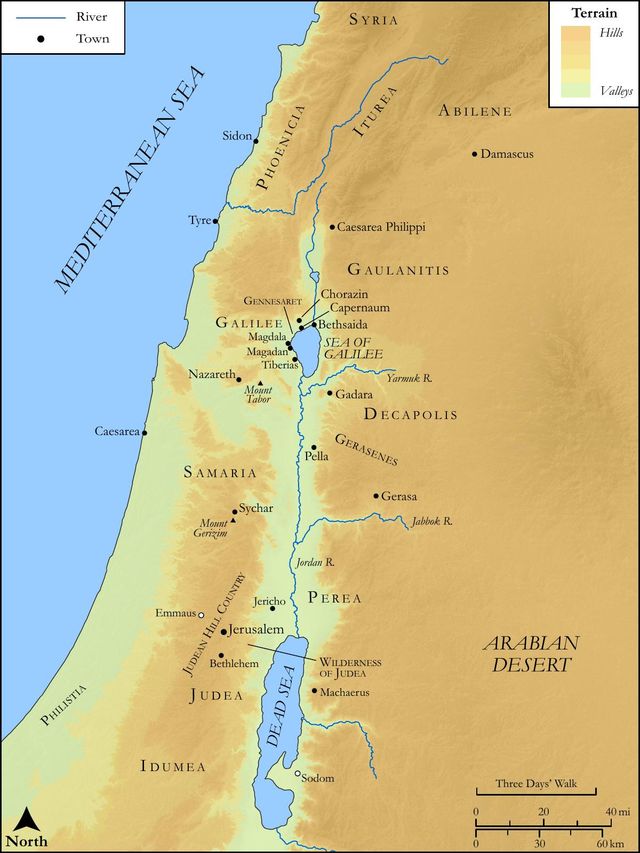
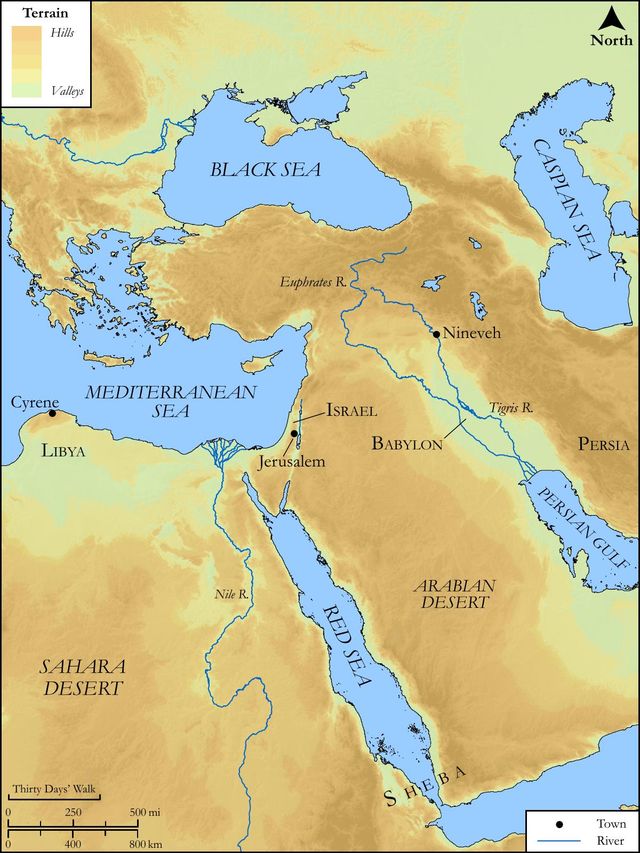
Study this verse
Public-domain commentary
Matthew Henry
From his Commentary on the Whole Bible. Henry comments on passages, not single verses — this entry covers Matthew 3:13–17. His four-level outline is real structure in the source text, so it is rendered as structure.
Our Lord Jesus, from his childhood till now, when he was almost thirty years of age, had lain hid in Galilee, as it were, buried alive; but now, after a long and dark night, behold, the Sun of righteousness rises in glory. The fulness of time was come that Christ should enter upon his prophetical office; and he chooses to do it, not at Jerusalem (though it is probable that he went thither at the three yearly feasts, as others did), but there where John was baptizing; for to him resorted those who waited for the consolation of Israel, to whom alone he would be welcome. John the Baptist was six months older than our Saviour, and it is supposed that he began to preach and baptize about six months before Christ appeared; so long he was employed in preparing his way, in the region round about Jordan; and more was done towards it in these six months than had been done in several ages before. Christ's coming from Galilee to Jordan, to be baptized, teaches us not the shrink from pain and toil, that we may have an opportunity of drawing nigh to God in ordinance. We should be willing to go far, rather than come short of communion with God. Those who will find must seek.
Now in this story of Christ's baptism we may observe,
I.How hardly John was persuaded to admit of it, Mat 3:14, Mat 3:15.
It was an instance of Christ's great humility, that he would offer himself to be baptized of John; that he who knew no sin would submit to the baptism of repentance. Note, As soon as ever Christ began to preach, he preached humility, preached it by his example, preached it to all, especially the young ministers. Christ was designed for the highest honours, yet in his first step he thus abases himself. Note, Those who would rise high must begin low. Before honour is humility. It was a great piece of respect done to John, for Christ thus to come to him; and it was a return for the service he did him, in giving notice of his approach. Note, Those that honour God he will honour. Now here we have,
1.The objection that John made against baptizing Jesus, Mat 3:14. John forbade him, as Peter did, when Christ went about to wash his feet, Joh 13:6, Joh 13:8. Note, Christ's gracious condescensions are so surprising, as to appear at first incredible to the strongest believers; so deep and mysterious, that even they who know his mind well cannot soon find out the meaning of them, but, by reason of darkness, start objections against the will of Christ. John's modesty thinks this an honour too great for him to receive, and he expresses himself to Christ, just as his mother had done to Christ's mother (Luk 1:43); Whence is this to me, that the mother of my Lord should come to me? John had now obtained a great name, and was universally respected: yet see how humble he is still! Note, God has further honours in reserve for those whose spirits continue low when their reputation rises.
(1.)John thinks it necessary that he should be baptized of Christ; I have need to be baptized of thee with the baptism of the Holy Ghost, as of fire, for that was Christ's baptism, Mat 3:11.
[1.]Though John was filled with the Holy Ghost from the womb (Luk 1:15), yet he acknowledges he had need to be baptized with that baptism. Note, They who have much of the Spirit of God, yet, while here, in this imperfect state, see that they have need of more, and need to apply themselves to Christ for more.
[2.]John has need to be baptized, though he was the greatest that ever was born of woman; yet, being born of a woman, he is polluted, as others of Adam's seed are, and owns he had need of cleansing. Note, The purest souls are most sensible of their own remaining impurity, and seek most earnestly for spiritual washing.
[3.]He has need to be baptized of Christ, who can do that for us, which no one else can, and which must be done for us, or we are undone. Note, The best and holiest of men have need of Christ, and the better they are, the more they see of that need.
[4.]This was said before the multitude, who had a great veneration for John, and were ready to embrace him for the Messiah; yet he publicly owns that he had need to be baptized of Christ. Note, It is no disparagement to the greatest of men, to confess that they are undone without Christ and his grace.
[5.]John was Christ's forerunner, and yet owns that he had need to be baptized of him. Note, Even they who were born before Christ in time depended on him, received from him, and had an eye to him.
[6.]While John was dealing with others about their souls, observe how feelingly he speaks of the case of his own soul, I have need to be baptized of thee. Note, Ministers, who preach to others, and baptize others, are concerned to look to it that they preach to themselves, and be themselves baptized with the Holy Ghost. Take heed to thyself first; save thyself, Ti1 4:16.
(2.)He therefore thinks it very preposterous and absurd, that Christ should be baptized by him; Comest thou to me? Does the holy Jesus, that is separated from sinners, come to be baptized by a sinner, as a sinner, and among sinners? How can this be? Or what account can we give of it? Note, Christ's coming to us may well be wondered at.
2.The overruling of this objection (Mat 3:15); Jesus said, Suffer it to be so now. Christ accepted his humility, but not his refusal; he will have the thing done; and it is fit that Christ should take his own method, though we do not understand it, nor can give a reason for it. See,
(1.)How Christ insisted upon it; It must be so now. He does not deny that John had need to be baptized of him, yet he will now be baptized of John. Aphes arti - Let it be yet so; suffer it to be so now. Note, Every thing is beautiful in its season. But why now? Why yet?
[1.]Christ is now in a state of humiliation: he has emptied himself, and made himself of no reputation. He is not only found in fashion as a man, but is made in the likeness of sinful flesh, and therefore now let him be baptized of John; as if he needed to be washed, though perfectly pure; and thus he was made sin for us, though he knew no sin.
[2.]John's baptism is now in reputation, it is that by which God is now doing his work; that is the present dispensation, and therefore Jesus will now be baptized with water; but his baptizing with the Holy Ghost is reserved for hereafter, many days hence, Act 1:5. John's baptism has now its day, and therefore honour must now be put upon that, and they who attend upon it must be encouraged. Note, They who are of greatest attainments in gifts and graces, should yet, in their place, bear their testimony to instituted ordinances, by a humble and diligent attendance on them, that they may give a good example to others. What we see God owns, and while we see he does so, we must own. John was now increasing, and therefore it must be thus yet; shortly he will decrease, and then it will be otherwise.
[3.]It must be so now, because now is the time for Christ's appearing in public, and this will be a fair opportunity for it, See Joh 1:31-34. Thus he must be made manifest to Israel, and be signalized by wonders from heaven, in that act of his own, which was most condescending and self-abasing.
(2.)The reason he gives for it; Thus it becomes us to fulfil all righteousness. Note,
[1.]There was a propriety in every thing that Christ did for us; it was all graceful (Heb 2:10; Heb 7:26); and we must study to do not only that which behoves us, but that which becomes us; not only that which is indispensably necessary, but that which is lovely, and of good report.
[2.]Our Lord Jesus looked upon it as a thing well becoming him, to fulfil all righteousness, that is (as Dr. Whitby explains it), to own every divine institution, and to show his readiness to comply with all God's righteous precepts. Thus it becomes him to justify God, and approve his wisdom, in sending John to prepare his way by the baptism of repentance. Thus it becomes us to countenance and encourage every thing that is good, by pattern as well as precept. Christ often mentioned John and his baptism with honour, which that he might do the better, he was himself baptized. Thus Jesus began first to do, and then to teach; and his ministers must take the same method. Thus Christ filled up the righteousness of the ceremonial law, which consisted in divers washings; thus he recommended the gospel-ordinance of baptism to his church, put honour upon it, and showed what virtue he designed to put into it. It became Christ to submit to John's washing with water, because it was a divine appointment; but it became him to oppose the Pharisees' washing with water, because it was a human invention and imposition; and he justified his disciples in refusing to comply with it.
With the will of Christ, and this reason for it, John was entirely satisfied, and then he suffered him. The same modesty which made him at first decline the honour Christ offered him, now made him do the service Christ enjoined him. Note, No pretence of humility must make us decline our duty.
II.How solemnly Heaven was pleased to grace the baptism of Christ with a special display of glory (Mat 3:16, Mat 3:17); Jesus when he was baptized, went up straightway out of the water. Others that were baptized staid to confess their sins (Mat 3:6); but Christ, having no sins to confess, went up immediately out of the water; so we read it, but not right: for it is apo tou hudatos - from the water; from the brink of the river, to which he went down to be washed with water, that is, to have his head or face washed (Joh 13:9); for here is no mention of the putting off, or putting on, of his clothes, which circumstance would not have omitted, if he had been baptized naked. He went up straightway, as one that entered upon his work with the utmost cheerfulness and resolution; he would lose no time. How was he straitened till it was accomplished!
Now, when he was coming up out of the water, and all the company had their eye upon him,
1.Lo! the heavens were opened unto him, so as to discover something above and beyond the starry firmament, at least, to him. This was,
(1.)To encourage him to go on in his undertaking, with the prospect of the glory and joy that were set before him. Heaven is opened to receive him, when he has finished the work he is now entering upon.
(2.)To encourage us to receive him, and submit to him. Note, In and through Jesus Christ, the heavens are opened to the children of men. Sin shut up heaven, put a stop to all friendly intercourse between God and man; but now Christ has opened the kingdom of heaven to all believers. Divine light and love are darted down upon the children of men, and we have boldness to enter into the holiest. We have receipts of mercy from God, we make returns of duty to God, and all by Jesus Christ, who is the ladder that had its foot on earth and its top in heaven, by whom alone it is that we have any comfortable correspondence with God, or any hope of getting to heaven at last. The heavens were opened when Christ was baptized, to teach us, that when we duly attend on God's ordinances, we may expect communion with him, and communications from him.
2.He saw the Spirit of God descending like a dove, or as a dove, and coming or lighting upon him. Christ saw it (Mar 1:10), and John saw it (Joh 1:33, Joh 1:34), and it is probable that all the standers-by saw it; for this was intended to be his public inauguration. Observe,
(1.)He saw the Spirit of God descended, and lighted on him. In the beginning of the old world, the Spirit of God moved upon the face of the waters (Gen 1:2), hovered as a bird upon the nest. So here, in the beginning of this new world, Christ, as God, needed not to receive the Holy Ghost, but it was foretold that the Spirit of the Lord should rest upon him (Isa 11:2; Isa 61:1), and here he did so; for,
[1.]He was to be a Prophet; and prophets always spoke by the Spirit of God, who came upon them. Christ was to execute the prophetic office, not by his divine nature (says Dr. Whitby), but by the afflatus of the Holy Spirit.
[2.]He was to be the Head of the church; and the Spirit descended upon him, by him to be derived to all believers, in his gifts, graces, and comforts. The ointment on the head ran down to the skirts; Christ received gifts for men, that he might give gifts to men.
(2.)He descended on him like a dove; whether it was a real, living dove, or, as was usual in visions, the representation or similitude of a dove, is uncertain. If there must be a bodily shape (Luk 3:22), it must not be that of a man, for the being seen in fashion as a man was peculiar to the second person: none therefore was more fit than the shape of one of the fowls of heaven (heaven being now opened), and of all fowl none was so significant as the dove.
[1.]The Spirit of Christ is a dove-like spirit; not like a silly dove, without heart (Hos 7:11), but like an innocent dove, without gall. The Spirit descended, not in the shape of an eagle, which is, though a royal bird, yet a bird of prey, but in the shape of a dove, than which no creature is more harmless and inoffensive. Such was the Spirit of Christ: He shall not strive, nor cry; such must Christians be, harmless as doves. The dove is remarkable for her eyes; we find that both the eyes of Christ (Sol 5:12), and the eyes of the church (Sol 1:15; Sol 4:1), are compared to doves' eyes, for they have the same spirit. The dove mourns much (Isa 38:14). Christ wept oft; and penitent souls are compared to doves of the valleys.
[2.]The dove was the only fowl that was offered in sacrifice (Lev 1:14), and Christ by the Spirit, the eternal Spirit, offered himself without spot to God.
[3.]The tidings of the decrease of Noah's flood were brought by a dove, with an olive-leaf in her mouth; fitly therefore are the glad tidings of peace with God brought by the Spirit as a dove. It speaks God's good will towards men; that his thoughts towards us are thoughts of good, and not evil. By the voice of the turtle heard in our land (Sol 2:12), the Chaldee paraphrase understands, the voice of the Holy Spirit. That God is in Christ reconciling the world unto himself, is a joyful message, which comes to us upon the wing, the wings of a dove.
3.To explain and complete this solemnity, there came a voice from heaven, which, we have reason to think, was heard by all that were present. The Holy Spirit manifested himself in the likeness of a dove, but God the Father by a voice; for when the law was given they saw no manner of similitude, only they heard a voice (Deu 4:12); and so this gospel came, and gospel indeed it is, the best news that ever came from heaven to earth; for it speaks plainly and fully God's favour to Christ, and us in him.
(1.)See here how God owns our Lord Jesus; This is my beloved Son. Observe,
[1.]The relation he stood in to him; He is my Son. Jesus Christ is the Son of God, by eternal generation, as he was begotten of the Father before all the worlds (Col 1:15; Heb 1:3); and by supernatural conception; he was therefore called the Son of God, because he was conceived by the power of the Holy Ghost (Luk 1:35); yet this is not all; he is the Son of God by special designation to the work and office of the world's Redeemer. He was sanctified and sealed, and sent upon that errand, brought up with the Father for it (Pro 8:30), appointed to it; I will make him my First-born, Psa 89:27.
[2.]The affection the Father had for him; He is my beloved Son; his dear Son, the Son of his love (Col 1:13); he has lain in his bosom from all eternity (Joh 1:18), had been always his delight (Pro 8:30), but particularly as Mediator, and in undertaking the work of man's salvation, he was his beloved Son. He is my Elect, in whom my soul delights. See Isa 42:1. Because he consented to the covenant of redemption, and delighted to do that will of God, therefore the Father loved him. Joh 10:17; Joh 3:35. Behold, then, behold, and wonder, what manner of love the Father has bestowed on us, that he should deliver up him that was the Son of his love, to suffer and die for those that were the generation of his wrath; nay, and that he therefore loved him, because he laid down his life for the sheep! Now know we that he loved us, seeing he has not withheld his Son, his only Son, his Isaac whom he loved, but gave him to be a sacrifice for our sin.
(2.)See here how ready he is to own us in him: He is my beloved Son, not only with whom, but in whom, I am well pleased. He is pleased with all that are in him, and are united to him by faith. Hitherto God had been displeased with the children of men, but now his anger is turned away, and he has made us accepted in the Beloved, Eph 1:6. Let all the world take notice, that this is the Peace-maker, the Days-man, who has laid his hand upon us both, and that there is no coming to God as a Father, but by him as Mediator, Joh 14:6. In him our spiritual sacrifices are acceptable, for his the Altar that sanctifies every gift, Pe1 2:5. Out of Christ, God is a consuming Fire, but, in Christ, a reconciled Father. This is the sum of the whole gospel; it is a faithful saying, and worthy of all acceptation, that God has declared, by a voice from heaven, that Jesus Christ is his beloved Son, in whom he is well pleased, with which we must by faith cheerfully concur, and say, that he is our beloved Saviour, in whom we are well pleased.
Historical interpretation
Eleven Centuries of Reception
19 surviving comments on this verse. Each one is dated, so this reads as a timeline rather than a list.
Select a marker to jump to its quote. Markers stagger vertically where authors wrote within a few decades of each other.
Accordingly the Spirit, admiring such as soar up to the celestial realms by these ascensions, says, "They fly, as if they were kites; they fly as clouds, and as young doves, unto me" -that is, simply like a dove. For we shall, according to the apostle, be caught up into the clouds to meet the Lord (even the Son of man, who shall come in the clouds, according to Daniel ) and so shall we ever be with the Lord, so long as He remains both on the earth and in heaven, who, against such as are thankless for both one promise and the other, calls the elements themselves to witness: "Hear, O heaven, and give ear, O earth.
Over the waters of baptism, recognising as it were His primeval seat, He reposes: (He who) glided down on the Lord "in the shape of a dove," in order that the nature of the Holy Spirit might be declared by means of the creature (the emblem) of simplicity and innocence, because even in her bodily structure the dove is without literal gall.
If you had not purposely rejected in some instances, and corrupter in others, the Scriptures which are opposed to your opinion, you would have been confuted in this matter by the Gospel of John, when it declares that the Spirit descended in the body of a dove, and sat upon the Lord. When the said Spirit was in this condition, He was as truly a dove as He was also a spirit; nor did He destroy His own proper substance by the assumption of an extraneous substance.
Christ was baptized for our sake, in order to sanctify the waters. The Spirit descended in the form of a dove, since wherever there is reconciliation with God there is a dove, as in the case of Noah’s ark … announcing God’s mercy to the world and at the same time making clear that what is spiritual should be meek and without wickedness, simple and without guile.
(Ambrosiaster. Serm. xii. 4.) For, as we have said, when the Saviour was washed, then the water was cleansed for our baptism, that a laver might be ministered to the people who were to come. Moreover, it behoved that in Christ's baptism should be signified those things which the faithful obtain by baptism.
"And Jesus, when He was baptized, went up straightway out of the water; and lo! the heavens were opened unto Him."
Wherefore were the heavens opened? To inform thee that at thy baptism also this is done, God calling thee to thy country on high, and persuading thee to have nothing to do with earth. And if thou see not, yet never doubt it. For so evermore at the beginnings of all wonderful and spiritual transactions, sensible visions appear, and such-like signs, for the sake of them that are somewhat dull in disposition, and who have need of outward sight, and who cannot at all conceive an incorporeal nature, but are excited only by the things that are seen: that so, though afterward no such thing occur, what hath been declared by them once for all at the first may be received by thy faith.
For in the case of the apostles too, there was a "sound of a mighty wind," and visions of fiery tongues appeared, but not for the apostles' sake, but because of the Jews who were then present. Nevertheless, even though no sensible signs take place, we receive the things that have been once manifested by them. Since the dove itself at that time therefore appeared, that as in place of a finger (so to say) it might point out to them that were present, and to John, the Son of God. Not however merely on this account, but to teach thee also, that upon thee no less at thy baptism the Spirit comes. But since then we have no need of sensible vision, faith sufficing instead of all. For signs are "not for them that believe, but for them that believe not."
But why in the fashion of a dove? Gentle is that creature, and pure. Forasmuch then as the Spirit too is "a Spirit of meekness," He therefore appears in this sort. And besides, He is reminding us of an ancient history. For so, when once a common shipwreck had overtaken the whole world, and our race was in danger of perishing, this creature appeared, and indicated the deliverance from the tempest, and bearing an olive branch, published the good tidings of the common calm of the whole world; all which was a type of the things to come. For in fact the condition of men was then much worse, and they deserved a much sorer punishment. To prevent thy despairing, therefore, He reminds thee of that history. Because then also, when things were desperate, there was a sort of deliverance and reformation; but then by punishment, now, on the contrary, by grace and an unspeakable gift. Therefore the dove also appears, not bearing an olive branch, but pointing out to us our Deliverer from all evils, and suggesting the gracious hopes. For not from out of an ark doth she lead one man only, but the whole world she leads up into heaven at her appearing, and instead of a branch of peace from an olive, she conveys the adoption to all the world's offspring in common.
Reflect now on the greatness of the gift, and do not account His dignity the less for His appearing in such a likeness. For I actually hear some saying, that "such as is the difference between a man and a dove, so great is that between Christ and the Spirit: since the one appeared in our nature, the other in the likeness of a dove." What must we say then to these things? That the Son of God did indeed take upon Him the nature of man, but the Spirit took not on Him the nature of a dove. Therefore the evangelist also said not, "in the nature of a dove," but "in the form of a dove." Accordingly, never after did He so much as appear in this fashion, but at that moment only. And if on this account thou affirmest His dignity to be less, the cherubim too will be made out by this reasoning much His superior, even as much so as an eagle is to a dove: because they too were figured into that visible shape. And the angels too superior again, for they no less have many times appeared in the fashion of men. But these things are not so, indeed they are not. For the truth of an economy is one thing, and the condescension of a temporary vision another.
But though you see it not, be not therefore unbelieving, for in the beginnings of spiritual matters sensible visions are always offered, for their sakes who can form no idea of things that have no body; which if they occur not in later times, yet faith may be established by those wonders once wrought.
It is moreover an allusion to ancient history; for in the deluge this creature appeared bearing an olive-branch, and tidings of rest to the world. All which things were a type of things to come. For now also a dove appears pointing out to us our liberator, and for an olive-branch bringing the adoption of the human race.
"Then he suffereth Him. And Jesus, when He was baptized, went up straightway out of the water; and, lo, the heavens were opened unto Him, and he saw the Spirit of God descending like a dove, and lighting upon Him."
For inasmuch as many supposed that John was greater than He, because John had been brought up all his time in the wilderness, and was son of a chief priest, and was clothed with such raiment, and was calling all men unto his baptism, and had been born of a barren mother; while Jesus, first of all, was of a damsel of ordinary rank (for the virgin birth was not yet manifest to all); and besides, He had been brought up in an house, and held converse with all men, and wore this common raiment; they suspected Him to be less than John, knowing as yet nothing of those secret things; and it fell out moreover that He was baptized of John, which thing added support to this surmise, even if none of those mentioned before had existed; for it would come into their mind that this man was one of the many (for were He not one of the many, He would not have come with the many to the baptism), but that John was greater than He and far more admirable: in order therefore that this opinion might not prevail, the heavens are opened, when He is baptized, and the Spirit comes down, and a voice with the Spirit, proclaiming the dignity of the Only Begotten. For since the voice that said, "This is my beloved Son," would seem to the multitude rather to belong to John, for it added not, "This that is baptized," but simply "This," and every hearer would conceive it to be said concerning the baptizer, rather than the baptized, partly on account of the Baptist's own dignity, partly for all that hath been mentioned; the Spirit came in form of a dove, drawing the voice towards Jesus, and making it evident to all, that "This" was not spoken of John that baptized, but of Jesus who was baptized.
[Daniel 10:4] "And in the twenty-fourth day of the first month, I was beside the great river which is the Tigris." Ezekiel also had seen a great vision beside a river, the Chebar (Ezekiel 1:1). And it was by the stream of the Jordan that the heavens were opened to the gaze of our Lord and Savior and also to John the Baptist (Matthew 3:1-17). Therefore those critics should leave off their foolish objections who raise questions about the presence of shadows and symbols in a matter of historical truth and attempt to destroy the truth itself by imagining that they should employ allegorical methods to destroy the historicity of rivers and trees and of Paradise.
Not by an actual cleaving of the visible element, but to the spiritual eye, as Ezekiel also in the beginning of his book relates that he saw them.
It sate on the head of Jesus, that none might suppose the voice of the Father spoken to John, and not to the Lord.
(Verse 16) For thus it is fitting for us to fulfill all righteousness. Then he let him go. And Jesus, having been baptized, immediately came up from the water. He did not add the righteousness of the Law or of nature, so that we may understand both: if God accepted baptism from a man, let no one refuse to accept it from a servant.
The Holy Spirit appeared in the form of a dove, being kindly, affectionate and a lover of humanity. Although frequently pushed aside, the dove nevertheless comes again to be possessed by us and does us good according to its own goodness. For the dove is an affectionate creature, a friend of humanity, who, even though mistreated by people who snatch away and eat its nestlings, does not depart from those it is accustomed to live with but remains no matter what.
(App. Serm. 135. 1.) Christ after He had been once born among men, is born a second time in the sacraments, that as we adore Him then born of a pure mother, so we may now receive Him immersed in pure water. His mother brought forth her Son, and is yet virgin; the wave washed Christ, and is holy. Lastly, that Holy Spirit which was present to Him in the womb, now shone round Him in the water, He who then made Mary pure, now sanctifies the waters.
(de Trin. ii. 5.) It is easy to understand how the Holy Ghost should be said to be sent, when as it were a dove in visible shape descended on the Lord; that is, there was created a certain appearance for the time in which the Holy Spirit might be visibly shewn. And this operation thus made visible and offered to mortal view, is called the mission of the Holy Spirit, not that His invisible substance was seen, but that the hearts of men might be roused by the external appearance to contemplate the unseen eternity. Yet this creature in the shape of which the Spirit appeared, was not taken into unity of person, as was that human shape taken of the Virgin. For neither did the Spirit bless the dove, nor unite it with Himself for all eternity, in unity of person. Further, though that dove is called the Spirit, so far as to show that in this dove was a manifestation of the Spirit, yet can we not say of the Holy Spirit that He is God and dove, as we say of the Son that He is God and man; and yet it is not as we say of the Son that He is the Lamb of God, as not only has John Baptist declared, but as John the Evangelist saw the vision of the Lamb slain in the Apocalypse. For this was a prophetic vision, not put before the bodily eyes in bodily shape, but seen in the Spirit in spiritual images. But concerning this dove none ever doubted that it was seen with the bodily eye; not that we say the Spirit is a dove as we say Christ is a Rock; (for that Rock was Christ.) (1 Cor. 10:4.) For that Rock already existed as a creature, and from the resemblance of its operation was called by the name of Christ, (whom it figured;) not so this dove, which was created at the moment for this single purpose. It seems to me to be more like the flame which appeared to Moses in the bush, or that which the people followed in the wilderness, or to the thunderings and lightnings which were when the Law was given from the mount. For all these were visible objects intended to signify something, and then to pass away. For that such forms have been from time to time seen, the Holy Spirit is said to have been sent; but these bodily forms appeared for the time to show what was required, and then ceased to be.
In the times before Christ’s coming, those being baptized were held down in the water a longer time for the confession of sin. But Christ, being sinless, “came up immediately.” For Christ was not baptized as one repenting but as one cleansing sins and sanctifying the waters.
This action of Christ's has a figurative meaning pertaining to all who were after Him to be baptized; and therefore he says, straightway He ascended, and not simply He ascended, for all who are worthily baptized in Christ, straightway ascend from the water; that is, make progress in virtues, and are carried on towards a heavenly dignity. They who had gone down to the water carnal and sinful sons of Adam, straightway ascend from the water spiritual sons of God. But if some by their own faults make no progress after baptism, what is that to the baptism?
For had the actual creation of the heavens been opened, he would not have said were opened to Him, for a physical opening would have been open to all. But some one will say, What, are the heavens then closed to the eye of the Son of God, who even when on earth is present in heaven? But it must be known, that as He was baptized according to the ordinance of humanity that He had taken on Him, so the heavens were opened to His sight as to His human nature, though as to His divine He was in heaven.
Perhaps there were before some unseen obstacles which hindered the souls of the dead from entering the skies. I suppose that since Adam's sin no soul had mounted the skies, but the heavens were continually closed. When, lo! on Christ's baptism they were again opened; after He had overcome by the Cross the great tyrant death, henceforward the heaven, never more to be closed, needed not gates, so that the Angels say not, 'Open ye gates,' for they were open, but take away the gates. (Ps. 24:7.) Or the heavens are opened to the baptized, and they see those things which are in heaven, not by seeing them with the bodily eye, but by believing with the spiritual eye of faith. Or thus; The heavens are the divine Scriptures, which all read but all do not understand, except they who have been so baptized as to receive the Holy Spirit. Thus the Scriptures of the Prophets were at the first sealed to the Apostles, but after they had received the Holy Spirit, all Scripture was opened to them. However, in whatever way we interpret, the heavens were opened to Him, that is to all, on His account; as if the Emperor were to say to any one preferring a petition for another, This boon I grant not to him but to you; that is, to him, for your sake.
The Holy Ghost took the likeness of a dove, as being more than other animals susceptible of love. All other forms of righteousness which the servants of God have in truth and verity, the servants of the Devil have in spurious imitation; the love of the Holy Spirit alone an unclean spirit cannot imitate. And the Holy Ghost has therefore reserved to Himself this special manifestation of love, because by no testimony is it so clearly seen where He dwells as by the grace of love.
Or thus; It becometh us to fulfil all righteousness, that is, to give an example of perfect justification in baptism, without which the gate of the kingdom of heaven is not opened. Hence let the proud take an example of humility, and not scorn to be baptized by My humble members when they see Me baptized by John My servant. That is true humility which obedience accompanies; as it continues, then he suffered Him, that is, at last consented to baptize Him.
But was this then the first time that the heavens were opened to Him according to His human nature? The faith of the Church both believes and holds that the heavens were no less open to Him before than after. It is therefore said here, that the heavens were opened, because to all them who are born again the door of the kingdom of heaven is opened.
As to all those who by baptism are born again, the door of the kingdom of heaven is opened, so all in baptism receive the gifts of the Holy Spirit.
As by the immersion of His body He dedicated the laver of baptism, He has shown that to us also after baptism received the entrance to heaven is open, and the Holy Spirit is given, as it follows, and the heavens were opened.
(ap. Anselm.) Seven excellencies in the baptized are figured by the dove. The dove has her abode near the rivers, that when the hawk is seen, she may dive under water and escape; she chooses the better grains of corn; she feeds the young of other birds; she does not tear with her beak; she lacks a gall; she has her rest in the caverns of the rocks; for her song she has a plaint. Thus the saints dwell beside the streams of Divine Scripture, that they may escape the assaults of the Devil; they choose wholesome doctrine, and not heretical for their food; they nourish by teaching and example, men who have been the children of the Devil, i. e. the imitators; they do not pervert good doctrine by tearing it to pieces as the heretics do; they are without hate irreconcileable; they build their nest in the wounds of Christ's death, which is to them a firm rock, that is their refuge and hope; as others delight in song, so do they in groaning for their sin.
He was baptized at the age of thirty; for by this age one has experienced all the sins. In the first ten years, there is great foolishness; in the second, during adolescence, the great flame of desire and anger; and in the years of adulthood, great avarice. Jesus waited for this age, therefore, so that He could fulfill the law in all the ages of a man, and sanctify us.
The Manichean heretics say that He left His body in the Jordan and thereafter displayed another, illusory, body. But their mouths are shut by this, for it says, "Jesus went up"; it was not another who went up, but He Who went down into the water.
Adam had closed the heavens, but through Christ they are opened, so that you may learn, O reader, that when you are baptized, you, too, open the heavens.
(non occ.) Or, so bright a glory shone round about Christ, that the blue concave seemed to be actually cloven.
Continue studying Matthew 3:16 across the web’s major study libraries — every link below opens this exact verse, chapter, or book on the destination site.
Read & Compare
 BibleGatewayThis verse in more than 200 translations and 70 languages.
 Bible.comThe YouVersion reader — hundreds of translations, reading plans, and highlights.
 ESV.orgCrossway's official English Standard Version reader.
 NET BibleThe NET translation with 60,000+ translators' notes on every rendering decision.
 STEP BibleTyndale House's free study tool — original text, vocabulary, and scholarly resources.
 BibliaLogos Bible Software's free web reader.
 USCCBThe New American Bible (Revised Edition) with the U.S. bishops' study notes.
Commentaries
 BibleHub CommentariesDozens of classic commentaries on this verse, gathered on one page.
 StudyLightMore than 100 commentary sets — the largest collection on the web.
 BibleRefPlain-English commentary on what this verse means, verse by verse.
 Enduring WordDavid Guzik's free commentary on this chapter, widely used by Bible teachers.
 Bible Study ToolsVerse commentary alongside Greek and Hebrew study aids.
Original Language & Research
- BibleHub InterlinearThe verse word by word — original language, transliteration, and English.
- BibleHub LexiconEvery word's original-language definition and Strong's entry.
 Blue Letter BibleDeep-study tools — Strong's numbers, concordance, and word studies.
 CNTR CollationThe earliest Greek manuscripts of this verse, collated letter by letter.
Sermons, Hymns & Audio


TrulyRandomVerse is not affiliated with these sites and doesn’t control their content. They’re linked because they’re genuinely useful.
Summary
Matthew 3:16 marks a pivotal moment in the Gospels, immediately following Jesus' baptism by John in the Jordan River. This verse describes a profound divine manifestation: the heavens opening, and the Spirit of God descending upon Jesus in a visible, dove-like form. This extraordinary event serves as a public anointing and affirmation of Jesus by God the Father, inaugurating His messianic ministry and revealing the distinct persons of the Trinity at work.
Context
ShowHideLiterary Context
This verse is the climactic moment of Jesus' encounter with John the Baptist at the Jordan River, as recorded in the Synoptic Gospels. It directly follows John's initial hesitation to baptize Jesus and Jesus' profound declaration that His baptism was necessary "to fulfill all righteousness" (Matthew 3:15). The events described in Matthew 3:16 set the stage for the Father's verbal affirmation in the subsequent verse (Matthew 3:17), forming a complete divine attestation. This entire passage serves as the formal inauguration of Jesus' public ministry, transitioning from John's preparatory work to Jesus' active messianic mission.
Historical & Cultural Context
In ancient Israel, anointing with oil symbolized divine appointment and empowerment for specific roles, particularly for prophets, priests, and kings. While Jesus was not physically anointed with oil here, the descent of the Spirit "like a dove" functioned as a visible, divine anointing, signifying His commissioning as the Messiah, the ultimate Prophet, Priest, and King. The Jewish people of this era were eagerly awaiting the Messiah, and the signs accompanying Jesus' baptism—the opening of the heavens and the Spirit's descent—would have resonated deeply with prophetic expectations of a new divine intervention and the coming of God's chosen one, particularly prophecies related to the Spirit resting upon the Servant of the Lord (e.g., Isaiah 42:1 or Isaiah 61:1).
Key Themes
ShowHideMatthew 3:16 profoundly contributes to several key themes. Firstly, it highlights the Divine Anointing and Empowerment of Jesus by the Holy Spirit. This anointing was not for purification (as Jesus was sinless), but for equipping Him for His earthly ministry of teaching, healing, and ultimately, redemption. Secondly, it offers a striking Revelation of the Triune Godhead, presenting the Son (Jesus) being baptized, the Spirit (the third person of the Trinity) descending, and the Father (whose voice is heard in Matthew 3:17) speaking from heaven. This moment uniquely displays the distinct persons of God working in perfect unity. Thirdly, the event signifies the Inauguration of Jesus' Public Ministry, marking the official commencement of His work as the Messiah, fulfilling the prophecies and expectations of Israel.
Exposition and Analysis
ShowHideKey Word Analysis
ShowHideThis verb means "to immerse, submerge; to make whelmed (i.e. fully wet)." In the New Testament, it is technically used for the ordinance of Christian baptism, signifying a ceremonial ablution. For Jesus, being sinless, His baptism was not for repentance but for identification with humanity and submission to God's righteous plan.
This term denotes "a current of air, i.e. breath or a breeze," but extends figuratively to "a spirit," including the rational soul, vital principle, mental disposition, or, supernaturally, an angel, demon, or, divinely, God, Christ's spirit, or the Holy Spirit. Here, it specifically refers to the Holy Spirit, the third person of the Trinity, who descends upon Jesus.
Meaning "to descend (literally or figuratively)." This verb emphasizes the downward movement of the Spirit, indicating a direct, intentional act of God from heaven towards Jesus, signifying a divine bestowal or empowerment.
Verse Breakdown
ShowHide"And Jesus, when he was baptized"
This clause establishes the immediate context, placing the divine manifestation directly after Jesus' immersion in the Jordan by John the Baptist. It underscores the significance of baptism as the gateway to this profound experience.
"went up straightway out of the water"
The Greek word for "straightway" (G2117, euthýs) emphasizes the immediacy and swiftness of Jesus' action. There was no delay between His emergence from the water and the ensuing divine event, highlighting the direct connection between His baptism and the heavenly affirmation.
"and, lo, the heavens were opened unto him"
The interjection "lo" (G2400, idoú) draws immediate attention to a miraculous and awe-inspiring sight. The "opening of the heavens" (G3772, ouranós, G455, anoígō) signifies a direct divine intervention, a tearing apart of the veil between the earthly and heavenly realms, allowing God's presence and power to be revealed. This is a common biblical motif for divine revelation and access to God's presence.
"and he saw the Spirit of God descending like a dove"
Jesus Himself witnessed this extraordinary event. The "Spirit of God" (G4151, pneûma, G2316, theós) refers to the Holy Spirit. The phrase "like a dove" (G5616, hōseí, G4058, peristerá) describes the manner of the Spirit's descent – gentle, visible, and perhaps with a hovering motion, rather than implying the Spirit literally transformed into a bird. This imagery conveys purity, peace, and perhaps a new creation, reminiscent of the dove in Noah's ark.
"and lighting upon him"
The Spirit's descent culminates in "lighting upon him" (G2064, érchomai, G1909, epí, G846, autós), indicating a settling or resting of the Spirit on Jesus. This signifies not a temporary visitation but a permanent indwelling and empowering for His messianic mission, marking Him as the anointed one.
Literary Devices
ShowHideMatthew 3:16 is rich in Imagery, particularly the vivid description of the Spirit "descending like a dove," which creates a powerful visual of peace, purity, and divine gentleness. This use of Simile (comparing the Spirit's descent to a dove) helps to convey the manner and character of the Spirit's arrival without suggesting a literal transformation. The "opening of the heavens" functions as a Theophany or Divine Manifestation, a visible sign of God's direct intervention and revelation. This dramatic opening serves as a Symbolism of God's direct communication and the breaking through of the divine into the human realm, emphasizing the profound significance of the moment for Jesus' identity and mission. The entire scene is imbued with Symbolism, with the dove representing peace, new creation (recalling Genesis 8:11), and the purity of the divine presence, while the opened heavens symbolize divine approval and the commencement of a new era.
Theological and Thematic Connections
ShowHideMatthew 3:16 stands as a foundational text for understanding the person and work of Jesus, as well as the nature of the Triune God. It unveils Jesus as the divinely appointed Messiah, empowered by the Holy Spirit for His redemptive mission. The simultaneous presence of Jesus (the Son), the descending Spirit, and the Father's voice (in the subsequent verse) provides one of the clearest biblical displays of the Trinity, demonstrating their distinct persons yet unified purpose in salvation history. This anointing of Jesus by the Spirit also foreshadows the Spirit's empowering work in believers, enabling them to live out their faith and participate in God's mission in the world.
Reflection and Application
ShowHideThe baptism of Jesus and the subsequent divine affirmation in Matthew 3:16 offer profound lessons for every believer. Just as Jesus, though sinless, submitted to baptism to "fulfill all righteousness," so too are we called to obedience and identification with Christ through baptism, publicly declaring our faith and commitment. The descent of the Holy Spirit upon Jesus signifies His empowerment for ministry, reminding us that effective Christian living and service are not accomplished in our own strength but through the indwelling and empowering presence of the Holy Spirit. This passage encourages us to seek and rely on the Spirit's power for our own callings, knowing that God equips those whom He calls. Furthermore, the Father's affirmation of Jesus as His "beloved Son" assures us that as adopted children of God through Christ, we too are affirmed and cherished by our heavenly Father, equipped for the good works He has prepared for us.
Questions for Reflection
ShowHideFAQ
ShowHideWhy did Jesus need to be baptized if He was sinless?
ShowHideJesus' baptism was not for the remission of sins, as He was without sin. Instead, as He Himself stated in Matthew 3:15, it was "to fulfill all righteousness." This act served multiple purposes: it identified Jesus with humanity and their need for salvation, it validated John the Baptist's ministry, it publicly inaugurated Jesus' messianic mission, and it provided an occasion for the divine affirmation of the Trinity. It was an act of perfect obedience to the Father's will, setting an example for all who would follow Him.
What is the significance of the Spirit appearing "like a dove"?
ShowHideThe description "like a dove" (G5616, hōseí, G4058, peristerá) is a simile, indicating the manner or appearance of the Spirit's descent, not that the Holy Spirit literally transformed into a bird. The dove carries rich symbolism in biblical tradition:
Christ-Centered Fulfillment
ShowHideMatthew 3:16 is a profoundly Christ-centered event, marking the divine inauguration of Jesus' redemptive work. His baptism, though an act of humility and identification with humanity, foreshadows His ultimate immersion in suffering and death for the world's sin, leading to His resurrection and ascension, which are the true "going up out of the water" for all humanity (Romans 6:3-4). The opening of the heavens signifies that in Christ, the barrier between God and humanity is torn down, granting access to the Father through Him (Hebrews 10:19-20). The descent of the Spirit upon Jesus is His anointing as the Messiah, empowering Him for His earthly ministry of preaching, healing, and delivering from spiritual bondage, as prophesied in Isaiah 61:1 and declared by Jesus Himself in Luke 4:18-19. This anointing is not merely for Jesus' personal benefit but for the benefit of all who believe in Him. It is the same Spirit, poured out by the exalted Christ, who now indwells and empowers believers, enabling them to participate in His ongoing mission as His body on earth (Acts 2:33). Thus, Matthew 3:16 reveals Jesus as the Spirit-anointed Son, the one through whom God's presence and power are fully manifested and ultimately extended to His people.