


Matthew 3:14
Bible text: King James Version (1769 Blayney text) · Public domain
Bible text: Berean Standard Bible · Public domain
Bible text: American Standard Version (1901) · Public domain
Bible text: World English Bible, Messianic edition · Public domain
Bible text: Geneva Bible (1599) · Public domain
Bible text: Young's Literal Translation · Public domain
- ὁho<the>G3588T-NSMDefinite article Nominative Singular Masculine
- δὲdeButG1161CONJConjunction
- ἸωάννηςIōannēsJohnG2491N-NSM-PNoun Nominative Singular Masculine Individual
- διεκώλυενdiekōluenwas hinderingG1254V-IAI-3SVerb Imperfect Active Indicative 3rd Singular
- αὐτὸνautonHimG846P-ASMPersonal pronoun Accusative Singular Masculine
- λέγων·legōnsayingG3004V-PAP-NSMVerb Present Active Participle Nominative Singular Masculine
- ἐγὼegōI myselfG1473P-1NSPersonal pronoun Nominative 1st Singular
- χρείανchreianneedG5532N-ASFNoun Accusative Singular Feminine
- ἔχωechōhaveG2192V-PAI-1SVerb Present Active Indicative 1st Singular
- ὑπὸhupobyG5259PREPPreposition
- σοῦsouYouG4771P-2GSPersonal pronoun Genitive 2nd Singular
- βαπτισθῆναιbaptisthēnaito be baptizedG907V-APNVerb Aorist Passive Infinitive
- καὶkaiandG2532CONJConjunction
- σὺsuYou yourselfG4771P-2NSPersonal pronoun Nominative 2nd Singular
- ἔρχῃerchēcomeG2064V-PNI-2SVerb Present Middle Or Passive Deponent Indicative 2nd Singular
- πρόςprostoG4314PREPPreposition
- με;meme?G3165P-1ASPersonal pronoun Accusative 1st Singular
English is a literal word-by-word gloss of the Greek, not the KJV's wording. Why?
This is the original text the KJV's translators worked from — each Greek word with its own literal English meaning in this verse, prepared by scholars at Tyndale House, Cambridge. The KJV translates whole sentences, not word by word, so its wording differs: one Greek word can become several English words, and the KJV may choose “charity” where the gloss reads “love”. Both are faithful — they answer different questions. For the KJV's own rendering, switch to the KJV text.
Details
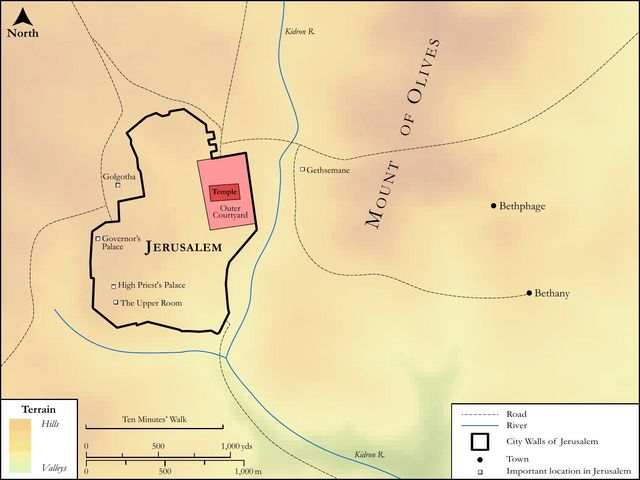
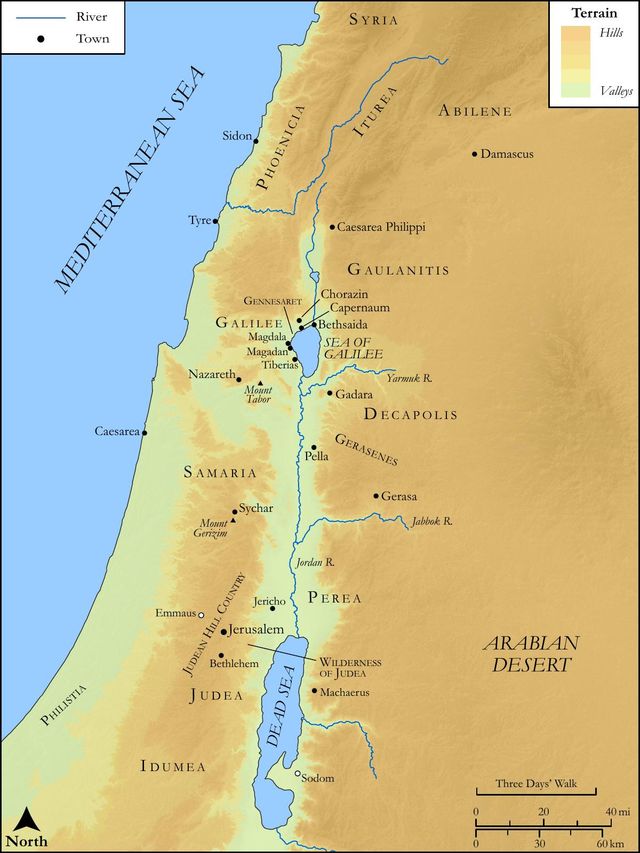
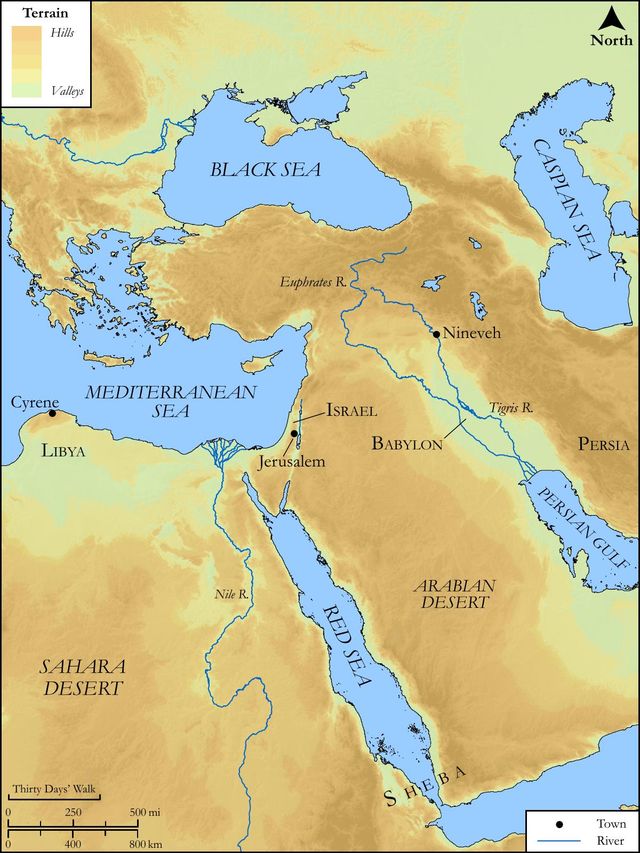
See on the biblical-era maps
Study this verse
Public-domain commentary
Matthew Henry
From his Commentary on the Whole Bible. Henry comments on passages, not single verses — this entry covers Matthew 3:13–17. His four-level outline is real structure in the source text, so it is rendered as structure.
Our Lord Jesus, from his childhood till now, when he was almost thirty years of age, had lain hid in Galilee, as it were, buried alive; but now, after a long and dark night, behold, the Sun of righteousness rises in glory. The fulness of time was come that Christ should enter upon his prophetical office; and he chooses to do it, not at Jerusalem (though it is probable that he went thither at the three yearly feasts, as others did), but there where John was baptizing; for to him resorted those who waited for the consolation of Israel, to whom alone he would be welcome. John the Baptist was six months older than our Saviour, and it is supposed that he began to preach and baptize about six months before Christ appeared; so long he was employed in preparing his way, in the region round about Jordan; and more was done towards it in these six months than had been done in several ages before. Christ's coming from Galilee to Jordan, to be baptized, teaches us not the shrink from pain and toil, that we may have an opportunity of drawing nigh to God in ordinance. We should be willing to go far, rather than come short of communion with God. Those who will find must seek.
Now in this story of Christ's baptism we may observe,
I.How hardly John was persuaded to admit of it, Mat 3:14, Mat 3:15.
It was an instance of Christ's great humility, that he would offer himself to be baptized of John; that he who knew no sin would submit to the baptism of repentance. Note, As soon as ever Christ began to preach, he preached humility, preached it by his example, preached it to all, especially the young ministers. Christ was designed for the highest honours, yet in his first step he thus abases himself. Note, Those who would rise high must begin low. Before honour is humility. It was a great piece of respect done to John, for Christ thus to come to him; and it was a return for the service he did him, in giving notice of his approach. Note, Those that honour God he will honour. Now here we have,
1.The objection that John made against baptizing Jesus, Mat 3:14. John forbade him, as Peter did, when Christ went about to wash his feet, Joh 13:6, Joh 13:8. Note, Christ's gracious condescensions are so surprising, as to appear at first incredible to the strongest believers; so deep and mysterious, that even they who know his mind well cannot soon find out the meaning of them, but, by reason of darkness, start objections against the will of Christ. John's modesty thinks this an honour too great for him to receive, and he expresses himself to Christ, just as his mother had done to Christ's mother (Luk 1:43); Whence is this to me, that the mother of my Lord should come to me? John had now obtained a great name, and was universally respected: yet see how humble he is still! Note, God has further honours in reserve for those whose spirits continue low when their reputation rises.
(1.)John thinks it necessary that he should be baptized of Christ; I have need to be baptized of thee with the baptism of the Holy Ghost, as of fire, for that was Christ's baptism, Mat 3:11.
[1.]Though John was filled with the Holy Ghost from the womb (Luk 1:15), yet he acknowledges he had need to be baptized with that baptism. Note, They who have much of the Spirit of God, yet, while here, in this imperfect state, see that they have need of more, and need to apply themselves to Christ for more.
[2.]John has need to be baptized, though he was the greatest that ever was born of woman; yet, being born of a woman, he is polluted, as others of Adam's seed are, and owns he had need of cleansing. Note, The purest souls are most sensible of their own remaining impurity, and seek most earnestly for spiritual washing.
[3.]He has need to be baptized of Christ, who can do that for us, which no one else can, and which must be done for us, or we are undone. Note, The best and holiest of men have need of Christ, and the better they are, the more they see of that need.
[4.]This was said before the multitude, who had a great veneration for John, and were ready to embrace him for the Messiah; yet he publicly owns that he had need to be baptized of Christ. Note, It is no disparagement to the greatest of men, to confess that they are undone without Christ and his grace.
[5.]John was Christ's forerunner, and yet owns that he had need to be baptized of him. Note, Even they who were born before Christ in time depended on him, received from him, and had an eye to him.
[6.]While John was dealing with others about their souls, observe how feelingly he speaks of the case of his own soul, I have need to be baptized of thee. Note, Ministers, who preach to others, and baptize others, are concerned to look to it that they preach to themselves, and be themselves baptized with the Holy Ghost. Take heed to thyself first; save thyself, Ti1 4:16.
(2.)He therefore thinks it very preposterous and absurd, that Christ should be baptized by him; Comest thou to me? Does the holy Jesus, that is separated from sinners, come to be baptized by a sinner, as a sinner, and among sinners? How can this be? Or what account can we give of it? Note, Christ's coming to us may well be wondered at.
2.The overruling of this objection (Mat 3:15); Jesus said, Suffer it to be so now. Christ accepted his humility, but not his refusal; he will have the thing done; and it is fit that Christ should take his own method, though we do not understand it, nor can give a reason for it. See,
(1.)How Christ insisted upon it; It must be so now. He does not deny that John had need to be baptized of him, yet he will now be baptized of John. Aphes arti - Let it be yet so; suffer it to be so now. Note, Every thing is beautiful in its season. But why now? Why yet?
[1.]Christ is now in a state of humiliation: he has emptied himself, and made himself of no reputation. He is not only found in fashion as a man, but is made in the likeness of sinful flesh, and therefore now let him be baptized of John; as if he needed to be washed, though perfectly pure; and thus he was made sin for us, though he knew no sin.
[2.]John's baptism is now in reputation, it is that by which God is now doing his work; that is the present dispensation, and therefore Jesus will now be baptized with water; but his baptizing with the Holy Ghost is reserved for hereafter, many days hence, Act 1:5. John's baptism has now its day, and therefore honour must now be put upon that, and they who attend upon it must be encouraged. Note, They who are of greatest attainments in gifts and graces, should yet, in their place, bear their testimony to instituted ordinances, by a humble and diligent attendance on them, that they may give a good example to others. What we see God owns, and while we see he does so, we must own. John was now increasing, and therefore it must be thus yet; shortly he will decrease, and then it will be otherwise.
[3.]It must be so now, because now is the time for Christ's appearing in public, and this will be a fair opportunity for it, See Joh 1:31-34. Thus he must be made manifest to Israel, and be signalized by wonders from heaven, in that act of his own, which was most condescending and self-abasing.
(2.)The reason he gives for it; Thus it becomes us to fulfil all righteousness. Note,
[1.]There was a propriety in every thing that Christ did for us; it was all graceful (Heb 2:10; Heb 7:26); and we must study to do not only that which behoves us, but that which becomes us; not only that which is indispensably necessary, but that which is lovely, and of good report.
[2.]Our Lord Jesus looked upon it as a thing well becoming him, to fulfil all righteousness, that is (as Dr. Whitby explains it), to own every divine institution, and to show his readiness to comply with all God's righteous precepts. Thus it becomes him to justify God, and approve his wisdom, in sending John to prepare his way by the baptism of repentance. Thus it becomes us to countenance and encourage every thing that is good, by pattern as well as precept. Christ often mentioned John and his baptism with honour, which that he might do the better, he was himself baptized. Thus Jesus began first to do, and then to teach; and his ministers must take the same method. Thus Christ filled up the righteousness of the ceremonial law, which consisted in divers washings; thus he recommended the gospel-ordinance of baptism to his church, put honour upon it, and showed what virtue he designed to put into it. It became Christ to submit to John's washing with water, because it was a divine appointment; but it became him to oppose the Pharisees' washing with water, because it was a human invention and imposition; and he justified his disciples in refusing to comply with it.
With the will of Christ, and this reason for it, John was entirely satisfied, and then he suffered him. The same modesty which made him at first decline the honour Christ offered him, now made him do the service Christ enjoined him. Note, No pretence of humility must make us decline our duty.
II.How solemnly Heaven was pleased to grace the baptism of Christ with a special display of glory (Mat 3:16, Mat 3:17); Jesus when he was baptized, went up straightway out of the water. Others that were baptized staid to confess their sins (Mat 3:6); but Christ, having no sins to confess, went up immediately out of the water; so we read it, but not right: for it is apo tou hudatos - from the water; from the brink of the river, to which he went down to be washed with water, that is, to have his head or face washed (Joh 13:9); for here is no mention of the putting off, or putting on, of his clothes, which circumstance would not have omitted, if he had been baptized naked. He went up straightway, as one that entered upon his work with the utmost cheerfulness and resolution; he would lose no time. How was he straitened till it was accomplished!
Now, when he was coming up out of the water, and all the company had their eye upon him,
1.Lo! the heavens were opened unto him, so as to discover something above and beyond the starry firmament, at least, to him. This was,
(1.)To encourage him to go on in his undertaking, with the prospect of the glory and joy that were set before him. Heaven is opened to receive him, when he has finished the work he is now entering upon.
(2.)To encourage us to receive him, and submit to him. Note, In and through Jesus Christ, the heavens are opened to the children of men. Sin shut up heaven, put a stop to all friendly intercourse between God and man; but now Christ has opened the kingdom of heaven to all believers. Divine light and love are darted down upon the children of men, and we have boldness to enter into the holiest. We have receipts of mercy from God, we make returns of duty to God, and all by Jesus Christ, who is the ladder that had its foot on earth and its top in heaven, by whom alone it is that we have any comfortable correspondence with God, or any hope of getting to heaven at last. The heavens were opened when Christ was baptized, to teach us, that when we duly attend on God's ordinances, we may expect communion with him, and communications from him.
2.He saw the Spirit of God descending like a dove, or as a dove, and coming or lighting upon him. Christ saw it (Mar 1:10), and John saw it (Joh 1:33, Joh 1:34), and it is probable that all the standers-by saw it; for this was intended to be his public inauguration. Observe,
(1.)He saw the Spirit of God descended, and lighted on him. In the beginning of the old world, the Spirit of God moved upon the face of the waters (Gen 1:2), hovered as a bird upon the nest. So here, in the beginning of this new world, Christ, as God, needed not to receive the Holy Ghost, but it was foretold that the Spirit of the Lord should rest upon him (Isa 11:2; Isa 61:1), and here he did so; for,
[1.]He was to be a Prophet; and prophets always spoke by the Spirit of God, who came upon them. Christ was to execute the prophetic office, not by his divine nature (says Dr. Whitby), but by the afflatus of the Holy Spirit.
[2.]He was to be the Head of the church; and the Spirit descended upon him, by him to be derived to all believers, in his gifts, graces, and comforts. The ointment on the head ran down to the skirts; Christ received gifts for men, that he might give gifts to men.
(2.)He descended on him like a dove; whether it was a real, living dove, or, as was usual in visions, the representation or similitude of a dove, is uncertain. If there must be a bodily shape (Luk 3:22), it must not be that of a man, for the being seen in fashion as a man was peculiar to the second person: none therefore was more fit than the shape of one of the fowls of heaven (heaven being now opened), and of all fowl none was so significant as the dove.
[1.]The Spirit of Christ is a dove-like spirit; not like a silly dove, without heart (Hos 7:11), but like an innocent dove, without gall. The Spirit descended, not in the shape of an eagle, which is, though a royal bird, yet a bird of prey, but in the shape of a dove, than which no creature is more harmless and inoffensive. Such was the Spirit of Christ: He shall not strive, nor cry; such must Christians be, harmless as doves. The dove is remarkable for her eyes; we find that both the eyes of Christ (Sol 5:12), and the eyes of the church (Sol 1:15; Sol 4:1), are compared to doves' eyes, for they have the same spirit. The dove mourns much (Isa 38:14). Christ wept oft; and penitent souls are compared to doves of the valleys.
[2.]The dove was the only fowl that was offered in sacrifice (Lev 1:14), and Christ by the Spirit, the eternal Spirit, offered himself without spot to God.
[3.]The tidings of the decrease of Noah's flood were brought by a dove, with an olive-leaf in her mouth; fitly therefore are the glad tidings of peace with God brought by the Spirit as a dove. It speaks God's good will towards men; that his thoughts towards us are thoughts of good, and not evil. By the voice of the turtle heard in our land (Sol 2:12), the Chaldee paraphrase understands, the voice of the Holy Spirit. That God is in Christ reconciling the world unto himself, is a joyful message, which comes to us upon the wing, the wings of a dove.
3.To explain and complete this solemnity, there came a voice from heaven, which, we have reason to think, was heard by all that were present. The Holy Spirit manifested himself in the likeness of a dove, but God the Father by a voice; for when the law was given they saw no manner of similitude, only they heard a voice (Deu 4:12); and so this gospel came, and gospel indeed it is, the best news that ever came from heaven to earth; for it speaks plainly and fully God's favour to Christ, and us in him.
(1.)See here how God owns our Lord Jesus; This is my beloved Son. Observe,
[1.]The relation he stood in to him; He is my Son. Jesus Christ is the Son of God, by eternal generation, as he was begotten of the Father before all the worlds (Col 1:15; Heb 1:3); and by supernatural conception; he was therefore called the Son of God, because he was conceived by the power of the Holy Ghost (Luk 1:35); yet this is not all; he is the Son of God by special designation to the work and office of the world's Redeemer. He was sanctified and sealed, and sent upon that errand, brought up with the Father for it (Pro 8:30), appointed to it; I will make him my First-born, Psa 89:27.
[2.]The affection the Father had for him; He is my beloved Son; his dear Son, the Son of his love (Col 1:13); he has lain in his bosom from all eternity (Joh 1:18), had been always his delight (Pro 8:30), but particularly as Mediator, and in undertaking the work of man's salvation, he was his beloved Son. He is my Elect, in whom my soul delights. See Isa 42:1. Because he consented to the covenant of redemption, and delighted to do that will of God, therefore the Father loved him. Joh 10:17; Joh 3:35. Behold, then, behold, and wonder, what manner of love the Father has bestowed on us, that he should deliver up him that was the Son of his love, to suffer and die for those that were the generation of his wrath; nay, and that he therefore loved him, because he laid down his life for the sheep! Now know we that he loved us, seeing he has not withheld his Son, his only Son, his Isaac whom he loved, but gave him to be a sacrifice for our sin.
(2.)See here how ready he is to own us in him: He is my beloved Son, not only with whom, but in whom, I am well pleased. He is pleased with all that are in him, and are united to him by faith. Hitherto God had been displeased with the children of men, but now his anger is turned away, and he has made us accepted in the Beloved, Eph 1:6. Let all the world take notice, that this is the Peace-maker, the Days-man, who has laid his hand upon us both, and that there is no coming to God as a Father, but by him as Mediator, Joh 14:6. In him our spiritual sacrifices are acceptable, for his the Altar that sanctifies every gift, Pe1 2:5. Out of Christ, God is a consuming Fire, but, in Christ, a reconciled Father. This is the sum of the whole gospel; it is a faithful saying, and worthy of all acceptation, that God has declared, by a voice from heaven, that Jesus Christ is his beloved Son, in whom he is well pleased, with which we must by faith cheerfully concur, and say, that he is our beloved Saviour, in whom we are well pleased.
Historical interpretation
Nine Centuries of Reception
13 surviving comments on this verse. Each one is dated, so this reads as a timeline rather than a list.
Select a marker to jump to its quote. Markers stagger vertically where authors wrote within a few decades of each other.
John rejects Him from baptism as God; He teaches him, that it ought to be performed on Him as man.
For by Him must all righteousness have been fulfilled, by whom alone the Law could be fulfilled.
(Ambrosiaster. Serm. x. 5.) Scripture tells of many wonders wrought at various times in this river; as that, among others, in the Psalms, Jordan, was driven backwards; (Ps. 114:3.) before the water was driven back, now sins are turned back in its current; as Elijah divided the waters of old, so Christ the Lord wrought in the same Jordan the separation of sin.
(Ambrosiaster. Serm. xii. 1.) Also like a wise master inculcating His doctrines as much by His own practice, as by word of mouth, He did that which He commanded all His disciples to do.
Jesus therefore descended to fulfill all the observances of the law, and in this context he was baptized by John in Galilee at the Jordan. But John, recognizing the Lord as his God through the Holy Spirit, declared that he was unworthy to bear his sandals. He excused himself from doing what he was directed to do, because he could not conceive that baptism was necessary for the One whom he knew had come to blot out the sins of the world. He rather pled that he himself ought to be baptized by Christ, saying, “It is I who should be baptized by you, and do you come to me?” It is as if he were saying, “I am a man. You are God. I am a sinner because I am a man. You are sinless because you are God. Why do you want to be baptized by me? I do not refuse the respect you pay me, but I am ignorant of the mystery. I baptize sinners in repentance. But you have no taint of sin. So why do you want to be baptized? Why do you want to be baptized as a sinner, who came to forgive sins?” This is what John in effect was saying to the Lord.
(Hom. x. 1.) Because after His baptism Christ was to put an end to the Law, He therefore came to be baptized at this age, that having so kept the Law, it might not be said that He cancelled it, because He could not observe it.
(Hom. xii.) But since John's baptism was to repentance, and therefore showed the presence of sin, that none might suppose Christ's coming to the Jordan to have been on this account, John cried to Him, I have need to be baptized of Thee, and comest Thou to me? As if he had said,
With the servants the Lord, with the criminals the Judge, cometh to be baptized. But be not thou troubled; for in these humiliations His exaltation doth most shine forth. For He who vouchsafed to be borne so long in a Virgin's womb, and to come forth thence with our nature, and to be smitten with rods, and crucified, and to suffer all the rest which He suffered; why marvellest thou if He vouchsafed also to be baptized, and to come with the rest to His servant. For the amazement lay in that one thing, that being God, He would be made Man; but the rest after this all follows in course of reason.
For this cause, let me add, John also by way of anticipation said all that he had said before, that he "was not worthy to unloose the latchet of His shoe;" and all the rest, as for instance, that He is Judge, and rewards every man according to his desert, and that He will bestow His Spirit abundantly on all; in order that when thou shouldest see Him coming to the baptism, thou mightest not suspect anything mean. Therefore he forbids Him, even when He was come, saying, "I have need to be baptized of Thee, and comest Thou to me?" For, because the baptism was "of repentance," and led men to accuse themselves for their offenses, lest any one should suppose that He too "cometh to Jordan" in this sort of mind, John sets it right beforehand, by calling Him both Lamb, and Redeemer from all the sin that is in the world. Since He that was able to take away the sins of the whole race of men, much more was He Himself without sin. For this cause then he said not, "Behold, He that is without sin," but what was much more, He "that beareth the sin of the world," in order that together with this truth thou mightest receive that other with all assurance, and having received it mightest perceive, that in the conduct of some further economy He cometh to the baptism.
And he said not, "And art Thou baptized of me?" nay, for this he feared to say: but what? "And comest Thou to me?" What then doth Christ? What He did afterwards with respect to Peter, this did He then also. For so he too would have forbidden Him to wash his feet, but when he had heard, "What I do thou knowest not now, but thou shalt know hereafter," and "thou hast no part with me," he speedily withdrew from his determination, and went over to the contrary. And this man again in like manner, when he had heard, "Suffer it to be so now, for thus it becometh us to fulfill all righteousness," straightway obeyed. For they were not unduly contentious, but they manifested both love and obedience, and made it their study to be ruled by their Lord in all things.
And mark how He urges him on that very ground which chiefly caused him to look doubtfully on what was taking place; in that He did not say, "thus it is just," but "thus it becometh." For, inasmuch as the point unworthy of Him was in his mind chiefly this, His being baptized by His servant, He stated this rather than anything else, which is directly opposed to that impression: as though He had said, "Is it not as unbecoming that thou avoidest and forbiddest this? nay, for this self-same cause I bid thee suffer it, that it is becoming, and that in the highest degree."
And He did not merely say, "suffer," but He added, "now." "For it will not be so forever," saith He, "but thou shalt see me such as thou desirest; for the present, however, endure this." Next He shows also how this "becometh" Him. How then doth it so? "In that we fulfill the whole law;" and to express this He said, "all righteousness." For righteousness is the fulfilling of the commandments. "Since then we have performed all the rest of the commandments," saith He, "and this alone remains, it also must be added: because I am come to do away the curse that is appointed for the transgression of the law. I must therefore first fulfill it all, and having delivered you from its condemnation, in this way bring it to an end. It becometh me therefore to fulfill the whole law, by the same rule that it becometh me to do away the curse that is written against you in the law: this being the very purpose of my assuming flesh, and coming hither."
[Daniel 10:4] "And in the twenty-fourth day of the first month, I was beside the great river which is the Tigris." Ezekiel also had seen a great vision beside a river, the Chebar (Ezekiel 1:1). And it was by the stream of the Jordan that the heavens were opened to the gaze of our Lord and Savior and also to John the Baptist (Matthew 3:1-17). Therefore those critics should leave off their foolish objections who raise questions about the presence of shadows and symbols in a matter of historical truth and attempt to destroy the truth itself by imagining that they should employ allegorical methods to destroy the historicity of rivers and trees and of Paradise.
Also that by being Himself baptized, He might sanction the baptism of John.
Beautifully said is that now, to show that as Christ was baptized with water by John, so John must be baptized by Christ with the Spirit. Or, suffer now that I who have taken the form of a servant should fulfil all that low estate; otherwise know that in the day of judgment thou must be baptized with my baptism. Or, the Lord says, 'Suffer this now; I have also another baptism wherewithal I must be baptized; thou baptizest Me with water, that I may baptize thee for Me with thy own blood.'
Righteousness; but he adds neither 'of the Law;' nor 'of nature,' that we may understand it of both.
(Verse 13, 14.) Then Jesus came from Galilee to the Jordan to John to be baptized by him. But John tried to prevent him, saying: I need to be baptized by you, and you come to me? But Jesus answered and said to him: The Savior accepted baptism from John for three reasons. First, to fulfill all righteousness and humility of the Law, because he was born as a human. Second, to confirm the baptism of John with his own baptism. Third, as Jordan sanctified the waters, by the descent of the dove, the Holy Spirit would show forth the coming in the baptism of believers.
Then, that is when John preached, that He might confirm his preaching, and Himself receive his witness. But as when the morning-star has risen, the sun does not wait for that star to set, but rising as it goes forward, gradually obscures its brightness; so Christ waited not for John to finish his course, but appeared while he yet taught.
He comes to baptism, that He who has taken upon Him human nature, may be found to have fulfilled the whole mystery of that nature; not that He is Himself a sinner, but He has taken on Him a nature that is sinful. And therefore though He needed not baptism Himself, yet the carnal nature in others needed it.
That Thou shouldest baptize me there is good cause, that I may be made righteous and worthy of heaven; but that I should baptize Thee, what cause is there? Every good gift comes down from heaven upon earth, not ascends from earth to heaven.
In this he shows that Christ after this baptized John; which is expressly told in some apocryphal booksi. Suffer now that I fulfil the righteousness of baptism in deed, and not only in word; first submitting to it, and then preaching it; for so it becometh us to fulfil all righteousness. Not that by being baptized He fulfils all righteousness, but so, in the same manner, that is, as He first fulfilled the righteousness of baptism by His deeds, and after preached it, so He might all other righteousness, according to that of the Acts, All things that Jesus began both to do and to teach. (Acts 1:1.) Or thus, all righteousness, according to the ordinance of human nature; as He had before fulfilled the righteousness of birth, growth, and the like.
In this verse is contained person, place, time, and office. Time, in the word Then.
The Persons are described in the words, came Jesus to John; that is, God to man, the Lord to His servant, the King to His soldier, the Light to the lamp. The Place, from Galilee to Jordan. Galilee means 'transmigration.' Whoso then will be baptized, must pass from vice to virtue, and humble himself in coming to baptism, for Jordan means 'descent.'
The office to be performed; that He might be baptized of him; not baptism to the remission of sins, but to leave the water sanctified for those after to be baptized.
Or thus; It becometh us to fulfil all righteousness, that is, to give an example of perfect justification in baptism, without which the gate of the kingdom of heaven is not opened. Hence let the proud take an example of humility, and not scorn to be baptized by My humble members when they see Me baptized by John My servant. That is true humility which obedience accompanies; as it continues, then he suffered Him, that is, at last consented to baptize Him.
That is, when He was thirty years old, showing that none should be ordained priest, or even to preach till He be of full age. Joseph at thirty years was made governor of Egypt; David began to reign, and Ezekiel his prophesying at the same age.
Jesus is pure, yet He is baptized in order to wash us, and to show us that if we intend to be baptized we must first be cleansed. Otherwise we might stain our baptism, being easily sullied afterwards because of our evil habits. John forbade Him so that those who saw the baptism would not think that Christ was being baptized unto repentance like one of the multitude.
The Forerunner was in need of cleansing by the Lord; for as he was descended from Adam, he too carried with him the stain of disobedience. But when Christ took flesh, He cleansed all mankind.
John did not dare to say, "Art Thou baptized by me?" but "Comest Thou to me?" such reverence did he have for the Lord.
(non occ.) Christ having been proclaimed to the world by the preaching of His forerunner, now after long obscurity will manifest Himself to men.
Continue studying Matthew 3:14 across the web’s major study libraries — every link below opens this exact verse, chapter, or book on the destination site.
Read & Compare
 BibleGatewayThis verse in more than 200 translations and 70 languages.
 Bible.comThe YouVersion reader — hundreds of translations, reading plans, and highlights.
 ESV.orgCrossway's official English Standard Version reader.
 NET BibleThe NET translation with 60,000+ translators' notes on every rendering decision.
 STEP BibleTyndale House's free study tool — original text, vocabulary, and scholarly resources.
 BibliaLogos Bible Software's free web reader.
 USCCBThe New American Bible (Revised Edition) with the U.S. bishops' study notes.
Commentaries
 BibleHub CommentariesDozens of classic commentaries on this verse, gathered on one page.
 StudyLightMore than 100 commentary sets — the largest collection on the web.
 BibleRefPlain-English commentary on what this verse means, verse by verse.
 Enduring WordDavid Guzik's free commentary on this chapter, widely used by Bible teachers.
 Bible Study ToolsVerse commentary alongside Greek and Hebrew study aids.
Original Language & Research
- BibleHub InterlinearThe verse word by word — original language, transliteration, and English.
- BibleHub LexiconEvery word's original-language definition and Strong's entry.
 Blue Letter BibleDeep-study tools — Strong's numbers, concordance, and word studies.
 CNTR CollationThe earliest Greek manuscripts of this verse, collated letter by letter.
Sermons, Hymns & Audio


TrulyRandomVerse is not affiliated with these sites and doesn’t control their content. They’re linked because they’re genuinely useful.
Summary
Matthew 3:14 captures the profound humility and spiritual discernment of John the Baptist as he confronts Jesus' unexpected request for baptism. John, recognizing Jesus' divine superiority and sinless nature, instinctively attempts to prevent the act, expressing his own desperate need for Jesus' baptism rather than the other way around. This pivotal moment not only highlights John's role as the forerunner who correctly identifies the Messiah but also sets the stage for Jesus to articulate the deeper theological purpose behind His submission to this ritual.
Context
ShowHideLiterary Context
Matthew 3:14 immediately follows Jesus' arrival at the Jordan River to be baptized by John, a scene introduced in Matthew 3:13. John the Baptist has been presented as a powerful prophetic figure, preaching a message of repentance and baptizing crowds, including Pharisees and Sadducees, whom he sternly rebuked (e.g., Matthew 3:7-10). He has also explicitly foretold the coming of one "mightier than I" who would baptize with the Holy Spirit and fire (Matthew 3:11). Thus, when Jesus appears, John's reaction in Matthew 3:14 is a direct consequence of his prior prophetic understanding and his profound personal recognition of Jesus' unique identity. The verse then directly leads into Jesus' crucial explanation in Matthew 3:15 regarding the fulfillment of all righteousness.
Historical & Cultural Context
Baptism, while not unique to John, was given a distinct eschatological and repentant significance in his ministry. Proselyte baptism was practiced by Jews for Gentiles converting to Judaism, symbolizing purification and entry into the covenant community. However, John's baptism was unique in that it was for Jews, signifying a national repentance in preparation for the coming Messiah and His kingdom. The Jordan River, a symbolically rich location associated with Israel's entry into the Promised Land, served as the geographical setting for John's ministry. John's ascetic lifestyle and prophetic attire (camel's hair, leather belt, locusts and wild honey) mirrored that of Old Testament prophets like Elijah (2 Kings 1:8), further cementing his authority and role as a harbinger of God's new work. The cultural expectation was that the lesser would be baptized by the greater, making John's protest entirely understandable from a human perspective.
Key Themes
ShowHideThis verse contributes significantly to several key themes within the Gospel of Matthew and broader biblical theology. It underscores the theme of John's Humility and Role as Forerunner, as he immediately recognizes Jesus' supremacy and defers to Him, fulfilling his mission to prepare the way for the Messiah. It highlights Jesus' Unique Identity and Sinlessness, as John's protest inadvertently emphasizes that Jesus, unlike all others, has no need of a baptism of repentance. Furthermore, it introduces the theme of Divine Will and Righteousness, setting the stage for Jesus' explanation in Matthew 3:15 that His baptism is necessary to "fulfill all righteousness," a concept central to Matthew's portrayal of Jesus as the obedient Son who perfectly accomplishes God's plan. This moment also subtly foreshadows the Paradox of the Incarnation, where the divine humbles Himself to identify with humanity.
Exposition and Analysis
ShowHideKey Word Analysis
ShowHideThis verb, stemming from a combination meaning "through" and "to hinder," implies a strong and persistent attempt to prevent or utterly prohibit. John was not merely expressing a mild objection but was actively, perhaps repeatedly, trying to dissuade Jesus from being baptized. This highlights the depth of John's conviction regarding Jesus' unique status and his own unworthiness.
John's declaration, "I have need," uses a word that denotes necessity, requirement, or even destitution. It is a powerful assertion of John's personal spiritual dependency on Jesus. He recognized that it was he, a sinner, who required the cleansing and empowering baptism that only the Messiah could provide, not the sinless Son of God.
This verb, meaning "to come or go," is used here to express John's utter astonishment at Jesus' action. The question "and comest thou to me?" conveys a sense of incredulity and profound surprise. It emphasizes the unexpected nature of the divine, the greater, humbling himself to come to the lesser for a ritual typically associated with repentance from sin.
Verse Breakdown
ShowHide"But John forbad him, saying,"
The conjunction "But" (G1161, dé) introduces a strong contrast to Jesus' action of coming for baptism. John's immediate reaction is one of active prohibition, indicating his recognition of Jesus' identity and his understanding of the conventional purpose of baptism (for repentance). His "saying" introduces his direct, astonished protest.
"I have need to be baptized of thee,"
This clause vividly expresses John's profound humility and spiritual insight. He acknowledges his own sinfulness and spiritual insufficiency, recognizing that he, a mere human, requires the transformative power and authority that only Jesus, the sinless Lamb of God and Baptizer with the Spirit, could bestow. This is a confession of his personal need for cleansing and empowerment from Jesus.
"and comest thou to me?"
This is a rhetorical question that underscores John's astonishment and the perceived incongruity of the situation. It highlights the reversal of roles: the one who is infinitely superior, the Messiah, is coming to be baptized by the one who is merely His forerunner and servant. This question encapsulates the tension and paradox of the Incarnation, where the divine humbles Himself to identify with humanity.
Literary Devices
ShowHideMatthew 3:14 is rich in Dramatic Irony and employs a powerful Rhetorical Question. The dramatic irony lies in John's attempt to prevent Jesus' baptism, which, from a human perspective, seems illogical given Jesus' sinlessness. Yet, this very protest inadvertently highlights Jesus' unique identity and sets the stage for Jesus to reveal the deeper, divine purpose of His baptism. John's question, "and comest thou to me?", functions as a Rhetorical Question, not seeking an answer but expressing profound astonishment, unworthiness, and a sense of the world being turned upside down. This question powerfully conveys John's humility and his correct understanding of Jesus' supreme authority and purity. The entire exchange also builds Dramatic Tension, as the reader is left to wonder why Jesus, the sinless Son of God, would submit to a baptism of repentance, thus compelling attention to Jesus' subsequent explanation.
Theological and Thematic Connections
ShowHideMatthew 3:14 serves as a crucial theological hinge, bridging the Old Testament prophetic tradition with the inauguration of Jesus' public ministry. John's protest, born of genuine humility and an accurate assessment of Jesus' divine nature, underscores the profound paradox of the Incarnation: the sinless Son of God condescending to identify with sinful humanity. This act of humility by both John and Jesus reveals the divine initiative in salvation, where God, in Christ, stoops to meet humanity in its fallen state. It sets the stage for understanding Jesus' subsequent explanation that His baptism is not for repentance, but for the "fulfillment of all righteousness," signifying His perfect obedience to the Father's will and His solidarity with humanity in order to redeem it.
Reflection and Application
ShowHideJohn the Baptist's immediate and heartfelt protest in Matthew 3:14 offers a profound lesson in humility and spiritual discernment for believers today. John, despite his significant prophetic ministry and widespread recognition, instantly recognized Jesus' infinitely superior status and his own unworthiness. His declaration, "I have need to be baptized of thee," is a powerful model of self-awareness and Christ-centeredness. In a world that often prizes self-promotion and personal achievement, John's example calls us to a radical humility that always defers to Christ, acknowledging our dependence on Him for all spiritual good. It challenges us to examine our own lives: do we truly recognize Jesus' supremacy in all areas? Are we quick to point others to Him, even when it means diminishing our own perceived importance? Furthermore, John's initial resistance, followed by his eventual submission to Jesus' will in Matthew 3:15, teaches us the importance of trusting God's plan even when it defies our human logic or expectations. Our understanding is limited, but God's wisdom is perfect.
Questions for Reflection
ShowHideFAQ
ShowHideWhy did John the Baptist initially forbid Jesus from being baptized?
ShowHideJohn forbade Jesus because he recognized Jesus' divine identity and sinless nature. John's baptism was a "baptism of repentance" for the forgiveness of sins (Mark 1:4), and Jesus, being without sin, had no need of repentance. John's protest, "I have need to be baptized of thee, and comest thou to me?", powerfully expresses his astonishment and profound humility, acknowledging Jesus' superiority and his own unworthiness to baptize the Messiah. He understood that the one who would baptize with the Holy Spirit (Matthew 3:11) should not be baptized by him.
What does John mean by "I have need to be baptized of thee"?
ShowHideJohn's statement, "I have need to be baptized of thee," signifies his deep spiritual dependency on Jesus. He recognized that Jesus was the one who possessed true spiritual authority and the power to baptize with the Holy Spirit (Matthew 3:11). John, as a human being, was a sinner in need of God's grace and cleansing, which he knew ultimately came through the Messiah. His words are a confession of his own unworthiness and a profound acknowledgment of Jesus' divine power and purity.
Christ-Centered Fulfillment
ShowHideMatthew 3:14, though seemingly a moment of human resistance, profoundly points to the Christ-centered fulfillment of God's redemptive plan. John's protest highlights the unique identity of Jesus as the sinless Son of God, who, unlike all humanity, had no personal need for a baptism of repentance. Yet, Jesus' subsequent insistence (in Matthew 3:15) to be baptized "to fulfill all righteousness" reveals His perfect obedience and His profound identification with humanity in its fallen state. This act foreshadows His ultimate identification with human sin on the cross, where He became sin for us (2 Corinthians 5:21) so that we might become the righteousness of God in Him. Jesus' baptism inaugurates His public ministry, marking the beginning of His journey of perfect obedience that culminates in His atoning death and resurrection, through which He truly baptizes believers into His death and new life (Romans 6:3-4), empowering them with the Holy Spirit (Acts 1:5). Thus, John's initial resistance ultimately serves to magnify the radical humility and redemptive purpose of Christ's mission.