


John 13:9
Bible text: King James Version (1769 Blayney text) · Public domain
Bible text: Berean Standard Bible · Public domain
Bible text: American Standard Version (1901) · Public domain
Bible text: World English Bible, Messianic edition · Public domain
Bible text: Geneva Bible (1599) · Public domain
Bible text: Young's Literal Translation · Public domain
- λέγειlegeiSaysG3004V-PAI-3SVerb Present Active Indicative 3rd Singular
- αὐτῷautōto HimG846P-DSMPersonal pronoun Dative Singular Masculine
- ΣίμωνSimōnSimonG4613N-NSM-PNoun Nominative Singular Masculine Individual
- Πέτρος·PetrosPeterG4074N-NSM-PNoun Nominative Singular Masculine Individual
- κύριεkurieLordG2962N-VSM-TNoun Vocative Singular Masculine Person Gentilic
- μὴmēnotG3361PRT-NNegative Particle Negative
- τοὺςtoustheG3588T-APMDefinite article Accusative Plural Masculine
- πόδαςpodasfeetG4228N-APMNoun Accusative Plural Masculine
- μουmouof meG3165P-1GSPersonal pronoun Genitive 1st Singular
- μόνονmonononlyG3441A-ASNAdjective Accusative Singular Neuter
- ἀλλὰallabutG235CONJConjunction
- καὶkaialsoG2532CONJConjunction
- τὰςtastheG3588T-APFDefinite article Accusative Plural Feminine
- χεῖραςcheirashandsG5495N-APFNoun Accusative Plural Feminine
- καὶkaiandG2532CONJConjunction
- τὴνtēntheG3588T-ASFDefinite article Accusative Singular Feminine
- κεφαλήνkephalēnheadG2776N-ASFNoun Accusative Singular Feminine
English is a literal word-by-word gloss of the Greek, not the KJV's wording. Why?
This is the original text the KJV's translators worked from — each Greek word with its own literal English meaning in this verse, prepared by scholars at Tyndale House, Cambridge. The KJV translates whole sentences, not word by word, so its wording differs: one Greek word can become several English words, and the KJV may choose “charity” where the gloss reads “love”. Both are faithful — they answer different questions. For the KJV's own rendering, switch to the KJV text.
Details
See on the biblical-era maps
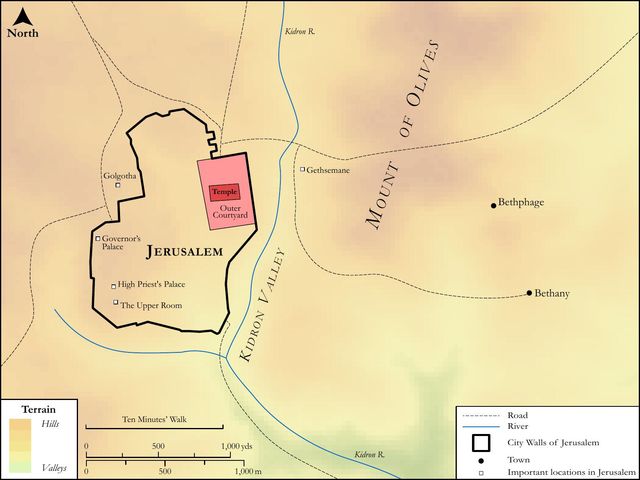
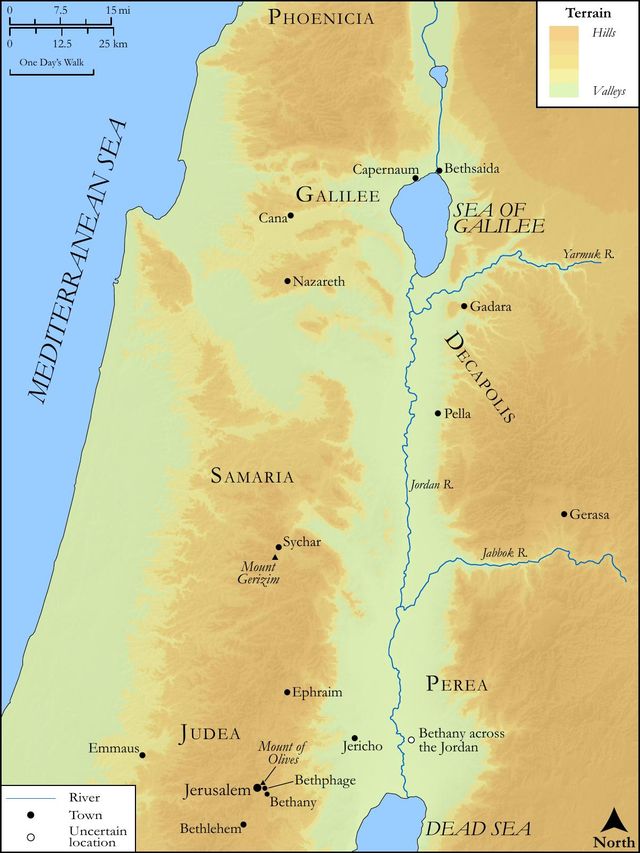
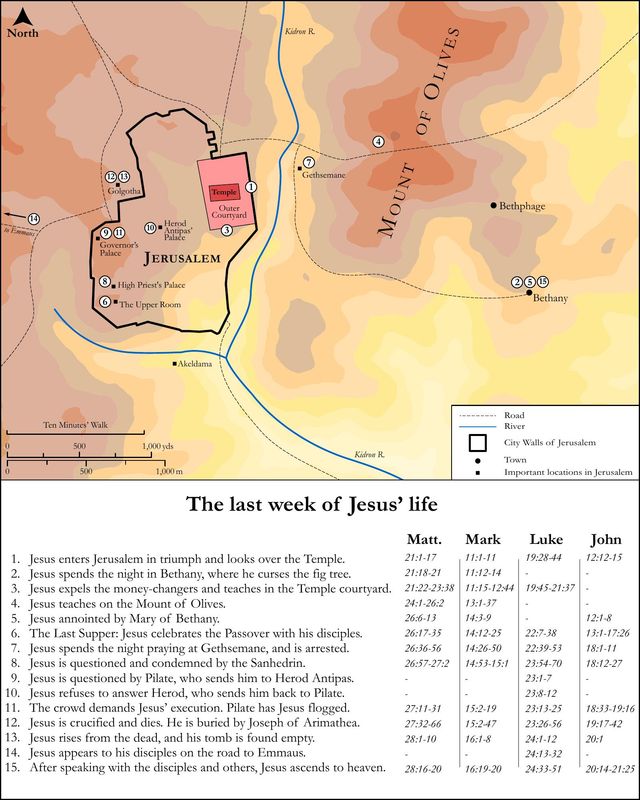
Study this verse
Public-domain commentary
Matthew Henry
From his Commentary on the Whole Bible. Henry comments on passages, not single verses — this entry covers John 13:1–17. His four-level outline is real structure in the source text, so it is rendered as structure.
It has generally been taken for granted by commentators that Christ's washing his disciples' feet, and the discourse that followed it, were the same night in which he was betrayed, and at the same sitting wherein he ate the passover and instituted the Lord's supper; but whether before the solemnity began, or after it was all over, or between the eating of the passover and the institution of the Lord's supper, they are not agreed. This evangelist, making it his business to gather up those passages which the others had omitted, industriously omits those which the others had recorded, which occasions some difficulty in putting them together. If it was then, we suppose that Judas went out (v. 30) to get his men ready that were to apprehend the Lord Jesus in the garden. But Dr. Lightfoot is clearly of opinion that this was done and said, even all that is recorded to the end of ch. xiv., not at the passover supper, for it is here said (v. 1) to be before the feast of the passover, but at the supper in Bethany, two days before the passover (of which we read Matt. xxvi. 2-6), at which Mary the second time anointed Christ's head with the remainder of her box of ointment. Or, it might be at some other supper the night before the passover, not as that was in the house of Simon the leper, but in his own lodgings, where he had none but his disciples about him, and could be more free with them.
In these verses we have the story of Christ's washing his disciples' feet; it was an action of a singular nature; no miracle, unless we call it a miracle of humility. Mary had just anointed his head; now, lest his acceptance of this should look like taking state, he presently balances it with this act of abasement. But why would Christ do this? If the disciples' feet needed washing, they could wash them themselves; a wise man will not do a thing that looks odd and unusual, but for very good causes and considerations. We are sure that it was not in a humour or a frolic that this was done; no, the transaction was very solemn, and carried on with a great deal of seriousness; and four reasons are here intimated why Christ did this:—1. That he might testify his love to his disciples, v. 1, 2. 2. That he might give an instance of his own voluntary humility and condescension, v. 3-5. 3. That he might signify to them spiritual washing, which is referred to in his discourse with Peter, v. 6-11. 4. That he might set them an example, v. 12-17. And the opening of these four reasons will take in the exposition of the whole story.
I.Christ washed his disciples' feet that he might give a proof of that great love wherewith he loved them; loved them to the end, v. 1, 2.
1.It is here laid down as an undoubted truth that our Lord Jesus, having loved his own that were in the world, loved them to the end, v. 1.
(1.)This is true of the disciples that were his immediate followers, in particular the twelve. These were his own in the world, his family, his school, his bosom-friends. Children he had none to call his own, but he adopted them, and took them as his own. He had those that were his own in the other world, but he left them for a time, to look after his own in this world. These he loved, he called them into fellowship with himself, conversed familiarly with them, was always tender of them, and of their comfort and reputation. He allowed them to be very free with him, and bore with their infirmities. He loved them to the end, continued his love to them as long as he lived, and after his resurrection; he never took away his loving kindness. Though there were some persons of quality that espoused his cause, he did not lay aside his old friends, to make room for new ones, but still stuck to his poor fishermen. They were weak and defective in knowledge and grace, dull and forgetful; and yet, though he reproved them often, he never ceased to love them and take care of them.
(2.)It is true of all believers, for these twelve patriarchs were the representatives of all the tribes of God's spiritual Israel. Note,
[1.]Our Lord Jesus has a people in the world that are his own,—his own, for they were given him by the Father, he has purchased them, and paid dearly for them, and he has set them apart for himself,—his own, for they have devoted themselves to him as a peculiar people. His own; where his own were spoken of that received him not, it is tous idious—his own persons, as a man's wife and children are his own, to whom he stands in a constant relation.
[2.]Christ has a cordial love for his own that are in the world. He did love them with a love of goodwill when he gave himself for their redemption. He does love them with a love of complacency when he admits them into communion with himself. Though they are in this world, a world of darkness and distance, of sin and corruption, yet he loves them. He was now going to his own in heaven, the spirits of just men made perfect there; but he seems most concerned for his own on earth, because they most needed his care: the sickly child is most indulged.
[3.]Those whom Christ loves he loves to the end; he is constant in his love to his people; he rests in his love. He loves with an everlasting love (Jer. xxxi. 3), from everlasting in the counsels of it to everlasting in the consequences of it. Nothing can separate a believer from the love of Christ; he loves his own, eis telos—unto perfection, for he will perfect what concerns them, will bring them to that world where love is perfect.
2.Christ manifested his love to them by washing their feet, as that good woman (Luke vii. 38) showed her love to Christ by washing his feet and wiping them. Thus he would show that as his love to them was constant so it was condescending,—that in prosecution of the designs of it he was willing to humble himself,—and that the glories of his exalted state, which he was now entering upon, should be no obstruction at all to the favour he bore to his chosen; and thus he would confirm the promise he had made to all the saints that he would make them sit down to meat, and would come forth and serve them (Luke xii. 37), would put honour upon them as great and surprising as for a lord to serve his servants. The disciples had just now betrayed the weakness of their love to him, in grudging the ointment that was poured upon his head (Matt. xxvi. 8), yet he presently gives this proof of his love to them. Our infirmities are foils to Christ's kindnesses, and set them off.
3.He chose this time to do it, a little before his last passover, for two reasons:—
(1.)Because now he knew that his hour was come, which he had long expected, when he should depart out of this world to the Father. Observe here,
[1.]The change that was to pass over our Lord Jesus; he must depart. This began at his death, but was completed at his ascension. As Christ himself, so all believers, by virtue of their union with him, when they depart out of the world, are absent from the body, go to the Father, are present with the Lord. It is a departure out of the world, this unkind, injurious world, this faithless, treacherous world—this world of labour, toil, and temptation—this vale of tears; and it is a going to the Father, to the vision of the Father of spirits, and the fruition of him as ours.
[2.]The time of this change: His hour was come. It is sometimes called his enemies' hour (Luke xxii. 53), the hour of their triumph; sometimes his hour, the hour of his triumph, the hour he had had in his eye all along. The time of his sufferings was fixed to an hour, and the continuance of them but for an hour.
[3.]His foresight of it: He knew that his hour was come; he knew from the beginning that it would come, and when, but now he knew that it was come. We know not when our hour will come, and therefore what we have to do in habitual preparation for it ought never to be undone; but, when we know by the harbingers that our hour is come, we must vigorously apply ourselves to an actual preparation, as our Master did, 2 Pet. iii. 14. Now it was in the immediate foresight of his departure that he washed his disciples' feet; that, as his own head was anointed just now against the day of his burial, so their feet might be washed against the day of their consecration by the descent of the Holy Ghost fifty days after, as the priests were washed, Lev. viii. 6. When we see our day approaching, we should do what good we can to those we leave behind.
(2.)Because the devil had now put it into the heart of Judas to betray him, v. 2. These words in a parenthesis may be considered,
[1.]As tracing Judas's treason to its origin; it was a sin of such a nature that it evidently bore the devil's image and superscription. What way of access the devil has to men's hearts, and by what methods he darts in his suggestions, and mingles them undiscerned with those thoughts which are the natives of the heart, we cannot tell. But there are some sins in their own nature so exceedingly sinful, and to which there is so little temptation from the world and the flesh, that it is plain Satan lays the egg of them in a heart disposed to be the nest to hatch them in. For Judas to betray such a master, to betray him so cheaply and upon no provocation, was such downright enmity to God as could not be forged but by Satan himself, who thereby thought to ruin the Redeemer's kingdom, but did in fact ruin his own.
[2.]As intimating a reason why Christ now washed his disciples' feet. First, Judas being now resolved to betray him, the time of his departure could not be far off; if this matter be determined, it is easy to infer with St. Paul, I am now ready to be offered. Note, The more malicious we perceive our enemies to be against us, the more industrious we should be to prepare for the worst that may come. Secondly, Judas being now got into the snare, and the devil aiming at Peter and the rest of them (Luke xxii. 31), Christ would fortify his own against him. If the wolf has seized one of the flock, it is time for the shepherd to look well to the rest. Antidotes must be stirring, when the infection is begun. Dr. Lightfoot observes that the disciples had learned of Judas to murmur at the anointing of Christ; compare ch. xii. 4, &c. with Matt. xxvi. 8. Now, lest those that had learned that of him should learn worse, he fortifies them by a lesson of humility against his most dangerous assaults. Thirdly, Judas, who was now plotting to betray him, was one of the twelve. Now Christ would hereby show that he did not design to cast them all off for the faults of one. Though one of their college had a devil, and was a traitor, yet they should fare never the worse for that. Christ loves his church though there are hypocrites in it, and had still a kindness for his disciples though there was a Judas among them and he knew it.
II.Christ washed his disciples' feet that he might give an instance of his own wonderful humility, and show how lowly and condescending he was, and let all the world know how low he could stoop in love to his own. This is intimated, v. 3-5. Jesus knowing, and now actually considering, and perhaps discoursing of, his honours as Mediator, and telling his friends that the Father had given all things into his hand, rises from supper, and, to the great surprise of the company, who wondered what he was going to do, washed his disciples' feet.
1.Here is the rightful advancement of the Lord Jesus. Glorious things are here said of Christ as Mediator.
(1.)The Father had given all things into his hands; had given him a propriety in all, and a power over all, as possessor of heaven and earth, in pursuance of the great designs of his undertaking; see Matt. xi. 27. The accommodation and arbitration of all matters in variance between God and man were committed into his hands as the great umpire and referee; and the administration of the kingdom of God among men, in all the branches of it, was committed to him; so that all acts, both of government and judgment, were to pass through his hands; he is heir of all things.
(2.)He came from God. This implies that he was in the beginning with God, and had a being and glory, not only before he was born into this world, but before the world itself was born; and that when he came into the world he came as God's ambassador, with a commission from him. He came from God as the son of God, and the sent of God. The Old-Testament prophets were raised up and employed for God, but Christ came directly from him.
(3.)He went to God, to be glorified with him with the same glory which he had with God from eternity. That which comes from God shall go to God; those that are born from heaven are bound for heaven. As Christ came from God to be an agent for him on earth, so he went to God to be an agent for us in heaven; and it is a comfort to us to think how welcome he was there: he was brought near to the Ancient of days, Dan. vii. 13. And it was said to him, Sit thou at my right hand, Ps. cx. 1.
(4.)He knew all this; was not like a prince in the cradle, that knows nothing of the honour he is born to, or like Moses, who wist not that his face shone; no, he had a full view of all the honours of his exalted state, and yet stooped thus low. But how does this come in here?
[1.]As an inducement to him now quickly to leave what lessons and legacies he had to leave to his disciples, because his hour was now come when he must take his leave of them, and be exalted above that familiar converse which he now had with them, v. 1.
[2.]It may come in as that which supported him under his sufferings, and carried him cheerfully through this sharp encounter. Judas was now betraying him, and he knew it, and knew what would be the consequence of it; yet, knowing also that he came from God and went to God, he did not draw back, but went on cheerfully.
[3.]It seems to come in as a foil to his condescension, to make it the more admirable. The reasons of divine grace are sometimes represented in scripture as strange and surprising (as Isa. lvii. 17, 18; Hos. ii. 13, 14); so here, that is given as an inducement to Christ to stoop which should rather have been a reason for his taking state; for God's thoughts are not as ours. Compare with this those passages which preface the most signal instances of condescending grace with the displays of divine glory, as Ps. lxviii. 4, 5; Isa. lvii. 15; lxvi. 1, 2.
2.Here is the voluntary abasement of our Lord Jesus notwithstanding this. Jesus knowing his own glory as God, and his own authority and power as Mediator, one would think it should follow, He rises from supper, lays aside his ordinary garments, calls for robes, bids them keep their distance, and do him homage; but no, quite the contrary, when he considered this he gave the greatest instance of humility. Note, A well-grounded assurance of heaven and happiness, instead of puffing a man up with pride, will make and keep him very humble. Those that would be found conformable to Christ, and partakers of his Spirit, must study to keep their minds low in the midst of the greatest advancements. Now that which Christ humbled himself to was to wash his disciples' feet.
(1.)The action itself was mean and servile, and that which servants of the lowest rank were employed in. Let thine handmaid (saith Abigail) be a servant to wash the feet of the servants of my lord; let me be in the meanest employment, 1 Sam. xxv. 41. If he had washed their hands or faces, it had been great condescension (Elisha poured water on the hands of Elijah, 2 Kings iii. 11); but for Christ to stoop to such a piece of drudgery as this may well excite our admiration. Thus he would teach us to think nothing below us wherein we may be serviceable to God's glory and the good of our brethren.
(2.)The condescension was so much the greater that he did this for his own disciples, who in themselves were of a low and despicable condition, not curious about their bodies; their feet, it is likely, were seldom washed, and therefore very dirty. In relation to him, they were his scholars, his servants, and such as should have washed his feet, whose dependence was upon him, and their expectations from him. Many of great spirits otherwise will do a mean thing to curry favour with their superiors; they rise by stooping, and climb by cringing; but for Christ to do this to his disciples could be no act of policy nor complaisance, but pure humility.
(3.)He rose from supper to do it. Though we translate it (v. 2) supper being ended, it might be better read, there being a supper made, or he being at supper, for he sat down again (v. 12), and we find him dipping a sop (v. 26), so that he did it in the midst of his meal, and thereby taught us,
[1.]Not to reckon it a disturbance, nor any just cause of uneasiness, to be called from our meal to do God or our brother any real service, esteeming the discharge of our duty more than our necessary food, ch. iv. 34. Christ would not leave his preaching to oblige his nearest relations (Mark iii. 33), but would leave his supper to show his love to his disciples.
[2.]Not to be over nice about our meat. It would have turned many a squeamish stomach to wash dirty feet at supper-time; but Christ did it, not that we might learn to be rude and slovenly (cleanliness and godliness will do well together), but to teach us not to be curious, not to indulge, but mortify, the delicacy of the appetite, giving good manners their due place, and no more.
(4.)He put himself into the garb of a servant, to do it: he laid aside his loose and upper garments, that he might apply himself to this service the more expeditely. We must address ourselves to duty as those that are resolved not to take state, but to take pains; we must divest ourselves of every thing that would either feed our pride or hang in our way and hinder us in what we have to do, must gird up the loins of our mind, as those that in earnest buckle to business.
(5.)He did it with all the humble ceremony that could be, went through all the parts of the service distinctly, and passed by none of them; he did it as if he had been used thus to serve; did it himself alone, and had none to minister to him in it. He girded himself with the towel, as servants throw a napkin on their arm, or put an apron before them; he poured water into the basin out of the water-pots that stood by (ch. ii. 6), and then washed their feet; and, to complete the service, wiped them. Some think that he did not wash the feet of them all, but only four or five of them, that being thought sufficient to answer the end; but I see nothing to countenance this conjecture, for in other places where he did make a difference it is taken notice of; and his washing the feet of them all, without exception, teaches us a catholic and extensive charity to all Christ's disciples, even the least.
(6.)Nothing appears to the contrary but that he washed the feet of Judas among the rest, for he was present, v. 26. It is the character of a widow indeed that she had washed the saints' feet (1 Tim. v. 10), and there is some comfort in this; but the blessed Jesus here washed the feet of a sinner, the worst of sinners, the worst to him, who was at this time contriving to betray him.
Many interpreters consider Christ's washing his disciples' feet as a representation of his whole undertaking. He knew that he was equal with God, and all things were his; and yet he rose from his table in glory, laid aside his robes of light, girded himself with our nature, took upon him the form of a servant, came not to be ministered to, but to minister, poured out his blood, poured out his soul unto death, and thereby prepared a laver to wash us from our sins, Rev. i. 5.
III.Christ washed his disciples' feet that he might signify to them spiritual washing, and the cleansing of the soul from the pollutions of sin.
This is plainly intimated in his discourse with Peter upon it, v. 6-11, in which we may observe,
1.The surprise Peter was in when he saw his Master go about this mean service (v. 6): Then cometh he to Simon Peter, with his towel and basin, and bids him put out his feet to be washed. Chrysostom conjectures that he first washed the feet of Judas, who readily admitted the honour, and was pleased to see his Master so disparage himself. It is most probable that when he went about this service (which is all that is meant by his beginning to wash, v. 5) he took Peter first, and that the rest would not have suffered it, if they had not first heard it explained in what passed between Christ and Peter. Whether Christ came first to Peter or no, when he did come to him, Peter was startled at the proposal: Lord (saith he) dost thou wash my feet? Here is an emphasis to be laid upon the persons, thou and me; and the placing of the words is observable, sy mou—what, thou mine? Tu mihi lavas pedes? Quid est tu? Quid est mihi? Cogitanda sunt potius quam dicenda—Dost thou wash my feet? What is it thou? What to me? These things are rather to be contemplated than uttered.—Aug. in loc. What thou, our Lord and Master, whom we know and believe to be the Son of God, and Saviour and ruler of the world, do this for me, a worthless worm of the earth, a sinful man, O Lord? Shall those hands wash my feet which with a touch have cleansed lepers, given sight to the blind, and raised the dead? So Theophylact, and from him Dr. Taylor. Very willingly would Peter have taken the basin and towel, and washed his Master's feet, and been proud of the honour, Luke xvii. 7, 8. "This had been natural and regular; for my Master to wash my feet is such a solecism as never was; such a paradox as I cannot understand. Is this the manner of men?" Note, Christ's condescensions, especially his condescensions to us, wherein we find ourselves taken notice of by his grace, are justly the matter of our admiration, ch. xiv. 22. Who am I, Lord God? And what is my father's house?
2.The immediate satisfaction Christ gave to this question of surprise. This was at least sufficient to silence his objections (v. 7): What I do, thou knowest not now, but thou shalt know hereafter. Here are two reasons why Peter must submit to what Christ was doing:—
(1.)Because he was at present in the dark concerning it, and ought not to oppose what he did not understand, but acquiesce in the will and wisdom of one who could give a good reason for all he said and did. Christ would teach Peter an implicit obedience: "What I do thou knowest not now, and therefore art no competent judge of it, but must believe it is well done because I do it." Note, Consciousness to ourselves of the darkness we labour under, and our inability to judge of what God does, should make us sparing and modest in our censures of his proceedings; see Heb. xi. 8.
(2.)Because there was something considerable in it, of which he should hereafter know the meaning: "Thou shalt know hereafter what need thou hast of being washed, when thou shalt be guilty of the heinous sin of denying me;" so some. "Thou shalt know, when, in the discharge of the office of an apostle, thou wilt be employed in washing off from those under thy charge the sins and defilements of their earthly affections;" so Dr. Hammond. Note,
[1.]Our Lord Jesus does many things the meaning of which even his own disciples do not for the present know, but they shall know afterwards. What he did when he became man for us and what he did when he became a worm and no man for us, what he did when he lived our life and what he did when he laid it down, could not be understood till afterwards, and then it appeared that it behoved him, Heb. ii. 17. Subsequent providences explain preceding ones; and we see afterwards what was the kind tendency of events that seemed most cross; and the way which we thought was about proved the right way.
[2.]Christ's washing his disciples' feet had a significancy in it, which they themselves did not understand till afterwards, when Christ explained it to be a specimen of the laver of regeneration, and till the Spirit was poured out upon them from on high. We must let Christ take his own way, both in ordinances and providences, and we shall find in the issue it was the best way.
3.Peter's peremptory refusal, notwithstanding this, to let Christ wash his feet (v. 8): Thou shalt by no means wash my feet; no, never. So it is in the original. It is the language of a fixed resolution. Now,
(1.)Here was a show of humility and modesty. Peter herein seemed to have, and no doubt he really had, a great respect for his Master, as he had, Luke v. 8. Thus many are beguiled of their reward in a voluntary humility (Col. ii. 18, 23), such a self-denial as Christ neither appoints nor accepts; for,
(2.)Under this show of humility there was a real contradiction to the will of the Lord Jesus: "I will wash thy feet," saith Christ; "But thou never shalt," saith Peter, "it is not a fitting thing;" so making himself wiser than Christ. It is not humility, but infidelity, to put away the offers of the gospel, as if too rich to be made to us or too good news to be true.
4.Christ's insisting upon his offer, and a good reason given to Peter why he should accept it: If I wash thee not, thou hast no part with me. This may be taken,
(1.)As a severe caution against disobedience: "If I wash thee not, if thou continue refractory, and wilt not comply with thy Master's will in so small a matter, thou shalt not be owned as one of my disciples, but be justly discarded and cashiered for not observing orders." Thus several of the ancients understand it; if Peter will make himself wiser than his Master, and dispute the commands he ought to obey, he does in effect renounce his allegiance, and say, as they did, What portion have we in David, in the Son of David? And so shall his doom be, he shall have no part in him. Let him use no more manners than will do him good, for to obey is better than sacrifice, 1 Sam. xv. 22. Or,
(2.)As a declaration of the necessity of spiritual washing; and so I think it is to be understood: "If I wash not thy soul from the pollution of sin, thou hast no part with me, no interest in me, no communion with me, no benefit by me." Note, All those, and those only, that are spiritually washed by Christ, have a part in Christ.
[1.]To have a part in Christ, or with Christ, has all the happiness of a Christian bound up in it, to be partakers of Christ (Heb. iii. 14), to share in those inestimable privileges which result from a union with him and relation to him. It is that good part the having of which is the one thing needful.
[2.]It is necessary to our having a part in Christ that he wash us. All those whom Christ owns and saves he justifies and sanctifies, and both are included in his washing them. We cannot partake of his glory if we partake not of his merit and righteousness, and of his Spirit and grace.
5.Peter's more than submission, his earnest request, to be washed by Christ, v. 9. If this be the meaning of it, Lord, wash not my feet only, but also my hands and my head. How soon is Peter's mind changed! When the mistake of his understanding was rectified, the corrupt resolution of his will was soon altered. Let us therefore not be peremptory in any resolve (except in our resolve to follow Christ), because we may soon see cause to retract it, but cautious in taking up a purpose we will be tenacious of. Observe,
(1.)How ready Peter is to recede from what he had said: "Lord, what a fool was I to speak such a hasty word!" Now that the washing of him appeared to be an act of Christ's authority and grace he admits it; but disliked when it seemed only an act of humiliation. Note,
[1.]Good men, when they see their error, will not be loth to recant it.
[2.]Sooner or later, Christ will bring all to be of his mind.
(2.)How importunate he is for the purifying grace of the Lord Jesus, and the universal influence of it, even upon his hands and head. Note, A divorce from Christ, and an exclusion from having a part in him, is the most formidable evil in the eyes of all that are enlightened, for the fear of which they will be persuaded to any thing. And for fear of this we should be earnest with God in prayer, that he will wash us, will justify and sanctify us. "Lord, that I may not be cut off from thee, make me fit for thee, by the washing of regeneration. Lord, wash not my feet only from the gross pollutions that cleave to them, but also my hands and my head from the spots which they have contracted, and the undiscerned filth which proceeds by perspiration from the body itself." Note, Those who truly desire to be sanctified desire to be sanctified throughout, and to have the whole man, with all its parts and powers, purified, 1 Thess. v. 23.
6.Christ's further explication of this sign, as it represented spiritual washing.
(1.)With reference to his disciples that were faithful to him (v. 10): He that is washed all over in the bath (as was frequently practised in those countries), when he returns to his house, needeth not save to wash his feet, his hands and head having been washed, and he having only dirtied his feet in walking home. Peter had gone from one extreme to the other. At first he would not let Christ wash his feet; and now he overlooks what Christ had done for him in his baptism, and what was signified thereby, and cries out to have his hands and head washed. Now Christ directs him into the meaning; he must have his feet washed, but not his hands and head.
[1.]See here what is the comfort and privilege of such as are in a justified state; they are washed by Christ, and are clean every whit, that is, they are graciously accepted of God, as if they were so; and, though they offend, yet they need not, upon their repentance, be again put into a justified state, for then should they often be baptized. The evidence of a justified state may be clouded, and the comfort of it suspended, when yet the charter of it is not vacated or taken away. Though we have occasion to repent daily, God's gifts and callings are without repentance. The heart may be swept and garnished, and yet still remain the devil's palace; but, if it be washed, it belongs to Christ, and he will not lose it.
[2.]See what ought to be the daily care of those who through grace are in a justified state, and that is to wash their feet; to cleanse themselves from the guilt they contract daily through infirmity and inadvertence, by the renewed exercise of repentance, with a believing application of the virtue of Christ's blood. We must also wash our feet by constant watchfulness against every thing that is defiling, for we must cleanse our way, and cleanse our feet by taking heed thereto, Ps. cxix. 9. The priests, when they were consecrated, were washed with water; and, though they did not need afterwards to be so washed all over, yet, whenever they went in to minister, they must wash their feet and hands at the laver, on pain of death, Exod. xxx. 19, 20. The provision made for our cleansing should not make us presumptuous, but the more cautious. I have washed my feet, how shall I defile them? From yesterday's pardon, we should fetch an argument against this day's temptation.
(2.)With reflection upon Judas: And you are clean, but not all, v. 10, 11. He pronounces his disciples clean, clean through the word he had spoken to them, ch. xv. 3. He washed them himself, and then said, You are clean; but he excepts Judas: not all; they were all baptized, even Judas, yet not all clean; many have the sign that have not the thing signified. Note,
[1.]Even among those who are called disciples of Christ, and profess relation to him, there are some who are not clean, Prov. xxx. 12.
[2.]The Lord knows those that are his, and those that are not, 2 Tim. ii. 19. The eye of Christ can separate between the precious and the vile, the clean and the unclean.
[3.]When those that have called themselves disciples afterwards prove traitors, their apostasy at last is a certain evidence of their hypocrisy all along.
[4.]Christ sees it necessary to let his disciples know that they are not all clean; that we may all be jealous over ourselves (Is it I? Lord, is it I that am among the clean, yet not clean?) and that, when hypocrites are discovered, it may be no surprise nor stumbling to us.
IV.Christ washed his disciples' feet to set before us an example.
This explication he gave of what he had done, when he had done it, v. 12-17. Observe,
1.With what solemnity he gave an account of the meaning of what he had done (v. 12): After he had washed their feet, he said, Know you what I have done?
(1.)He adjourned the explication till he had finished the transaction,
[1.]To try their submission and implicit obedience. What he did they should not know till afterwards, that they might learn to acquiesce in his will when they could not give a reason for it.
[2.]Because it was proper to finish the riddle before he unriddled it. Thus, as to his whole undertaking, when his sufferings were finished, when he had resumed the garments of his exalted state and was ready to sit down again, then he opened the understandings of his disciples, and poured out his Spirit, Luke xxiv. 45, 46.
(2.)Before he explained it, he asked them if they could construe it: Know you what I have done to you? He put this question to them, not only to make them sensible of their ignorance, and the need they had to be instructed (as Zech. iv. 5, 13, Knowest thou not what these be? and I said, No, my Lord), but to raise their desires and expectations of instruction: "I would have you know, and, if you will give attention, I will tell you." Note, It is the will of Christ that sacramental signs should be explained, and that his people should be acquainted with the meaning of them; otherwise, though ever so significant, to those who know not the thing signified they are insignificant. Hence they are directed to ask, What mean you by this service? Exod. xii. 26.
2.Upon what he grounds that which he had to say (v. 13): "You call me Master and Lord, you give me those titles, in speaking of me, in speaking to me, and you say well, for so I am; you are in the relation of scholars to me, and I do the part of a master to you." Note,
(1.)Jesus Christ is our Master and Lord; he that is our Redeemer and Saviour is, in order to that, our Lord and Master. He is our Master, didaskalos—our teacher and instructor in all necessary truths and rules, as a prophet revealing to us the will of God. He is our Lord, kyrios—our ruler and owner, that has authority over us and propriety in us.
(2.)It becomes the disciples of Christ to call him Master and Lord, not in compliment, but in reality; not by constraint, but with delight. Devout Mr. Herbert, when he mentioned the name of Christ, used to add, my Master; and thus expresses himself concerning it in one of his poems:
(3.)Our calling Christ Master and Lord is an obligation upon us to receive and observe the instruction he gives us. Christ would thus pre-engage their obedience to a command that was displeasing to flesh and blood. If Christ be our Master and Lord, be so by our own consent, and we have often called him so, we are bound in honour and honesty to be observant of him.
3.The lesson which he hereby taught: You also ought to wash one another's feet, v. 14.
(1.)Some have understood this literally, and have thought these words amount to the institution of a standing ordinance in the church; that Christians should, in a solemn religious manner, wash one another's feet, in token of their condescending love to one another. St. Ambrose took it so, and practised it in the church of Milan. St. Austin saith that those Christians who did not do it with their hands, yet (he hoped) did it with their hearts in humility; but he saith, It is much better to do it with the hands also, when there is occasion, as 1 Tim. v. 10. What Christ has done Christians should not disdain to do. Calvin saith that the pope, in the annual observance of this ceremony on Thursday in the passion week, is rather Christ's ape than his follower, for the duty enjoined, in conformity to Christ, was mutual: Wash one another's feet. And Jansenius saith, It is done, Frigidè et dissimiliter—Frigidly, and unlike the primitive model.
(2.)But doubtless it is to be understood figuratively; it is an instructive sign, but not sacramental, as the eucharist. This was a parable to the eye; and three things our Master hereby designed to teach us:—[1.] A humble condescension. We must learn of our Master to be lowly in heart (Matt. xi. 29), and walk with all lowliness; we must think meanly of ourselves and respectfully of our brethren, and deem nothing below us but sin; we must say of that which seems mean, but has a tendency to the glory of God and our brethren's good, as David (2 Sam. vi. 22), If this be to be vile, I will be yet more vile. Christ had often taught his disciples humility, and they had forgotten the lesson; but now he teaches them in such a way as surely they could never forget. [2.] A condescension to be serviceable. To wash one another's feet is to stoop to the meanest offices of love, for the real good and benefit one of another, as blessed Paul, who, though free from all, made himself servant of all; and the blessed Jesus, who came not to be ministered unto, but to minister. We must not grudge to take care and pains, and to spend time, and to diminish ourselves for the good of those to whom we are not under any particular obligations, even of our inferiors, and such as are not in a capacity of making us any requital. Washing the feet after travelling contributes both to the decency of the person and to his ease, so that to wash one another's feet is to consult both the credit and the comfort one of another, to do what we can both to advance our brethren's reputation and to make their minds easy. See 1 Cor. x. 24; Heb. vi. 10. The duty is mutual; we must both accept help from our brethren and afford help to our brethren. [3.] A serviceableness to the sanctification one of another: You ought to wash one another's feet, from the pollutions of sin. Austin takes it in this sense, and many others. We cannot satisfy for one another's sins, this is peculiar to Christ, but we may help to purify one another from sin. We must in the first place wash ourselves; this charity must begin at home (Matt. vii. 5), but it must not end there; we must sorrow for the failings and follies of our brethren, much more for their gross pollutions (1 Cor. v. 2), must wash our brethren's polluted feet in tears. We must faithfully reprove them, and do what we can to bring them to repentance (Gal. vi. 1), and we must admonish them, to prevent their falling into the mire; this is washing their feet.
4.Here is the ratifying and enforcing of this command from the example of what Christ had now done: If I your Lord and Master have done it to you, you ought to do it to one another. He shows the cogency of this argument in two things:—
(1.)I am your Master, and you are my disciples, and therefore you ought to learn of me (v. 15); for in this, as in other things, I have given you an example, that you should do to others as I have done to you. Observe,
[1.]What a good teacher Christ is. He teaches by example as well as doctrine, and for this end came into this world, and dwelt among us, that he might set us a copy of all those graces and duties which his holy religion teaches; and it is a copy without one false stroke. Hereby he made his own laws more intelligible and honourable. Christ is a commander like Gideon, who said to his soldiers, Look on me, and do likewise (Judg. vii. 17); like Abimelech, who said, What you have seen me do, make haste and do as I have done (Judg. ix. 48); and like Cæsar, who called his soldiers, not milites—soldiers, but, commilitones—fellow-soldiers, and whose usual word was, not Ite illue, but Venite huc; not Go, but Come.
[2.]What good scholars we must be. We must do as he hath done; for therefore he gave us a copy, that we should write after it, that we might be as he was in this world (1 John iv. 17), and walk as he walked, 1 John ii. 6. Christ's example here in is to be followed by ministers in particular, in whom the graces of humility and holy love should especially appear, and by the exercise thereof they effectually serve the interests of their Master and the ends of their ministry. When Christ sent his apostles abroad as his agents, it was with this charge, that they should not take state upon them, nor carry things with a high hand, but become all things to all men, 1 Cor. ix. 22. What I have done to your dirty feet that do you to the polluted souls of sinners; wash them. Some who suppose this to have been done at the passover supper think it intimates a rule in admitting communicants to the Lord's-supper, to see that they be first washed and cleansed by reformation and a blameless conversation, and then take them in to compass God's altar. But all Christians likewise are here taught to condescend to each other in love, and to do it as Christ did it, unasked, unpaid; we must not be mercenary in the services of love, nor do them with reluctancy.
(2.)I am your Master, and you are my disciples, and therefore you cannot think it below you to do that, how mean soever it may seem, which you have seen me do, for (v. 16) the servant is not greater than his Lord, neither he that is sent, though sent with all the pomp and power of an ambassador, greater than he that sent him. Christ had urged this (Matt. x. 24, 25) as a reason why they should not think it strange if they suffered as he did; here he urges it as a reason why they should not think it much to humble themselves as he did. What he did not think a disparagement to him, they must not think a disparagement to them. Perhaps the disciples were inwardly disgusted at this precept of washing one another's feet, as inconsistent with the dignity they expected shortly to be preferred to. To obviate such thoughts, Christ reminds them of their place as his servants; they were not better men than their Master, and what was consistent with his dignity was much more consistent with theirs. If he was humble and condescending, it ill became them to be proud and assuming. Note,
[1.]We must take good heed to ourselves, lest Christ's gracious condescensions to us, and advancements of us, through the corruption of nature occasion us to entertain high thoughts of ourselves or low thoughts of him. We need to be put in mind of this, that we are not greater than our Lord.
[2.]Whatever our Master was pleased to condescend to in favour to us, we should much more condescend to in conformity to him. Christ, by humbling himself, has dignified humility, and put an honour upon it, and obliged his followers to think nothing below them but sin. We commonly say to those who disdain to do such or such a thing, As good as you have done it, and been never the worse thought of; and true indeed it is, if our Master has done it. When we see our Master serving, we cannot but see how ill it becomes us to be domineering.
Historical interpretation
Two Centuries of Reception
9 surviving comments on this verse. Each one is dated, so this reads as a timeline rather than a list.
Select a marker to jump to its quote. Markers stagger vertically where authors wrote within a few decades of each other.
For if they had undergone the human baptism of John, and were longing for that of the Lord, then since the Lord Himself had defined baptism to be one; (saying to Peter, who was desirous of being thoroughly bathed, "He who hath once bathed hath no necessity to wash a second time; " which, of course, He would not have said at all to one not baptized; ) even here we have a conspicuous proof against those who, in order to destroy the sacrament of water, deprive the apostles even of John's baptism.
Now, whether they were baptized in any manner whatever, or whether they continued unbathed to the end-so that even that saying of the Lord touching the "one bath" does, under the person of Peter, merely regard us-still, to determine concerning the salvation of the apostles is audacious enough, because on them the prerogative even of first choice, and thereafter of undivided intimacy, might be able to confer the compendious grace of baptism, seeing they (I think) followed Him who was wont to promise salvation to every believer.
"Then cometh He to Simon Peter and Peter saith unto Him, Lord, dost Thou wash my feet?"
"With those hands," he saith, "with which Thou hast opened eyes, and cleansed lepers, and raised the dead?" For this (question) is very emphatic; wherefore He needed not to have said any more than the, "Thou"; for even of itself this would have sufficed to convey the whole. Some one might reasonably enquire, how none of the others forbade Him, but Peter only, which was a mark of no slight love and reverence. What then is the cause? He seemeth to me to have washed the traitor first, then to have come to Peter, and that the others were afterwards instructed from his case. That He washed some one other before him is clear from its saying, "But when He came to Peter." Yet the Evangelist is not a vehement accuser, for the "began," is the expression of one implying this. And even if Peter were the first, yet it is probable that the traitor, being a forward person, had reclined even before the chief. For by another circumstance also his forwardness is shown, when He dippeth with his Master in the dish, and being convicted, feels no compunction; while Peter being rebuked but once on a former occasion, and for words which he spake from loving affection, was so abashed, that being even distressed and trembling, he begged another to ask a question. But Judas, though continually convicted, felt not.
(Hom. lxx. 2) Though Peter was the first of the Apostles, yet it is possible that the traitor petulantly placed himself above him; and that this may be the reason, why our Lord first began to wash, and then cometh to Peter.
(Hom. lxx. 2) Some one will ask why none of them prevented Him, except Peter, this being a sign not of want of love, but of reverence. The reason seems to be, that He washed the traitor first, and came next to Peter, and that the other disciples were checked by the reply to Peter. Any of the rest would have said what Peter did, had his turn come first.
(Hom. lxx. 2) i. e. How useful a lesson of humility it teaches thee, and how directly this virtue leads to God.
(Hom. lxx. 2) He does not say on what account He performs this act of washing, but only threatens him. For Peter was not persuaded by the first answer: Thou shalt know hereafter: he did not say, Teach me then that I may submit. But when he was threatened with separation from Christ, then he submitted.
(Hom. lxx. 2) Or thus: When He calls them clean, you must not suppose that they were delivered from sin before the victim was offered. He means cleanness in respect of knowledge; for they were now delivered from Jewish error.
What then saith that hot and burning one? "Lord, not my feet only, but also my hands and my head."
Vehement in deprecation, he becometh yet more vehement in acquiescence; but both from love. For why said He not wherefore He did this, instead of adding a threat? Because Peter would not have been persuaded. For had He said, "Suffer it, for by this I persuade you to be humbleminded," Peter would have promised it ten thousand times, in order that his Master might not do this thing. But now what saith He? He speaketh of that which Peter most feared and dreaded, the being separated from Him; for it is he who continually asks, "Whither goest Thou?" Wherefore also he said, "I will give even my life for Thee." And if, after hearing, "What I do thou knowest not now, but thou shalt know hereafter," he still persisted, much more would he have done so had he learnt (the meaning of the action). Therefore said He, "but thou shalt know hereafter," as being aware, that should he learn it immediately he would still resist. And Peter said not, "Tell me, that I may suffer Thee," but (which was much more vehement) he did not even endure to learn, but withstands Him, saying, "Thou shalt never wash my feet." But as soon as He threatened, he straightway relaxed his tone. But what meaneth, "Thou shalt know after this"? "After this?" When? "When in My Name thou shall have cast out devils; when thou shalt have seen Me taken up into Heaven, when thou shalt have learnt from the Spirit that I sit on His right hand, then shall thou understand what is being done now."
"He saith unto him, What I do thou knowest not now, but thou shall know here after."
That is "thou shall know how great is the gain from this, the profit of the lesson, and how it is able to guide us into all humblemindedness." What then doth Peter? He still hinders Him, and saith, "Thou shall never wash my feet." "What doest thou, Peter? Rememberest thou not those former words? Saidst thou not, 'Be merciful to Thyself,' and heardest thou not in return, 'Get thee behind Me, Satan'? Art thou not even so sobered, but art thou yet vehement?" "Yea," he saith, "for what is being done is a great matter, and full of amazement." Since then he did this from exceeding love, Christ in turn subdueth him by the same; and as there He effected this by sharply rebuking him, and saying, "Thou art an offense unto Me," so here also by saying, "If I wash thee not, thou hast no part with Me."
"He that is washed, needeth not save to wash his feet, but is clean every whit; and ye are clean, but not all. For He knew who should betray Him."
"And if they are clean, why washeth He their feet?" That we may learn to be modest. On which account He came not to any other part of the body, but to that which is considered more dishonorable than the rest. But what is, "He that is washed"? It is instead of, "he that is clean." Were they then clean, who had not yet been delivered from their sins, nor deemed worthy of the Spirit, since sin still had the mastery, the handwriting of the curse still remaining, the victim not having yet been offered? How then calleth He them "clean"? That thou mayest not deem them clean, as delivered from their sins, He addeth, Behold, "ye are clean through the word that I have spoken unto you." That is, "In this way ye are so far clean; ye have received the light, ye have been freed from Jewish error. For the Prophet also saith, 'Wash you, make you clean, put away the wickedness from your souls'; so that such a one is washed and is clean." Since then these men had cast away all wickedness from their souls, and had companied with Him with a pure mind, therefore He saith according to the word of the Prophet, "he that is washed is clean already." For in that place also It meaneth not the "washing" of water, practiced by the Jews; but the cleansing of the conscience.
For when terrified at the thought of losing part in Christ, "Simon Peter saith unto Him, Lord, not my feet only, but also my hands and my head." Since, then, Thou threatenest me with the loss of a part in Thee, unless I submit to the washing of my feet, deprive me not of such a blessing, and give me not only my feet to be washed, but my hands and my head. But "Jesus saith unto him, He that is washed needeth not save to wash his feet, but is clean every whit." Here the question naturally arises, how, if a man is washed and clean every whit, he has any necessity to have his feet washed.
He who lately exhibited to us so strongly his opposition to what Christ was doing, and who expressly refused to allow the washing of his feet, now offers not them only, but also hands and head as well. For if, says he, my refusal to assent to Thy wish and Thy deliberate purpose, in the matter of washing my feet, is to be followed by my falling away from my fellowship with Thee, and by my being excluded from the blessings for which I hope; then I will offer Thee my other members also, rather than incur so very frightful a loss. Certainly therefore pious devotion was the motive of the former refusal: it was the behaviour of one who feared to submit to the action because there seemed to be something about it which he could not bring himself to tolerate, and not at all the conduct of one who set himself in opposition to his master's injunctions. For bearing in mind, as I said, both the dignity of the Saviour and the utter unworthiness of his own nature, he at first refused; but on learning the jeopardy in which he had thus put himself, immediately he hastens to change his will so as to conform to the good pleasure of his Master.
But look again closely, and accept what was done as a pattern for our profit. For in spite of having said: Thou shalt never wash my feet, he in a moment changes from his purpose thus expressed, not allowing it to be the uppermost thought in his mind that he ought to appear truthful in the eyes of men by adhering to his own words, but rather [influenced by the warning] that he would find a greater and more grievous loss to be the necessary consequence of holding to what he had said. Therefore every one ought to guard against using rash and hasty words, and no one ought in a spirit of violent energy to hastily urge a course of action, which on account of its very recklessness may be afterwards bitterly regretted. But if anything should ever happen to be said by any one in such a way that by persistence in adhering to it something of great value and importance would suffer harm, let the speaker in such a case learn from the words before us that it is very much better for him not to preserve consistency, and not to vainly carry out an intention merely because he has once given expression to it, but rather to use all his efforts to do what will really be profitable to him. For every one, I imagine, will allow that it is safer to incur an indictment for inconsistency in our words, than to suffer a loss of indispensable blessings. And let swearing be altogether absent from our conversation; for words are often spoken on the spur of the moment and without deliberate intention, and our plans are necessarily liable to occasional change and chance. For surely it may be called a worthy and in very truth an enviable possession, to have a discreet tongue, that very rarely lapses into unbefitting language. And since even the Divine Scripture itself has shown to us that the matter is one for violent and tedious struggling----for, as it is written, the tongue can no man tame,----let us keep the utterance of our words free from oaths. For then, if circumstances compel us to refrain from carrying out something we have said, the blame will be less, and our error will be liable to a less severe indictment. And readily will pardon be granted, I think, even by God Himself, for the thoughtless levity of language that is ever besetting us: for who can understand his errors? according to that which is written. Else surely man would utterly perish from the face of the earth, since most easily does language fall away into mistakes of all kinds; for it is a work of the greatest difficulty to keep our tongue under due restraint.
Continue studying John 13:9 across the web’s major study libraries — every link below opens this exact verse, chapter, or book on the destination site.
Read & Compare
 BibleGatewayThis verse in more than 200 translations and 70 languages.
 Bible.comThe YouVersion reader — hundreds of translations, reading plans, and highlights.
 ESV.orgCrossway's official English Standard Version reader.
 NET BibleThe NET translation with 60,000+ translators' notes on every rendering decision.
 STEP BibleTyndale House's free study tool — original text, vocabulary, and scholarly resources.
 BibliaLogos Bible Software's free web reader.
 USCCBThe New American Bible (Revised Edition) with the U.S. bishops' study notes.
Commentaries
 BibleHub CommentariesDozens of classic commentaries on this verse, gathered on one page.
 StudyLightMore than 100 commentary sets — the largest collection on the web.
 BibleRefPlain-English commentary on what this verse means, verse by verse.
 Enduring WordDavid Guzik's free commentary on this chapter, widely used by Bible teachers.
 Bible Study ToolsVerse commentary alongside Greek and Hebrew study aids.
Original Language & Research
- BibleHub InterlinearThe verse word by word — original language, transliteration, and English.
- BibleHub LexiconEvery word's original-language definition and Strong's entry.
 Blue Letter BibleDeep-study tools — Strong's numbers, concordance, and word studies.
 CNTR CollationThe earliest Greek manuscripts of this verse, collated letter by letter.
Sermons, Hymns & Audio


TrulyRandomVerse is not affiliated with these sites and doesn’t control their content. They’re linked because they’re genuinely useful.
Summary
In John 13:9, Simon Peter, with characteristic impulsiveness, responds to Jesus' declaration regarding the necessity of spiritual cleansing. Having initially refused Jesus' offer to wash his feet, Peter, upon hearing that a lack of such cleansing would mean having "no part" with Christ, immediately shifts from resistance to an eager, albeit misguided, request for a full-body wash, seeking to ensure his complete association with his Lord.
Context
ShowHideLiterary Context
This verse is an immediate and direct response to Jesus' profound statement in John 13:8. The preceding verses (John 13:1-5) describe Jesus' astonishing act of humility in washing His disciples' feet, an act typically performed by the lowest servant. Peter's initial refusal in John 13:8a ("Thou shalt never wash my feet") stems from a mixture of reverence and perhaps a misunderstanding of the act's significance. Jesus' subsequent declaration in John 13:8b ("If I wash thee not, thou hast no part with me") elevates the physical act to a spiritual necessity, prompting Peter's dramatic reversal in verse 9. This exchange sets the stage for Jesus' further clarification in John 13:10-11, distinguishing between the complete spiritual cleansing received at conversion and the ongoing need for daily purification from defilement.
Historical & Cultural Context
Foot-washing was a common practice among the patriarchs and in Israel, necessitated by dusty roads and open sandals. It was a customary act of hospitality, usually performed by a servant for guests entering a home. The act itself was mundane but deeply symbolic of humility and service. For a master, especially a revered teacher like Jesus, to perform this task for His disciples was an inversion of social norms, designed to teach a radical lesson in servant leadership. The concept of ritual purity was also deeply ingrained in Jewish thought, though Jesus often challenged the external focus of such practices, emphasizing inner spiritual cleanliness. Peter's reaction reflects both his cultural understanding of the act's lowliness and his immediate, passionate desire for full spiritual connection with Jesus, even if his understanding of the means was still developing.
Key Themes
ShowHideJohn 13 introduces several pivotal themes. Humility and Service are paramount, as exemplified by Jesus' act of foot-washing, which He explicitly commands His disciples to emulate (John 13:14-15). The theme of Spiritual Cleansing and Fellowship with Christ is also central, as Jesus' words to Peter underscore that His cleansing work is indispensable for having a "part" or relationship with Him. Peter's response highlights the theme of Peter's Impetuosity and Developing Understanding, showcasing his characteristic zeal and devotion, often expressed before full comprehension, a trait evident throughout the Gospels, such as in his confession in Matthew 16:16 and his denial in John 18:25-27. This passage also subtly introduces the distinction between Initial Justification and Ongoing Sanctification, which Jesus clarifies in the subsequent verse, differentiating between being "clean every whit" (a complete spiritual bath) and the need for daily washing of "feet" (cleansing from daily defilement).
Exposition and Analysis
ShowHideKey Word Analysis
ShowHideThis term, used by Peter to address Jesus, signifies supreme authority and mastery. While it can be a respectful title like "Sir," in the context of Peter's relationship with Jesus, it carries the weight of acknowledging Jesus' divine authority and sovereignty. Peter's appeal to Jesus as "Lord" underscores his submission and recognition of Jesus' ultimate control over his spiritual destiny, intensifying his plea for full cleansing.
This conjunction marks a strong contrast or opposition. It signifies a dramatic shift in Peter's stance, moving from an absolute refusal ("never") to an equally absolute embrace of the necessity of cleansing. It highlights Peter's passionate and immediate reversal of opinion, driven by the profound implication of Jesus' words in John 13:8 that without cleansing, he would have "no part" with his Master.
Literally referring to the physical head, this word here represents the highest and most prominent part of the body. Peter's inclusion of "hands and head" alongside "feet" signifies his desire for a complete, all-encompassing cleansing. It reflects his understanding that if partial cleansing is necessary, then total cleansing must be even better, demonstrating his fervent, though still physically-oriented, desire for full spiritual purity and union with Jesus.
Verse Breakdown
ShowHide"Simon Peter saith unto him,"
This phrase sets the stage for Peter's immediate and characteristic response. It highlights his direct engagement with Jesus' profound statement, emphasizing his central role in this pivotal exchange. Peter's personality, often impulsive and outspoken, is immediately evident.
"Lord,"
Peter's address to Jesus as "Lord" signifies his deep reverence and recognition of Jesus' authority. This respectful title underscores the gravity with which Peter receives Jesus' words, acknowledging the Master's right to declare the terms of their relationship and the necessity of His cleansing work.
"not my feet only,"
This clause directly references Jesus' act of foot-washing and Peter's initial refusal. Peter now acknowledges the insufficiency of a partial cleansing if the consequence of not being washed is so severe. The "only" implies a recognition that the feet are not enough, given the stakes.
"but also [my] hands and [my] head."
This is Peter's impulsive escalation. Having understood that a lack of washing means "no part" with Jesus, he swings to the opposite extreme, desiring a complete, full-body cleansing. "Hands" represent action and work, while "head" represents thought, will, and the whole person. Peter's request for his hands and head to be washed signifies his desire for a total spiritual purification, encompassing every aspect of his being, even if he still perceives it in physical terms.
Literary Devices
ShowHideThe passage employs Dramatic Irony, as Peter's fervent request for a full bath, while seemingly devout, still operates under a partial understanding of Jesus' spiritual meaning, which Jesus will clarify in the very next verse. Peter is physically oriented in his thinking, while Jesus' focus is spiritual. There is also evident Hyperbole in Peter's "not my feet only, but also my hands and my head," which is an exaggerated expression of his desire for complete cleansing, emphasizing his passionate commitment. Furthermore, the scene presents a powerful Contrast between Peter's initial stubborn refusal and his subsequent eager, almost desperate, plea, highlighting his volatile yet devoted nature.
Theological and Thematic Connections
ShowHideJohn 13:9 profoundly illustrates the human struggle to grasp divine truth, particularly concerning the nature of salvation and sanctification. Peter's initial resistance and subsequent overzealous request highlight that while the necessity of Christ's cleansing work is absolute for fellowship with God, our understanding of its scope and application often develops incrementally. Theologically, this passage points to the foundational truth that no human effort or self-purification can substitute for the cleansing work of Christ, which is indispensable for gaining and maintaining a relationship with God. Peter's desire for full cleansing, though misguided in its physical application, reflects a true spiritual longing for complete union with his Lord, a longing that every believer should possess for a deeper, more comprehensive work of grace in their lives.
Reflection and Application
ShowHidePeter's dramatic shift in John 13:9 serves as a powerful mirror for our own spiritual journeys. Often, like Peter, we may initially resist God's humbling work in our lives, perhaps out of pride, misunderstanding, or a sense of unworthiness. Yet, when confronted with the profound implications of rejecting Christ's grace—that without His cleansing, we have "no part" with Him—our hearts should similarly turn from defiance to desperate longing. This passage reminds us that true spiritual cleansing is not something we can achieve through our own efforts or partial measures; it is entirely a work of Christ. Our response, therefore, should be one of humble submission and an earnest desire for His complete work of purification in every area of our lives, acknowledging that only through Him can we be made truly clean and have an enduring relationship with God.
Questions for Reflection
ShowHideFAQ
ShowHideWhy did Peter change his mind so quickly from refusal to eagerness?
ShowHidePeter's rapid change of mind stems from Jesus' profound statement in John 13:8: "If I wash thee not, thou hast no part with me." This declaration revealed the spiritual necessity of Jesus' cleansing work for fellowship with Him. Peter, passionate and devoted, immediately grasped the gravity of having "no part" with his Lord. His initial refusal was likely born of reverence or misunderstanding, but once he understood the eternal stakes, his fervent desire to be fully associated with Jesus led him to request a complete cleansing, even if he still understood it in physical terms.
What is the significance of Peter asking for his "hands and head" to be washed, in addition to his feet?
ShowHidePeter's request to have his "hands and head" washed, beyond just his feet, signifies his desire for a total and comprehensive cleansing. In Jewish thought, hands often represented actions and deeds, while the head could symbolize the mind, will, or the entire person. By including these, Peter was expressing a longing for every part of his being—his thoughts, actions, and very identity—to be purified by Christ. While his understanding was still literal, Jesus' subsequent clarification in John 13:10 would reveal the deeper spiritual truth that those who are "clean every whit" (fully justified by Christ) only need daily cleansing from the defilement of walking in the world.
Christ-Centered Fulfillment
ShowHidePeter's impulsive yet earnest plea in John 13:9 beautifully foreshadows the comprehensive and all-encompassing nature of Christ's redemptive work. While Peter's request was still rooted in a physical understanding of cleansing, it pointed to the spiritual reality that Jesus would accomplish through His atoning sacrifice. The "washing" Jesus offers is not merely external, but an internal purification from sin, making us "clean every whit." This is fulfilled in the New Covenant through the blood of Christ, which cleanses us from all unrighteousness (1 John 1:7). Just as Peter desired to have "no part" of himself untouched by Jesus' cleansing, so too does Christ's work on the cross provide a complete and perfect cleansing for all who believe, washing away sins and making us new creations (2 Corinthians 5:17). His death and resurrection provide not just a partial washing, but a full spiritual bath, enabling us to have full and eternal fellowship with God (Hebrews 10:10-14). Peter's zeal, though initially misdirected, ultimately reflects the heart of one who understands the absolute necessity of Christ's saving work for every aspect of his life, a truth fully realized in the finished work of the Lamb of God (John 1:29).