


Matthew 27:24
Bible text: King James Version (1769 Blayney text) · Public domain
Bible text: King James Version with Strong's numbers · Public domain
Bible text: Berean Standard Bible · Public domain
Bible text: American Standard Version (1901) · Public domain
Bible text: World English Bible, Messianic edition · Public domain
Bible text: Geneva Bible (1599) · Public domain
Bible text: Young's Literal Translation · Public domain
- ἸδὼνIdōnHaving seenG1492V-2AAP-NSMVerb 2nd Aorist Active Participle Nominative Singular Masculine
- δὲdenowG1161CONJConjunction
- ὁho<the>G3588T-NSMDefinite article Nominative Singular Masculine
- ΠιλᾶτοςPilatosPilateG4091N-NSM-PNoun Nominative Singular Masculine Individual
- ὅτιhotithatG3754CONJConjunction
- οὐδὲνoudenno [thing]G3762A-ASNAdjective Accusative Singular Neuter
- ὠφελεῖōpheleiit availedG5623V-PAI-3SVerb Present Active Indicative 3rd Singular
- ἀλλὰallabutG235CONJConjunction
- μᾶλλονmallonratherG3123ADVAdverb
- θόρυβοςthorubosa riotG2351N-NSMNoun Nominative Singular Masculine
- γίνεταιginetaiis arisingG1096V-PNI-3SVerb Present Middle Or Passive Deponent Indicative 3rd Singular
- λαβὼνlabōnhaving takenG2983V-2AAP-NSMVerb 2nd Aorist Active Participle Nominative Singular Masculine
- ὕδωρhudōrwaterG5204N-ASNNoun Accusative Singular Neuter
- ἀπενίψατοapenipsatohe washedG633V-AMI-3SVerb Aorist Middle Indicative 3rd Singular
- τὰςtastheG3588T-APFDefinite article Accusative Plural Feminine
- χεῖραςcheirashandsG5495N-APFNoun Accusative Plural Feminine
- ἀπέναντιapenantioppositeG561PREPPreposition
- τοῦtoutheG3588T-GSMDefinite article Genitive Singular Masculine
- ὄχλουochloucrowdG3793N-GSMNoun Genitive Singular Masculine
- λέγων·legōnsayingG3004V-PAP-NSMVerb Present Active Participle Nominative Singular Masculine
- ἀθῷόςathōosGuiltlessG121A-NSMAdjective Nominative Singular Masculine
- εἰμιeimiI amG1510V-PAI-1SVerb Present Active Indicative 1st Singular
- ἀπὸapoofG575PREPPreposition
- τοῦtoutheG3588T-GSNDefinite article Genitive Singular Neuter
- αἵματοςaimatosbloodG129N-GSNNoun Genitive Singular Neuter
- τοῦtou<the>G3588T-GSMDefinite article Genitive Singular Masculine
- δικαίουdikaiourighteous [one]G1342A-GSMAdjective Genitive Singular Masculine
- τούτου·toutouof thisG3778D-GSMDemonstrative pronoun Genitive Singular Masculine
- ὑμεῖςhumeisFor yourselvesG4771P-2NPPersonal pronoun Nominative 2nd Plural
- ὄψεσθεopsestheyou will beholdG3700V-FDI-2PVerb Future Middle Deponent Indicative 2nd Plural
English is a literal word-by-word gloss of the Greek, not the KJV's wording. Why?
This is the original text the KJV's translators worked from — each Greek word with its own literal English meaning in this verse, prepared by scholars at Tyndale House, Cambridge. The KJV translates whole sentences, not word by word, so its wording differs: one Greek word can become several English words, and the KJV may choose “charity” where the gloss reads “love”. Both are faithful — they answer different questions. For the KJV's own rendering, switch to the KJV text.
Details
See on the biblical-era maps
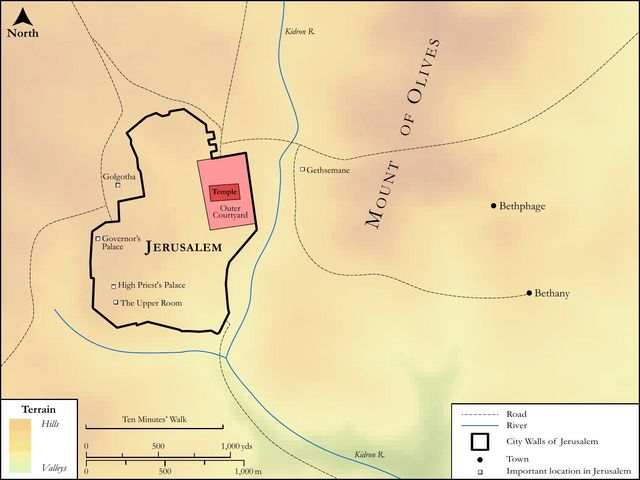
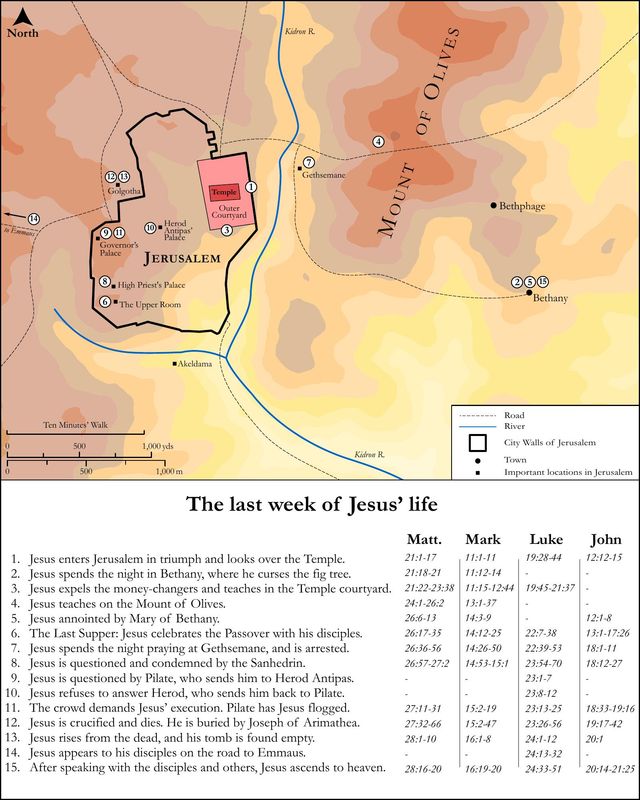
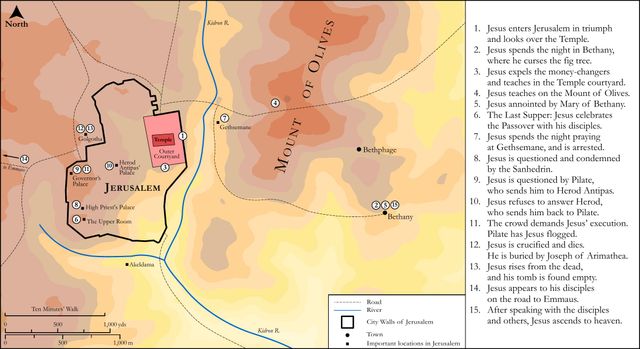
Study this verse
Historical interpretation
Eleven Centuries of Reception
15 surviving comments on this verse. Each one is dated, so this reads as a timeline rather than a list.
Select a marker to jump to its quote. Markers stagger vertically where authors wrote within a few decades of each other.
Accordingly, all the synagogue of Israel did slay Him, saying to Pilate, when he was desirous to dismiss Him, "His blood be upon us, and upon our children; " and, "If thou dismiss him, thou art not a friend of Caesar; " in order that all things might be fulfilled which had been written of Him.
When I was scrupulously making a thorough investigation of this practice, and searching into the reason of it, I ascertained it to be a commemorative act, bearing on the surrender of our Lord.
Onward even to the passion does the witness of baptism last: while He is being surrendered to the cross, water intervenes; witness Pilate's hands: when He is wounded, forth from His side bursts water; witness the soldier's lance!
At the desire of the Priests the populace chose Barabbas, which is interpreted 'the son of a Father,' thus shadowing forth the unbelief to come when Antichrist the son of sin should be preferred to Christ.
Because Christ had answered nothing to the accusations of the Jews, by which Pilate could acquit Him of what was alleged against Him, he contrives other means of saving Him. Now on the feast day the governor we as wont to release unto the people a prisoner whom they would.
And he sought to rescue Christ by means of this practice, that the Jews might not have the shadow of an excuse left them. A convicted murderer is put in comparison with Christ, Barabbas, whom he calls not merely a robber, but a notable one, that is, renowned for crime.
Whom will ye that I release unto you? &c. As much as to say, If ye will not let him go as innocent, at least, yield Him, as convicted, to this holy day. For if you would have released one of whose guilt there was no doubt, much more should you do so in doubtful cases. Observe how circumstances are reversed. It is the populace who are wont to petition for the condemned, and the prince to grant, but here it is the reverse, the prince asks of the people, and renders them thereby more violent.
Then is added something else which alone was enough to deter all from putting Him to death; When we he as set on the judgment seat, his wife sent unto him, saying, Have thou nothing to do with that just man. For joined with the proof afforded by the events themselves, a dream was no light confirmation.
But why did Pilate himself not see this vision? Because his wife was more worthy; or because if Pilate had seen it, he would not have had equal credit, or perhaps would not have told it; wherefore it is provided by God that his wife should see it, and thus it be made manifest to all. And she not merely sees it, but suffers many things because of him, so that sympathy with his wife would make the husband more slack to put Him to death. And the time agreed well, for it was the same night that she saw it.
(Hom. iii. in Cæn. Dom.) Thus then the judge is terrified through his wife, and that he might not consent in the judgment to the accusation of the Jews, himself endured judgment in the affliction of his wife; the judge is judged, and tortured before he tortures.
But none of the foregoing things moved Christ's enemies, because envy had altogether blinded them, and of their own wickedness they corrupt the people, for they persuaded the people that they should ask Barabbas, and destroy Jesus.
Observe here the infatuation of the Jews; their headlong haste, and destructive passions will not let them see what they ought to see, and they curse themselves, saying, His blood be upon us, and even entail the curse upon their children. Yet a merciful God did not ratify this sentence, but accepted such of them and of their children as repented; for Paul was of them, and many thousands of those who in Jerusalem believed.
(Hom. iii. in Cæna Dom.) See the Lord is made ready for the scourge, see now it descends upon Him! That sacred skin is torn by the fury of the rods; the cruel might of repeated blows lacerates His shoulders. Ah me! God is stretched out before man, and He, in whom not one trace of sin can be discerned, suffers punishment as a malefactor.
Pilate accepted the water in line with that prophetic saying, “I will wash my hands among the innocent,” that he might cleanse the works of the Gentiles by the washing of his hands and in some way separate us from the wickedness of the Jews who cried out “Crucify him!” What he intimated was this: I truly wanted to release an innocent man, but a riot is breaking out and the charge of treason against Caesar has been brought against me. So “I am innocent of the blood of this just man.”The judge who was induced to pass judgment against the Lord does not condemn the defendant but puts the blame on the plaintiffs. He declares him to be a just man who was meant to be crucified. “See to it yourselves,” he says. “I am the administrator of the laws. It is according to your word that his blood is being shed.”
In the Gospel entitled 'according to the Hebrews,' Barabbas is interpreted, 'The son of their master,' who had been condemned for sedition and murder. Pilate gives them the choice between Jesus and the robber, not doubting but that Jesus would be the rather chosen.
Observe also that visions are often vouchsafed by God to the Gentiles, and that the confession of Pilate and his wife that the Lord was innocent is a testimony of the Gentile people.
Yet even after this answer of theirs, Pilate did not at once assent, but in accordance with his wife's suggestion, Have thou nothing to do with that just man, he answered, Why, what evil hath he done? This speech of Pilate's acquits Jesus. But they cried out the more, saying, Let him be crucified; that it might be fulfilled which is said in the Psalm, Many dogs have compassed me, the congregation of the wicked hath inclosed me; (Ps. 22:16.) and also that of Hieremias, Mine heritage is unto me as a lion in the forest, they have given forth their voice against me. (Jer. 12:8.)
Pilate took water in accordance with that, I will wash my hands in innocency, (Ps. 26:6.) in a manner testifying and saying, I indeed have sought to deliver this innocent man, but since a tumult is rising, and the charge of treason to Cæsar is urged against me, I am innocent of the blood of this just man. The judge then who is thus compelled to give sentence against the Lord, does not convict the accused, but the accusers, pronouncing innocent Him who is to be crucified. See ye to it, as though he had said, I am the law's minister, it is your voice that has shed this blood. Then answered all the people and said, His blood be on us and on our children. This imprecation rests at the present day upon the Jews, the Lord's blood is not removed from them.
It should be known that Pilate administered the Roman law, which enacted that every one who was crucified should first be scourged. Jesus then is given up to the soldiers to be beaten, and they tore with whips that most holy body and capacious bosom of God.
This was done that we might be delivered from those stripes of which it is said, Many stripes shall be to the wicked. (Ps. 32:10.) Also in the washing of Pilate's hands all the works of the Gentiles are cleansed, and we are acquitted of all share in the impiety of the Jews.
(Verse 24) But Pilate, seeing that he was accomplishing nothing, but rather that a tumult was taking place, took water and washed his hands before the people, saying: I am innocent of the blood of this just man: you shall see. Pilate took water, according to that prophetic saying: I will wash my hands among the innocent (Ps. 25:6); so that in the washing of his hands, the works of the Gentiles might be cleansed, and he might separate us from the impiety of the Jews, who cried out, crucify him, thereby attesting in a way that I indeed wanted to free the innocent man; but since sedition arises and an accusation of treason against Caesar is brought against me: I am innocent of the blood of this just man. The judge who is forced to pass sentence against Christ does not condemn the accused; but he accuses those who offer him, pronouncing that the one who must be crucified is just. He says, 'You will see. I am the minister of the laws: your voice sheds blood.'
(de Cons. Ev. iii. 8.) Pilate many times pleaded with the Jews, desiring that Jesus might be released, which Matthew witnesses in very few words, when he says, Pilate seeing that he could prevail nothing, but that rather a tumult was made. He would not have spoken thus, if Pilate had not striven much, though how many efforts he made to release Jesus he does not mention.
(Serm. lix. 2.) The impiety of the Jews then exceeded the fault of Pilate; but he was not guiltless, seeing he resigned his own jurisdiction, and acquiesced in the injustice of others.
By what law is it, my Jewish friends, that what is unlawful to do is lawful to desire? By what standard is it that what defiles the body does not taint the heart? You fear to be contaminated by the shedding of his blood that you would take upon yourselves and your children. Since your wickedness will not commit so great a crime, allow the procurator to pass judgment. But, prevailing upon him impetuously, you do not allow him to swerve from that goal you deceitfully abstain from.Pilate sinned by doing what he did not want to do. He acquiesced in your judgment, doing whatever your rage wrought by force. Such was your observance of the law that you eschewed placing into the treasury the money which the seller of Christ returned to you, wary lest the blood money pollute the sacred coffers. Whose heart is guilty of this pretense? The conscience of the priests accepts what the money box does not receive. Thus with untold shades of deceit you cover yourselves, and a deal is made with the traitor.
For Christ conquers when he is judged, because in this way he is proven innocent. Hence Pilate says, “I am innocent of the blood of this just man.” It is a better case which is not defended and still is proved. It is a fuller righteousness that is not supplemented by words but is still supported by the truth. It must be that the tongue should keep silent when justice itself is present to itself. Let the human tongue keep silent in a good affair, inasmuch as it has also been accustomed to speak out in favor of bad causes. I do not want righteousness to be defended in the same manner that wickedness is usually excused. It is not by reason of speech but because of virtue that Christ vanquishes, for the Savior, who is wisdom, knows how to vanquish by keeping silent and how to overcome by not responding. Therefore he prefers to establish the truth of his case rather than to speak about it. What in fact would compel him to speak when silence is enough to conquer? But perhaps fear would compel him, lest he lose his life. Yet this was precisely the reason for his victory. He lost his own life in order to gain life for all; he preferred to be conquered in himself in order to be the victor in everyone.
John explains what their envy was, when he says, Behold, the world is gone after him; (John 12:19.) and, If we let him thus alone, all men will believe on him. (John 11:48.) Observe also that in place of what Matthew says, Jesus, who is called Christ, Mark says, Will ye that I release unto you the King of the Jews? (Mark 15:9.) For the kings of the Jews alone were anointed, and from that anointing were called Christs.
It was customary among the ancients, when one would refuse to participate in any crime, to take water and wash his hands before the people.
It is to be noted, that the bench (tribunal) is the seat of the judge, the throne (solium) of the king, the chair (cathedra) of the master. In visions and dreams the wife of a Gentile understood what the Jews when awake would neither believe nor understand.
Or otherwise; The devil now at last understanding that he should lose his trophies through Christ, as he had at the first brought in death by a woman, so by a woman he would deliver Christ out of the hands of His enemies, lest through His death he should lose the sovereignty of death.
Those who were crucified being suspended on a cross, by nails driven into the wood through their hands and feet, perished by a lingering death, and lived long on the cross, not that they sought longer life, but that death was deferred to prolong their sufferings. The Jews indeed contrived this as the worst of deaths, but it had been chosen by the Lord without their privity, thereafter to place upon the foreheads of the faithful the same cross as a trophy of His victory over the Devil.
Barabbas also, who headed a sedition among the people, is released to the Jews, that is the Devil, who to this day reigns among them, so that they cannot have peace.
(non occ.) The Evangelist adds the reason why Pilate sought to deliver Christ, For he knew that for envy they had delivered him.
(non occ.) Pilate is said to make this answer, Whether of the twain will ye that I release unto you? either to the message of his wife, or the petition of the people, with whom it was a custom to ask such release on the feast-day.
Continue studying Matthew 27:24 across the web’s major study libraries — every link below opens this exact verse, chapter, or book on the destination site.
Read & Compare
 BibleGatewayThis verse in more than 200 translations and 70 languages.
 Bible.comThe YouVersion reader — hundreds of translations, reading plans, and highlights.
 ESV.orgCrossway's official English Standard Version reader.
 NET BibleThe NET translation with 60,000+ translators' notes on every rendering decision.
 STEP BibleTyndale House's free study tool — original text, vocabulary, and scholarly resources.
 BibliaLogos Bible Software's free web reader.
 USCCBThe New American Bible (Revised Edition) with the U.S. bishops' study notes.
Commentaries
 BibleHub CommentariesDozens of classic commentaries on this verse, gathered on one page.
 StudyLightMore than 100 commentary sets — the largest collection on the web.
 BibleRefPlain-English commentary on what this verse means, verse by verse.
 Enduring WordDavid Guzik's free commentary on this chapter, widely used by Bible teachers.
 Bible Study ToolsVerse commentary alongside Greek and Hebrew study aids.
Original Language & Research
- BibleHub InterlinearThe verse word by word — original language, transliteration, and English.
- BibleHub LexiconEvery word's original-language definition and Strong's entry.
 Blue Letter BibleDeep-study tools — Strong's numbers, concordance, and word studies.
 CNTR CollationThe earliest Greek manuscripts of this verse, collated letter by letter.
Sermons, Hymns & Audio


TrulyRandomVerse is not affiliated with these sites and doesn’t control their content. They’re linked because they’re genuinely useful.
Summary
Matthew 27:24 captures the dramatic moment when Pontius Pilate, the Roman governor, publicly attempts to absolve himself of responsibility for Jesus' impending crucifixion. Despite his personal conviction of Jesus' innocence, Pilate yields to the escalating pressure from the agitated Jewish multitude, who, incited by their religious leaders, demand Jesus' death. In a symbolic gesture before the crowd, Pilate washes his hands, declaring his innocence of "the blood of this just person" and placing the responsibility squarely on the people. This act underscores his moral cowardice and the profound injustice of Jesus' condemnation.
Context
ShowHideLiterary Context
This verse is a pivotal moment in the Passion narrative within Matthew's Gospel, immediately following Pilate's repeated attempts to release Jesus. Pilate had already offered the crowd a choice between Jesus and Barabbas, a notorious prisoner, hoping they would choose Jesus, as recorded in Matthew 27:15-17. However, influenced by the chief priests and elders, the crowd vehemently demanded Barabbas' release and Jesus' crucifixion. Pilate's wife had also warned him about Jesus, calling Him a "just man" in Matthew 27:19, further highlighting Pilate's awareness of Jesus' innocence. Faced with an uncontrollable "tumult," Pilate's hand-washing is his final, desperate act to distance himself from a decision he clearly knew was unjust, but felt compelled to make for political expediency.
Historical & Cultural Context
The act of hand-washing to declare innocence was a recognized custom in both Jewish and Roman cultures. In Jewish law, as seen in Deuteronomy 21:6-7, elders would wash their hands to disavow responsibility for an unsolved murder, symbolizing their lack of complicity. Similarly, Roman officials might perform symbolic acts to underscore their judgments or distance themselves from popular unrest. Pilate, as the Roman governor of Judea, was responsible for maintaining order and preventing riots, which could lead to severe repercussions from Rome. The "tumult" mentioned in the text indicates a dangerous, escalating mob mentality, which Pilate feared could erupt into a full-scale rebellion, jeopardizing his position and potentially his life. His decision was thus a calculated political move, prioritizing civil order and self-preservation over moral justice.
Key Themes
ShowHideMatthew 27:24 powerfully illustrates several key themes. Firstly, it highlights Pilate's moral abdication, as he, despite acknowledging Jesus' innocence, succumbs to external pressure and political expediency rather than upholding justice. This demonstrates the profound danger of compromising one's convictions. Secondly, the symbolism of hand-washing is central, representing a futile attempt to cleanse oneself of guilt for an unjust act. While Pilate physically washed his hands, his spiritual and moral culpability remained. Thirdly, the verse underscores the power of mob mentality and crowd pressure, showing how an agitated multitude, manipulated by influential leaders, can override reason and justice, leading to grave injustice. This is a recurring theme in the Passion narrative, where the crowd's cry for crucifixion drowns out Pilate's attempts at release, as seen in Matthew 27:22-23. Finally, the explicit reference to Jesus as "this just person" emphasizes the unjust nature of His condemnation, highlighting His blamelessness in the face of a corrupt legal process.
Exposition and Analysis
ShowHideKey Word Analysis
ShowHideMeaning a disturbance, uproar, or noisy commotion. In this context, it describes the escalating, violent agitation of the crowd, indicating a potential riot that Pilate sought to prevent. It emphasizes the intense pressure and chaotic environment Pilate faced.
Meaning not guilty. This is Pilate's direct declaration concerning his own involvement in Jesus' condemnation. It signifies his attempt to publicly disavow any culpability for the "blood" of Jesus, acknowledging that Jesus was not legally deserving of death.
Meaning equitable, righteous, or innocent. Pilate's description of Jesus. This word powerfully underscores Jesus' blamelessness and the profound injustice of the proceedings. It confirms that even His judge recognized His lack of wrongdoing, making the subsequent crucifixion an act of extreme injustice.
Verse Breakdown
ShowHide"When Pilate saw that he could prevail nothing, but [that] rather a tumult was made,"
Pilate recognized the futility of his efforts to release Jesus. His attempts to persuade the crowd had failed, and instead of calming down, the situation was deteriorating into a violent, disorderly commotion or riot. This clause highlights Pilate's assessment of the uncontrollable nature of the crowd's demands and the potential threat to public order.
"he took water, and washed [his] hands before the multitude, saying,"
In a highly public and symbolic act, Pilate took water and cleansed his hands in full view of the agitated crowd. This physical action was intended to be a visual declaration of his moral detachment and innocence regarding the decision that was about to be made. It was a dramatic performance designed to shift responsibility away from himself.
"I am innocent of the blood of this just person: see ye [to it]."
Pilate's verbal declaration accompanying the hand-washing. He explicitly stated his blamelessness concerning Jesus' impending death, referring to Jesus as a "just person," thereby acknowledging His innocence. The final phrase, "see ye to it," is a direct challenge and a forceful transfer of responsibility, effectively placing the culpability for Jesus' death upon the multitude.
Literary Devices
ShowHideMatthew 27:24 is rich with Symbolism, primarily through Pilate's act of washing his hands. This gesture, rooted in ancient customs, symbolically represents an attempt to cleanse oneself of guilt or responsibility for bloodshed. However, the narrative employs Irony, as Pilate's outward ritual of purification stands in stark contrast to his inner moral compromise; a physical act cannot absolve spiritual culpability. There is also a strong element of Dramatic Irony, where the audience knows the full significance of Jesus' innocence and the profound consequences of His death, while Pilate, despite acknowledging Jesus' justice, fails to grasp the ultimate theological weight of his decision. The "tumult" itself functions as a Metonymy for the chaotic and irrational mob mentality that overrides justice and reason.
Theological and Thematic Connections
ShowHideThis verse profoundly speaks to the themes of human responsibility, the nature of justice, and the tragic consequences of moral cowardice. Pilate's public declaration of innocence, while acknowledging Jesus' blamelessness, ultimately serves as a stark example of a leader abdicating his duty to uphold truth and justice when faced with popular pressure. His attempt to wash away guilt highlights the human tendency to externalize blame rather than confront internal culpability. The narrative implicitly teaches that true innocence is not achieved through ritualistic acts or shifting blame, but through righteous action and adherence to truth, even in the face of overwhelming opposition. The "blood of this just person" foreshadows the immense theological significance of Jesus' innocent sacrifice.
Reflection and Application
ShowHidePilate's actions in Matthew 27:24 serve as a powerful cautionary tale for all who face moral dilemmas. It challenges us to consider whether we prioritize personal convenience, social acceptance, or political expediency over truth and justice. Pilate knew what was right, yet he succumbed to the crowd's pressure, attempting to outwardly absolve himself while inwardly compromising his integrity. This calls believers to cultivate moral courage, to stand firm in their convictions even when it means facing unpopularity or opposition. True responsibility cannot be washed away by symbolic gestures; it demands a commitment to righteousness and a willingness to bear the cost of upholding what is just. We are reminded that the opinions of the multitude, especially when inflamed by prejudice or manipulation, can lead to profound injustice, and we must be vigilant against the dangers of mob mentality in our own contexts.
Questions for Reflection
ShowHideFAQ
ShowHideDid Pilate truly believe Jesus was innocent?
ShowHideYes, the text strongly suggests Pilate believed Jesus was innocent. He explicitly calls Jesus "this just person" in Matthew 27:24, and earlier, his wife warned him about Jesus, referring to Him as a "just man" in Matthew 27:19. Furthermore, John's Gospel records Pilate repeatedly declaring, "I find no guilt in him" (John 18:38 and John 19:4). His attempts to release Jesus, even offering a choice between Jesus and Barabbas, confirm his conviction of Jesus' blamelessness.
Was Pilate's hand-washing effective in absolving his guilt?
ShowHideFrom a theological and moral perspective, no. While Pilate's hand-washing was a public, symbolic act intended to declare his innocence and shift blame to the crowd, it did not genuinely absolve him of his culpability. He was the Roman governor with the authority to release Jesus, and despite his conviction of Jesus' innocence, he yielded to political pressure and fear of a riot. His act was a desperate attempt to appear clean, but it could not erase his moral responsibility for condemning an innocent man. The New Testament does not present this act as a means of true absolution, but rather as a demonstration of his moral cowardice.
What was the significance of the "tumult" Pilate observed?
ShowHideThe "tumult" (Greek: thórybos) signifies a noisy, agitated, and potentially violent commotion or uproar among the crowd. For a Roman governor like Pilate, such a disturbance was a serious matter. Riots could lead to widespread rebellion, which would be met with severe Roman reprisal, potentially costing Pilate his position or even his life. The escalating "tumult" therefore represented a direct threat to Roman order and Pilate's authority, pressuring him to make a decision that would quell the unrest, even if it meant sacrificing justice. It highlights the volatile political climate of Judea under Roman rule.
Christ-Centered Fulfillment
ShowHidePilate's declaration, "I am innocent of the blood of this just person," ironically underscores the very truth that makes Jesus' sacrifice so profoundly redemptive. The "just person" whom Pilate condemned was indeed perfectly innocent, "a lamb without blemish or spot" (1 Peter 1:18-19). This blamelessness was essential, for only a spotless sacrifice could atone for the sins of humanity. Pilate's futile attempt to wash his hands of Jesus' blood stands in stark contrast to the true cleansing power of Christ's own blood. While Pilate tried to remove himself from guilt, Jesus' blood was shed precisely to remove the guilt of all who believe, cleansing our consciences from dead works to serve the living God (Hebrews 9:14). The crowd's cry, "His blood be on us and on our children!" (Matthew 27:25), though spoken in ignorance and malice, tragically foreshadowed the ultimate reality that Christ's blood would indeed be "on" humanity, not as a curse, but as the means of salvation, washing us from our sins and making us a kingdom of priests to God (Revelation 1:5-6). Thus, Pilate's act, intended to distance himself from the blood, inadvertently highlights the very purity and atoning power of the innocent blood that would be shed for the world.