


Matthew 26:35
Bible text: King James Version (1769 Blayney text) · Public domain
Bible text: King James Version with Strong's numbers · Public domain
Bible text: Berean Standard Bible · Public domain
Bible text: American Standard Version (1901) · Public domain
Bible text: World English Bible, Messianic edition · Public domain
Bible text: Geneva Bible (1599) · Public domain
Bible text: Young's Literal Translation · Public domain
- ΛέγειLegeiSaysG3004V-PAI-3SVerb Present Active Indicative 3rd Singular
- αὐτῷautōto HimG846P-DSMPersonal pronoun Dative Singular Masculine
- ὁho<the>G3588T-NSMDefinite article Nominative Singular Masculine
- Πέτρος·PetrosPeterG4074N-NSM-PNoun Nominative Singular Masculine Individual
- κἂνkanEven ifG1437CONJ + G1437=COND
- δέῃdeēit shall be necessary forG1163V-PAS-3SVerb Present Active Subjunctive 3rd Singular
- μεmemeG3165P-1ASPersonal pronoun Accusative 1st Singular
- σὺνsunwithG4862PREPPreposition
- σοὶsoiYouG4771P-2DSPersonal pronoun Dative 2nd Singular
- ἀποθανεῖνapothaneinto dieG599V-2AANVerb 2nd Aorist Active Infinitive
- οὐoucertainlyG3756PRT-NNegative Particle Negative
- μήmēnotG3361PRT-NNegative Particle Negative
- σεseYouG4771P-2ASPersonal pronoun Accusative 2nd Singular
- ἀπαρνήσομαιaparnēsomaiI will denyG533V-FDI-1SVerb Future Middle Deponent Indicative 1st Singular
- ὁμοίωςhomoiōsLikewiseG3668ADVAdverb
- καὶkaialsoG2532CONJConjunction
- πάντεςpantesallG3956A-NPMAdjective Nominative Plural Masculine
- οἱhoitheG3588T-NPMDefinite article Nominative Plural Masculine
- μαθηταὶmathētaidisciplesG3101N-NPMNoun Nominative Plural Masculine
- εἶπανeipansaidG2036V-2AAI-3PVerb 2nd Aorist Active Indicative 3rd Plural
English is a literal word-by-word gloss of the Greek, not the KJV's wording. Why?
This is the original text the KJV's translators worked from — each Greek word with its own literal English meaning in this verse, prepared by scholars at Tyndale House, Cambridge. The KJV translates whole sentences, not word by word, so its wording differs: one Greek word can become several English words, and the KJV may choose “charity” where the gloss reads “love”. Both are faithful — they answer different questions. For the KJV's own rendering, switch to the KJV text.
Details
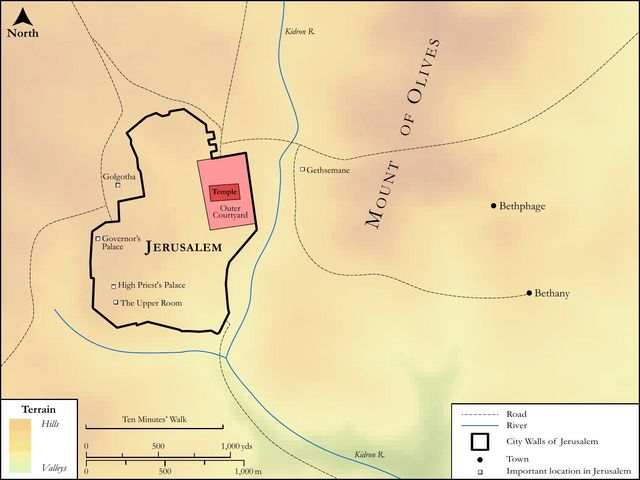
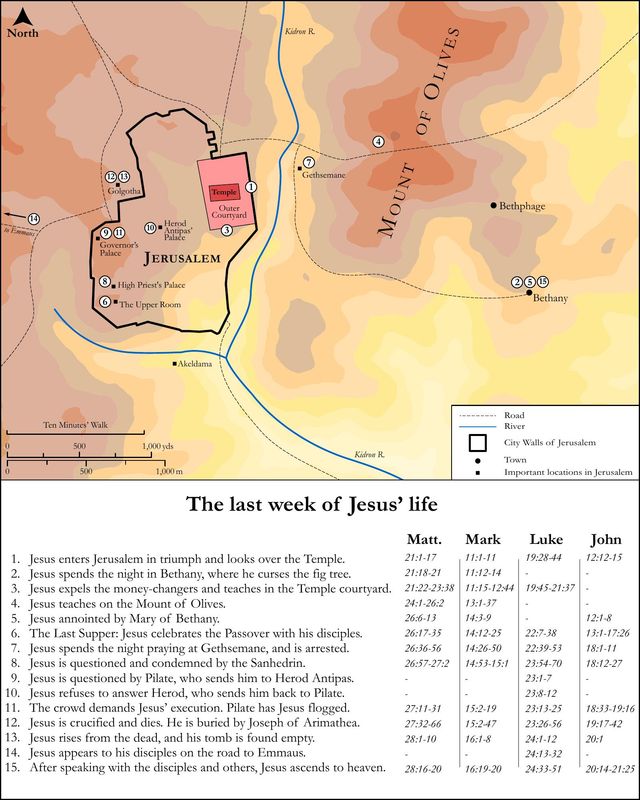
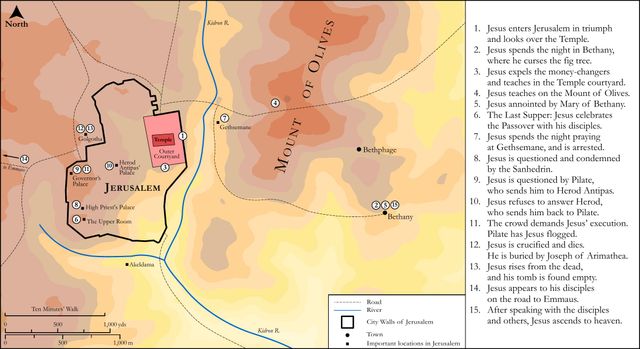
See on the biblical-era maps
Study this verse
Historical interpretation
Ten Centuries of Reception
11 surviving comments on this verse. Each one is dated, so this reads as a timeline rather than a list.
Select a marker to jump to its quote. Markers stagger vertically where authors wrote within a few decades of each other.
But you will ask, whether it were possible that Peter should not have been offended, when once the Saviour had said, All ye shall be offended in me. To which one will answer, what is foretold by Jesus must of necessity come to pass; and another will say, that He who at the prayer of Ninevites turned away the wrath He had denounced by Jonas, might also have averted Peter's offence at his entreaty. But his presumptuous confidence, prompted by zeal indeed but not a cautious zeal, became the cause not only of offence but of a thrice repeated denial. And since He confirmed it with the sanction of an oath, some one will say that it was not possible that he should not have denied Him. For Christ would have spoken falsely when he said, Verily I say unto thee, if Peter's assertion, I will not deny thee, had been true. It seems to me that the other disciples having in view not that which was first said, All ye shall be offended, but that which was said to Peter, Verily I say unto thee, &c. made a like promise with Peter because they were not comprehended in the prophecy of denial. Peter said unto him, Though I should die with thee, yet will I not deny thee. Likewise also said all the disciples. Here again Peter knows not what he says; he could not die with Him who was to die for all mankind, who were all in sin, and had need of some one to die for them, not that they should die for others.
Hereby He shows that men confirmed by the powers of the Divine mysteries, are exalted to heavenly glory in a common joy and gladness.
The credit of this prediction is supported by the authority of old prophecy; It is written, I will smite the shepherd, and the sheep of the flock shall he scattered abroad.
But Peter was carried so far by his zeal and affection for Christ, that he regarded neither the weakness of his flesh nor the truth of the Lord's words; as if what He spake must not come to pass, Peter answered and said unto him, Though all should be offended because of thee, yet will I never be offended.
"And when they had sung an hymn, they went out unto the Mount of Olives." Let them hear this, as many as, like swine eating at random, rudely spurn the natural table, and rise up in drunkenness, whereas it were meet to give thanks, and end with an hymn.
Hear this, as many as wait not again for the last prayer of the mysteries, for this is a symbol of that. He gave thanks before He gave it to His disciples, that we also may give thanks. He gave thanks, and sang an hymn after the giving, that we also may do this selfsame thing.
But for what reason doth He go forth unto the mountain? Making Himself manifest, that He may be taken, in order not to seem to hide himself. For He hastened to go to the place which was also known to Judas.
Then "He saith unto them, All ye shall be offended in me." After this He mentions also a prophecy, "For it is written, I will smite the shepherd, and the sheep shall be scattered abroad:" at once persuading them ever to give heed to the things that are written, and at same time making it plain that He was crucified, according to God's purpose; and by everything showing He was no alien from the old covenant, nor from the God preached therein, but that what is done is a dispensation, and that the prophets all proclaimed all things beforehand from the beginning that are comprised in the matter, so that they be quite confident about the better things also.
And He teaches us to know what the disciples were before the crucifixion, what after the crucifixion. For indeed they who, when He was crucified, were not able so much as to stand their ground, these after His death were mighty, and stronger than adamant.
And this self-same thing is a demonstration of His death, the fright and cowardice, I mean, of His disciples. For if when so many things have been both done and said, still some are shameless, and say that He was not crucified; if none of these things had come to pass, to what pitch of wickedness would they not have proceeded? So for this reason, not by His own sufferings only, but by what took place with respect to the disciples, He confirms the word concerning His death, and by the mysteries also, in every way confounding those that are diseased with the pest of Marcion. For this reason He suffers even the chief apostle to deny Him. But if He was not bound nor crucified, whence sprung the fear to Peter, and to the rest of the apostles.
He suffers them not however, on the other hand, to wait until the sorrows, but what saith He? "But after I am risen again, I will go before you into Galilee." For not from Heaven doth He appear at once, neither will He depart into any distant country, but in the same nation, in which He had also been crucified, nearly in the same place, so as hereby again to assure them that He that was crucified was the very same that rose again, and in this way to comfort them more abundantly when in sorrow. Therefore also He said "in Galilee," that being freed from the fears of the Jews they might believe His saying. For which cause indeed He appeared there.
"But Peter answered and said, Though all men should be offended because of Thee, yet will I never be offended."
What sayest thou, O Peter? the prophet said, "The sheep shall be scattered;" Christ hath confirmed the saying, and sayest thou, No? Is not what passed before enough, when Thou saidst, "Far be it from Thee," and thy mouth was stopped? For this then He suffers him to fall, teaching him thereby to believe Christ in all things, and to account His declaration more trustworthy than one's own conscience. And the rest too reaped no small benefit from his denial, having come to know man's weakness, and God's truth. For when He foretells anything, we must no longer be subtle, nor lift up ourselves above the common sort. For, "thy rejoicing," it is said, "thou shall have in thyself, and not in another." For where he should have prayed, and have said, Help us, that we be not cut off, he is confident in himself, and saith, "Though all men should be offended in Thee, yet will I never;" though all should undergo this, I shall not undergo it, which led him on by little and little to self-confidence. Christ then, out of a desire to put down this, permitted his denial.
Hence we learn a great doctrine, that a man's willingness is not sufficient, unless any one receive the succor from above; and that again we shall gain nothing by the succor from above, if there be not a willingness. And both these things do Judas and Peter show; for the one, though he had received much help, was profited nothing, because he was not willing, neither contributed his part; but this one, though he was ready in mind, because he received no assistance, fell. For indeed of these two things is virtue's web woven.
"But Peter answered and said, Though all men should be offended because of Thee, yet will I never be offended."
What sayest thou, O Peter? the prophet said, "The sheep shall be scattered;" Christ hath confirmed the saying, and sayest thou, No? Is not what passed before enough, when Thou saidst, "Far be it from Thee," and thy mouth was stopped? For this then He suffers him to fall, teaching him thereby to believe Christ in all things, and to account His declaration more trustworthy than one's own conscience. And the rest too reaped no small benefit from his denial, having come to know man's weakness, and God's truth. For when He foretells anything, we must no longer be subtle, nor lift up ourselves above the common sort. For, "thy rejoicing," it is said, "thou shall have in thyself, and not in another." For where he should have prayed, and have said, Help us, that we be not cut off, he is confident in himself, and saith, "Though all men should be offended in Thee, yet will I never;" though all should undergo this, I shall not undergo it, which led him on by little and little to self-confidence. Christ then, out of a desire to put down this, permitted his denial. For since he neither submitted to Him nor the prophet (and yet for this intent He brought in the prophet besides, that they may not gainsay), but nevertheless since he submitted not to His words, he is instructed by deeds.
And He said sharply reproving him, and showing that his fall was more grievous than the rest, and needed more help. For the matters of blame were two; both that he gainsaid; and, that he set himself before the other; or rather a third too, namely, that he attributed all to himself.
To cure these things then, He suffered the fall to take place, and for this cause also leaves the others, and addresses Himself earnestly to him. For, "Simon," saith He, "Simon, behold Satan hath desired to have you that he may sift you as wheat;" that is, that he may trouble, confound, tempt you; but "I have prayed for thee, that thy faith fail not."
And why, if Satan desired all, did He not say concerning all, I have prayed for you? Is it not quite plain that it is this, which I have mentioned before, that it is as reproving him, and showing that his fall was more grievous than the rest, that He directs His words to him?
And wherefore said He not, But I did not suffer it, rather than, "I have prayed?" He speaks from this time lowly things, on His way to His passion, that He may show His humanity. For He that has built His church upon Peter's confession, and has so fortified it, that ten thousand dangers and deaths are not to prevail over it; He that hath given him the keys of Heaven, and hath put him in possession of so much authority, and in no manner needed a prayer for these ends (for neither did He say, I have prayed, but with His own authority, "I will build my church, and I will give thee the keys of Heaven"), how should He need to pray, that He might brace up the shaken soul of a single man? Wherefore then did He speak in this way? For the cause which I mentioned, and because of their weakness, for they had not as yet the becoming view of Him.
How then was it that He denied? he said not, that thou mayest not deny, but that thy faith fail not, that thou perish not utterly. For this came from His care.
For indeed fear had driven out all else, for it was beyond measure, and it became beyond measure, since God had to an exceeding degree deprived him of His help, and He did exceedingly deprive him thereof, because there was to an exceeding degree in him the passion of self-will and contradiction. In order then that He might pluck it up by the roots, therefore He suffered the terror to overtake him.
For in proof that this passion was grievous in him, he was not content with his former words, gainsaying both prophet and Christ, but also after these things when Christ had said unto him, "Verily I say unto thee, that this night, before the cock crow, thou shalt deny me thrice," he replieth, "Though I should die with Thee, I will not deny Thee in any wise." And Luke signifies moreover, that the more Christ warned him, so much the more did Peter exceedingly oppose Him.
What mean these things, O Peter? When He was saying, "One of you shall betray me," thou didst fear lest thou shouldest be the traitor, and didst constrain the disciple to ask, although conscious to thyself of no such thing; but now, when He is plainly crying out, and saying, "All shall be offended," art thou gainsaying it, and not once only, but twice and often? For this is what Luke saith.
Whence then did this come to him? From much love, from much pleasure. I mean, that after that he was delivered from that distressing fear about the betrayal, and knew the traitor, he then spoke confidently, and lifted himself up over the rest, saying, "Though all men shall be offended, yet will I not be offended." And in some degree too his conduct sprung from jealousy, for at supper they reasoned "which of them is the greater," to such a degree did this passion trouble them. Therefore He checked him, not compelling him to the denial, God forbid! but leaving him destitute of His help, and convicting human nature.
See at any rate after these things how he was subdued. For after the resurrection, when he had said, "And what shall this man do?" and was silenced, he ventured no more to gainsay as here, but held his peace. Again, towards the assumption, when he heard, "It is not for you to know times or seasons," again he holds his peace, and contradicts not. After these things, on the house, and by the sheet, when he heard a voice saying to him, "What God hath cleansed, call not thou common," even though he knew not for the time what the saying could be, he is quiet, and strives not.
All these things did that fall effect, and whereas before that he attributes all to himself, saying, "Though all men shall be offended, yet will I not be offended;" and, "If I should die, I will not deny Thee" (when he should have said, If I receive the assistance from Thee); yet after these things altogether the contrary, "Why do ye give heed to us, as though by our own power or holiness we had made him to walk?"
Hence we learn a great doctrine, that a man's willingness is not sufficient, unless any one receive the succor from above; and that again we shall gain nothing by the succor from above, if there be not a willingness. And both these things do Judas and Peter show; for the one, though he had received much help, was profited nothing, because he was not willing, neither contributed his part; but this one, though he was ready in mind, because he received no assistance, fell. For indeed of these two things is virtue's web woven.
Wherefore I entreat you neither (when you have cast all upon God) to sleep yourselves, nor, when laboring earnestly, to think to accomplish all by your own toils. For neither is it God's will that we should be supine ourselves, therefore He worketh it not all Himself; nor yet boasters, therefore He did not give all to us; but having removed what was hurtful in either way, left that which is useful for us. Therefore He suffered even the chief apostle to fall, both rendering him more humbled in mind, and training him thenceforth to greater love. "For to whom more is forgiven," it is said, "he loveth more."
Let us then in everything believe God, and gainsay Him in nothing, though what is said seem to be contrary to our thoughts and senses, but let His word be of higher authority than both reasonings and sight. Thus let us do in the mysteries also, not looking at the things set before us, but keeping in mind His sayings.
For His word cannot deceive, but our senses are easily beguiled. That hath never failed, but this in most things goeth wrong. Since then the word saith, "This is my body," let us both be persuaded and believe, and look at it with the eyes of the mind.
Let them hear this, who like swine with no thought but of eating rise from the table drunk, when they should have given thanks, and closed with a hymn. Let them hear who will not tarry for the final prayer in the sacred mysteries; for the last prayer of the mysteries represents that hymn. He gave thanks before He delivered the holy mysteries to the disciples, that we also might give thanks; He sung a hymn after He had delivered them, that we also should do the like.
In this we see what the disciples were both before and after the cross. They who could not stand with Christ whilst He was crucified, became after the death of Christ harder than adamant. This flight and fear of the disciples is a demonstration of Christ's death against those who are infected with the heresy of Marcion. If the had been neither bound nor crucified, whence arose the terror of Peter and the rest?
He produces this prophecy to teach them to attend to the things that are written, and to show that His crucifixion was according to the counsel of God, and (as He does throughout) that He was not a stranger to the Old Testament, but that it prophesied of Him. But He did not suffer them to continue in sorrow, but announces glad tidings, saying, When I am risen again, I will go before you into Galilee. After His resurrection He does not appear to them immediately from heaven, nor depart into any far country, but in the very same nation in which He was crucified, almost in the very place, giving them thereby assurance, that He who was crucified was the same as He who rose again, thereby to cheer their cast-down countenances. He fixes upon Galilee, that, being delivered from fear of the Jews, they might believe what He spoke to them.
What sayest thou, Peter? The Prophet says, The sheep shall be scattered abroad, and Christ has confirmed it, yet thou sayest, Never. When He said, One of you shall betray me, thou fearedst for thyself, although thou wert not conscious of such a thought; now when He openly affirms, All ye shall be offended, you deny it. But because when he was relieved of the anxiety he had concerning the betrayal, he grew confident concerning the rest, he therefore says thus, I will never be offended.
[I suppose also that Peter fell into these words through ambition and boastfulness. And they had disputed at supper which of them should be greatest, whence we see that the love of empty glory disturbed them much. And so to deliver him from such passions, Christ withdrew His aid from him. Moreover observe how after the resurrection, taught by his fall he speaks to Christ more humbly, and does not any more resist His words. All this his fall wrought for him; for before he had attributed all to himself, when he ought rather to have said, I will not deny Thee if Thou succour me with Thy aid. But afterwards he shows that every thing is to be ascribed to God; Why look ye so earnestly upon us, as though by our own power and holiness we had made this man to walk?]q (Act 3:12.) Hence then we learn the great doctrine, that man's wish is not enough, unless he enjoys Divine support.
After this example of the Saviour, whosoever is filled and is drunken upon the bread and cup of Christ, may praise God and ascend the Mount of Olives, where is refreshment after toil, solace of grief, and knowledge of the true light.
He foretels what they should suffer, that they might not after it had befallen them despair of salvation; but doing penitence might be set free.
And He adds emphatically this night, (1 These. 5:7.) because as they that are drunken are drunken by night, so they that are scandalized are scandalized by night, and in the dark.
This is found in Zacharias in words different; it is said to God in the person of the Prophet, Smite the shepherd, and the sheep will be scattered abroad. (Zech. 13:7.) The good Shepherd is smitten, that He may lay down His life for His sheep, and that of many flocks of divers errors should be made one flock, and one Shepherd.
It is not wilfulness, not falsehood, but the Apostle's faith, and ardent attachment towards the Lord his Saviour.
(de Cons. Ev. iii. 4.) Perplexity may be occasioned to some by the great difference, not in words only, but in substance, of the speeches in which Peter is forewarned by Our Lord, and which occasion his presumptuous declaration of dying with or for the Lord. Some would oblige us to understand that he thrice expressed his confidence, and the Lord thrice answered him that he would deny Him thrice before cock-crowing; as after His resurrection He thrice asked him if he loved Him, and as often gave him command to feed His sheep. For what in language or matter has Matthew like the expressions of Peter in either Luke or John? Mark indeed relates it in nearly the same words as Matthew, only marking more precisely in the Lord's words the manner in which it should fall in, Verily I say unto thee, that this day, in the night, before the cock crow twice, thou shalt deny me thrice. (Mark 14:30.) Whence some inattentive persons think that there is a discrepancy between Mark and the rest. For the sum of Peter's denials is three; if the first then had been after the first cock crowing, the other three Evangelists must be wrong when they make the Lord say that Peter should deny Him before the cock crow. But, on the other hand, if he had made all three denials before the cock began to crow, it would be superfluous in Mark to say, Before the cock crow twice. Forasmuch as this threefold denial was begun before the first cockcrow, the three Evangelists have marked, not when it was to be concluded, but how often it was to happen, and when to begin, that is, before cock-crow. Though indeed if we understand it of Peter's heart we may well say, that the whole denial was complete before the first cock-crow, seeing that "before that his mind was seized with that great fear which wrought upon him to the third denial. Much less therefore ought it to disquiet us, how the three-fold denial in three distinct speeches was begun, but not finished before cockcrow. Just as though one should say, Before cock-crow you will write me a letter, in which you will revile me three times; if the letter were begun before any cock-crow, but not finished till after the first, we should not therefore say that the prediction was false.
What the One affirms by His power of foreknowledge, the other denies through love; whence we may take a practical lesson, that in proportion as we are confident of the warmth of our faith, we should be in fear of the weakness of our flesh. Peter seems culpable, first, because he contradicted the Lord's words; secondly, because he set himself before the rest; and thirdly, because he attributed every thing to himself as though he had power to persevere strenuously. His fall then was permitted to heal this in him; not that he was driven to deny, but left to himself, and so convinced of the frailty of his human nature.p
(in Luc. 22:39.) Beautifully after the disciples have been filled with the Sacraments of His Body and Blood, and, commended to the Father in a hymn of pious intercession, does He lead them into the mount of Olives; thus by type teaching us how we ought, by the working of His Sacraments, and the aid of His intercession, mount up to the higher gifts of the virtues and the graces of the Holy Spirit, with which we are anointed in our hearts.
This hymn may be that thanksgiving which in John, (c. 17.) Our Lord offers up to the Father, when He lifted up His eyes and prayed for His disciples, and those who should believe through their word. This is that of which the Psalm speaks, The poor shall eat and be filled, they shall praise the Lord.] (Ps. 22:26.)
Peter understood the Lord to have foretold that he should deny Him under terror of death, and therefore he declares that though death were imminent, nothing could shake him from his faith; and the other Apostles in like manner in the warmth of their zeal, valued not the infliction of death, but human presumption is vain without Divine aid.
(non occ.) But in support of the opinion of other saints, that Judas did receive the sacraments from Christ, it is to be said, that the words with you may refer to the greater part of them, and not necessarily to the whole.
Continue studying Matthew 26:35 across the web’s major study libraries — every link below opens this exact verse, chapter, or book on the destination site.
Read & Compare
 BibleGatewayThis verse in more than 200 translations and 70 languages.
 Bible.comThe YouVersion reader — hundreds of translations, reading plans, and highlights.
 ESV.orgCrossway's official English Standard Version reader.
 NET BibleThe NET translation with 60,000+ translators' notes on every rendering decision.
 STEP BibleTyndale House's free study tool — original text, vocabulary, and scholarly resources.
 BibliaLogos Bible Software's free web reader.
 USCCBThe New American Bible (Revised Edition) with the U.S. bishops' study notes.
Commentaries
 BibleHub CommentariesDozens of classic commentaries on this verse, gathered on one page.
 StudyLightMore than 100 commentary sets — the largest collection on the web.
 BibleRefPlain-English commentary on what this verse means, verse by verse.
 Enduring WordDavid Guzik's free commentary on this chapter, widely used by Bible teachers.
 Bible Study ToolsVerse commentary alongside Greek and Hebrew study aids.
Original Language & Research
- BibleHub InterlinearThe verse word by word — original language, transliteration, and English.
- BibleHub LexiconEvery word's original-language definition and Strong's entry.
 Blue Letter BibleDeep-study tools — Strong's numbers, concordance, and word studies.
 CNTR CollationThe earliest Greek manuscripts of this verse, collated letter by letter.
Sermons, Hymns & Audio


TrulyRandomVerse is not affiliated with these sites and doesn’t control their content. They’re linked because they’re genuinely useful.
Summary
Matthew 26:35 captures the fervent, yet ultimately misplaced, declaration of loyalty by Peter and the other disciples to Jesus just hours before His arrest and crucifixion. Despite Jesus' direct prophecy that Peter would deny Him three times before the rooster crowed, Peter vehemently asserts his unwavering commitment, even to the point of death. This bold pledge, echoed by the collective voice of all the disciples, sets a poignant stage for the imminent fulfillment of Jesus' words, highlighting the stark contrast between human resolve and divine foreknowledge in the face of impending crisis.
Context
ShowHideLiterary Context
This verse is situated within the intensely dramatic narrative of Jesus' final hours before His passion. Immediately preceding it, Jesus has shared the Last Supper with His disciples, instituting the new covenant through His body and blood (Matthew 26:26-28). Following this, He leads them to the Mount of Olives, where He predicts their scattering and Peter's specific denial (Matthew 26:31-34). Peter's passionate retort in verse 35, asserting his steadfastness, directly follows Jesus' prophecy, underscoring the disciples' initial confidence and their inability to grasp the depth of the trial awaiting them. This moment serves as a crucial setup for the events in Gethsemane and Peter's subsequent denials, providing a powerful narrative arc of human frailty versus divine plan.
Historical & Cultural Context
In the ancient Near East, and particularly within Jewish culture, oaths and declarations of loyalty were taken with extreme seriousness, often carrying significant social and religious weight. To deny someone, especially a teacher or a leader, could be seen as a profound act of disloyalty or betrayal. Peter's declaration, "Though I should die with thee, yet will I not deny thee," functions as a solemn vow, reflecting a deeply held, albeit emotionally charged, commitment. The cultural expectation of unwavering allegiance between a disciple and his rabbi further amplifies the gravity of Peter's statement and the tragic irony of his impending failure. Furthermore, the political climate under Roman occupation meant that association with a condemned figure like Jesus could lead to severe consequences, including arrest or death, making the disciples' declarations of loyalty particularly courageous in their intent, even if ultimately unfulfilled.
Key Themes
ShowHideMatthew 26:35 contributes significantly to several overarching themes in the Gospel of Matthew. Firstly, it powerfully illustrates the theme of human weakness and divine foreknowledge. Jesus knows precisely what will transpire (Matthew 26:34), while Peter, despite his earnest intentions, is tragically unaware of his own limitations. Secondly, it highlights the nature of discipleship and its challenges, revealing that true faithfulness is tested not merely by verbal declarations but by enduring trials and persecution. The disciples' collective boast foreshadows their collective failure, as they all abandon Jesus following His arrest (Matthew 26:56). Lastly, this verse underscores the theme of suffering and sacrifice, as Jesus prepares to face His passion alone, a path the disciples are not yet ready to walk with Him, despite their brave words. The entire narrative of Matthew 26 is steeped in these themes, moving from the Last Supper to Gethsemane and Jesus' arrest.
Exposition and Analysis
ShowHideKey Word Analysis
ShowHideDerived from a word meaning "rock" (larger than a mere stone), this name was given to Simon by Jesus, signifying his foundational role in the early church. Here, Peter, the one designated as a "rock," paradoxically demonstrates human instability and weakness, highlighting the contrast between his divinely appointed potential and his present human frailty.
This verb means "to deny utterly," "to disown," or "to abstain from." It implies a complete repudiation or refusal to acknowledge someone. Peter's use of this word in his declaration underscores the absolute nature of his intended loyalty, making his subsequent three denials a profound and painful fulfillment of Jesus' prophecy, a complete disavowal of his association with Christ.
An adverb meaning "similarly" or "in like manner." Its inclusion here emphasizes that Peter's overconfident declaration was not an isolated incident but a shared sentiment among all the disciples. This collective affirmation of loyalty highlights their unified, yet ultimately flawed, understanding of the trials ahead and their own spiritual fortitude, setting the stage for their collective scattering.
Verse Breakdown
ShowHide"Peter said unto him,"
This opening clause immediately focuses on Peter, the disciple known for his impulsiveness and outspokenness. It sets up a direct, personal exchange between Peter and Jesus, following Jesus' specific prophecy to Peter in the preceding verse. Peter's response is characteristic of his bold, often overzealous, personality.
"Though I should die with thee, yet will I not deny thee."
This is Peter's passionate and emphatic declaration of loyalty. The phrase "Though I should die with thee" (κἂν δέῃ με συναποθανεῖν σοι) expresses an absolute commitment, indicating his willingness to face death alongside Jesus. The strong double negative "yet will I not deny thee" (οὐ μή σε ἀπαρνήσομαι) intensifies his denial of denial, conveying an absolute certainty in his steadfastness. This statement reveals Peter's sincere devotion but also his profound overestimation of his own strength and resilience in the face of extreme pressure.
"Likewise also said all the disciples."
This concluding clause broadens the scope of the declaration from Peter to the entire group of disciples. It indicates a collective sentiment of loyalty and shared confidence, mirroring Peter's individual boast. This collective affirmation underscores their solidarity in their commitment to Jesus, but also their shared vulnerability to the impending trials, as they, too, would abandon Him.
Literary Devices
ShowHideMatthew 26:35 is rich with Irony and Foreshadowing. The primary irony lies in Peter's fervent declaration of unwavering loyalty ("Though I should die with thee, yet will I not deny thee") immediately preceding his actual denial of Jesus, just as Jesus had predicted. This creates a dramatic contrast between human boastfulness and the harsh reality of human weakness under pressure. The verse also serves as powerful Foreshadowing, directly setting the stage for Peter's three denials later in the chapter (Matthew 26:69-75). The collective declaration of "all the disciples" likewise foreshadows their collective abandonment of Jesus when He is arrested (Matthew 26:56), highlighting a universal human tendency to overstate one's spiritual fortitude. There is also a subtle Contrast between Jesus' calm, omniscient foreknowledge and the disciples' earnest but ultimately blind self-confidence.
Theological and Thematic Connections
ShowHideMatthew 26:35 powerfully illustrates the theological truth of human fallibility and the pervasive nature of sin, even among those most committed to Christ. Peter's boast, echoed by the other disciples, highlights the danger of spiritual self-confidence and the profound difference between good intentions and the strength required to endure severe trials. It underscores that true faithfulness is not rooted in human resolve, which can falter under pressure, but in humble dependence on God's sustaining grace. This passage serves as a stark reminder that even the most devoted followers are susceptible to fear and failure, yet God's plan and grace remain steadfast.
Reflection and Application
ShowHideMatthew 26:35 offers profound lessons for every believer on the nature of commitment, the reality of human weakness, and the necessity of humility. Peter's confident assertion, though sincere, reveals a common human tendency to overestimate our own spiritual strength and underestimate the power of temptation or fear. Before a crisis, it is easy to declare unwavering loyalty, but true discipleship is proven in the crucible of adversity. This verse calls us to a sober self-assessment, recognizing that our ability to stand firm comes not from our own will or emotional fervor, but from the indwelling power of the Holy Spirit and a humble reliance on Christ. It reminds us that even when we stumble, God's grace is greater than our failures, offering a path to repentance and restoration, as Peter himself would later experience. We are called to pray for strength, not to boast in our own, and to remember that our steadfastness is ultimately a gift from God.
Questions for Reflection
ShowHideFAQ
ShowHideWhy did Peter and the disciples make such a strong declaration of loyalty if they were going to fail?
ShowHidePeter and the disciples likely made such a strong declaration out of genuine love and devotion to Jesus at that moment. Their words reflect sincere intentions and an emotional commitment, but they underestimated the immense pressure, fear, and confusion they would face when Jesus was arrested. They had not yet fully grasped the nature of Jesus' mission, particularly His suffering and death, nor had they fully understood their own human limitations. Their declaration highlights the gap between heartfelt intentions and the actual strength required to endure severe trials, especially when confronted with the immediate threat of persecution or death. It serves as a poignant reminder that even the most devoted followers can falter without divine strength.
Christ-Centered Fulfillment
ShowHideMatthew 26:35, with its poignant depiction of human frailty, ultimately directs our gaze to the unwavering steadfastness of Christ. While Peter and all the disciples would deny and abandon Him, Jesus Himself remained perfectly obedient to the Father's will, even unto death. Their declarations of "I will not deny thee" stand in stark contrast to Jesus' resolute "Nevertheless, not as I will, but as you will" in Gethsemane (Matthew 26:39). He is the true and faithful disciple, the one who never wavered, never denied His Father, and never forsook His mission. Peter's denial, and the disciples' scattering, underscore the profound need for a Savior who is perfectly righteous, one whose faithfulness does not depend on human strength but on divine perfection. Jesus' perfect obedience and ultimate sacrifice on the cross (Philippians 2:8) not only atones for the sins of denial and abandonment but also provides the very strength and grace that Peter and all believers desperately need to stand firm. He is the Lamb of God who truly takes away the sin of the world, including our failures and denials (John 1:29). Through His perfect life, death, and resurrection, Christ fulfills what humanity, in its weakness, could not, offering forgiveness and restoration even to those who falter, as He later did for Peter (John 21:15-19).