


1 Corinthians 10:12
Bible text: King James Version (1769 Blayney text) · Public domain
Bible text: Berean Standard Bible · Public domain
Bible text: American Standard Version (1901) · Public domain
Bible text: World English Bible, Messianic edition · Public domain
Bible text: Geneva Bible (1599) · Public domain
Bible text: Young's Literal Translation · Public domain
- ὭστεHōsteThereforeG5620CONJConjunction
- ὁhothe [one]G3588T-NSMDefinite article Nominative Singular Masculine
- δοκῶνdokōnthinkingG1380V-PAP-NSMVerb Present Active Participle Nominative Singular Masculine
- ἑστάναιhestanaito have stoodG2476V-RANVerb Perfect Active Infinitive
- βλεπέτωblepetōhe should take heedG991V-PAM-3SVerb Present Active Imperative 3rd Singular
- μὴmēlestG3361PRT-NNegative Particle Negative
- πέσῃpesēhe may fallG4098V-2AAS-3SVerb 2nd Aorist Active Subjunctive 3rd Singular
English is a literal word-by-word gloss of the Greek, not the KJV's wording. Why?
This is the original text the KJV's translators worked from — each Greek word with its own literal English meaning in this verse, prepared by scholars at Tyndale House, Cambridge. The KJV translates whole sentences, not word by word, so its wording differs: one Greek word can become several English words, and the KJV may choose “charity” where the gloss reads “love”. Both are faithful — they answer different questions. For the KJV's own rendering, switch to the KJV text.
Details
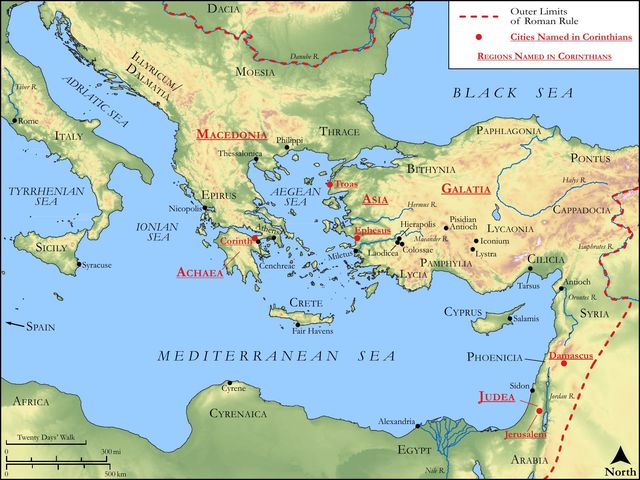
See on the biblical-era maps

Study this verse
Public-domain commentary
Matthew Henry
From his Commentary on the Whole Bible. Henry comments on passages, not single verses — this entry covers 1 Corinthians 10:6–14. His two-level outline is real structure in the source text, so it is rendered as structure.
The apostle, having recited their privileges, proceeds here to an account of their faults and punishments, their sins and plagues, which are left upon record for an example to us, a warning against the like sins, if we would escape the like punishments. We must not do as they did, lest we suffer as they suffered.
I.Several of their sins are specified as cautions to us; as,
1.We should shun inordinate desires after carnal objects: Not lust after evil things, as they lusted, Co1 10:6. God fed them with manna, but they must have flesh, Num 11:4. They had food for their supply, but, not content with this, they asked meat for their lusts, Psa 106:14. Carnal desires get head by indulgence, and therefore should be observed and checked in their first rise: if once they prevail, and bear sway in us, we know not whither they will carry us. This caution stands first, because carnal appetites indulged are the root and source of much sin.
2.He warns against idolatry (Co1 10:7): Neither be you idolaters, as were some of them; as it is written, The people sat down to eat and drink, and rose up to play. The sin of the golden calf is referred to, Exo 32:6. They first sacrificed to their idol, then feasted on the sacrifices, and then danced before it. Though only eating and drinking are mentioned here, yet the sacrifice is supposed. The apostle is speaking to the case of the Corinthians, who were tempted to feast on the heathen sacrifices, things offered to idols, though they do not seem to have been under any temptation to offer sacrifice themselves. Even eating and drinking of the sacrifices before the idol, and as things sacrificed, was idolatry, which, by the example of the Israelites, they should be warned to avoid.
3.He cautions against fornication, a sin to which the inhabitants of Corinth were in a peculiar manner addicted. They had a temple among them dedicated to Venus (that is, to lust), with above a thousand priestesses belonging to it, all common prostitutes. How needful was a caution against fornication to those who lived in so corrupt a city, and had been used to such dissolute manners, especially when they were under temptations to idolatry too! and spiritual whoredom did in many cases lead to bodily prostitution. Most of the gods whom the heathens served were represented as patterns of lewdness; and much lewdness was committed in the very worship of many of them. Many of the Jewish writers, and many Christians after them, think that such worship was paid to Baal-Peor; and that fornication was committed with the daughters of Moab in the worship of that idol. They were enticed by these women both to spiritual and corporal whoredom; first to feast on the sacrifice, if not to do more beastly acts, in honour of the idol, and then to defile themselves with strange flesh (Num. 25), which brought on a plague, that in one day slew twenty-three thousand, besides those who fell by the hand of public justice. Note, Whoremongers and adulterers God will judge, in whatever external relation they may stand to him, and whatever outward privileges he may bestow upon them. Let us fear the sins of Israel, if we would shun their plagues.
4.He warns us against tempting Christ (as some of them tempted, and were destroyed of serpents, Co1 10:9), or provoking him to jealousy, Co1 10:22. He was with the church in the wilderness; he was the angel of the covenant, who went before them. But he was greatly grieved and provoked by them in many ways: They spoke against him and Moses, Wherefore have you brought us out of Egypt to die in the wilderness? for which reason God sent fiery serpents among them (Num 21:5, Num 21:6), by which many of them were stung mortally. And it is but just to fear that such as tempt Christ under the present dispensation will be left by him in the power of the old serpent.
5.He warns against murmuring: Neither murmur you as some of them also murmured, and were destroyed of the destroyer (Co1 10:10), by a destroying angel, an executioner of divine vengeance. They quarrelled with God, and murmured against Moses his minister, when any difficulties pressed them. When they met with discouragements in the way to Canaan, they were very apt to fly in the face of their leaders, were for displacing them, and going back to Egypt under the conduct of others of their own choosing. Something like this seems to have been the case of the Corinthians; they murmured against Paul, and in him against Christ, and seem to have set up other teachers, who would indulge and soothe them in their inclinations, and particularly in a revolt to idolatry. Rather let them feast on idol sacrifices than bear the reproach, or expose themselves to the ill-will, of heathen neighbours. Such conduct was very provoking to God, and was likely to bring upon them swift destruction, as it did on the Israelites, Num 14:37. Note, Murmuring against divine disposals and commands is a sin that greatly provokes, especially when it grows to such a head as to issue in apostasy, and a revolt from him and his good ways.
II.The apostle subjoins to these particular cautions a more general one (Co1 10:11):
All these things happened to them for ensamples, and were written for our admonition. Not only the laws and ordinances of the Jews, but the providences of God towards them, were typical. Their sins against God, and backslidings from him, were typical of the infidelity of many under the gospel. God's judgments on them were types of spiritual judgments now. Their exclusion from the earthly Canaan typified the exclusion of many under the gospel out of the heavenly Canaan, for their unbelief. Their history was written, to be a standing monitor to the church, even under the last and most perfect dispensation: To us, on whom the end of the world is come, the concluding period of God's gracious government over men. Note, Nothing in scripture is written in vain. God had wise and gracious purposes towards us in leaving the Jewish history upon record; and it is our wisdom and duty to receive instruction from it. Upon this hint the apostle grounds a caution (Co1 10:12): Let him that thinketh he standeth take heed lest he fall. Note, The harms sustained by others should be cautious to us. He that thinks he stands should not be confident and secure, but upon his guard. Others have fallen, and so may we. And then we are most likely to fall when we are most confident of our own strength, and thereupon most apt to be secure, and off our guard. Distrust of himself, putting him at once upon vigilance and dependence on God, is the Christian's best security against all sin. Note, He who thinks he stands is not likely to keep his footing, if he fears no fall, nor guards against it. God has not promised to keep us from falling, if we do not look to ourselves: his protection supposes our own care and caution.
III.But to this word of caution he adds a word of comfort, Co1 10:13.
Though it is displeasing to God for us to presume, it is not pleasing to him for us to despair. If the former be a great sin, the latter is far from being innocent. Though we must fear and take heed lest we fall, yet should we not be terrified and amazed; for either our trials will be proportioned to our strength, or strength will be supplied in proportion to our temptations. We live indeed in a tempting world, where we are compassed about with snares. Every place, condition, relation, employment, and enjoyment, abounds with them; yet what comfort may we fetch from such a passage! For, 1. "No temptation," says the apostle, "hath yet taken you, but such as is common to man, what is human; that is, such as you may expect from men of such principles as heathens, and such power; or else such as is common to mankind in the present state; or else such as the spirit and resolution of mere men may bear you through." Note, The trials of common Christians are but common trials: others have the like burdens and the like temptations; what they bear up under, and break through, we may also. 2. God is faithful. Though Satan be a deceiver, God is true. Men may be false, and the world may be false; but God is faithful, and our strength and security are in him. He keepeth his covenant, and will never disappoint the filial hope and trust of his children. 3. He is wise as well as faithful, and will proportion our burden to our strength. He will not suffer us to be tempted above what we are able. He knows what we can bear, and what we can bear up against; and he will, in his wise providence, either proportion our temptations to our strength or make us able to grapple with them. He will take care that we be not overcome, if we rely upon him, and resolve to approve ourselves faithful to him. We need not perplex ourselves with the difficulties in our way when God will take care that they shall not be too great for us to encounter, especially. 4. When he will make them to issue well. He will make a way to escape, either the trial itself, or at least the mischief of it. There is no valley so dark but he can find a way through it, no affliction so grievous but he can prevent, or remove, or enable us to support it, and in the end overrule it to our advantage.
IV.And upon this argument he grounds another caution against idolatry: Wherefore, my dearly beloved, flee from idolatry. Observe,
1.How he addresses them: My dearly beloved. It is out of tender affection to them that he presses this advice upon them.
2.The matter of his advice: "Flee idolatry; shun it, and all approaches towards it." Idolatry is the most heinous injury and affront to the true God; it is transferring his worship and honour to a rival.
3.The ground of this advice: "Seeing you have such encouragement to trust God, and to be faithful, do you approve yourselves men, be not shaken by any discouragements your heathen enemies may lay before you. God will succour and assist, help you in your trials, and help you out of them; and therefore be not guilty of any idolatrous compliances." Note, We have all the encouragement in the world to flee sin and prove faithful to God. We cannot fall by a temptation if we cleave fast to him.
Historical interpretation
Two Centuries of Reception
7 surviving comments on this verse. Each one is dated, so this reads as a timeline rather than a list.
Select a marker to jump to its quote. Markers stagger vertically where authors wrote within a few decades of each other.
That we must not rashly judge of another. In the Gospel according to Luke: "Judge not, that ye be not judged: condemn not, that ye be not condemned." Of this same subject to the Romans: "Who art thou that judgest another man's servant? to his own master he standeth or falleth. But he shall stand; for God is able to make him stand." And again: "Wherefore thou art without excuse, O every man that judgest: for in that in which thou judgest another, thou condemnest thyself; for thou doest the same things which thou judgest. But dost thou hope, who judgest those who do evil, and doest the same, that thou thyself shalt escape the judgment of God" Also in the first Epistle of Paul to the Corinthians.: "And let him that thinketh he standeth take heed lest he fall." And again: "If any man thinketh that he knoweth anything, he knoweth not yet in what manner he ought to know."
Moreover, we do not prejudge when the Lord is to be the judge; save that if He shall find the repentance of the sinners full and sound, He will then ratify what shall have been here determined by us. If, however, any one should delude us with the pretence of repentance, God, who is not mocked, and who looks into man's heart, will judge of those things which we have imperfectly looked into, and the Lord will amend the sentence of His servants; while yet, dearest brother, we ought to remember that it is written, "A brother that helpeth a brother shall be exalted; " and that the apostle also has said, "Let all of you severally have regard to yourselves, lest ye also be tempted. Bear ye one another's burdens, and so fulfil the law of Christ; " also that, rebuking the haughty, and breaking down their arrogance, he says in his epistle, "Let him that thinketh he standeth, take heed lest he fall; " and in another place he says, "Who art thou that judgest another man's servant? To his own master he standeth or falleth; yea, he shall stand, for God is able to make him stand." John also proves that Jesus Christ the Lord is our Advocate and Intercessor for our sins, saying, "My little children, these things write I unto you, that ye sin not. And if any man sin, we have an Advocate with the Father, Jesus Christ the Supporter: and He is the propitiation for our sins." And Paul also, the apostle, in his epistle, has written, "If, while we were yet sinners, Christ died for us; much more, being now justified by His blood, we shall be saved from wrath through Him."
Paul says this to those who, relying on their knowledge that it was lawful to eat anything, were a cause of scandal to their weaker brethren. Thinking that they had risen to a higher level, they in fact declined because of the teaching of the false apostles and condemned Paul when they were the guilty ones.
"Wherefore let him that thinketh he standeth take heed lest he fall."
Again, he casts down their pride who thought highly of their knowledge. For if they who had so great privileges suffered such things; and some for murmuring alone were visited with such punishment, and others for tempting, and neither their multitude moved God to repent, nor their having attained to such things; much more shall it be so in our case, except we be sober. And well said he, "he that thinketh he standeth:" for this is not even standing as one ought to stand, to rely on yourself: for quickly will such an one fall: since they too, had they not been high-minded and self-confident, but of a subdued frame of mind, would not have suffered these things. Whence it is evident, that chiefly pride, and carelessness from which comes gluttony also, are the sources of these evils. Wherefore even though thou stand, yet take heed lest thou fall. For our standing here is not secure standing, no not until we be delivered out of the waves of this present life and have sailed into the tranquil haven. Be not therefore high-minded at thy standing, but guard against thy falling; for if Paul feared who was firmer than all, much more ought we to fear.
Now the Apostle's word, as we have seen, was, "Wherefore let him that thinketh he standeth take heed lest he fall;" but we cannot say even this; all of us, so to speak, having fallen, and lying prostrate on the ground. For to whom am I to say this? To him that committeth extortion every day? Nay, he lies prostrate with a mighty fall. To the fornicator? He too is cast down to the ground. To the drunkard? He also is fallen, and knoweth not even that he is fallen. So that it is not the season for this word, but for that saying of the prophet which he spake even to the Jews, "He that falleth, doth he not rise again?" For all are fallen, and to rise again they have no mind. So that our exhortation is not concerning the not falling, but concerning the ability of them that are fallen to arise. Let us rise again then, late though it be, beloved, let us rise again, and let us stand nobly.
[Syncletica] also said, ‘We have no security in this world. The Apostle said, “Let him that thinks he stands, take heed lest he fall” (1 Cor. 10:12). We are sailing on uncharted seas, as the psalmist David said, “Our life is like a sea.” Yet some seas have dangerous reefs, some are full of sharks, some seas are calm. It seems as if we are sailing in calm waters, while men of the world are sailing in rough weather. We are sailing in daylight, led by the sun of righteousness, while they are being driven along in the night of ignorance. Yet it often happens that worldly men, sailing in darkness and through storms, are so afraid of danger that they save the ship by calling upon God and by watchfulness, while we, in our calm waters, become careless, leave the proper course of righteousness, and are sunk.’
Daniel used to say that Arsenius told him a story, as if he were speaking of some other man, and it went like this: Whilst a certain hermit was sitting in his cell, a voice came to him which said, ‘Come here, and I will show you the works of the children of men,’ so he got up and went out. The voice led him out and showed him a black man cutting wood; he made up a large bundle and wanted to take it away, but he could not do so. Then instead of making the bundle smaller, he went and cut down some more wood, and added it to the first, and this he did many times. When he had gone on a little further, the voice showed him a man who was standing by a pit drawing up water; he poured it out into a certain hollowed-out place, and when he had poured the water into it, it ran down back into the pit. Again the voice said to him, ‘Come, and I will show you other things.’ Then he looked, and, behold, there was a temple, and two men on horseback were carrying a piece of wood as wide as the temple between them. They wanted to go in through the door, but the width of the wood did not let them do so, and they would not humble themselves to go in one after his companion to bring it in end-wise, and so they remained outside the door. Now these are the men who bear the yoke of righteousness with boasting, and they will not be humble enough to correct themselves and go in by the humble way of Christ, and therefore they remain outside the kingdom of God. The man who was cutting wood is the man who labours at many sins, and who, instead of repenting and diminishing his sins, adds other wickednesses to them. Now he who was drawing water is the man who does good works, but because other things are mingled in his good works they are lost. It is right for us to be watchful in all we do, lest we toil in vain.
A hermit said to a brother, ‘Do not measure yourself against your brother, saying that you are more serious or more chaste or more understanding than he is. But be obedient to the grace of God, in the spirit of poverty, and in love unfeigned. The efforts of a man swollen with vanity are futile. It is written, “Let him that thinks he stands take heed lest he fall” (1 Cor. 10:12); “let your speech be seasoned with salt” (Col. 4:6) and so you will be dependent upon Christ.’
Continue studying 1 Corinthians 10:12 across the web’s major study libraries — every link below opens this exact verse, chapter, or book on the destination site.
Read & Compare
 BibleGatewayThis verse in more than 200 translations and 70 languages.
 Bible.comThe YouVersion reader — hundreds of translations, reading plans, and highlights.
 ESV.orgCrossway's official English Standard Version reader.
 NET BibleThe NET translation with 60,000+ translators' notes on every rendering decision.
 STEP BibleTyndale House's free study tool — original text, vocabulary, and scholarly resources.
 BibliaLogos Bible Software's free web reader.
 USCCBThe New American Bible (Revised Edition) with the U.S. bishops' study notes.
Commentaries
 BibleHub CommentariesDozens of classic commentaries on this verse, gathered on one page.
 StudyLightMore than 100 commentary sets — the largest collection on the web.
 BibleRefPlain-English commentary on what this verse means, verse by verse.
 Enduring WordDavid Guzik's free commentary on this chapter, widely used by Bible teachers.
 Bible Study ToolsVerse commentary alongside Greek and Hebrew study aids.
Original Language & Research
- BibleHub InterlinearThe verse word by word — original language, transliteration, and English.
- BibleHub LexiconEvery word's original-language definition and Strong's entry.
 Blue Letter BibleDeep-study tools — Strong's numbers, concordance, and word studies.
 CNTR CollationThe earliest Greek manuscripts of this verse, collated letter by letter.
Sermons, Hymns & Audio


TrulyRandomVerse is not affiliated with these sites and doesn’t control their content. They’re linked because they’re genuinely useful.
Summary
The apostle Paul delivers a solemn warning to the Corinthian believers, urging those who perceive themselves to be spiritually secure and steadfast to exercise extreme caution lest they succumb to temptation and fall from their faith. This verse serves as a critical reminder against spiritual overconfidence and complacency, emphasizing the ongoing need for humility, vigilance, and dependence on God's sustaining grace in the Christian walk.
Context
ShowHideLiterary Context
1 Corinthians 10:12 stands as a pivotal warning within a broader section of Paul's letter where he addresses the issue of Christian liberty, particularly concerning food offered to idols, and the dangers of idolatry. Chapters 8-10 form a cohesive unit discussing the principles of Christian freedom and responsibility, especially toward weaker believers. Immediately preceding verse 12, Paul recounts a series of historical examples from Israel's wilderness journey in 1 Corinthians 10:1-11. He highlights how, despite their spiritual privileges (such as being "baptized unto Moses in the cloud and in the sea" and partaking of "spiritual meat and drink"), the Israelites fell into idolatry, sexual immorality, grumbling, and testing God, leading to divine judgment. Verse 12 directly applies these cautionary tales, transitioning from historical examples to a direct imperative for the Corinthian believers, underscoring that their spiritual privileges do not grant immunity from similar failures. The verse then sets the stage for Paul's assurance of God's faithfulness in 1 Corinthians 10:13, providing a balanced perspective on human weakness and divine strength.
Historical & Cultural Context
The Corinthian church was situated in a bustling, cosmopolitan city known for its wealth, diverse population, and pervasive paganism, including prominent idol worship and associated temple prostitution. Believers in Corinth faced constant pressure and temptation to conform to the surrounding culture. Many converts came from pagan backgrounds, and the question of participating in social events that involved eating meat sacrificed to idols was a significant practical and theological challenge. Paul's warnings about idolatry and immorality were highly relevant to their daily lives, as participation in such feasts could easily lead to spiritual compromise or a stumbling block for others. The historical examples of Israel's failures would have resonated with a Jewish-Christian audience and served as a powerful, universally understood cautionary narrative for Gentile believers, illustrating that even those with a covenant relationship with God could fall if they succumbed to temptation, pride, and disobedience.
Key Themes
ShowHideThis verse contributes significantly to several key themes woven throughout 1 Corinthians and the broader New Testament. It powerfully underscores the danger of spiritual pride and overconfidence, a recurring concern for Paul who often warns against self-sufficiency (e.g., 1 Corinthians 4:7). It emphasizes the necessity of ongoing spiritual vigilance and humility, reminding believers that no one is beyond the reach of temptation or the possibility of spiritual failure, echoing the call to "be sober, be vigilant" found in 1 Peter 5:8. The verse also implicitly highlights the theme of perseverance in faith and the active pursuit of holiness, contrasting with a passive or presumptive approach to salvation. By connecting to the failures of Israel, it reinforces the theme of learning from history and the enduring relevance of Old Testament narratives as examples for New Testament believers, as seen in Paul's broader argument in 1 Corinthians 10.
Exposition and Analysis
ShowHideKey Word Analysis
ShowHideThis verb implies a subjective perception, an opinion, or a supposition rather than an objective reality or certainty. It suggests a person seems or supposes themselves to be standing firm. This highlights the danger of a false sense of security, an overestimation of one's own spiritual strength, or a reliance on personal feeling rather than actual spiritual steadfastness rooted in Christ. It's not about truly standing firm, but about the belief or presumption of one's own stability.
This word denotes being established, standing firm, or holding one's ground. In a spiritual context, it refers to maintaining one's position in faith, remaining steadfast in Christian living, or being firm against temptation. The combination with dokéō creates a powerful contrast: the presumption of standing versus the reality of one's spiritual condition.
This is a strong imperative meaning "to look at," "to perceive," "to beware," or "to be careful." It calls for active, conscious vigilance and circumspection. It's not a passive suggestion but an urgent command to observe one's spiritual state carefully and to guard against potential dangers.
This verb literally means "to fall down," but in this context, it carries the figurative meaning of spiritual collapse, succumbing to sin, or departing from faithfulness. It implies a loss of spiritual standing, a failure in the face of temptation, or a lapse into disobedience, mirroring the "fall" of the Israelites described earlier in the chapter.
Verse Breakdown
ShowHide"Wherefore let him that thinketh he standeth"
This opening phrase, "Wherefore" (G5620, hṓste), functions as a strong conclusion or application drawn from the preceding historical examples of Israel's failures. It directly connects the lessons of the past to the present reality of the Corinthian believers. The phrase "him that thinketh he standeth" targets individuals who are self-assured, confident in their spiritual stability, or perhaps even arrogant about their immunity to temptation. The use of "thinketh" (dokéō) implies a subjective assessment, a presumption of strength rather than a divinely confirmed reality. It warns against a dangerous self-perception that can blind one to genuine spiritual vulnerability.
"take heed"
This is a direct, imperative command (G991, blépō). It calls for active vigilance, careful observation, and a conscious awareness of one's spiritual state and surroundings. It's a call to introspection and caution, urging believers to be sober-minded and watchful, rather than complacent. This command directly counters the presumptive attitude of "thinking one stands."
"lest he fall"
This concluding phrase states the dire consequence of spiritual overconfidence and lack of vigilance. "Lest" (G3361, mḗ) indicates a negative purpose or a warning against a potential outcome. The "fall" (G4098, píptō) refers to a spiritual stumble, a succumbing to sin, a departure from faithfulness, or a collapse in one's walk with God. It echoes the historical "falls" of the Israelites, emphasizing that similar spiritual failures are a real and present danger for any believer who becomes complacent.
Literary Devices
ShowHidePaul employs several effective literary devices in this concise warning. The primary device is Admonition, a strong warning or counsel against a potential danger, which is clearly articulated through the imperative "take heed." This admonition is delivered as a Proverbial Statement, a short, pithy saying that expresses a general truth or piece of advice, making it memorable and universally applicable. The verse also functions as a Climax to Paul's preceding historical examples, serving as the direct application of the cautionary tales from 1 Corinthians 10:1-11. Furthermore, there is an implicit Irony at play: those who think they are strong are precisely those most vulnerable to falling, highlighting the deceptive nature of spiritual pride. The use of Contrast between "standeth" and "fall" starkly illustrates the two possible outcomes of one's spiritual journey, contingent upon humility and vigilance.
Theological and Thematic Connections
ShowHide1 Corinthians 10:12 serves as a profound theological anchor, grounding the Christian life in a posture of humble dependence rather than self-assured confidence. It underscores the ongoing reality of spiritual warfare and the human propensity for sin, even among those who have experienced God's grace. The warning is not meant to induce fear or doubt in God's faithfulness, but rather to cultivate a healthy self-awareness and a constant reliance on divine strength. It reminds us that spiritual standing is not a static achievement but a dynamic process requiring continuous vigilance and a deep understanding that our stability comes from Christ alone, not from our own perceived strength or past accomplishments. This verse stands as a timeless call to humility, recognizing that pride is a precursor to spiritual downfall, and that true security is found in acknowledging our weakness and cleaving to God's sustaining power.
Reflection and Application
ShowHide1 Corinthians 10:12 is a piercing and perpetually relevant word for every believer, regardless of their spiritual maturity or experience. It confronts the insidious danger of spiritual complacency and the deceptive nature of pride. In a world that often celebrates self-reliance and strength, this verse calls us to a counter-cultural posture of humble vigilance. It forces us to ask: Am I truly standing firm in Christ, or merely thinking I am? Have I become so comfortable in my faith journey, or so confident in my past victories, that I have lowered my guard against temptation? The warning is not that God might fail us, but that we might presume upon His grace and our own strength, leading to a spiritual stumble. True spiritual security is not found in an absence of temptation or a feeling of invincibility, but in a constant, conscious dependence on the Lord, coupled with an honest assessment of our own vulnerabilities. This verse compels us to remain teachable, to learn from the failures of others, and to never cease praying for strength and deliverance from evil.
Questions for Reflection
ShowHideFAQ
ShowHideWhat does Paul mean by "thinketh he standeth"?
ShowHideBy "thinketh he standeth," Paul is addressing those who hold a subjective perception or presumption of their own spiritual stability and strength. The Greek word dokéō (G1380) implies "he seems" or "he supposes," suggesting a potentially false sense of security or an overestimation of one's spiritual resilience. It's a warning against spiritual arrogance or complacency, where a believer might feel immune to temptation or above the possibility of falling into sin, perhaps due to past successes, knowledge, or perceived maturity. Paul is highlighting the danger of relying on one's own perceived strength rather than on God's sustaining power.
How does this verse relate to God's faithfulness in temptation?
ShowHideThis verse, while a stern warning, is immediately followed by the comforting assurance in 1 Corinthians 10:13: "There hath no temptation taken you but such as is common to man: but God is faithful, who will not suffer you to be tempted above that ye are able; but will with the temptation also make a way to escape, that ye may be able to bear it." This juxtaposition is crucial. Verse 12 warns against human presumption, while verse 13 affirms divine provision. The warning in 1 Corinthians 10:12 is not meant to instill fear that God will abandon us, but to cultivate humility and vigilance, knowing that while we are weak, God is faithful to provide the strength and the way of escape we need to stand firm. The "take heed" is our responsibility, empowered by God's unwavering faithfulness.
Christ-Centered Fulfillment
ShowHideWhile 1 Corinthians 10:12 is a direct warning to believers about spiritual complacency, its ultimate fulfillment and resolution are found in Christ. The "standing" that we are warned not to presume upon is a standing in Christ, and our ability to "take heed lest we fall" is entirely dependent on His finished work and ongoing intercession. The failures of Israel, which precede this verse, highlight humanity's inability to stand firm on its own, even with divine privilege and law. This points to the desperate need for a perfect High Priest who could truly stand, and who could secure the standing of His people. Jesus Christ is that one; He is the perfect example of one who stood firm against all temptation, never once falling (Hebrews 4:15). Furthermore, our spiritual standing is not earned by our vigilance but is a gift secured by Christ's righteousness imputed to us (Romans 5:1-2). He is our rock and our fortress, the one who is able to keep us from falling and to present us faultless before the presence of His glory with exceeding joy (Jude 1:24). Therefore, the call to "take heed" is not a call to self-reliance, but a call to continually look to Jesus, the author and finisher of our faith (Hebrews 12:2), recognizing that our strength, vigilance, and ultimate perseverance are found in Him alone, who continually upholds us by His power (Colossians 1:17).