


Numbers 21:5
Bible text: King James Version (1769 Blayney text) · Public domain
Bible text: King James Version with Strong's numbers · Public domain
Bible text: Berean Standard Bible · Public domain
Bible text: American Standard Version (1901) · Public domain
Bible text: World English Bible, Messianic edition · Public domain
Bible text: Geneva Bible (1599) · Public domain
Bible text: Young's Literal Translation · Public domain
- וַיְדַבֵּרvay·da·Berand it spokeH1696Conj-w ¦ V-Piel-ConsecImperf-3msVerb Piel Consecutive Imperfect 3rd Singular Masculineוַandיְדַבֵּרit spoke
- הָעָםha·'Amthe peopleH5971Art ¦ N-msNoun Singular Masculine Absoluteהָtheעָםpeople
- בֵּאלֹהִיםbe·lo·Himagainst GodH430Prep-b ¦ N-mpNoun Plural Masculine AbsoluteבֵּagainstאלֹהִיםGod
- וּבְמֹשֶׁהu·ve·mo·Shehand against MosesH4872Conj-w ¦ Prep-b ¦ N-proper-mNoun Proper MasculineוּandבְagainstמֹשֶׁהMoses
- לָמָהla·Mah<to> why?H4100Prep-l ¦ InterrogPronoun Interrogativeלָ<to>מָהwhy?
- הֶעֱלִיתֻנוּhe·'e·li·Tu·nuhave you brought up usH5927V-Hiphil-Perf-2mp ¦ 1cpVerb Hiphil Perfect 2nd Plural Masculineהֶעֱלִיתֻhave you brought upנוּus
- מִמִּצְרַיִםmi·mitz·Ra·yimfrom EgyptH4714Prep-m ¦ N-properNoun Proper LocationמִfromמִּצְרַיִםEgypt
- לָמוּתla·Mutto dieH4191Prep-l ¦ V-Qal-InfVerb Qal Infinitive Constructלָtoמוּתdie
- בַּמִּדְבָּרba·mid·Barin the wildernessH4057Prep-b ¦ N-msNoun Singular Masculine Absoluteבַּin theמִּדְבָּרwilderness
- כִּיkiforH3588PrtParticle Conditional
- אֵין'einthere notH369N-mscNoun Singular Masculine Construct
- לֶחֶםle·chem[is] foodH3899N-msNoun Singular Masculine Absolute
- וְאֵיןve·'Einand there notH369Conj-w ¦ N-mscNoun Singular Masculine Constructוְandאֵיןthere not
- מַיִםMa·yim[is] waterH4325N-mpNoun Plural Masculine Absolute
- וְנַפְשֵׁנוּve·naf·She·nuand our selfH5315Conj-w ¦ N-fsc ¦ 1cpNoun Singular Feminine Constructוְandנַפְשֵׁselfנוּour
- קָצָהKa·tzahit loathesH6973V-Qal-Perf-3fsVerb Qal Perfect 3rd Singular Feminine
- בַּלֶּחֶםba·Le·chem<in> the foodH3899Prep-b ¦ N-msNoun Singular Masculine Absoluteבַּ<in> theלֶּחֶםfood
- הַקְּלֹקֵלha·ke·lo·Kel<the> worthlessH7052Art ¦ N-msNoun Singular Masculine Absoluteהַ<the>קְּלֹקֵלworthless
English is a literal word-by-word gloss of the Hebrew, not the KJV's wording. Why?
This is the original text the KJV's translators worked from — each Hebrew word with its own literal English meaning in this verse, prepared by scholars at Tyndale House, Cambridge. The KJV translates whole sentences, not word by word, so its wording differs: one Hebrew word can become several English words, and the KJV may choose “the LORD” where the gloss reads “Yahweh”. Both are faithful — they answer different questions. For the KJV's own rendering, switch to the KJV text.
Details
See on the biblical-era maps
Study this verse
Public-domain commentary
Matthew Henry
From his Commentary on the Whole Bible. Henry comments on passages, not single verses — this entry covers Numbers 21:4–9. His three-level outline is real structure in the source text, so it is rendered as structure.
Here is, I. The fatigue of Israel by a long march round the land of Edom, because they could not obtain passage through it the nearest way: The soul of the people was much discouraged because of the way, Num 21:4. Perhaps the way was rough and uneven, or foul and dirty; or it fretted them to go far about, and that they were not permitted to force their passage through the Edomites' country. Those that are of a fretful discontented spirit will always find something or other to make them uneasy.
II.Their unbelief and murmuring upon this occasion, Num 21:5.
Though they had just now obtained a glorious victory over the Canaanites, and were going on conquering and to conquer, yet they speak very discontentedly of what God had done for them and distrustfully of what he would do, vexed that they were brought out of Egypt, that they had not bread and water as other people had by their own care and industry, but by miracle, they knew not how. They have bread enough and to spare; and yet they complain there is no bread, because, though they eat angels' food, yet they are weary of it; manna itself is loathed, and called light bread, fit for children, not for men and soldiers. What will those be pleased with whom manna will not please? Those that are disposed to quarrel will find fault where there is no fault to be found. Thus those who have long enjoyed the means of grace are apt to surfeit even on the heavenly manna, and to call it light bread. But let not the contempt which some cast upon the word of God cause us to value it the less: it is the bread of life, substantial bread, and will nourish those who by faith feed upon it to eternal life, whoever calls it light bread.
III.The righteous judgment which God brought upon them for their murmuring, Num 21:6.
He sent fiery serpents among them, which bit or stung many of them to death. The wilderness through which they had passed was all along infested with those fiery serpents, as appears, Deu 8:15. but hitherto God had wonderfully preserved his people from receiving hurt by them, till now that they murmured, to chastise them for which these animals, which hitherto had shunned their camp, now invade it. Justly are those made to feel God's judgments that are not thankful for his mercies. These serpents are called fiery, from their colour, or from their rage, or from the effects of their bitings, inflaming the body, putting it immediately into a high fever, scorching it with an insatiable thirst. They had unjustly complained for want of water (Num 21:5), to chastise them for which God sends upon them this thirst, which no water would quench. Those that cry without cause have justly cause given them to cry out. They distrustfully concluded that they must die in the wilderness, and God took them at their word, chose their delusions, and brought their unbelieving fears upon them; many of them did die. They had impudently flown in the face of God himself, and the poison of asps was under their lips, and now these fiery serpents (which, it should seem, were flying serpents, Isa 14:29) flew in their faces and poisoned them. They in their pride had lifted themselves up against God and Moses, and now God humbled and mortified them, by making these despicable animals a plague to them. That artillery is now turned against them which had formerly been made use of in their defence against the Egyptians. He that brought quails to feast them let them know that he could bring serpents to bite them; the whole creation is at war with those that are in arms against God.
IV.Their repentance and supplication to God under this judgment, Num 21:7.
They confess their fault: We have sinned. They are particular in their confession: We have spoken against the Lord, and against thee. It is to be feared that they would not have owned the sin if they had not felt the smart; but they relent under the rod; when he slew them, then they sought him. They beg the prayers of Moses for them, as conscious to themselves of their own unworthiness to be heard, and convinced of the great interest which Moses had in heaven. How soon is their tone altered! Those who had just before quarrelled with him as their worst enemy now make their court to him as their best friend, and choose him for their advocate with God. Afflictions often change men's sentiments concerning God's people, and teach them to value those prayers which, at a former period, they had scorned. Moses, to show that he had heartily forgiven them, blesses those who had cursed him, and prays for those who had despitefully used him Herein he was a type of Christ, who interceded for his persecutors, and a pattern to us to go and do likewise, and thus to show that we love our enemies.
V.The wonderful provision which God made for their relief.
He did not employ Moses in summoning the judgment, but, that he might recommend him to the good affection of the people, he made him instrumental in their relief, Num 21:8, Num 21:9. God ordered Moses to make the representation of a fiery serpent, which he did, in brass, and set it up on a very long pole, so that it might be seen from all parts of the camp, and every one that was stung with a fiery serpent was healed by looking up to this serpent of brass. The people prayed that God would take away the serpents from them (Num 21:7), but God saw fit not to do this: for he gives effectual relief in the best way, though not in our way. Thus those who did not die for their murmuring were yet made to smart for it, that they might the more feelingly repent and humble themselves for it; they were likewise made to receive their cure from God, by the hand of Moses, that they might be taught, if possible, never again to speak against God and Moses. This method of cure was altogether miraculous, and the more wonderful if what some naturalists say be true, that looking upon bright and burnished brass is hurtful to those that are stung with fiery serpents. God can bring about his purposes by contrary means. The Jews themselves say that it was not the sight of the brazen serpent that cured them, but, in looking up to it, they looked up to God as the Lord that healed them. But there was much of gospel in this appointment. Our Saviour has told us so (Joh 3:14, Joh 3:15), that as Moses lifted up the serpent in the wilderness so the Son of man must be lifted up, that whosoever believeth in him should not perish. Observe then a resemblance,
1.Between their disease and ours. The devil is the old serpent, a fiery serpent, hence he appears (Rev 12:3) as a great red dragon. Sin is the biting of this fiery serpent; it is painful to the startled conscience, and poisonous to the seared conscience. Satan's temptations are called his fiery darts, Eph 6:16. Lust and passion inflame the soul, so do the terrors of the Almighty, when they set themselves in array. At the last, sin bites like a serpent and stings like an adder; and even its sweets are turned into the gall of asps.
2.Between their remedy and ours.
(1.)It was God himself that devised and prescribed this antidote against the fiery serpents; so our salvation by Christ was the contrivance of Infinite Wisdom; God himself has found the ransom.
(2.)It was a very unlikely method of cure; so our salvation by the death of Christ is to the Jews a stumbling-block and to the Greeks foolishness. It was Moses that lifted up the serpent in the wilderness, so the law is a schoolmaster to bring us to Christ, and Moses wrote of him, Joh 3:14-16. Christ was lifted up by the rulers of the Jews, who were the successors of Moses.
(3.)That which cured was shaped in the likeness of that which wounded. So Christ, though perfectly free from sin himself, yet was made in the likeness of sinful flesh (Rom 8:3), so like that it was taken for granted that this man was a sinner, Joh 9:24.
(4.)The brazen serpent was lifted up; so was Christ. He was lifted up upon the cross (Joh 12:33, Joh 12:34), for his was made a spectacle to the world. He was lifted up by the preaching of the gospel. The word here used for a pole signifies a banner, or ensign, for Christ crucified stands for an ensign of the people, Isa 11:10. Some make the lifting up of the serpent to be a figure of Christ's triumphing over Satan, the old serpent, whose head he bruised, when in his cross he made an open show of the principalities and powers which he had spoiled and destroyed, Col 2:15.
3.Between the application of their remedy and ours. They looked and lived, and we, if we believe, shall not perish; it is by faith that we look unto Jesus, Heb 12:2. Look unto me, and be you saved, Isa 45:22. We must be sensible of our wound and of our danger by it, receive the record which God has given concerning his Son, and rely upon the assurance he has given us that we shall be healed and saved by him if we resign ourselves to his direction. The brazen serpent's being lifted up would not cure if it was not looked upon. If any pored on their wound, and would not look up to the brazen serpent, they inevitably died. If they slighted this method of cure, and had recourse to natural medicines, and trusted to them, they justly perished; so if sinners either despise Christ's righteousness or despair of benefit by it their wound will, without doubt, be fatal. But whoever looked up to this healing sign, though from the outmost part of the camp, though with a weak and weeping eye, was certainly healed; so whosoever believes in Christ, though as yet but weak in faith, shall not perish. There are weak brethren for whom Christ died. Perhaps for some time after the serpent was set up the camp of Israel was molested by the fiery serpents; and it is the probable conjecture of some that they carried this brazen serpent along with them through the rest of their journey, and set it up wherever they encamped, and, when they settled in Canaan, fixed it somewhere within the borders of the land; for it is not likely that the children of Israel went so far off as this was into the wilderness to burn incense to it, as we find they did, Kg2 18:4. Even those that are delivered from the eternal death which is the wages of sin must expect to feel the pain and smart of it as long as they are here in this world; but, if it be not our own fault, we may have the brazen serpent to accompany us, to be still looked up to upon all occasions, by bearing about with us continually the dying of the Lord Jesus.
Historical interpretation
Fourteen Centuries of Reception
2 surviving comments on this verse. Each one is dated, so this reads as a timeline rather than a list.
Select a marker to jump to its quote. Markers stagger vertically where authors wrote within a few decades of each other.
Many things were done in figure which were done in former times. For when he said that the fathers who were bitten by serpents in the desert could not be healed in any other way except that Moses hung up a brazen serpent, and when this was seen, those deadly bites and injurious effects of the poison were cured, he added: But these things were done in figure to instruct us (1 Corinthians 10:6). In the image, a bronze serpent was placed on a cross; because the true one to be crucified was announced to the human race, who would empty the venom of the devilish serpent, cursed in its image, but in truth, would erase all curses of the world.
Very light food: So they call the heavenly manna: thus worldlings loathe the things of heaven, for which they have no relish.
Continue studying Numbers 21:5 across the web’s major study libraries — every link below opens this exact verse, chapter, or book on the destination site.
Read & Compare
 BibleGatewayThis verse in more than 200 translations and 70 languages.
 Bible.comThe YouVersion reader — hundreds of translations, reading plans, and highlights.
 ESV.orgCrossway's official English Standard Version reader.
 NET BibleThe NET translation with 60,000+ translators' notes on every rendering decision.
 STEP BibleTyndale House's free study tool — original text, vocabulary, and scholarly resources.
 BibliaLogos Bible Software's free web reader.
 USCCBThe New American Bible (Revised Edition) with the U.S. bishops' study notes.
Commentaries
 BibleHub CommentariesDozens of classic commentaries on this verse, gathered on one page.
 StudyLightMore than 100 commentary sets — the largest collection on the web.
 BibleRefPlain-English commentary on what this verse means, verse by verse.
 Enduring WordDavid Guzik's free commentary on this chapter, widely used by Bible teachers.
 Bible Study ToolsVerse commentary alongside Greek and Hebrew study aids.
Original Language & Research
- BibleHub InterlinearThe verse word by word — original language, transliteration, and English.
- BibleHub LexiconEvery word's original-language definition and Strong's entry.
 Blue Letter BibleDeep-study tools — Strong's numbers, concordance, and word studies.
 SefariaThe Hebrew text with Rashi and centuries of Jewish commentary.
Sermons, Hymns & Audio


TrulyRandomVerse is not affiliated with these sites and doesn’t control their content. They’re linked because they’re genuinely useful.
Summary
Numbers 21:5 vividly portrays a pivotal moment of Israelite rebellion and profound ingratitude during their arduous wilderness journey. Exhausted by the prolonged travel and disillusioned by their circumstances, the people launched a direct accusation against both God and Moses, questioning their very deliverance from Egypt and asserting that they had been led into the wilderness only to perish. Their bitter complaint cited a perceived absence of essential provisions—bread and water—and culminated in a contemptuous rejection of the manna, the miraculous "light bread" that had sustained them daily for years, thereby exposing a deep-seated spiritual malaise, a profound distrust in divine faithfulness, and a longing for the perceived comforts of their former bondage.
Context
ShowHideLiterary Context
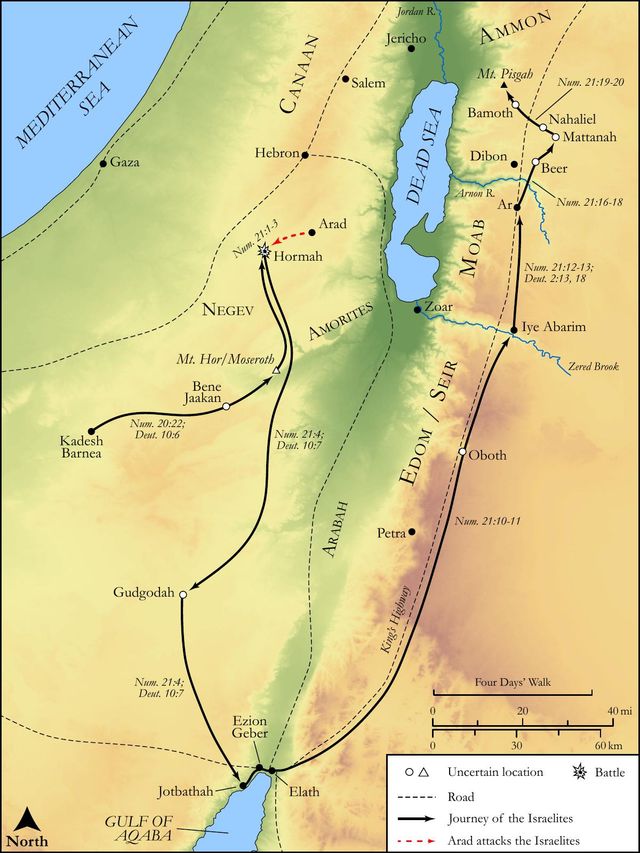
Numbers 21:5 is strategically placed within the latter stages of Israel's forty-year wilderness wandering, immediately following their significant victory over the Canaanite king of Arad and a challenging detour around the territory of Edom (Numbers 20:14-21:4). The preceding verses describe the people's initial success in battle and their subsequent journey from Mount Hor by way of the Red Sea, a circuitous route necessitated by Edom's refusal of passage. This particular journey was long and difficult, and the physical hardship, coupled with their inherent impatience, culminates in this verse with an eruption of open defiance. This act of rebellion sets the immediate stage for God's swift judgment—the plague of fiery serpents—and the subsequent provision of the bronze serpent as a means of salvation (Numbers 21:6-9). This episode echoes and amplifies earlier instances of Israelite grumbling and discontent, such as those detailed in Exodus 16 concerning food and Numbers 11 regarding their craving for meat.
Historical & Cultural Context
The Israelites were navigating a harsh, arid wilderness, a desolate and unforgiving environment that relentlessly tested their physical endurance and spiritual resolve. Their journey was not a direct route but a divinely guided, circuitous path, often dictated by geopolitical realities and God's sovereign purposes. In Israel, a leader was a shepherd of the people, and his legitimacy and authority were intrinsically linked to his ability to provide for and protect them. Failure to do so could easily incite widespread discontent and rebellion. Moses, as God's chosen mediator and leader, bore the initial brunt of the people's frustration, yet their words quickly escalated beyond him to a direct affront against God Himself. Their complaint about the absence of "bread" and "water" reflects a primal fear of starvation and thirst, common anxieties in such a desolate landscape. However, this complaint deliberately ignores God's consistent, miraculous provision of both manna and water throughout their decades-long journey. Their nostalgic longing for the "fleshpots of Egypt," as previously expressed in Exodus 16:3, underscores a cultural memory that romanticized the perceived abundance of slavery over the perceived scarcity and hardship of freedom under God's direct, yet often demanding, leading.
Key Themes
ShowHideNumbers 21:5 powerfully encapsulates several pervasive themes woven throughout the Pentateuch. Foremost is the theme of Complaint and Rebellion, a recurring and deeply entrenched pattern in Israel's wilderness narrative, consistently demonstrating their spiritual immaturity, lack of trust in God's leadership, and resistance to His sovereign will. This directly intertwines with the theme of Unbelief or Lack of Faith, as their accusatory question, "Wherefore have ye brought us up... to die?", reveals a fundamental distrust in God's benevolent intentions, His redemptive purpose, and His omnipotent power to sustain them. Furthermore, their contemptuous dismissal of the manna as "light bread" that their "soul loatheth" highlights the profound theme of Ingratitude and Despising Divine Provision. Despite God's sustained, miraculous, and life-saving care, they fixated on the monotony and perceived inadequacy of His gifts. They failed to appreciate the daily miracle that prevented their demise in the wilderness, a faithful provision that had commenced since Exodus 16:4. This deep-seated ingratitude often invited severe divine consequences, as chillingly illustrated by the subsequent judgment of the fiery serpents in Numbers 21:6.
Exposition and Analysis
ShowHideKey Word Analysis
ShowHideWhile dâbar fundamentally means "to speak" or "to say," its usage here, coupled with the preposition "against" (בְּ, be), transforms its meaning to convey a strong sense of accusation, complaint, or open rebellion. It signifies not merely the articulation of an opinion but the voicing of a direct challenge or opposition to authority. In this context, the people's words are not a humble petition but an overt act of defiance and disrespect directed at both Moses, God's appointed leader, and, more significantly, at God Himself, indicating a deep-seated bitterness and resentment in their hearts.
This primitive root conveys the idea of severing oneself from something, leading to a sense of disgust, anxiety, or weariness. When applied to the "soul" (נֶפֶשׁ, nephesh), as it is here, it describes a profound spiritual and emotional repugnance, a deep-seated revulsion. The people's "soul loatheth" the manna, indicating not merely a dislike for its taste or texture, but an utter spiritual and emotional exhaustion with God's daily provision, reflecting a heart that is completely fed up, ungrateful, and spiritually sick.
Derived from a root meaning "to be light" or "to be swift," this adjective carries the pejorative sense of being despised, worthless, contemptible, or vile. It is a derogatory term used by the Israelites to describe the manna, the miraculous food God had provided daily. By calling it "light bread," they were not referring to its physical weight but to its perceived insignificance, worthlessness, and the profound contempt they felt for it, despite its supernatural origin and its continuous, life-sustaining properties. This term starkly contrasts with the divine miracle it truly represented.
Verse Breakdown
ShowHide"And the people spake against God, and against Moses"
This opening clause immediately establishes the dual and direct targets of the Israelites' profound discontent. Their grumbling is not a private murmur but an openly voiced accusation against Moses, their divinely appointed leader, and, more critically, against God Himself. This dual accusation reveals a profound spiritual rebellion, as challenging Moses' authority was tantamount to challenging God's authority, given Moses' unique role as God's prophet and mediator.
"Wherefore have ye brought us up out of Egypt to die in the wilderness?"
This rhetorical question is a bitter, despair-laden accusation, steeped in hyperbole. It implies that God's (and Moses') true intention in delivering them from Egyptian bondage was not liberation and life, but rather a slow, agonizing death in the desolate desert. This statement demonstrates a complete and shocking lack of faith in God's redemptive purpose and His power to sustain them, reducing their glorious Exodus to a fatal trap.
"for [there is] no bread, neither [is there any] water;"
This clause articulates the immediate, perceived physical deprivations that fueled their complaint. While God had consistently provided both manna for bread and water from the rock throughout their journey, the people's current hardship led them to declare an absolute lack. This highlights their profound short-sightedness and their failure to remember God's past faithfulness, focusing solely on their present discomfort and perceived scarcity.
"and our soul loatheth this light bread."
This final clause reveals the depth of their ingratitude and spiritual sickness. "Light bread" refers to the manna, the miraculous, daily provision from God. To "loathe" it signifies a profound disgust and contempt. Despite its supernatural origin and its indispensable role in sustaining their lives for decades, the monotony of the manna had bred contempt, revealing a heart that despised God's faithful, albeit consistent, provision.
Literary Devices
ShowHideNumbers 21:5 is rich with literary devices that amplify its dramatic and theological impact. The most prominent is Hyperbole, vividly evident in the people's declaration, "Wherefore have ye brought us up out of Egypt to die in the wilderness?" This exaggerated statement expresses their extreme despair and frustration, painting a picture of imminent death despite God's continuous, life-sustaining provision. It is a dramatic overstatement of their current suffering, designed to convey the depth of their perceived plight. Another significant device is Irony. The people complain bitterly about "no bread" while simultaneously despising the very "light bread" (manna) that God has miraculously provided daily for forty years. They also lament "no water," despite God's repeated provision of water from rocks (e.g., Exodus 17:6 and Numbers 20:11). This highlights the stark, tragic contrast between God's faithful, miraculous sustenance and the people's ungrateful, rebellious rejection of it. Furthermore, the verse employs Repetition of a thematic pattern, as this specific complaint echoes numerous prior instances of grumbling against God and Moses throughout the wilderness narrative (e.g., Exodus 15:24, Exodus 16:2-3, Numbers 11:4-6), underscoring Israel's persistent spiritual rebellion and the deep-seated nature of their unbelief.
Theological and Thematic Connections
ShowHideNumbers 21:5 stands as a stark testament to the human propensity for ingratitude and rebellion, even in the face of overwhelming divine faithfulness. The Israelites' bitter complaint against God and Moses, coupled with their contempt for the manna, reveals a profound lack of faith and a spiritual amnesia regarding God's past deliverances and consistent, miraculous provision. This episode underscores the theological truth that true spiritual sustenance, when it becomes routine or mundane, is often despised. It highlights how impatience with God's timing or methods can quickly devolve into open defiance and an questioning of His very character. This passage powerfully demonstrates the danger of focusing on perceived lack rather than acknowledging abundant grace, illustrating how a heart of discontent can blind one to God's daily miracles and lead to severe, often self-inflicted, consequences. This recurring pattern of human rebellion and divine response is a pervasive motif throughout redemptive history, serving as a solemn warning against testing God's patience and despising His grace.
Reflection and Application
ShowHideNumbers 21:5 serves as a potent mirror for our own hearts, revealing the insidious nature of discontent and ingratitude that can subtly erode our faith. Like the Israelites, we often find ourselves in "wilderness" seasons—periods of hardship, monotony, delayed gratification, or unmet expectations—where our patience wears thin, and our focus shifts from God's unwavering faithfulness to our perceived lack. This verse challenges us to critically examine our attitudes when life is difficult, when God's provisions seem less exciting or abundant than we desire, or when His timing seems slow. Do we, like ancient Israel, complain against God and His appointed leaders, questioning His wisdom, love, or power? Do we despise the "light bread" of His consistent, daily grace—the mundane blessings, the faithful presence of His Spirit, the simple yet profound truths of His Word—because we crave something more dramatic, more palatable, or more aligned with our immediate desires? Our response to the ordinary and the challenging reveals the true state of our faith and the depth of our trust. This passage calls us to cultivate a spirit of profound and persistent thankfulness, recognizing God's hand in every provision, no matter how small, consistent, or seemingly insignificant. It is a call to trust implicitly in His sovereign plan, even when the path is arduous, the wilderness feels endless, and the destination seems distant. Ultimately, it is a summons to remember His past faithfulness and to believe that He who has delivered us will also sustain us to the very end.
Questions for Reflection
ShowHideFAQ
ShowHideWhy did the people complain about "no bread" when God was providing manna?
ShowHideThe complaint "no bread" was a hyperbole born out of their deep discontent and weariness, rather than an absolute lack. God was indeed providing manna daily (as recounted in Exodus 16), but the Israelites had grown utterly sick of it, calling it "light bread" that their "soul loatheth." This indicates that their complaint was not about the absence of food, but about the monotony, the lack of variety, and the perceived inadequacy of the food God was providing. They craved the "fish, cucumbers, melons, leeks, onions, and garlic" they remembered from Egypt (Numbers 11:5). Their grumbling was fundamentally a spiritual issue—a profound lack of faith, a failure to remember God's past faithfulness, and a deep-seated ingratitude—rather than a genuine physical one, as God's provision was constant and miraculous.
Christ-Centered Fulfillment
ShowHideNumbers 21:5, with its poignant depiction of Israel's rejection of God's miraculous provision, finds profound Christ-centered fulfillment in the New Testament. The "light bread" that the Israelites despised was the manna, a supernatural, life-sustaining food given by God in the wilderness. Jesus Himself explicitly connects this Old Testament manna to His own person and work, declaring, "I am the bread of life; whoever comes to me shall not hunger, and whoever believes in me shall never thirst" (John 6:35). Just as Israel rejected the physical manna, which was a type and shadow of true spiritual sustenance, so too did many in Jesus' day reject Him, the true "bread from heaven" who came to give life to the world (John 6:32-33). Their grumbling against God and Moses in the wilderness thus foreshadows the world's persistent grumbling, unbelief, and ultimate rejection of Christ, who offers eternal life. Furthermore, the immediate consequence of this complaint in Numbers 21 was the plague of fiery serpents, leading to the miraculous healing achieved by looking at the bronze serpent lifted up on a pole (Numbers 21:6-9). Jesus directly interprets this pivotal event as a prophetic type of His own crucifixion and the salvation it brings: "And as Moses lifted up the serpent in the wilderness, so must the Son of Man be lifted up, that whoever believes in him may have eternal life" (John 3:14-15). Thus, Israel's sin of ingratitude and rebellion in Numbers 21:5 sets the stage for God's gracious provision of a remedy that ultimately points to the saving work of Christ on the cross, the ultimate answer to humanity's spiritual sickness, thirst, and rebellion.