


Numbers 21:4
Bible text: King James Version (1769 Blayney text) · Public domain
Bible text: King James Version with Strong's numbers · Public domain
Bible text: Berean Standard Bible · Public domain
Bible text: American Standard Version (1901) · Public domain
Bible text: World English Bible, Messianic edition · Public domain
Bible text: Geneva Bible (1599) · Public domain
Bible text: Young's Literal Translation · Public domain
- וַיִּסְעוּvai·yis·'Uand they set outH5265Conj-w ¦ V-Qal-ConsecImperf-3mpVerb Qal Consecutive Imperfect 3rd Plural Masculineוַandיִּסְעוּthey set out
- מֵהֹרme·Horfrom HorH2023Prep-m ¦ N-properNoun Proper LocationמֵfromהֹרHor
- הָהָרha·Harthe mountainH2022Art ¦ N-msNoun Singular Masculine Absoluteהָtheהָרmountain
- דֶּרֶךְDe·rekh[the] direction ofH1870N-cscNoun Singular common gender Construct
- יַםyam[the] sea ofH3220N-mscNoun Singular Masculine Construct
- סוּףSufreed[s]H5488N-msNoun Title Singular Masculine Absolute
- לִסְבֹבlis·Voto go aroundH5437Prep-l ¦ V-Qal-InfVerb Qal Infinitive Constructלִtoסְבֹבgo around
- אֶת'et<obj.>H853DirObjMParticle Object Indicator
- אֶרֶץ'E·retz[the] land ofH776N-fscNoun Singular Feminine Construct
- אֱדוֹם'e·DomEdomH123N-proper-mNoun Proper Masculine
- וַתִּקְצַרva·tik·Tzarand it became shortH7114Conj-w ¦ V-Qal-ConsecImperf-3fsVerb Qal Consecutive Imperfect 3rd Singular Feminineוַandתִּקְצַרit became short
- נֶפֶשׁne·fesh[the] self ofH5315N-fscNoun Singular Feminine Construct
- הָעָםha·'Amthe peopleH5971Art ¦ N-msNoun Singular Masculine Absoluteהָtheעָםpeople
- בַּדָּרֶךְba·Da·rekhon the wayH1870Prep-b ¦ N-csNoun Singular common gender Absoluteבַּon theדָּרֶךְway
English is a literal word-by-word gloss of the Hebrew, not the KJV's wording. Why?
This is the original text the KJV's translators worked from — each Hebrew word with its own literal English meaning in this verse, prepared by scholars at Tyndale House, Cambridge. The KJV translates whole sentences, not word by word, so its wording differs: one Hebrew word can become several English words, and the KJV may choose “the LORD” where the gloss reads “Yahweh”. Both are faithful — they answer different questions. For the KJV's own rendering, switch to the KJV text.
Details
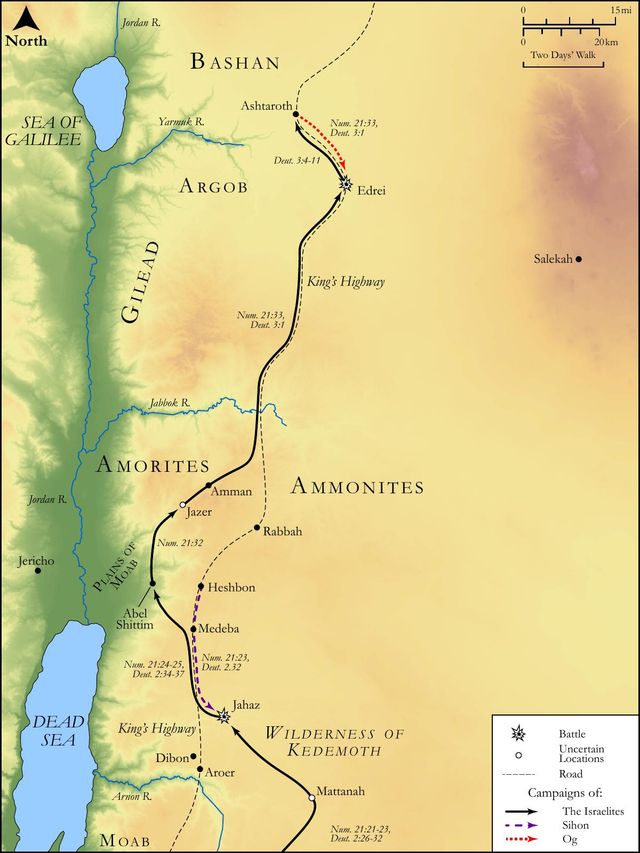
See on the biblical-era maps
Study this verse
Public-domain commentary
Matthew Henry
From his Commentary on the Whole Bible. Henry comments on passages, not single verses — this entry covers Numbers 21:4–9. His three-level outline is real structure in the source text, so it is rendered as structure.
Here is, I. The fatigue of Israel by a long march round the land of Edom, because they could not obtain passage through it the nearest way: The soul of the people was much discouraged because of the way, Num 21:4. Perhaps the way was rough and uneven, or foul and dirty; or it fretted them to go far about, and that they were not permitted to force their passage through the Edomites' country. Those that are of a fretful discontented spirit will always find something or other to make them uneasy.
II.Their unbelief and murmuring upon this occasion, Num 21:5.
Though they had just now obtained a glorious victory over the Canaanites, and were going on conquering and to conquer, yet they speak very discontentedly of what God had done for them and distrustfully of what he would do, vexed that they were brought out of Egypt, that they had not bread and water as other people had by their own care and industry, but by miracle, they knew not how. They have bread enough and to spare; and yet they complain there is no bread, because, though they eat angels' food, yet they are weary of it; manna itself is loathed, and called light bread, fit for children, not for men and soldiers. What will those be pleased with whom manna will not please? Those that are disposed to quarrel will find fault where there is no fault to be found. Thus those who have long enjoyed the means of grace are apt to surfeit even on the heavenly manna, and to call it light bread. But let not the contempt which some cast upon the word of God cause us to value it the less: it is the bread of life, substantial bread, and will nourish those who by faith feed upon it to eternal life, whoever calls it light bread.
III.The righteous judgment which God brought upon them for their murmuring, Num 21:6.
He sent fiery serpents among them, which bit or stung many of them to death. The wilderness through which they had passed was all along infested with those fiery serpents, as appears, Deu 8:15. but hitherto God had wonderfully preserved his people from receiving hurt by them, till now that they murmured, to chastise them for which these animals, which hitherto had shunned their camp, now invade it. Justly are those made to feel God's judgments that are not thankful for his mercies. These serpents are called fiery, from their colour, or from their rage, or from the effects of their bitings, inflaming the body, putting it immediately into a high fever, scorching it with an insatiable thirst. They had unjustly complained for want of water (Num 21:5), to chastise them for which God sends upon them this thirst, which no water would quench. Those that cry without cause have justly cause given them to cry out. They distrustfully concluded that they must die in the wilderness, and God took them at their word, chose their delusions, and brought their unbelieving fears upon them; many of them did die. They had impudently flown in the face of God himself, and the poison of asps was under their lips, and now these fiery serpents (which, it should seem, were flying serpents, Isa 14:29) flew in their faces and poisoned them. They in their pride had lifted themselves up against God and Moses, and now God humbled and mortified them, by making these despicable animals a plague to them. That artillery is now turned against them which had formerly been made use of in their defence against the Egyptians. He that brought quails to feast them let them know that he could bring serpents to bite them; the whole creation is at war with those that are in arms against God.
IV.Their repentance and supplication to God under this judgment, Num 21:7.
They confess their fault: We have sinned. They are particular in their confession: We have spoken against the Lord, and against thee. It is to be feared that they would not have owned the sin if they had not felt the smart; but they relent under the rod; when he slew them, then they sought him. They beg the prayers of Moses for them, as conscious to themselves of their own unworthiness to be heard, and convinced of the great interest which Moses had in heaven. How soon is their tone altered! Those who had just before quarrelled with him as their worst enemy now make their court to him as their best friend, and choose him for their advocate with God. Afflictions often change men's sentiments concerning God's people, and teach them to value those prayers which, at a former period, they had scorned. Moses, to show that he had heartily forgiven them, blesses those who had cursed him, and prays for those who had despitefully used him Herein he was a type of Christ, who interceded for his persecutors, and a pattern to us to go and do likewise, and thus to show that we love our enemies.
V.The wonderful provision which God made for their relief.
He did not employ Moses in summoning the judgment, but, that he might recommend him to the good affection of the people, he made him instrumental in their relief, Num 21:8, Num 21:9. God ordered Moses to make the representation of a fiery serpent, which he did, in brass, and set it up on a very long pole, so that it might be seen from all parts of the camp, and every one that was stung with a fiery serpent was healed by looking up to this serpent of brass. The people prayed that God would take away the serpents from them (Num 21:7), but God saw fit not to do this: for he gives effectual relief in the best way, though not in our way. Thus those who did not die for their murmuring were yet made to smart for it, that they might the more feelingly repent and humble themselves for it; they were likewise made to receive their cure from God, by the hand of Moses, that they might be taught, if possible, never again to speak against God and Moses. This method of cure was altogether miraculous, and the more wonderful if what some naturalists say be true, that looking upon bright and burnished brass is hurtful to those that are stung with fiery serpents. God can bring about his purposes by contrary means. The Jews themselves say that it was not the sight of the brazen serpent that cured them, but, in looking up to it, they looked up to God as the Lord that healed them. But there was much of gospel in this appointment. Our Saviour has told us so (Joh 3:14, Joh 3:15), that as Moses lifted up the serpent in the wilderness so the Son of man must be lifted up, that whosoever believeth in him should not perish. Observe then a resemblance,
1.Between their disease and ours. The devil is the old serpent, a fiery serpent, hence he appears (Rev 12:3) as a great red dragon. Sin is the biting of this fiery serpent; it is painful to the startled conscience, and poisonous to the seared conscience. Satan's temptations are called his fiery darts, Eph 6:16. Lust and passion inflame the soul, so do the terrors of the Almighty, when they set themselves in array. At the last, sin bites like a serpent and stings like an adder; and even its sweets are turned into the gall of asps.
2.Between their remedy and ours.
(1.)It was God himself that devised and prescribed this antidote against the fiery serpents; so our salvation by Christ was the contrivance of Infinite Wisdom; God himself has found the ransom.
(2.)It was a very unlikely method of cure; so our salvation by the death of Christ is to the Jews a stumbling-block and to the Greeks foolishness. It was Moses that lifted up the serpent in the wilderness, so the law is a schoolmaster to bring us to Christ, and Moses wrote of him, Joh 3:14-16. Christ was lifted up by the rulers of the Jews, who were the successors of Moses.
(3.)That which cured was shaped in the likeness of that which wounded. So Christ, though perfectly free from sin himself, yet was made in the likeness of sinful flesh (Rom 8:3), so like that it was taken for granted that this man was a sinner, Joh 9:24.
(4.)The brazen serpent was lifted up; so was Christ. He was lifted up upon the cross (Joh 12:33, Joh 12:34), for his was made a spectacle to the world. He was lifted up by the preaching of the gospel. The word here used for a pole signifies a banner, or ensign, for Christ crucified stands for an ensign of the people, Isa 11:10. Some make the lifting up of the serpent to be a figure of Christ's triumphing over Satan, the old serpent, whose head he bruised, when in his cross he made an open show of the principalities and powers which he had spoiled and destroyed, Col 2:15.
3.Between the application of their remedy and ours. They looked and lived, and we, if we believe, shall not perish; it is by faith that we look unto Jesus, Heb 12:2. Look unto me, and be you saved, Isa 45:22. We must be sensible of our wound and of our danger by it, receive the record which God has given concerning his Son, and rely upon the assurance he has given us that we shall be healed and saved by him if we resign ourselves to his direction. The brazen serpent's being lifted up would not cure if it was not looked upon. If any pored on their wound, and would not look up to the brazen serpent, they inevitably died. If they slighted this method of cure, and had recourse to natural medicines, and trusted to them, they justly perished; so if sinners either despise Christ's righteousness or despair of benefit by it their wound will, without doubt, be fatal. But whoever looked up to this healing sign, though from the outmost part of the camp, though with a weak and weeping eye, was certainly healed; so whosoever believes in Christ, though as yet but weak in faith, shall not perish. There are weak brethren for whom Christ died. Perhaps for some time after the serpent was set up the camp of Israel was molested by the fiery serpents; and it is the probable conjecture of some that they carried this brazen serpent along with them through the rest of their journey, and set it up wherever they encamped, and, when they settled in Canaan, fixed it somewhere within the borders of the land; for it is not likely that the children of Israel went so far off as this was into the wilderness to burn incense to it, as we find they did, Kg2 18:4. Even those that are delivered from the eternal death which is the wages of sin must expect to feel the pain and smart of it as long as they are here in this world; but, if it be not our own fault, we may have the brazen serpent to accompany us, to be still looked up to upon all occasions, by bearing about with us continually the dying of the Lord Jesus.
Historical interpretation
Historical reception
1 surviving comment on this verse from the historical church.
Many things were done in figure which were done in former times. For when he said that the fathers who were bitten by serpents in the desert could not be healed in any other way except that Moses hung up a brazen serpent, and when this was seen, those deadly bites and injurious effects of the poison were cured, he added: But these things were done in figure to instruct us (1 Corinthians 10:6). In the image, a bronze serpent was placed on a cross; because the true one to be crucified was announced to the human race, who would empty the venom of the devilish serpent, cursed in its image, but in truth, would erase all curses of the world.
Continue studying Numbers 21:4 across the web’s major study libraries — every link below opens this exact verse, chapter, or book on the destination site.
Read & Compare
 BibleGatewayThis verse in more than 200 translations and 70 languages.
 Bible.comThe YouVersion reader — hundreds of translations, reading plans, and highlights.
 ESV.orgCrossway's official English Standard Version reader.
 NET BibleThe NET translation with 60,000+ translators' notes on every rendering decision.
 STEP BibleTyndale House's free study tool — original text, vocabulary, and scholarly resources.
 BibliaLogos Bible Software's free web reader.
 USCCBThe New American Bible (Revised Edition) with the U.S. bishops' study notes.
Commentaries
 BibleHub CommentariesDozens of classic commentaries on this verse, gathered on one page.
 StudyLightMore than 100 commentary sets — the largest collection on the web.
 BibleRefPlain-English commentary on what this verse means, verse by verse.
 Enduring WordDavid Guzik's free commentary on this chapter, widely used by Bible teachers.
 Bible Study ToolsVerse commentary alongside Greek and Hebrew study aids.
Original Language & Research
- BibleHub InterlinearThe verse word by word — original language, transliteration, and English.
- BibleHub LexiconEvery word's original-language definition and Strong's entry.
 Blue Letter BibleDeep-study tools — Strong's numbers, concordance, and word studies.
 SefariaThe Hebrew text with Rashi and centuries of Jewish commentary.
Sermons, Hymns & Audio


TrulyRandomVerse is not affiliated with these sites and doesn’t control their content. They’re linked because they’re genuinely useful.
Summary
Numbers 21:4 captures a poignant moment in Israel's wilderness journey, detailing how a necessary, prolonged detour around the hostile land of Edom led to profound weariness and spiritual exhaustion among the people. This verse succinctly encapsulates the immense physical and emotional toll of protracted hardship and delayed gratification, serving as the immediate narrative trigger for their subsequent complaints against God and Moses, which in turn precipitates divine judgment and the miraculous provision of the bronze serpent. It powerfully illustrates the persistent human tendency towards impatience and discouragement when God's sovereign path deviates from expected timelines or routes, even as His redemptive purposes continue to unfold.
Context
ShowHideLiterary Context
Numbers 21:4 immediately follows the somber account of Aaron's death on Mount Hor, marking a significant transition point in the wilderness narrative. The preceding chapter, Numbers 20, meticulously details Israel's diplomatic request for passage through Edomite territory and Edom's staunch refusal, backed by a formidable military presence. This refusal necessitates the long, circuitous route described in Numbers 21:4, which directly precipitates the people's renewed murmuring against God and Moses in Numbers 21:5. Their complaints then lead to the divine judgment of the fiery serpents and the subsequent provision of the bronze serpent for healing, as recounted in Numbers 21:6-9. Thus, this verse functions as a crucial narrative link, explaining the immediate cause of the people's spiritual decline that triggers the next major divine intervention and profound spiritual lesson.
Historical & Cultural Context
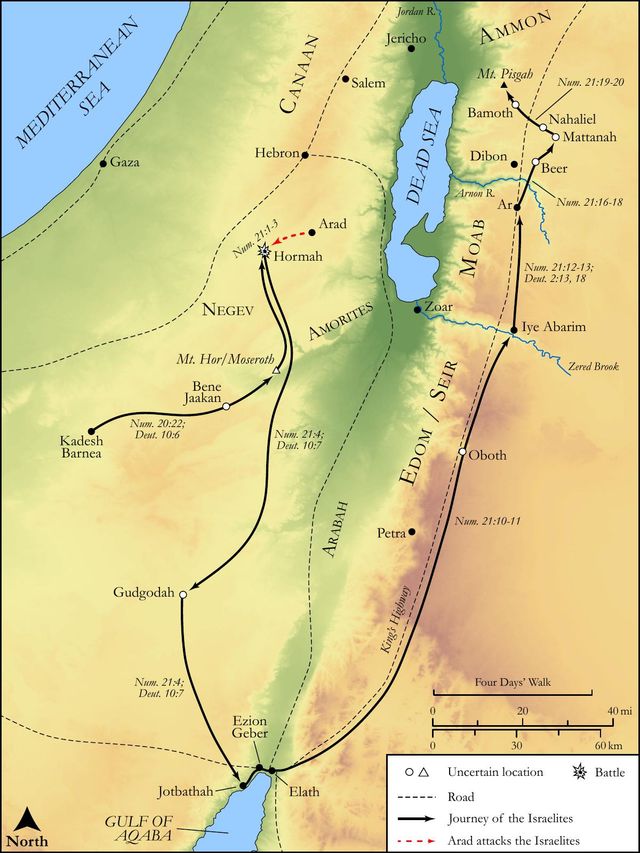
The journey "by the way of the Red sea" refers to the route along the eastern arm of the Red Sea, specifically the Gulf of Aqaba. This region would have been an incredibly arduous trek through desolate, mountainous, and arid terrain, demanding immense physical endurance. "To compass the land of Edom" indicates a forced, circuitous route around the formidable kingdom of Edom, located southeast of the Dead Sea. The Edomites, descendants of Esau, were a powerful and hostile nation, making direct passage through their heartland militarily impossible and divinely forbidden (Deuteronomy 2:4-6). For the Israelites, who had already endured nearly 40 years of wilderness wandering, this unexpected and lengthy detour would have been culturally and psychologically devastating. Their traditional understanding of divine guidance often involved direct paths, and this prolonged "way" (Hebrew: derekh) severely challenged their patience and trust in God's leading, exacerbating existing weariness from decades of nomadic life and the recent loss of their high priest.
Key Themes
ShowHideThis verse powerfully contributes to several overarching themes within the book of Numbers and the broader Pentateuch:
The Burden of the Journey
It vividly illustrates the immense physical and emotional toll of prolonged hardship and delayed gratification inherent in the wilderness experience. The "way" is not merely a physical route but a potent symbol of the entire arduous process of sanctification and preparation for entering the Promised Land. This theme underscores the reality that even under divine guidance, the path can be difficult, testing human endurance and highlighting the need for persistent faith, as seen in the repeated trials throughout Numbers.
Human Discouragement and Impatience
The core message of the verse is the people's "discouraged soul," a deep-seated weariness and impatience that frequently led to murmuring and rebellion against God and His appointed leaders, Moses and Aaron. This recurring theme is central to understanding Israel's repeated failures in the wilderness, as evidenced by episodes like the complaints about manna and quail in Numbers 11:1-6 or the rebellion of Korah in Numbers 16:1-3. It reveals the fragility of human faith under duress.
God's Sovereign Purpose in Detours
While the detour around Edom seemed like an unnecessary hardship to the Israelites, it subtly points to God's sovereign control over their path and His protective care. Even when the journey is long and difficult, God's purposes are being fulfilled, whether through testing, discipline, or further revelation, ultimately leading His people to their promised inheritance, albeit through means they might not understand or prefer. This underscores the divine prerogative to lead His people in ways that refine their character and deepen their dependence on Him.
Exposition and Analysis
ShowHideKey Word Analysis
ShowHideThis verb literally means "to dock off, i.e. curtail (transitive or intransitive, literal or figurative); especially to harvest (grass or grain); [idiom] at all, cut down, much discouraged, grieve, harvestman, lothe, mourn, reap(-er), (be, wax) short(-en, -er), straiten, trouble, vex." When applied to the "soul" (Hebrew: nephesh), as it is here, it conveys a profound sense of exasperated weariness, a "shortening of spirit" or "loss of patience." It describes a state of deep, almost suffocating frustration where one's capacity for endurance has been diminished. The KJV's "much discouraged" aptly captures the intensity of this internal state, indicating not just mild disappointment but a deep, debilitating weariness that makes one prone to complaint and doubt.
Meaning "properly, a breathing creature, i.e. animal of (abstractly) vitality; used very widely in a literal, accommodated or figurative sense (bodily or mental); any, appetite, beast, body, breath, creature, [idiom] dead(-ly), desire, [idiom] (dis-) contented, [idiom] fish, ghost, [phrase] greedy, he, heart(-y), (hath, [idiom] jeopardy of) life ([idiom] in jeopardy), lust, man, me, mind, mortally, one, own, person, pleasure, (her-, him-, my-, thy-) self, them (your) -selves, [phrase] slay, soul, [phrase] tablet, they, thing, ([idiom] she) will, [idiom] would have it." In this context, nephesh refers to the inner being, the very essence of the people's collective life and spirit. When the nephesh is "shortened" or "discouraged," it signifies a deep, pervasive internal depletion, not merely a superficial feeling. It speaks to a profound spiritual and emotional exhaustion that affects their entire being and capacity for faith.
Meaning "from דָּרַךְ; a road (as trodden); figuratively, a course of life or mode of action, often adverb; along, away, because of, [phrase] by, conversation, custom, (east-) ward, journey, manner, passenger, through, toward, (high-) (path-) way(-side), whither(-soever)." While primarily referring to the physical path or road, derekh in biblical Hebrew often carries deeper theological significance. It can represent a manner of life, a course of conduct, or even God's appointed path or destiny for His people. In this context, "the way" encompasses not just the physical, circuitous route around Edom but also the entire prolonged, difficult wilderness journey itself, which had become a source of immense spiritual and emotional burden for the people. It symbolizes the unexpected trials and extended periods of waiting that test faith.
Verse Breakdown
ShowHide"And they journeyed from mount Hor by the way of the Red sea, to compass the land of Edom:"
This initial clause precisely delineates the Israelites' challenging itinerary and its immediate cause. "Mount Hor" serves as a significant geographical and narrative marker, being the place of Aaron's recent death, which undoubtedly added to the people's emotional burden. The phrase "by the way of the Red sea" (likely referring to the Gulf of Aqaba, the eastern arm of the Red Sea) indicates a movement southward, then eastward, and finally northward, highlighting a long and indirect route through desolate terrain. The explicit purpose, "to compass the land of Edom," underscores the forced nature of this detour, a direct consequence of Edom's refusal to grant passage, thus emphasizing the external constraints and hardships imposed upon Israel's journey.
"and the soul of the people was much discouraged because of the way."
This second clause shifts focus from the external circumstances to the internal, collective state of the people. "The soul of the people" (Hebrew: nephesh ha'am) emphasizes their collective inner being, their spirit, their very life-force, indicating a deep, pervasive weariness that affected every individual. The phrase "was much discouraged" (Hebrew: qāṣar nephesh) powerfully conveys their profound impatience, spiritual exhaustion, and loss of resolve. The cause is explicitly stated: "because of the way," meaning the arduous, prolonged, and unexpected detour. This deep weariness and frustration are presented as the direct precursors to their subsequent grumbling and rebellion against divine authority, setting the stage for the narrative that follows.
Literary Devices
ShowHideNumbers 21:4 effectively employs Pathos to evoke a sense of empathy and understanding for the Israelites' plight, detailing their profound emotional and spiritual exhaustion ("the soul of the people was much discouraged"). The use of "the way" functions as Metonymy, standing not merely for the physical route but for the entire arduous, prolonged wilderness journey and its associated hardships, including the delays, deprivations, and challenges to faith. This "way" also carries strong Symbolism, representing the trials, detours, and periods of waiting inherent in any spiritual journey, highlighting the human tendency to grow weary when God's timing or methods differ from expectations. The verse's concise structure, presenting the action followed by its emotional consequence, creates a clear sense of Cause and Effect, directly linking the difficult journey to the people's internal state of discouragement and foreshadowing their subsequent sinful response.
Theological and Thematic Connections
ShowHideNumbers 21:4 serves as a stark reminder of the human propensity for discouragement and impatience when faced with prolonged trials and unexpected detours on the path God has set. It illustrates that even a people under divine guidance can falter in faith when the "way" becomes too hard or too long. This deep weariness often precedes murmuring and rebellion against God, as seen repeatedly throughout the wilderness narrative. The verse underscores the theological truth that God's ways are often not our ways, and His sovereign plan may involve circuitous routes designed to test, refine, and teach His people patience and dependence, even when those paths seem counter-intuitive or unnecessarily difficult from a human perspective. It highlights the constant tension between human impatience and divine timing, and the crucial need for persistent trust in God's wisdom and goodness, even when His leading is perplexing.
Reflection and Application
ShowHideNumbers 21:4 offers a timeless mirror for the human experience of spiritual and life journeys. We, too, often find ourselves "discouraged because of the way" when our expectations of a smooth, direct path are unmet by the reality of detours, delays, and unexpected hardships. This verse validates the reality of emotional and spiritual weariness in the face of prolonged trials, reminding us that it is natural to feel tired and even disheartened. However, it also serves as a potent warning: unmanaged discouragement can quickly devolve into complaining against God, doubting His goodness, and losing sight of His ultimate purposes. Our response to the "way" reveals the depth of our trust. Instead of succumbing to a "shortening of spirit," we are called to cultivate patience, remember God's faithfulness in past provisions, and fix our eyes on the promised destination, understanding that even the most arduous detours can be part of God's refining and sanctifying work in our lives. It challenges us to find spiritual resilience and renewed hope, even when the path is long and difficult, by clinging to the steadfast character of God.
Questions for Reflection
ShowHideFAQ
ShowHideWhy did the Israelites have to take such a long detour around Edom?
ShowHideThe Israelites were forced to take a long detour around Edom because the king of Edom, a descendant of Esau and thus a distant relative of Israel, refused them peaceful passage through his territory. Numbers 20:18-21 explains that Edom met Israel with a large and powerful army, threatening to attack if they attempted to pass through. This forced the Israelites to abandon their more direct route to the Promised Land and take a circuitous path "by the way of the Red sea" (likely the Gulf of Aqaba) to bypass Edom entirely, leading to the prolonged and arduous journey described in Numbers 21:4. This refusal highlights the geopolitical realities and the challenges Israel faced in their journey, demonstrating God's guidance even through obstacles.
What does "the soul of the people was much discouraged" truly mean in the original language?
ShowHideThe KJV phrase "the soul of the people was much discouraged" translates the Hebrew qāṣar nephesh, which literally means "the soul was shortened" or "the spirit was cut short." This conveys a much deeper and more intense meaning than simple disappointment or mild frustration. It describes a profound state of impatience, exasperation, and spiritual exhaustion, where one's capacity for endurance or hope has been severely diminished. It indicates a deep, debilitating weariness that makes an individual or a collective prone to complaining, doubting, and losing resolve, brought on by the prolonged and difficult "way," or journey. It speaks to a profound internal depletion of vitality and spiritual fortitude.
How does this verse relate to the subsequent story of the fiery serpents?
ShowHideNumbers 21:4 directly sets the stage for the incident of the fiery serpents and the bronze serpent found in Numbers 21:5-9. The people's profound discouragement "because of the way" quickly escalates into open complaining against God and Moses, as explicitly stated in Numbers 21:5. This murmuring, a direct consequence of their "shortened spirit" and lack of trust, is then met with divine judgment in the form of poisonous serpents. The subsequent provision of the bronze serpent for healing serves as God's merciful response to their repentance, demonstrating His continued faithfulness even in their rebellion. The discouragement is the emotional and spiritual root that blossoms into their sinful complaints, leading to the need for divine intervention and a powerful lesson on faith and obedience.
Christ-Centered Fulfillment
ShowHideNumbers 21:4, with its poignant depiction of a people "much discouraged because of the way," finds profound Christ-centered fulfillment in the person and work of Jesus. While the Israelites grumbled and rebelled on their arduous journey, Jesus, the true and faithful Israel, endured a far greater "way" without complaint. He "set his face to go to Jerusalem" (Luke 9:51), knowing the suffering and ultimate detour to the cross that awaited Him, yet He never allowed His "soul" to be "discouraged" in the face of His mission. He became the Lamb of God who takes away the sin of the world, enduring the wilderness of temptation (Matthew 4:1-11) and the ultimate trial of Gethsemane, where His "soul was very sorrowful, even to death" (Matthew 26:38). Unlike Israel, who looked to a bronze serpent for physical healing from a curse, we look to Christ, who was "lifted up" on the cross (John 3:14-15) to provide spiritual and eternal life to all who believe. He is the faithful leader who traversed the "way" of suffering and death, not for His own sin, but for ours, ensuring that though our journey may be difficult, we have a High Priest who sympathizes with our weaknesses (Hebrews 4:15). In Him, our discouragement is met with grace, and our weary souls find rest (Matthew 11:28), for He has already walked the hardest path and secured our ultimate destination, the promised land of eternal life.