


Numbers 21:3
Bible text: King James Version (1769 Blayney text) · Public domain
Bible text: King James Version with Strong's numbers · Public domain
Bible text: Berean Standard Bible · Public domain
Bible text: American Standard Version (1901) · Public domain
Bible text: World English Bible, Messianic edition · Public domain
Bible text: Geneva Bible (1599) · Public domain
Bible text: Young's Literal Translation · Public domain
- וַיִּשְׁמַעvai·yish·Ma'and he listenedH8085Conj-w ¦ V-Qal-ConsecImperf-3msVerb Qal Consecutive Imperfect 3rd Singular Masculineוַandיִּשְׁמַעhe listened
- יְהוָהYah·wehYahwehH3068N-properNoun Proper Title
- בְּקוֹלbe·Kolto [the] voice ofH6963Prep-b ¦ N-mscNoun Singular Masculine Constructבְּtoקוֹל[the] voice of
- יִשְׂרָאֵלYis·ra·'ElIsraelH3478N-properNoun Proper Location
- וַיִּתֵּןvai·yi·Tenand he delivered upH5414Conj-w ¦ V-Qal-ConsecImperf-3msVerb Qal Consecutive Imperfect 3rd Singular Masculineוַandיִּתֵּןhe delivered up
- אֶת'et<obj.>H853DirObjMParticle Object Indicator
- הַכְּנַעֲנִיha·ke·na·'a·Nithe Canaanite[s]H3669Art ¦ N-msNoun Gentilic Singular Masculine AbsoluteהַtheכְּנַעֲנִיCanaanite[s]
- וַיַּחֲרֵםvai·ya·cha·Remand it totally destroyedH2763Conj-w ¦ V-Hiphil-ConsecImperf-3msVerb Hiphil Consecutive Imperfect 3rd Singular Masculineוַandיַּחֲרֵםit totally destroyed
- אֶתְהֶם'et·Hem<obj.> themH853DirObjM ¦ 3mpParticle Object Indicatorאֶתְ<obj.>הֶםthem
- וְאֶתve·'Etand <obj.>H853Conj-w ¦ DirObjMParticle Object Indicatorוְandאֶת<obj.>
- עָרֵיהֶם'a·rei·Hemtheir citiesH5892N-mpc ¦ 3mpNoun Plural Masculine Constructעָרֵיcitiesהֶםtheir
- וַיִּקְרָאvai·yik·Ra'and someone calledH7121Conj-w ¦ V-Qal-ConsecImperf-3msVerb Qal Consecutive Imperfect 3rd Singular Masculineוַandיִּקְרָאsomeone called
- שֵׁםshem[the] name ofH8034N-mscNoun Singular Masculine Construct
- הַמָּקוֹםha·ma·Komthe placeH4725Art ¦ N-msNoun Singular Masculine Absoluteהַtheמָּקוֹםplace
- חָרְמָהcha·re·MahHormahH2767N-properNoun Proper Location
English is a literal word-by-word gloss of the Hebrew, not the KJV's wording. Why?
This is the original text the KJV's translators worked from — each Hebrew word with its own literal English meaning in this verse, prepared by scholars at Tyndale House, Cambridge. The KJV translates whole sentences, not word by word, so its wording differs: one Hebrew word can become several English words, and the KJV may choose “the LORD” where the gloss reads “Yahweh”. Both are faithful — they answer different questions. For the KJV's own rendering, switch to the KJV text.
Details
See on the biblical-era maps
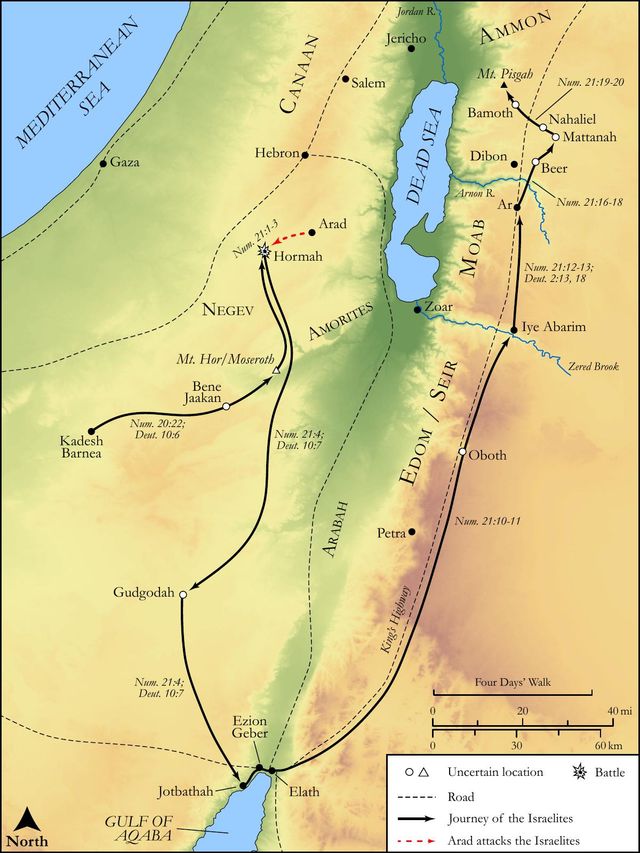
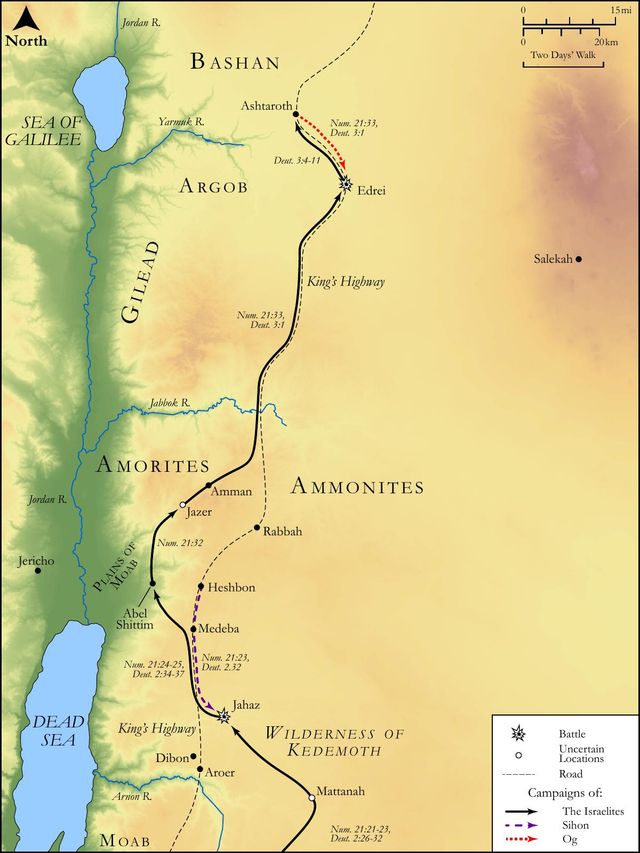
Study this verse
Public-domain commentary
Matthew Henry
From his Commentary on the Whole Bible. Henry comments on passages, not single verses — this entry covers Numbers 21:1–3.
Here is, 1. The descent which Arad the Canaanite made upon the camp of Israel, hearing that they came by the way of the spies; for, though the spies which Moses had sent thirty-eight years before then passed and repassed unobserved, yet their coming, and their errand, it is likely, were afterwards known to the Canaanites, gave them an alarm, and induced them to keep an eye upon Israel and get intelligence of all their motions. Now, when they understood that they were facing about towards Canaan, this Arad, thinking it policy to keep the war at a distance, made an onset upon them and fought with them. But it proved that he meddled to his own hurt; had he sat still, his people might have been last destroyed of all the Canaanites, but now they were the first. Thus those that are overmuch wicked die before their time, Ecc 7:17. 2. His success at first in this attempt. His advance-guards picked up some straggling Israelites, and took them prisoners, Num 21:1. This, no doubt, puffed him up, and he began to thin that he should have the honour of crushing this formidable body, and saving his country from the ruin which it threatened. It was likewise a trial to the faith of the Israelites and a check to them for their distrusts and discontents. 3. Israel's humble address to God upon this occasion, Num 21:2. It was a temptation to them to murmur as their fathers did, and to despair of getting possession of Canaan; but God, who thus tried them by his providence, enabled them by his grace to quit themselves well in the trial, and to trust in him for relief against this fierce and powerful assailant. They, by their elders, in prayer for success, vowed a vow. Noe, When we are desiring and expecting mercy from God we should bind our souls with a bond that we will faithfully do our duty to him, particularly that we will honour him with the mercy we are in the pursuit of. Thus Israel here promised to destroy the cities of these Canaanites, as devoted to God, and not to take the spoil of them to their own use. If God would give them victory, he should have all the praise, and they would not make a gain of it to themselves. When we are in this frame we are prepared to receive mercy. 4. The victory which the Israelites obtained over the Canaanites, Num 21:3. A strong party was sent out, probably under the command of Joshua, which not only drove back these Canaanites, but followed them to their cities, which probably lay on the edge of the wilderness, and utterly destroyed them, and so returned to the camp. Vincimur in praelie, sed non in bello - We lose a battle, but we finally triumph. What is said of the tribe of God is true of all God's Israel, a troop may overcome them, but they shall overcome at the last. The place was called Hormah, as a memorial of the destruction, for the terror of the Canaanites, and probably for warning to posterity not to attempt the rebuilding of these cities, which were destroyed as devoted to God and sacrifices to divine justice. And it appears from the instance of Jericho that the law concerning such cities was that they should never be rebuilt. There seems to be an allusion to this name in the prophecy of the fall of the New Testament Babylon (Rev 16:16), where its forces are said to be gathered together to a place called Armageddon - the destruction of a troop.
Historical interpretation
Historical reception
1 surviving comment on this verse from the historical church.
Anathema: That is, a thing devoted to utter destruction.
Continue studying Numbers 21:3 across the web’s major study libraries — every link below opens this exact verse, chapter, or book on the destination site.
Read & Compare
 BibleGatewayThis verse in more than 200 translations and 70 languages.
 Bible.comThe YouVersion reader — hundreds of translations, reading plans, and highlights.
 ESV.orgCrossway's official English Standard Version reader.
 NET BibleThe NET translation with 60,000+ translators' notes on every rendering decision.
 STEP BibleTyndale House's free study tool — original text, vocabulary, and scholarly resources.
 BibliaLogos Bible Software's free web reader.
 USCCBThe New American Bible (Revised Edition) with the U.S. bishops' study notes.
Commentaries
 BibleHub CommentariesDozens of classic commentaries on this verse, gathered on one page.
 StudyLightMore than 100 commentary sets — the largest collection on the web.
 BibleRefPlain-English commentary on what this verse means, verse by verse.
 Enduring WordDavid Guzik's free commentary on this chapter, widely used by Bible teachers.
 Bible Study ToolsVerse commentary alongside Greek and Hebrew study aids.
Original Language & Research
- BibleHub InterlinearThe verse word by word — original language, transliteration, and English.
- BibleHub LexiconEvery word's original-language definition and Strong's entry.
 Blue Letter BibleDeep-study tools — Strong's numbers, concordance, and word studies.
 SefariaThe Hebrew text with Rashi and centuries of Jewish commentary.
Sermons, Hymns & Audio


TrulyRandomVerse is not affiliated with these sites and doesn’t control their content. They’re linked because they’re genuinely useful.
Summary
Numbers 21:3 narrates a pivotal moment in Israel's wilderness journey, showcasing God's immediate and favorable response to His people's sincere prayer and vow. Following a period of defeat and spiritual malaise, this verse records the LORD's active intervention in delivering the Canaanites into Israel's hands, enabling their complete and consecrated destruction of the enemy's inhabitants and cities. The subsequent naming of the place "Hormah" serves as a lasting memorial, signifying both divine judgment and Israel's renewed obedience.
Context
ShowHideLiterary Context
Numbers 21:3 forms the triumphant climax of a concise yet significant narrative arc that begins in Numbers 21:1. Preceding this victory, Israel had endured a period of severe trials, including a defeat by the King of Arad and a devastating plague of fiery serpents, which God healed through the miraculous provision of the bronze serpent (Numbers 21:4-9). In the immediate context, the King of Arad, a Canaanite ruler, attacked Israel and took some of them captive. This aggression, coupled with their recent failures and the ensuing distress, prompted Israel to make a solemn vow to the LORD in Numbers 21:2, promising to "utterly destroy" the Canaanite cities if God would grant them victory. Verse 3 then details God's swift "hearkening" to their plea and the subsequent fulfillment of their vow, marking a decisive shift from despair to divine deliverance and renewed covenant faithfulness.
Historical & Cultural Context
The events of Numbers 21:3 unfold as Israel traverses the Negev, a semi-arid region south of Judah, on their circuitous route towards the Promised Land. The Canaanites, including the King of Arad, were entrenched indigenous peoples known for their polytheistic idolatry, immoral practices, and fierce resistance to any perceived encroachment on their territory. The concept of "utter destruction" (Hebrew: cherem) carried profound theological weight in Israel. It was not merely a brutal military tactic but a divine command for consecrated warfare, where enemies and their possessions were "devoted" to God, often through complete destruction. This act served as an execution of divine judgment against the Canaanites' pervasive wickedness and a preventative measure to safeguard Israel from the corrupting influence of their idolatry, as stipulated in laws concerning the conquest, such as those found in Deuteronomy 20:16-18.
Key Themes
ShowHideNumbers 21:3 powerfully articulates several foundational themes central to the book of Numbers and the broader Pentateuch. The verse highlights Divine Responsiveness and Covenant Faithfulness, as "the LORD hearkened to the voice of Israel," demonstrating God's readiness to respond favorably to His people's sincere prayers and vows, particularly when they turn to Him in obedience after periods of rebellion. The theme of Obedience and Consequence is also prominent; Israel's vow was directly followed by their decisive action, and God's deliverance was a direct consequence of their renewed commitment to Him. Furthermore, the concept of Cherem, or "utter destruction," is a critical theological theme, representing God's righteous judgment against persistent sin and idolatry, and Israel's role in executing this judgment as a consecrated act. Finally, the Naming of Hormah functions as an etiological narrative, providing a permanent memorial to this specific act of vow and fulfillment, signifying "devotion" or "utter destruction," thereby reinforcing the theological weight and lasting impact of the event.
Exposition and Analysis
ShowHideKey Word Analysis
ShowHideThis verb signifies more than mere auditory perception; it denotes attentive listening, understanding, and a positive, responsive action. When applied to the LORD, as it is here, it implies His active engagement and favorable disposition towards the prayers and pleas of His people. In this context, it underscores God's attentiveness to Israel's distress and their renewed vow, indicating His readiness to act on their behalf when they turn to Him in sincerity and obedience, even after their past failures.
This primitive root, from which the noun cherem is derived, means "to seclude" or "to devote to religious uses," specifically by complete destruction. It is a theological term indicating a dedication that removes something from common use, typically because it is an abomination in God's sight. The destruction was not for personal gain, revenge, or wanton violence, but was an act of divine judgment against the idolatry and wickedness of the Canaanite nations. Its purpose was to ensure Israel's separation from their corrupting influence and to purify the land for God's holy presence.
Verse Breakdown
ShowHide"And the LORD hearkened to the voice of Israel"
This opening clause immediately establishes God's active role and responsiveness. After a period marked by murmuring, rebellion, and a military defeat, Israel's cry and solemn vow (as detailed in Numbers 21:2) are heard, acknowledged, and favorably received by the LORD. This demonstrates God's unwavering covenant faithfulness and His willingness to intervene powerfully when His people turn to Him in genuine repentance and commitment, even in the wake of their shortcomings.
"and delivered up the Canaanites"
This signifies the divine enablement and guaranteed victory. God, in His sovereign power, actively hands over the enemy to Israel. This is not merely a human military triumph but a supernatural intervention, confirming that the success of the battle was due entirely to God's might and not Israel's strength. It serves as divine validation of Israel's vow and God's acceptance of their renewed commitment to Him.
"and they utterly destroyed them and their cities"
This clause describes Israel's faithful fulfillment of their vow and the execution of God's righteous judgment. The phrase "utterly destroyed" (from the Hebrew root châram) emphasizes the completeness and consecrated nature of the destruction. It was a comprehensive act of judgment against the Canaanites, removing their presence and their idolatrous influence from the land, in accordance with God's commands for the conquest (e.g., Deuteronomy 7:2). This act served to purify the land and prevent Israel from adopting the pagan practices of its former inhabitants.
"and he called the name of the place Hormah"
This final clause records the naming of the battle site. "Hormah" (Hebrew, Chormâh) is directly derived from the same root as châram, meaning "devotion," "utter destruction," or "a devoted thing." The naming serves as a perpetual memorial to the event, signifying that the place was forever marked by this act of consecrated destruction. It was intended to remind future generations of God's faithfulness in delivering His people, the consequences of Israel's obedience, and the severe judgment against the Canaanites' wickedness.
Literary Devices
ShowHideNumbers 21:3 masterfully employs several literary devices to convey its profound theological message. Divine Action is paramount, with the LORD explicitly serving as the primary agent who "hearkened" and "delivered up," underscoring His sovereignty and active involvement in human affairs. The verse functions as the Climax of a brief Vow-Fulfillment Narrative, where Israel's solemn promise in Numbers 21:2 is met with God's immediate response and Israel's subsequent obedience in Numbers 21:3. This narrative structure highlights the principle of divine reciprocity within the covenant relationship. Furthermore, the naming of the place "Hormah" serves as an Etiology, explaining the origin of a place name through a significant historical and theological event. This Symbolism embedded in the name "Hormah" (meaning "devotion" or "utter destruction") encapsulates the entire narrative, serving as a powerful reminder of God's righteous judgment and the consequences of sin, as well as the importance of Israel's consecrated obedience.
Theological and Thematic Connections
ShowHideNumbers 21:3 profoundly illustrates God's unwavering covenant faithfulness and His dynamic relationship with Israel. It underscores that while God is sovereign and acts according to His perfect will, He also graciously responds to the sincere prayers and vows of His people, especially when they turn from rebellion to obedience. The concept of cherem (utter destruction) here is not merely about military conquest but about God's absolute holiness and His righteous judgment against pervasive evil and idolatry. It reveals a God who demands purity and separation from the corrupting influences of the world, ensuring the integrity and sanctity of His covenant community. This act of judgment also serves as a stark warning against rebellion and a powerful demonstration of God's power to deliver His people and execute His justice.
Reflection and Application
ShowHideThe account in Numbers 21:3 offers timeless and profound lessons for believers today. It reminds us that even after seasons of failure, murmuring, or spiritual defeat, God remains faithful and profoundly responsive to His people's genuine repentance and earnest cries for help. Our vows and commitments to God, when made with sincerity of heart and followed by obedient action, are not in vain; He hears and acts decisively. This passage encourages us to approach God with confident faith, trusting that He will provide victory over our spiritual adversaries and life's challenges, just as He delivered Israel from the Canaanites. While we no longer engage in physical cherem, the principle of setting ourselves apart from the corrupting influences of the world remains vitally important for our spiritual health. We are called to "utterly destroy" the idols in our own lives—the sins, destructive habits, and worldly attitudes that separate us from God—and to live lives fully consecrated to Him. This requires discernment, spiritual warfare against unseen forces, and an unwavering commitment to holiness, knowing that true and lasting victory comes through God's power working in and through our obedience.
Questions for Reflection
ShowHideFAQ
ShowHideWhat does "utterly destroyed" mean in this context, and how does it relate to the Hebrew concept of cherem?
ShowHideThe phrase "utterly destroyed" translates the Hebrew verb châram (H2763), which is intrinsically linked to the noun cherem (H2763, specifically from the same root). This concept transcends mere annihilation in warfare. Cherem signifies something "devoted" or "set apart" to God, often by complete destruction. In the context of the Canaanites, it was a divine command for consecrated warfare, where the people and their cities were dedicated to God as an act of judgment against their pervasive idolatry, gross immorality, and deep-seated wickedness. This was not for Israel's personal gain or revenge, but was a holy act to prevent the Canaanites' corrupting influence from spreading to Israel and to purify the land for God's holy people. It underscored God's absolute holiness and His righteous judgment against persistent sin, as clearly articulated in passages like Deuteronomy 20:16-18.
Why did God command such extreme measures as "utter destruction" against the Canaanites?
ShowHideGod commanded the cherem against the Canaanites due to their profound and persistent wickedness, which included abhorrent practices such as child sacrifice, rampant idolatry, and various sexual perversions (Leviticus 18:24-28 and Deuteronomy 9:4-5). This was a divine judgment, the culmination of centuries of their unrepentant sin, and a necessary measure to protect Israel from spiritual and moral corruption. God, being perfectly holy and just, could not allow such pervasive evil to continue unchecked, especially in the land He had promised to His covenant people. The destruction served as a stark warning against idolatry and a powerful demonstration of the severe consequences of rebellion against God's moral law.
What is the significance of the place being named "Hormah"?
ShowHideThe name "Hormah" (Hebrew, Chormâh, H2767) is derived from the same Hebrew root as cherem (H2763), meaning "devotion," "utter destruction," or "a devoted thing." The naming of the place Hormah serves as a permanent memorial and an etiological explanation for the place name. It signifies that this location was forever marked by the act of consecrated destruction. It served to remind Israel, and subsequent generations, of God's faithfulness in hearing their prayer and delivering the enemy, as well as their own obedience in carrying out the cherem. It also stood as a lasting testament to God's righteous judgment against the Canaanites and the severe consequences of their unrepentant sin.
Christ-Centered Fulfillment
ShowHideThe victory at Hormah, where God "hearkened to the voice of Israel" and delivered the Canaanites for "utter destruction," finds its ultimate Christ-centered fulfillment in the person and redemptive work of Jesus Christ. While Israel's victory was a partial and temporal triumph over physical enemies, Christ's work on the cross represents the decisive and eternal victory over the ultimate enemies of humanity: sin, death, and the devil (Colossians 2:15). Just as God "hearkened" to Israel's cry, so too does God hear the cries of His people for salvation, answered perfectly in Christ's intercession and sacrificial atonement (Hebrews 7:25). The concept of cherem, or "utter destruction," foreshadows Christ's role as the one who perfectly fulfills God's righteous judgment. He is the ultimate "devoted thing" (from châram) in the most profound sense, consecrated to God through His obedient sacrifice, thereby taking away the sin of the world (John 1:29). Through His death and resurrection, Christ utterly destroys the power of sin and death for all who believe in Him (Hebrews 2:14-15). The spiritual warfare believers engage in today is not against flesh and blood, but against spiritual forces, a battle already decisively won by Christ, enabling us to "destroy arguments and every lofty opinion raised against the knowledge of God" (2 Corinthians 10:4-5). Thus, Hormah points to the greater victory and ultimate judgment enacted by the Lamb of God, who establishes a new covenant people set apart for His holiness and purposes.