


Numbers 21:1
- וַיִּשְׁמַעvai·yish·Ma'and he heardH8085Conj-w ¦ V-Qal-ConsecImperf-3msVerb Qal Consecutive Imperfect 3rd Singular Masculineוַandיִּשְׁמַעhe heard
- הַכְּנַעֲנִיha·ke·na·'a·Nithe CanaaniteH3669Art ¦ N-msNoun Gentilic Singular Masculine AbsoluteהַtheכְּנַעֲנִיCanaanite
- מֶלֶךְMe·lekh[the] king ofH4428N-mscNoun Singular Masculine Construct
- עֲרָד'a·RadAradH6166N-properNoun Proper Location
- יֹשֵׁבyo·Shev[who] dweltH3427V-Qal-Prtcpl-msVerb Qal Participle Singular Masculine Absolute
- הַנֶּגֶבha·Ne·gevthe NegevH5045Art ¦ N-properNoun Proper LocationהַtheנֶּגֶבNegev
- כִּיkithatH3588PrtParticle Conditional
- בָּאba'it had comeH935V-Qal-Perf-3msVerb Qal Perfect 3rd Singular Masculine
- יִשְׂרָאֵלYis·ra·'ElIsraelH3478N-properNoun Proper Location
- דֶּרֶךְDe·rekh[the] way ofH1870N-cscNoun Singular common gender Construct
- הָאֲתָרִיםha·'a·ta·Rimthe AtharimH871Art ¦ N-properNoun Proper LocationהָtheאֲתָרִיםAtharim
- וַיִּלָּחֶםvai·yi·La·chemand he engaged in battleH3898Conj-w ¦ V-Niphal-ConsecImperf-3msVerb Niphal Consecutive Imperfect 3rd Singular Masculineוַandיִּלָּחֶםhe engaged in battle
- בְּיִשְׂרָאֵלbe·Yis·ra·'Elagainst IsraelH3478Prep-b ¦ N-properNoun Proper LocationבְּagainstיִשְׂרָאֵלIsrael
- וַיִּשְׁבְּvai·Yishband he took captiveH7617Conj-w ¦ V-Qal-ConsecImperf-3msVerb Qal Consecutive Imperfect 3rd Singular Masculineוַandיִּשְׁבְּhe took captive
- מִמֶּנּוּmi·Me·nusome of itH4480Prep ¦ 3msPreposition Definiteמִמֶּsome ofנּוּit
- שֶׁבִיShe·vicaptive[s]H7628N-msNoun Singular Masculine Absolute
English is a literal word-by-word gloss of the Hebrew, not the KJV's wording. Why?
This is the original text the KJV's translators worked from — each Hebrew word with its own literal English meaning in this verse, prepared by scholars at Tyndale House, Cambridge. The KJV translates whole sentences, not word by word, so its wording differs: one Hebrew word can become several English words, and the KJV may choose “the LORD” where the gloss reads “Yahweh”. Both are faithful — they answer different questions. For the KJV's own rendering, switch to the KJV text.
Details
See on the biblical-era map
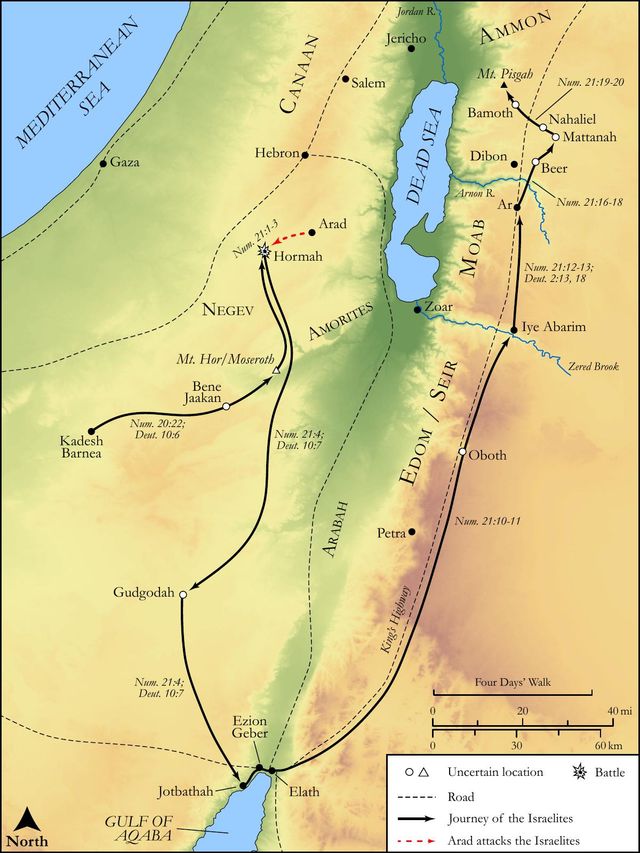
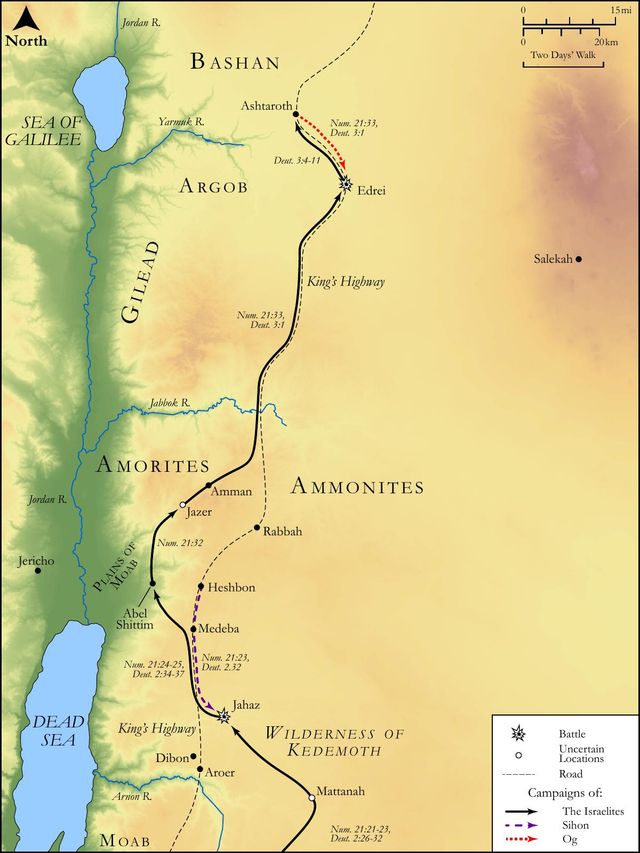
Study this verse
Public-domain commentary
Matthew Henry
From his Commentary on the Whole Bible. Henry comments on passages, not single verses — this entry covers Numbers 21:1–3.
Here is, 1. The descent which Arad the Canaanite made upon the camp of Israel, hearing that they came by the way of the spies; for, though the spies which Moses had sent thirty-eight years before then passed and repassed unobserved, yet their coming, and their errand, it is likely, were afterwards known to the Canaanites, gave them an alarm, and induced them to keep an eye upon Israel and get intelligence of all their motions. Now, when they understood that they were facing about towards Canaan, this Arad, thinking it policy to keep the war at a distance, made an onset upon them and fought with them. But it proved that he meddled to his own hurt; had he sat still, his people might have been last destroyed of all the Canaanites, but now they were the first. Thus those that are overmuch wicked die before their time, Ecc 7:17. 2. His success at first in this attempt. His advance-guards picked up some straggling Israelites, and took them prisoners, Num 21:1. This, no doubt, puffed him up, and he began to thin that he should have the honour of crushing this formidable body, and saving his country from the ruin which it threatened. It was likewise a trial to the faith of the Israelites and a check to them for their distrusts and discontents. 3. Israel's humble address to God upon this occasion, Num 21:2. It was a temptation to them to murmur as their fathers did, and to despair of getting possession of Canaan; but God, who thus tried them by his providence, enabled them by his grace to quit themselves well in the trial, and to trust in him for relief against this fierce and powerful assailant. They, by their elders, in prayer for success, vowed a vow. Noe, When we are desiring and expecting mercy from God we should bind our souls with a bond that we will faithfully do our duty to him, particularly that we will honour him with the mercy we are in the pursuit of. Thus Israel here promised to destroy the cities of these Canaanites, as devoted to God, and not to take the spoil of them to their own use. If God would give them victory, he should have all the praise, and they would not make a gain of it to themselves. When we are in this frame we are prepared to receive mercy. 4. The victory which the Israelites obtained over the Canaanites, Num 21:3. A strong party was sent out, probably under the command of Joshua, which not only drove back these Canaanites, but followed them to their cities, which probably lay on the edge of the wilderness, and utterly destroyed them, and so returned to the camp. Vincimur in praelie, sed non in bello - We lose a battle, but we finally triumph. What is said of the tribe of God is true of all God's Israel, a troop may overcome them, but they shall overcome at the last. The place was called Hormah, as a memorial of the destruction, for the terror of the Canaanites, and probably for warning to posterity not to attempt the rebuilding of these cities, which were destroyed as devoted to God and sacrifices to divine justice. And it appears from the instance of Jericho that the law concerning such cities was that they should never be rebuilt. There seems to be an allusion to this name in the prophecy of the fall of the New Testament Babylon (Rev 16:16), where its forces are said to be gathered together to a place called Armageddon - the destruction of a troop.
Continue studying Numbers 21:1 across the web’s major study libraries — every link below opens this exact verse, chapter, or book on the destination site.
Read & Compare
 BibleGatewayThis verse in more than 200 translations and 70 languages.
 Bible.comThe YouVersion reader — hundreds of translations, reading plans, and highlights.
 ESV.orgCrossway's official English Standard Version reader.
 NET BibleThe NET translation with 60,000+ translators' notes on every rendering decision.
 STEP BibleTyndale House's free study tool — original text, vocabulary, and scholarly resources.
 BibliaLogos Bible Software's free web reader.
 USCCBThe New American Bible (Revised Edition) with the U.S. bishops' study notes.
Commentaries
 BibleHub CommentariesDozens of classic commentaries on this verse, gathered on one page.
 StudyLightMore than 100 commentary sets — the largest collection on the web.
 BibleRefPlain-English commentary on what this verse means, verse by verse.
 Enduring WordDavid Guzik's free commentary on this chapter, widely used by Bible teachers.
 Bible Study ToolsVerse commentary alongside Greek and Hebrew study aids.
Original Language & Research
- BibleHub InterlinearThe verse word by word — original language, transliteration, and English.
- BibleHub LexiconEvery word's original-language definition and Strong's entry.
 Blue Letter BibleDeep-study tools — Strong's numbers, concordance, and word studies.
 SefariaThe Hebrew text with Rashi and centuries of Jewish commentary.
Sermons, Hymns & Audio


TrulyRandomVerse is not affiliated with these sites and doesn’t control their content. They’re linked because they’re genuinely useful.
Summary
Numbers 21:1 marks a pivotal moment in Israel's wilderness journey, signaling a transition from decades of wandering and internal challenges to direct confrontation with the inhabitants of Canaan. As the newly matured generation of Israelites approaches the southern border of the Promised Land, King Arad, a Canaanite ruler, perceives their advance as an existential threat. He launches a preemptive military strike, resulting in an initial defeat for Israel and the capture of some of their people, thereby setting the stage for the first significant military engagement in the unfolding conquest narrative and highlighting the immediate and formidable opposition Israel would face in claiming their divine inheritance.
Context
ShowHideLiterary Context
Numbers 21:1 serves as a crucial narrative hinge within the book of Numbers. It immediately follows the somber accounts of the death of Aaron and the circumvention of Edom in Numbers 20. Having endured forty years of wilderness wandering as a consequence of the previous generation's disobedience at Kadesh-barnea, the new generation of Israelites is now poised to enter the Promised Land. This verse initiates a distinct new phase, shifting the narrative focus from internal rebellion and divine judgment to external conflict and the initial stages of the conquest. The unexpected setback described here directly precipitates Israel's solemn vow to the Lord in Numbers 21:2, leading to a subsequent divine victory and the utter destruction of the Canaanite cities, thereby establishing a significant precedent for future engagements in the land.
Historical & Cultural Context
King Arad was the ruler of a powerful Canaanite city-state situated in the Negev, the semi-arid southern region of Canaan. In the Late Bronze Age, Canaan was not a unified empire but a mosaic of independent city-states, each governed by its own king and fortified by its own stronghold. These city-states typically controlled surrounding agricultural and pastoral territories. From King Arad's perspective, the approach of a massive, migrating population like Israel, particularly "by the way of the spies" (likely referring to a well-known strategic route, possibly through the region of Atharim, or a path used by scouts), would have been unequivocally perceived as a direct invasion of his sovereign territory. His immediate and aggressive military response was a standard defensive maneuver by a local ruler protecting his domain from perceived foreign encroachment. The practice of taking prisoners was a common and brutal aspect of ancient warfare, serving various purposes such as humiliation, forced labor, or leverage for ransom.
Key Themes
ShowHideNumbers 21:1 introduces and reinforces several crucial themes that resonate throughout the conquest narratives and the broader biblical metanarrative. Firstly, it starkly reveals the reality of Canaanite hostility and the formidable opposition Israel would inevitably encounter in possessing the land God had promised them. The Canaanite nations were not passive, but actively defended their territories, underscoring the necessity of divine intervention for Israel's ultimate success. Secondly, the verse highlights the theme of initial setback and divine testing. Despite God's overarching covenantal promise, Israel experiences an immediate and unexpected defeat, serving as a potent reminder that their ultimate victory depends not on their own military strength or strategic prowess, but on their unwavering obedience and complete reliance on God's power. This initial setback acts as a catalyst for renewed commitment to the Lord, as powerfully evidenced by Israel's subsequent vow and the ensuing divine victory in Numbers 21:2-3. Finally, it subtly emphasizes the theme of divine providence and guidance even amidst adversity. This initial conflict, though a defeat, is intricately woven into God's larger sovereign plan to prepare Israel for the arduous challenges ahead and to continually demonstrate His unfailing faithfulness in leading them into their promised inheritance.
Exposition and Analysis
ShowHideKey Word Analysis
ShowHideThis primitive root means "to hear intelligently," often implying attention, obedience, or understanding. In this context, it signifies that King Arad not only perceived Israel's presence but also understood the implications of their movement, interpreting it as a direct threat. This intelligent hearing prompted his immediate and aggressive military action, demonstrating his strategic awareness.
This primitive root means "to feed on" or "to consume," and figuratively, "to battle (as destruction)." Here, it vividly describes King Arad's aggressive engagement with Israel, indicating a direct, destructive military confrontation. The use of this word emphasizes the violent nature of the encounter and the intent to overcome and prevail against Israel.
This word refers to "exiled" or "captured" individuals, and as a noun, "exile" (abstractly or concretely and collectively), or by extension, "booty." The fact that Arad "took some of them prisoners" underscores the severity of Israel's initial defeat. It signifies not just a routing, but a capture of individuals, which was a common outcome of ancient warfare, often leading to forced labor, humiliation, or ransom.
Verse Breakdown
ShowHide"And when king Arad the Canaanite, which dwelt in the south, heard tell"
This opening clause meticulously introduces the primary antagonist, King Arad, specifying his royal status, his ethnic identity as a Canaanite, and his geographical domain "in the south" (referring to the Negev region). The phrase "heard tell" indicates that Arad received intelligence or reports regarding Israel's movements, highlighting his awareness and preparedness for potential conflict rather than being caught by surprise.
"that Israel came by the way of the spies"
This clause pinpoints the specific route or manner of Israel's approach that alerted King Arad. As explored in the key word analysis, "the way of the spies" (Hebrew: derekh ha'atarim) could refer to a known geographical path or to Israel's movement in a reconnaissance-like manner. Regardless of the precise interpretation, it implies a strategic advance by Israel that was nonetheless detected, signaling their intent to enter the land and prompting Arad's defensive posture.
"then he fought against Israel, and took some of them prisoners"
This concluding clause describes King Arad's immediate and aggressive military response. "He fought against Israel" denotes a direct and forceful military engagement. The outcome, "took some of them prisoners," signifies an initial and significant defeat for Israel, a harsh setback at the very threshold of the Promised Land. This detail powerfully underscores the formidable challenges that lay ahead for Israel in possessing their inheritance and their vulnerability without direct divine intervention.
Literary Devices
ShowHideNumbers 21:1 skillfully employs several literary devices to convey its profound message. The verse functions as a critical Narrative Transition, marking a distinct shift in the book of Numbers from the protracted period of wilderness wandering and internal struggles to the direct and often violent engagement with the indigenous inhabitants of Canaan. It effectively sets the stage for the intense conquest narratives that immediately follow. There is also a strong element of Foreshadowing present; this initial, unexpected conflict with King Arad serves as a grim preview of the broader, more intense, and sustained battles Israel would face in conquering the Promised Land. The immediate and fierce opposition signals that the divine inheritance would not be easily gained or passively received. Furthermore, a subtle Irony can be perceived: the generation that had previously recoiled in fear from the Canaanites at Kadesh-barnea now immediately encounters them upon their approach, highlighting the unavoidable nature of the conflict and the imperative for a different kind of faith and obedience from this new generation.
Theological and Thematic Connections
ShowHideNumbers 21:1, despite detailing an initial defeat, is profoundly interwoven with the overarching biblical narrative of God's unwavering faithfulness to His covenant promises and the inescapable reality of spiritual warfare. It powerfully demonstrates that the path to divine inheritance is rarely without significant opposition. Just as ancient Israel faced formidable earthly foes at the border of their promised land, believers today consistently encounter spiritual resistance as they strive to live out their faith and advance God's kingdom. This verse serves as a poignant reminder that while God promises ultimate victory, He often allows initial challenges and setbacks to test our reliance on Him, refine our faith, and expose our absolute need for His divine power. The subsequent and decisive victory in Numbers 21:3 powerfully underscores that God's ultimate plan will prevail, even if the journey involves temporary defeats or arduous trials.
Reflection and Application
ShowHideNumbers 21:1 offers profound and timeless lessons for the contemporary believer navigating their spiritual journey. Just as Israel, standing on the cusp of their promised inheritance, faced immediate and unexpected opposition, so too do we often encounter significant challenges and resistances precisely when we are closest to realizing God's purposes in our lives. This verse serves as a stark reminder that the journey of faith is not a smooth, uninterrupted progression but frequently involves resistance, setbacks, and even initial defeats. These moments are not indicators of God's absence or unfaithfulness, but rather divinely ordained opportunities for deeper reliance on Him and for the strengthening of our faith. Our response to such "Arads"—whether they manifest as spiritual attacks, personal failures, external obstacles, or unexpected adversities—critically determines our trajectory. Like Israel, we are called to learn from our defeats, to turn to God in renewed commitment and humble dependence, and to trust implicitly that His power will ultimately secure the victory. This passage profoundly encourages perseverance, reminding us that an initial setback does not define the final outcome when the sovereign God of the universe is leading the way.
Questions for Reflection
ShowHideFAQ
ShowHideWho was King Arad, and why was his resistance significant?
ShowHideKing Arad was the ruler of a powerful Canaanite city-state located in the southern region of Canaan, specifically the Negev. His resistance was profoundly significant because it marked the very first direct military confrontation Israel faced as they approached the Promised Land after forty years of wilderness wandering. His preemptive strike against Israel and the subsequent initial defeat of the Israelites served as a stark and immediate reminder that the divine inheritance would not be easily claimed. It underscored that the Canaanite inhabitants were well-established and fiercely prepared to defend their territory. This challenging encounter set the tone for the future conflicts Israel would experience throughout the conquest of Canaan, powerfully demonstrating the absolute necessity of divine intervention and Israel's unwavering obedience for any true victory.
What is meant by "the way of the spies"?
ShowHideThe phrase "the way of the spies" translates the Hebrew derekh ha'atarim. This can be understood in at least two primary, yet complementary, ways. First, it could refer to a specific geographical route or region known as "Atharim" in the Negev, which Israel was traversing as they moved towards Canaan. Second, it could more broadly mean "the way of the explorers" or "the way of the scouts," suggesting that Israel was moving in a manner that indicated reconnaissance or a clear intent to enter the land. Regardless of the precise interpretation, it unequivocally signifies that King Arad was well-informed about Israel's approach and accurately perceived their movement as a direct and imminent threat to his domain, prompting his aggressive military response. This detail highlights Arad's strategic awareness and the immediate danger Israel faced at the very border of their promised land.
Why did Israel suffer an initial defeat despite God's promises to give them the land?
ShowHideIsrael's initial defeat in Numbers 21:1, despite God's unwavering promises to give them the land, served several crucial theological and practical purposes. Firstly, it underscored that God's promises do not negate the reality of human opposition or the vital need for Israel's active participation and faithful obedience. Secondly, this setback was a profound test of Israel's faith and a powerful reminder that their ultimate victory depended not on their own military might, strategic prowess, or numerical superiority, but solely on God's sovereign intervention and power. This initial defeat immediately led Israel to make a solemn vow to the Lord in Numbers 21:2, promising to utterly destroy the Canaanite cities if God delivered them into their hands. This act of renewed commitment, humility, and reliance on God then led to a decisive victory in Numbers 21:3, powerfully demonstrating that God honors their obedience and faithfully fights on their behalf. Thus, the defeat served as a catalyst for deeper dependence on God and a foundational lesson in spiritual warfare.
Christ-Centered Fulfillment
ShowHideNumbers 21:1, with its account of Israel's initial encounter with King Arad and their subsequent defeat, powerfully foreshadows the spiritual warfare inherent in the journey of faith and finds its ultimate, glorious fulfillment in Jesus Christ. Just as Israel faced a formidable earthly foe at the threshold of their promised inheritance, fallen humanity stands under the dominion of spiritual powers that vehemently resist God's kingdom and His redemptive purposes. The initial setback for Israel highlights the profound inadequacy of human strength and strategy in securing divine promises, pointing compellingly to the absolute need for a greater Deliverer. This Deliverer is Jesus Christ, the true King, who, unlike Israel, decisively confronted and triumphed over the powers of darkness. He entered the "territory" of sin and death, not to be defeated, but to conquer. His death on the cross, though appearing to be a devastating defeat, was precisely the means by which He disarmed the spiritual rulers and authorities, triumphing over them publicly (as powerfully declared in Colossians 2:15). Through His glorious resurrection, Christ secured the ultimate and eternal victory, leading His people into the true "Promised Land"—an eternal inheritance and rest that far surpasses any earthly territory (as beautifully described in Hebrews 4:9). Believers, united with Him through faith, participate in His decisive victory, overcoming the world not by their own might, but by the blood of the Lamb and the word of their testimony, for Christ Himself has declared, "I have overcome the world" (as promised in John 16:33).