


Numbers 20:29
- וַיִּרְאוּvai·yir·'Uand they sawH7200Conj-w ¦ V-Qal-ConsecImperf-3mpVerb Qal Consecutive Imperfect 3rd Plural Masculineוַandיִּרְאוּthey saw
- כָּלkolallH3605N-mscNoun Singular Masculine Construct
- הָעֵדָהha·'e·Dahthe congregationH5712Art ¦ N-fsNoun Singular Feminine Absoluteהָtheעֵדָהcongregation
- כִּיkithatH3588PrtParticle Conditional
- גָוַעga·Va'he had diedH1478V-Qal-Perf-3msVerb Qal Perfect 3rd Singular Masculine
- אַהֲרֹן'a·ha·RonAaronH175N-proper-mNoun Proper Masculine
- וַיִּבְכּוּvai·yiv·Kuand they wept forH1058Conj-w ¦ V-Qal-ConsecImperf-3mpVerb Qal Consecutive Imperfect 3rd Plural Masculineוַandיִּבְכּוּthey wept for
- אֶת'et<obj.>H853DirObjMParticle Object Indicator
- אַהֲרֹן'a·ha·RonAaronH175N-proper-mNoun Proper Masculine
- שְׁלֹשִׁיםshe·lo·ShimthirtyH7970Adj-mpAdjective Numerical Plural Masculine Absolute
- יוֹםYomday[s]H3117N-msNoun Singular Masculine Absolute
- כֹּלkolallH3605N-mscNoun Singular Masculine Construct
- בֵּיתbeit[the] house ofH1004N-mscNoun Singular Masculine Construct
- יִשְׂרָאֵלYis·ra·'ElIsraelH3478N-properNoun Proper Location
English is a literal word-by-word gloss of the Hebrew, not the KJV's wording. Why?
This is the original text the KJV's translators worked from — each Hebrew word with its own literal English meaning in this verse, prepared by scholars at Tyndale House, Cambridge. The KJV translates whole sentences, not word by word, so its wording differs: one Hebrew word can become several English words, and the KJV may choose “the LORD” where the gloss reads “Yahweh”. Both are faithful — they answer different questions. For the KJV's own rendering, switch to the KJV text.
Details
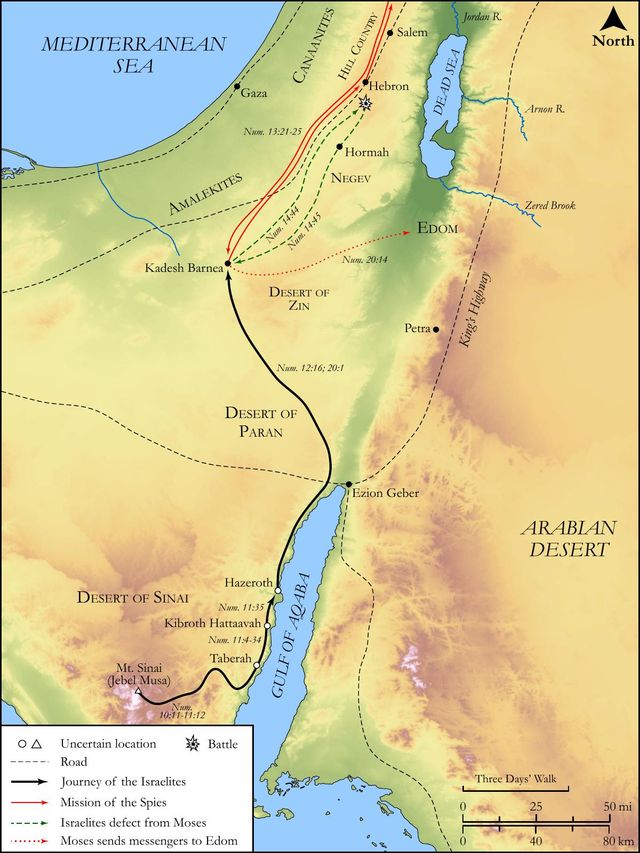
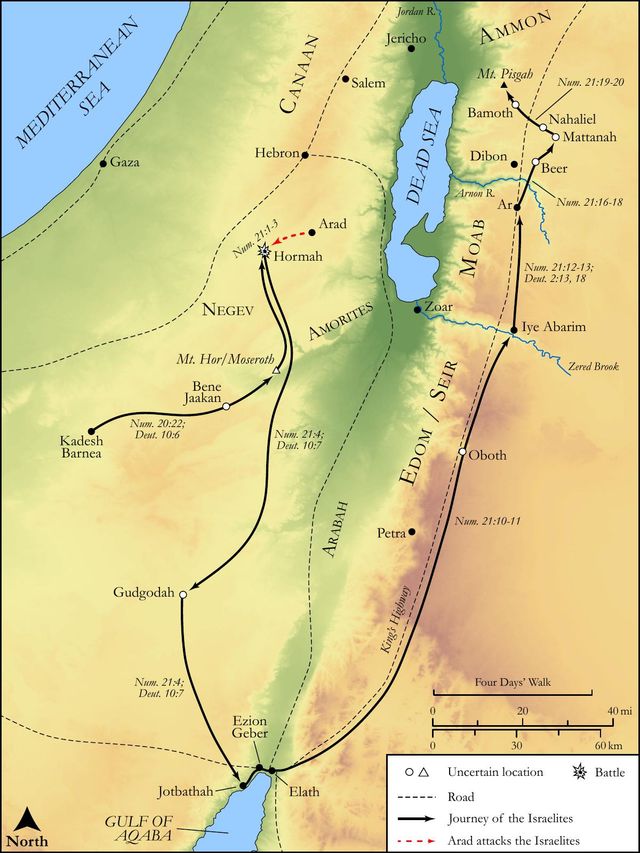
See on the biblical-era map
Study this verse
Public-domain commentary
Matthew Henry
From his Commentary on the Whole Bible. Henry comments on passages, not single verses — this entry covers Numbers 20:22–29. His three-level outline is real structure in the source text, so it is rendered as structure.
The chapter began with the funeral of Miriam, and it ends with the funeral of her brother Aaron. When death comes into a family, it often strikes double. Israel had not improved the former affliction they were under, by the death of the prophetess, and therefore, soon after, God took away their priest, to try if they would lay that to heart. This happened at the very next stage, when they removed to Mount Hor, fetching a compass round the Edomites' country, leaving it on their left hand. Wherever we go, death attends us, and the graves are ready for us.
I.God bids Aaron die, Num 20:24.
God takes Moses and Aaron aside, and tells them, Aaron shall be gathered to his people. These two dear brothers are told that they must part. Aaron the elder must die first, but Moses is not likely to be long after him; so that it is but for a while, a little while, that they are parted.
1.There is something of displeasure in these orders. Aaron must not enter Canaan, because he had failed in his duty at the waters of strife. The mention of this, no doubt, went to the heart of Moses, who knew himself, perhaps, at that time, to be the guiltier of the two.
2.There is much of mercy in them. Aaron, though he dies for his transgression, is not put to death as a malefactor, by a plague, or fire from heaven, but dies with ease and in honour. He is not cut off from his people, as the expression usually is concerning those that die by the hand of divine justice, but he is gathered to his people, as one that died in the arms of divine grace.
3.There is much of type and significancy in them. Aaron must not enter Canaan, to show that the Levitical priesthood could make nothing perfect: that must be done by the bringing in of a better hope. Those priests could not continue by reason of sin and death, but the priesthood of Christ, being undefiled, is unchangeable, and to this, which abides for ever, Aaron must resign all his honour, Heb 7:23-25.
II.Aaron submits, and dies in the method and manner appointed, and, for aught that appears, with as much cheerfulness as if he had been going to bed.
1.He puts on his holy garments to take his leave of them, and goes up with his brother and son to the top of Mount Hor, and probably some of the elders of Israel with him, Num 20:27. They went up in the sight of all the congregation, who, it is likely, were told on what errand they went up; by this solemn procession Aaron lets Israel know that he is neither afraid nor ashamed to die, but, when the bridegroom comes, can trim his lamp and go forth to meet him. His going up the hill to die signified that the death of saints (and Aaron is called the saint of the Lord) is their ascension; they rather go up than go down to death.
2.Moses, whose hands had first clothed Aaron with his priestly garments, now strips him of them; for, in reverence to the priesthood, it was not fit that he should die in them. Note, Death will strip us; naked we came into the world, and naked we must go out. We shall see little reason to be proud of our clothes, our ornaments, or marks of honour, if we consider how soon death will strip us of our glory, divest us of all our offices and honours, and take the crown off from our head.
3.Moses immediately puts the priestly garments upon Eleazar his son, clothes him with his father's robe, and strengthens him with his girdle, Isa 22:21. Now,
(1.)This was a great comfort to Moses, by whose hand the law of the priesthood was given to see that it should be kept up in a succession, and that a lamp was ordained for the anointed, which should not be extinguished by death itself. This was a happy earnest and indication to the church of the care God would take that as one generation of ministers and Christians (spiritual priests) passes away another generation should come up instead of it.
(2.)It was a great satisfaction to Aaron to see his son, who was dear to him, thus preferred, and his office, which was dearer, thus preserved and secured, and especially to see in this a figure of Christ's everlasting priesthood, in which alone his would be perpetuated. Now, Lord, might Aaron say, let thy servant depart in peace, for my eyes have seen thy salvation.
(3.)It was a great kindness to the people. The installing of Eleazar before Aaron was dead would prevent those who bore ill-will to Aaron's family from attempting to set up another upon his death, in competition with his son. What could they do when the matter was already settled? It would likewise encourage those among them that feared God, and be a token for good to them, that he would not leave them, nor suffer his faithfulness to fail.
4.Aaron died there. Quickly after he was stripped of his priestly garments, he laid himself down and died contentedly; for a good man would desire, if it were the will of God, not to outlive his usefulness. Why should we covet to continue any longer in this world than while we may do God and our generation some service in it?
5.Moses and Eleazar, with those that attended them, buried Aaron where he died, as appears by Deu 10:6, and then came down from the mount. And now, when they came down, and had left Aaron behind, it might be proper for them to think that he had rather gone up to the better world and had left them behind.
6.All the congregation mourned for Aaron thirty days, Num 20:29. Though the loss was well made up in Eleazar, who, being in the prime of life, was fitter from public service that Aaron would have been if he had lived, yet it was a debt owing to their deceased high priest to mourn for him. While he lived, they were murmuring at him upon all occasions, but now that he was dead they mourned for him. Thus many are taught to lament the loss of those mercies which they would not learn to be thankful for the enjoyment of. Many good men have had more honour done to their memories than ever they had to their persons, witness those that were persecuted while they lived, but when they were dead had their sepulchres garnished.
Continue studying Numbers 20:29 across the web’s major study libraries — every link below opens this exact verse, chapter, or book on the destination site.
Read & Compare
 BibleGatewayThis verse in more than 200 translations and 70 languages.
 Bible.comThe YouVersion reader — hundreds of translations, reading plans, and highlights.
 ESV.orgCrossway's official English Standard Version reader.
 NET BibleThe NET translation with 60,000+ translators' notes on every rendering decision.
 STEP BibleTyndale House's free study tool — original text, vocabulary, and scholarly resources.
 BibliaLogos Bible Software's free web reader.
 USCCBThe New American Bible (Revised Edition) with the U.S. bishops' study notes.
Commentaries
 BibleHub CommentariesDozens of classic commentaries on this verse, gathered on one page.
 StudyLightMore than 100 commentary sets — the largest collection on the web.
 BibleRefPlain-English commentary on what this verse means, verse by verse.
 Enduring WordDavid Guzik's free commentary on this chapter, widely used by Bible teachers.
 Bible Study ToolsVerse commentary alongside Greek and Hebrew study aids.
Original Language & Research
- BibleHub InterlinearThe verse word by word — original language, transliteration, and English.
- BibleHub LexiconEvery word's original-language definition and Strong's entry.
 Blue Letter BibleDeep-study tools — Strong's numbers, concordance, and word studies.
 SefariaThe Hebrew text with Rashi and centuries of Jewish commentary.
Sermons, Hymns & Audio


TrulyRandomVerse is not affiliated with these sites and doesn’t control their content. They’re linked because they’re genuinely useful.
Summary
Numbers 20:29 meticulously records the profound and widespread national mourning of the Israelite community for a full thirty days following the death of Aaron, their first High Priest. This collective lament underscores Aaron's immense spiritual and national significance, marking a pivotal moment of leadership transition in Israel's journey through the wilderness and highlighting the solemn consequences of divine judgment, even for revered figures.
Context
ShowHideLiterary Context
This verse immediately follows the solemn account of Aaron's death on Mount Hor, as explicitly commanded by God in Numbers 20:23-28. The preceding verses vividly describe Moses stripping Aaron of his priestly garments and clothing his son, Eleazar, with them, signifying a divinely ordained and seamless transfer of the high priestly office before Aaron's demise. This event is a direct consequence of Aaron's and Moses' disobedience at the waters of Meribah, where they failed to honor God as holy before the people, as detailed in Numbers 20:12. The thirty-day mourning period for Aaron serves as a crucial narrative bridge, closing one chapter of leadership and preparing the people for the full assumption of Eleazar's priestly duties as they continue their arduous journey towards the Promised Land. It also provides a necessary pause for the community to process this significant loss before moving forward.
Historical & Cultural Context
In ancient Israel and the broader Ancient Near East, mourning rituals were deeply ingrained cultural practices, often involving specific durations, outward expressions of grief, and public displays of sorrow. A thirty-day mourning period, as seen here for Aaron and later for Moses in Deuteronomy 34:8, was an exceptionally significant and extended period reserved for individuals of immense national importance, such as patriarchs, prophets, or kings. This duration signified profound respect, deep personal and communal loss, and a formal period of lamentation that allowed for collective processing of grief. Aaron, as the divinely appointed first High Priest, the brother of Moses, and a central figure in Israel's wilderness experience, held a unique and irreplaceable position. His role as mediator between God and Israel, responsible for sacrifices and atonement, meant his passing left a significant void that the entire nation was expected to acknowledge and mourn.
Key Themes
ShowHideNumbers 20:29 contributes to several overarching themes within the book of Numbers and the Pentateuch. Firstly, it powerfully illustrates the consequences of disobedience, even for God's chosen leaders. Aaron's death, like Moses' exclusion from the Promised Land, serves as a stark reminder that divine justice is impartial and that even those in high office are accountable to God's holiness, as underscored in Numbers 20:12. Secondly, the verse highlights the theme of divine sovereignty in leadership transition. God orchestrates the succession of the high priesthood from Aaron to Eleazar, ensuring the continuity of the Levitical priestly line and the ongoing spiritual guidance for the nation, as seen in Numbers 20:28. Thirdly, it emphasizes communal solidarity and national lament. The unified mourning of "all the congregation" and "all the house of Israel" demonstrates the deep respect and profound grief felt across the entire nation, showcasing the importance of collective acknowledgment of loss and the shared identity of the people of Israel. This national mourning for Aaron foreshadows the similar lament for Moses found in Deuteronomy 34:8.
Exposition and Analysis
ShowHideKey Word Analysis
ShowHideThe Hebrew verb בָּכָה (bâkâh, H1058) means "to weep" or "to bemoan." Its use here signifies not merely a formal acknowledgment of death but a genuine, emotional outpouring of grief from the entire community. It conveys a profound sense of loss and emotional pain felt by the people for their departed spiritual leader, indicating a deep, heartfelt lament rather than a mere ritualistic observance.
The phrase שְׁלֹשִׁים יוֹם (shᵉlôwshîym yôwm, H7970 and H3117) denotes a specific, extended period of formal mourning. According to the Strong's data, shᵉlôwshîym means "thirty," and yôwm refers to "a day." This duration was customary for highly esteemed individuals in ancient Israel, signifying an exceptionally deep and prolonged expression of national grief and respect. It was not a casual period but a time set aside for communal lament, reflection, and remembrance, indicating the immense stature of the deceased and the gravity of the national loss.
These parallel phrases, כָּל־הָעֵדָה (kol haʻêdâh, H5712) and כָּל־בֵּית יִשְׂרָאֵל (kol bayith Yisrâʼêl, H1004 and H3478), emphasize the universality and national scope of the mourning. ʻêdâh refers to "a stated assemblage, assembly, company, congregation," while bayith means "a house (in the greatest variation of applications, especially family)" and Yisrâʼêl is the name for "Israel." The repetition underscores that the grief was not limited to a small group but was a collective, unified expression from every segment of the Israelite people, from the assembled community to every family and tribe across the entire nation.
Verse Breakdown
ShowHide"And when all the congregation saw that Aaron was dead"
This clause establishes the public and undeniable reality of Aaron's passing. The phrase "all the congregation saw" implies that the death was a witnessed event, or at least its immediate aftermath and the transfer of priestly garments (as described in Numbers 20:28) were publicly known and acknowledged, solidifying the fact of his demise in the communal consciousness. It underscores the transparency of the leadership transition.
"they mourned for Aaron thirty days"
This specifies the duration and nature of the communal response. The act of "mourning" (weeping, lamenting) indicates deep sorrow, while "thirty days" denotes a formal, extended period of national lamentation. This extended period signifies the immense respect and profound loss felt for their High Priest, acknowledging his irreplaceable role in their spiritual and national life. It was a time for the nation to collectively process grief and honor his legacy.
"[even] all the house of Israel."
This final phrase serves as an emphatic reiteration of the preceding "all the congregation," reinforcing the complete and unified national participation in the mourning. It leaves no doubt that the grief was universal, encompassing every tribe, family, and individual within the Israelite nation, signifying a truly collective and unifying experience of sorrow. This repetition highlights the profound impact of Aaron's death on the entire covenant community.
Literary Devices
ShowHideThe verse employs several effective literary devices to convey the depth and scope of the national mourning. Repetition is prominently evident in the phrases "all the congregation" and "all the house of Israel," which serve to underscore the widespread and unified nature of the grief, emphasizing that the lament was truly national in scale. This repetition functions as a form of hyperbole, suggesting that virtually every Israelite participated in this period of mourning, even if not every single individual literally wept. The phrase "house of Israel" also functions as a synecdoche, where a part (the "house" or lineage) represents the whole (the entire nation). Furthermore, the verse acts as a crucial narrative transition, marking the definitive end of Aaron's leadership era and setting the stage for Eleazar's full assumption of the high priestly office, thereby signaling a significant shift in the Israelites' journey and spiritual guidance. The precise mention of "thirty days" also adds a sense of verisimilitude and historical accuracy to the account, grounding the emotional response in a culturally specific, formal practice.
Theological and Thematic Connections
ShowHideThe national mourning for Aaron in Numbers 20:29 serves as a poignant reminder of the universal reality of death and the human need for lament in the face of loss, even for those divinely appointed to sacred office. It underscores God's absolute holiness and justice, demonstrating that even His most revered leaders are accountable for their actions and subject to the consequences of disobedience. The passing of Aaron, the High Priest, also highlights the temporary and imperfect nature of the Old Covenant priesthood, which was continually interrupted by death and sin, necessitating a perpetual succession of priests. This mortality stands in stark contrast to the eternal and unchanging nature of God's character and His redemptive plan. The communal mourning also speaks to the importance of solidarity within the community of faith, where shared grief can foster unity and provide collective solace, demonstrating the communal bonds that define God's people.
Reflection and Application
ShowHideNumbers 20:29 offers profound insights into how communities process loss and transition, and it challenges us to reflect on our own responses to grief, leadership, and divine justice. The collective mourning for Aaron validates the human need to lament, to acknowledge pain, and to create space for communal healing in the face of significant loss. It reminds us that healthy spiritual communities do not shy away from sorrow but embrace it as a part of the human experience, offering mutual support and shared remembrance, fostering deeper bonds of empathy and compassion. Furthermore, Aaron's death, a consequence of his disobedience, serves as a sober reminder that accountability to God's standards applies to all, regardless of position or influence. It prompts us to consider the weighty responsibility of spiritual leadership and the importance of humility, obedience, and integrity in serving God and His people. Finally, the seamless transition of the priesthood to Eleazar underscores God's sovereign hand in orchestrating leadership and ensuring the continuity of His work, even through the passing of key figures, inviting us to trust in His ongoing provision for His people and His unwavering commitment to His redemptive plan.
Questions for Reflection
ShowHideFAQ
ShowHideWhy did Aaron die before entering the Promised Land?
ShowHideAaron's death before entering the Promised Land was a direct consequence of his disobedience at the waters of Meribah, as recorded in Numbers 20:12. Along with Moses, he failed to honor God as holy before the people by striking the rock twice instead of speaking to it as commanded. This act of unbelief and self-exaltation in the sight of the congregation prevented both Moses and Aaron from leading the Israelites into the land of Canaan, emphasizing God's strict standard of holiness for His chosen leaders.
What was the significance of "thirty days" of mourning?
ShowHideThe "thirty days" of mourning (שְׁלֹשִׁים יוֹם, shloshim yom) was a customary and significant period of national lament in ancient Israel, reserved for individuals of immense national importance. It indicated a profound and prolonged expression of grief, respect, and remembrance for the departed leader. This duration is also seen in the mourning period for Moses in Deuteronomy 34:8, highlighting the exceptionally high regard in which these foundational figures were held by the entire nation. It was a formal, communal acknowledgment of a significant loss.
Who succeeded Aaron as High Priest?
ShowHideAaron was succeeded as High Priest by his son, Eleazar. Before Aaron's death on Mount Hor, Moses, at God's command, stripped Aaron of his priestly garments and put them on Eleazar, signifying the divinely ordained transfer of the high priestly office. This event, detailed in Numbers 20:28, ensured the continuity of the Levitical priesthood and the ongoing spiritual guidance for the nation of Israel.
Christ-Centered Fulfillment
ShowHideThe death of Aaron, the first High Priest of Israel, and the subsequent national mourning, powerfully foreshadows and highlights the necessity of the perfect, eternal High Priesthood of Jesus Christ. Aaron's death, a consequence of his sin and the inherent mortality of all human beings, underscored the temporary and imperfect nature of the Old Covenant priesthood. Each earthly high priest, being a sinful man, eventually died, requiring a successor and thus an interruption in their intercessory ministry, as the author of Hebrews points out in Hebrews 7:23. This cycle of death and succession pointed to the profound need for a High Priest who would not die, whose sacrifice would be once for all, and whose intercession would be eternal. Jesus Christ fulfills this need perfectly. Unlike Aaron, whose death was a consequence of his own failing, Christ's death was a substitutionary atonement for the sins of humanity, a voluntary act of perfect obedience, as described in Hebrews 9:11-14. His resurrection conquered death, establishing an unchangeable priesthood that endures forever, as proclaimed in Hebrews 7:24. The mourning for Aaron signifies the end of an era and the limitations of the Levitical system; Christ's death, however, ushers in an eternal covenant of grace, transforming mourning into eternal joy and hope for those who believe in Him, for He is the resurrection and the life. He is the Lamb of God who takes away the sin of the world, and our great High Priest who has passed through the heavens, interceding for us eternally at the right hand of God.