


Genesis 50:10
Bible text: King James Version (1769 Blayney text) · Public domain
Bible text: King James Version with Strong's numbers · Public domain
Bible text: Berean Standard Bible · Public domain
Bible text: American Standard Version (1901) · Public domain
Bible text: World English Bible, Messianic edition · Public domain
Bible text: Geneva Bible (1599) · Public domain
Bible text: Young's Literal Translation · Public domain
- וַיָּבֹאוּvai·ya·Vo·'uand they cameH935Conj-w ¦ V-Qal-ConsecImperf-3mpVerb Qal Consecutive Imperfect 3rd Plural Masculineוַandיָּבֹאוּthey came
- עַד'adtoH5704PrepPreposition
- גֹּרֶןGo·ren[the] threshing floor ofH1637N-fscNoun Singular Feminine Construct
- הָאָטָדha·'a·Tad<the> AtadH329Art ¦ N-properNoun Proper Locationהָ<the>אָטָדAtad
- אֲשֶׁר'a·SherwhichH834RelParticle Relative
- בְּעֵבֶרbe·'E·ver[is] on [the] other side ofH5676Prep-b ¦ N-mscNoun Singular Masculine Constructבְּ[is] onעֵבֶר[the] other side of
- הַיַּרְדֵּןhai·yar·Denthe JordanH3383Art ¦ N-properNoun Proper LocationהַtheיַּרְדֵּןJordan
- וַיִּסְפְּדוּvai·Yis·pe·duand they lamentedH5594Conj-w ¦ V-Qal-ConsecImperf-3mpVerb Qal Consecutive Imperfect 3rd Plural Masculineוַandיִּסְפְּדוּthey lamented
- שָׁםShamthereH8033AdvAdverb
- מִסְפֵּדmis·Peda lamentH4553N-msNoun Singular Masculine Absolute
- גָּדוֹלga·DolgreatH1419Adj-msAdjective Singular Masculine Absolute
- וְכָבֵדve·kha·Vedand heavyH3515Conj-w ¦ Adj-msAdjective Singular Masculine Absoluteוְandכָבֵדheavy
- מְאֹדme·'OdveryH3966Adj-msAdjective Numerical Singular Masculine Absolute
- וַיַּעַשׂvai·Ya·'asand he madeH6213Conj-w ¦ V-Qal-ConsecImperf-3msVerb Qal Consecutive Imperfect 3rd Singular Masculineוַandיַּעַשׂhe made
- לְאָבִיוle·'a·Vivfor his fatherH1Prep-l ¦ N-msc ¦ 3msNoun Singular Masculine Constructלְforאָבִיfatherוhis
- אֵבֶל'E·velmourningH60N-msNoun Singular Masculine Absolute
- שִׁבְעַתshiv·'AtsevenH7651Adj-cscAdjective Numerical Singular common gender Construct
- יָמִיםya·MimdaysH3117N-mpNoun Plural Masculine Absolute
English is a literal word-by-word gloss of the Hebrew, not the KJV's wording. Why?
This is the original text the KJV's translators worked from — each Hebrew word with its own literal English meaning in this verse, prepared by scholars at Tyndale House, Cambridge. The KJV translates whole sentences, not word by word, so its wording differs: one Hebrew word can become several English words, and the KJV may choose “the LORD” where the gloss reads “Yahweh”. Both are faithful — they answer different questions. For the KJV's own rendering, switch to the KJV text.
Details
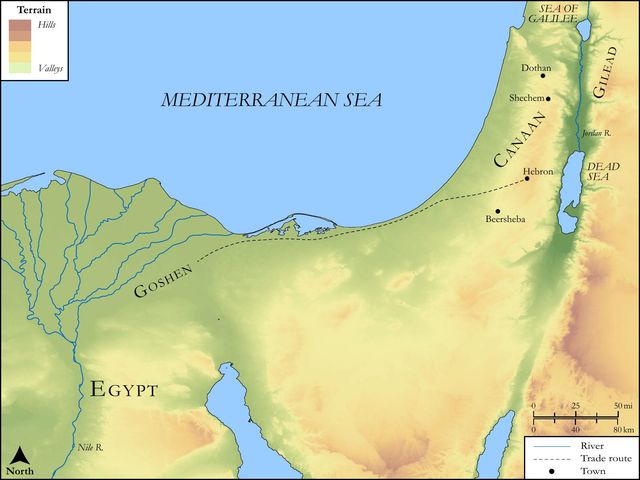
See on the biblical-era maps


Study this verse
Public-domain commentary
Matthew Henry
From his Commentary on the Whole Bible. Henry comments on passages, not single verses — this entry covers Genesis 50:7–14.
We have here an account of Jacob's funeral. Of the funerals of the kings of Judah, usually, no more is said than this, They were buried with their fathers in the city of David: but the funeral of the patriarch Jacob is more largely and fully described, to show how much better God was to him than he expected (he had spoken more than once of dying for grief, and going to the grave bereaved of his children, but, behold, he dies in honour, and is followed to the grave by all his children), and also because his orders concerning his burial were given and observed in faith, and in expectation both of the earthly and of the heavenly Canaan. Now, 1. It was a stately funeral. He was attended to the grave, not only by his own family, but by the courtiers, and all the great men of the kingdom, who, in token of their gratitude to Joseph, showed this respect to his father for his sake, and did him honour at his death. Though the Egyptians had had an antipathy to the Hebrews, and had looked upon them with disdain (Gen 43:32), yet now, that they were better acquainted with them, they began to have a respect for them. Good old Jacob had conducted himself so well among them as to gain universal esteem. Note, Professors of religion should endeavour, by wisdom and love, to remove the prejudices which many may have conceived against them because they do not know them. There went abundance of chariots and horsemen, not only to attend them a little way, but to go through with them. Note, The decent solemnities of funerals, according to a man's situation, are very commendable; and we must not say of them, To what purpose is this waste? See Act 8:2; Luk 7:12. 2. It was a sorrowful funeral (Gen 50:10, Gen 50:11); standers-by took notice of it as a grievous mourning. Note, The death of good men is a great loss to any place, and ought to be greatly lamented. Stephen dies a martyr, and yet devout men make great lamentations for him. The solemn mourning for Jacob gave a name to the place, Abel-Mizraim, the mourning of the Egyptians, which served for a testimony against the next generation of the Egyptians, who oppressed the posterity of this Jacob to whom their ancestors showed such respect.
Historical interpretation
Historical reception
1 surviving comment on this verse from the historical church.
For your part, however, dearly beloved, don’t simply pass this by on hearing it; instead, consider the time when it happened and absolve Joseph of all blame. I mean, the gates of the underworld were still not broken or the bonds of death loosed. Nor was death yet called sleep. Hence, because they feared death, they acted this way; today, on the contrary, thanks to the grace of God, since death has been turned into slumber and life’s end into repose and since there is great certitude of resurrection, we rejoice and exult at death like people moving from one life to another. Why do I say from one life to another? From a worse to a better, from a temporary to an eternal, from an earthly to a heavenly.
Continue studying Genesis 50:10 across the web’s major study libraries — every link below opens this exact verse, chapter, or book on the destination site.
Read & Compare
 BibleGatewayThis verse in more than 200 translations and 70 languages.
 Bible.comThe YouVersion reader — hundreds of translations, reading plans, and highlights.
 ESV.orgCrossway's official English Standard Version reader.
 NET BibleThe NET translation with 60,000+ translators' notes on every rendering decision.
 STEP BibleTyndale House's free study tool — original text, vocabulary, and scholarly resources.
 BibliaLogos Bible Software's free web reader.
 USCCBThe New American Bible (Revised Edition) with the U.S. bishops' study notes.
Commentaries
 BibleHub CommentariesDozens of classic commentaries on this verse, gathered on one page.
 StudyLightMore than 100 commentary sets — the largest collection on the web.
 BibleRefPlain-English commentary on what this verse means, verse by verse.
 Enduring WordDavid Guzik's free commentary on this chapter, widely used by Bible teachers.
 Bible Study ToolsVerse commentary alongside Greek and Hebrew study aids.
Original Language & Research
- BibleHub InterlinearThe verse word by word — original language, transliteration, and English.
- BibleHub LexiconEvery word's original-language definition and Strong's entry.
 Blue Letter BibleDeep-study tools — Strong's numbers, concordance, and word studies.
 SefariaThe Hebrew text with Rashi and centuries of Jewish commentary.
Sermons, Hymns & Audio


TrulyRandomVerse is not affiliated with these sites and doesn’t control their content. They’re linked because they’re genuinely useful.
Summary
Genesis 50:10 meticulously details a significant pause in Jacob's funeral procession, where Joseph, his family, and a large Egyptian entourage halted at the "threshingfloor of Atad" located beyond the Jordan River. This site became the scene of a profound and intense seven-day period of lamentation, a public and culturally prescribed expression of deep grief and honor for the deceased patriarch, Jacob.
Context
ShowHideLiterary Context
Genesis 50:10 is situated at the climax of the book of Genesis, immediately following Jacob's death in Egypt and Joseph's poignant request to Pharaoh for permission to bury his father in Canaan. The preceding verses (Genesis 50:1-9) describe the embalming of Jacob, the period of mourning in Egypt, and the formation of the grand funeral procession. This verse marks a crucial geographical and emotional waypoint on the journey from Egypt to the Cave of Machpelah in Hebron, fulfilling Jacob's dying wish recorded in Genesis 49:29-30. The subsequent verse (Genesis 50:11) reveals the local impact of this mourning, leading to the naming of the site as "Abel-mizraim," underscoring the magnitude of the event.
Historical & Cultural Context
Funerary practices among the nations of that day were elaborate and deeply significant. Embalming, as performed on Jacob (and Joseph later), was an Egyptian custom, reflecting Joseph's assimilation and high status. Public mourning, characterized by loud wailing, tearing of clothes, and specific durations, was common across the region, serving as a communal acknowledgment of loss and a demonstration of respect for the deceased. A "threshingfloor" was typically an open, flat, elevated area, suitable for winnowing grain, but also large enough to accommodate a significant gathering, making it a practical and visible location for a public display of grief. The journey from Egypt to Canaan was substantial, requiring careful planning and provision for such a large retinue, which included chariots and horsemen, indicative of Joseph's powerful position and the honor bestowed upon Jacob.
Key Themes
ShowHideThis verse powerfully contributes to several overarching themes in Genesis. It highlights Filial Piety, as Joseph meticulously orchestrates and participates in this elaborate funeral, fulfilling his father's final wishes and demonstrating profound love and respect. The journey to Canaan and the burial there underscore the theme of Covenant Fulfillment, as Jacob is laid to rest in the land God promised to Abraham, Isaac, and Jacob, reaffirming God's faithfulness to His word despite the family's long sojourn in Egypt. Furthermore, the intense and public mourning speaks to the profound human experience of Grief and Loss, acknowledging its legitimacy and communal expression. The entire narrative, from Jacob's death to his burial, also subtly reinforces the theme of Divine Providence, as God's guiding hand is evident in bringing the patriarch to his final resting place in the land of promise, even through seemingly secular arrangements.
Exposition and Analysis
ShowHideGenesis 50:10 states, "And they came to the threshingfloor of Atad, which [is] beyond Jordan, and there they mourned with a great and very sore lamentation: and he made a mourning for his father seven days." This verse captures a pivotal moment of public grief and a significant geographical marker in the funeral procession of Jacob.
Key Word Analysis
ShowHideFrom an unused root meaning to smooth; a threshing-floor (as made even); by analogy, any open area; (barn, corn, threshing-) floor, (threshing-, void) place. The choice of a threshingfloor, a common, open, and often elevated agricultural site, suggests a practical location large enough for the extensive funeral procession to gather and perform public mourning rituals. It was a well-known landmark, making it a suitable place for such a notable event.
From çâphad (H5594); a lamentation; lamentation, one mourneth, mourning, wailing. This term specifically refers to the vocal and demonstrative expression of grief, often involving loud wailing, crying, and other ritualistic displays of sorrow, as when the Egyptians mourned for Jacob seventy days. Its use here emphasizes the audible and public nature of the mourning.
From kâbad (H3513); heavy; figuratively in a good sense (numerous) or in a bad sense (severe, difficult, stupid); (so) great, grievous, hard(-ened), (too) heavy(-ier), laden, much, slow, sore, thick. When combined with "great and very," the word "sore" intensifies the description of the lamentation, indicating an exceedingly heavy, severe, and difficult expression of grief, conveying its profound emotional depth and intensity.
Verse Breakdown
ShowHide"And they came to the threshingfloor of Atad, which [is] beyond Jordan"
This clause describes the geographical location where the procession paused. The "threshingfloor of Atad" was a specific, named landmark, likely a well-known site marked by thorn bushes. The phrase "beyond Jordan" (Hebrew: 'ever hayarden) is crucial; given the journey from Egypt into Canaan, it most logically refers to a location west of the Jordan River. This means the procession had already crossed into the Promised Land, making this a significant entry point for their formal mourning before proceeding further into the heart of the land for burial.
"and there they mourned with a great and very sore lamentation"
This part details the nature and intensity of the mourning. The Hebrew emphasizes the extreme depth and audibility of the sorrow. This was not a private, quiet grief but a public, communal, and culturally prescribed wailing and lamentation, involving both Jacob's family and the accompanying Egyptian dignitaries. The triple emphasis ("great and very sore") highlights the extraordinary nature of this expression of grief.
"and he made a mourning for his father seven days"
The "he" here refers to Joseph, who orchestrated and led this specific period of mourning. The duration of "seven days" was a customary and symbolically significant period of intense grief and ritual mourning in Israel and among the nations round about (1 Samuel 31:13). This act underscores Joseph's unwavering filial devotion, his commitment to honoring his father's memory and wishes, and his continued leadership even in sorrow.
Literary Devices
ShowHideThe verse employs several Literary Devices to convey the profound significance of the event. The use of Hyperbole or Emphasis is evident in the phrase "a great and very sore lamentation," which uses multiple intensifiers to underscore the extreme depth and public nature of the grief. This emphasizes the emotional weight of Jacob's passing and the respect accorded to him. The naming of the location, "threshingfloor of Atad," and its subsequent renaming in the next verse as Abel-mizraim ("mourning of Egypt"), functions as a Toponymic Etiology, explaining the origin of a place name through a significant event. This device grounds the narrative in a specific geographical reality and highlights the lasting impact of this funeral on the local populace. Furthermore, the precise mention of "seven days" is an example of Symbolism, as the number seven often denotes completeness or perfection in biblical numerology, signifying a full and proper period of mourning.
Theological and Thematic Connections
ShowHideGenesis 50:10 encapsulates profound theological truths concerning human grief, filial duty, and God's enduring faithfulness to His covenant promises. The intense, public, and prolonged lamentation for Jacob underscores the biblical recognition of deep sorrow as a natural and appropriate human response to loss. Joseph's meticulous orchestration of this funeral, including the seven-day mourning period, exemplifies profound filial piety and unwavering devotion, setting a powerful example of honoring one's parents. Most significantly, the journey to and mourning within the land of Canaan, even before the final burial, powerfully affirms the enduring nature of God's covenant promise of land to Abraham, Isaac, and Jacob, demonstrating His faithfulness across generations and through challenging circumstances.
Reflection and Application
ShowHideGenesis 50:10 offers profound insights into the human experience of loss and the enduring nature of divine faithfulness. It reminds us of the importance of honoring our parents and loved ones, even in death, by respecting their wishes and providing appropriate expressions of grief. The passage highlights the natural and necessary human experience of sorrow, affirming that mourning is a valid and healthy part of processing loss, and that it can be a communal, supportive process. Joseph's unwavering commitment to fulfilling his father's final wish serves as an enduring example of faithfulness, respect, and filial duty, demonstrating that love extends beyond life. Furthermore, the emphasis on Jacob's burial in the promised land powerfully reinforces the enduring nature of God's covenant promises, demonstrating His faithfulness across generations and through challenging circumstances. This encourages believers to trust in God's unwavering commitment to His word, just as Joseph trusted in the divine plan that ultimately led his family back to the land of promise, even for burial.
Questions for Reflection
ShowHideFAQ
ShowHideWhat was the "threshingfloor of Atad"?
ShowHideA threshingfloor (Hebrew: gôren) was typically a flat, open, and often elevated area used by farmers to separate grain from its husks through winnowing. The "threshingfloor of Atad" was a specific, named location, likely a prominent landmark, that was large enough to accommodate Jacob's grand funeral procession for a public, extended period of mourning. Its name "Atad" means "thorn-bush," suggesting a place marked by such vegetation, serving as a distinct geographical marker.
Why is the phrase "beyond Jordan" significant in this context?
ShowHideThe phrase "beyond Jordan" (Hebrew: 'ever hayarden) is significant because, given the procession's journey from Egypt into Canaan, it indicates they had crossed the Jordan River and were now west of the river, firmly within the geographical boundaries of the land of Canaan. This marked their entry into the Promised Land, fulfilling Jacob's desire to be buried there, even before reaching the final burial site in Hebron. The mourning at this location, therefore, occurred on the threshold of the promised inheritance, underscoring the fulfillment of God's covenant.
What was the significance of the "seven days" of mourning?
ShowHideIn Israel and among the nations round about, a seven-day period of mourning was a customary and symbolically significant duration for expressing deep grief. It was a formal, intense period of lamentation, often involving specific rituals and public displays of sorrow, as seen in other biblical accounts (e.g., 1 Samuel 31:13). This duration underscored the profound respect and sorrow felt for the deceased, in this case, Jacob, signifying a complete and proper period of lamentation.
Why did Joseph go to such great lengths for his father's funeral?
ShowHideJoseph's elaborate orchestration of Jacob's funeral demonstrates his profound love, respect, and unwavering filial devotion to his father. It also reflects his high status and influence as a powerful figure in Egypt, allowing him to arrange such a grand procession, including a significant Egyptian delegation (as detailed in Genesis 50:7-9). This act fulfilled Jacob's dying wish to be buried in Canaan (recorded in Genesis 49:29-30), showcasing Joseph's faithfulness to his father's final instructions and his commitment to the covenant promises associated with the land.
Christ-Centered Fulfillment
ShowHideThe solemn procession and burial of Jacob in the Promised Land, marked by profound mourning and the fulfillment of a long-held desire, finds its ultimate echo and fulfillment in Christ. Jacob's burial in the land promised by God foreshadows the believer's ultimate rest and inheritance in the New Heavens and New Earth, secured not by human endeavor but by Christ's redemptive work. Just as Joseph meticulously led his family to the place of burial, Christ, as the greater Son and faithful Shepherd (John 10:11), leads His people through the wilderness of this life to their eternal home. The deep lamentation for Jacob, though genuine and appropriate, is contrasted with the ultimate hope of resurrection in Christ, who has conquered death and the grave (1 Corinthians 15:54-57). He offers eternal life and comfort beyond earthly sorrow, promising a future where all tears will be wiped away (Revelation 21:4). Thus, Jacob's burial in the promised land, a testament to God's faithfulness, points forward to the greater and eternal inheritance found in Christ Jesus, the true and living hope for all who believe (1 Peter 1:3-5).