


2 Samuel 1:17
Bible text: King James Version (1769 Blayney text) · Public domain
Bible text: Berean Standard Bible · Public domain
Bible text: American Standard Version (1901) · Public domain
Bible text: World English Bible, Messianic edition · Public domain
Bible text: Geneva Bible (1599) · Public domain
Bible text: Young's Literal Translation · Public domain
- וַיְקֹנֵןvay·ko·Nenand he lamentedH6969Conj-w ¦ V-Piel-ConsecImperf-3msVerb Piel Consecutive Imperfect 3rd Singular Masculineוַandיְקֹנֵןhe lamented
- דָּוִדda·VidDavidH1732N-proper-mNoun Proper Masculine
- אֶת'et<obj.>H853DirObjMParticle Object Indicator
- הַקִּינָהha·ki·Nahthe lamentationH7015Art ¦ N-fsNoun Singular Feminine Absoluteהַtheקִּינָהlamentation
- הַזֹּאתha·Zot<the> thisH2063Art ¦ PrtParticle Demonstrativeהַ<the>זֹּאתthis
- עַל'alonH5921PrepPreposition
- שָׁאוּלsha·'UlSaulH7586N-proper-mNoun Proper Masculine
- וְעַלve·'aland onH5921Conj-w ¦ PrepPrepositionוְandעַלon
- יְהוֹנָתָןye·ho·na·TanJonathanH3083N-proper-mNoun Proper Masculine
- בְּנוֹbe·Nohis sonH1121N-msc ¦ 3msNoun Singular Masculine Constructבְּנsonוֹhis
English is a literal word-by-word gloss of the Hebrew, not the KJV's wording. Why?
This is the original text the KJV's translators worked from — each Hebrew word with its own literal English meaning in this verse, prepared by scholars at Tyndale House, Cambridge. The KJV translates whole sentences, not word by word, so its wording differs: one Hebrew word can become several English words, and the KJV may choose “the LORD” where the gloss reads “Yahweh”. Both are faithful — they answer different questions. For the KJV's own rendering, switch to the KJV text.
Details
See on the biblical-era maps

Study this verse
Public-domain commentary
Matthew Henry
From his Commentary on the Whole Bible. Henry comments on passages, not single verses — this entry covers 2 Samuel 1:17–27. His four-level outline is real structure in the source text, so it is rendered as structure.
When David had rent his clothes, mourned, and wept, and fasted, for the death of Saul, and done justice upon him who made himself guilty of it, one would think he had made full payment of the debt of honour he owed to his memory; yet this is not all: we have here a poem he wrote on that occasion; for he was a great master of his pen as well as of his sword. By this elegy he designed both to express his own sorrow for this great calamity and to impress the like on the minds of others, who ought to lay it to heart. The putting of lamentations into poems made them, 1. The more moving and affecting. The passion of the poet, or singer, is, by this way, wonderfully communicated to the readers and hearers. 2. The more lasting. Thus they were made, not only to spread far, but to continue long, from generation to generation. Those might gain information by poems that would not read history. Here we have,
I.The orders David gave with this elegy (Sa2 1:18):
He bade them teach the children of Judah (his own tribe, whatever others did) the use of the bow, either.
1.The bow used in war. Not but that the children of Judah knew how to use the bow (it was so commonly used in war, long before this, that the sword and bow were put for all weapons of war, Gen 48:22), but perhaps they had of late made more use of slings, as David in killing Goliath, because cheaper, and David would have them now to see the inconvenience of these (for it was the archers of the Philistines that bore so hard upon Saul, Sa1 21:3), and to return more generally to the use of the bow, to exercise themselves in this weapon, that they might be in a capacity to avenge the death of their prince upon the Philistines, and to outdo them at their own weapon. It was a pity but those that had such good heads and hearts as the children of Judah should be well armed. David hereby showed his authority over and concern for the armies of Israel, and set himself to rectify the errors of the former reign. But we find that the companies which had now come to David to Ziklag were armed with bows (Ch1 12:2); therefore,
2.Some understand it either of some musical instrument called a bow (to which he would have the mournful ditties sung) or of the elegy itself: He bade them teach the children of Judah Kesheth, the bow, that is, this song, which was so entitled for the sake of Jonathan's bow, the achievements of which are here celebrated. Moses commanded Israel to learn his song (Deu 31:19), so David his. Probably he bade the Levites teach them. It is written in the book of Jasher, there it was kept upon record, and thence transcribed into this history. That book was probably a collection of state-poems; what is said to be written in that book (Jos 10:13) is also poetical, a fragment of an historical poem. Even songs would be forgotten and lost if they were not committed to writing, that best conservatory of knowledge.
II.The elegy itself.
It is not a divine hymn, nor given by inspiration of God to be used in divine service, nor is there any mention of God in it; but it is a human composition, and therefore was inserted, not in the book of Psalms (which, being of divine original, is preserved), but in the book of Jasher, which, being only a collection of common poems, is long since lost. This elegy proves David to have been,
1.A man of an excellent spirit, in four things: -
(1.)He was very generous to Saul, his sworn enemy. Saul was his father-in-law, his sovereign, and the anointed of the Lord; and therefore, though he had done him a great deal of wrong, David does not wreak his revenge upon his memory when he is in his grave; but like a good man, and a man of honour,
[1.]He conceals his faults; and, though there was no preventing their appearance in his history, yet they should not appear in this elegy. Charity teaches us to make the best we can of every body and to say nothing of those of whom we can say no good, especially when they are gone. De mortuis nil nisi bonum - Say nothing but good concerning the dead. We ought to deny ourselves the satisfaction of making personal reflections upon those who have been injurious to us, much more drawing their character thence, as if every man must of necessity be a bad man that has done ill by us. Let the corrupt part of the memory be buried with the corrupt part of the man - earth to earth, ashes to ashes; let the blemish be hidden and a veil drawn over the deformity.
[2.]He celebrates that which was praiseworthy in him. He does not commend him for that which he was not, says nothing of his piety or fidelity. Those funeral commendations which are gathered out of the spoils of truth are not at all to the praise of those on whom they are bestowed, but very much the dispraise of those who unjustly misplace them. But he has this to say in honour of Saul himself, First, That he was anointed with oil (Sa2 1:21), the sacred oil, which signified his elevation to, and qualification for, the government. Whatever he was otherwise, the crown of the anointing oil of his God was upon him, as is said of the high priest (Lev 21:12), and on that account he was to be honoured, because God, the fountain of honour, had honoured him. Secondly, That he was a man of war, a mighty man (Sa2 1:19-21), that he had often been victorious over the enemies of Israel and vexed them whithersoever he turned, Sa1 14:47. His sword returned not empty, but satiated with blood and spoil, Sa2 1:22. His disgrace and fall at last must not make his former successes and services to be forgotten. Though his sun set under a cloud, time was when it shone brightly. Thirdly, That take him with Jonathan he was a man of a very agreeable temper, that recommended himself to the affections of his subjects (Sa2 1:23): Saul and Jonathan were lovely and pleasant. Jonathan was always so, and Saul was so as long as he concurred with him. Take them together, and in the pursuit of the enemy, never were men more bold, more brave; they were swifter than eagles and stronger than lions. Observe, Those that were most fierce and fiery in the camp were no less sweet and lovely in the court, as amiable to the subject as they were formidable to the foe; a rare combination of softness and sharpness they had, which makes any man's temper very happy. It may be understood of the harmony and affection that for the most part subsisted between Saul and Jonathan: they were lovely and pleasant one to another, Jonathan a dutiful son, Saul an affectionate father; and therefore dear to each other in their lives, and in their death they were not divided, but kept close together in the stand they made against the Philistines, and fell together in the same cause. Fourthly, That he had enriched his country with the spoils of conquered nations, and introduced a more splendid attire. When they had a king like the nations, they must have clothes like the nations; and herein he was, in a particular manner, obliging to his female subjects, Sa2 1:24. The daughters of Israel he clothed in scarlet, which was their delight.
(2.)He was very grateful to Jonathan, his sworn friend. Besides the tears he shed over him, and the encomiums he gives of him in common with Saul, he mentions him with some marks of distinction (Sa2 1:25): O Jonathan! thou wast slain in thy high places! which (compared with Sa2 1:19) intimates that he meant him by the beauty of Israel, which, he there says, was slain upon the high places. He laments Jonathan as his particular friend (Sa2 1:26): My brother, Jonathan; not so much because of what he would have been to him if he had lived, very serviceable no doubt in his advancement to the throne and instrumental to prevent those long struggles which, for want of his assistance, he had with the house of Saul (had this been the only ground of his grief it would have been selfish), but he lamented him for what he had been: "Very pleasant hast thou been unto me; but that pleasantness is now over, and I am distressed for thee." He had reason to say that Jonathan's love to him was wonderful; surely never was the like, for a man to love one who he knew was to take the crown over his head, and to be so faithful to his rival: this far surpassed the highest degree of conjugal affection and constancy. See here,
[1.]That nothing is more delightful in this world than a true friend, that is wise and good, that kindly receives and returns our affection, and is faithful to us in all our true interests.
[2.]That nothing is more distressful than the loss of such a friend; it is parting with a piece of one's self. It is the vanity of this world that what is most pleasant to us we are most liable to be distressed in. The more we love the more we grieve.
(3.)He was deeply concerned for the honour of God; for this is what he has an eye to when he fears lest the daughters of the uncircumcised, that are out of covenant with God, should triumph over Israel, and the God of Israel, Sa2 1:20. Good men are touched in a very sensible part by the reproaches of those that reproach God.
(4.)He was deeply concerned for the public welfare. It was the beauty of Israel that was slain (Sa2 1:19) and the honour of the public that was disgraced: The mighty have fallen (this is three times lamented, Sa2 1:19, Sa2 1:25, Sa2 1:27), and so the strength of the people is weakened. Public losses are most laid to heart by men of public spirit. David hoped God would make him instrumental to repair those losses and yet laments them.
2.A man of a fine imagination, as well as a wise and holy man. The expressions are all excellent, and calculated to work upon the passions.
(1.)The embargo he would fain lay upon Fame is elegant (Sa2 1:20): Tell it not in Gath. It grieved him to the heart to think that it would be proclaimed in the cities of the Philistines, and that they would insult over Israel upon it, and the more in remembrance of the triumphs of Israel over them formerly, when they sang, Saul has slain his thousands; for this would now be retorted.
(2.)The curse he entails on the mountains of Gilboa, the theatre on which this tragedy was acted: Let there be no dew upon you, nor fields of offerings, Sa2 1:21. This is a poetical strain, like that of Job, Let the day perish wherein I was born. Not as if David wished that any part of the land of Israel might be barren, but, to express his sorrow for the thing, he speaks with a seeming indignation at the place. Observe,
[1.]How the fruitfulness of the earth depends upon heaven. The worst thing he could wish to the mountains of Gilboa was barrenness and unprofitableness to man: those are miserable that are useless. It was the curse Christ pronounced on the fig-tree, Never fruit grow on thee more, and that took effect - the fig-tree withered away: this, on the mountains of Gilboa, did not. But, when he wished them barren, he wished there might be no rain upon them; and, if the heavens be brass, the earth will soon be iron.
[2.]How the fruitfulness of the earth must therefore be devoted to heaven, which is intimated in his calling the fruitful fields fields of offerings. Those fruits of their land that were offered to God were the crown and glory of it: and therefore the failure of the offerings is the saddest consequent of the failure of the corn. See Joe 1:9. To want that wherewith we should honour God is worse than to want that wherewith we should sustain ourselves. This is the reproach David fastens upon the mountains of Gilboa, which, having been stained with royal blood, thereby forfeited celestial dews. In this elegy Saul had a more honourable interment than that which the men of Jabesh-Gilead gave him.
Continue studying 2 Samuel 1:17 across the web’s major study libraries — every link below opens this exact verse, chapter, or book on the destination site.
Read & Compare
 BibleGatewayThis verse in more than 200 translations and 70 languages.
 Bible.comThe YouVersion reader — hundreds of translations, reading plans, and highlights.
 ESV.orgCrossway's official English Standard Version reader.
 NET BibleThe NET translation with 60,000+ translators' notes on every rendering decision.
 STEP BibleTyndale House's free study tool — original text, vocabulary, and scholarly resources.
 BibliaLogos Bible Software's free web reader.
 USCCBThe New American Bible (Revised Edition) with the U.S. bishops' study notes.
Commentaries
 BibleHub CommentariesDozens of classic commentaries on this verse, gathered on one page.
 StudyLightMore than 100 commentary sets — the largest collection on the web.
 BibleRefPlain-English commentary on what this verse means, verse by verse.
 Enduring WordDavid Guzik's free commentary on this chapter, widely used by Bible teachers.
 Bible Study ToolsVerse commentary alongside Greek and Hebrew study aids.
Original Language & Research
- BibleHub InterlinearThe verse word by word — original language, transliteration, and English.
- BibleHub LexiconEvery word's original-language definition and Strong's entry.
 Blue Letter BibleDeep-study tools — Strong's numbers, concordance, and word studies.
 SefariaThe Hebrew text with Rashi and centuries of Jewish commentary.
Sermons, Hymns & Audio


TrulyRandomVerse is not affiliated with these sites and doesn’t control their content. They’re linked because they’re genuinely useful.
Summary
Second Samuel 1:17 serves as the poignant introduction to David's deeply moving lament, often referred to as "The Song of the Bow," mourning the tragic deaths of King Saul and his beloved son, Jonathan, on Mount Gilboa. This verse immediately establishes David's profound sorrow and his intention to publicly express his grief through a formal dirge, underscoring his character marked by loyalty, respect for God's anointed, and an extraordinary capacity for love, even in the face of personal gain.
Context
ShowHideLiterary Context
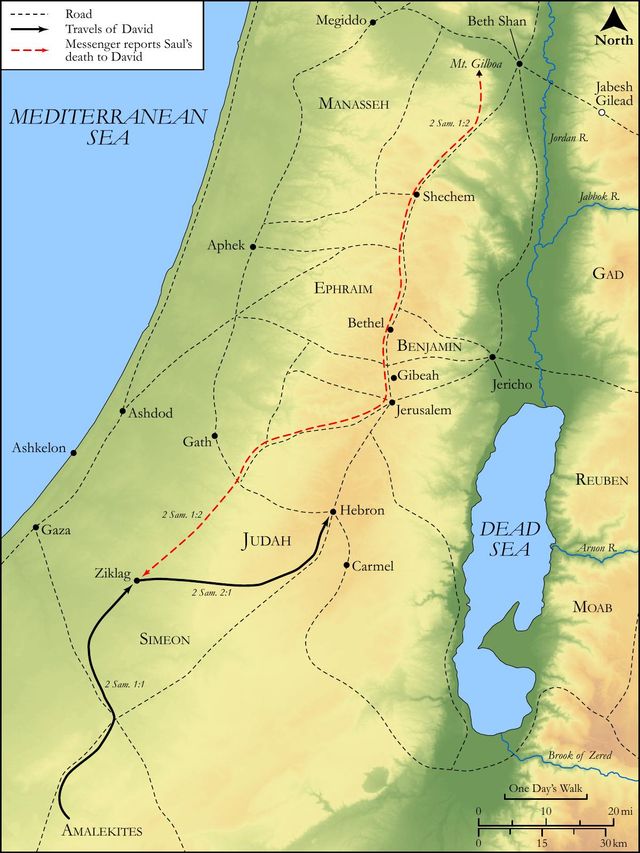
This verse immediately follows the grim report delivered by an Amalekite, falsely claiming to have killed Saul and bringing Saul's crown and armlet to David, expecting a reward. Instead of rejoicing at the removal of his persecutor and the clear path to the throne, David's response is one of profound grief. He and his men tear their clothes, weep, and fast until evening, mourning Saul, Jonathan, and the fallen army of Israel, as detailed in 2 Samuel 1:11-12. Verse 17 then transitions from this immediate, visceral reaction to a structured, poetic expression of sorrow, indicating that David's grief was not merely internal but also a public, communal act of remembrance and honor. The lament itself follows in the subsequent verses, from 2 Samuel 1:19 through 2 Samuel 1:27, making verse 17 the crucial narrative bridge introducing this significant piece of biblical poetry.
Historical & Cultural Context
The setting is Ziklag, a Philistine town where David and his men had been residing in the service of the Philistine king, having fled from Saul's relentless pursuit. The news of Saul's death on Mount Gilboa, as narrated in 1 Samuel 31, marks a pivotal moment in Israelite history, signifying the end of the united monarchy under Saul and the imminent transition to David's reign. In Israel, public lamentation was a deeply ingrained social and religious practice, often involving professional mourners, specific poetic forms (dirges or laments), and ritualistic expressions of grief like tearing clothes, wearing sackcloth, and fasting. Such laments served not only as an outlet for personal sorrow but also as a communal act of acknowledging loss, honoring the deceased, and processing national tragedy. David, as a future king, models appropriate leadership by engaging in this cultural practice, demonstrating respect for the fallen king and a shared sense of national loss.
Key Themes
ShowHideThis verse, by introducing David's lament, highlights several profound themes. Firstly, it underscores the theme of grief and lamentation as a legitimate and necessary human response to loss, even for powerful leaders. David's raw sorrow contrasts sharply with the Amalekite's opportunistic report, revealing David's righteous character. Secondly, it emphasizes respect for God's anointed, even when that anointed leader has been a personal enemy. Despite Saul's repeated attempts on David's life, David consistently refused to harm him, recognizing Saul's divine appointment, as seen in 1 Samuel 24:6. His lament over Saul affirms this deep reverence, demonstrating a profound understanding of God's sovereignty over human institutions. Thirdly, and most poignantly, it highlights the theme of unwavering friendship between David and Jonathan. Their covenantal bond, forged in loyalty and selflessness, as established in 1 Samuel 18:1-4, transcended the political rivalry between their fathers and serves as a biblical paradigm for true companionship. David's specific mention of Jonathan in the lament's introduction foreshadows the profound expression of love found later in the song, particularly in 2 Samuel 1:26.
Exposition and Analysis
ShowHideKey Word Analysis
ShowHideThis verb (H6969) is a primitive root meaning "to strike a musical note, i.e. chant or wail (at a funeral)." It signifies an active, purposeful expression of sorrow, often in a structured, poetic form. The Piel imperfect form used here (wayqōnen) suggests an intensive or causative action, indicating that David not only felt profound grief but also formally composed and recited a dirge. This is more than a spontaneous cry; it is a public, formal act of mourning, implying a deliberate artistic and communal expression of sorrow.
This noun (H7015), derived from the verb qûwn, refers to "a dirge (as accompanied by beating the breasts or on instruments)." The definite article "this" (ה, ha) before qîynâh (קינה) indicates a specific, known, or archetypal form of lament. A qîynâ is a funeral dirge or mournful song, often characterized by a distinctive poetic meter (the qînâ meter, or "limping meter," where the second half of a poetic line is shorter than the first, creating a sense of brokenness or sorrow). This term specifies the genre of the song David composed and recited, emphasizing its formal, artistic, and communal nature, designed to be heard and remembered by others.
Verse Breakdown
ShowHide"And David lamented"
This opening phrase immediately establishes David as the subject and the act of lamentation as his primary, deliberate response to the news of Saul and Jonathan's deaths. The verb "lamented" (wayqōnen) signifies a formal, public act of mourning, involving the composition and recitation of a dirge, rather than merely a private expression of grief.
"with this lamentation"
The phrase "this lamentation" (haqqînâ hazzōʾt) points specifically to the formal dirge that follows in the subsequent verses (2 Samuel 1:19-27). It signals to the reader that the narrative is transitioning from a description of David's emotional state to the actual poetic expression of his grief. The definite article "this" emphasizes its particularity and significance as a composed work, a specific piece of poetry.
"over Saul and over Jonathan his son"
This crucial concluding phrase identifies the specific objects of David's profound sorrow. The repetition of the preposition "over" (ʿal) underscores the dual nature of his grief: a national mourning for the fallen king, Saul, despite their tumultuous relationship, and an intensely personal mourning for his beloved friend, Jonathan. This immediately sets the emotional and thematic focus for the entire lament, highlighting both David's respect for divine authority and his deep capacity for loyal friendship.
Literary Devices
ShowHide2 Samuel 1:17 effectively employs several literary devices to set the tone for the ensuing lament. The most prominent is Foreshadowing, as this introductory verse directly announces the subject and nature of the poetic piece that follows, preparing the reader for the depth of emotion and the specific individuals to be mourned. The use of Repetition with the preposition "over" ("over Saul and over Jonathan his son") serves to emphasize the dual focus of David's grief, underscoring that both men, though connected by family, represented distinct losses to David. This repetition also creates a sense of Parallelism, drawing a connection between the two figures in David's mind and highlighting the comprehensive nature of David's sorrow. Furthermore, the very act of "lamenting with this lamentation" points to the genre of Elegy or Dirge, a formal poetic expression of mourning, which immediately conveys a sense of solemnity and profound sorrow. The verse's concise nature, yet rich implication, also contributes to its Pathos, immediately evoking sympathy and understanding for David's emotional state and setting the stage for the emotional impact of the full lament.
Theological and Thematic Connections
ShowHideDavid's lament over Saul and Jonathan, introduced by 2 Samuel 1:17, is a profound theological statement on the nature of grief, leadership, and human relationships within a covenantal framework. It reveals a leader whose heart is aligned with God's purposes, even when those purposes bring personal sorrow. David's respect for Saul, God's anointed, despite Saul's personal failings and relentless pursuit of David, underscores the biblical principle of honoring authority, not merely for the individual's merit, but for the office they hold by divine appointment. This demonstrates a mature faith that sees beyond personal grievances to God's sovereign hand. Furthermore, the lament's emphasis on Jonathan highlights the sacredness of covenant friendship, a bond that transcends political ambition and familial loyalties, reflecting God's own faithfulness to His covenants. This verse sets the stage for a lament that is not merely an personal expression of pain but a public testimony to God's sovereignty, the value of human life, and the enduring power of love and loyalty.
Reflection and Application
ShowHideDavid's immediate and profound lament in 2 Samuel 1:17, rather than a celebration of his enemy's demise, offers a powerful model for believers in how to navigate loss and demonstrate Christ-like character. It teaches us that grief is a natural and biblically affirmed response to tragedy, encouraging us to embrace and express our sorrow authentically, rather than suppressing it. David's lament also challenges us to cultivate a heart of respect and honor, even towards those who may have wronged us or hold positions of authority we find challenging. His unwavering loyalty to Jonathan, even in death, reminds us of the immense value of deep, covenantal friendships that mirror God's own faithfulness. In a world often driven by self-interest and quick to celebrate the downfall of rivals, David's lament stands as a testament to humility, compassion, and a profound understanding of human dignity, urging us to mourn with those who mourn and to honor all people, reflecting the image of God within them.
Questions for Reflection
ShowHideFAQ
ShowHideWhy did David lament for Saul, given that Saul had relentlessly persecuted him?
ShowHideDavid's lament for Saul, introduced in 2 Samuel 1:17, demonstrates his profound respect for God's anointed king, regardless of Saul's personal failings and his attempts on David's life. David consistently refused to harm Saul, recognizing that Saul's authority came from God, as seen in 1 Samuel 24:6 and 1 Samuel 26:9. His lament was not just a personal expression of sorrow but also a public act of mourning for the fallen king of Israel, acknowledging the national tragedy and upholding the sanctity of the office. It showcased David's righteous character, his humility, and his deep understanding of God's sovereignty over human rulers.
Christ-Centered Fulfillment
ShowHideDavid's lament for Saul and Jonathan, initiated in 2 Samuel 1:17, finds its ultimate Christ-centered fulfillment in the person and work of Jesus Christ. David's profound grief, particularly for Jonathan, foreshadows the ultimate sorrow of God over humanity's sin and death. Just as David mourned the loss of a beloved friend and a fallen king, Jesus, the perfect King, lamented over Jerusalem's rejection of Him, as recorded in Luke 19:41-44, and wept at the tomb of Lazarus, demonstrating His deep empathy with human suffering and loss, as seen in John 11:35. David's respect for Saul, the flawed anointed one, points to Christ, the truly Anointed One, who perfectly honored His Father's will even unto death on the cross, as described in Philippians 2:8. Furthermore, David's lament, a public dirge, anticipates the ultimate act of lament and sacrifice on the cross, where Christ bore the full weight of humanity's sin and sorrow, becoming the ultimate Lamb of God who takes away the sin of the world. Through His death and resurrection, Jesus transforms our laments into hope, promising a day when all mourning, crying, and pain will be no more, as revealed in Revelation 21:4, ultimately fulfilling the longing for restoration and eternal life that every lament implicitly expresses.