


1 Samuel 24:6
Bible text: King James Version (1769 Blayney text) · Public domain
Bible text: King James Version with Strong's numbers · Public domain
Bible text: Berean Standard Bible · Public domain
Bible text: American Standard Version (1901) · Public domain
Bible text: World English Bible, Messianic edition · Public domain
Bible text: Geneva Bible (1599) · Public domain
Bible text: Young's Literal Translation · Public domain
- וַיֹּאמֶרvai·Yo·merand he saidH559Conj-w ¦ V-Qal-ConsecImperf-3msVerb Qal Consecutive Imperfect 3rd Singular Masculineוַandיֹּאמֶרhe said
- לַאֲנָשָׁיוla·'a·na·Shavto his menH582Prep-l ¦ N-mpc ¦ 3msNoun Plural Masculine Constructלַtoאֲנָשָׁיmenוhis
- חָלִילָהcha·Li·lahfar be itH2486PrtParticle Interjection
- לִּיlito <the> mePrep-l ¦ 1csSuffix Personal 1st Singular common genderלִּto <the>יme
- מֵיהוָהme·Yah·wehfrom YahwehH3068Prep-m ¦ N-properNoun Proper TitleמֵfromיהוָהYahweh
- אִם'imifH518PrtParticle Conditional
- אֶעֱשֶׂה'e·'e·SehI will doH6213V-Qal-Imperf-1csVerb Qal Imperfect 1st Singular common gender
- אֶת'et<obj.>H853DirObjMParticle Object Indicator
- הַדָּבָרha·da·Varthe thingH1697Art ¦ N-msNoun Singular Masculine Absoluteהַtheדָּבָרthing
- הַזֶּהha·Zeh<the> thisH2088Art ¦ PrtParticle Demonstrativeהַ<the>זֶּהthis
- לַאדֹנִיla·do·Nito my lordH113Prep-l ¦ N-msc ¦ 1csNoun Singular Masculine Constructלַtoאדֹנִlordיmy
- לִמְשִׁיחַlim·Shi·achto [the] [one] anointed ofH4899Prep-l ¦ N-mscNoun Singular Masculine Constructלִtoמְשִׁיחַ[the] [one] anointed of
- יְהוָהYah·wehYahwehH3068N-properNoun Proper Title
- לִשְׁלֹחַlish·Lo·achby stretching outH7971Prep-l ¦ V-Qal-InfVerb Qal Infinitive Constructלִbyשְׁלֹחַstretching out
- יָדִיya·Dimy handH3027N-csc ¦ 1csNoun Singular common gender Constructיָדִhandיmy
- בּוֹboon <the> himPrep-b ¦ 3msSuffix Personal 3rd Singular Masculineבּon <the>וֹhim
- כִּיkiforH3588PrtParticle Conditional
- מְשִׁיחַme·Shi·ach[is] [the] [one] anointed ofH4899N-mscNoun Singular Masculine Construct
- יְהוָהYah·wehYahwehH3068N-properNoun Proper Title
- הוּאHu'heH1931Pro-3msPronoun Personal 3rd Singular Masculine
English is a literal word-by-word gloss of the Hebrew, not the KJV's wording. Why?
This is the original text the KJV's translators worked from — each Hebrew word with its own literal English meaning in this verse, prepared by scholars at Tyndale House, Cambridge. The KJV translates whole sentences, not word by word, so its wording differs: one Hebrew word can become several English words, and the KJV may choose “the LORD” where the gloss reads “Yahweh”. Both are faithful — they answer different questions. For the KJV's own rendering, switch to the KJV text.
Details
See on the biblical-era map
Study this verse
Public-domain commentary
Matthew Henry
From his Commentary on the Whole Bible. Henry comments on passages, not single verses — this entry covers 1 Samuel 24:1–8. His two-level outline is real structure in the source text, so it is rendered as structure.
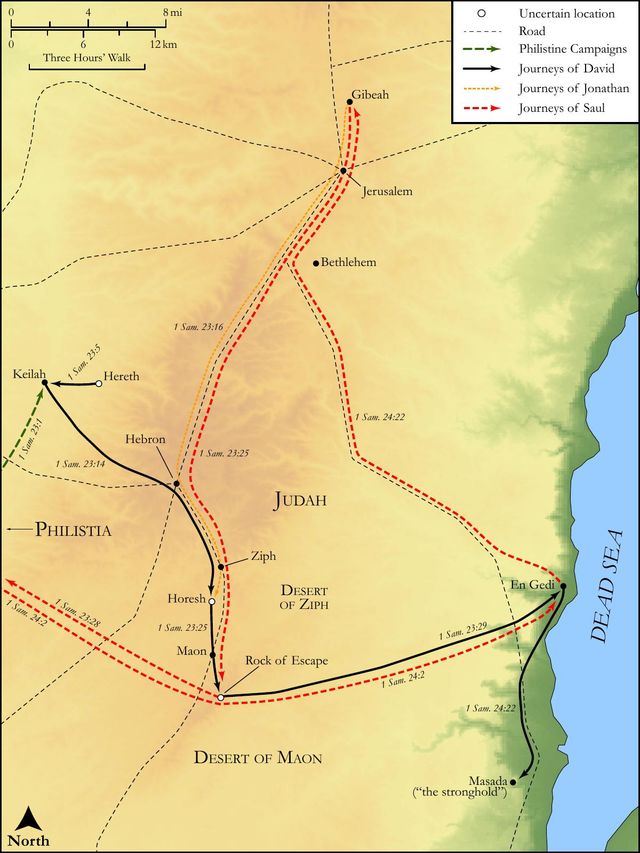
Here, I. Saul renews his pursuit of David, Sa1 24:1, Sa1 24:2. No sooner had he come home safely from chasing the Philistines, in which it should seem he had good success, than he enquired after David to do him a mischief, and resolved to have another thrust at him, as if he had been delivered to do all these abominations, Jer 7:10. By the frequent incursions of the Philistines, he might have seen how necessary it was to recall David from his banishment and restore him to his place in the army again; but so far is he from doing this that now more than ever he is exasperated against him, and, hearing that he is in the wilderness of En-gedi, he draws out 3000 choice men, and goes with them at his feet in pursuit of him upon the rocks of the wild goats, where, one would think, David should not have been envied a habitation nor Saul desirous of disturbing him; for what harm could he fear from one who was no better accommodated? But it is not enough for Saul that David is thus cooped up; he cannot be easy while he is alive.
II.Providence brings Saul alone into the same cave wherein David and his men had hidden themselves, Sa1 24:3.
In those countries there were very large caves in the sides of the rocks or mountains, partly natural, but probably much enlarged by art for the sheltering of sheep from the heat of the sun; hence we read of places where the flocks did rest at noon (Sol 1:7), and this cave seems to be spoken of as one of the sheep-cotes. In the sides of this cave David and his men remained, perhaps not all his men, the whole 600, but only some few of his particular friends, the rest being disposed of in similar retirements. Saul, passing by, turned in himself alone, not in search of David (for, supposing him to be an aspiring ambitious man, he thought to find him rather climbing with the wild goats upon the rocks than retiring with the sheep into a cave), but thither he turned aside to cover his feet, that is, to sleep awhile, it being a cool and quiet place, and very refreshing in the heat of the day; probably he ordered his attendants to march before, reserving only a very few to wait for him at the mouth of the cave. Some by the covering of the feet understand the easing of nature, and think that this was Saul's errand into the cave: but the former interpretation is more probable.
III.David's servants stir him up to kill Saul now that he has so fair an opportunity to do it, Sa1 24:4.
They reminded him that this was the day which he had long looked for, and of which God had spoken to him in general when he was anointed to the kingdom, which should put a period to his troubles and open the passage to his advancement. Saul now lay at his mercy, and it was easy to imagine how little mercy he would find with Saul and therefore what little reason he had to show mercy to him. "By all means" (say his servants) "give him the fatal blow now." See how apt we are to misunderstand,
1.The promises of God. God had assured David that he would deliver him from Saul, and his men interpret this as a warrant to destroy Saul.
2.The providences of God. Because it was now in his power to kill him, they concluded he might lawfully do it.
IV.David cut off the skirt of his robe, but soon repented that he had done this:
His heart smote him for it (Sa1 24:5); though it did Saul no real hurt, and served David for a proof that it was in his power to have killed him (Sa1 24:11), yet, because it was an affront to Saul's royal dignity, he wished he had not done it. Note, It is a good thing to have a heart within us smiting us for sins that seem little; it is a sign that conscience is awake and tender, and will be the means of preventing greater sins.
V.He reasons strongly both with himself and with his servants against doing Saul any hurt.
1.He reasons with himself (Sa1 24:6): The Lord forbid that I should do this thing. Note, Sin is a thing which it becomes us to startle at, and to resist the temptations to, not only with resolution, but with a holy indignation. He considered Saul now, not as his enemy, and the only person that stood in the way of his preferment (for then he would be induced to hearken to the temptation), but as God's anointed (that is, the person whom God had appointed to reign as long as he lived, and who, as such, was under the particular protection of the divine law), and as his master, to whom he was obliged to be faithful. Let servants and subjects learn hence to be dutiful and loyal, whatever hardships are put upon them, Pe1 2:18.
2.He reasons with his servants: He suffered them not to rise against Saul, Sa1 24:7. He would not only not do this evil thing himself, but he would not suffer those about him to do it. Thus did he render good for evil to him from whom he had received evil for good, and was herein both a type of Christ, who saved his persecutors, and an example to all Christians not to be overcome of evil, but to overcome evil with good.
VI.He followed Saul out of the cave, and, though he would not take the opportunity to slay him, yet he wisely took the opportunity, if possible, to slay his enmity, by convincing him that he was not such a man as he took him for.
1.Even in showing his head now he testified that he had an honourable opinion of Saul. He had too much reason to believe that, let him say what he would, Saul would immediately be the death of him as soon as he saw him, and yet he bravely lays aside that jealousy, and thinks Saul so much a man of sense as to hear his reasoning when he had so much to say in his own vindication and such fresh and sensible proofs to give of his own integrity.
2.His behaviour was very respectful: He stooped with his face to the earth, and bowed himself, giving honour to whom honour was due, and teaching us to order ourselves lowly and reverently to all our superiors, even to those that have been most injurious to us.
Historical interpretation
Fourteen Centuries of Reception
5 surviving comments on this verse. Each one is dated, so this reads as a timeline rather than a list.
Select a marker to jump to its quote. Markers stagger vertically where authors wrote within a few decades of each other.
What a virtuous action that was, when David wished rather to spare the king his enemy, though he could have injured him! How useful, too, it was, for it helped him when he succeeded to the throne. For all learned to be faithful to their king and not to seize the kingdom but to fear and reverence him. Thus what is virtuous was preferred to what was useful, and then usefulness followed on what was virtuous.
It was not without God’s influence, you see, that he [David] succeeded in prevailing over those frenzied men [his soldiers who wished to kill Saul]: the grace of God was found on the inspired man’s lips, adding a sort of inducement to those words. It was, however, no slight contribution that David also made: since he had formed them in the past, consequently in the critical moment he found them ready and willing. It was not as leader of troops, you see, but as priest he commanded them, and that cave was a church on that occasion: like someone appointed as bishop, he delivered a homily to them, and after this homily he offered a kind of remarkable and unusual sacrifice, not sacrificing a calf, not slaying a lamb, but—what was of greater value than these—he offered to God gentleness and clemency, sacrificing irrational resentment, slaying anger and mortifying the limbs that are on the earth. He acted as victim, priest and altar: everything came from him—the thought that offered gentleness and clemency, the clemency and gentleness and the heart in which they were offered.
As a Christian judge, you must play the part of a loving father, you must show anger for wrongdoing but remember to make allowance for human weakness; do not indulge your inclination to seek vengeance for the vile acts of sinners, but direct your effort to the cure of the sinners’ wounds.… There is also that well-known example of forbearance on the part of holy David, when his enemy was delivered into his hands and he spared him, an example which shines with greater luster from the fact that he had power to act otherwise. Do not, then, let your power of punishment make you harsh, when the necessity of inquiry did not shake your spirit of mildness.
And he said to his men, “May the Lord be merciful to me,” etc. David is shown to have refrained from killing Saul, despite Saul's most hostile pursuit of him, for two main reasons: first, he remembered him as his lord and as having been anointed with royal chrism. Here, primarily, he venerates the kingdom and the anointing with due honor, which indeed he always knew symbolized the ever inviolable kingdom of the Lord and the spiritual anointing. Furthermore, he also teaches us through moral disciplines that we should not dare to wound our leaders, especially those distinguished by sacred orders, with the sword of harsh words, nor presume to criticize by tearing away even the fringe of their final and unnecessary actions. Yet if we accidentally do such a thing incautiously, we should immediately strike the heart with sorrow and strive to correct the rash deed by repenting. However, according to the established order of explanation, in which we have said that Saul signifies the Jewish people or kingdom and David signifies Christ, we can understand that Christ called the same people or kingdom his lord, because he deigned to take on the form of a servant from it; and he called Christ the Anointed of the Lord, because he had bestowed the anointing of spiritual grace on that people before all other nations. Therefore, he did not wish to strike them down with his hand to utterly destroy the wicked, but, as with the royal robe cut off, he divided them from the earth and overthrew them in their own life. And as another psalm says, “Do not kill them, lest my people forget; scatter them by your power, and bring them down, O Lord our shield.” (Psalm 59).
Heart struck him: Viz., with remorse, as fearing he had done amiss.
Continue studying 1 Samuel 24:6 across the web’s major study libraries — every link below opens this exact verse, chapter, or book on the destination site.
Read & Compare
 BibleGatewayThis verse in more than 200 translations and 70 languages.
 Bible.comThe YouVersion reader — hundreds of translations, reading plans, and highlights.
 ESV.orgCrossway's official English Standard Version reader.
 NET BibleThe NET translation with 60,000+ translators' notes on every rendering decision.
 STEP BibleTyndale House's free study tool — original text, vocabulary, and scholarly resources.
 BibliaLogos Bible Software's free web reader.
 USCCBThe New American Bible (Revised Edition) with the U.S. bishops' study notes.
Commentaries
 BibleHub CommentariesDozens of classic commentaries on this verse, gathered on one page.
 StudyLightMore than 100 commentary sets — the largest collection on the web.
 BibleRefPlain-English commentary on what this verse means, verse by verse.
 Enduring WordDavid Guzik's free commentary on this chapter, widely used by Bible teachers.
 Bible Study ToolsVerse commentary alongside Greek and Hebrew study aids.
Original Language & Research
- BibleHub InterlinearThe verse word by word — original language, transliteration, and English.
- BibleHub LexiconEvery word's original-language definition and Strong's entry.
 Blue Letter BibleDeep-study tools — Strong's numbers, concordance, and word studies.
 SefariaThe Hebrew text with Rashi and centuries of Jewish commentary.
Sermons, Hymns & Audio


TrulyRandomVerse is not affiliated with these sites and doesn’t control their content. They’re linked because they’re genuinely useful.
Summary
1 Samuel 24:6 captures a pivotal moment demonstrating David's profound reverence for God's divine appointment and sovereignty, even when faced with an opportunity to eliminate his persecutor, King Saul. Despite Saul's relentless pursuit and attempts on David's life, David steadfastly refused to harm him, recognizing Saul as "the LORD'S anointed." This verse powerfully illustrates David's unwavering faith, integrity, and commitment to allowing God to execute justice and fulfill His purposes in His own timing, distinguishing David's character from that of the jealous and disobedient monarch he would one day replace.
Context
ShowHideLiterary Context
This verse is situated within the intensely dramatic narrative of 1 Samuel 24, a pivotal moment in the escalating conflict between King Saul and David. Saul, driven by an irrational jealousy and paranoia, relentlessly pursues David, whom he views as a rival to his throne. David and his loyal men have sought refuge in the rugged terrain of the Judean wilderness, specifically the caves near En-gedi. In a remarkable turn of events, Saul, unaware of David's presence, enters the very cave where David and his men are hiding, placing himself completely at David's mercy. David's men, interpreting this as a divinely orchestrated opportunity, urge him to eliminate their persecutor. David's profound response in 1 Samuel 24:6, followed by his strong rebuke of his men in 1 Samuel 24:7, highlights his unwavering spiritual conviction and remarkable self-restraint. This incident serves as a powerful narrative foil, sharply contrasting David's character with Saul's increasingly erratic and disobedient reign.
Historical & Cultural Context
In ancient Israel, the anointing of kings with oil was not merely a ceremonial act but a deeply sacred ritual, signifying God's sovereign selection and empowerment of an individual for a divinely ordained office. Saul, as Israel's first king, had been anointed by the prophet Samuel, establishing his legitimate, albeit conditional, divine appointment. Even though God had declared His rejection of Saul's kingship due to his persistent disobedience, particularly highlighted in 1 Samuel 15:23, the sanctity of that initial anointing remained paramount in David's understanding. Geographically, the Judean wilderness, with its numerous caves such as those found at En-gedi, provided natural, albeit harsh, refuge for fugitives like David. Culturally, the prevailing societal norms often condoned, if not expected, a wronged party to seek retribution or eliminate a perceived threat. David's extraordinary act of restraint, therefore, was profoundly counter-cultural, demonstrating a unique reverence for divine justice and the inviolability of God's chosen instruments, even when those instruments were acting in direct opposition to God's will.
Key Themes
ShowHideThis pivotal verse powerfully illuminates several foundational themes within the book of Samuel and broader biblical theology. Firstly, it underscores the sanctity of divine appointment and authority. David's unwavering refusal to harm Saul, despite the king's unrighteous and hostile actions, reveals his profound respect for the office of the king and the divine hand that initially placed Saul there. Secondly, the passage emphasizes unwavering trust in God's sovereignty and perfect timing. Rather than succumbing to the temptation to seize power or exact personal justice, David chooses to patiently await God's intervention to remove Saul and establish him as king, demonstrating a deep conviction that God would faithfully fulfill His promises, as seen in David's own anointing in 1 Samuel 16:13. Thirdly, this incident vividly showcases David's integrity, remarkable self-control, and steadfast adherence to spiritual principles even under immense provocation. This extraordinary act of mercy and restraint stands in stark contrast to Saul's increasingly vengeful and paranoid behavior, powerfully illustrating why David was later described as "a man after God's own heart" in 1 Samuel 13:14.
Exposition and Analysis
ShowHideKey Word Analysis
ShowHideA directive from a root meaning "to profane," this interjection literally means "for a profaned thing" and is used to express a vehement rejection or abhorrence, often translated as "far be it!" or "God forbid!" It conveys David's profound conviction that harming Saul would be an act of sacrilege, utterly contrary to God's will and his own spiritual principles, marking it as unthinkable in the sight of God.
This term refers to someone consecrated or set apart by God for a special office, typically a king, priest, or prophet, through the ritual anointing with oil. In this verse, it specifically designates Saul as God's divinely appointed king. David's emphatic repetition of this term underscores his profound respect for the sacredness of Saul's office, irrespective of Saul's personal failings. This is the very word from which "Messiah" is derived, highlighting its profound theological significance.
This idiomatic phrase combines shâlach (H7971, "to send away, stretch forth") and yâd (H3027, "hand"), signifying the act of taking violent action, specifically to harm or kill someone. David's refusal to "stretch forth his hand" against Saul emphasizes his deliberate choice of non-violence and restraint, directly countering the pragmatic urgings of his men. It implies a conscious decision to refrain from usurping God's prerogative to deal with His anointed, recognizing the hand as an instrument of power and action.
Verse Breakdown
ShowHide"And he said unto his men, The LORD forbid that I should do this thing unto my master,"
This opening clause captures David's immediate and vehement rejection of his men's pragmatic suggestion. His use of "The LORD forbid" (Hebrew châlîylâh) is a powerful theological exclamation, indicating that the proposed action is not merely undesirable but an abomination in God's sight. He still acknowledges Saul as "my master," demonstrating a remarkable and continued respect for the king's divinely instituted office, despite Saul's relentless and unjust persecution.
"the LORD'S anointed,"
This crucial phrase articulates the foundational principle behind David's moral stance. David recognizes that Saul's authority and kingship were established by divine decree through the sacred act of anointing. To physically harm Saul, therefore, would not merely be an act of rebellion against a human king, but an act of sacrilege and a direct affront to God's sovereign choice and appointment.
"to stretch forth mine hand against him,"
This specific phrase, an idiom for violent assault or assassination, precisely defines the action David is refusing. It underscores his active and conscious decision to exercise profound self-restraint, choosing non-violence and deferring vengeance, even when presented with what appeared to be a providential and opportune moment to end his prolonged suffering and secure his own divinely promised future.
"seeing he [is] the anointed of the LORD."
This concluding statement functions as a powerful reiteration and emphatic reinforcement of David's primary justification. The repetition of "the anointed of the LORD" serves to underscore the absolute and non-negotiable nature of this theological principle for David. His decision is not predicated on Saul's personal character or his unrighteous actions, but solely on the sacred, inviolable nature of his divine appointment by Yahweh.
Literary Devices
ShowHideThe narrative of 1 Samuel 24:6 is rich with powerful literary devices. Irony is profoundly at play as Saul, the relentless hunter, unwittingly places himself entirely at the mercy of David, his intended prey, by entering the very cave where David is hidden. This dramatic reversal of roles intensifies the narrative tension. A stark contrast is drawn between the pragmatic, vengeful counsel of David's men, who perceive Saul's vulnerability as a divinely sanctioned opportunity, and David's principled, God-fearing decision to refrain from harming the king. The recurring phrase "the LORD'S anointed" functions as a potent symbol, not merely of Saul's personal identity but of the sacredness of divine appointment and the inviolability of God's chosen instruments. Furthermore, David's earlier act of cutting off a corner of Saul's robe in 1 Samuel 24:4 serves as a subtle metonymy, representing a symbolic 'cutting off' of Saul's kingdom, yet David's immediate remorse highlights his deep reverence for the king's person and office, even down to the garment representing his authority. The entire episode, through its moral and theological implications, also serves as a significant foreshadowing of David's just and God-honoring reign, standing in stark opposition to Saul's increasingly ungodly and self-serving rule.
Theological and Thematic Connections
ShowHideDavid's resolute refusal to harm Saul, despite the immense provocation and the apparent 'divine' opportunity, stands as a profound theological declaration concerning the intricate interplay of divine sovereignty and human responsibility. This pivotal moment teaches that even when God's chosen instruments falter in obedience or become oppressive, their ultimate removal and the establishment of new leadership remain God's exclusive prerogative, not to be usurped by human intervention or vengeance. David's actions reflect a deep conviction that "vengeance is Mine; I will repay," as the Lord declares, trusting that God would establish His chosen king in His perfect time and according to His divine methodology. This extraordinary act of restraint powerfully demonstrates a radical trust in God's perfect justice, His unfailing faithfulness, and His impeccable timing, rather than resorting to human machinations or violence to achieve a divinely promised outcome. It firmly establishes the principle that one must honor and respect the divinely instituted office, even when the individual occupying that office is deeply flawed or acting contrary to God's will.
Reflection and Application
ShowHideDavid's profound decision in the cave of En-gedi provides a timeless and profoundly challenging paradigm for believers in every generation. It calls us to cultivate a radical and unwavering trust in God's absolute sovereignty, even when our circumstances scream for immediate, self-initiated human intervention. In a world that often champions self-reliance and swift retribution, we are frequently tempted to "stretch forth our hand"—to exact personal justice, to manipulate situations for our own benefit, or to undermine those we perceive as obstacles. However, David's exemplary integrity reminds us that genuine faith is demonstrated by patiently waiting on God's perfect timing, trusting in His righteous justice, and respecting the authorities He has ordained, even when those in power are flawed, unjust, or overtly hostile. This crucial principle extends beyond political leadership to encompass our interactions with authorities in all spheres of life—be it in government, the church, our workplaces, or within our families. David's actions serve as a powerful exhortation to maintain our spiritual principles and Christ-like character, resisting the seductive temptations of revenge, bitterness, or self-serving ambition. His example is a compelling call to humility, enduring patience, and unwavering obedience to God's higher, often counter-intuitive, ways, assuring us that God unfailingly honors those who honor Him and His divinely established order.
Questions for Reflection
ShowHideFAQ
ShowHideWhy was Saul still considered "the LORD'S anointed" even after God had rejected him as king?
ShowHideWhile God had indeed rejected Saul as king due to his persistent disobedience, as explicitly stated in 1 Samuel 15:23, and had already chosen and secretly anointed David as his successor in 1 Samuel 16:13, Saul still retained the office of king and the designation of "the LORD'S anointed" in the public sphere and, critically, in David's theological understanding. David recognized that God had initially placed Saul in that position through a sacred act of anointing, and therefore, only God had the divine prerogative to remove him. Saul's anointing was a divine consecration for a sacred office, and even though his personal conduct rendered him unfit in God's eyes, the sanctity of that initial divine act remained inviolable to David. David understood that to harm Saul would be to directly interfere with God's sovereign plan and to disrespect the divine act of anointing, effectively usurping God's role as judge and executor of justice.
Christ-Centered Fulfillment
ShowHideDavid's profound reverence for "the LORD'S anointed" in 1 Samuel 24:6 finds its ultimate and most glorious fulfillment in the person and work of Jesus Christ, the true and eternal Anointed One—the Messiah. David, though himself an anointed king and God's chosen successor, refused to lay a hand on Saul, recognizing the sacredness of God's initial choice. This act profoundly foreshadows Christ's perfect submission to the Father's will, even when confronted with profound injustice, betrayal, and the temptation to seize worldly power. Jesus, who is truly the King of kings and Lord of lords, deliberately chose not to "stretch forth His hand" to defend Himself, to exact vengeance on His enemies, or to establish His kingdom by force. Instead, He willingly submitted to the ignominy of the cross, allowing Himself to be unjustly condemned and crucified, trusting entirely in the Father's perfect timing and sovereign plan for His vindication and ultimate enthronement, as powerfully articulated in Philippians 2:8-11. Unlike Saul, whose anointing was temporary and conditional, Christ's anointing by the Holy Spirit was eternal, perfect, and without measure, as declared in Luke 4:18. David's restraint, born of respect for a flawed human king, points to the infinitely greater truth that while no one can ultimately "stretch forth their hand" against God's ultimate Anointed One without facing divine judgment, Christ willingly allowed Himself to be touched, scourged, and crucified for the salvation of humanity, bearing our sins and infirmities as prophesied in Isaiah 53:5. In Christ, the principle of honoring God's anointed culminates in the worship and absolute submission due to the one true King, whose kingdom is not of this world (John 18:36), and who perfectly embodies the divine justice, mercy, and sovereign authority that David sought to uphold.