


1 Samuel 24:5
- וַיְהִיvay·Hiand it wasH1961Conj-w ¦ V-Qal-ConsecImperf-3msVerb Qal Consecutive Imperfect 3rd Singular Masculineוַandיְהִיit was
- אַחֲרֵי'a·cha·reiafterH310Adj-mpcAdjective Numerical Plural Masculine Construct
- כֵןKhenthusH3651AdvAdverb
- וַיַּךְvai·Yakhand it struckH5221Conj-w ¦ V-Hiphil-ConsecImperf-3msVerb Hiphil Consecutive Imperfect 3rd Singular Masculineוַandיַּךְit struck
- לֵבlev[the] heart ofH3820N-mscNoun Singular Masculine Construct
- דָּוִדda·VidDavidH1732N-proper-mNoun Proper Masculine
- אֹתוֹ'o·To<obj.> himH853DirObjM ¦ 3msParticle Object Indicatorאֹת<obj.>וֹhim
- עַל'alonH5921PrepPreposition
- אֲשֶׁר'a·SherthatH834RelParticle Relative
- כָּרַתka·Rathe had cut offH3772V-Qal-Perf-3msVerb Qal Perfect 3rd Singular Masculine
- אֶת'et<obj.>H853DirObjMParticle Object Indicator
- כָּנָףka·Naf[the] skirtH3671N-fsNoun Singular Feminine Absolute
- אֲשֶׁר'a·SherwhichH834RelParticle Relative
- לְשָׁאוּלle·sha·'Ul[belonged] to SaulH7586Prep-l ¦ N-proper-mNoun Proper Masculineלְ[belonged] toשָׁאוּלSaul
English is a literal word-by-word gloss of the Hebrew, not the KJV's wording. Why?
This is the original text the KJV's translators worked from — each Hebrew word with its own literal English meaning in this verse, prepared by scholars at Tyndale House, Cambridge. The KJV translates whole sentences, not word by word, so its wording differs: one Hebrew word can become several English words, and the KJV may choose “the LORD” where the gloss reads “Yahweh”. Both are faithful — they answer different questions. For the KJV's own rendering, switch to the KJV text.
Details
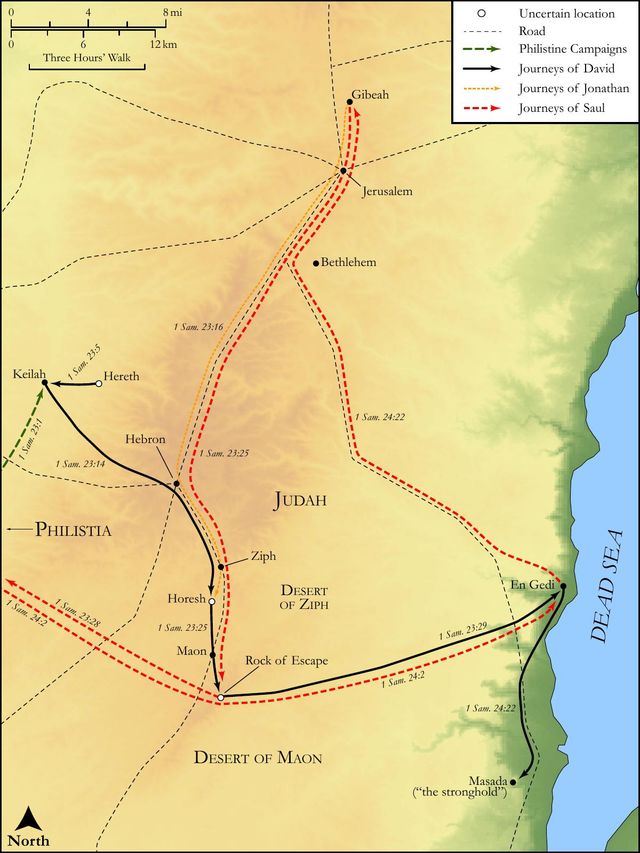
See on the biblical-era map
Study this verse
Public-domain commentary
Matthew Henry
From his Commentary on the Whole Bible. Henry comments on passages, not single verses — this entry covers 1 Samuel 24:1–8. His two-level outline is real structure in the source text, so it is rendered as structure.
Here, I. Saul renews his pursuit of David, Sa1 24:1, Sa1 24:2. No sooner had he come home safely from chasing the Philistines, in which it should seem he had good success, than he enquired after David to do him a mischief, and resolved to have another thrust at him, as if he had been delivered to do all these abominations, Jer 7:10. By the frequent incursions of the Philistines, he might have seen how necessary it was to recall David from his banishment and restore him to his place in the army again; but so far is he from doing this that now more than ever he is exasperated against him, and, hearing that he is in the wilderness of En-gedi, he draws out 3000 choice men, and goes with them at his feet in pursuit of him upon the rocks of the wild goats, where, one would think, David should not have been envied a habitation nor Saul desirous of disturbing him; for what harm could he fear from one who was no better accommodated? But it is not enough for Saul that David is thus cooped up; he cannot be easy while he is alive.
II.Providence brings Saul alone into the same cave wherein David and his men had hidden themselves, Sa1 24:3.
In those countries there were very large caves in the sides of the rocks or mountains, partly natural, but probably much enlarged by art for the sheltering of sheep from the heat of the sun; hence we read of places where the flocks did rest at noon (Sol 1:7), and this cave seems to be spoken of as one of the sheep-cotes. In the sides of this cave David and his men remained, perhaps not all his men, the whole 600, but only some few of his particular friends, the rest being disposed of in similar retirements. Saul, passing by, turned in himself alone, not in search of David (for, supposing him to be an aspiring ambitious man, he thought to find him rather climbing with the wild goats upon the rocks than retiring with the sheep into a cave), but thither he turned aside to cover his feet, that is, to sleep awhile, it being a cool and quiet place, and very refreshing in the heat of the day; probably he ordered his attendants to march before, reserving only a very few to wait for him at the mouth of the cave. Some by the covering of the feet understand the easing of nature, and think that this was Saul's errand into the cave: but the former interpretation is more probable.
III.David's servants stir him up to kill Saul now that he has so fair an opportunity to do it, Sa1 24:4.
They reminded him that this was the day which he had long looked for, and of which God had spoken to him in general when he was anointed to the kingdom, which should put a period to his troubles and open the passage to his advancement. Saul now lay at his mercy, and it was easy to imagine how little mercy he would find with Saul and therefore what little reason he had to show mercy to him. "By all means" (say his servants) "give him the fatal blow now." See how apt we are to misunderstand,
1.The promises of God. God had assured David that he would deliver him from Saul, and his men interpret this as a warrant to destroy Saul.
2.The providences of God. Because it was now in his power to kill him, they concluded he might lawfully do it.
IV.David cut off the skirt of his robe, but soon repented that he had done this:
His heart smote him for it (Sa1 24:5); though it did Saul no real hurt, and served David for a proof that it was in his power to have killed him (Sa1 24:11), yet, because it was an affront to Saul's royal dignity, he wished he had not done it. Note, It is a good thing to have a heart within us smiting us for sins that seem little; it is a sign that conscience is awake and tender, and will be the means of preventing greater sins.
V.He reasons strongly both with himself and with his servants against doing Saul any hurt.
1.He reasons with himself (Sa1 24:6): The Lord forbid that I should do this thing. Note, Sin is a thing which it becomes us to startle at, and to resist the temptations to, not only with resolution, but with a holy indignation. He considered Saul now, not as his enemy, and the only person that stood in the way of his preferment (for then he would be induced to hearken to the temptation), but as God's anointed (that is, the person whom God had appointed to reign as long as he lived, and who, as such, was under the particular protection of the divine law), and as his master, to whom he was obliged to be faithful. Let servants and subjects learn hence to be dutiful and loyal, whatever hardships are put upon them, Pe1 2:18.
2.He reasons with his servants: He suffered them not to rise against Saul, Sa1 24:7. He would not only not do this evil thing himself, but he would not suffer those about him to do it. Thus did he render good for evil to him from whom he had received evil for good, and was herein both a type of Christ, who saved his persecutors, and an example to all Christians not to be overcome of evil, but to overcome evil with good.
VI.He followed Saul out of the cave, and, though he would not take the opportunity to slay him, yet he wisely took the opportunity, if possible, to slay his enmity, by convincing him that he was not such a man as he took him for.
1.Even in showing his head now he testified that he had an honourable opinion of Saul. He had too much reason to believe that, let him say what he would, Saul would immediately be the death of him as soon as he saw him, and yet he bravely lays aside that jealousy, and thinks Saul so much a man of sense as to hear his reasoning when he had so much to say in his own vindication and such fresh and sensible proofs to give of his own integrity.
2.His behaviour was very respectful: He stooped with his face to the earth, and bowed himself, giving honour to whom honour was due, and teaching us to order ourselves lowly and reverently to all our superiors, even to those that have been most injurious to us.
Historical interpretation
Three Centuries of Reception
5 surviving comments on this verse. Each one is dated, so this reads as a timeline rather than a list.
Select a marker to jump to its quote. Markers stagger vertically where authors wrote within a few decades of each other.
When, therefore, he was alone and had removed his robe and laid it down somewhere beside him, the light from the mouth of the cave made him visible to those hidden within the darkness. All of David’s companions wanted to rush upon the enemy and avenge themselves on the one who had come to kill them, since God had given the enemy into the hands of those who were being pursued for slaughter. But David forbade them to attack, considering an assault against their king unlawful. He drew his own sword from its sheath and imperceptibly stood behind Saul. There was no witness to his undertaking against Saul, for the darkness in the cave concealed his appearance and prevented scrutiny of what was happening. When, then, he could have driven his whole sword through Saul’s heart from behind with one blow, he neither touched his body nor was he about to. But he secretly cut off the end of his robe with his sword, so that the garment might be a witness later of his clemency toward Saul and prove the power that he had had to strike a blow against Saul’s body by means of the cut at its end.By this it became obvious that David had been trained in forbearance. When he held the bare sword in his palm, and the body of his enemy lay under his hand, he had the power to kill him, but he conquered his anger with reason, and his power to strike the blow with the fear of God. Not only did he become superior to his own anger, but he also restrained his shield bearer who was eager to murder Saul, addressing him with that saying famous in song, “Destroy not the anointed of the Lord.”
This is why the coming together of Saul, who was in pursuit of murder, and of David, who was shunning murder, in the cave is described after many events which it had preceded. The authority to kill was reversed in this event, since the one who was being pursued for execution had authority over the slaughter of his killer, and although he had the right, so far as retribution against his enemy was concerned, he stayed his power so far as consisted with the right and killed his own anger in himself instead of his enemy. - "On the Inscriptions of the Psalms 2.14.224"
In the same way, Saul’s kingdom foreshadowed one that should last forever, though he personally was reprobate and rejected. The very oil with which he was anointed (the chrism by token of which he was called a “Christ”) must be understood symbolically as pointing to a profound mystery. David himself so religiously respected this anointed state that he was conscience-stricken when, in a dark cave where Saul had entered to ease himself, David came up, unseen, from behind and cut off a tiny piece of Saul’s robe. David did this merely to have evidence later how he had spared Saul when he could have killed him, thus hoping to disabuse Saul of the idea which drove him implacably to pursue David as his foe. Nevertheless, David quaked with fear that perhaps merely by so touching Saul’s garments he was guilty of sacrilege.… Such deep religious reverence was paid to this foreshadowing figure, not for what it was in itself but precisely because of the reality it typified. - "City of God 17.6"
You have grounds for complaint against the leaders of our people, since you are redeeming those whom they very often permitted to be taken captive or even themselves reduced to servitude. Scripture gives us an example of singular praise when it extols David to the very skies because, having his enemy Saul in his power, he spared him, cutting off but the hem of his robe as evidence of both the opportunity that was his and of his loyalty. Good God, how munificently will You reward the deed of this man who now negotiates for the liberation of so many oppressed souls, you who have exalted David for sparing the life of a single man! - "Life of St. Epiphanius"
After these things, David's heart struck him, etc. The Lord groaned for the human race, from which he took flesh, with the affection of compassion, because by its merits he was compelled to take away some part of its royal ornament, preferring that it might have the kingdom here and always in the future age, preserved by divine law. Finally, seeing the sinful city, he wept over it saying: For if you also had known, and the rest (Luke 19). He lamented with human pious compassion the detestable loss of the kingdom, which he decreed by divine justice would come to pass.
Continue studying 1 Samuel 24:5 across the web’s major study libraries — every link below opens this exact verse, chapter, or book on the destination site.
Read & Compare
 BibleGatewayThis verse in more than 200 translations and 70 languages.
 Bible.comThe YouVersion reader — hundreds of translations, reading plans, and highlights.
 ESV.orgCrossway's official English Standard Version reader.
 NET BibleThe NET translation with 60,000+ translators' notes on every rendering decision.
 STEP BibleTyndale House's free study tool — original text, vocabulary, and scholarly resources.
 BibliaLogos Bible Software's free web reader.
 USCCBThe New American Bible (Revised Edition) with the U.S. bishops' study notes.
Commentaries
 BibleHub CommentariesDozens of classic commentaries on this verse, gathered on one page.
 StudyLightMore than 100 commentary sets — the largest collection on the web.
 BibleRefPlain-English commentary on what this verse means, verse by verse.
 Enduring WordDavid Guzik's free commentary on this chapter, widely used by Bible teachers.
 Bible Study ToolsVerse commentary alongside Greek and Hebrew study aids.
Original Language & Research
- BibleHub InterlinearThe verse word by word — original language, transliteration, and English.
- BibleHub LexiconEvery word's original-language definition and Strong's entry.
 Blue Letter BibleDeep-study tools — Strong's numbers, concordance, and word studies.
 SefariaThe Hebrew text with Rashi and centuries of Jewish commentary.
Sermons, Hymns & Audio


TrulyRandomVerse is not affiliated with these sites and doesn’t control their content. They’re linked because they’re genuinely useful.
Summary
1 Samuel 24:5 captures a pivotal moment revealing David's profound spiritual sensitivity and unwavering reverence for God's anointed. After secretly cutting off a piece of King Saul's robe while Saul was vulnerable in a cave, David's conscience immediately convicts him. This seemingly minor act deeply troubles David, showcasing his unique character as a man after God's own heart who prioritizes divine honor and sovereignty over personal vengeance or opportunistic gain, even when facing unjust persecution from the very king he respects.
Context
ShowHideLiterary Context
This verse is deeply embedded within a tense and dramatic narrative that highlights the escalating conflict between Saul and David. Immediately preceding 1 Samuel 24:5, David and his loyal men are hiding from Saul in a cave at En-gedi. In a remarkable turn of events, Saul, unaware of David's presence, enters this very cave to relieve himself (1 Samuel 24:3). David's men, seeing this as a divinely orchestrated opportunity, urge him to kill Saul and end his persecution. However, David refuses to lay a hand on the Lord's anointed, choosing instead merely to cut off a corner of Saul's robe as he slept (1 Samuel 24:4). The verse in question, 1 Samuel 24:5, immediately follows this act, emphasizing David's profound and instantaneous remorse. This internal struggle sets the stage for David's subsequent powerful confrontation with Saul, where he uses the cut garment as undeniable proof of his innocence and respect, demonstrating his commitment to God's timing and sovereignty rather than human vengeance (1 Samuel 24:8-15).
Historical & Cultural Context
The narrative unfolds in ancient Israel, where the institution of kingship was understood as a sacred, divinely appointed office. Though Saul had been rejected by God due to his disobedience (1 Samuel 15:23), he still held the title and cultural status of "the LORD's anointed" (1 Samuel 24:6). In this cultural milieu, to "touch" or harm God's anointed, even symbolically, was considered a grave offense against God Himself. The "skirt" or "hem" (Hebrew: kanaph) of a garment, especially a king's robe, was not merely fabric; it symbolized the wearer's authority, honor, and even his very identity. Cutting it off could be perceived as a symbolic act of undermining or usurping that authority, or even a magical attempt to weaken the wearer. Caves, like those found in the rugged Judean wilderness around En-gedi, were common places of refuge for fugitives and outlaws. David's actions in this context reflect a deep understanding and reverence for the sacred nature of the king's office, a cultural norm that transcended Saul's personal unworthiness and his unjust persecution of David.
Key Themes
ShowHideThis verse serves as a powerful illustration of several overarching themes present in 1 Samuel and the broader biblical narrative. Firstly, it profoundly emphasizes Respect for God's Anointed, even when that individual is acting unjustly and persecuting God's chosen successor. David's immediate remorse reveals his deep reverence for the divine institution of kingship, regardless of the incumbent's personal failings. This theme is powerfully reiterated when David later refuses to harm Saul a second time (1 Samuel 26:9). Secondly, the verse highlights David's Sensitive Conscience and spiritual maturity. Unlike Saul, whose heart had become hardened and unresponsive to God's word, David's conscience was quick to convict him of even a symbolic transgression, demonstrating his earnest desire to live blamelessly and honorably before God. Thirdly, this incident underscores David's unwavering Trust in Divine Justice and Sovereignty. By consciously refusing to take vengeance or justice into his own hands, David exemplifies a profound faith that God would ultimately deal with Saul and establish David as king in His own perfect timing and manner, a principle consistently echoed throughout the wisdom literature (Proverbs 20:22).
Exposition and Analysis
ShowHideKey Word Analysis
ShowHideThe Hebrew verb נָכָה (nâkâh) is a primitive root meaning "to strike" or "to hit," capable of conveying both light and severe physical blows. However, in the phrase "David's heart smote him," its usage is profoundly metaphorical. It signifies a sudden, sharp, and deeply impactful internal blow to David's conscience, a powerful pang of guilt, regret, and conviction that struck his innermost being. This is not a fleeting thought, but a significant and painful spiritual and emotional wound that immediately registered his wrongdoing.
The Hebrew word לֵב (lêb) refers to the heart, but it is used figuratively and very widely in Scripture to denote the seat of one's feelings, will, intellect, and moral core. It represents the innermost being, the center of thought, emotion, and decision. When David's "heart smote him," it indicates that the conviction of his action resonated deeply within his moral and spiritual essence, affecting his entire inner person, not just a superficial emotion.
The Hebrew word כָּנָף (kânâph) literally means "wing" or "extremity." In the context of clothing, it refers to the "corner," "hem," or "fringe" of a garment. In ancient Israel, the corners of garments often held symbolic significance, sometimes bearing tassels (Numbers 15:38-39). More broadly, the "skirt" or "hem" of a king's robe was a potent symbol of his authority, honor, and even his very person. Cutting it off was not merely damaging fabric; it was a symbolic act of disrespect, an undermining of his royal authority, or even a claim to his power. David's remorse indicates his recognition of the profound symbolic weight of his action as an affront to Saul's divinely appointed office.
Verse Breakdown
ShowHide"And it came to pass afterward"
This introductory phrase serves as a crucial temporal marker. It indicates that David's profound remorse was not immediate during the act of cutting the skirt, but rather occurred "afterward" – perhaps moments later, as the full weight and implications of his action settled upon him. This highlights the reflective nature of his conviction, suggesting a moment of spiritual realization and internal reckoning after the deed was done.
"that David's heart smote him"
This is the central declaration of the verse, powerfully describing David's immediate and intense internal reaction. His "heart" (לֵב, lêb), representing his inner being, conscience, and moral core, was "smitten" (נָכָה, nâkâh), signifying a sudden, painful, and deep internal blow. This phrase conveys a profound sense of guilt, regret, and conviction that he had committed a serious wrong, even if his intentions were not malicious. It vividly demonstrates David's spiritual sensitivity and his alignment with God's standards for conduct.
"because he had cut off Saul's skirt"
This concluding clause explicitly states the precise cause of David's profound remorse. The act of cutting the skirt, though not physically harmful to Saul, was understood by David as a significant symbolic transgression. He recognized that by "touching" the garment of the LORD's anointed, he had, in a profound sense, "touched" or dishonored God's chosen king. His conscience was smitten not out of fear of Saul's retaliation, but because he felt he had acted improperly against God's established order and against the person God had set apart, even if that person was acting unjustly.
Literary Devices
ShowHideThe verse employs several potent literary devices to convey its profound message. Symbolism is central, as Saul's "skirt" or "hem" functions as a powerful symbol of his royal authority, dignity, and even his very person. David's act of cutting it off is therefore a symbolic undermining of that authority, even if it was not a direct physical assault. The immediate remorse following this act underscores the profound symbolic weight David attributed to it, recognizing its spiritual implications. There is also a strong element of Irony present: David, the hunted and seemingly powerless fugitive, demonstrates a far greater reverence for God's anointed office than Saul, the reigning king, who is actively seeking to murder God's chosen successor. Furthermore, the phrase "heart smote him" is a powerful Metaphor, transforming a physical action ("smote" or "struck") into an internal, psychological, and spiritual experience of profound conviction and regret. This vivid imagery effectively conveys the depth and immediacy of David's moral distress and his quick responsiveness to his conscience.
Theological and Thematic Connections
ShowHideDavid's immediate and profound remorse in 1 Samuel 24:5 serves as a powerful theological statement about the sanctity of God's anointing and the indispensable importance of cultivating a sensitive conscience. It underscores the biblical truth that God's chosen instruments, even when deeply flawed or actively hostile, retain a certain sacred status in the eyes of those who truly fear the Lord. David's refusal to take matters into his own hands, even when presented with a seemingly perfect opportunity for self-vindication, demonstrates his unwavering trust in divine justice and timing. This remarkable act of self-restraint and profound reverence, despite extreme personal provocation, sets David apart as a man whose heart was deeply attuned to God's will, even in the face of immense danger and injustice. It teaches us that true faith often manifests not in aggressive action or opportunistic gain, but in patient submission to God's sovereign plan and a deep, abiding respect for His established order.
Reflection and Application
ShowHideDavid's immediate and profound remorse over cutting Saul's robe offers a timeless and essential lesson for believers today. It challenges us to cultivate a conscience that is not only sensitive to overt and obvious sin but also to actions that, while seemingly minor or justifiable in human eyes, may subtly dishonor God or those He has placed in positions of authority. In a world that often encourages immediate retaliation, self-vindication, or the opportunistic seizing of personal advantage, David's example calls us to a higher standard of spiritual discernment, self-control, and integrity. It powerfully reminds us that our ultimate allegiance is to God, and our actions, even those performed in private or seemingly insignificant, reflect our reverence for His sovereignty and His appointed order. When faced with injustice, persecution, or profound provocation, rather than taking matters into our own hands, we are called to emulate David's trust in God's perfect timing and justice, allowing Him to vindicate us and deal with our adversaries in His way. This requires profound humility, unwavering patience, and a deep-seated conviction that God is ultimately in control and will work all things for good for those who love Him and are called according to His purpose.
Questions for Reflection
ShowHideFAQ
ShowHideWhy was cutting Saul's skirt such a big deal that David's heart "smote him"?
ShowHideCutting Saul's skirt was a profoundly significant act for David, even though it wasn't physically harmful to Saul himself. Firstly, in ancient Near Eastern cultures, the hem or corner of a garment, especially a king's robe, was a powerful symbol of his authority, honor, and even his very person. To cut it off was seen as a symbolic act of undermining, dishonoring, or even attempting to usurp that authority. It was a direct affront to Saul's status as "the LORD's anointed" king, regardless of Saul's personal failings or his unjust persecution of David. David, as a man after God's own heart, understood the sacred nature of the kingship, as God had established it. His conscience was "smitten" because he recognized that he had disrespected God's chosen office and the divine order, even if he didn't intend to harm Saul physically. He felt he had gone too far, even in merely proving his innocence, because he had symbolically "touched" God's anointed.
Why didn't David just kill Saul when he had the chance? Wouldn't that have been God's will, given Saul's persecution and rejection by God?
ShowHideDavid explicitly refused to kill Saul because Saul was "the LORD's anointed" (1 Samuel 24:6). While Saul was indeed persecuting David and had been rejected by God as king (1 Samuel 15:23), David believed that only God had the right to remove His anointed. Taking Saul's life would have been an act of taking justice into his own hands, usurping God's prerogative, and potentially establishing himself as king through violence rather than divine appointment. David consistently demonstrated a profound trust in God's sovereignty and timing. He believed that God would establish him as king when and how He saw fit, without David needing to resort to ungodly or premature means. This principle of respecting God's anointing and trusting His timing is further reinforced when David spares Saul a second time in 1 Samuel 26:9-11.
Christ-Centered Fulfillment
ShowHideDavid's profound respect for God's anointed, even in the face of extreme provocation and unjust persecution, beautifully foreshadows the character and mission of Jesus Christ, the ultimate Anointed One. While David refrained from harming Saul, an earthly king who unjustly pursued him, Jesus, the true and eternal King, willingly submitted to the unjust authorities of His day. He allowed Himself to be arrested, tried, and crucified, even though He possessed the divine power to summon legions of angels for His defense (Matthew 26:53). Unlike David, who merely cut a garment as a symbolic act, Jesus allowed His own body to be "cut off" and broken for the sins of humanity, demonstrating ultimate humility and perfect submission to the Father's will (Philippians 2:8). Where David refused to take personal vengeance, Jesus, "when he was reviled, he did not revile in return; when he suffered, he did not threaten, but continued entrusting himself to him who judges justly" (1 Peter 2:23). David's sensitive conscience and unwavering trust in God's justice point directly to Christ, who perfectly fulfilled all righteousness, never allowing personal gain, retaliation, or earthly ambition to divert Him from His divine mission of redemption. His ultimate vindication came not through earthly power or violence, but through His glorious resurrection, proving His absolute sovereignty over all things, including death and sin (Romans 1:4). Thus, David's remarkable restraint in the cave is a powerful shadow of the perfect, non-retaliatory love and complete submission embodied by our Savior, who perfectly trusted the Father to bring about His ultimate reign and perfect justice.