


1 Samuel 24:2
Bible text: King James Version (1769 Blayney text) · Public domain
Bible text: Berean Standard Bible · Public domain
Bible text: American Standard Version (1901) · Public domain
Bible text: World English Bible, Messianic edition · Public domain
Bible text: Geneva Bible (1599) · Public domain
Bible text: Young's Literal Translation · Public domain
- וַיִּקַּחvai·yi·Kachand he tookH3947Conj-w ¦ V-Qal-ConsecImperf-3msVerb Qal Consecutive Imperfect 3rd Singular Masculineוַandיִּקַּחhe took
- שָׁאוּלsha·'UlSaulH7586N-proper-mNoun Proper Masculine
- שְׁלֹשֶׁתshe·Lo·shetthreeH7969N-cscNoun Singular common gender Construct
- אֲלָפִים'a·la·Fimthousand<s>H505N-cpNoun Plural common gender Absolute
- אִישׁ'ishmanH376N-msNoun Singular Masculine Absolute
- בָּחוּרba·ChurchosenH977V-Qal-PassPrtcpl-msVerb Qal Participle Passive Singular Masculine Absolute
- מִכָּלmi·kolfrom allH3605Prep-m ¦ N-mscNoun Singular Masculine Constructמִfromכָּלall
- יִשְׂרָאֵלYis·ra·'ElIsraelH3478N-properNoun Proper Location
- וַיֵּלֶךְvai·Ye·lekhand he wentH1980Conj-w ¦ V-Qal-ConsecImperf-3msVerb Qal Consecutive Imperfect 3rd Singular Masculineוַandיֵּלֶךְhe went
- לְבַקֵּשׁle·va·Keshto seekH1245Prep-l ¦ V-Piel-InfVerb Piel Infinitive Constructלְtoבַקֵּשׁseek
- אֶת'et<obj.>H853DirObjMParticle Object Indicator
- דָּוִדda·VidDavidH1732N-proper-mNoun Proper Masculine
- וַאֲנָשָׁיוva·'a·na·Shavand his menH582Conj-w ¦ N-mpc ¦ 3msNoun Plural Masculine Constructוַandאֲנָשָׁיmenוhis
- עַל'alonH5921PrepPreposition
- פְּנֵיpe·Nei[the] face ofH6440N-mpcNoun Plural Masculine Construct
- צוּרֵיtzu·Rei[the] rocks ofH6697N-mpcNoun Plural Masculine Construct
- הַיְּעֵלִיםhai·ye·'e·Limthe mountain goatsH3277Art ¦ N-mpNoun Plural Masculine Absoluteהַtheיְּעֵלִיםmountain goats
English is a literal word-by-word gloss of the Hebrew, not the KJV's wording. Why?
This is the original text the KJV's translators worked from — each Hebrew word with its own literal English meaning in this verse, prepared by scholars at Tyndale House, Cambridge. The KJV translates whole sentences, not word by word, so its wording differs: one Hebrew word can become several English words, and the KJV may choose “the LORD” where the gloss reads “Yahweh”. Both are faithful — they answer different questions. For the KJV's own rendering, switch to the KJV text.
Details
See on the biblical-era map
Study this verse
Public-domain commentary
Matthew Henry
From his Commentary on the Whole Bible. Henry comments on passages, not single verses — this entry covers 1 Samuel 24:1–8. His two-level outline is real structure in the source text, so it is rendered as structure.
Here, I. Saul renews his pursuit of David, Sa1 24:1, Sa1 24:2. No sooner had he come home safely from chasing the Philistines, in which it should seem he had good success, than he enquired after David to do him a mischief, and resolved to have another thrust at him, as if he had been delivered to do all these abominations, Jer 7:10. By the frequent incursions of the Philistines, he might have seen how necessary it was to recall David from his banishment and restore him to his place in the army again; but so far is he from doing this that now more than ever he is exasperated against him, and, hearing that he is in the wilderness of En-gedi, he draws out 3000 choice men, and goes with them at his feet in pursuit of him upon the rocks of the wild goats, where, one would think, David should not have been envied a habitation nor Saul desirous of disturbing him; for what harm could he fear from one who was no better accommodated? But it is not enough for Saul that David is thus cooped up; he cannot be easy while he is alive.
II.Providence brings Saul alone into the same cave wherein David and his men had hidden themselves, Sa1 24:3.
In those countries there were very large caves in the sides of the rocks or mountains, partly natural, but probably much enlarged by art for the sheltering of sheep from the heat of the sun; hence we read of places where the flocks did rest at noon (Sol 1:7), and this cave seems to be spoken of as one of the sheep-cotes. In the sides of this cave David and his men remained, perhaps not all his men, the whole 600, but only some few of his particular friends, the rest being disposed of in similar retirements. Saul, passing by, turned in himself alone, not in search of David (for, supposing him to be an aspiring ambitious man, he thought to find him rather climbing with the wild goats upon the rocks than retiring with the sheep into a cave), but thither he turned aside to cover his feet, that is, to sleep awhile, it being a cool and quiet place, and very refreshing in the heat of the day; probably he ordered his attendants to march before, reserving only a very few to wait for him at the mouth of the cave. Some by the covering of the feet understand the easing of nature, and think that this was Saul's errand into the cave: but the former interpretation is more probable.
III.David's servants stir him up to kill Saul now that he has so fair an opportunity to do it, Sa1 24:4.
They reminded him that this was the day which he had long looked for, and of which God had spoken to him in general when he was anointed to the kingdom, which should put a period to his troubles and open the passage to his advancement. Saul now lay at his mercy, and it was easy to imagine how little mercy he would find with Saul and therefore what little reason he had to show mercy to him. "By all means" (say his servants) "give him the fatal blow now." See how apt we are to misunderstand,
1.The promises of God. God had assured David that he would deliver him from Saul, and his men interpret this as a warrant to destroy Saul.
2.The providences of God. Because it was now in his power to kill him, they concluded he might lawfully do it.
IV.David cut off the skirt of his robe, but soon repented that he had done this:
His heart smote him for it (Sa1 24:5); though it did Saul no real hurt, and served David for a proof that it was in his power to have killed him (Sa1 24:11), yet, because it was an affront to Saul's royal dignity, he wished he had not done it. Note, It is a good thing to have a heart within us smiting us for sins that seem little; it is a sign that conscience is awake and tender, and will be the means of preventing greater sins.
V.He reasons strongly both with himself and with his servants against doing Saul any hurt.
1.He reasons with himself (Sa1 24:6): The Lord forbid that I should do this thing. Note, Sin is a thing which it becomes us to startle at, and to resist the temptations to, not only with resolution, but with a holy indignation. He considered Saul now, not as his enemy, and the only person that stood in the way of his preferment (for then he would be induced to hearken to the temptation), but as God's anointed (that is, the person whom God had appointed to reign as long as he lived, and who, as such, was under the particular protection of the divine law), and as his master, to whom he was obliged to be faithful. Let servants and subjects learn hence to be dutiful and loyal, whatever hardships are put upon them, Pe1 2:18.
2.He reasons with his servants: He suffered them not to rise against Saul, Sa1 24:7. He would not only not do this evil thing himself, but he would not suffer those about him to do it. Thus did he render good for evil to him from whom he had received evil for good, and was herein both a type of Christ, who saved his persecutors, and an example to all Christians not to be overcome of evil, but to overcome evil with good.
VI.He followed Saul out of the cave, and, though he would not take the opportunity to slay him, yet he wisely took the opportunity, if possible, to slay his enmity, by convincing him that he was not such a man as he took him for.
1.Even in showing his head now he testified that he had an honourable opinion of Saul. He had too much reason to believe that, let him say what he would, Saul would immediately be the death of him as soon as he saw him, and yet he bravely lays aside that jealousy, and thinks Saul so much a man of sense as to hear his reasoning when he had so much to say in his own vindication and such fresh and sensible proofs to give of his own integrity.
2.His behaviour was very respectful: He stooped with his face to the earth, and bowed himself, giving honour to whom honour was due, and teaching us to order ourselves lowly and reverently to all our superiors, even to those that have been most injurious to us.
Historical interpretation
Historical reception
1 surviving comment on this verse from the historical church.
Saul, however, taking three thousand chosen men, etc. Just as in a good sense the number three is usually placed for a certain mysterious grace, clearly designating those who are either glorious by the confession of the Holy Trinity, or devoted by faith, hope, and charity, or perfect in thought, speech, and action, or something of the sort; so also, when it is placed in an evil army, it not undeservedly denotes those who are found to do everything contrary. Therefore, in this place, the three thousand armed men with whom Saul sets out to persecute David and his men are to be mystically understood as those who, with a threefold battle array against the Lord and against His Christ, meditating vain things (Psalm II), that is, going in the counsel of the ungodly, standing in the way of sinners, and sitting in the seat of pestilence, have done everything contrary to the Blessed Man; those namely whose will is in the law of the Lord, and who will meditate in His law day and night. Saul also proceeds to search for David even upon the most abrupt rocks, which are accessible only to the ibexes, as he sets the snares of deception and treachery to the kingdom of the Jews against the Lord; even in his highest sayings, which remain scarcely comprehensible to perfect listeners alone. For the ibexes, which are small quadrupeds and know how to stay and give birth only on rocks, and if at any time they fall from the high peaks of rocks, they catch themselves unharmed with their horns, symbolize the humble listeners of the word of God, who, the more they perceive themselves to be of lesser merit, wisdom, and virtue, the more they seek strong refuges of the Holy Scriptures, in which they ought to dwell mentally and place the fruits of good works, as ibexes seek refuge among the rocks, and whatever temporal ruin befalls them, sustaining themselves on the testaments of heavenly words, they are saved as if by the reception of their horns. The Lord remembers this animal, and has marked how it is not contemptible in its figure, speaking mystically to the blessed Job: "Do you know the time when the ibexes give birth among the rocks?" (Job XXXIX).
Continue studying 1 Samuel 24:2 across the web’s major study libraries — every link below opens this exact verse, chapter, or book on the destination site.
Read & Compare
 BibleGatewayThis verse in more than 200 translations and 70 languages.
 Bible.comThe YouVersion reader — hundreds of translations, reading plans, and highlights.
 ESV.orgCrossway's official English Standard Version reader.
 NET BibleThe NET translation with 60,000+ translators' notes on every rendering decision.
 STEP BibleTyndale House's free study tool — original text, vocabulary, and scholarly resources.
 BibliaLogos Bible Software's free web reader.
 USCCBThe New American Bible (Revised Edition) with the U.S. bishops' study notes.
Commentaries
 BibleHub CommentariesDozens of classic commentaries on this verse, gathered on one page.
 StudyLightMore than 100 commentary sets — the largest collection on the web.
 BibleRefPlain-English commentary on what this verse means, verse by verse.
 Enduring WordDavid Guzik's free commentary on this chapter, widely used by Bible teachers.
 Bible Study ToolsVerse commentary alongside Greek and Hebrew study aids.
Original Language & Research
- BibleHub InterlinearThe verse word by word — original language, transliteration, and English.
- BibleHub LexiconEvery word's original-language definition and Strong's entry.
 Blue Letter BibleDeep-study tools — Strong's numbers, concordance, and word studies.
 SefariaThe Hebrew text with Rashi and centuries of Jewish commentary.
Sermons, Hymns & Audio


TrulyRandomVerse is not affiliated with these sites and doesn’t control their content. They’re linked because they’re genuinely useful.
Summary
1 Samuel 24:2 vividly portrays the relentless and disproportionate pursuit of David by King Saul, who, consumed by jealousy and paranoia, mobilizes an elite force of three thousand chosen men from across Israel. This formidable military expedition is directed toward the rugged and desolate "rocks of the wild goats" in the wilderness of Engedi, a known refuge for fugitives, setting the stage for a dramatic and pivotal encounter between the reigning monarch and God's anointed future king. The verse underscores the extreme peril David faced and highlights Saul's spiritual decline as he misuses his royal authority for a personal vendetta against a man whom God had favored.
Context
ShowHideLiterary Context
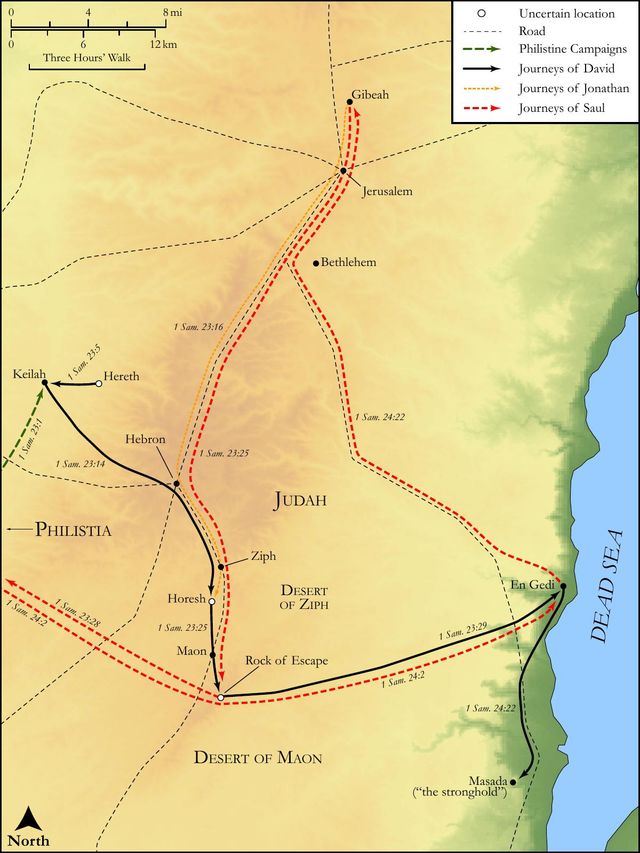
This verse immediately follows David's narrow escape from the fortified city of Keilah, where Saul had attempted to trap him by besieging the city. Having received divine guidance that the people of Keilah would betray him, David and his men fled into the wilderness, moving from stronghold to stronghold to evade Saul's relentless pursuit, as seen in passages like 1 Samuel 23:14. The narrative consistently emphasizes Saul's obsessive focus on capturing David, even to the detriment of his kingly duties, highlighting the deep spiritual and psychological deterioration of the king. Chapter 24 then opens with Saul being informed of David's presence in the wilderness of Engedi, prompting this immediate and massive mobilization, which directly sets up the dramatic confrontation in the cave where David has the opportunity to harm Saul.
Historical & Cultural Context
In ancient Israel, kings possessed the authority to levy troops for military campaigns. The mobilization of "three thousand chosen men out of all Israel" signifies a substantial and elite force, representing a significant portion of the standing army or a special conscription for a high-priority mission. This was not a typical military engagement against a foreign enemy but a personal vendetta, illustrating the absolute power of the monarch and the gravity of Saul's obsession. The "rocks of the wild goats" (Hebrew: tsûwr and yâʻêl) refers to the rugged, mountainous terrain of the wilderness of Engedi, on the western shore of the Dead Sea. This region is characterized by deep wadis, steep cliffs, numerous caves, and a sparse but distinct ecosystem, including the Nubian ibex (wild goats). Such an environment provided natural fortifications and hiding places for fugitives like David, making it exceptionally challenging for a large army to navigate and effectively search.
Key Themes
ShowHideThis verse powerfully contributes to several overarching themes in 1 Samuel. Firstly, it amplifies the theme of Saul's Obsession and Spiritual Decline, showcasing how his unchecked jealousy and paranoia, evident since 1 Samuel 18:8-9, have consumed him, leading him to misuse his royal power for a personal vendetta rather than for the good of the nation. Secondly, it highlights David's Peril and God's Providence, portraying David as a vulnerable fugitive constantly on the run, yet implicitly under God's protection. Despite the overwhelming odds, God consistently preserves His anointed one, as He did when David was first anointed in 1 Samuel 16:13. Thirdly, the "wilderness" setting reinforces the theme of The Wilderness as a Testing Ground, where David's faith, patience, leadership, and character are rigorously refined under extreme pressure, preparing him for his future role as king of Israel.
Exposition and Analysis
ShowHideKey Word Analysis
ShowHideA primitive root meaning "to try" or "to select." In this context, it denotes that the three thousand men were not merely conscripts but were specifically hand-picked, tried, and selected for their skill and readiness. This emphasizes the deliberate and high-priority nature of Saul's mission, indicating a force of elite soldiers chosen for their effectiveness in a difficult pursuit.
A primitive root meaning "to search out (by any method)," "to strive after," or "to make inquisition." This word reveals the intensity and singular focus of Saul's pursuit. He is not merely looking for David; he is actively and relentlessly searching him out, implying a determined and exhaustive effort to capture him, underscoring his deep-seated obsession.
Derived from a root meaning "to climb," this term refers to an ibex, a species of wild goat known for its agility and ability to navigate steep, rocky, and seemingly impassable cliffs. The mention of "wild goats" specifically grounds the narrative in the physical reality of the Engedi wilderness, a region characterized by such animals, and subtly hints at the elusive nature of David, who, like the ibex, was difficult to corner in such an environment.
Verse Breakdown
ShowHide"Then Saul took three thousand chosen men out of all Israel"
This clause reveals the king's decisive and formidable action. The number "three thousand" is significant, indicating a massive military contingent. The phrase "chosen men out of all Israel" signifies that these were not just any soldiers, but the best, hand-picked for this specific mission, demonstrating the extreme lengths to which Saul was willing to go to apprehend David. It highlights the vast disparity in resources between the reigning monarch and the fugitive.
"and went to seek David and his men"
This part specifies the objective of Saul's mobilization. Saul's sole focus is on "seek[ing] David and his men," highlighting his personal obsession and the fact that this was a targeted manhunt rather than a broader military campaign. The verb "seek" (Hebrew: bâqash) implies a thorough and determined effort to track down his perceived rival.
"upon the rocks of the wild goats"
This final phrase pinpoints the rugged, desolate, and challenging wilderness of Engedi as the specific location of the pursuit. This region, characterized by its "rocks" (Hebrew: tsûwr, meaning cliff or sharp rock) and the presence of "wild goats" (Hebrew: yâʻêl, ibex), was a natural stronghold and hiding place for David and his followers, setting the stage for the dramatic and tense encounter that follows.
Literary Devices
ShowHideThe verse employs several powerful literary devices that enrich its meaning. Foreshadowing is evident as the mobilization of such a large, elite force against David hints at a climactic and dangerous confrontation, building suspense for the reader regarding the inevitable encounter. The specific mention of the "rocks of the wild goats" serves as potent Symbolism, representing not only the physical refuge David sought but also the harsh, testing environment that refined his character and faith. This wilderness period is a crucible for David, preparing him for kingship through trials and reliance on God. Furthermore, there is a stark Contrast between Saul's overwhelming military power and David's vulnerable, fugitive status, highlighting the spiritual and moral disparity between the two men. Saul, the powerful king, is driven by irrational fear and personal vendetta, while David, the hunted, relies on God's providence in the desolate wilderness.
Theological and Thematic Connections
ShowHide1 Samuel 24:2 serves as a stark illustration of human depravity and the destructive power of unchecked sin, particularly jealousy and paranoia, when contrasted with God's unwavering providence. Saul's relentless pursuit of David, despite God's clear anointing of David and Saul's own rejection, demonstrates a king consumed by his own insecurity and rebellion against divine will. The theological message underscores that true authority and power do not reside in military might or human position, but in obedience and submission to God's plan. Even in extreme peril, God's anointed one is protected and guided, often through seemingly insurmountable circumstances, demonstrating that God works through humble means and in unexpected places. This narrative foreshadows the ultimate triumph of God's chosen king over the forces of darkness and human opposition, revealing God's faithfulness to His covenant promises.
Reflection and Application
ShowHideThis verse offers profound insights into the human condition and the nature of divine providence. Saul's irrational and disproportionate response to David's success serves as a powerful warning against allowing jealousy, fear, and insecurity to fester into destructive obsessions. When we allow our personal vendettas or anxieties to consume us, we risk misusing our resources, authority, and energy in ways that are counterproductive and morally compromising, ultimately leading to our own downfall. Conversely, David's experience in the rugged wilderness, constantly pursued by a superior force, reminds us that even in the most dire and seemingly hopeless circumstances, God provides refuge and protection. It calls us to cultivate a deep trust in God's sovereignty, recognizing that our ultimate security comes not from our own strength or hiding places, but from His unfailing presence and provision. This narrative encourages us to respond to adversity with patience, faith, and integrity, even when facing overwhelming opposition, mirroring David's character in the subsequent verses of this chapter.
Questions for Reflection
ShowHideFAQ
ShowHideWhy did Saul take so many men to pursue just one man?
ShowHideSaul's decision to mobilize "three thousand chosen men" against David underscores the depth of his paranoia and the irrationality of his obsession. David was not just one man; he was a highly popular figure, a successful military commander, and God's anointed future king, whom Saul perceived as a direct threat to his throne. The large, elite force reflects Saul's desperate determination to eliminate this perceived rival, signifying that this was not merely a manhunt but a full-scale military operation against a perceived internal enemy. It also highlights the extent of Saul's spiritual and psychological decline, as he prioritized a personal vendetta over the welfare of his kingdom, neglecting his true responsibilities.
What is significant about the "rocks of the wild goats"?
ShowHideThe "rocks of the wild goats" (Hebrew: tsûwr and yâʻêl) refers to the rugged, cliff-filled terrain of the wilderness of Engedi. This region is known for its steep wadis, numerous caves, and the presence of Nubian ibex (wild goats), which are incredibly agile on such difficult terrain. This detail is significant for several reasons: it grounds the narrative in a specific, geographically accurate location; it emphasizes the challenging and almost inaccessible nature of David's hiding places, which made his capture incredibly difficult despite Saul's overwhelming force; and it subtly symbolizes David's elusive nature, like the wild goats that inhabit these crags. It also sets the stage for the dramatic encounter in a cave, a common feature of this landscape, as seen in 1 Samuel 24:3.
Christ-Centered Fulfillment
ShowHideThe relentless pursuit of David by King Saul, culminating in this dramatic confrontation in the wilderness, powerfully foreshadows the persecution of Christ. David, God's anointed king, is unjustly hunted by the reigning authority, forced to flee and live as a fugitive in desolate places, much like Jesus, the true King of Israel, was pursued by Herod (Matthew 2:13-15) and later by the religious and political powers of His day (John 11:53-54). Just as David found refuge in the "rocks of the wild goats," Jesus often retreated to desolate places or the mountains for prayer and solitude, finding refuge from the crowds and His enemies (Mark 1:35). Ultimately, David's act of sparing Saul's life in the cave (1 Samuel 24:4-7) serves as a profound type of Christ's greater mercy and redemptive work. Jesus, though having all power to destroy His enemies, chose to lay down His life, offering forgiveness and salvation even to those who persecuted Him (Luke 23:34). Thus, David's flight and subsequent act of grace in the wilderness point to the ultimate Lamb of God, who endured persecution and offered Himself as a sacrifice, not for His own sin, but for the sins of the world (John 1:29).