


1 Samuel 26:2
Bible text: King James Version (1769 Blayney text) · Public domain
Bible text: King James Version with Strong's numbers · Public domain
Bible text: Berean Standard Bible · Public domain
Bible text: American Standard Version (1901) · Public domain
Bible text: World English Bible, Messianic edition · Public domain
Bible text: Geneva Bible (1599) · Public domain
Bible text: Young's Literal Translation · Public domain
- וַיָּקָםvai·Ya·komand he aroseH6965Conj-w ¦ V-Qal-ConsecImperf-3msVerb Qal Consecutive Imperfect 3rd Singular Masculineוַandיָּקָםhe arose
- שָׁאוּלsha·'UlSaulH7586N-proper-mNoun Proper Masculine
- וַיֵּרֶדvai·Ye·redand he went downH3381Conj-w ¦ V-Qal-ConsecImperf-3msVerb Qal Consecutive Imperfect 3rd Singular Masculineוַandיֵּרֶדhe went down
- אֶל'eltoH413PrepPreposition
- מִדְבַּרmid·bar[the] wilderness ofH4057N-mscNoun Singular Masculine Construct
- זִיףZifZiphH2128N-properNoun Proper Location
- וְאִתּוֹve·'i·Toand [were] with himH854Conj-w ¦ Prep ¦ 3msPreposition Definiteוְandאִתּ[were] withוֹhim
- שְׁלֹשֶׁתshe·lo·shetthreeH7969N-cscNoun Singular common gender Construct
- אֲלָפִים'a·la·Fimthousand<s>H505N-cpNoun Plural common gender Absolute
- אִישׁ'ishmanH376N-msNoun Singular Masculine Absolute
- בְּחוּרֵיbe·chu·Rei[the] chosen [men] ofH977V-Qal-PassPrtcpl-mpVerb Qal Participle Passive Plural Masculine Construct
- יִשְׂרָאֵלYis·ra·'ElIsraelH3478N-properNoun Proper Location
- לְבַקֵּשׁle·va·Keshto seekH1245Prep-l ¦ V-Piel-InfVerb Piel Infinitive Constructלְtoבַקֵּשׁseek
- אֶת'et<obj.>H853DirObjMParticle Object Indicator
- דָּוִדda·VidDavidH1732N-proper-mNoun Proper Masculine
- בְּמִדְבַּרbe·mid·barin [the] wilderness ofH4057Prep-b ¦ N-mscNoun Singular Masculine Constructבְּinמִדְבַּר[the] wilderness of
- זִיףZifZiphH2128N-properNoun Proper Location
English is a literal word-by-word gloss of the Hebrew, not the KJV's wording. Why?
This is the original text the KJV's translators worked from — each Hebrew word with its own literal English meaning in this verse, prepared by scholars at Tyndale House, Cambridge. The KJV translates whole sentences, not word by word, so its wording differs: one Hebrew word can become several English words, and the KJV may choose “the LORD” where the gloss reads “Yahweh”. Both are faithful — they answer different questions. For the KJV's own rendering, switch to the KJV text.
Details
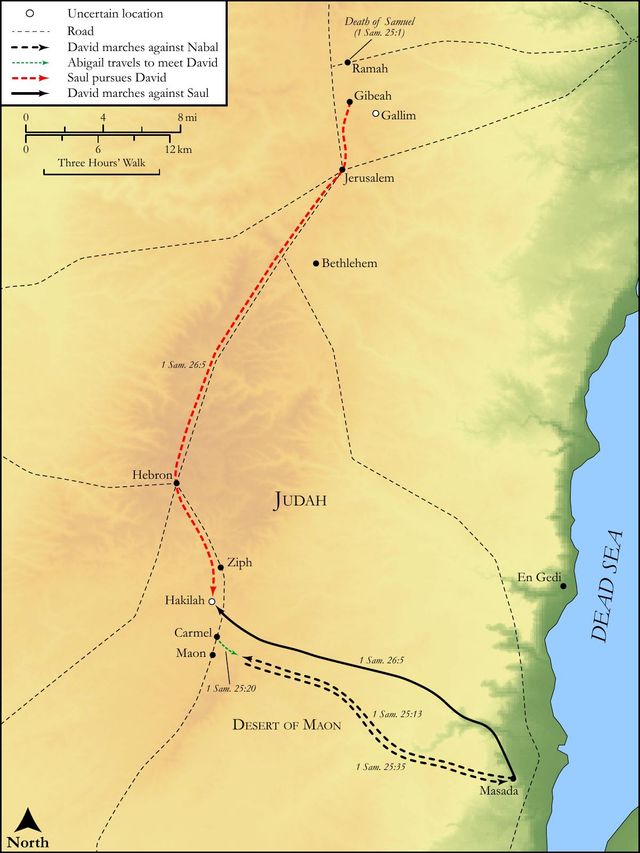
See on the biblical-era map
Study this verse
Public-domain commentary
Matthew Henry
From his Commentary on the Whole Bible. Henry comments on passages, not single verses — this entry covers 1 Samuel 26:1–5. His three-level outline is real structure in the source text, so it is rendered as structure.
Here, 1. Saul gets information of David's movements and acts offensively. The Ziphites came to him and told him where David now was, in the same place where he was when they formerly betrayed him, Sa1 23:19. Perhaps (though it is not mentioned) Saul had given them intimation, under-hand, that he continued his design against David, and would be glad of their assistance. If not, they were very officious to Saul, aware of what would please him, and very malicious against David, to whom they despaired of ever reconciling themselves, and therefore they stirred up Saul (who needed no such spur) against him, Sa1 26:1. For aught we know, Saul would have continued in the same good mind that he was in (Sa1 24:17), and would not have given David this fresh trouble, if the Ziphites had not put him on. See what need we have to pray to God that, since we have so much of the tinner of corruption in our own hearts, the sparks of temptation may be kept far from us, lest, if they come together, we be set on fire of hell. Saul readily caught at the information, and went down with an army of 3000 men to the place where David hid himself, Sa1 26:2. How soon do unsanctified hearts lose the good impressions which their convictions have made upon them and return with the dog to their vomit!
2.David gets information of Saul's movements and acts defensively. He did not march out to meet and fight him; he sought only his own safety, not Saul's ruin; therefore he abode in the wilderness (Sa1 26:3), putting thereby a great force upon himself, and curbing the bravery of his own spirit by a silent retirement, showing more true valour than he could have done by an irregular resistance.
(1.)He had spies who informed him of Saul's descent, that he had come in very deed (Sa1 26:4.); for he would not believe that Saul would deal so basely with him till he had the utmost evidence of it.
(2.)He observed with his own eyes how Saul was encamped, Sa1 26:5. He came towards the place where Saul and his men had pitched their tents, so near as to be able, undiscovered, to take a view of their entrenchments, probably in the dusk of the evening.
Historical interpretation
Historical reception
1 surviving comment on this verse from the historical church.
And Saul arose and went down to the desert of Ziph, etc. Understand Gabaa of Achila, not the city of Saul, but the hill of Achila, which is called Gabaa in Hebrew. Therefore, incited by perverse teachers, the kingdom of the Jews was stirred up to persecute the Lord, having in the army of impiety those who were prepared to fight against faith, hope, and charity, advancing to war as if in a triple line: of infidelity, despair, and hatred. With this armed force, the camps of iniquity hastened to encamp in the midst of the crowd that had received Christ in their hearts, in the hope that they might either find and kill him bodily, or spiritually repel him from the love of his faithful. Therefore, with David dwelling in the desert, Saul came after him into the desert; because once Christ as a dweller was received in the hearts of those who strove to desert the world, persecution immediately followed, which tested the believers, and provided with the struggle an occasion for earning the palm of victory. This same thing happens now and continues to happen at all times in the history of the Church. But let us see what David did when Saul followed him.
Continue studying 1 Samuel 26:2 across the web’s major study libraries — every link below opens this exact verse, chapter, or book on the destination site.
Read & Compare
 BibleGatewayThis verse in more than 200 translations and 70 languages.
 Bible.comThe YouVersion reader — hundreds of translations, reading plans, and highlights.
 ESV.orgCrossway's official English Standard Version reader.
 NET BibleThe NET translation with 60,000+ translators' notes on every rendering decision.
 STEP BibleTyndale House's free study tool — original text, vocabulary, and scholarly resources.
 BibliaLogos Bible Software's free web reader.
 USCCBThe New American Bible (Revised Edition) with the U.S. bishops' study notes.
Commentaries
 BibleHub CommentariesDozens of classic commentaries on this verse, gathered on one page.
 StudyLightMore than 100 commentary sets — the largest collection on the web.
 BibleRefPlain-English commentary on what this verse means, verse by verse.
 Enduring WordDavid Guzik's free commentary on this chapter, widely used by Bible teachers.
 Bible Study ToolsVerse commentary alongside Greek and Hebrew study aids.
Original Language & Research
- BibleHub InterlinearThe verse word by word — original language, transliteration, and English.
- BibleHub LexiconEvery word's original-language definition and Strong's entry.
 Blue Letter BibleDeep-study tools — Strong's numbers, concordance, and word studies.
 SefariaThe Hebrew text with Rashi and centuries of Jewish commentary.
Sermons, Hymns & Audio


TrulyRandomVerse is not affiliated with these sites and doesn’t control their content. They’re linked because they’re genuinely useful.
Summary
1 Samuel 26:2 vividly portrays King Saul's renewed and relentless pursuit of David, despite David's recent act of mercy towards him. Driven by deep-seated paranoia and an unyielding jealousy, Saul mobilizes a formidable force of three thousand elite soldiers from Israel and descends into the desolate wilderness of Ziph, specifically intending to hunt down and capture David, whom he perceives as an existential threat to his throne. This verse sets the stage for another critical encounter that profoundly highlights Saul's ongoing spiritual decline and David's unwavering trust in God's sovereign protection.
Context
ShowHideLiterary Context
This verse immediately follows the dramatic events of 1 Samuel 24, where David had a clear opportunity to kill Saul in the cave at Engedi but chose to spare his life, demonstrating profound respect for God's anointed king. Saul, momentarily touched by David's compassion, even acknowledged David's future kingship. However, this brief truce proved fleeting, as Saul's deep-seated insecurity quickly resurfaced. 1 Samuel 26:1 reveals that the Ziphites, who had previously betrayed David to Saul in 1 Samuel 23, once again informed Saul of David's whereabouts. Thus, this verse, 1 Samuel 26:2, marks Saul's swift return to his obsessive vendetta, setting the stage for David's second opportunity to spare Saul's life. This narrative structure further underscores David's righteous character and Saul's persistent spiritual blindness and hardened heart.
Historical & Cultural Context
The "wilderness of Ziph" refers to a rugged, arid region in the Judean wilderness, situated southeast of Hebron. This geographical area is characterized by rocky terrain, numerous caves, and sparse vegetation, making it an ideal hiding place for fugitives like David and his men, but also a challenging environment to navigate and escape once discovered. Saul's deployment of "three thousand chosen men of Israel" highlights the significant military resources he was willing to commit to a personal vendetta rather than focusing on national defense against perennial external threats like the Philistines. This action reflects the cultural expectation of a king to maintain order and eliminate perceived threats, yet in Saul's case, this duty was tragically twisted by his personal insecurity, paranoia, and spiritual decline. His behavior stands in stark contrast to the ideal king described in Deuteronomy 17:14-20, who is to be humble and obedient to God's law. Saul's actions vividly demonstrate the dangers of a leader consumed by jealousy and fear, disregarding God's clear intentions for David's succession.
Key Themes
ShowHideThis verse powerfully contributes to several key themes within the broader narrative of 1 Samuel. It unequivocally underscores the theme of Persistent Persecution, as Saul's irrational hatred and fear of David resurface despite moments of apparent reconciliation, illustrating the destructive and self-perpetuating nature of unchecked sin and envy. Simultaneously, it implicitly highlights the theme of Divine Protection, as David, despite facing overwhelming military odds and relentless pursuit, consistently escapes Saul's grasp, demonstrating God's unwavering faithfulness to His chosen servant (Psalm 3:3). Furthermore, this verse reinforces the tragic theme of Saul's Spiritual Decline, showcasing his continued disobedience, paranoia, and inability to submit to God's sovereign will. This stands in stark contrast to David's unwavering trust in God's sovereignty and his profound respect for God's anointed, even in the face of profound injustice. This narrative arc vividly portrays the devastating consequences of rejecting God's will and attempting to thwart His divine plan.
Exposition and Analysis
ShowHideKey Word Analysis
ShowHideThis primitive root signifies "to rise," often implying a decisive, intentional, and vigorous action. Here, it conveys Saul's renewed determination and immediate mobilization. It is not a casual movement but a deliberate, purposeful act of setting out, indicating his unwavering commitment to his personal vendetta against David, even after the emotional encounter at Engedi. It suggests a fresh, resolute intent to complete his task.
This primitive root means "to try" or "to select." In this context, "chosen men" refers to select, elite, or prime warriors, specifically implying those who are young, strong, and exceptionally fit for military service. The "three thousand chosen men" were not merely soldiers but the very best of Israel's fighting force, indicating the formidable scale and seriousness of Saul's personal war against David. This highlights the disproportionate effort and resources Saul was willing to expend to eliminate David.
This primitive root means "to search out" (by any method) or "to strive after." It conveys a determined and active pursuit. In this verse, it clearly states Saul's singular objective: to find and capture David. The use of this verb emphasizes the intensity and relentless nature of Saul's hunt, highlighting his obsessive focus on David, to the exclusion of other royal duties.
Verse Breakdown
ShowHide"Then Saul arose,"
This phrase signifies Saul's active and immediate response to the information provided by the Ziphites (as noted in 1 Samuel 26:1). It indicates a renewed resolve and a decisive action on his part, demonstrating that his momentary repentance and acknowledgment of David's righteousness in 1 Samuel 24 had completely dissipated, replaced by his consuming paranoia and vengeful obsession.
"and went down to the wilderness of Ziph,"
This clause specifies Saul's geographical movement and destination. "Went down" suggests a descent from a higher elevation (likely Gibeah, Saul's capital, or a military encampment) into the lower, rugged terrain of the wilderness. The "wilderness of Ziph" is a precise and known location, indicating Saul's targeted approach to an area where David had previously sought refuge and been betrayed.
"having three thousand chosen men of Israel with him,"
This clause details the immense military force Saul commanded. "Three thousand" is a substantial number for a personal manhunt, and "chosen men" emphasizes their elite status and readiness for battle. This highlights the overwhelming military might arrayed against David, underscoring the severity of Saul's obsession and the disproportionate resources he dedicated to this personal vendetta, diverting them from national defense.
"to seek David in the wilderness of Ziph."
This clause clearly states the singular and unwavering objective of Saul's expedition. His entire focus, and that of his elite army, was solely on finding and capturing David. The repetition of "in the wilderness of Ziph" reinforces the specific and familiar hunting ground, emphasizing the relentless, targeted, and almost cyclical nature of Saul's pursuit of David.
Literary Devices
ShowHideThe verse employs several potent literary devices to enhance its impact and convey its underlying themes. Repetition is prominently evident in the phrase "wilderness of Ziph," which appears twice. This repetition serves to emphasize the specific geographical setting and subtly reminds the reader of the previous encounter in this very location (1 Samuel 23), thereby highlighting Saul's persistent, almost cyclical, and irrational obsession. The mention of "three thousand chosen men" creates a powerful sense of Hyperbole or extreme contrast; such a massive, elite force being deployed against a single fugitive (albeit one with a band of loyal followers) underscores the irrationality and intensity of Saul's paranoia and his distorted perception of David as an overwhelming threat. This disproportionate show of force also serves as Foreshadowing, setting the stage for David's remarkable escape and his second act of mercy towards Saul, which will further highlight God's protective hand over David and His sovereign control over events. Finally, there is an implicit Contrast between Saul's relentless, vengeful pursuit and David's consistent demonstration of loyalty, patience, and profound respect for God's anointed, even when unjustly persecuted.
Theological and Thematic Connections
ShowHide1 Samuel 26:2 vividly portrays the tragic consequences of unchecked sin, particularly jealousy, paranoia, and a refusal to yield to God's will, in the life of King Saul. His renewed pursuit of David, despite David's recent act of profound mercy, reveals a heart hardened against divine instruction and consumed by a personal vendetta. Theologically, it underscores the persistent and destructive nature of spiritual rebellion and the profound difficulty of true repentance when one is deeply entrenched in sin and pride. It also powerfully highlights the theme of God's unwavering faithfulness to His chosen servant, David. Even with three thousand elite soldiers arrayed against him, David remains under divine protection, demonstrating that God's purposes cannot be thwarted by human opposition or overwhelming force. This narrative serves as a powerful reminder that God's anointing and promises are secure, even in the face of the most formidable human threats.
Reflection and Application
ShowHideThis passage offers profound and timeless lessons for contemporary believers. Saul's relentless pursuit of David, despite David's demonstrated loyalty and the clear evidence of God's favor upon him, serves as a stark warning about the destructive power of unchecked jealousy, insecurity, and a refusal to submit to God's sovereign plan. It reminds us that even after moments of apparent reconciliation or spiritual breakthrough, deeply rooted sinful patterns can resurface with devastating force if they are not truly repented of, confessed, and surrendered to God's transforming power. For us, this means vigilantly examining our own hearts for any lingering bitterness, envy, unforgiveness, or self-centered ambition that might lead us down a similar path of spiritual decline and destructive behavior. Conversely, David's continued trust in God's protection, even when facing overwhelming odds and existential threats, encourages us to rely on divine strength and timing rather than resorting to our own devices, retaliation, or manipulation. It challenges us to respond to injustice, persecution, and betrayal with the same grace, patience, and profound respect for God's anointing that David exemplified, trusting that God is our ultimate defender and will fulfill His purposes in His perfect time and way.
Questions for Reflection
ShowHideFAQ
ShowHideWhy did Saul pursue David again after David had spared his life in the cave at Engedi?
ShowHideSaul's renewed pursuit of David, as seen in 1 Samuel 26:2, powerfully demonstrates the temporary and superficial nature of his repentance and emotional outburst in 1 Samuel 24. While he was momentarily touched by David's compassion and even acknowledged David's future kingship, his deep-seated paranoia, jealousy, and spiritual decline quickly resurfaced. Saul's heart was not truly transformed; his fear of losing his throne, his inability to trust God's sovereignty, and his unaddressed sin led him back to his destructive obsession with eliminating David, whom he perceived as a rival, despite all evidence to the contrary. This highlights the profound danger of unaddressed sin and a lack of genuine, lasting spiritual change.
What is the significance of Saul bringing "three thousand chosen men of Israel" to seek David?
ShowHideThe detail of "three thousand chosen men" is highly significant. It emphasizes the immense scale and formidable nature of Saul's military operation against David. These were not just ordinary soldiers, but "chosen" or elite warriors, indicating the seriousness and determination of Saul's vendetta. This disproportionate force highlights Saul's irrational obsession and the vast resources he was willing to commit to a personal hunt for one man (and his small band of followers), rather than focusing on national defense. The overwhelming odds faced by David underscore the miraculous nature of his continued survival and God's protective hand over him, reinforcing the theme of divine protection in the narrative (Psalm 18:2).
Why did Saul specifically go to the "wilderness of Ziph" again?
ShowHideThe "wilderness of Ziph" was a familiar and strategic hunting ground for Saul. David had previously hidden there, and the Ziphites had already betrayed David's location to Saul in 1 Samuel 23:19-29. Therefore, when the Ziphites again informed Saul of David's whereabouts (as noted in 1 Samuel 26:1), it was a logical and strategic move for Saul to return to this known area. The rugged, cave-filled terrain of the Judean wilderness offered both hiding places and potential traps, making it a suitable location for a determined manhunt. The repetition of the location also subtly emphasizes the cyclical nature of Saul's pursuit and David's constant need to evade capture, highlighting the relentless pressure David endured.
Christ-Centered Fulfillment
ShowHideThe relentless pursuit of David by King Saul, as vividly depicted in 1 Samuel 26:2, serves as a profound Old Testament foreshadowing of the unjust persecution faced by Jesus Christ. David, God's anointed king-elect, was pursued without cause by the reigning king, mirroring how Jesus, the true King of Israel and the Son of God, was relentlessly pursued by the religious and political authorities of His day. These authorities sought to eliminate Him out of jealousy, fear of losing their own power, and a rejection of God's divine plan (John 11:47-48). Just as Saul mobilized a massive, elite force against David, the world arrayed itself against Christ, culminating in His unjust trial and crucifixion (Acts 4:27-28). However, David's consistent refusal to retaliate against Saul, even when given multiple opportunities to take Saul's life, profoundly prefigures Christ's non-retaliation and His ultimate, sacrificial love for His enemies on the cross (Luke 23:34 and Romans 5:8). The divine protection that shielded David from Saul's murderous intent points to God's sovereign plan for His Messiah, ensuring that Jesus would fulfill His redemptive mission, endure the cross, and ultimately triumph over sin and death through His glorious resurrection, establishing His eternal and unshakeable kingdom (Philippians 2:8-11). Thus, Saul's futile pursuit of David ultimately highlights the world's powerlessness to thwart God's eternal redemptive purposes in Christ.