


1 Samuel 26:1
- וַיָּבֹאוּvai·ya·Vo·'uand they wentH935Conj-w ¦ V-Qal-ConsecImperf-3mpVerb Qal Consecutive Imperfect 3rd Plural Masculineוַandיָּבֹאוּthey went
- הַזִּפִיםha·zi·Fimthe ZiphitesH2130Art ¦ N-mpNoun Gentilic Plural Masculine AbsoluteהַtheזִּפִיםZiphites
- אֶל'eltoH413PrepPreposition
- שָׁאוּלsha·'UlSaulH7586N-proper-mNoun Proper Masculine
- הַגִּבְעָתָהha·giv·'A·tah<the> Gibeah towardsH1390Art ¦ N-proper ¦ SfxNoun Proper Locationהַ<the>גִּבְעָתָGibeahהtowards
- לֵאמֹרle·Mor<to> sayingH559Prep-l ¦ V-Qal-InfVerb Qal Infinitive Constructלֵ<to>אמֹרsaying
- הֲלוֹאha·Lo'¿ notH3808Interrog ¦ NegParticle Negativeהֲ¿לוֹאnot
- דָוִדda·Vid[is] DavidH1732N-proper-mNoun Proper Masculine
- מִסְתַּתֵּרmis·ta·Terhiding himselfH5641V-Hithpael-Prtcpl-msVerb Hithpael Participle Singular Masculine Absolute
- בְּגִבְעַתbe·giv·'Aton [the] hill ofH1389Prep-b ¦ N-fscNoun Singular Feminine Constructבְּonגִבְעַת[the] hill of
- הַחֲכִילָהha·cha·khi·Lah<the> HakilahH2444Art ¦ N-properNoun Proper Locationהַ<the>חֲכִילָהHakilah
- עַל'alonH5921PrepPreposition
- פְּנֵיpe·Nei[the] face ofH6440N-mpcNoun Plural Masculine Construct
- הַיְשִׁימֹןhay·shi·Mon<the> JeshimonH3452Art ¦ N-properNoun Proper Locationהַ<the>יְשִׁימֹןJeshimon
English is a literal word-by-word gloss of the Hebrew, not the KJV's wording. Why?
This is the original text the KJV's translators worked from — each Hebrew word with its own literal English meaning in this verse, prepared by scholars at Tyndale House, Cambridge. The KJV translates whole sentences, not word by word, so its wording differs: one Hebrew word can become several English words, and the KJV may choose “the LORD” where the gloss reads “Yahweh”. Both are faithful — they answer different questions. For the KJV's own rendering, switch to the KJV text.
Details
See on the biblical-era map
Study this verse
Public-domain commentary
Matthew Henry
From his Commentary on the Whole Bible. Henry comments on passages, not single verses — this entry covers 1 Samuel 26:1–5. His three-level outline is real structure in the source text, so it is rendered as structure.
Here, 1. Saul gets information of David's movements and acts offensively. The Ziphites came to him and told him where David now was, in the same place where he was when they formerly betrayed him, Sa1 23:19. Perhaps (though it is not mentioned) Saul had given them intimation, under-hand, that he continued his design against David, and would be glad of their assistance. If not, they were very officious to Saul, aware of what would please him, and very malicious against David, to whom they despaired of ever reconciling themselves, and therefore they stirred up Saul (who needed no such spur) against him, Sa1 26:1. For aught we know, Saul would have continued in the same good mind that he was in (Sa1 24:17), and would not have given David this fresh trouble, if the Ziphites had not put him on. See what need we have to pray to God that, since we have so much of the tinner of corruption in our own hearts, the sparks of temptation may be kept far from us, lest, if they come together, we be set on fire of hell. Saul readily caught at the information, and went down with an army of 3000 men to the place where David hid himself, Sa1 26:2. How soon do unsanctified hearts lose the good impressions which their convictions have made upon them and return with the dog to their vomit!
2.David gets information of Saul's movements and acts defensively. He did not march out to meet and fight him; he sought only his own safety, not Saul's ruin; therefore he abode in the wilderness (Sa1 26:3), putting thereby a great force upon himself, and curbing the bravery of his own spirit by a silent retirement, showing more true valour than he could have done by an irregular resistance.
(1.)He had spies who informed him of Saul's descent, that he had come in very deed (Sa1 26:4.); for he would not believe that Saul would deal so basely with him till he had the utmost evidence of it.
(2.)He observed with his own eyes how Saul was encamped, Sa1 26:5. He came towards the place where Saul and his men had pitched their tents, so near as to be able, undiscovered, to take a view of their entrenchments, probably in the dusk of the evening.
Continue studying 1 Samuel 26:1 across the web’s major study libraries — every link below opens this exact verse, chapter, or book on the destination site.
Read & Compare
 BibleGatewayThis verse in more than 200 translations and 70 languages.
 Bible.comThe YouVersion reader — hundreds of translations, reading plans, and highlights.
 ESV.orgCrossway's official English Standard Version reader.
 NET BibleThe NET translation with 60,000+ translators' notes on every rendering decision.
 STEP BibleTyndale House's free study tool — original text, vocabulary, and scholarly resources.
 BibliaLogos Bible Software's free web reader.
 USCCBThe New American Bible (Revised Edition) with the U.S. bishops' study notes.
Commentaries
 BibleHub CommentariesDozens of classic commentaries on this verse, gathered on one page.
 StudyLightMore than 100 commentary sets — the largest collection on the web.
 BibleRefPlain-English commentary on what this verse means, verse by verse.
 Enduring WordDavid Guzik's free commentary on this chapter, widely used by Bible teachers.
 Bible Study ToolsVerse commentary alongside Greek and Hebrew study aids.
Original Language & Research
- BibleHub InterlinearThe verse word by word — original language, transliteration, and English.
- BibleHub LexiconEvery word's original-language definition and Strong's entry.
 Blue Letter BibleDeep-study tools — Strong's numbers, concordance, and word studies.
 SefariaThe Hebrew text with Rashi and centuries of Jewish commentary.
Sermons, Hymns & Audio


TrulyRandomVerse is not affiliated with these sites and doesn’t control their content. They’re linked because they’re genuinely useful.
Summary
1 Samuel 26:1 marks the dramatic and disheartening recommencement of King Saul's relentless, irrational pursuit of David, instigated once again by the treacherous Ziphites. This verse sets the stage for a second profound confrontation between Saul and David, immediately following David's remarkable act of mercy in sparing Saul's life. It starkly highlights the persistent animosity, deep-seated jealousy, and unrepentant heart that continued to drive Saul, underscoring the precariousness of David's existence as a fugitive, forced to navigate the desolate wilderness while relying solely on divine protection amidst human treachery and unyielding opposition.
Context
ShowHideLiterary Context
This verse serves as a jarring re-entry into the cycle of Saul's persecution of David, coming immediately after a significant narrative interlude. In 1 Samuel 24, David had a clear opportunity to kill Saul in the cave of En Gedi but chose instead to spare his life, demonstrating profound respect for God's anointed king. This act elicited a momentary, tearful acknowledgment from Saul regarding David's righteousness and future kingship, even leading to an oath. The subsequent chapter, 1 Samuel 25, further develops David's character, showcasing his restraint and reliance on divine justice in the face of insult from Nabal, and his wise interaction with Abigail. Therefore, the Ziphites' renewed betrayal in 1 Samuel 26:1 is particularly poignant and tragic, revealing the fleeting nature of Saul's repentance and the deep-seated corruption of his heart. It sets up another profound test of David's integrity, his unwavering trust in God's timing, and his continued refusal to usurp God's anointed king through human means, contrasting sharply with Saul's persistent, self-destructive paranoia.
Historical & Cultural Context
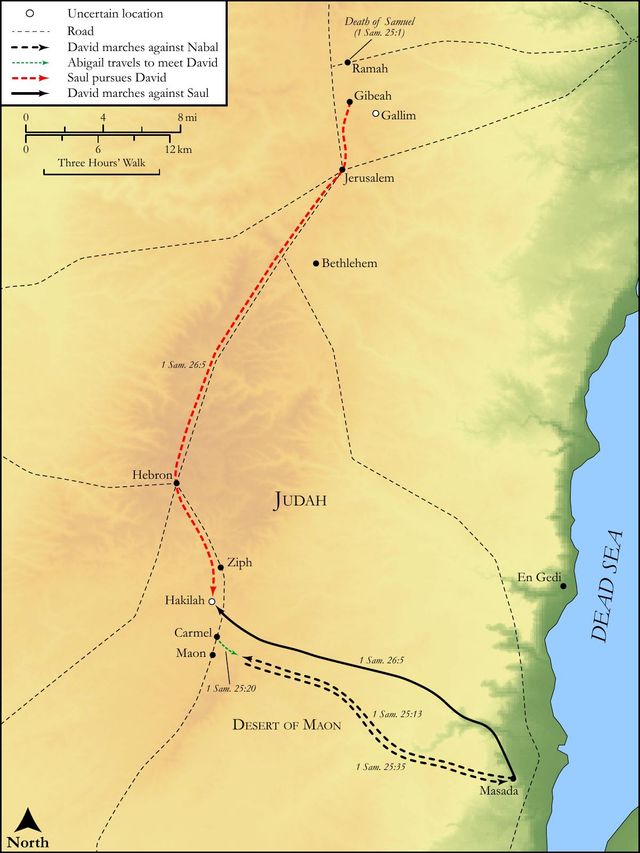
The Ziphites were inhabitants of Ziph, a town situated in the hill country of Judah, southeast of Hebron, placing them geographically close to David's hiding spots. Their repeated act of informing on David (first in 1 Samuel 23:19) suggests a calculated move to curry favor with the reigning King Saul, likely motivated by fear, political expediency, or the desire for reward, despite David being a fellow Judahite. Such acts of betrayal against a fugitive were not uncommon in ancient Near Eastern societies, where allegiance often shifted based on power dynamics. Gibeah, Saul's capital, was located in the tribal territory of Benjamin, north of Jerusalem, underscoring the considerable distance Saul was willing to travel to pursue David, highlighting his obsessive focus. The "hill of Hachilah" and "Jeshimon" refer to specific geographical features within the wilderness of Ziph, a desolate and rugged region characterized by caves, wadis, and sparse vegetation. This environment provided both concealment and harsh living conditions for David and his men, emphasizing his vulnerable, fugitive status, yet also God's consistent provision for him in the wilderness, reminiscent of Israel's journey through the desert.
Key Themes
ShowHideThis verse powerfully contributes to several overarching themes within the book of 1 Samuel. It vividly reiterates the theme of Persistent Persecution, showcasing Saul's unyielding obsession with eliminating David, an obsession fueled by profound jealousy and an irrational fear of losing his divinely appointed kingship (which he had already forfeited, as proclaimed in 1 Samuel 15:28). This relentless pursuit underscores the destructive nature of unchecked envy and a heart hardened against God's will. Secondly, it emphasizes the theme of Betrayal and Loyalty, sharply contrasting the Ziphites' treachery with David's unwavering allegiance to God's anointed, even when presented with multiple opportunities to retaliate against Saul (as demonstrated in 1 Samuel 24:4-7). Finally, the narrative consistently points to Divine Providence; despite constant threats, betrayals, and the harsh realities of wilderness life, David's life is miraculously preserved, illustrating God's faithfulness to His chosen one and His sovereign control over seemingly chaotic events, ensuring His ultimate plan for Israel's kingship will prevail. The wilderness setting itself becomes a crucible for David's character, where his reliance on God is continually tested and refined, preparing him for the throne.
Exposition and Analysis
ShowHideKey Word Analysis
ShowHidePatrial from Ziph, meaning "a Ziphite or inhabitant of Ziph." These individuals, by informing Saul of David's whereabouts, act as instruments of treachery, highlighting the fragmented loyalties within Israel during Saul's reign. Their actions underscore the political opportunism and fear that could lead local communities to betray a fellow Judahite, even one destined for the throne, in favor of the reigning, albeit unstable, king.
Meaning "the hill," this refers to Saul's capital city in the tribal territory of Benjamin. Its mention here emphasizes the considerable distance and effort Saul was willing to exert to pursue David, traveling from his seat of power to the remote wilderness of Ziph. It underscores the king's singular, destructive focus on David, often to the neglect of his kingdom's true needs and the welfare of his people.
From a root meaning "to be desolate," this term refers to "a desolation; desert, Jeshimon, solitary, wilderness." This word powerfully conveys the barren, inhospitable, and isolated nature of the region where David was hiding. It paints a vivid picture of David's desperate circumstances as a fugitive in a desolate land, yet also hints at the vastness and ruggedness that could offer temporary refuge from Saul's relentless forces.
Verse Breakdown
ShowHide"¶ And the Ziphites came unto Saul to Gibeah, saying,"
This opening clause immediately reintroduces the antagonists who had previously betrayed David, signaling a renewed and persistent threat. Their direct approach to Saul in his capital, Gibeah, demonstrates their boldness and their clear intent to gain favor by delivering precise information about David's whereabouts. The "¶" (pilcrow) in the KJV often marks a new paragraph or section, indicating a fresh turn in the narrative, here signaling the resumption of Saul's persecution.
"Doth not David hide himself in the hill of Hachilah,"
This is the Ziphites' direct question and accusation, phrased as a rhetorical question designed to elicit an affirmative response and incite Saul's anger. It reveals their precise knowledge of David's current hiding place, the "hill of Hachilah," which was a prominent landmark in the wilderness of Ziph. The phrasing implies a certain urgency and certainty on their part, calculated to spur Saul into immediate action against his perceived rival.
"[which is] before Jeshimon?"
This phrase further specifies the location of Hachilah, placing it geographically in relation to "Jeshimon," the vast wilderness. It provides additional detail for Saul's forces to pinpoint David's position, demonstrating the Ziphites' thoroughness in their betrayal. The inclusion of this geographical marker underscores the desolate and remote nature of David's refuge, emphasizing his vulnerability and the harsh conditions he endured as a fugitive, relying on the rugged terrain for concealment.
Literary Devices
ShowHideThe verse employs several potent literary devices that deepen its impact. Irony is profoundly present, as the Ziphites, fellow Judahites, betray David, the divinely chosen future king of Judah, to Saul, who is from the tribe of Benjamin. This act of treachery stands in stark contrast to David's previous act of mercy towards Saul in 1 Samuel 24, highlighting the moral decay of Saul's supporters versus David's righteous character. The repeated phrase "Doth not David hide himself" functions as a form of rhetorical question, designed not to elicit information but to confirm Saul's existing suspicions and incite his wrath, effectively manipulating him into renewed pursuit. Furthermore, the detailed description of David's hiding place as "the hill of Hachilah, which is before Jeshimon" uses vivid setting to evoke a sense of desolation, vulnerability, and isolation. This barren landscape serves as a symbolic backdrop for David's spiritual journey, where he is stripped of worldly comforts and forced to rely solely on divine protection, emphasizing God's faithfulness even in the most desolate circumstances.
Theological and Thematic Connections
ShowHide1 Samuel 26:1 powerfully illustrates the persistent nature of evil and human treachery, even in the face of divine favor and demonstrated righteousness. Despite David's previous act of mercy and Saul's momentary, superficial repentance, the spirit of jealousy, fear, and a hardened heart continues to drive Saul's actions, demonstrating the deep-seated corruption of a soul estranged from God. The Ziphites' betrayal underscores the painful reality that even those within one's own community or tribe can become instruments of adversity and opposition. Yet, amidst this relentless persecution, the verse implicitly points to God's sovereign hand, allowing these events to unfold not to destroy David, but to refine his character, deepen his dependence on God, and prepare him for the throne. It is a profound testament to the truth that God's ultimate purposes cannot be thwarted by human malice, and His chosen one will be preserved for His divine plan.
Reflection and Application
ShowHideThis passage serves as a profound reminder that even when we act with integrity, extend mercy, and demonstrate faithfulness, we may still face relentless opposition, betrayal, and unmerited persecution. David's experience in the wilderness of Ziph, hunted by a king consumed by jealousy and betrayed by his own countrymen, mirrors the "wilderness seasons" we may encounter in our lives—periods of isolation, hardship, and unjust suffering. It challenges us to consider our response to injustice and persecution: do we retaliate in kind, or do we, like David, continue to trust in God's ultimate justice and perfect timing, refusing to take matters into our own hands? The Ziphites' actions warn us against the dangers of seeking favor through treachery or allowing fear and self-interest to dictate our loyalties. Saul's continued, irrational pursuit, despite David's grace, vividly illustrates the destructive power of unchecked envy, insecurity, and a refusal to repent, which can blind individuals to truth and lead them down paths of self-destruction. Ultimately, David's story here encourages us to find our refuge and strength not in our circumstances, human alliances, or personal vindication, but in the unwavering faithfulness of God, who protects His own even in the most desolate and dangerous places, shaping us through adversity for His greater purposes.
Questions for Reflection
ShowHideFAQ
ShowHideWho were the Ziphites, and why did they betray David?
ShowHideThe Ziphites were inhabitants of Ziph, a town located in the hill country of Judah, near the wilderness where David was hiding. They betrayed David to King Saul on two separate occasions (1 Samuel 23:19 and 1 Samuel 26:1). Their motivation was likely to gain favor with King Saul, who was the reigning monarch. In ancient societies, informing on fugitives or enemies of the state was a common way to secure political standing, rewards, or protection from the king. Despite David being a fellow Judahite and God's anointed, their loyalty was seemingly to the established power structure under Saul, rather than to the divinely chosen, albeit fugitive, future king. This highlights the complex and often self-serving loyalties prevalent in that era.
What is the significance of "Jeshimon" in this context?
ShowHide"Jeshimon" (Hebrew: Yəšîmôn) literally translates to "the desert," "the wilderness," or "the desolation." In the context of 1 Samuel 26:1, it signifies the desolate, barren, and remote nature of the region where David was hiding. This geographical detail is significant for several reasons: it emphasizes the harsh conditions David and his men endured as fugitives, highlighting their vulnerability; it paradoxically also suggests the vastness and ruggedness that offered him temporary concealment from Saul's relentless pursuit; and biblically, the wilderness often serves as a place of testing, purification, and deepened reliance on God. David's time in Jeshimon is no exception, as he is stripped of worldly comforts and forced to trust in divine provision and protection.
Christ-Centered Fulfillment
ShowHideThe narrative of David's relentless persecution by Saul, culminating in the Ziphites' betrayal in 1 Samuel 26:1, finds its ultimate and profound fulfillment in the life and ministry of Jesus Christ. David, the anointed king, hunted and betrayed by his own people and the reigning authority, powerfully foreshadows Christ, the true Anointed One, who came to His own but was rejected and persecuted (John 1:11). Just as Saul sought to destroy David out of fear and jealousy, so too did the religious and political leaders of Jesus' day conspire against Him, driven by envy and a perceived threat to their power and position (Mark 15:10). Jesus, like David, faced profound betrayal by those close to Him, most notably Judas Iscariot, one of His own disciples (Matthew 26:47-50). Yet, unlike David, who still had to flee and evade capture, Christ willingly submitted to His captors, knowing it was part of God's redemptive plan to accomplish salvation for humanity (John 18:4-11). David's miraculous preservation in the wilderness by God's providence points to Christ's ultimate victory over death and the grave, demonstrating that no human treachery or persecution can thwart God's sovereign plan for His chosen King. Believers, too, are called to endure persecution and betrayal, trusting in the same God who protected David and ultimately raised Christ from the dead, knowing that our suffering in Christ leads to ultimate glory and participation in His eternal kingdom (Romans 8:17).