


1 Samuel 23:19
Bible text: King James Version (1769 Blayney text) · Public domain
Bible text: King James Version with Strong's numbers · Public domain
Bible text: Berean Standard Bible · Public domain
Bible text: American Standard Version (1901) · Public domain
Bible text: World English Bible, Messianic edition · Public domain
Bible text: Geneva Bible (1599) · Public domain
Bible text: Young's Literal Translation · Public domain
- וַיַּעֲלוּvai·ya·'a·Luand they went upH5927Conj-w ¦ V-Qal-ConsecImperf-3mpVerb Qal Consecutive Imperfect 3rd Plural Masculineוַandיַּעֲלוּthey went up
- זִפִיםzi·FimZiphitesH2130N-mpNoun Gentilic Plural Masculine Absolute
- אֶל'eltoH413PrepPreposition
- שָׁאוּלsha·'UlSaulH7586N-proper-mNoun Proper Masculine
- הַגִּבְעָתָהha·giv·'A·tah<the> Gibeah towardsH1390Art ¦ N-proper ¦ SfxNoun Proper Locationהַ<the>גִּבְעָתָGibeahהtowards
- לֵאמֹרle·Mor<to> sayingH559Prep-l ¦ V-Qal-InfVerb Qal Infinitive Constructלֵ<to>אמֹרsaying
- הֲלוֹאha·Lo'¿ notH3808Interrog ¦ NegParticle Negativeהֲ¿לוֹאnot
- דָוִדDa·vid[is] DavidH1732N-proper-mNoun Proper Masculine
- מִסְתַּתֵּרmis·ta·Terhiding himselfH5641V-Hithpael-Prtcpl-msVerb Hithpael Participle Singular Masculine Absolute
- עִמָּנוּ'i·Ma·nuwith usH5973Prep ¦ 1cpPreposition Definiteעִמָּwithנוּus
- בַמְּצָדוֹתva·me·tza·dOtin the strongholdsH4679Prep-b ¦ N-fpNoun Plural Feminine Absoluteבַin theמְּצָדוֹתstrongholds
- בַּחֹרְשָׁהba·Cho·re·shahat <the> HoreshH2793Prep-b ¦ N-properNoun Proper Locationבַּat <the>חֹרְשָׁהHoresh
- בְּגִבְעַתbe·giv·'Aton [the] hill ofH1389Prep-b ¦ N-fscNoun Singular Feminine Constructבְּonגִבְעַת[the] hill of
- הַחֲכִילָהha·cha·khi·Lah<the> HakilahH2444Art ¦ N-properNoun Proper Locationהַ<the>חֲכִילָהHakilah
- אֲשֶׁר'a·SherwhichH834RelParticle Relative
- מִימִיןmi·Min[is] from [the] south ofH3225Prep-m ¦ N-fscNoun Singular Feminine Constructמִ[is] fromימִין[the] south of
- הַיְשִׁימוֹןhay·shi·Mon<the> JeshimonH3452Art ¦ N-properNoun Proper Locationהַ<the>יְשִׁימוֹןJeshimon
English is a literal word-by-word gloss of the Hebrew, not the KJV's wording. Why?
This is the original text the KJV's translators worked from — each Hebrew word with its own literal English meaning in this verse, prepared by scholars at Tyndale House, Cambridge. The KJV translates whole sentences, not word by word, so its wording differs: one Hebrew word can become several English words, and the KJV may choose “the LORD” where the gloss reads “Yahweh”. Both are faithful — they answer different questions. For the KJV's own rendering, switch to the KJV text.
Details
See on the biblical-era map
Study this verse
Public-domain commentary
Matthew Henry
From his Commentary on the Whole Bible. Henry comments on passages, not single verses — this entry covers 1 Samuel 23:19–29.
Here, 1. The Ziphites offer their service to Saul, to betray David to him, Sa1 23:19, Sa1 23:20. He was sheltering himself in the wilderness of Ziph (Sa1 23:14, Sa1 23:15), putting the more confidence in the people of that country because they were of his own tribe. They had reason to think themselves happy that they had an opportunity of serving one who was the ornament of their tribe and was likely to be much more so, who was so far from plundering the country, or giving it any disturbance with his troops, that he was ready to protect it and to them all the good offices that there was occasion for. But, to ingratiate themselves with Saul, they went to him, and not only informed him very particularly where David quartered (Sa1 23:19), but invited him to come with his forces into their country in pursuit of him, and promised to deliver him into his hand, Sa1 23:20. Saul had not sent to examine or threaten them, but of their own accord, and even without asking a reward (as Judas did - What will you give me?), they offered to betray David to him who, they knew, thirsted after his blood. 2. Saul thankfully receives their information, and gladly lays hold of the opportunity of hunting David in their wilderness, in hopes to make a prey of him at length. He intimates to them how kindly he took it (Sa1 23:21): Blessed be you of the Lord (so near is God to his mouth, though far from his heart), for you have compassion on me. It seems he looked upon himself as a miserable man and an object of pity; his own envy and ill-nature made him so, otherwise he might have been easy and have needed no man's compassion. He likewise insinuates the little concern that the generality of his people showed for him. "You have compassion on me, which others have not." Saul gives them instructions to search more particularly for his haunts (Sa1 23:22), "for" (says he) "I hear he deals very subtilely," representing him as a man crafty to do mischief, whereas all his subtlety was to secure himself. It was strange that Saul did not go down with them immediately, but he hoped by their means to set his game with the more certainty, and thus divine Providence gave David time to shift for himself. But the Ziphites had laid their spies upon all the places where he was likely to be discovered, and therefore Saul might come and seize him if he was in the land, Sa1 23:23. New he thought himself sure of his prey and pleased himself with the thoughts of devouring it. 3. The imminent peril that David was now brought into. Upon intelligence that the Ziphites had betrayed him, he retired from the hill of Hachilah to the wilderness of Maon (Sa1 23:24), and at this time he penned the 54th Psalm, as appears by the title, wherein he calls the Ziphites strangers, though they were Israelites, because they used him barbarously; but he puts himself under the divine protection: "Behold, God is my helper, and then all shall be well" Saul, having got intelligence of him, pursued him closely (Sa1 23:25), till he came so near him that there was but a mountain between them (Sa1 23:26), David and his men on one side of the mountain flying and Saul and his men on the other side pursuing, David in fear and Saul in hope. But this mountain was an emblem of the divine Providence coming between David and the destroyer, like the pillar of cloud between the Israelites and the Egyptians. David was concealed by this mountain and Saul confounded by it. David now flees as a bird to his mountain (Psa 11:1) and finds God to him as the shadow of a great rock. Saul hoped with his numerous forces to enclose David, and compass him in and his men; but the ground did not prove convenient for his design, and so it failed. A new name was given to the place in remembrance of this (Sa1 23:28): Selah-hammah-lekoth - the rock of division, because it divided between Saul and David. 4. The deliverance of David out of this danger. Providence gave Saul a diversion, when he was just ready to lay hold of David; notice was brought him that the Philistines were invading the land (Sa1 23:27), probably that part of the land where his own estate lay, which would be seized, or at least spoiled, by the invaders; for the little notice he took of Keilah's distress and David's relief of it, in the beginning of this chapter, gives us cause to suspect that he would not now have left pursuing David, and gone to oppose the Philistines, if some private interests of his own had not been at stake. However it was, he found himself under a necessity of going against the Philistines (Sa1 23:28), and by this means David was delivered when he was on the brink of destruction. Saul was disappointed of his prey, and God was glorified as David's wonderful protector. When the Philistines invaded the land they were far from intending any kindness to David by it, yet the overruling providence of God, which orders all events and the times of them, made it very serviceable to him. The wisdom of God is never at a loss for ways and means to preserve his people. As this Saul was diverted, so another Saul was converted, just then when he was breathing out threatenings and slaughter against the saints of the Lord, Act 9:1. 5. David, having thus escaped, took shelter in some natural fortresses, which he found in the wilderness of En-gedi, Sa1 23:29. And this Dr. Lightfoot thinks was the wilderness of Judah, in which David was when he penned Psa 63:1-11, which breathes as much pious and devout affection as almost any of his psalms; for in all places and in all conditions he still kept up his communion with God.
Historical interpretation
Historical reception
1 surviving comment on this verse from the historical church.
But the Ziphites went up to Saul at Gibeah, etc. Often false brothers, abandoning the bud and flower of their virtues, ascend to the arrogant enemies of faith to help them against the Church and, detesting the simplicity of the faithful, in a way say to the persecutors: "Does not Christ dwell among us through faith in the most secure hearts of the Gentiles?" Nor is it in vain that it is said in the hill of Hachilah, that is, receiving it. For where should we think the spirit of Christ more gracefully stays than in the height of a mind firmly receiving its faith? Which is to the right of the desert, because for the sake of the right side, that is, the joys of eternal life, it abandons the pomp of the world. For he who declines worldly enticements with a view to temporal and earthly reward, is said not to have turned to the right of the desert, but rather to the left, where our desirable king does not dwell, but the detestable enemy is accustomed to inhabit. And all these things the Ziphites say to Saul, when some falsely faithful men betray the mysteries of faith or its worshippers to open persecutors, and with a perverse mind, though they differ in the recognition of faith, they concord in hatred of the same faith; and to the extent they internally know the secrets of Christ, as David's hiding places, they more wickedly help those who attempt to attack the Church from without.
Continue studying 1 Samuel 23:19 across the web’s major study libraries — every link below opens this exact verse, chapter, or book on the destination site.
Read & Compare
 BibleGatewayThis verse in more than 200 translations and 70 languages.
 Bible.comThe YouVersion reader — hundreds of translations, reading plans, and highlights.
 ESV.orgCrossway's official English Standard Version reader.
 NET BibleThe NET translation with 60,000+ translators' notes on every rendering decision.
 STEP BibleTyndale House's free study tool — original text, vocabulary, and scholarly resources.
 BibliaLogos Bible Software's free web reader.
 USCCBThe New American Bible (Revised Edition) with the U.S. bishops' study notes.
Commentaries
 BibleHub CommentariesDozens of classic commentaries on this verse, gathered on one page.
 StudyLightMore than 100 commentary sets — the largest collection on the web.
 BibleRefPlain-English commentary on what this verse means, verse by verse.
 Enduring WordDavid Guzik's free commentary on this chapter, widely used by Bible teachers.
 Bible Study ToolsVerse commentary alongside Greek and Hebrew study aids.
Original Language & Research
- BibleHub InterlinearThe verse word by word — original language, transliteration, and English.
- BibleHub LexiconEvery word's original-language definition and Strong's entry.
 Blue Letter BibleDeep-study tools — Strong's numbers, concordance, and word studies.
 SefariaThe Hebrew text with Rashi and centuries of Jewish commentary.
Sermons, Hymns & Audio


TrulyRandomVerse is not affiliated with these sites and doesn’t control their content. They’re linked because they’re genuinely useful.
Summary
1 Samuel 23:19 vividly portrays a moment of profound betrayal in David's life as a fugitive, detailing the unsolicited and precise information provided by the Ziphites to King Saul regarding David's hiding place. This treacherous act underscores the relentless and personal persecution David endured from Saul, highlighting the precariousness of his existence and his constant need for divine protection amidst the disloyalty of his own countrymen.
Context
ShowHideLiterary Context
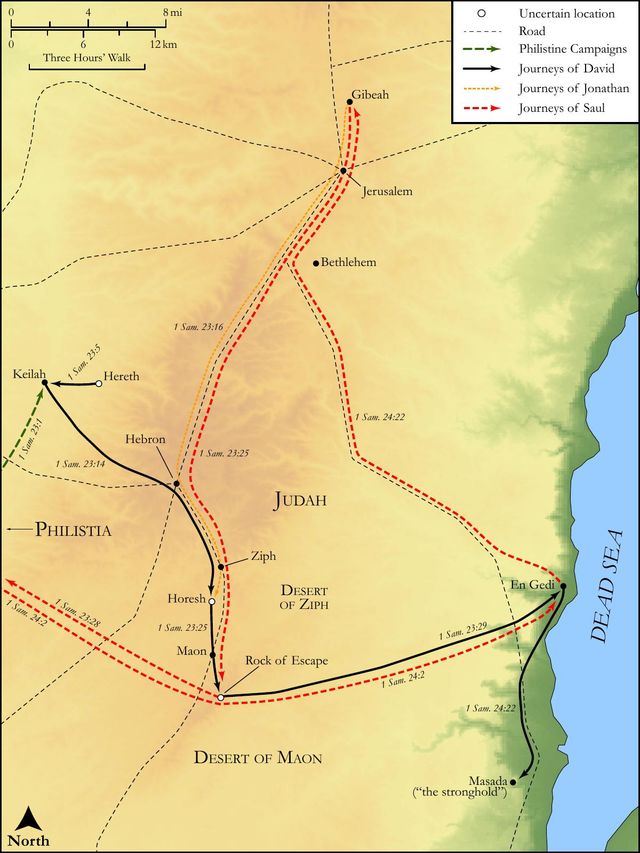
This verse is strategically placed within the narrative of David's flight from Saul, immediately following his escape from Keilah. David, having just delivered Keilah from the Philistines, learns through divine inquiry that the city's inhabitants would betray him to Saul, prompting his hasty departure into the wilderness of Ziph. The Ziphites' subsequent act of informing Saul in this verse marks a new, proactive level of human treachery against David, demonstrating the pervasive nature of Saul's influence and the constant threat to David's life. This incident directly precedes David's remarkably narrow escape from Saul in the wilderness of Maon, detailed in 1 Samuel 23:24-29, and is notably repeated by the Ziphites in 1 Samuel 26:1, emphasizing their persistent disloyalty.
Historical & Cultural Context
The events of 1 Samuel 23 unfold during a period of escalating tension and instability in Saul's reign, marked by his deepening paranoia and spiritual decline. Gibeah, mentioned as Saul's capital, signifies the Ziphites' deliberate and formal action of seeking out the king to deliver their intelligence. Ziph, Hachilah, and Jeshimon are all geographical markers within the rugged, desolate wilderness of Judah, a region characterized by its numerous caves, wadis, and hills, making it a natural, albeit harsh, refuge for those fleeing persecution. In ancient Israelite society, betraying a fellow Israelite, especially one who was God's anointed (even if currently a fugitive), was a grave violation of communal solidarity and covenantal loyalty. The Ziphites' actions were likely motivated by a desire to gain favor with the reigning monarch or to avoid his wrath, illustrating the corrupting influence of power and fear within the kingdom.
Key Themes
ShowHideThis verse powerfully contributes to several overarching themes within the book of 1 Samuel. Foremost, it vividly illustrates the theme of betrayal and human treachery, revealing how self-interest, fear, and a desire for political favor can supersede communal loyalty and even divine will. Secondly, it underscores David's relentless persecution and suffering, portraying him as a vulnerable fugitive constantly on the run, dependent solely on divine protection amidst overwhelming odds. This motif of David as a hunted innocent resonates throughout his time in exile, highlighting his trust in God despite human perfidy. Lastly, it further highlights Saul's consuming obsession and spiritual decline, as his jealousy of David has devolved into an irrational, relentless hunt that diverts his resources and focus from leading Israel against its enemies, confirming his unsuitability for kingship, a theme established earlier in 1 Samuel 15.
Exposition and Analysis
ShowHideKey Word Analysis
ShowHideThe inhabitants of Ziph, a town in the hill country of Judah. Their name becomes synonymous with betrayal in the narrative of David's life. Their proactive act of informing Saul here is not merely an incidental report but a deliberate effort to curry favor with the king by delivering David into his hands. This highlights a deep moral and spiritual failure within this segment of the Israelite community, choosing political expediency over loyalty to God's anointed.
A specific hill located in the wilderness of Ziph, characterized as "dark." The precise geographical naming indicates the Ziphites' intimate knowledge of David's movements and hiding places. It suggests David sought refuge in a well-known, perhaps previously used, strategic location, making the Ziphites' information particularly valuable and dangerous for Saul's relentless pursuit. This detail underscores the chilling accuracy of their betrayal.
Meaning "desolation" or "wilderness," this term refers to the barren, arid region east of the Judean hill country, bordering the Dead Sea. Its inclusion emphasizes the harsh, inhospitable environment where David sought refuge, underscoring his extreme vulnerability and the desperate nature of his flight. The Ziphites' knowledge of David's location "on the south of Jeshimon" pinpoints his position with chilling accuracy, leaving little room for doubt or error in Saul's pursuit.
Verse Breakdown
ShowHide"Then came up the Ziphites to Saul to Gibeah"
This opening clause immediately establishes the treacherous initiative. The Ziphites, not Saul's scouts, are the aggressors in this encounter, willingly seeking out the king to betray David. Their journey "to Gibeah," Saul's capital, signifies a deliberate, formal act of informing, rather than a casual encounter, underscoring their intent to gain favor and their clear alignment with Saul against David.
"saying, Doth not David hide himself with us in strong holds in the wood"
This rhetorical question functions as an eager disclosure, confirming David's presence within their territorial sphere and implying a shared knowledge or even a sense of territorial ownership over David's hiding place. The phrase "strong holds in the wood" suggests a network of natural fortresses or concealed positions, indicating David's reliance on the rugged, forested terrain for protection from Saul's forces.
"in the hill of Hachilah, which [is] on the south of Jeshimon?"
This final part of the Ziphites' report provides Saul with highly specific and actionable intelligence. Naming "the hill of Hachilah" and pinpointing its location "on the south of Jeshimon" demonstrates their intimate familiarity with David's movements and the wilderness terrain. This precision dramatically increases the threat to David, as it allows Saul's forces to narrow their search significantly and underscores the depth of the Ziphites' betrayal.
Literary Devices
ShowHideThe verse employs Geographical Precision by naming specific locations like Ziph, Gibeah, Hachilah, and Jeshimon. This grounds the narrative in a tangible reality, enhancing its verisimilitude and highlighting the Ziphites' accurate and dangerous intelligence. The Ziphites' rhetorical question, "Doth not David hide himself with us...?", functions as a form of Eager Disclosure, emphasizing their willingness and readiness to betray David, almost boasting of their knowledge. Furthermore, the scene presents a stark Contrast between David, the innocent fugitive and God's anointed, and the Ziphites, fellow Israelites who choose self-interest and betrayal. This act of betrayal also serves as Foreshadowing, hinting at the ongoing trials and opposition David will face throughout his life, even from within his own people, and setting the stage for subsequent narrow escapes that will demonstrate God's unwavering protection.
Theological and Thematic Connections
ShowHideThis incident powerfully illustrates the pervasive nature of sin and human depravity, even among God's covenant people. The Ziphites' betrayal of David, God's anointed, reveals how self-interest, fear, or a desire for royal favor can lead to actions that directly oppose God's will and harm His servants. Yet, even in this moment of extreme vulnerability, the narrative implicitly points to God's sovereign protection over David. Despite the precision of the Ziphites' information and Saul's relentless pursuit, David repeatedly escapes, demonstrating that divine providence ultimately overrules human treachery. This highlights a recurring biblical theme: while evil may conspire and human loyalty may falter, God's purposes for His chosen ones will ultimately prevail, often through miraculous intervention.
Reflection and Application
ShowHideThe Ziphites' betrayal of David in 1 Samuel 23:19 offers profound lessons for contemporary believers. It reminds us that opposition and treachery can arise from unexpected sources, even from within our own communities or those who seemingly share our faith. In such moments, like David, we are called not to despair but to deepen our reliance on God. David's subsequent actions in this chapter, seeking God's guidance and finding refuge in Him, provide a powerful model for navigating adversity. This passage encourages us to cultivate spiritual discernment, recognizing that not all who appear to be allies are trustworthy, and to remember that our ultimate security rests not in human loyalty or strategic hiding places, but in the unfailing faithfulness of God, who knows our every step and protects His own. It also serves as a cautionary tale against the corrosive effects of envy and fear, which led Saul to obsessive persecution and the Ziphites to opportunistic betrayal, urging us to examine our own hearts for similar tendencies.
Questions for Reflection
ShowHideFAQ
ShowHideWho were the Ziphites, and why did they betray David?
ShowHideThe Ziphites were inhabitants of Ziph, a town located in the hill country of Judah, near the wilderness where David was hiding. Their motivation for betraying David is not explicitly stated in the text, but it is generally understood to be a desire to curry favor with King Saul, who was relentlessly pursuing David. They likely hoped for reward or protection from the powerful king by delivering his rival. This act highlights a lack of loyalty to God's anointed and a pragmatic, self-serving approach to the political tensions of the time. They are mentioned again betraying David in 1 Samuel 26:1, reinforcing their pattern of disloyalty and demonstrating a willingness to side with earthly power over divine appointment.
Where were Hachilah and Jeshimon, and why are these details important?
ShowHideHachilah was a specific hill in the wilderness of Ziph, and Jeshimon refers to the desolate wilderness region east of the Judean hill country, bordering the Dead Sea. These geographical details are crucial because they demonstrate the Ziphites' intimate and precise knowledge of David's hiding places. By providing such specific locations, they gave Saul highly actionable intelligence, significantly increasing the danger to David. It underscores the extreme vulnerability of David, who was hiding in remote, harsh terrain, and the chilling accuracy of the Ziphites' betrayal, making his subsequent escape (as described in 1 Samuel 23:24-29) all the more miraculous and a testament to God's protective hand.
Christ-Centered Fulfillment
ShowHideThe narrative of David's betrayal by the Ziphites in 1 Samuel 23:19 finds profound Christ-centered fulfillment in the life of Jesus, the ultimate Son of David. Just as David, God's anointed king, was unjustly hunted and betrayed by his own countrymen, so too was Jesus, the true King of Israel, persecuted and ultimately handed over by those He came to save. The Ziphites' act of informing on David foreshadows the betrayal of Judas Iscariot, who, for a price, delivered Jesus into the hands of His enemies (Matthew 26:14-16). Like David, who sought refuge in the wilderness and relied on God's protection amidst relentless pursuit, Jesus also experienced rejection and homelessness, often retreating to desolate places or mountains to pray, relying solely on His Father's will (Luke 9:58). The suffering and betrayal of David, though painful, ultimately served God's sovereign plan to establish him as king. Similarly, the betrayal and crucifixion of Jesus, while the epitome of human treachery, were not a defeat but the very means by which God accomplished His ultimate redemptive purpose, establishing Jesus as King over all creation and providing salvation for humanity (Philippians 2:8-11). Thus, David's experience of being hunted and betrayed by the Ziphites points forward to the greater suffering and ultimate triumph of the Lamb of God, who was "led like a lamb to the slaughter" (Isaiah 53:7) but rose victorious, demonstrating God's power to turn even the deepest betrayal into the greatest good for His people and His glory.