


1 Samuel 23:20
Bible text: King James Version (1769 Blayney text) · Public domain
Bible text: Berean Standard Bible · Public domain
Bible text: American Standard Version (1901) · Public domain
Bible text: World English Bible, Messianic edition · Public domain
Bible text: Geneva Bible (1599) · Public domain
Bible text: Young's Literal Translation · Public domain
- וְעַתָּהVe·'a·tahand nowH6258Conj-w ¦ AdvAdverbוְandעַתָּהnow
- לְכָלle·kholto allH3605Prep-l ¦ N-mscNoun Singular Masculine Constructלְtoכָלall
- אַוַּת'a·Vat[the] desire ofH185N-fscNoun Singular Feminine Construct
- נַפְשְׁךָnaf·she·Khayour selfH5315N-fsc ¦ 2msNoun Singular Feminine Constructנַפְשְׁselfךָyour
- הַמֶּלֶךְha·Me·lekhO kingH4428Art ¦ N-msNoun Singular Masculine AbsoluteהַOמֶּלֶךְking
- לָרֶדֶתla·Re·detto come downH3381Prep-l ¦ V-Qal-InfVerb Qal Infinitive Constructלָtoרֶדֶתcome down
- רֵדRedcome downH3381V-Qal-Imp-2msVerb Qal Imperative 2nd Singular Masculine
- וְלָנוּve·La·nuand [belongs] to <the> usConj-w ¦ Prep-l ¦ 1cpSuffix Personal 1st Plural common genderוְandלָ[belongs] to <the>נוּus
- הַסְגִּירוֹhas·gi·Roto deliver up himH5462V-Hiphil-Inf ¦ 3msVerb Hiphil Infinitive Constructהַסְגִּירto deliver upוֹhim
- בְּיַדbe·Yadin [the] hand ofH3027Prep-b ¦ N-cscNoun Singular common gender Constructבְּinיַד[the] hand of
- הַמֶּלֶךְha·Me·lekhthe kingH4428Art ¦ N-msNoun Singular Masculine Absoluteהַtheמֶּלֶךְking
English is a literal word-by-word gloss of the Hebrew, not the KJV's wording. Why?
This is the original text the KJV's translators worked from — each Hebrew word with its own literal English meaning in this verse, prepared by scholars at Tyndale House, Cambridge. The KJV translates whole sentences, not word by word, so its wording differs: one Hebrew word can become several English words, and the KJV may choose “the LORD” where the gloss reads “Yahweh”. Both are faithful — they answer different questions. For the KJV's own rendering, switch to the KJV text.
Details
See on the biblical-era map
Study this verse
Public-domain commentary
Matthew Henry
From his Commentary on the Whole Bible. Henry comments on passages, not single verses — this entry covers 1 Samuel 23:19–29.
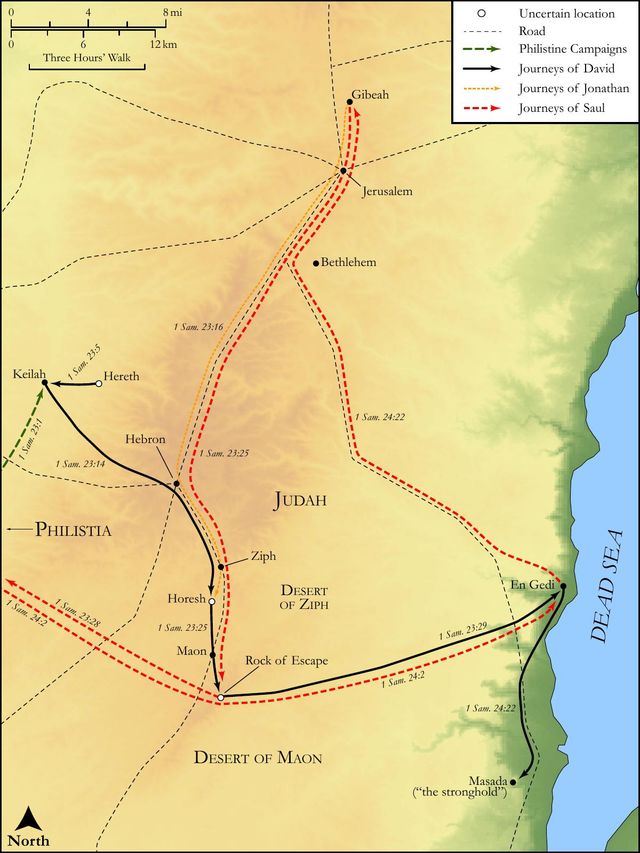
Here, 1. The Ziphites offer their service to Saul, to betray David to him, Sa1 23:19, Sa1 23:20. He was sheltering himself in the wilderness of Ziph (Sa1 23:14, Sa1 23:15), putting the more confidence in the people of that country because they were of his own tribe. They had reason to think themselves happy that they had an opportunity of serving one who was the ornament of their tribe and was likely to be much more so, who was so far from plundering the country, or giving it any disturbance with his troops, that he was ready to protect it and to them all the good offices that there was occasion for. But, to ingratiate themselves with Saul, they went to him, and not only informed him very particularly where David quartered (Sa1 23:19), but invited him to come with his forces into their country in pursuit of him, and promised to deliver him into his hand, Sa1 23:20. Saul had not sent to examine or threaten them, but of their own accord, and even without asking a reward (as Judas did - What will you give me?), they offered to betray David to him who, they knew, thirsted after his blood. 2. Saul thankfully receives their information, and gladly lays hold of the opportunity of hunting David in their wilderness, in hopes to make a prey of him at length. He intimates to them how kindly he took it (Sa1 23:21): Blessed be you of the Lord (so near is God to his mouth, though far from his heart), for you have compassion on me. It seems he looked upon himself as a miserable man and an object of pity; his own envy and ill-nature made him so, otherwise he might have been easy and have needed no man's compassion. He likewise insinuates the little concern that the generality of his people showed for him. "You have compassion on me, which others have not." Saul gives them instructions to search more particularly for his haunts (Sa1 23:22), "for" (says he) "I hear he deals very subtilely," representing him as a man crafty to do mischief, whereas all his subtlety was to secure himself. It was strange that Saul did not go down with them immediately, but he hoped by their means to set his game with the more certainty, and thus divine Providence gave David time to shift for himself. But the Ziphites had laid their spies upon all the places where he was likely to be discovered, and therefore Saul might come and seize him if he was in the land, Sa1 23:23. New he thought himself sure of his prey and pleased himself with the thoughts of devouring it. 3. The imminent peril that David was now brought into. Upon intelligence that the Ziphites had betrayed him, he retired from the hill of Hachilah to the wilderness of Maon (Sa1 23:24), and at this time he penned the 54th Psalm, as appears by the title, wherein he calls the Ziphites strangers, though they were Israelites, because they used him barbarously; but he puts himself under the divine protection: "Behold, God is my helper, and then all shall be well" Saul, having got intelligence of him, pursued him closely (Sa1 23:25), till he came so near him that there was but a mountain between them (Sa1 23:26), David and his men on one side of the mountain flying and Saul and his men on the other side pursuing, David in fear and Saul in hope. But this mountain was an emblem of the divine Providence coming between David and the destroyer, like the pillar of cloud between the Israelites and the Egyptians. David was concealed by this mountain and Saul confounded by it. David now flees as a bird to his mountain (Psa 11:1) and finds God to him as the shadow of a great rock. Saul hoped with his numerous forces to enclose David, and compass him in and his men; but the ground did not prove convenient for his design, and so it failed. A new name was given to the place in remembrance of this (Sa1 23:28): Selah-hammah-lekoth - the rock of division, because it divided between Saul and David. 4. The deliverance of David out of this danger. Providence gave Saul a diversion, when he was just ready to lay hold of David; notice was brought him that the Philistines were invading the land (Sa1 23:27), probably that part of the land where his own estate lay, which would be seized, or at least spoiled, by the invaders; for the little notice he took of Keilah's distress and David's relief of it, in the beginning of this chapter, gives us cause to suspect that he would not now have left pursuing David, and gone to oppose the Philistines, if some private interests of his own had not been at stake. However it was, he found himself under a necessity of going against the Philistines (Sa1 23:28), and by this means David was delivered when he was on the brink of destruction. Saul was disappointed of his prey, and God was glorified as David's wonderful protector. When the Philistines invaded the land they were far from intending any kindness to David by it, yet the overruling providence of God, which orders all events and the times of them, made it very serviceable to him. The wisdom of God is never at a loss for ways and means to preserve his people. As this Saul was diverted, so another Saul was converted, just then when he was breathing out threatenings and slaughter against the saints of the Lord, Act 9:1. 5. David, having thus escaped, took shelter in some natural fortresses, which he found in the wilderness of En-gedi, Sa1 23:29. And this Dr. Lightfoot thinks was the wilderness of Judah, in which David was when he penned Psa 63:1-11, which breathes as much pious and devout affection as almost any of his psalms; for in all places and in all conditions he still kept up his communion with God.
Continue studying 1 Samuel 23:20 across the web’s major study libraries — every link below opens this exact verse, chapter, or book on the destination site.
Read & Compare
 BibleGatewayThis verse in more than 200 translations and 70 languages.
 Bible.comThe YouVersion reader — hundreds of translations, reading plans, and highlights.
 ESV.orgCrossway's official English Standard Version reader.
 NET BibleThe NET translation with 60,000+ translators' notes on every rendering decision.
 STEP BibleTyndale House's free study tool — original text, vocabulary, and scholarly resources.
 BibliaLogos Bible Software's free web reader.
 USCCBThe New American Bible (Revised Edition) with the U.S. bishops' study notes.
Commentaries
 BibleHub CommentariesDozens of classic commentaries on this verse, gathered on one page.
 StudyLightMore than 100 commentary sets — the largest collection on the web.
 BibleRefPlain-English commentary on what this verse means, verse by verse.
 Enduring WordDavid Guzik's free commentary on this chapter, widely used by Bible teachers.
 Bible Study ToolsVerse commentary alongside Greek and Hebrew study aids.
Original Language & Research
- BibleHub InterlinearThe verse word by word — original language, transliteration, and English.
- BibleHub LexiconEvery word's original-language definition and Strong's entry.
 Blue Letter BibleDeep-study tools — Strong's numbers, concordance, and word studies.
 SefariaThe Hebrew text with Rashi and centuries of Jewish commentary.
Sermons, Hymns & Audio


TrulyRandomVerse is not affiliated with these sites and doesn’t control their content. They’re linked because they’re genuinely useful.
Summary
1 Samuel 23:20 captures a pivotal moment of profound treachery where the Ziphites, seeking favor with King Saul, eagerly offer to betray David's hiding place. This verse vividly illuminates Saul's consuming obsession to capture David and underscores the constant peril and vulnerability David faced as God's anointed fugitive, ultimately highlighting the depth of human malice contrasted with the unwavering reality of divine protection.
Context
ShowHideLiterary Context
This verse is deeply embedded within a critical and perilous phase of David's flight from King Saul. It immediately follows David's courageous and successful defense of Keilah against the Philistines, a victory that ironically made his position there untenable once he learned of Saul's intent to besiege him within the city walls (1 Samuel 23:1-13). Having narrowly escaped Keilah by divine revelation, David and his approximately six hundred men sought refuge in the desolate and rugged wilderness of Ziph, a region characterized by its strongholds and caves. The Ziphites, inhabitants of this specific area, discovered David's presence. Rather than offering the traditional sanctuary or maintaining neutrality, they actively chose to curry favor with the increasingly paranoid and vengeful King Saul by revealing David's precise location. This verse, therefore, represents their direct and eager proposition to Saul, demonstrating their willingness to assist in David's capture and setting the stage for yet another dramatic divine intervention on David's behalf.
Historical & Cultural Context
The wilderness of Ziph was a harsh, sparsely populated, and geographically challenging region situated within the tribal territory of Judah, south of Hebron. David, as a fellow Judahite and the divinely anointed future king, might have reasonably expected some degree of tribal loyalty or protection from his kinsmen. However, the Ziphites' actions profoundly reflect the volatile and often brutal political climate under King Saul's increasingly erratic rule. In this era, loyalty to the reigning monarch often superseded traditional tribal or familial ties, especially when faced with the king's notorious wrath and the potential for severe retribution. Their offer to "deliver him into the king's hand" was not merely an act of informing but implied active participation in David's apprehension and surrender, likely leading to his execution. This act also aligns with the practice of that day, in which subjects demonstrated their fealty to their king by assisting in the capture of perceived rebels or enemies of the state, often in exchange for rewards or to avoid punishment themselves, underscoring the pragmatic and self-preserving nature of their betrayal.
Key Themes
ShowHide1 Samuel 23:20 powerfully contributes to several overarching theological and narrative themes woven throughout the book of 1 Samuel. Firstly, it highlights the pervasive theme of betrayal and treachery, showcasing how David, despite being God's chosen and anointed, faced relentless disloyalty from various quarters, even from within his own tribe and among those who should have offered support. Secondly, it underscores Saul's relentless and unrighteous pursuit of David, a pursuit driven by deep-seated envy, paranoia, and a profound spiritual decline, a theme dramatically introduced early in Saul's reign following David's victory over Goliath (1 Samuel 18:8). Saul's "desire of thy soul" emphasizes the consuming, almost demonic, nature of his hatred and obsession. Finally, and perhaps most significantly, the verse reinforces the overarching theme of God's unfailing protection and sovereignty over His anointed. Despite the intense human malice and numerous attempts on his life, David consistently experiences miraculous divine deliverance, demonstrating unequivocally that God's sovereign plan for His chosen king would not be thwarted by any human scheme or act of betrayal.
Exposition and Analysis
ShowHideKey Word Analysis
ShowHideThis word denotes a strong longing, craving, or appetite. While it can be neutral, it often carries a negative connotation, implying an intense, sometimes unholy, yearning or covetousness. In this context, it vividly portrays the depth of Saul's obsession with capturing David, suggesting a desire that has consumed his very being and driven him to irrational and wicked acts. It is not a casual wish but a consuming, all-encompassing passion that dictates his actions.
This term refers to the whole person, the inner being, or the seat of emotions, will, and life. When combined with "desire," it emphasizes that Saul's longing for David's capture was not merely a political or strategic calculation, but a deeply personal, visceral, and all-encompassing drive that originated from the very core of his being. His entire person, his very essence, was bent on this destructive pursuit.
Meaning "to shut up," "to close," or "to surrender," this word signifies a decisive and complete act of handing over someone into the absolute power or custody of another. The Ziphites' use of this term indicates their confidence and commitment to ensuring David's capture and his irreversible surrender to Saul's authority, leaving no room for escape. It implies a total and unreserved act of betrayal, sealing David's fate in their eyes.
Verse Breakdown
ShowHide"Now therefore, O king, come down according to all the desire of thy soul to come down;"
This opening clause functions as a fawning, eager, and strategically calculated invitation from the Ziphites to King Saul. They appeal directly to Saul's well-known and consuming obsession, explicitly acknowledging and validating his intense longing to capture David. The repetition of "come down" emphasizes their readiness, the perceived ease of the task, and their eagerness to facilitate Saul's objective, while "all the desire of thy soul" highlights their astute understanding of Saul's deep-seated hatred and their willingness to cater to his most sinister desires. It reflects a cynical move to gain royal favor by playing directly to the king's personal vendetta.
"and our part [shall be] to deliver him into the king's hand."
This second clause is the Ziphites' explicit promise of full cooperation, active participation, and guaranteed success in the venture. They assure Saul that their role will be decisive and effective in ensuring David's capture and surrender. The phrase "into the king's hand" signifies complete control and absolute authority, implying that David would be entirely at Saul's mercy, likely for immediate execution. This statement powerfully underscores the Ziphites' profound treachery, as they willingly volunteer to betray a fellow Judahite, who is also God's anointed, purely for their own perceived gain or safety, demonstrating a chilling moral compromise.
Literary Devices
ShowHideThe passage employs several potent literary devices that enrich its meaning and impact. There is a striking irony in the Ziphites, inhabitants of Judah, betraying David, a future king from their own tribe, to Saul, the current, increasingly illegitimate king. This highlights the fractured loyalties, moral decay, and political instability pervading Israel during Saul's later reign. The phrase "according to all the desire of thy soul" functions as both intensification and hyperbole, powerfully emphasizing the extreme, consuming, and almost pathological nature of Saul's obsession with David. This vivid portrayal serves as a potent form of characterization, revealing the depth of Saul's spiritual decline, his unholy fixation, and his descent into irrational hatred. Furthermore, the Ziphites' eager and explicit offer to "deliver him into the king's hand" creates significant dramatic tension and serves as foreshadowing, setting up the subsequent narrative where David's life is once again placed in imminent danger, only to be miraculously preserved by divine intervention, thereby reinforcing the overarching theme of God's unwavering and sovereign protection over His chosen one.
Theological and Thematic Connections
ShowHide1 Samuel 23:20 stands as a stark and enduring reminder of the pervasive nature of human sin, particularly the destructive power of unchecked envy, paranoia, and the willingness to betray for personal gain or out of fear. The Ziphites' actions demonstrate that even those who should be allies can become instruments of opposition against God's anointed. Theologically, this event profoundly underscores God's unwavering sovereignty and faithfulness. Despite the intensity of Saul's unholy desire and the Ziphites' eager complicity, God's plan for David's life and his eventual ascension to the throne remains utterly unthwarted. This incident is a powerful testament to the truth that no human scheme, however well-laid, malicious, or seemingly insurmountable, can ultimately frustrate the divine will. It serves as a compelling illustration of God's ability to protect His chosen ones even in the face of overwhelming odds and insidious betrayal, ensuring His purposes are brought to fruition.
Reflection and Application
ShowHideThe narrative of the Ziphites' betrayal of David in 1 Samuel 23:20 offers profound and timeless insights for contemporary believers. It serves as a sobering reminder that even when we are walking in God's will and are His chosen instruments, we are not immune to betrayal, persecution, or the malicious intentions of others. David's experience teaches us the critical importance of radical dependence on God, for it was not human loyalty or strategic brilliance but consistent divine intervention that preserved him time and again. This passage also functions as a powerful warning against the destructive nature of unchecked envy and paranoia, as vividly seen in Saul, and the moral compromise that can arise from seeking human favor or security over divine righteousness, exemplified by the Ziphites. In a world where loyalty can be fleeting, self-interest often reigns supreme, and moral lines are frequently blurred, this verse calls us to cultivate spiritual discernment, to trust implicitly in God's sovereign protection above all else, and to steadfastly resist the temptation to betray our convictions or others for fleeting gains. It encourages us to find our ultimate security not in fragile human alliances, but in the steadfast, unwavering faithfulness of our God.
Questions for Reflection
ShowHideFAQ
ShowHideWho were the Ziphites and why did they betray David?
ShowHideThe Ziphites were inhabitants of Ziph, a town located in the wilderness region of Judah, near Hebron. Their betrayal of David, a fellow Judahite and God's anointed, was almost certainly motivated by a desire to gain favor with King Saul. In a monarchy, demonstrating loyalty to the reigning king by assisting in the capture of a perceived rebel (as Saul viewed David) could lead to significant rewards, political advancement, or, at the very least, prevent royal disfavor and potential punishment. They likely feared Saul's unpredictable wrath more than they respected David's anointing or their shared tribal kinship. Their actions vividly highlight the political expediency and moral compromise that often characterized life under an unstable and paranoid ruler like Saul, where self-preservation often trumped ethical considerations.
How does this incident relate to David's character development?
ShowHideThis incident, along with the numerous other close calls and betrayals David experienced during his fugitive years, played a crucial role in shaping and refining his character. It deepened his absolute reliance on God, teaching him to trust implicitly in divine protection rather than human alliances, his own strategic prowess, or the strength of his men. These prolonged periods of intense pressure and vulnerability forged in David an enduring resilience, profound patience, and a deep sense of dependence on God's guidance and timing, qualities often expressed in his Psalms. For instance, the superscription of Psalm 54 explicitly links it to the Ziphites' betrayal, showcasing David's immediate and characteristic response of seeking God's deliverance and justice. This crucible of adversity refined David's faith and prepared him profoundly for the immense responsibilities of kingship.
What happened immediately after this betrayal?
ShowHideAfter the Ziphites betrayed David, King Saul swiftly mobilized his forces and descended into the wilderness of Ziph to pursue him. David and his men were cornered in a precarious position, and it seemed inevitable that Saul would finally capture him. However, at the critical moment, a messenger arrived with urgent news that the Philistines were raiding the land, specifically attacking Israelite territory (1 Samuel 23:27). This sudden and pressing external threat forced Saul to immediately break off his pursuit of David and return to confront the Philistines, providing David with a miraculous and providential escape. This event is often cited as a prime example of God's direct and timely intervention to protect His anointed servant, demonstrating His faithfulness to His covenant promises.
Christ-Centered Fulfillment
ShowHideThe relentless pursuit of David by Saul, culminating in the Ziphites' eager and opportunistic betrayal, powerfully foreshadows the experience of the ultimate Anointed One, Jesus Christ. David, though God's chosen king, faced constant rejection, hostility, and attempts on his life from his own people and the ruling authorities, yet was supernaturally protected by God's providence. In Christ, we see the perfect and complete fulfillment of this pattern: He came to His own, and His own received Him not (John 1:11), facing relentless opposition and plots against His life from the religious and political leaders of His day (John 11:47-53). Most strikingly, Jesus, like David, was ultimately betrayed by one of His own inner circle, Judas Iscariot, who "delivered" Him into the hands of His enemies for a paltry sum (Matthew 26:47-50). However, unlike David, who was miraculously delivered from his enemies by divine intervention, Jesus was intentionally delivered to His enemies according to the predetermined plan and foreknowledge of God (Acts 2:23). His "betrayal" and subsequent crucifixion were not a defeat but the very means by which God accomplished the salvation of the world, transforming the ultimate act of human treachery into the ultimate act of divine love and redemption, leading to His glorious resurrection and eternal reign as King of kings.