


1 Samuel 23:22
Bible text: King James Version (1769 Blayney text) · Public domain
Bible text: King James Version with Strong's numbers · Public domain
Bible text: Berean Standard Bible · Public domain
Bible text: American Standard Version (1901) · Public domain
Bible text: World English Bible, Messianic edition · Public domain
Bible text: Geneva Bible (1599) · Public domain
Bible text: Young's Literal Translation · Public domain
- לְכוּle·khugoH1980V-Qal-Imp-2mpVerb Qal Imperative 2nd Plural Masculine
- נָאna'pleaseH4994PrtParticle Interjection
- הָכִינוּha·Khi·nuprepareH3559V-Hiphil-Imp-2mpVerb Hiphil Imperative 2nd Plural Masculine
- עוֹדodstillH5750Adj-msAdjective Numerical Singular Masculine Absolute
- וּדְעוּu·de·'Uand knowH3045Conj-w ¦ V-Qal-Imp-2mpVerb Qal Imperative 2nd Plural Masculineוּandדְעוּknow
- וּרְאוּu·re·'Uand seeH7200Conj-w ¦ V-Qal-Imp-2mpVerb Qal Imperative 2nd Plural Masculineוּandרְאוּsee
- אֶת'et<obj.>H853DirObjMParticle Object Indicator
- מְקוֹמוֹme·ko·Mohis placeH4725N-msc ¦ 3msNoun Singular Masculine Constructמְקוֹמplaceוֹhis
- אֲשֶׁר'a·SherwhereH834RelParticle Relative
- תִּהְיֶהtih·Yehit isH1961V-Qal-Imperf-3fsVerb Qal Imperfect 3rd Singular Feminine
- רַגְלוֹrag·Lohis footH7272N-fsc ¦ 3msNoun Singular Feminine Constructרַגְלfootוֹhis
- מִיmiwho?H4310InterrogPronoun Interrogative
- רָאָהוּra·'A·huhas he seen himH7200V-Qal-Perf-3ms ¦ 3msVerb Qal Perfect 3rd Singular Masculineרָאָhas he seenהוּhim
- שָׁםShamthereH8033AdvAdverb
- כִּיkiforH3588PrtParticle Conditional
- אָמַר'a·Marsomeone has saidH559V-Qal-Perf-3msVerb Qal Perfect 3rd Singular Masculine
- אֵלַי'e·Laito meH413Prep ¦ 1csPreposition Definiteאֵלַtoיme
- עָרוֹםa·Romcertainly <to be crafty>H6191V-Qal-InfAbsVerb Qal Infinitive Absolute
- יַעְרִםya'·Rimhe is craftyH6191V-Qal-Imperf-3msVerb Qal Imperfect 3rd Singular Masculine
- הוּאHu'heH1931Pro-3msPronoun Personal 3rd Singular Masculine
English is a literal word-by-word gloss of the Hebrew, not the KJV's wording. Why?
This is the original text the KJV's translators worked from — each Hebrew word with its own literal English meaning in this verse, prepared by scholars at Tyndale House, Cambridge. The KJV translates whole sentences, not word by word, so its wording differs: one Hebrew word can become several English words, and the KJV may choose “the LORD” where the gloss reads “Yahweh”. Both are faithful — they answer different questions. For the KJV's own rendering, switch to the KJV text.
Details
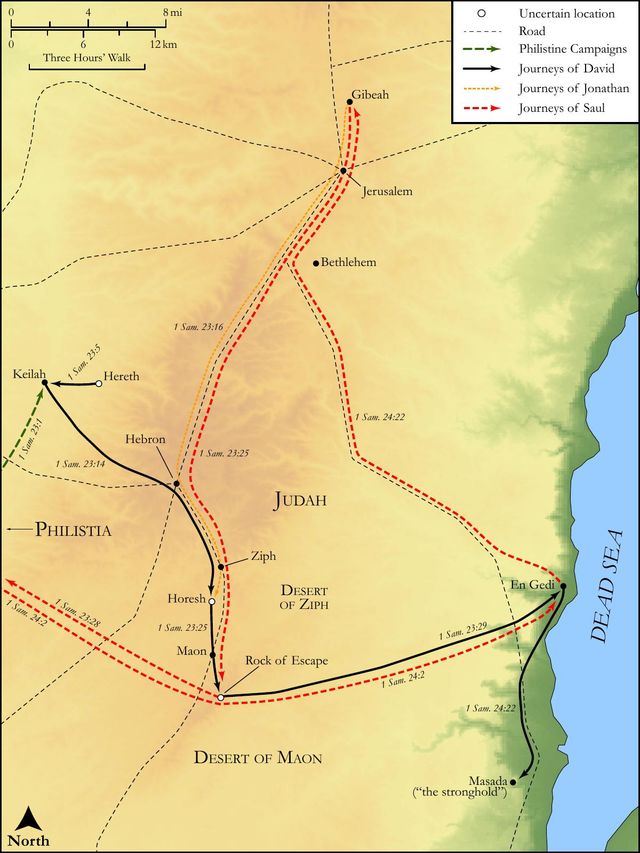
See on the biblical-era map
Study this verse
Public-domain commentary
Matthew Henry
From his Commentary on the Whole Bible. Henry comments on passages, not single verses — this entry covers 1 Samuel 23:19–29.
Here, 1. The Ziphites offer their service to Saul, to betray David to him, Sa1 23:19, Sa1 23:20. He was sheltering himself in the wilderness of Ziph (Sa1 23:14, Sa1 23:15), putting the more confidence in the people of that country because they were of his own tribe. They had reason to think themselves happy that they had an opportunity of serving one who was the ornament of their tribe and was likely to be much more so, who was so far from plundering the country, or giving it any disturbance with his troops, that he was ready to protect it and to them all the good offices that there was occasion for. But, to ingratiate themselves with Saul, they went to him, and not only informed him very particularly where David quartered (Sa1 23:19), but invited him to come with his forces into their country in pursuit of him, and promised to deliver him into his hand, Sa1 23:20. Saul had not sent to examine or threaten them, but of their own accord, and even without asking a reward (as Judas did - What will you give me?), they offered to betray David to him who, they knew, thirsted after his blood. 2. Saul thankfully receives their information, and gladly lays hold of the opportunity of hunting David in their wilderness, in hopes to make a prey of him at length. He intimates to them how kindly he took it (Sa1 23:21): Blessed be you of the Lord (so near is God to his mouth, though far from his heart), for you have compassion on me. It seems he looked upon himself as a miserable man and an object of pity; his own envy and ill-nature made him so, otherwise he might have been easy and have needed no man's compassion. He likewise insinuates the little concern that the generality of his people showed for him. "You have compassion on me, which others have not." Saul gives them instructions to search more particularly for his haunts (Sa1 23:22), "for" (says he) "I hear he deals very subtilely," representing him as a man crafty to do mischief, whereas all his subtlety was to secure himself. It was strange that Saul did not go down with them immediately, but he hoped by their means to set his game with the more certainty, and thus divine Providence gave David time to shift for himself. But the Ziphites had laid their spies upon all the places where he was likely to be discovered, and therefore Saul might come and seize him if he was in the land, Sa1 23:23. New he thought himself sure of his prey and pleased himself with the thoughts of devouring it. 3. The imminent peril that David was now brought into. Upon intelligence that the Ziphites had betrayed him, he retired from the hill of Hachilah to the wilderness of Maon (Sa1 23:24), and at this time he penned the 54th Psalm, as appears by the title, wherein he calls the Ziphites strangers, though they were Israelites, because they used him barbarously; but he puts himself under the divine protection: "Behold, God is my helper, and then all shall be well" Saul, having got intelligence of him, pursued him closely (Sa1 23:25), till he came so near him that there was but a mountain between them (Sa1 23:26), David and his men on one side of the mountain flying and Saul and his men on the other side pursuing, David in fear and Saul in hope. But this mountain was an emblem of the divine Providence coming between David and the destroyer, like the pillar of cloud between the Israelites and the Egyptians. David was concealed by this mountain and Saul confounded by it. David now flees as a bird to his mountain (Psa 11:1) and finds God to him as the shadow of a great rock. Saul hoped with his numerous forces to enclose David, and compass him in and his men; but the ground did not prove convenient for his design, and so it failed. A new name was given to the place in remembrance of this (Sa1 23:28): Selah-hammah-lekoth - the rock of division, because it divided between Saul and David. 4. The deliverance of David out of this danger. Providence gave Saul a diversion, when he was just ready to lay hold of David; notice was brought him that the Philistines were invading the land (Sa1 23:27), probably that part of the land where his own estate lay, which would be seized, or at least spoiled, by the invaders; for the little notice he took of Keilah's distress and David's relief of it, in the beginning of this chapter, gives us cause to suspect that he would not now have left pursuing David, and gone to oppose the Philistines, if some private interests of his own had not been at stake. However it was, he found himself under a necessity of going against the Philistines (Sa1 23:28), and by this means David was delivered when he was on the brink of destruction. Saul was disappointed of his prey, and God was glorified as David's wonderful protector. When the Philistines invaded the land they were far from intending any kindness to David by it, yet the overruling providence of God, which orders all events and the times of them, made it very serviceable to him. The wisdom of God is never at a loss for ways and means to preserve his people. As this Saul was diverted, so another Saul was converted, just then when he was breathing out threatenings and slaughter against the saints of the Lord, Act 9:1. 5. David, having thus escaped, took shelter in some natural fortresses, which he found in the wilderness of En-gedi, Sa1 23:29. And this Dr. Lightfoot thinks was the wilderness of Judah, in which David was when he penned Psa 63:1-11, which breathes as much pious and devout affection as almost any of his psalms; for in all places and in all conditions he still kept up his communion with God.
Continue studying 1 Samuel 23:22 across the web’s major study libraries — every link below opens this exact verse, chapter, or book on the destination site.
Read & Compare
 BibleGatewayThis verse in more than 200 translations and 70 languages.
 Bible.comThe YouVersion reader — hundreds of translations, reading plans, and highlights.
 ESV.orgCrossway's official English Standard Version reader.
 NET BibleThe NET translation with 60,000+ translators' notes on every rendering decision.
 STEP BibleTyndale House's free study tool — original text, vocabulary, and scholarly resources.
 BibliaLogos Bible Software's free web reader.
 USCCBThe New American Bible (Revised Edition) with the U.S. bishops' study notes.
Commentaries
 BibleHub CommentariesDozens of classic commentaries on this verse, gathered on one page.
 StudyLightMore than 100 commentary sets — the largest collection on the web.
 BibleRefPlain-English commentary on what this verse means, verse by verse.
 Enduring WordDavid Guzik's free commentary on this chapter, widely used by Bible teachers.
 Bible Study ToolsVerse commentary alongside Greek and Hebrew study aids.
Original Language & Research
- BibleHub InterlinearThe verse word by word — original language, transliteration, and English.
- BibleHub LexiconEvery word's original-language definition and Strong's entry.
 Blue Letter BibleDeep-study tools — Strong's numbers, concordance, and word studies.
 SefariaThe Hebrew text with Rashi and centuries of Jewish commentary.
Sermons, Hymns & Audio


TrulyRandomVerse is not affiliated with these sites and doesn’t control their content. They’re linked because they’re genuinely useful.
Summary
1 Samuel 23:22 vividly portrays King Saul's intensifying paranoia and obsessive pursuit of David, revealing his meticulous and desperate instructions to his scouts to thoroughly investigate David's precise hiding places in the wilderness of Ziph. This verse underscores Saul's deep-seated fear and suspicion, as he is convinced David is employing highly cunning and deceptive tactics to evade capture and, in Saul's distorted view, to usurp his throne. It highlights the king's determination to thwart God's chosen successor, even as David consistently demonstrates his reliance on divine protection and prudent action rather than malicious craftiness.
Context
ShowHideLiterary Context
This verse is situated within a prolonged and intense narrative of Saul's relentless hunt for David, immediately following David's miraculous escape from Keilah, where Saul had planned to trap him. Chapters 21-23 detail David's life as a fugitive, constantly on the move, often relying on divine guidance and the unwavering loyalty of a small band of followers. Specifically, 1 Samuel 23:19-21 describes the Ziphites betraying David's location to Saul, offering to deliver him into his hands. Saul's enthusiastic response in verse 22, with its exceptionally detailed directives, demonstrates his heightened resolve and his increasingly unhinged state. The subsequent verses, 1 Samuel 23:23-29 then detail Saul's near success and David's dramatic escape, further emphasizing the consistent divine protection over David. This passage serves as a critical juncture, illustrating the escalating stakes and the futility of Saul's efforts against God's chosen one.
Historical & Cultural Context
During this tumultuous period, Israel was undergoing a critical transition from a loose tribal confederacy to a centralized monarchy. Saul, as the first king, was expected to provide stability and security, but his personal insecurities, spiritual decline, and disobedience to God led to his rejection and the anointing of David as his successor. The wilderness of Ziph, a rugged, arid, and desolate region in the Judean desert, was characterized by caves, wadis, and difficult terrain, providing natural hiding places for fugitives. Such an environment necessitated highly detailed reconnaissance for any successful pursuit. The concept of "subtlety" or "cunning" (Hebrew: ʿāram) in Hebrew thought was often ambiguous; it could denote wisdom and prudence, or deceit and treachery, depending on the context and the observer's perspective. Saul's interpretation of David's evasiveness as malicious cunning reflects his own paranoia and distorted perception rather than an objective assessment of David's character or actions.
Key Themes
ShowHide1 Samuel 23:22 contributes significantly to several overarching themes in the book of 1 Samuel. Firstly, it powerfully illustrates Saul's escalating paranoia and obsession, showing how his fear of losing the throne has consumed him, leading him to pursue David with a single-minded, almost irrational intensity. This is a recurring motif throughout 1 Samuel from the moment God rejects Saul. Secondly, it highlights the profound contrast between human schemes and divine sovereignty; despite Saul's meticulous planning, extensive resources, and the perceived cunning of David, God consistently protects David, demonstrating that God's chosen one cannot be thwarted by human efforts. This theme is evident throughout David's miraculous escapes, such as his deliverance from Keilah in 1 Samuel 23:7-13. Lastly, the verse touches upon the theme of David's wisdom and reliance on God, as his ability to evade capture, which Saul labels as "subtlety," is often a direct result of divine guidance and David's prudent actions, rather than malicious craftiness.
Exposition and Analysis
ShowHideKey Word Analysis
ShowHideThis primitive root means "to know," often implying to ascertain by seeing, to comprehend, or to gain knowledge through observation and experience. Saul's command to "know" David's place goes beyond mere information; it demands a thorough, experiential understanding of David's movements and habits. It signifies an obsessive desire for complete intelligence, reflecting Saul's desperate need to eliminate any uncertainty in his pursuit. This isn't a casual inquiry but a demand for comprehensive reconnaissance, highlighting the king's deep-seated anxiety.
Derived from the word for "foot," regel literally refers to a foot or step. In this context, "where his haunt is" uses regel idiomatically to imply the place where one's feet frequently go, or where one habitually resides or hides. Saul's use of this term emphasizes his conviction that David has established specific, recurring hiding places. It suggests a methodical, almost animal-like tracking, where the pursuer seeks to find the "tracks" or "footprints" leading to the fugitive's lair. This word underscores the intensity of Saul's hunt, aiming to pinpoint David's most secure and secret locations.
This primitive root properly means "to be (or make) bare," but is used in a derivative sense to be cunning, shrewd, or prudent. While it can carry a negative connotation of craftiness or deceit (as Saul intends it here), it can also denote positive wisdom or shrewdness, as seen in Proverbs 1:4. Saul's accusation that David "dealeth very subtilly" reveals his biased and fearful interpretation of David's actions. He perceives David's resourceful evasion not as divinely guided wisdom or necessary prudence for survival, but as malicious cunning aimed at undermining his authority. This word choice is a window into Saul's paranoid mindset, projecting his own suspicions onto David.
Verse Breakdown
ShowHide"Go, I pray you, prepare yet,"
Saul's urgent and imperative command reveals his desperate eagerness to capture David. The phrase "prepare yet" suggests a renewed, more thorough, and meticulous effort than previous attempts, indicating his heightened determination and the precision he now demands from his scouts. This is not a casual request but a royal command born of desperation.
"and know and see his place where his haunt is,"
This clause emphasizes the detailed, on-the-ground reconnaissance Saul requires. He doesn't want general information but precise locations. "Know and see" implies a thorough, direct investigation to pinpoint David's exact hiding spots and habitual movements, demonstrating Saul's obsessive need for control and certainty in his pursuit. He wants an undeniable, verifiable location.
"and who hath seen him there:"
Saul is not only interested in David's current location but also in his past movements and associations. This suggests an attempt to gather intelligence on David's network of support or anyone who might be aiding him, reflecting Saul's deep suspicion that David has collaborators and his desire to cut off all avenues of escape, isolating his target.
"for it is told me [that] he dealeth very subtilly."
This final clause provides the justification for Saul's intense instructions. His belief that David is acting with extreme cunning ("very subtilly") fuels his paranoia and necessitates this meticulous, almost obsessive, level of investigation. It underscores Saul's distorted perception of David, seeing his prudence and divinely guided evasiveness as malicious craftiness, thereby rationalizing his relentless and unjust persecution.
Literary Devices
ShowHideThe verse employs several significant literary devices that enrich its meaning and characterization. Characterization is prominently displayed, as Saul's words vividly portray his deteriorating mental state, marked by profound paranoia, obsession, and a desperate need for control. His meticulous instructions ("know and see," "where his haunt is," "who hath seen him there") reveal a man consumed by a singular, destructive purpose. There is also a powerful irony at play: Saul, the king, with all the resources of the monarchy, is reduced to relying on the betrayal of the Ziphites and demanding detailed reconnaissance, while David, the fugitive, is consistently protected by divine intervention, often escaping by narrow margins. Saul's perception of David's "subtlety" is an ironic mischaracterization, as David's evasiveness is often a direct result of God's guidance and protection, not malicious craftiness. Furthermore, the verse serves as foreshadowing, subtly hinting at the ultimate futility of Saul's relentless pursuit. Despite his meticulous plans and the perceived cunning of David, the narrative consistently demonstrates that God's plan for David's kingship will prevail, rendering Saul's efforts ultimately fruitless and highlighting the unstoppable nature of divine sovereignty.
Theological and Thematic Connections
ShowHideThis verse powerfully illustrates the futility of human schemes when they stand in opposition to God's sovereign will. Saul's meticulous, almost obsessive, pursuit of David is a stark example of a human king attempting to thwart the divine plan for succession. Despite his resources, his intelligence-gathering, and his belief that David is acting with "subtlety," the narrative consistently demonstrates that God protects David, often through miraculous interventions or timely diversions. This highlights a core biblical truth: God's purposes cannot be ultimately frustrated by human opposition, no matter how cunning, powerful, or meticulously planned. It underscores the profound contrast between the limited, often misguided, efforts of humanity and the infinite, unwavering sovereignty of God, whose counsel alone stands firm.
Reflection and Application
ShowHide1 Samuel 23:22 serves as a profound cautionary tale regarding the destructive nature of unchecked fear, paranoia, and a refusal to yield to God's will. Saul's descent into obsession, fueled by his perceived threat from David, demonstrates how corrosive these emotions can be, distorting one's perception of reality and leading to irrational and ultimately futile actions. For believers today, this verse challenges us to examine our own hearts: are we allowing fear, jealousy, or a desperate desire for control to dictate our actions, or are we trusting in God's sovereign plan, even when circumstances seem threatening or beyond our understanding? David's story, in contrast, reminds us that even when pursued relentlessly and accused falsely, reliance on God's protection and wisdom is the ultimate safeguard. It encourages us to cultivate discernment, recognizing that what the world or our adversaries label as "cunning" or "subtlety" may, in God's eyes, be prudence, wisdom, or simply divine guidance in navigating difficult situations, always seeking to honor Him rather than manipulate circumstances for personal gain.
Questions for Reflection
ShowHideFAQ
ShowHideWhy was Saul so obsessed with David, even after David proved his loyalty multiple times?
ShowHideSaul's obsession stemmed primarily from a deep-seated insecurity and a profound spiritual decline that began after his disobedience to God. God had rejected him as king and secretly anointed David (1 Samuel 16:13). Saul was acutely aware that "the Spirit of the Lord departed from Saul, and an evil spirit from the Lord tormented him" (1 Samuel 16:14). His initial jealousy of David's popularity after the defeat of Goliath (1 Samuel 18:7-9) festered into paranoia, convincing him that David was actively seeking to usurp his throne. This was compounded by his own disobedience and the loss of God's favor, which made him increasingly irrational and consumed by a desire to eliminate the perceived threat, despite David's repeated demonstrations of loyalty and respect for Saul's anointed position (1 Samuel 24:1-7 and 1 Samuel 26:7-12). Saul's spiritual brokenness prevented him from seeing David's true character or God's sovereign hand.
Christ-Centered Fulfillment
ShowHideWhile 1 Samuel 23:22 depicts Saul's relentless, paranoid pursuit of David, it powerfully foreshadows the ultimate opposition faced by the True King, Jesus Christ. Just as Saul, driven by fear and a distorted perception, sought to eliminate David, humanity, in its fallen state, often opposes God's chosen one. The "subtlety" Saul attributes to David, though misconstrued as malicious cunning, points to the profound wisdom and divine strategy of Christ, who "dealt very subtilly" in the most profound sense, not through deception, but through humility, self-sacrifice, and strategic withdrawal to fulfill His Father's will (Matthew 4:1-11 and John 7:1-10). The futile nature of Saul's pursuit of David ultimately finds its fulfillment in the inability of all human and demonic forces to thwart God's plan for His Son. The world, represented by the religious and political powers, sought to "know and see His place" to capture and destroy Him (John 11:47-53), yet Christ, in His divine wisdom, always acted according to the Father's timing and purpose, ultimately laying down His life voluntarily and triumphing over death. Thus, Saul's desperate search for David, the anointed king, serves as a poignant backdrop to the world's failed attempts to overcome the Lamb of God, who, through His ultimate "subtlety" of divine wisdom and sacrificial love, secured eternal victory and an everlasting kingdom for His people (Revelation 5:9-10 and Philippians 2:9-11).